

🤔 What is the Market Momentum column about? 🤔
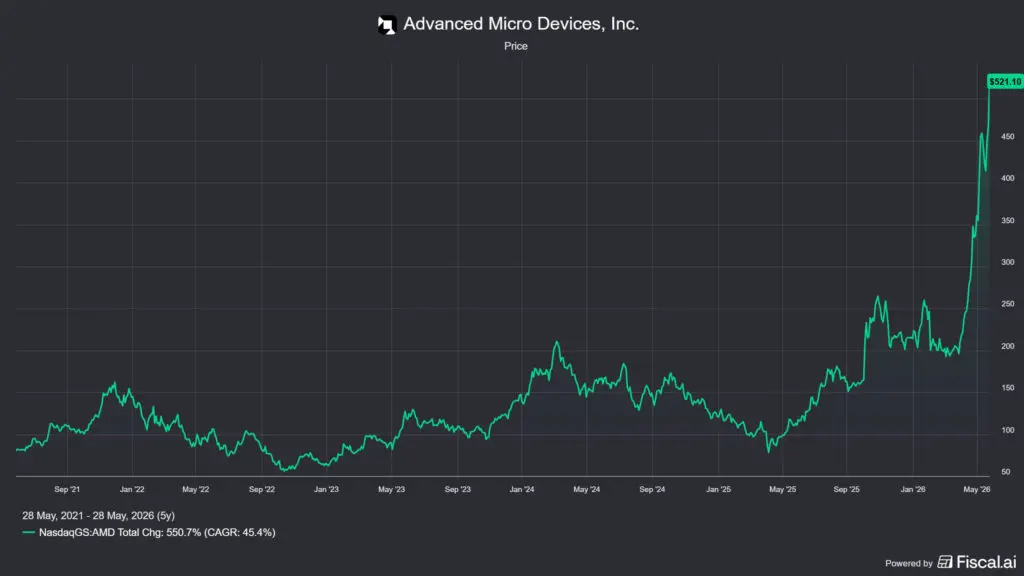
AMD shares have nearly quintupled in the past five years, and the company recently had a record quarter. If you saw the company as a chipmaker that was about to overtake Intel in 2022-2023, it might be hard to believe today that it has gone much higher since then. Still, the stock is far from cheap, competition is fierce, and Chinese export restrictions hang over their heads like the sword of Damocles. Is it worth getting in now, or are you too late?
I don't know if you're aware of this, but a thorough fundamental in-depth analysis can take 40-50 hours. As an investor, it's impossible to put that much energy into analyzing each company if you want to effectively manage a long enough watch list. That's why I created the Market Impulse column, which provides a snapshot of each stock, especially AMD, and roughly outlines current events. It's not an in-depth analysis, but rather a thought-provoking piece based on the current state of affairs. My goal is not to give daily trading tips or analyze technical patterns. Instead, I'll provide quick, to-the-point fundamental mini-analyses that will help you filter.
You can find the share subpage with detailed information here: The AMD stock page
If you are looking for in-depth analyses of the site, click on the link below: iO Charts stock analyses
📒 Table of Contents 📒
I have created a table of contents to make it easier for you to navigate the content:
- ❓ What does AMD (AMD) do?
- 🏆 AMD's current situation and competitors
- 🔥 Does AMD have a lasting competitive advantage?
- 🎢 AMD stock metrics
- ✅ AMD stock: will you get used to it or will you run away?
- 📝 Thesis summary
- ❓ Frequently Asked Questions
❓ What does AMD (AMD) do? ❓
Advanced Micro Devices (AMD) is a semiconductor design company founded in Santa Clara, California in 1969, and traded on the Nasdaq under the ticker AMD. The founders, Jerry Sanders and eight others, were recruited from former Intel employees and spent the first decades of their existence almost exclusively in Intel's shadow. This forced path paradoxically became the source of one of AMD's most important competitive advantages: Thanks to the x86 architecture license, AMD remained fully compatible with the Intel ecosystem in terms of software, which became a key issue when reconquering the server market.
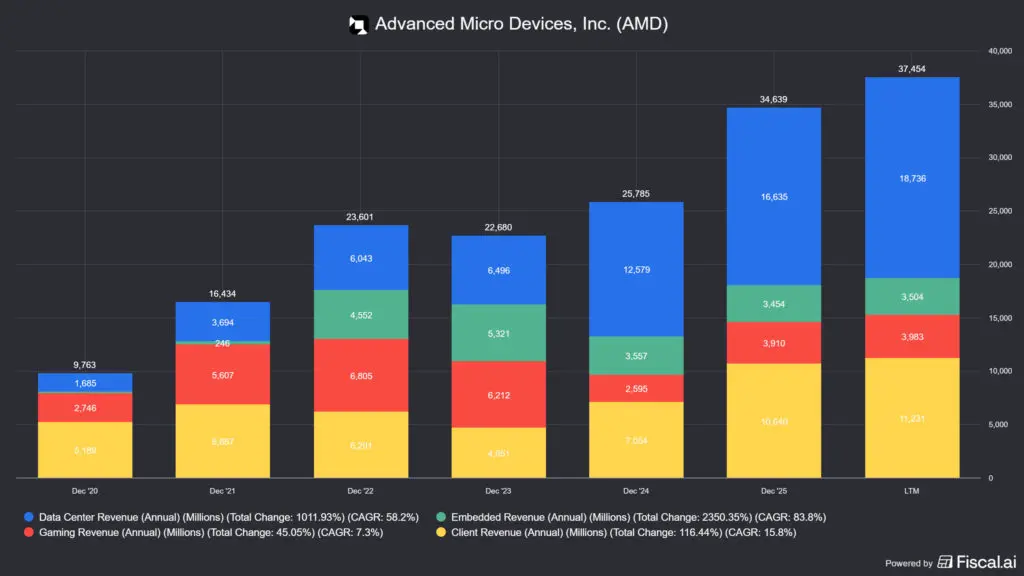
AMD today operates in four business segments (this reporting has been like this since 2020):
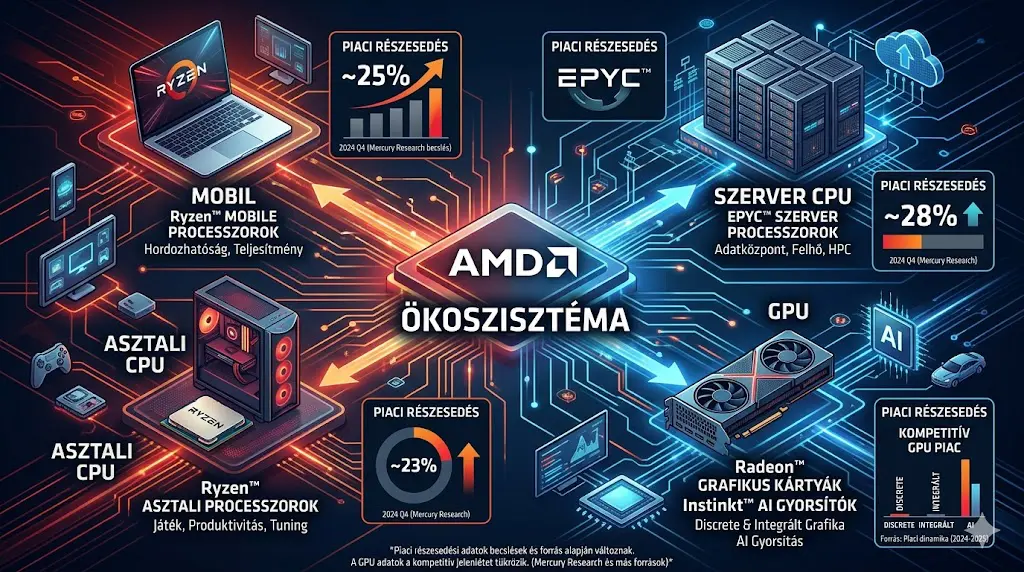
- 🖥️ Data Center: server CPUs (EPYC) and AI accelerators (Instinct MI series). This is what AMD's engine has become: Generated a record $16.6 billion in revenue in 2025, which represents almost half of the total revenue.
- 🎮 Client (PC): Ryzen processors and Radeon graphics cards for desktops and laptops. USD 10.6 billion in revenue in 2025, +51% year-on-year. This seems like a lot, but in reality the dominant player in the GPU market is not AMD but Nvidia, which has dominated this segment for years.
- 🎯 Gaming: console chips (PlayStation 5, Xbox Series) and Radeon RX cards. 3.98 billion USD, is essentially stagnant, the console life cycle has reached a mature phase.
- ⚙️ Embedded: industrial, communications and FPGA-based solutions (from the Xilinx acquisition). 3.5 billion USD, it is picking up after the inventory adjustment cycle.
📌 In practice: AMD operates as a fabless chip manufacturer. This means that it does not manufacture itself, it entrusts production to TSMC, and only designs its products. This is a very capital-efficient model: there is no high capital cost, and engineering capacity is concentrated on the design competition. AMD is therefore actually a software and design company that thinks in silicon, but is dependent on ASML, which provides the machines necessary for production, and TSMC, which physically manufactures the product.
🏆 AMD's current situation and competitors 🏆
AMD is fighting a war on two fronts in 2026: with Intel in the x86 CPU market, with Nvidia in the AI accelerator marketThis situation would have seemed catastrophic a few years ago, as Intel dominated the x86 market until 2017-18, but today they navigate the segments surprisingly well.
🆚The AMD vs. Intel front: the heir to the throne stumbles
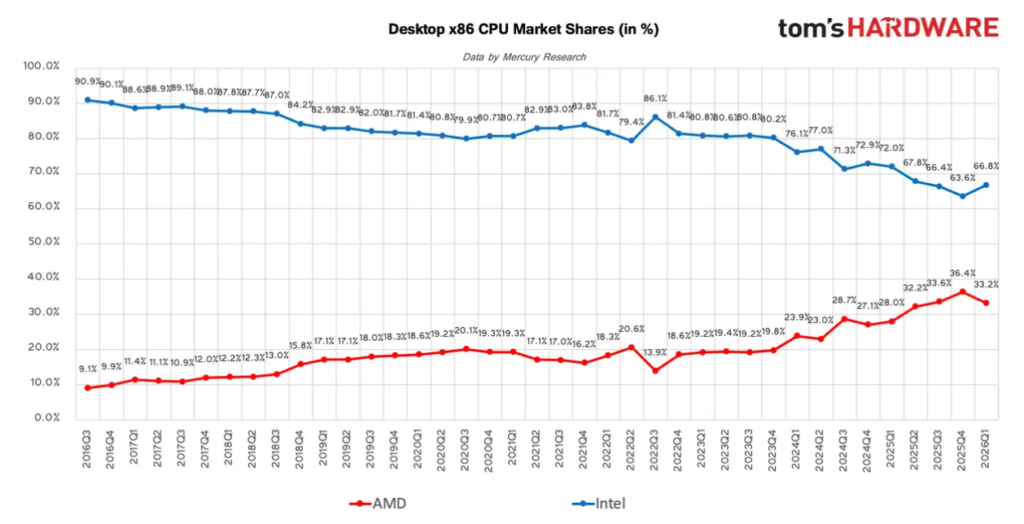
Intel dominated the PC processor market for decades with a share of over 80%. According to Mercury Research, AMD's desktop CPU market share jumped from 26.9% to 36.4% in the fourth quarter of 2025 in a single year., and achieved a record 41.3% share of the server market revenue with the EPYC series. Stability issues with Intel's 13th-14th generation CPUs, platform changes, and lost manufacturing technology advantage all contributed to this. In April 2026, AMD and Intel also announced a collaboration, which boosted the shares of both companies.
🔰The Nvidia front: great superiority, but the cake is also big
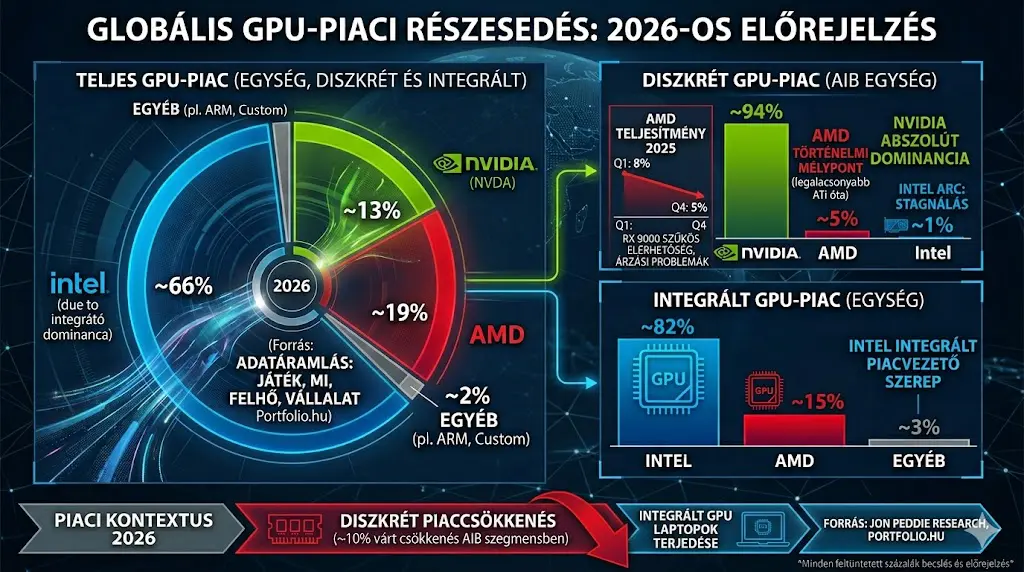
Nvidia is almost the only player in the discrete GPU market with a ~94% share, AMD Radeon cards only take up 5-7%. However, this is just the consumer graphics card market. AMD has made significant inroads in AI data center accelerators with its Instinct MI series (MI300X, MI350, MI455X), with OpenAI ordering 6 gigawatts of AMD GPUs over the next few years, and Meta announcing a similar commitment. Lisa Su confirmed that the company has strong confidence that data center AI revenue will reach “the $10 billion mark next year, exceeding our long-term 80% annual growth target.”
📌 In practice: AMD's competitive position is twofold. Where it is pressing Intel, it has been clearly gaining ground for years, to the point that Intel has been operating at a loss for some time, although not because of the CPU segment. Where it is struggling with Nvidia, it is weak in the consumer market, but the AI data center market is growing rapidly, the question is whether the pie is big enough for AMD to enjoy a good share of it, even if Nvidia's dominance persists. At the moment, it seems that it is, because the growing market can accommodate several markets at once.
However, it is worth remembering that large companies such as Google, Amazon, Microsoft or Meta develop their own chips, simply because the involvement of Nvidia – who also does not manufacture, only designs – means huge costs for the companies. Google has also stated that it would be very happy to be a direct partner of TSMC, but it is not able to do this yet, but the Tensor chip family is already an in-house development. This is also true for AMD's CPU/GPU/NPU segment, the competition is huge, but for now it seems that AMD is holding the market.

🔥 Does AMD have a sustainable competitive advantage? 🔥
When examining the competitive advantage of a chip manufacturer, it is worth considering at least the following three factors: the architecture, the software ecosystem and the manufacturing capacity.
- 💻 Architecture: the Zen revolution is permanent. The Zen CPU architecture, launched in 2017, truly revolutionized the market. Today's Zen 5 consistently beats Intel's equivalent products in the server market in terms of performance per watt, the number one metric for companies buying hardware for data centers. This is not a random success story, but the result of 8-10 years of consistent development work, of which Intel is the loser.
- 🔗 The software ecosystem: the ROCm issue, which stands for Radeon Open Compute. This is AMD's only serious weakness compared to Nvidia. Nvidia's CUDA ecosystem is the de facto standard for AI development, AMD's ROCm platform has improved a lot, but CUDA's competitive advantage cannot be easily eliminated. At the same time, hyperscaler companies (Meta, Microsoft, Google) are actively looking for alternatives to reduce their dependence on Nvidia, and as I wrote earlier, this could be AMD's structural opportunity. After all, if they can offer similar services cheaper than Nvidia, then large IT companies may not stay with their in-house developments.
- 🏭 Manufacturing: TSMC dependency. All of AMD's major chips are manufactured in Taiwan by TSMC. This is an advantage (access to state-of-the-art nodes, no factory construction risk), but it also carries a geopolitical concentrated risk. It is true that TSMC is currently building a factory in Arizona, but the other solution could be Intel's manufacturing capacity, although it does not yet match TSMC's technological level.
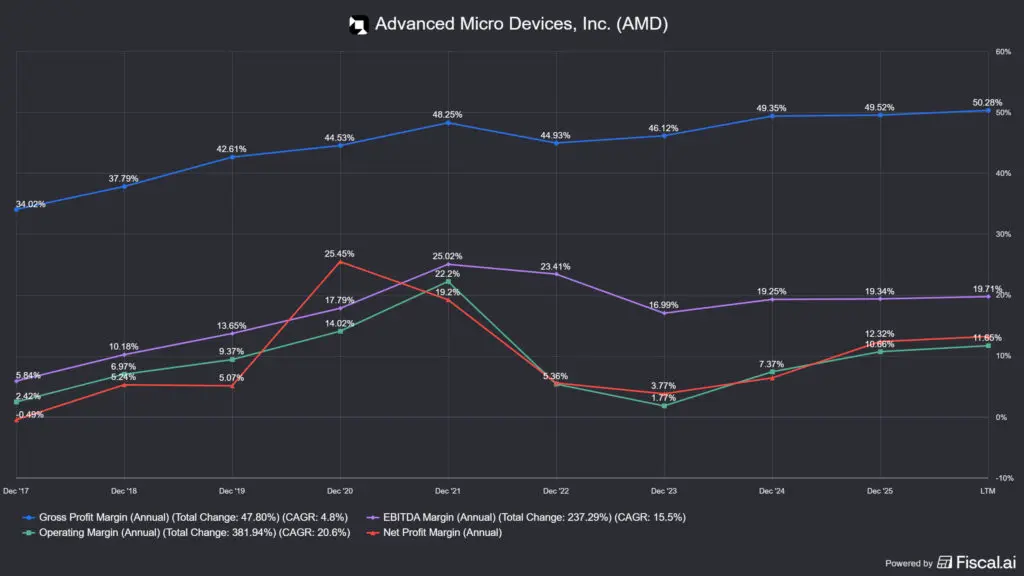
📌 In practice: AMD's competitive advantage is real, but not monopolistic. Perhaps most importantly, AMD is the only company to have both competitive x86 CPUs and AI accelerators, and to build both on TSMC's best-in-class manufacturing technology. This is a rare position in a market where the convergence of AI infrastructure and traditional computing is accelerating. However, things are changing very quickly, considering that ChatGPT was not even released 4 years ago - in October 2022 - and how much AI solutions have evolved since then.

🎢 AMD Stock Metrics 🎢
| Indicator | Value |
|---|---|
| Market capitalization | ~854 billion USD (2026-05-28) |
| Current exchange rate | ~ 523 USD |
| 5-year yield | + 554 % |
| Revenue 2025 (GAAP) | USD 34.6 billion (+34% year-on-year) |
| Revenue TTM | 37.5 billion USD |
| Adjusted EPS 2025 | $4.17 (+26% year-on-year) |
| Adjusted EPS 2026 (E) | 7.37 USD (+77% expected) |
| Gross margin (adjusted, 2025) | 52 % |
| Operating margin (GAAP, 2025) | 10.7 % |
| FCF 2025 | USD 6.7 billion (+178% year-on-year) |
| Net cash position | +8.5 billion USD (debt-free!) |
| TTM P/E | ~170x |
| Forward P/E (NTM) | ~26x |
| Forward P/FCF (NTM) | ~35x |
| Data Center Revenue 2025 | USD 16.6 billion (+32% year-on-year) |
| Client revenue 2025 | USD 10.6 billion (+51% year-on-year) |
| Dividend | nincs |
| ROIC (5-year average) | 16.5 % |
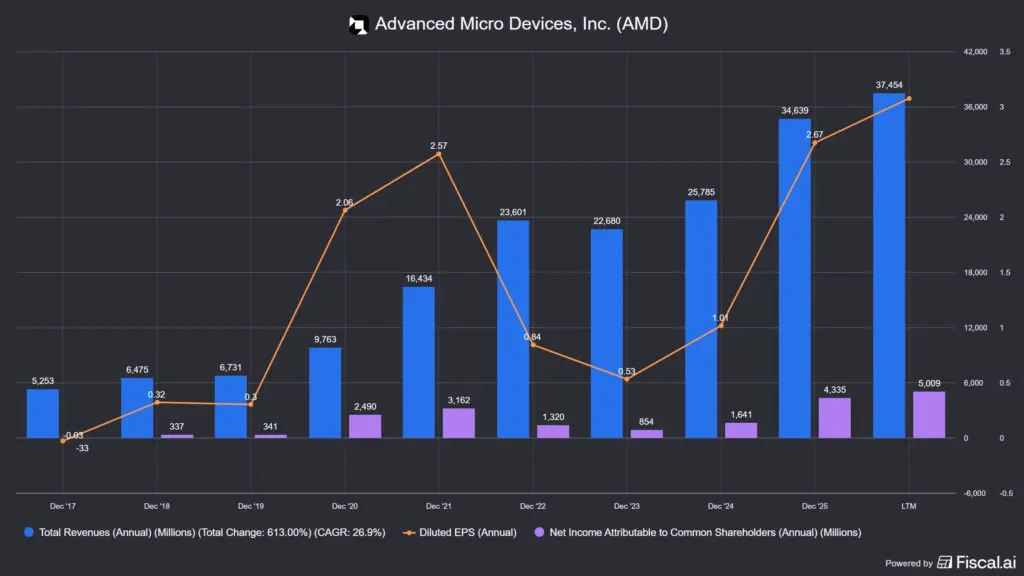
What is immediately apparent: The TTM P/E (~170x) looks scary at first glance, but this is due to the low GAAP profit (10.7% GAAP operating margin), which largely includes depreciation items from the Xilinx acquisition. On an adjusted (Non-GAAP) basis, the forward P/E is ~26x, which is more in line with a company expecting a 42% EPS growth rate. The expected adjusted EPS of ~$7.37 for 2026 and the expected EPS of ~$12.96 for 2027 draw a rapidly declining valuation trajectory. And it's not because the stock has become cheaper, as the price is soaring like a rocket, but because the market has followed the brutal underlying performance.
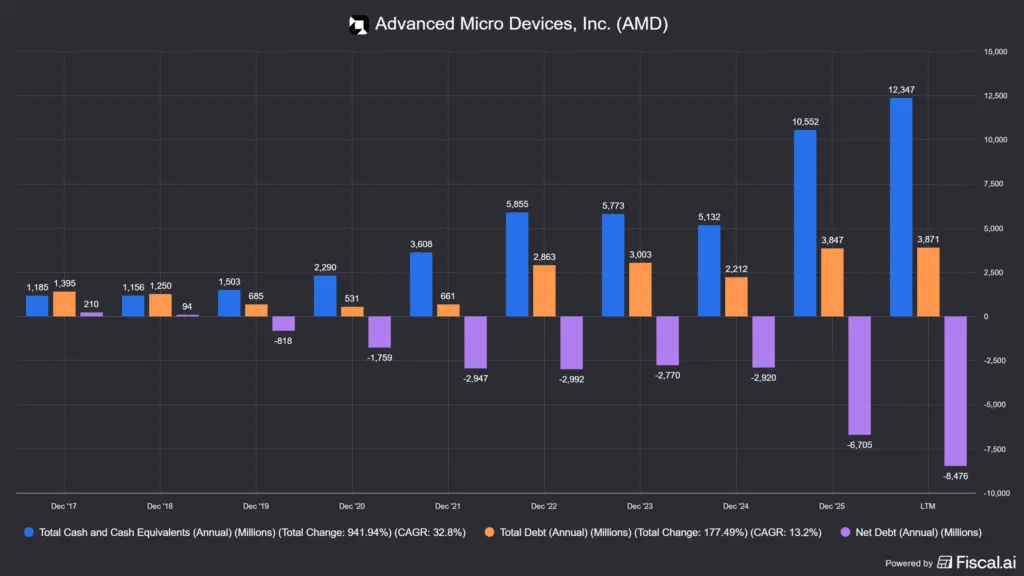
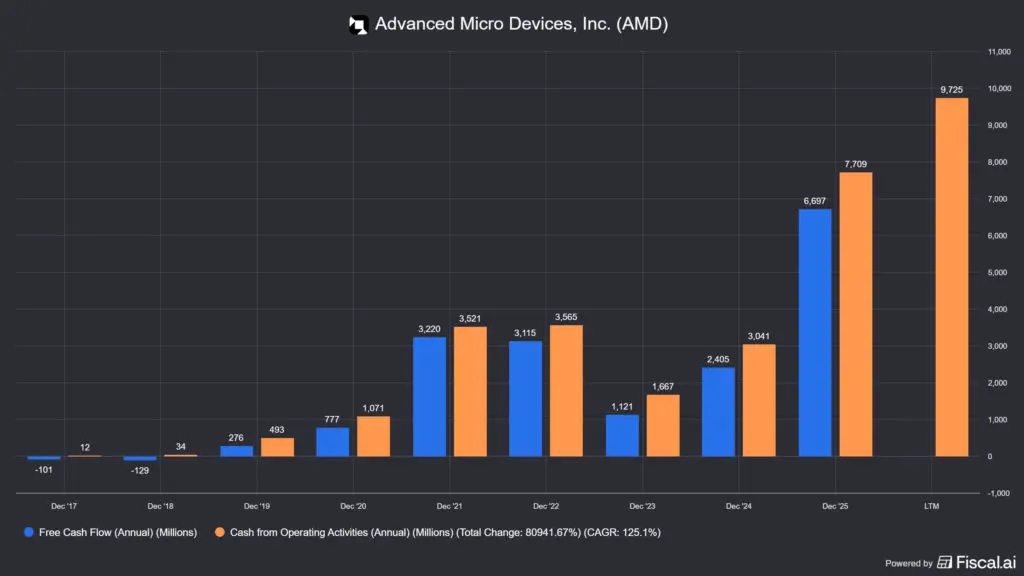
With a net cash position of (+8.5 billion USD) and FCF of 6.7 billion USD, AMD is debt-free today and its free cash flow has almost tripled from 2024 levels.
About the ownership structure: Insider ownership is low (all executives hold a total of ~0.43%, 7.0M shares, valued at ~2.8 billion USD), which is not surprising with such a large market capitalization, but it also means that this is not a founder-led company with skin in the game, but a professional management team is running AMD. CEO Lisa Su holds ~3.8 million shares (0.23%, valued at ~1.6 billion USD), which seems small, but the market capitalization is also brutal. Among institutional investors, Vanguard owns 9.8%, BlackRock 8.9%, and State Street 4.6%. Insider transactions are typically sales (automatic dispositions related to option exercise), which in itself does not mean a negative sign, the picture is more neutral.

✅ AMD stock: will you get used to it or will you run away? ✅
AMD stock: what speaks for it 🟢
- 🚀 The growth story was realized, it wasn't just a promise. Full-year revenue in 2025 is $34.6 billion (+34%), adjusted EPS is $4.17 (+26%), and FCF is $6.7 billion (+178%). This is not hype, this is improving fundamentals.
- 🧠 On the CPU front, Intel is structurally weakening. AMD's desktop and server CPU market share is steadily growing, as each product generation lags Intel's current lineup. It will take Intel another 2-3 years to reverse the decline. However, this has been the narrative for years, and since 2017-18, the situation has not improved, but has worsened.
- 🌐 Hyperscalers want to diversify. Meta and OpenAI's AMD orders are not just business decisions, but strategic moves to reduce their dependence on Nvidia. Where customers are actively looking for alternatives, newer suppliers always have some leverage.
- 💵 Debt-free balance sheet, strong FCF. A net cash position of +$8.5 billion and annual FCF of $6.7 billion are rare luxuries in the chip industry. This allows the company to finance growth without having to borrow.
- (I.e. Agentic AI is bringing a CPU renaissance. AMD says the server CPU market could grow by more than 35% annually through 2030 (up from an earlier estimate of 18%) as AI applications become more widespread, requiring significant CPU capacity, not just GPUs. This is roughly what Nvidia has been seeing since late 2022.
AMD stock: what goes against it 🔴
- (I.e. The downside to the GPU ecosystem is real and persistent. CUDA has become the backbone of AI development everywhere. AMD's ROCm has improved, but Nvidia's software competitive advantage doesn't seem to be easily broken.
- ⚠️ Export restrictions (and Trump) are unpredictable. The ban on sales of AI-series GPUs to the Chinese market caused a burden of ~$440 million in 2025. Of course, this is dwarfed by total revenue, but it is difficult to calculate how the relationship between the US and China will develop in the near future. Since these are two competing powers, a major collapse is unlikely, but rather you can expect a competition that limits each other.
- ???? GAAP margins are low. The 10.7% GAAP operating margin and the amortization from the Xilinx acquisition will distort true profitability for a long time, which may lead to valuation misunderstandings among less experienced investors.
- 📊 The psychological burden of ~170x TTM P/E. Even if the adjusted forward P/E of ~26x can be explained, the high valuation in a market correction could cause a disproportionate price drop.
📌 In practice: AMD is a proven growth story that is fully priced in by the market. The problem with this situation is that expectations are high, they are priced into the price, and even the slightest disappointment can cause massive drops in the market. But for those who believe in the continuation of the AI infrastructure boom and the CPU renaissance in the long term, the current valuation may even be an acceptable premium. It is worth knowing that we are talking about a 5-10 year horizon here, so short-term speculation now carries an asymmetric risk in my opinion.
📝 Thesis summary 📝
AMD has produced one of the most spectacular stock market turnarounds in the past five years: a +554% share price increase, a debt-free balance sheet, a tripling of free cash flow, and record segment revenues in every major area. Today, the company is successfully competing with Intel in the processor market and breaking into the AI-GPU market dominated by Nvidia.
The pivotal question of the investment thesis is not whether AMD is a good company, but whether it is worth opening a position at this valuation. In the bull scenario, the expected EPS of ~7.37 USD for 2026 and ~12.96 USD for 2027 could easily wipe out the current premium. In the bear scenario, if CUDA's competitive advantage does not erode or if a more serious export restriction occurs, as has already happened several times in the Trump era, then the stock could easily fall significantly from this high valuation.
I think it's especially true in the current AI and chip race that panic or euphoria can easily develop when sentiment-driven big drops and spikes occur. So, until there's blood on the streets, it's worth keeping AMD on your watch list and waiting for the opportunity.
And if you want to analyze further, use iO Charts' stock finder and portfolio manager, which you can access here: iO Charts.
❓ Frequently Asked Questions about AMD stock ❓
Why has AMD's stock price soared so dramatically over the past five years?
AMD's stock has risen more than sixfold in five years, driven by two fundamental shifts. The first is its ability to beat Intel: since the introduction of the Zen CPU architecture in 2017, AMD has gradually gained market share in all segments of the processor market. The second is the convergence of chip manufacturing and AI infrastructure: with its Instinct AI series, AMD has entered the data center AI accelerator market, where Meta, OpenAI, and other hyperscaler companies have secured significant orders.
AMD stock and Intel's relationship: competitors or partners?
AMD and Intel are long-time rivals in the x86 processor market, Both chipmakers are competing for the server and PC market. However, in April 2026, they announced a surprising collaboration aimed at strengthening the x86 ecosystem against ARM-based solutions. The long-term competition between Intel and AMD in the CPU market remains unchanged, and market share figures clearly tip the scales in AMD's favor.
Why can't AMD beat Nvidia in the GPU market?
Nvidia's strength in the GPU market is not primarily based on hardware, but rather on its CUDA software ecosystem. CUDA has been the standard for AI and scientific computing for over 15 years, and despite AMD's ROCm platform having evolved considerably, the vast majority of developers and software libraries are still optimized for CUDA. Replacing this obsession with hardware performance alone is extremely difficult, and this is a common limitation for Intel and AMD in the face of Nvidia's chipmaking dominance.
What impact does the US export ban have on AMD's stock?
The US government has restricted exports of AMD's advanced AI accelerators to China. This has resulted in inventory write-downs and related losses of nearly $440 million in 2025. In the longer term, the partial loss of the Chinese AI chip manufacturing market could be a significant growth constraint, especially if local competitors (Huawei Ascend series) quickly fill this void.
Does AMD stock pay dividends?
No: AMD stock does not pay a dividend and does not plan to do so in the near future. In terms of capital allocation, the company focuses on research and development and strategic acquisitions. The debt-free balance sheet (+8.5 billion USD net cash) and FCF of 6.7 billion USD provide sufficient funding for growth without having to return capital through share buybacks or dividends. Those who expect this kind of regular income from the stock should consider other options.
Legal and liability statement (aka. disclaimer): My articles contain personal opinions, I write them solely for my own entertainment and that of my readers. The articles published here do NOT in any way exhaust the scope of investment advice. I have never intended, do not intend, and am unlikely to provide such in the future. What is written here is for informational purposes only and should NOT be construed as an offer. The expression of opinion is NOT in any way considered a guarantee to sell or buy financial instruments. You are SOLELY responsible for the decisions you make, and no one else, including me, assumes the risk.