What does the stock market report section contain?
Before Adobe's Q3 2026 report, the stock price rose by almost 50%, and then began a rapid decline, but those who were clever could realize a 50% price gain in a month and a half with a good entry. With this performance, it earned its place in the "Reporting on the Stock Exchange" column, which is always an update of the fundamental analysis. But what is this all about?
The column is a kind of compass for investors, helping them navigate the dense data set of listed companies. The essence of the column is not just to report raw numbers, but to professionally process the latest quarterly or annual report of the given company. During each such analysis, we put the most important financial indicators (such as sales, profit, ROCE or ROIC) into context, comparing them with previous expectations and, in some cases, with the performance of competitors. Now the previously analyzed Adobe Inc. (NASDAQ:ADBE) I have compiled for you the lessons learned from the past year and a half.
☝️Adobe's fiscal year ends in late November or early December (fiscal year 2025 ended on November 28, 2025), so Adobe Q3 2026 covers the period from May 30 to August 28, 2026.
Beyond the dry data, the column pays special attention to reading between the lines: it analyzes management's expectations and future market prospects. We examine how global economic trends, technological shifts, or industry specifics can affect the company's long-term growth trajectory. The column aims to provide investors with not only a snapshot of what has happened in the past few months, but also what to expect in the market in the coming period. The given quarterly report will also be linked to the in-depth analysis of the stock, if this has already been done on the iO Charts blog. In this case, you can read it at the link above.
📌In the "Practice" section, you can find my comments beyond mere numbers, which take into account qualitative rather than quantitative aspects.
Adobe Q3 2026 Analysis
I owe a confession, I am writing a purchase/sale journal for my stock portfolio, and accordingly, on 04/30/2025, I sold my entire Adobe position for 363 USD. which roughly coincides with writing the in-depth analysis, the gist of which was that I saw too much risk in the company for the price at the time. However, 14 months later, on 2026.06.17, I bought Adobe back, I almost never do that. The reason for this was that ADBE simply looked ridiculously cheap, so I essentially missed out on a ~45% drop, which would have been an 81.5% increase.
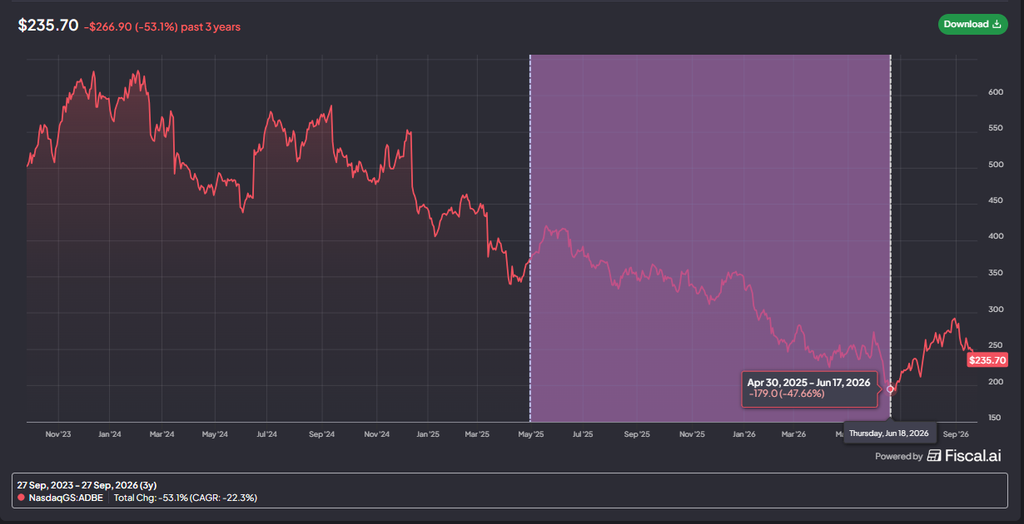
From that price, the stock rose to $292, then fell back to around $235, where it is today, this combination of fall-rise-fall is visible in the picture above. Why did I do what I did? First, the market eventually priced in too much uncertainty, and there were countless problems with Adobe, as you will see. Below a certain level, however, the pricing became completely unrealistic, and the risk was overpriced due to the low valuation.
Let's start with a number that can also be found in Adobe's Q3 2026, revenue growth, which is +13% measured in USD. But how much has it grown in the 6 quarters since I wrote the first analysis? 18.3%, which is a pretty decent increase in 1.5 years.
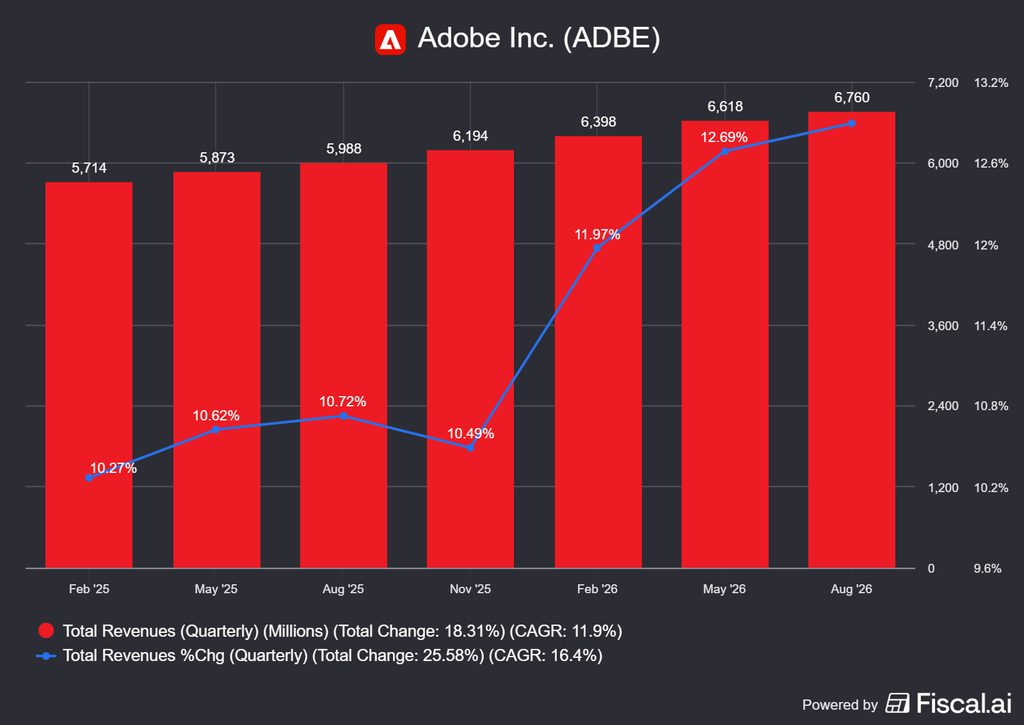
Based on the picture above, I would say: there is nothing to see here, revenue has increased by an average of 10-11% each quarter compared to the previous year, and in the last 2 quarters it has even shown an upward trend. It is true that not all of this is reflected in EBITDA or net profit, but there is growth there as well, so Adobe's basic problem is not that the company is not prospering.
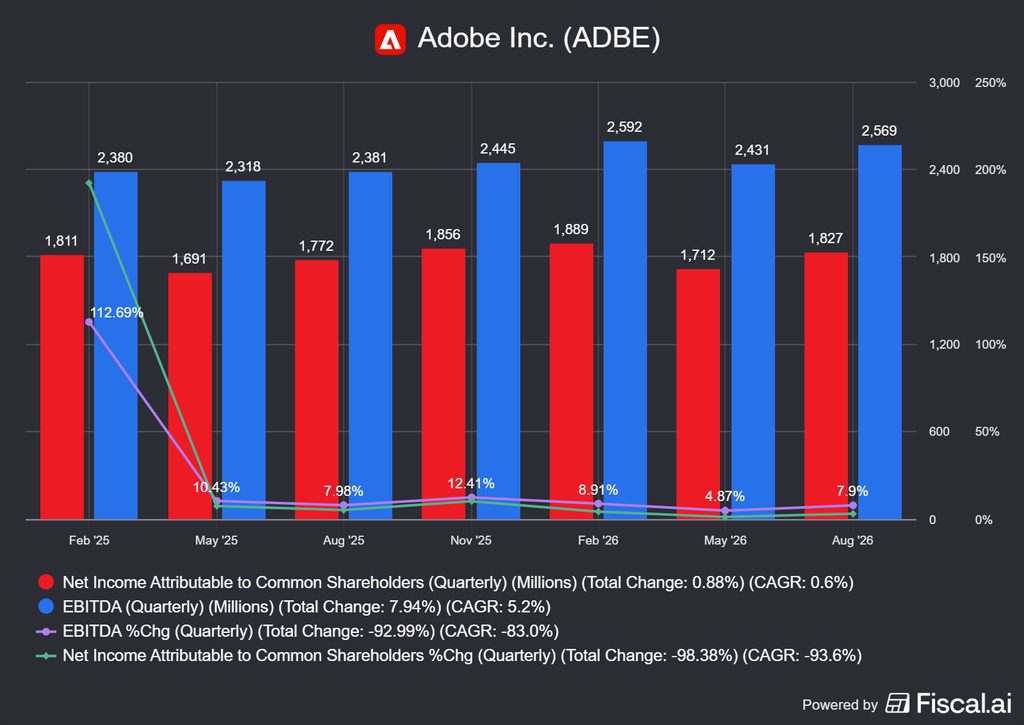
🤔You have to look for Adobe's problems on the qualitative rather than quantitative side, but the market narrative is not in their favor either!
The general artificial intelligence narrative that all software companies will be taken over by AI is still held by many investors, but no one really knows what will happen. My opinion is that generative AI poses a much greater threat to horizontal software companies than, say, vertical ones, because who hasn't generated images or videos with, for example, OpenAI's ChatGPT or Gemini?
The other thing is that there were quite significant changes in management. The company was beheaded, the CEO is leaving, the CFO, one of the CEO candidates, David Wadhwani, left, while a new managing director was chosen from the Digital Experience segment internally. In addition to these, acquisitions, a large amount of share buybacks, and the announcement of another buyback framework stirred up emotions, so life was happening, which I will expand on below. I'll start with Adobe's 2026 Q3 numbers so that you can see the most recent data.

Adobe 2026 Q3: key financial metrics
In the last quarter, Q3, Adobe reported the following numbers:
- 💵 Total revenue increased by 13% to USD 6.76 billion (+12% at constant exchange rate).
- 🔁 Subscription revenue increased by 14% to USD 6.58 billion.
- 🛠️ Product, service and other revenue fell by approximately 10% to approximately USD 178 million.
- 📊 Non-GAAP operating income increased 7% to $2.97 billion, with a margin of 44% (previous year: 46%).
- 📉 GAAP operating income increased by 8% to USD 2.35 billion, and net income increased by 3% to USD 1.83 billion.
- 💰 Operating cash flow increased 15% to $2.52 billion (Q3 record), from approximately $5.20 per share to approximately $6.36.
- 🧾 GAAP EPS increased from USD 4.18 to USD 4.62 (+11%), non-GAAP EPS increased from USD 5.31 to USD 6.13 (+15%).
- 🏦 Cash and short-term investments amounted to USD 5.64 billion at the end of the quarter.
- ✂️ The number of diluted shares decreased from approximately 423 million to approximately 396 million in one year, a decrease of approximately 6.4%. Approximately 9.5 million shares were repurchased during the quarter, leaving approximately USD 24.55 billion remaining from the April 2026 cap.
- 🎯 Does not pay dividends. The 2026 annual revenue target was raised to USD 26.576–26.626 billion and the non-GAAP EPS target to USD 24.45–24.50.
- 🤖AI-first ARR, or annual recurring revenue from AI-focused products, grew to $650 million, a 150% increase in 1 year.
- 📈The closing of the Semrush acquisition and the subsequent announcement and closing of the Topaz Labs acquisition.
- 🤑Introducing a freemium strategy.
The most interesting thing about the above list is that Adobe slightly raised its forecast in June after its Q2 2026 report. So, management expects the company to perform better than the previous forecast (based on the previous revenue estimate of USD 24.34-24.45 non-GAAP EPS), which is not usually the case for companies that are currently in trouble.
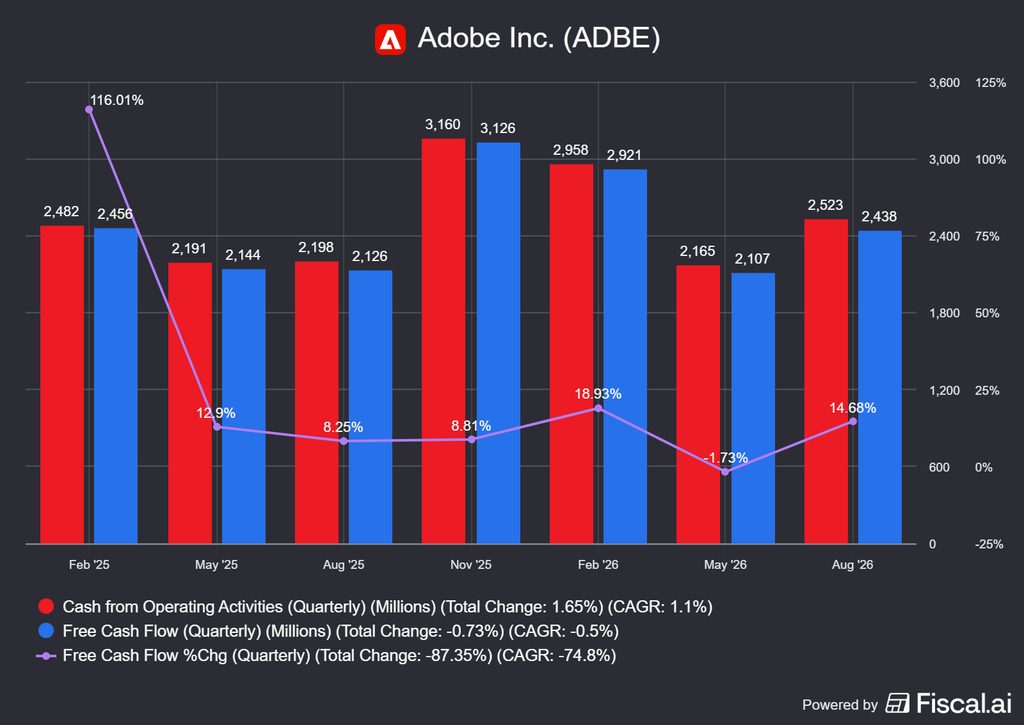
Meanwhile, Q3 2026 operating cash flow was the highest ever for a third quarter, reaching $2.52 billion. This is due to the cyclical nature of Adobe's revenue within the year, with Q3 typically being one of the weaker quarters. Because the company's cost of capital is very low, Adobe continues to generate an enormous amount of cash. However, the revenue also includes the revenue increase from the Semrush acquisition in Q2 2026.
Adobe 2026 Q3: shift to freemium strategy
The freemium business model means that the basic version of the product is free, and you have to pay for more advanced features or a larger usage limit.
🤔The goal is to get as many people as possible to try the product and for some of them to later become paying subscribers.
For Adobe, this means that more features in Acrobat, Express, and Firefly are available for free, without an immediate paywall. They've also postponed planned price increases for Creative Cloud that were scheduled for the second half of 2026.
Why was it introduced:
- 🤖 AI has changed user habits. Narayen says the change is even faster than expected at the beginning of the year. Adobe.com traffic has increased by about 40%, and they want to capture that traffic without a paywall.
- ⚔️ Competitive pressure. Canva and AI-native tools offer a free or low-cost entry point. If you hit a paywall, it's easy to start creating elsewhere and stay there. It's also worth mentioning CapCut, which is one of the most popular software used for editing short video formats, it is used for editing YouTube Shorts, TikTok and similar videos.
- 🎓 Getting the next generation. Young people are no longer growing up on Adobe software, but on Canva, Capcut, and similar tools. Freemium is trying to reclaim this entry-level segment, meaning it is trying to rejuvenate the user base.
- ???? Cheaper customer acquisition. In the long run, it is cheaper to convert paying customers from a large free base than to spend on marketing.
The results so far: the number of freemium users has grown from around 50 million to over 90 million in Q2 and over 100 million in Q3. The total number of monthly active users exceeds 1 billion. Another interesting fact is, Although revenue related to Adobe's AI developments is rising rapidly almost every quarter, it still only accounts for a very small portion of total revenue, but the progress is promising.
📌In practice: Overall, Adobe did the same thing in Q3 2026 as before: it bought back shares, generated a lot of cash, and acquired two companies, while its share price continued to fall, so the risk/reward ratio shifted significantly towards the latter. However, the problems previously revealed in the in-depth analysis, such as high stock-based compensation, confusing, segment-based reporting of revenue, and leadership changes, do not make it easier to see the situation, which is also distorted by the role of AI.
Adobe 2026 Q3: the company will devour itself
If you read my recent article about how I put together my own portfolio, you know that there is a category I called cannibal stocks. I have had good or bad luck with quite a few of these companies, good examples of which are Evolution AB, PayPal, Oracle and, based on the past 2 years, Adobe.
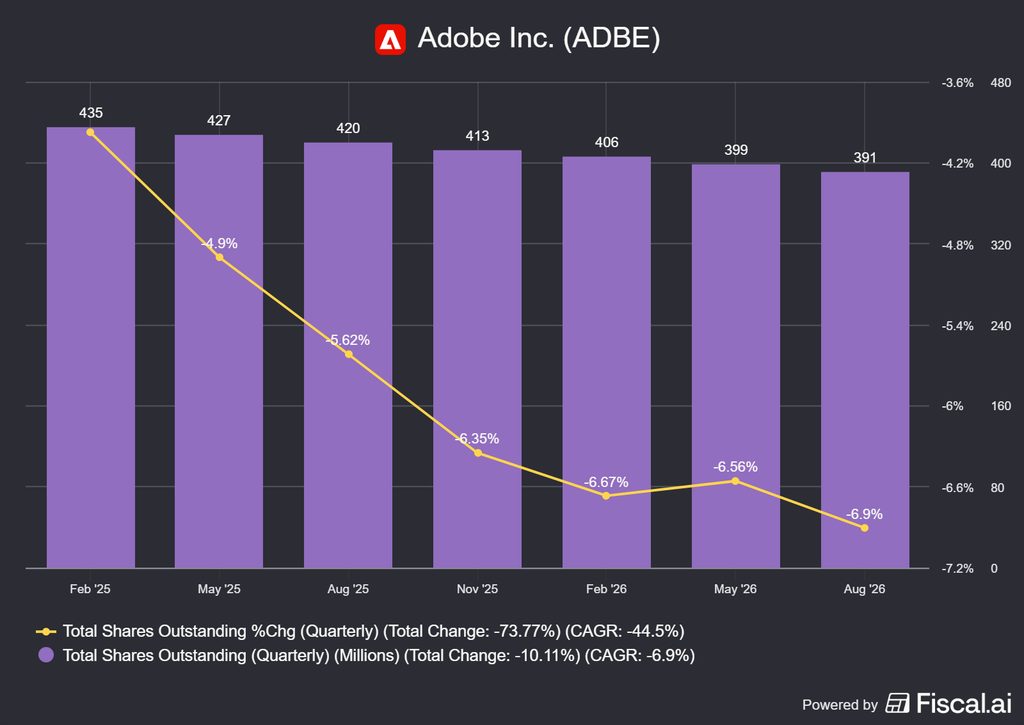
After all, in March 2024, a 25 billion USD share buyback plan was announced, which was exhausted by 2026, so another 25 billion USD was announced. Of the new plan, approximately 24.55 billion USD was still available at the end of Q3. Approximately 9.5 million shares were bought back in Q3 alone, and a total of approximately 33 million in the last four quarters. Based on the above, management valued Adobe shares as very cheap, as it reduced the number of shares from 435 million to 391 million, or by 44 million in 6 quarters, or by a good 10%.
Unfortunately, the above is contradicted by the fact that none of the management's transactions involve the purchase of shares, and in fact, the CEO even sold a third of his share package. The outgoing CEO's remaining share package is ~240000, which is worth 56.3 million USD, while his annual compensation was 51 million USD! The other NEOs have even smaller shares in the company, typically worth 5-15 million USD.
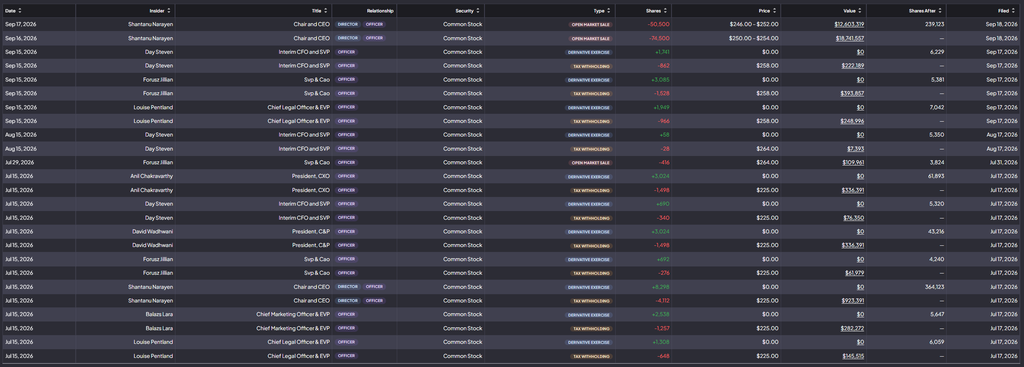
There is also another problem with the above: the decrease in the number of shares masks the very significant stock compensation package that management receives, which reaches 8% of revenue, which I think is blood-curdling. This means that they are paying out roughly $2 billion worth of stock-based compensation to employees per year, but this is done out of cash generated, which is offset by share buybacks. In other words, it is terribly expensive to run the company while not actually committing to it, which is a huge red flag.🚩
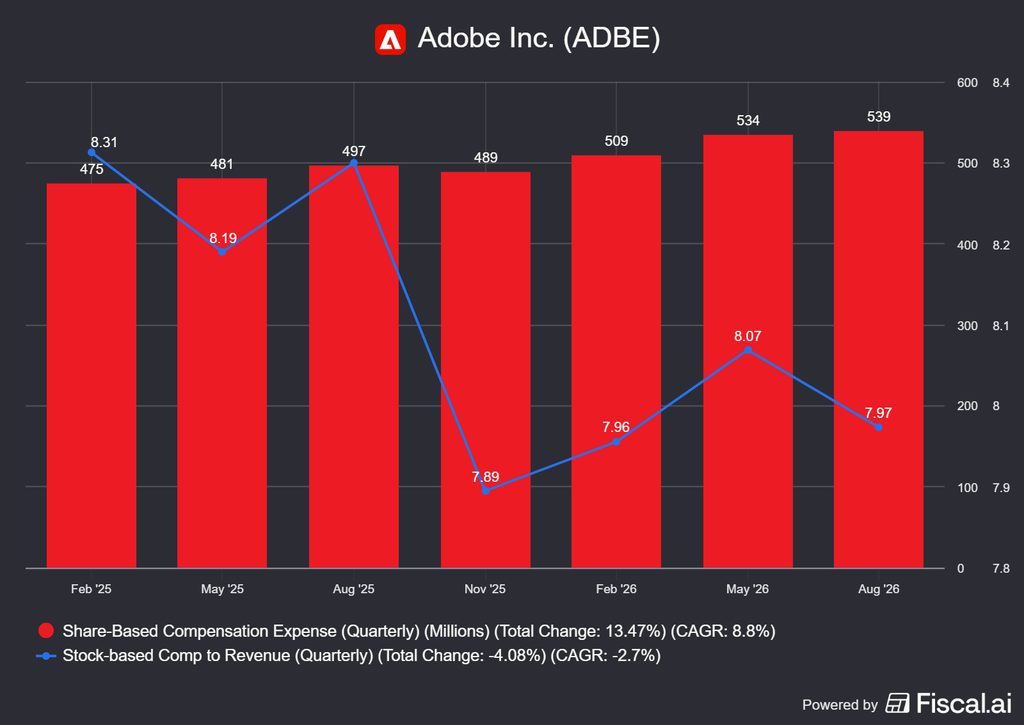
🧑💼❌This clearly shows how uncommitted the leaders are to Adobe. I think it's a real "mercenary management" who grab the big bucks and then step down on occasion.
📌In practice: I really don't like this kind of management, in fact, it's a red flag in my eyes, I much prefer managements like Constellation Software and its spin-offs, Röko AB, or the excellent capital allocators of Kinsale Capital. But if I had to name just one exemplary management, I would mention CSU.I don't believe that capital allocation and management attitudes can change, as this is mostly related to corporate culture. This means that Adobe can only be in my stock portfolio until its valuation is adjusted to a level that I am comfortable with.
Adobe 2026 Q3: management change
There have been quite a few top executives leaving or leaving Adobe in the past few quarters, some of which have honestly surprised me. When top executives leave management, it usually doesn't bode well, think of Starbucks, Nike, Kering, or Novo Nordisk, for example. It's true that in the case of "mercenary management" like Adobe, this is not so uncommon, since they are neither founders nor very committed to the company.
Adobe's departures
- 🇧🇷Shantanu Narayen: Chairman and CEO, says goodbye after almost 2 decades, replaced by Anil Chakravarthy on December 1, 2026. After 18 years, at the age of 62, the change of leadership was expected sooner or later, and the process was orderly: the search for a successor began upon the announcement, Narayen remained chairman, the search lasted six months. What is unusual, however, is for a long-reigning, successful CEO to step back when the stock is at its lowest point. and the company is in the middle of an AI revolution. This can be read as both a responsible handover and an admission of failure, the market has so far voted for the latter.
- 👱Daniel (Dan) Durn: that was the real surprise. He left with four days' notice, announced on the day of the quick report, and transferred to Marvell. All this happened when the CEO position was also vacant, so for a while there was no permanent CEO and CFO at the same time. The market punished this the most: despite the good quarter, the stock fell by about 6%. Such a sudden departure of a CFO is rarely a good sign, Although he doesn't point to an accounting problem here, Marvell's offer may simply have been too attractive. I wonder how much they offered him, given that Adobe's top executives already earn brutally high salaries? His interim successor was Steven (Steve) Day, who is the CFO of the Customer Experience Orchestration business unit and Head of Corporate Finance from 2023.
- 🤕David Wadhwani: his switch was not surprising. It is a common pattern in corporate practice for an internal CEO candidate to leave after a successor is appointed. Wadhwani was considered a contender, but Anil Chakravarthy ended up as the runner-up, so his departure is more likely a consequence of not getting the coveted position.
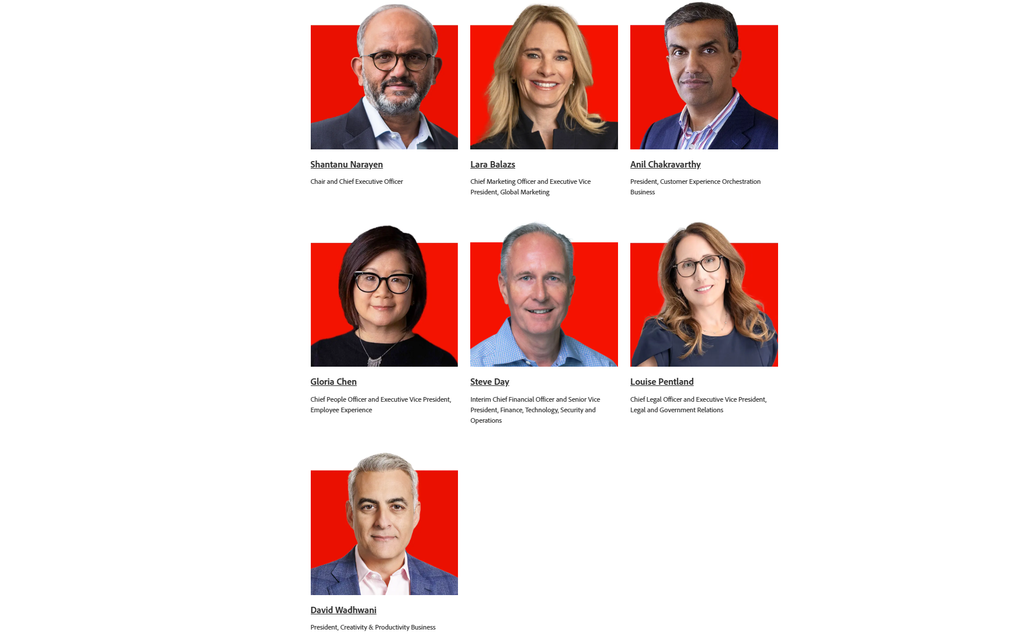
I would add to the above that Shantanu Narayen essentially led Adobe from the era of boxed products to complete SaaS, or subscription-based models, and in fact, around 2012, they were almost pioneers in this. You can safely call him a successful leader, but I think he can be included in Adobe's management compensation. There should also be a "newcomers" section here, but no external names have been announced for a serious position as of the time of writing:
- 👱Anil Chakravarthy (future CEO) internal candidate on paper, but relatively fresh: he arrived in January 2020 as head of Digital Experience, and six months later he was also given global sales. Before that, he was CEO of Informatica, where he transformed the traditional software company into a cloud-based subscription business. His last position was President, Customer Experience Orchestration. I couldn't find any news about who will take over this position when he becomes CEO in December.
- 🇧🇷Steven Day is also an internal candidate, He has been working as a financial manager at Adobe for about 20 years, before that he was CFO of the Customer Experience Orchestration business unit. The final CFO position is still open. According to several analysts, the lack of a CFO is a bigger risk than the CEO change itself.
- 👱♂️David Wadhwani on the evening of his appointment, he announced on LinkedIn that he would be leaving after handing over his duties. He led Photoshop, Illustrator, Lightroom, Acrobat, Express, and the Creative Cloud ecosystem, a business that accounts for about three-quarters of revenue. This is not encouraging until his successor is in place.
Without claiming to be exhaustive, I would like to mention that managers also arrived in two, not very significant, operational positions:
- 🙍♀️Lara Balazs: Balazs is responsible for managing Adobe's brand, adobe.com, events, and communications. His area of expertise is also important on the user acquisition side of the freemium strategy.
- 🙍♂️Louise Pentland: Pentland succeeds Dana Rao, who left in the fall of 2024. In the interim, HR chief Gloria Chen also temporarily led the legal department. Pentland arrived at the time of the US Department of Justice (DOJ) lawsuit over Adobe's subscription practices. The appointment was met with criticism, as it was his third new legal position in four years. He received an eight-figure stock package upon joining.
🤔I think those leaving and those arriving are not in the same category, and management seems to me to be communicating quite vaguely on this issue (as well).
📌In practice: I've never been fond of Adobe's management, but the changes of the past year and a half have made that even worse. My main concern is that at a world-famous multinational company, they don't usually let key people go with 4 days' notice, and it's also very rare for the CEO to step down during an important transformation. The succession is currently hazy.
Adobe 2026 Q3 Acquisitions: Semrush and Topaz Labs in the Hat
Adobe has grown mostly organically over the past few decades, but has also made smaller acquisitions. In September 2022, however, it attempted to acquire one of its most promising rivals, Figma, in a transformative acquisition. This was blocked by regulators, which forced Figma to pay a $1 billion penalty, which was paid in fiscal year 2024. Since then, there have been few transformative acquisitions, but the company has managed to close a few store-on deals. Semrush, an SEO platform, was acquired in late 2025, but the deal did not close until Q2 2026, but the full revenue impact was only felt in Q3, so I thought it was worth mentioning. Topaz Labs is a new acquisition that was announced in June and closed on September 23.
The Semrush acquisition
The acquisition was announced on November 19, 2025, and closed on April 28, 2026, i.e. in Q2 (March-May) of the 2026 financial year. The deal was signed by the future CEO, Anil Chakravarthy. The main details are:
- 💵 Price: $12 per share, all in cash. That's about $1.9 billion in equity. One analysis suggests the actual cash outflow was $1.56 billion, likely offset by Semrush's own cash. This is a 74% premium to the closing price at the time of the announcement.
- (I.e. Size: Semrush's 2024 annual revenue was $376.8 million, with approximately 118 paying customers.
- 📊 Impact on numbers: Of the $27.10 billion in ARR at the end of Q2, approximately $480 million came from Semrush, so some of the revenue growth from Q2 is acquisition-based, not organic.
- 🎯 Strategic goal: Semrush strengthens the Digital Experience side, fits into the new CX Enterprise platform. In addition to SEO, it also offers tools for visibility in AI search engines (GEO, agentic search optimization).
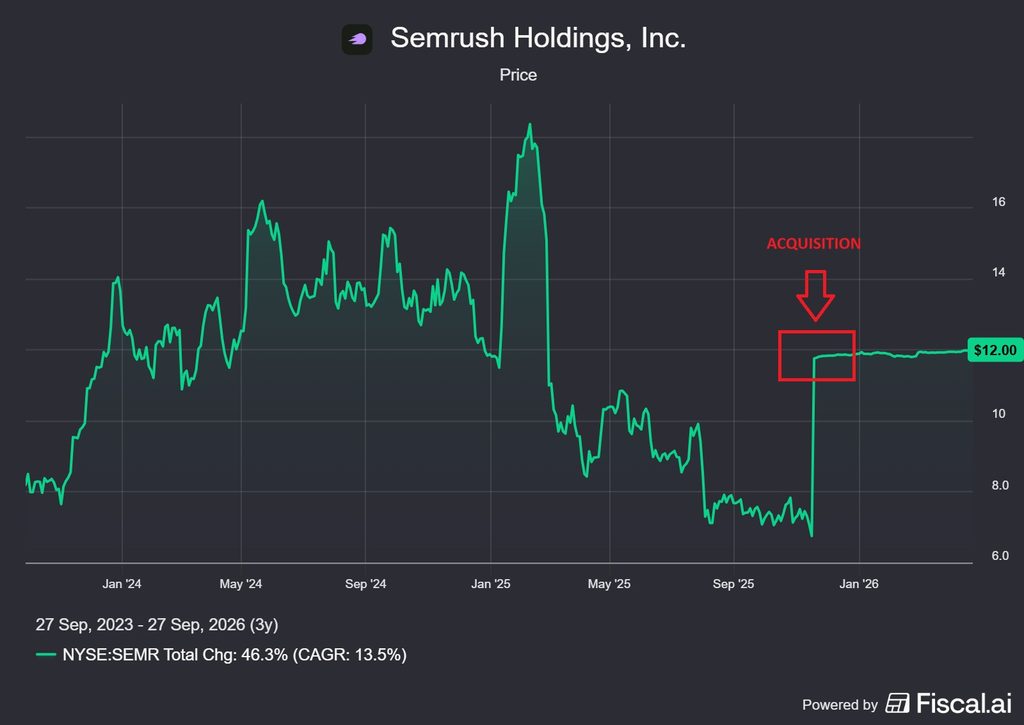
The acquisition fits into Adobe's portfolio, I have used Semrush myself in my work, and it has relatively few competitors on the market - Ahrefs, MOZ, Ubersuggest software. For me, the big question is how well old search engine optimization techniques can still work in the age of artificial intelligence. This is also indicated by the fact that in Q3 2025 it generated an operating loss of USD 4.5 million according to GAAP, but on a non-GAAP basis it was profitable with a margin of 12.6%. In other words, it is not a loss-making company, but its profitability is far behind Adobe's.
👆This acquisition can only work if Adobe can channel Semrush's customers with its other products, otherwise it will just be a very expensive waste of money.
Topaz Labs acquisition
Topaz Labs develops AI-based image and video enhancement software (Topaz Photo, Topaz Video, Gigapixel) that are market leaders in upscaling, sharpening, noise reduction and archival restoration, and are used by 20 of the world's 50 largest companies. Key to Adobe is its proprietary Neurostream technology, which enables large AI models to run on the user's own machine. Eric Yang, CEO of Topaz Labs, will join Adobe's Digital Video and Audio team. The purchase price was not disclosed.
Why Adobe cares:
- 💰 Cost: If the AI models run on the user's machine, Adobe will have to pay for less cloud computing capacity. This directly addresses the biggest risk of the freemium strategy: rising compute costs.
- ️ Product: The noise reduction and sharpening features of Photoshop and Lightroom have so far lagged behind Topaz. Many photographers have used both software before, so this brings a step outside of the Adobe workflow in-house.
- (I.e. Corporate use: Companies can mass-convert their old, low-quality images and videos into reusable content.
I think this is a much more logical move than the Semrush acquisition, as Adobe can compensate for the biggest threat, the impact of rapidly developing artificial intelligence, by integrating the technology into its existing software. At least, assuming that many users use AI to improve image quality. Although we don't know much about the acquisition price, the time and cost of the development could have been more than the acquisition itself, so I think Topaz Labs fits nicely into Adobe's portfolio.
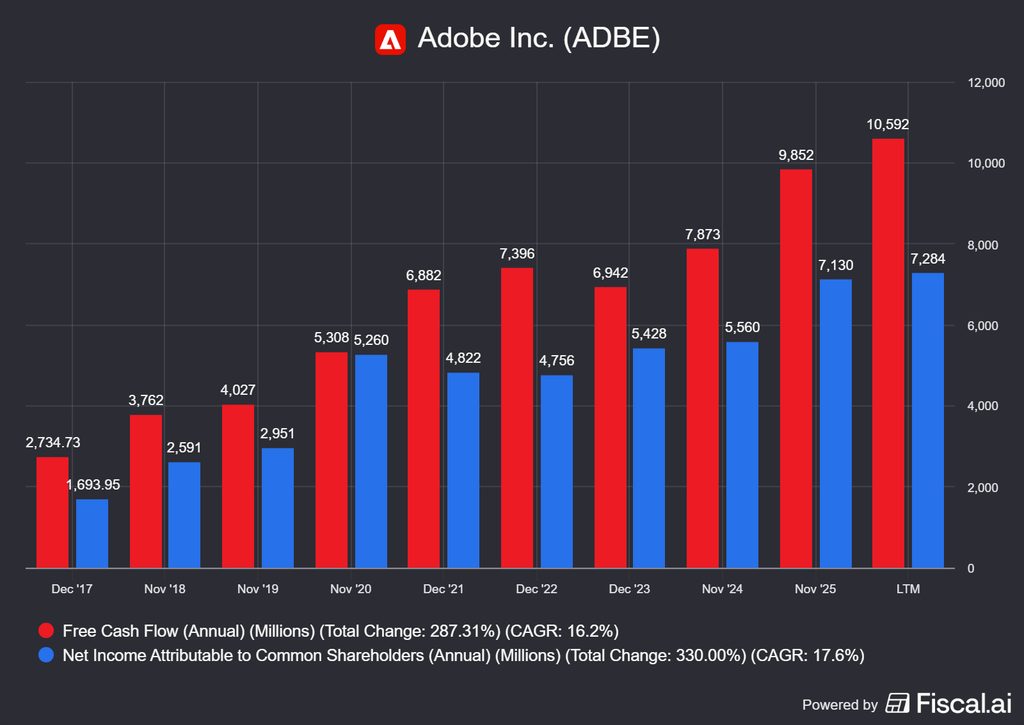
📌In practice: Overall, I think these two acquisitions are too small to significantly change Adobe's thesis. Considering the company's $25-26 billion in revenue, $7 billion in net income, and $10 billion in free cash flow, neither deal was particularly large. But that's okay, transformative acquisitions always carry huge risks, but they can support the freemium strategy and AI threat mitigation. It is worth taking a wait-and-see approach and monitoring future quarterly reports and management communications.
Adobe 2026 Q3: Summary
Adobe's Q3 2026 report didn't bring any big surprises, and in fact, in the 6 quarters since the in-depth analysis, pretty much the same thing has happened: Adobe Inc. (ADBE) has consistently grown its revenue while the market continues to hate the stock, so the price has continued to fall, despite a temporary breakout. Overall, this means that today you have to pay less for essentially the same risks.
Things to love about Adobe: excellent cash generation ability, stable double-digit revenue growth, no dividend, little net debt, It has not made any transformative acquisitions so far and is using the cash it generates to buy itself, which really creates value at this price. In fact, the company is acting like a real blood-sucking vampire with its pricing, its margins are excellent and it seems to be able to maintain this. It doesn't seem like there's any problem with the quantitative side.
🏷️With such pricing, the stock looks incredibly cheap, even despite its risks.
What I really don't like is the management compensation, the outrageously high salaries and even more outrageous stock-based compensation, which is not associated with significant Adobe stock ownership and insider buying, which is typical of mercenary management. The departure of key executives and the filling of vacant positions also raise some serious questions.
But the biggest problem is not this, but the company's hazy future, as it seems that artificial intelligence can be very dangerous for horizontal software companies.. The best example of this is how easy it will be to generate images with AI services in 2026. Moreover, these companies are funded by the world's largest software holdings, Google, Amazon, Microsoft, Meta, just to name a few, which are much stronger financially than Adobe. And the big fish usually eats the small ones, so on the qualitative side, neon-lit red flags are lit up in the company's thesis.
However, not too many thesis-defining events have occurred in the past year and a half or in Q3 2026, so I think the current price is not justified by the problems mentioned so far, or at least it is certainly not supported by a fundamental reason. The depressed exchange rate can largely be explained by sentiment: market opinion drives the price, not real reasons.
For those who want to get even more involved, Regarding Adobe Inc. (ADBE), read the original analysis at this link: Adobe (ADBE) Stock Analysis: AI Competition and Valuation.
🤑If you are interested in what brokers we use, read our articles below:
(I.e.Interactive Brokers broker account analysis – Professional for professionals
📈LightYear Broker Account Analysis - Simplicity and cheapness go hand in hand
Frequently Asked Questions about Adobe Stock
Answers to the most common questions
Do you own Adobe stock or just want to understand what happened after the Q3 2026 report? Here you will find concise answers to the most frequently asked questions: why is the share price falling despite good numbers, what does the freemium strategy mean, who will lead the company from now on, how much does AI matter in revenue, and what are the biggest risks.
Click on any question and the answer will open. These are intentionally short summaries: if you are interested in the details, I will expand on them in more detail in the appropriate sections of the article. Important: Adobe is in the midst of a leadership change and a change in strategy, the data reflects the time of writing of the article.
Is Adobe stock a good investment now?
Adobe is a cheaply priced, quality company with an uncertain future. At around $235, it trades at around 9.6x P/E on 2026 non-GAAP EPS target ($24.45-24.50), while revenue is growing at double digits, gross margin is around 89%, and share count is down around 6.4% year-over-year. The numbers are fine. The question is how much generative AI will erode Creative Cloud's pricing power in the long term. Valuations already heavily price in this risk, but management compensation and the loss of leadership continuity are real weaknesses.
Why is Adobe's share price falling when the numbers are good?
Because the market doesn't price the past, it prices the narrative. In early 2026, the entire software sector was priced out due to AI disruption fears. Added to this was the freemium shift, which is slowing ARR growth in the short term, and the almost simultaneous departure of the CEO and CFO. Both Q2 and Q3 were beat-and-raise quarters, yet the stock fell both times.
The low was around USD 193–194, which is a drop of about 45–47% compared to the levels in early 2025. From there, the stock rebounded by about 50% to USD 292–293 in a month and a half, before falling back to around USD 235.
What does Adobe's freemium strategy mean?
More and more features in Acrobat, Express, and Firefly are available for free, without an immediate paywall, and Adobe has postponed planned price increases for Creative Cloud. The goal is to win back younger users from Canva, CapCut, and AI-native tools, and then convert them to paid subscribers later. The number of creative freemium users has grown from about 50 million to over 100 million in a year. The price: slower ARR growth and higher compute costs, and the pace of conversion is still unproven.
Who will be Adobe's new CEO?
Anil Chakravarthy, effective December 1, 2026. He has been with Adobe since 2020, leading the Digital Experience (now Customer Experience Orchestration) business, and previously served as CEO of Informatica. Shantanu Narayen will remain as executive chair after 18 years.
Meanwhile, CFO Dan Durn has left (interim successor Steven Day), and David Wadhwani, head of creative, is also leaving, with no successor yet named. Key positions have so far been filled exclusively from within.
How much does AI matter to Adobe's revenue?
It's growing slowly, but fast. AI-first ARR, or annual recurring revenue from AI-focused products, exceeded $650 million at the end of Q3 2026, up +150% year-over-year. This is only about 2.4% of the total ARR of $27.5 billion. So the company's growth continues to be driven by traditional subscriptions, with AI more of a future potential for now.
What did Adobe buy with the acquisition of Semrush and Topaz Labs?
Semrush is an SEO and brand visibility platform, the approximately $1.9 billion deal closed on April 28, 2026. It brought in approximately $480 million in ARR and strengthens the company's marketing side, including visibility in AI search engines.
Topaz Labs, which develops AI-based image and video enhancement software, closed on September 23 for an undisclosed price. Topaz's biggest asset is that its models run on the user's machine, which could reduce Adobe's cloud computing costs. Neither deal is transformative given Adobe's size.
Why is Adobe's management subject to criticism?
Stock-based compensation is about $2 billion a year, about 8% of revenue, while executives barely hold any Adobe stock and there has been no market buybacks. Narayen sold about a third of his directly held shares in September 2026, after the Q3 report, for about $31 million, at $246-254. So some of the buybacks are just offsetting the dilution from compensation. This makes me see management as more mercenary than owner-oriented.
What are the biggest risks for Adobe stock?
Four main issues: AI-native tools (and the tech giants behind them) could erode Creative Cloud's pricing power, freemium conversion could be slower than expected, leadership continuity lost in the midst of a strategy shift, and high stock-based compensation permanently reduces shareholder value. Smaller risks include the Semrush integration, the shrinking stock photo business, and a lawsuit by the US Department of Justice (DOJ) over subscription practices.
How to understand Adobe's fiscal year and when is the next report coming out?
Adobe's fiscal year ends in late November or early December, so Q3 2026 covers the period from May 30 to August 28, 2026, roughly a month behind the calendar quarter. The next report will be Q4 2026 and the full fiscal year, expected in mid-December. It's worth keeping an eye on net new ARR, the first signs of freemium conversion, and the 2027 outlook, which will be the new CEO's first own forecast.
Legal and liability statement (aka. disclaimer): My articles contain personal opinions, I write them solely for my own entertainment and that of my readers. The articles published here do NOT in any way exhaust the topic of investment advice. What is written here is for informational purposes only and should NOT be construed as an offer. You are SOLELY responsible for the decisions you make.