
?What is the Market Momentum column about??
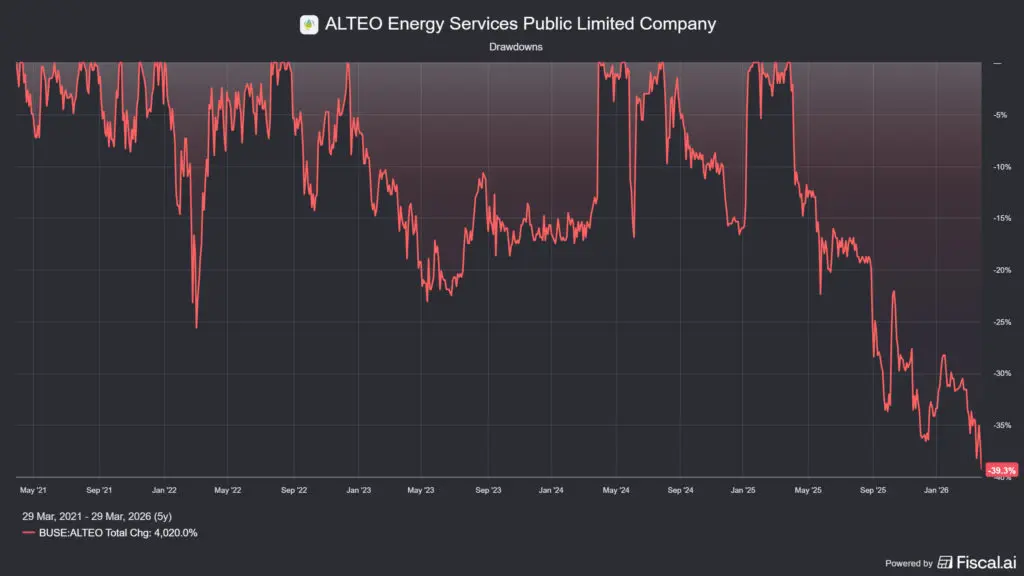
Alteo's price movement has shown significant fluctuations over the past year: in March 2025, it rallied to a new historical high of ~6800 HUF, and then by early October, the paper had fallen by nearly 2600 HUF, with the current exchange rate of 4000 HUF, which is a drop of almost 40%. What is behind the movements, and what does this mean for investors?
I don't know if you're aware of this, but a thorough fundamental in-depth analysis can take 40-50 hours. As an investor, it's impossible to put that much energy into analyzing each company if you want to effectively manage a long enough watch list. That's why I created the Market Impulse column, which provides a snapshot of each stock, specifically Alteo, and roughly outlines current events. It is not an in-depth analysis, but rather just food for thought based on the current state.
My goal is not to give daily trading tips or analyze technical patterns. Instead, I provide quick, to the point fundamental mini-analyses that help you filter. These impulses help you keep in mind whether the current price movement of Alteo or another market participant is worthy of deeper investigation or is just a passing market phenomenon.
You can find the share subpage with detailed information here: ALTEO stock page
If you are looking for in-depth analyses of the site, click on the link below: iO Charts stock analyses
?Table of Contents?
I have created a table of contents to make it easier for you to navigate the content:
- ❓What does Alteo do?
- 💡Current situation of Alteo and its competitors
- 🎢Alteo metrics
- ✅Alteo: will you get used to it or will you run away?
- 📝Summary of the thesis
❓What does Alteo do?❓
ALTEO Energiaszolgáltató Nyrt. is a company founded in 2008, listed on the Budapest Stock Exchange under the ticker ALTEO, which is primarily focused on renewable energy, as its activities have been supplemented with waste management since 2019. The company is one of the most innovative players in the BSE mid-cap segment, covering the entire value chain of energy production, trade and storage. It was owned by the Wallis Group (Tibor Veres), but at the end of 2022 it sold its 61.6% stake to MOL, Diófa Alapkezelő and the Indotek Group, which purchased the shares in equal proportions. These are all quasi-state entities. Later, MOL acquired another stake, so that it currently owns 49% of Alteo, while the remaining 25% went to private equity funds.
Alteo's business is built on three main pillars:
- ☀️ Renewable energy production: a portfolio of solar, wind and geothermal power plants, the capacity of which is constantly expanding. This segment is the most decisive for Alteo's share price, as renewable capacity expansion is one of the main value creation engines.
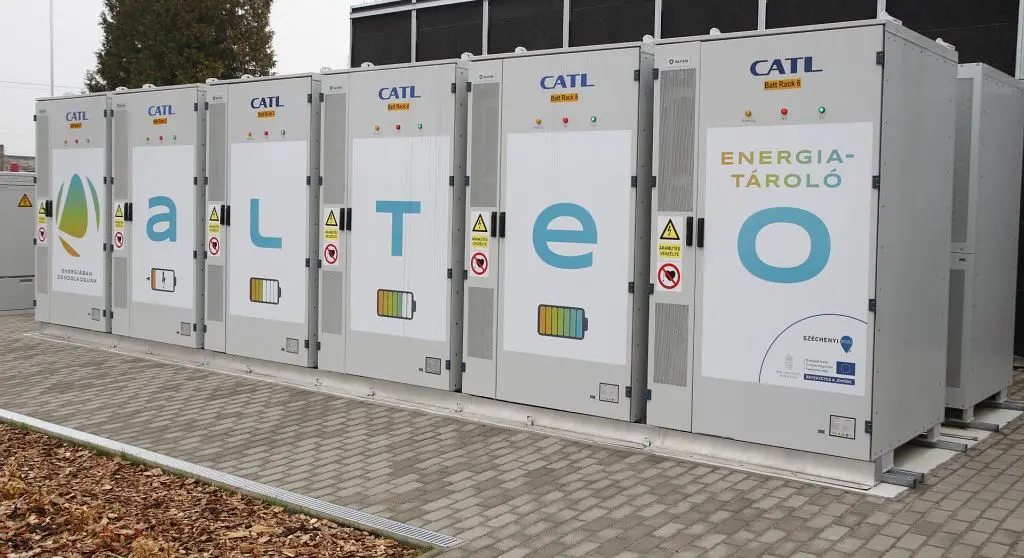
- ? Energy storage and system services: Alteo is one of the largest industrial energy storage operators in Hungary. The energy storage portfolio with a total capacity of 70 MW (Sinergy Kft., 100% owned by Alteo) will be commissioned in early 2026, which will enable the provision of higher margin regulation services, including connection to the European PICASSO platform, available from October 2026, which will expand the market to the entire continent, you can read about it here: Picasso platform.
- ♻️ Circular farming (ALTEO Circular): The acquisition of ÉLTEX Kft., which brought Alteo into the waste management market, was completed in mid-2025. This could be a new, capital-intensive but stable source of revenue in the long term and directly parallels MOL's MOHU strategy.
? In practice: Alteo is not a simple company to interpret. It is simultaneously a growth investment story (capacity expansion, acquisitions, new markets) and increasingly a utility-type business (stable rental and regulatory revenues). It also confuses the equation that they actually gained exposure to MOL with Alteo, so one of the biggest tasks here is to diversify the ownership group.
? Alteo's situation and competitors
Alteo occupies a unique market position: it operates at the intersection of renewable energy production, energy storage and waste management, where the range of direct competitors is extremely heterogeneous.
? The most important comparison bases:
- ? PannErgy Plc.: Another renewable energy player on the BSE, with a geothermal focus. Smaller but with a similar growth narrative. Analysts tend to mention it in parallel with Alteo's share price.
- ⚡ MVM Group (non-listed): the state-owned energy giant, which is also active in renewable developments, but Alteo focuses more on the corporate sector, where MVM is less dominant (it is a 100% state-owned company, you receive your monthly bills from them, it practically manages part of the utilities).
- ?️ MOL: not a direct competitor, but a strategic partner, Alteo performs some of MOL's tasks, and the Algyő solar power plant development was also commissioned by MOL. MOL aims to use 2500 GW of renewable energy by 2030, in which Alteo can play a key role, but MOL is also the owner of Alteo, so the money is actually transferred from one entity to the other.
? In practice: Alteo's positioning on the BSE is unique, it has no direct stock exchange competitor in Hungary in this business model. This may justify a premium in valuation, but also makes comparability with other companies difficult.

? Alteo metrics
? Exchange rate and catalysts
Alteo's price change is difficult to follow because it is one of the most volatile BSE papers, among mid-cap papers in Hungarian terms. It reached a historic high of 6880 forints in March 2025, and then, due to the narrowing of energy market margins and deteriorating profitability figures, it gave back 40% of this by March 2026. Of course, as always, the question now is whether this makes the paper cheap or not. What I am a little concerned about is that the paper has risen from 1220 HUF to 5.6 since 2021, i.e. over a 5-year period, which means +460%, but the current price is at the levels of the end of 2024. This is quite a lot of volatility, but it cannot be considered unreasonable, for example, due to the explosion of revenue data.
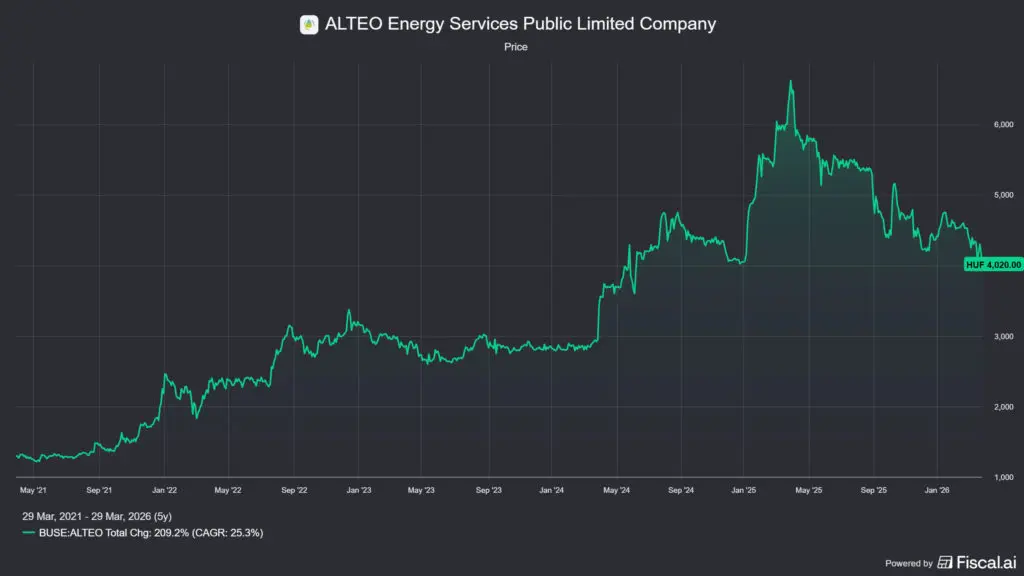
However, I think that it is not worth looking back at the movement of Alteo's share price for a period longer than 5 years, as the separation from the Wallis group in 2022 and the MOL ownership in 2024 transformed Alteo into a radically different company. Never forget that by owning the share, you are also betting on MOL, the two companies are inseparable.
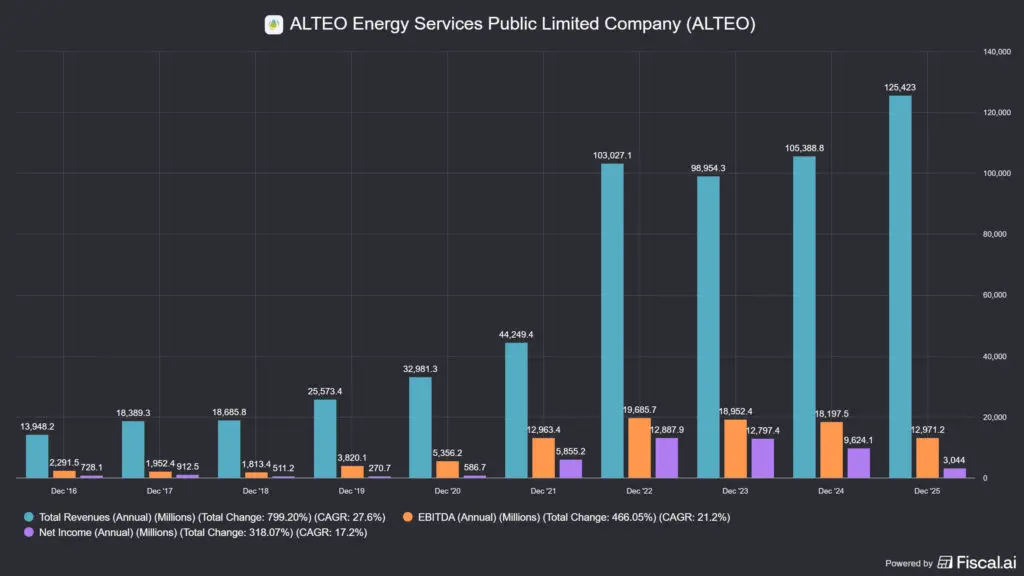
Alteo's share price is driven in the short term by energy market prices (especially balancing energy and electricity spot prices), acquisition news and capacity expansion announcements. The company closed 2025 with mixed results: revenue increased by 19% to HUF 125.4 billion, while EBITDA decreased to HUF 13 billion, a significant drop compared to the previous EBITDA of HUF 18 billion. So the share price essentially followed the underlying fundamentals, the question is to what extent the political mood affects the share price of a state-owned company. There are always more question marks than certainty before the upcoming Hungarian elections, but these are short-term effects, it is worth looking at investments in this way.
? Rating
Alteo's valuation is higher than blue chips due to its growth story, but they are not directly comparable, so it is much better to compare the current values with the company's own historical values, as I did earlier when analyzing other Hungarian stocks:
- ? P/E: 29.4
- ⏳ Historical, 3-year P/E: 15
- ⏳ Historical, 5-year P/E: 11.6
- ? EV/EBITDA: 18.4
- ⏳ Historical, 3-year EV/EBITDA: 8.5
- ⏳ Historical, 5 years old EV / EBITDA: 6.7
Based on the above, Alteo is currently hellishly expensive, especially if you look back at the previous picture, where you can see that at the end of 2022, revenue was 103 billion HUF and profit was ~13 billion HUF, but the valuation was much lower. In fact, the underlying numbers do not justify this at all in the present, which is a sentiment effect and prices the future: the commissioning of the 70 MW energy storage portfolio, the PICASSO platform, and the completion of the ÉLTEX integration all promised a substantial EBITDA jump by 2026. Investors bought this in advance, but the paper gave back much of this hype.
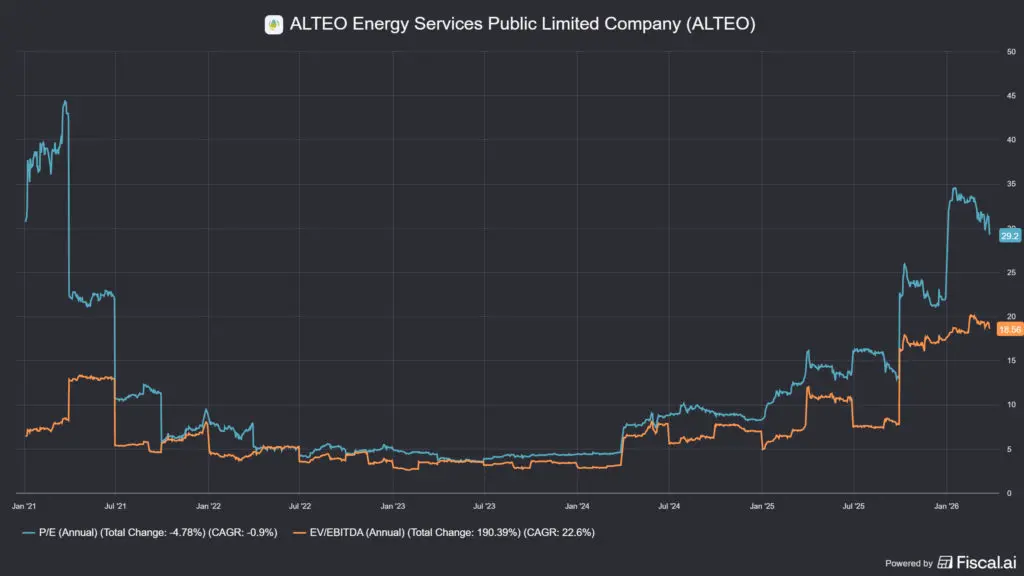
The question is why? One reason could be that Alteo is a mid-cap paper with low liquidity. Even a relatively small capital can cause serious price movements, and vice versa. The other is that Alteo is a state-owned interest, so the choice will definitely affect the mood. Plus, since the profit has become the lowest in the last 5 years, everything has actually come together for a bigger drop, you can see this in the price.
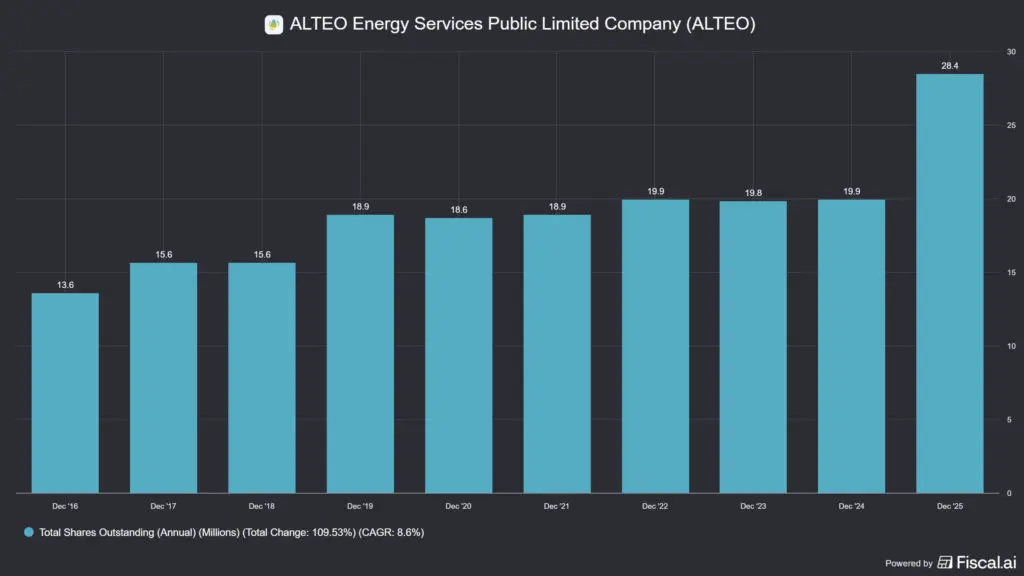
Alteo does not pay dividends, but it dilutes its shares to finance investments. This is problematic because it continuously lowers its per-share figures, with the promise that the investment financed by the share issue will pay off in the future. Unfortunately, the situation is not that simple, as Alteo finances not only through share dilution, but also through debt.
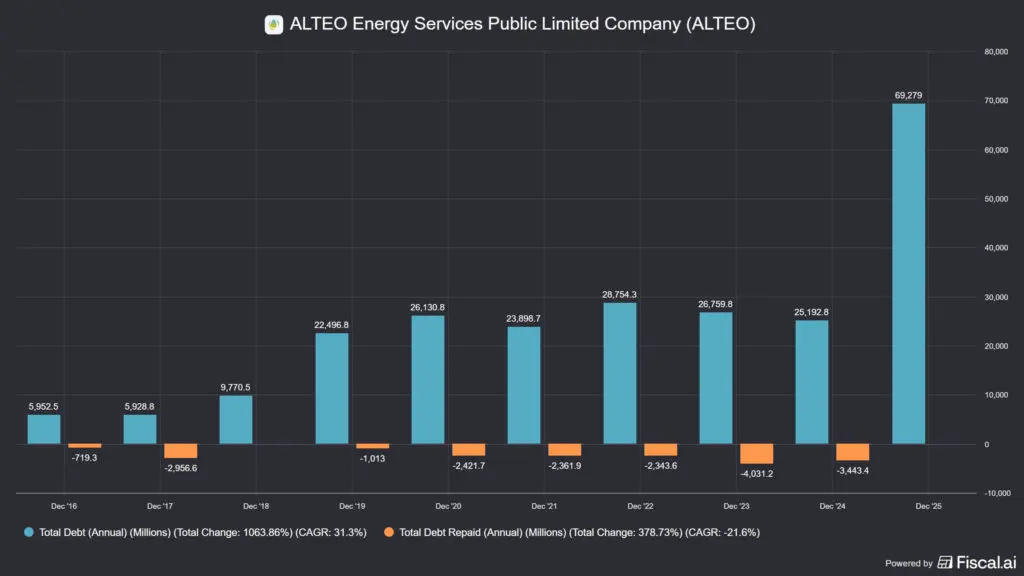
The reason is the same: the operating model is quite acquisitive in nature (FE-Group, MOV-R, ÉLTEX, Mecséri Wind Park), for which Alteo also uses a lot of loans. This actually puts double pressure on the capital structure, even if most of these are covered by physical assets. But, there is always the risk of overpayment, which typically only becomes apparent later.
?️ Ownership structure
After the separation of Wallis Asset Management Zrt. in 2022, ownership was transferred through several structures, and according to public data from the BSE, 73.79% is currently in the hands of three entities:
- MOL RES Investments Zrt. and Riverland Private Equity Fund (also a MOL interest): ~49%
- Főnix Private Equity Fund (managed by Diófa Fund Management): ~25%

This already shows one of the basic problems: the free float, i.e. the securities circulating in the market, accounts for approximately 26%, which is further reduced by the 4.73% employee share program (MRP), as these are typically slow-moving, longer-term shares. However, they cannot be removed from the float, which is why I included them together. The low free float also means that liquidity is limited, and the securities can be effectively moved by larger owners. Since Alteo is directly dependent on MOL, it is worth paying attention to that company over Alteo's numbers.
? Risk factors
- ? Margin squeeze in the power generation segment: The main reason for the EBITDA decline in 2025 was the margin squeeze experienced in the power generation markets. If energy prices develop unfavorably, this will put immediate pressure on Alteo's share price. Since this is an energy sector stock, it is worth being aware of its specificities.
- ? Investment load: The construction of the 70 MW energy storage portfolio and the integration of ÉLTEX (one of the largest waste processors) both require capital, which keeps free cash flow under permanent pressure. As long as the investments do not generate meaningful income, profitability will remain weaker.
- ? Low liquidity: Alteo is a mid-cap stock with a daily turnover of a fraction of that of blue chips. This makes it difficult to both establish and close positions, as I wrote in the section on ownership structure.
- ? Regulatory risk: In the field of renewable energy, state intervention (modification of mandatory off-take systems, changes in network fees) can significantly affect revenues and these are difficult to estimate in advance.
- ⚡Changes in energy prices: Since it is essentially a raw materials and energy company, rapid changes in energy prices pose significant risks to the company's revenues. The company can offset these risks by hedging transactions and reducing them.
- ? Management risk: In February 2026, Péter Luczay, one of the company's founding members and deputy CEO, left after 13 years; the loss of such a key person is always a warning sign.
?In practice: Energy stocks are typically capital-intensive companies, as they need to make large investments to grow their revenue. As long as money is flowing out of the company, there is always a risk that it will not be repaid properly, as future revenue is a possibility and rising capital costs are a certainty. So to understand this more deeply, you need to look at the state subsidies spent on infrastructure. However, as MOL aims to increase its renewable energy consumption to 2500 GWh by 2030, this will provide Alteo with a tailwind for years to come.
? Alteo: will you get used to it or will you run away?
As with all energy companies, one of the most important valuation components for Alteo is how energy prices change. However, this can be modified by many Black Swan events. The Iran war, which has been going on for about a month, is a typical example of this, which is very difficult to model in advance. How much will the price of gas and electricity be, how much will the sun shine or the wind blow? Alteo has gained exposure to the latter, for example, with the MOV-R wind farm. So, the final mix has to be mixed with a fairly complicated formula, which does not seem very simple.
? Bulls say (Optimistic scenario):
- ? The energy storage portfolio will turn around in 2026: With the commissioning of the 70 MW storage capacity, Alteo enters the higher margin regulation market. The PICASSO platform will make the sale of balancing energy available on a European level from October 2026, a completely new revenue dimension.
- ♻️ ALTEO Circular scales: The waste processing segment is in the integration phase after the ÉLTEX acquisition and may appear in the consolidated figures with a significant EBITDA contribution from 2026.
- ?️ MOL synergy is lasting: The strategic cooperation between Alteo and MOL is beneficial to both parties, and due to MOL's ambitious renewable energy goals, this relationship may remain relevant in the medium term.
? Bears say (Pessimistic scenario):
- ? The numbers for 2025 are disappointing: The significant decline in EBITDA and profit margin shows that the growth story is not always accompanied by a meaningful improvement in profitability. If this trend continues, Alteo's share price may suffer further.
- ? Uncertain timing of return on investment: The return on energy storage investments depends on regulatory and market conditions; if the PICASSO connection or the balancing energy market develops unfavorably, the expected margin growth will not occur. However, if energy prices trend upwards, the opposite may happen and the return may improve.
- ? Liquidity and volatility: Alteo's share price can fluctuate widely even with low turnover, which is a two-way risk. In 2025, the stock fell by nearly 40% from its peak of 6880 forints, which is not a place for the faint of heart.
? In practice: Alteo is a particularly risky but potentially higher-yielding investment, with higher volatility and lower liquidity compared to blue chips such as Magyar Telekom or OTP. For those who believe in the green energy transition and accept the risk of short-term margin squeeze, Alteo's price may offer an attractive entry opportunity from current levels.
? Summary of the Alteo situation
Alteo's share price movement follows a typical growth investment thesis: the company is actively building, making acquisitions and opening new markets, while short-term profitability temporarily suffers from the investment burden, and the capital structure is burdened by loans, while shareholder value is eroded by share dilution. 2025 was a successful year, with strong revenue growth but weaker profitability. The turning point could come in 2026 with the commissioning of the energy storage portfolio and the completion of the ALTEO Circular integration.
This, in turn, raises many question marks, which are further complicated by the upcoming Hungarian election, as no one knows whether the political winds or the regulatory environment will change. Alteo's share price movement is quite unpredictable, and the volatility in 2025 is a reminder that there can always be a gap between narrative and reality. Alteo is recommended for patient, risk-taking investors, but anyone who is scared of stocks with debt-laden balance sheets and does not want to delve into the specifics of the energy market should stay far away.
If you want to analyze further, use iO Charts' stock finder and portfolio manager, which you can access here: iO Charts.
FAQ: Professional questions about Alteo
Why did Alteo's price fall so much after its 2025 peak?
There were two main reasons for Alteo's share price to fall after its peak of HUF 6880. On the one hand, the margin squeeze experienced in the energy production markets: energy prices and especially the balancing energy market developed less favorably than in previous record years. On the other hand, the impact of growth investments on the balance sheet: the ÉLTEX acquisition and the development of the energy storage portfolio simultaneously required capital, while not yet generating significant income. The decline in EBITDA resulted in rational pricing, Alteo's share price simply reflected overly optimistic expectations.
What is the PICASSO platform and why is it important for Alteo?
PICASSO (Platform for the International Coordination of Automated Frequency Restoration and Stable System Operation) is a common market for automatic frequency restoration services in the European electricity system. Alteo can join this platform from October 2026, which means that it can provide regulation services across the continent with the energy stored in Hungary, opening up a significantly larger market than the current domestic demand. This could be one of the most significant medium-term catalysts for Alteo's share price.
Why doesn't Alteo pay dividends?
The company is in an active growth phase, their goal is acquisitions, capacity expansions, and opening new markets, which is also reflected in Alteo's share price movement. The management reinvests the generated free cash flow into these investments and does not pay it out as dividends. This is a conscious, growth-oriented decision, the question is whether it will be fulfilled in the future. Anyone who expects regular income from Alteo investment in the form of dividends should look for other securities, such as MOL or Telekom.
What is ALTEO Circular and why did Alteo buy ÉLTEX?
ALTEO Circular is Alteo's recycling segment, which was created with the acquisition of ÉLTEX Kft. in mid-2025. ÉLTEX is a leading domestic player in the waste management market. The strategic logic: waste management and renewable energy show natural synergy (biomass, biogas, energy recovery) with each other, and the segment is less exposed to energy market fluctuations from a regulatory perspective, thus bringing stability to the portfolio.
KIs it the Alteo?
Wallis Asset Management (Tibor Veres) sold its ~61,6% stake in Alteo at the end of 2022, and since then the company has been controlled by a completely different group of owners. According to BSE data from February 2026, MOL RES Investments Zrt., Riverland Private Equity Fund and Főnix Private Equity Fund hold a combined 73,79%, the public share is 21,47%, and the MRP (employee share ownership program) 4,73%. Behind the three larger players are two groups of owners: MOL (direct share + ~49% in total with the takeover of Riverland) and Főnix (~24,6%) managed by Diófa Alapkezelő. This ownership picture is significantly more complex from a political risk perspective than it was during the Wallis era.
Legal and liability statement (aka. disclaimer): My articles contain personal opinions, I write them solely for my own entertainment and that of my readers. The articles published here do NOT in any way exhaust the scope of investment advice. I have never intended, do not intend, and am unlikely to provide such in the future. What is written here is for informational purposes only and should NOT be construed as an offer. The expression of opinion is NOT in any way considered a guarantee to sell or buy financial instruments. You are SOLELY responsible for the decisions you make, and no one else, including me, assumes the risk.