

?What is the Market Momentum column about??
Half the country follows the movement of Magyar Telekom's share price, as it is one of the most well-known names on the BSE. But will the almost continuously upward trajectory break in the future or will Tcom soar further than before? How will Telekom cope with its state-owned rivals One and Yettel? This is what will be discussed in the article.
I don't know if you're aware of this, but a thorough fundamental in-depth analysis can take 40-50 hours. As an investor, it's impossible to put that much energy into analyzing each company if you want to effectively manage a long enough watch list. That's why I created the Market Impulse column, which provides a snapshot of each stock, currently Magyar Telekom's affairs, and roughly outlines current events. It is not an in-depth analysis, but rather just food for thought based on the current state.
My goal is not to give daily trading tips or analyze technical patterns. Instead, I provide quick, to the point fundamental mini-analyses that help you filter. These impulses help you keep in mind whether the current price movement of Magyar Telekom or another market participant deserves deeper investigation or is just a passing market phenomenon.
You can find the share subpage with detailed information here: MTEL.BUD stock page
If you are looking for in-depth analyses of the site, click on the link below: iO Charts stock analyses
?Table of Contents?
I have created a table of contents to make it easier for you to navigate the content:
- ❓What is Magyar Telekom doing?
- 💡Magyar Telekom's current situation and competitors
- 🎢Magyar Telekom metrics
- ✅Magyar Telekom: will you get used to it or will you run away?
- 📝Summary of the thesis
? What is Magyar Telekom doing?
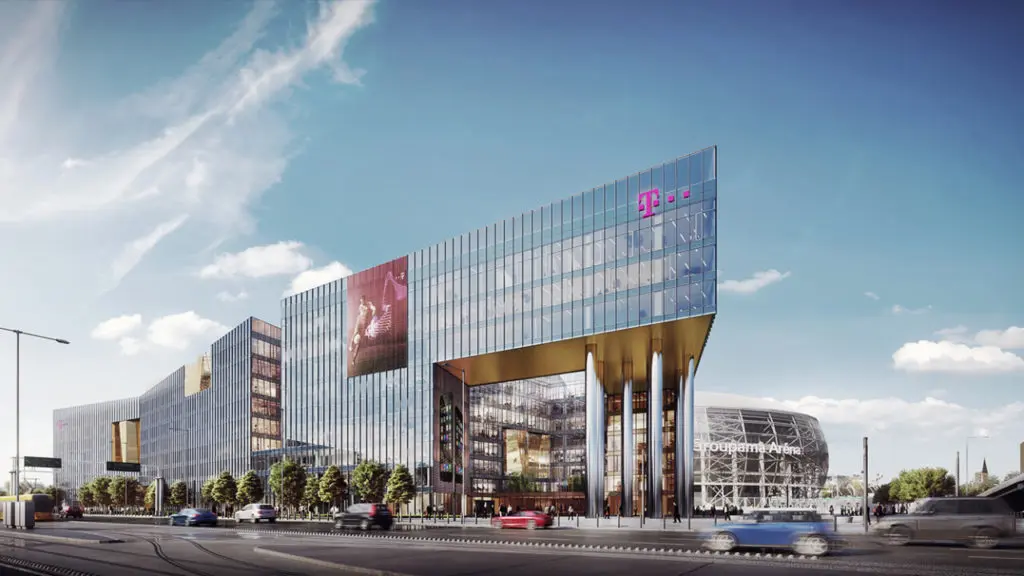
Magyar Telekom Plc. is the leading telecommunications service provider in Hungary, founded in 1991 as Matáv Magyar Távközlési Rt. Today, it is a member of the Deutsche Telekom Group, its shares are traded on the Budapest Stock Exchange under the ticker MTELEKOM, and it is considered one of the four largest blue chips of the BUX index. The company covers the entire telecommunications value chain: mobile and fixed telephony, broadband internet, television services and corporate IT solutions are all in its portfolio.
Magyar Telekom's business is built on three main pillars:
- ? Mobile services: The company is a stable market leader in Hungary with a ~48% mobile market share. Mobile data and voice services provided under the T-Mobile brand account for the majority of revenue.
- ? Wired and broadband internet: The development of a gigabit network is a strategic priority, and Telekom has committed to providing gigabit-capable access to 4.5 million households by 2027, the development of which is supported by the capital released from the abolition of special taxes.
- ? Corporate IT and T-Systems: serving large enterprise and public sector clients, cloud services and digital transformation. This segment generates stable high margins, as you can see in the case of other large American IT companies.
? In practice: Magyar Telekom Plc. is known by many different names by investors. MTelekom, Tcom, Telekom, Matáv, if you want to give the company a nickname that evokes the past. I think this is perhaps the best-known name in Hungary out of the four blue chips; in addition to Magyar Telekom, this group includes OTP, MOL and Gedeon Richter. Magyar Telekom's business model is one of the best understood on the BSE: stable, predictable revenues, oligopolistic market protection, strong parent company background.
? Magyar Telekom's situation and its competitors
The domestic telecommunications market is a three-player oligopoly segment in which competition is structurally limited. A new entrant cannot realistically appear due to infrastructural entry barriers and frequency regulation, and it is also very unlikely that even if it were to enter, it would be able to operate profitably due to the other three competitors. This is one of the biggest structural advantages for Magyar Telekom shares, and similar structures exist in other countries as well.
In the US, AT&T and Verizon are the dominant players, complemented by several smaller, regional telecom partners. These are companies that perform well in the long term, albeit relatively capital-intensive, and their profitability can be undermined by periodic large investment needs.
? The two major players besides Magyar Telekom:
- ? Yettel Hungary: The legal successor of the former Pannon/Telenor, it is currently owned by e& (Etisalat of Abu Dhabi) and the PPF group. The third largest player in the market with a mobile market share of ~25%, but is actively expanding: from 2026 it will also enter the broadband market via its 2Connect fixed-line network, which will mean direct competition with Telekom. Yettel's focus is on services provided via the mobile network, for example, OtthonNet is one of their most interesting, mobile-based solutions that compete with fixed-line mobile providers. Yettel is not a listed company.
- ? One Hungary (formerly Vodafone): is the most interesting political economy conglomerate in the Hungarian market. 4iG and Corvinus International Investment Co. (i.e. the Hungarian state) jointly purchased Vodafone Hungary in 2023. 4iG holds a 70,5% stake in One, while state-owned Corvinus holds approximately 29,5%. The state is therefore a direct owner of Telekom's competitor, which poses both a regulatory merger and a competition policy risk. One will bear its new name from January 2025, and ranks second with ~27% mobile market share.
? The dilemma of state involvement: Magyar Telekom is a company affected by the regulatory environment, while the government is also an owner of one of its competitors in the same regulatory system, which can create internal tensions. The 4iG-One group was also provided with state loans for infrastructure development, which cannot be considered as completely free market competition. As an owner of Magyar Telekom shares, it is worth monitoring whether these market-distorting effects do not adversely affect competitors.
However, since Magyar Telekom is owned by Deutsche Telekom, there is a bit of German interest being asserted through the company. This is an exciting question because the same is true for One Magyarország, owned by 4iG, which is a state bastion of Hungarian interests.
? Magyar Telekom's metrics
? Exchange rate and catalysts
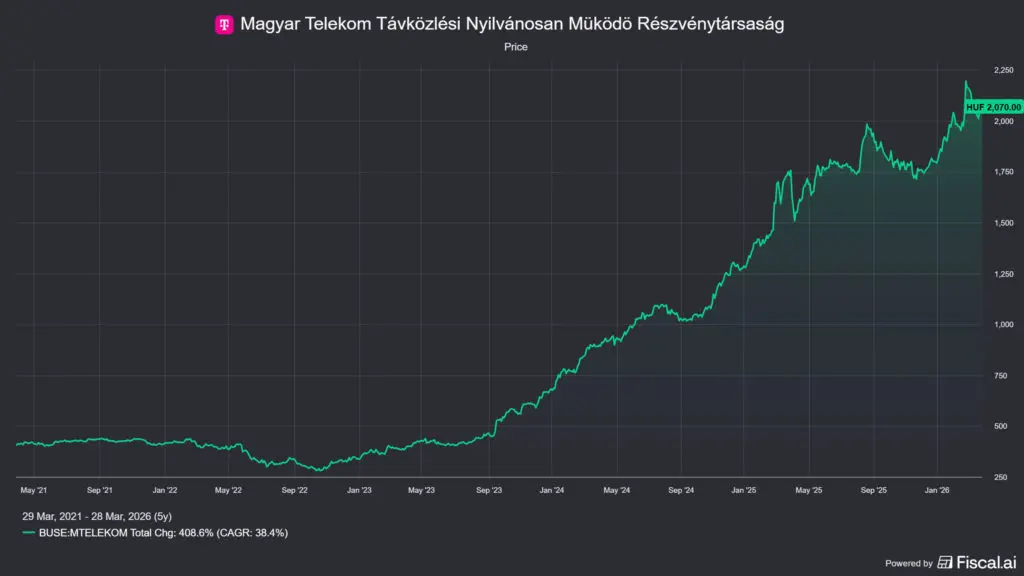
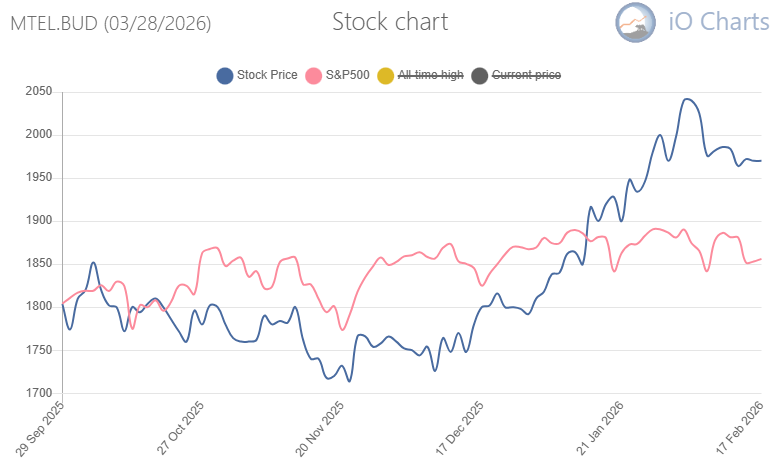
Magyar Telekom's share price has seen a spectacular, multi-step rally since October 2022: it rose from a low of 280 HUF to over 2000 HUF by the beginning of 2026, representing a more than seven-fold increase. The rally was driven by three structural catalysts: inflation-tracking tariff increases (~15% each in 2023 and 2024), the abolition of special taxes (utility tax in 2024, telecommunications surcharge in 2025) and record-high dividend announcements.
Regarding the latter, it should be noted that in September 2023, in the presence of Viktor Orbán and Timotheus Höttges, CEO of Deutsche Telekom, an agreement was signed between the Hungarian government and Magyar Telekom. The state undertook to abolish the telecommunications utility tax from January 1, 2024, and the telecommunications surcharge from January 1, 2025. In return, Magyar Telekom undertook to build a gigabit-capable wired network covering 1 million households from 2024 over 4 years. By the end of 2027, it will make gigabit infrastructure available to 4,5 million Hungarian homes and businesses and ensure 99% 5G coverage by 2026. So, in essence, the tax will be used for infrastructure developments.
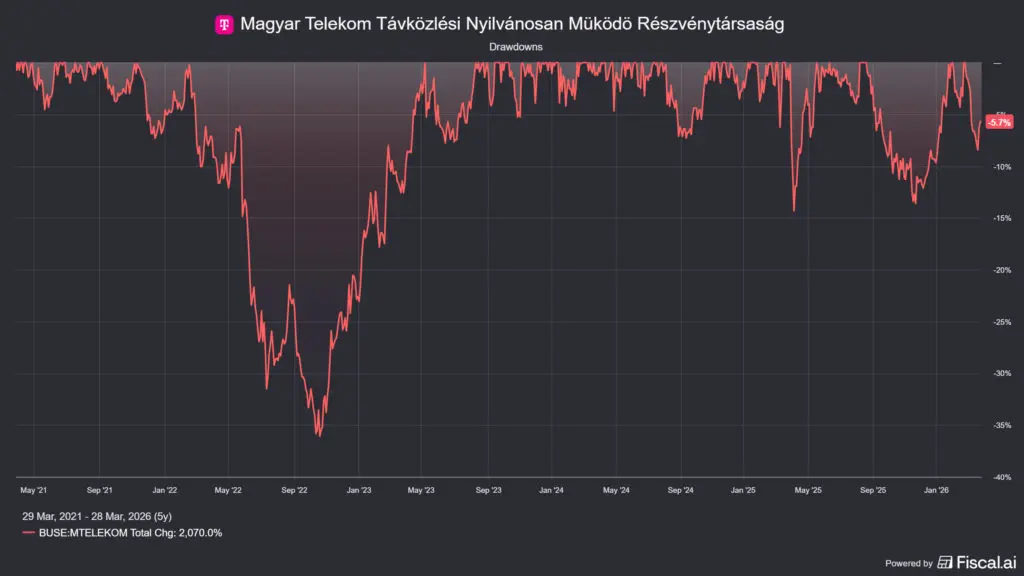
In the short term, Magyar Telekom's share price is mostly driven by dividend and buyback announcements, quarterly earnings reports, and regulatory news (price increase policy, frequency auctions). Along with OTP and Gedeon Richter, Magyar Telekom presents one of the healthiest fundamentals among BSE stocks. The three-year average revenue growth was 9.6%, revenue generates plenty of profit, while the price increases are supported by a decent amount of dividends.
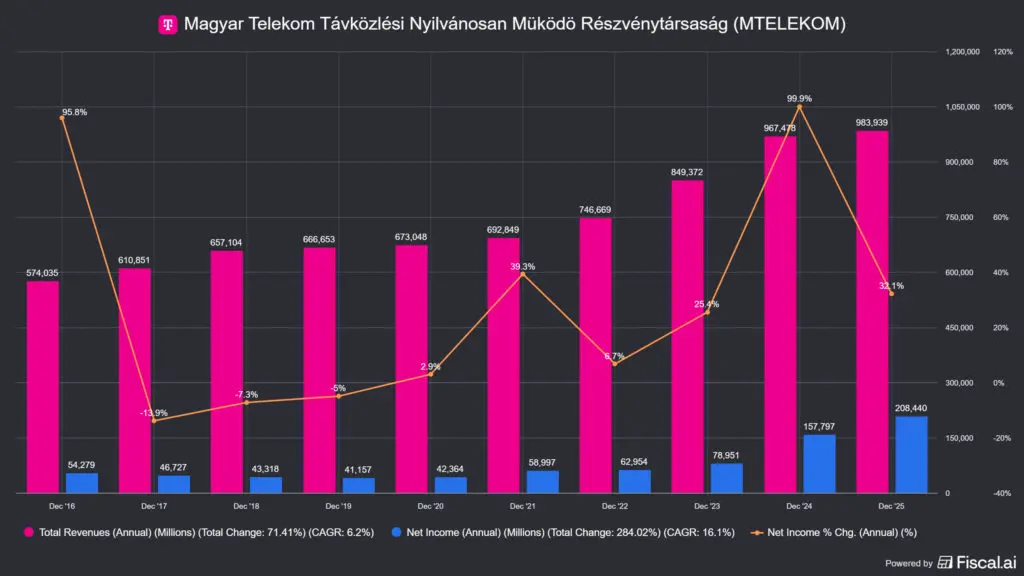
The only blemish on the almost spotless balance sheet is the significant debt, in addition to the cash balance of ~121 billion HUF, the company has a debt of ~369 billion HUF. Subtracting the two gives the net debt, which is ~248 billion HUF. This does not tell you much by itself, but if you add the equity, the debt/equity ratio is 0.4, which actually means moderate debt, especially for a company that holds a lot of physical assets on its balance sheet. In comparison, the American AT&T (NYSE:T) the same value is 1.2, while for Verizon (NYSE:VZ) 1.5, meaning that similar companies in the USA are much more indebted.
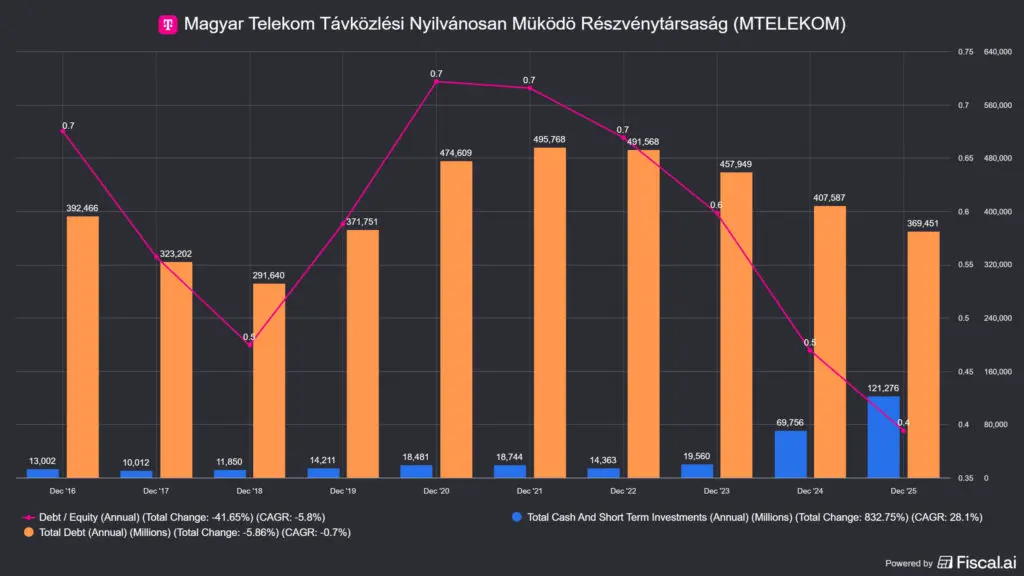
Since revenue reached HUF 983 billion in 2025, which generates a net profit of approximately HUF 208 billion, Magyar Telekom could actually pay off its entire debt in less than a year if it used its cash. This conservative debt level has a positive impact on Magyar Telekom's share price, as investors trust the company and its management.
? Rating
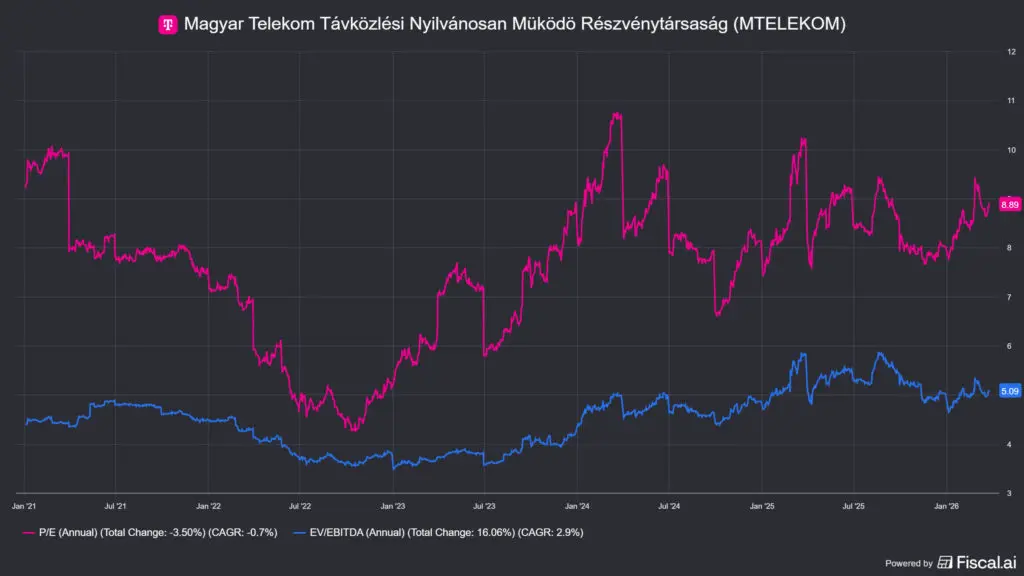
- ? P/E: 8.6
- ⏳ Historical, 3-year P/E: 8
- ⏳ Historical, 5-year P/E: 9.3
- ? EV/EBITDA: 4.9
- ⏳ Historical, 3-year EV/EBITDA: 4.4
- ⏳ Historical, 5 years old EV / EBITDA: 8.6
Based on the above, Magyar Telekom is slightly overvalued at the current exchange rate, close to its historical valuation. It is not too cheap, but not too expensive either.
Since Magyar Telekom is also a dividend-paying stock, in principle the stock could also be valued on a dividend basis. The new dividend policy (from 2025) allows for the distribution of 60-100% of the adjusted net profit, which is why Telekom has been increasing its dividend at a rapid pace. This means that in 2026 it will pay out a dividend of 154 HUF per share, which represents a dividend yield of 7.4% at the current exchange rate of 2070 forints. Based on the steep price increase that has lasted for 3 years and the dividend yield, quite rough returns could be expected, it is no coincidence that the stock is popular in Hungary, but this will probably not continue in the future.
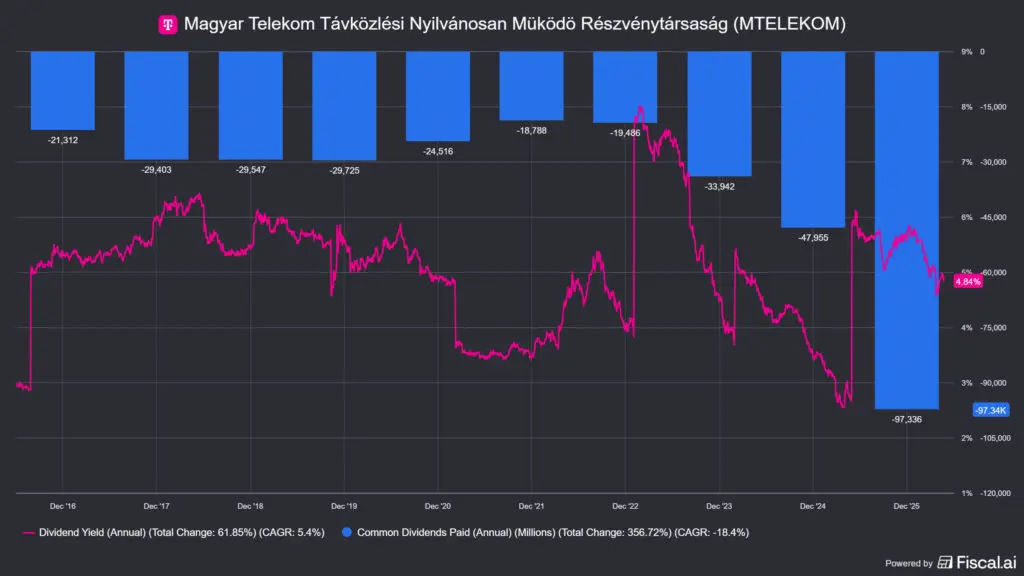
The dividend yield is offset by consistent share buybacks, which have been increasing for years, amounting to HUF 24 billion in 2023. However, these are more of a recurring share buyback than an opportunistic one, so the company does not really pay attention to the valuation at which the shares are reduced. However, it would probably be unnecessary to reinvest the money into the infrastructure because it would not be able to create added value with it, so they would simply pay it out. Moreover, another effect of share buybacks is that they indirectly improve most metrics because the same revenue, profit, or dividend is distributed across fewer shares.
?️ Ownership structure
Deutsche Telekom is the dominant shareholder, and its shareholding is gradually increasing as the buyback programs progress. This means stability, but also that Deutsche Telekom's strategic interests determine the dividend policy and capital allocation.
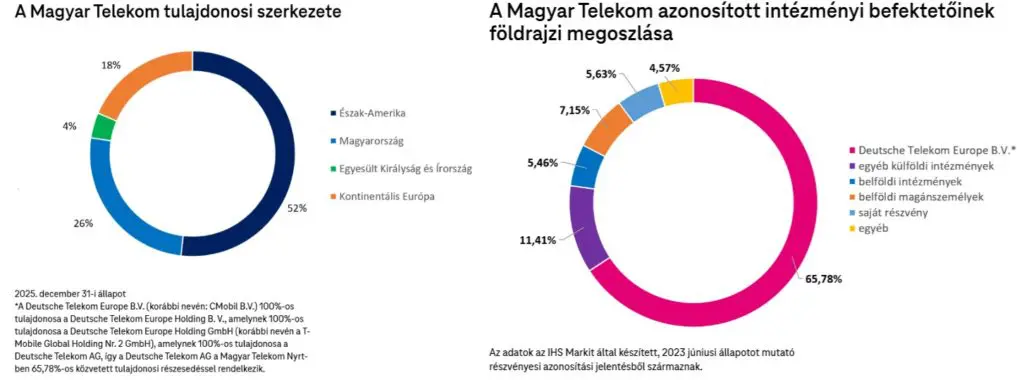
Deutsche Telekom is a controlling shareholder in Magyar Telekom, but not with a 100% ownership stake. Deutsche Telekom, through various holding structures (Deutsche Telekom Europe BV), directly and indirectly jointly with a share of around 66% holds in Magyar Telekom, and this proportion is gradually increasing as a result of continuous share buyback programs. The rest are float shares on the market, i.e. shares that can be freely traded. Also interesting is that Hungarian investors own 26% of Magyar Telekom, based on data at the end of 2025.
? Risk factors
- ? The exchange rate has already gone up a lot: Magyar Telekom shares have risen roughly sevenfold since their 2022 low. Some analysts are now recommending the stock as a hold, indicating that the easy money has run out and further appreciation is limited. However, analysts typically think in the short term; these effects are dwarfed over a 5-10 year horizon.
- ⚖️ Regulatory unpredictability: The cancellation of the 2025 tariff increase set a precedent. The three major providers backed down from the planned 3,5-3,7% inflation-tracking increase under government pressure. This would not have been an outrageously high fee compared to the 15-15% increases in 2023-24, but it indicates that the ability to raise prices requires political will. Read more here: Article by HWSW.
- ?️ State competitor asymmetry: The competition policy risk arising from the state ownership of One, which could mean preferential financing and accelerated regulatory approvals, is not fully priced into Magyar Telekom's share price. But as the election approaches, this situation may change in the future, which is an extra uncertainty factor.
- ? Infrastructure investment burden: The gigabit network development commitment requires an investment of HUF 123 billion between 2024-2027, which will significantly burden free cash flow and will only occur in the future.
- ? Yettel expansion in landline: If Yettel successfully enters the broadband market from 2026, it could affect one of Telekom's most stable segments and provide strong competition to Tcom.
?In practice: Magyar Telekom is one of the companies with the healthiest capital structure on the BSE. I think in this case, the state headwind of One is not nearly as strong, and moreover, its owner is one of the largest capital-intensive companies in Europe, so they can operate quite profitably in the Hungarian market. Moreover, they provide services for which the switching cost is relatively high: few people cancel their internet or mobile phone subscriptions, for example, and customers rarely change service providers.
? Magyar Telekom: will you get used to it or will you run away?
? Bulls say (Optimistic scenario):
- ? The abolition of special taxes is a permanent profit-increasing factor: The elimination of the utility tax in 2024 and the telecommunications surcharge in 2025 together means annual savings of more than 35 billion HUF, and as long as this situation does not change, it will be incorporated into the results of the following years, which will thus be higher.
- ? Dividend policy remained attractive: The possibility of paying out up to 100% of the adjusted net profit is unique in the domestic market. If the profit targets are met, the dividend yield of Magyar Telekom shares can regularly remain above the risk-free forint returns.
- ? Oligopoly market protection: A three-player market, high entry barriers, and inflation-tracking pricing capabilities ensure the durability of the business model.
? Bears say (Pessimistic scenario):
- ? The time for the easy rally has expired: The share price has already priced in the effects of the special tax abolition, tariff increases and the record dividend. From here, Magyar Telekom's share price can only go significantly higher if the fundamentals continue to improve, and this requires an increasingly difficult pace of growth.
- ?️ State regulation may be unpredictable in the future: The state stake in One and the political ties of 4iG pose a competitive environment risk that could put Telekom at a regulatory disadvantage in certain market situations.
- ⚠️ Rate increase ability is limited: The 2025 rebound from the tariff increase indicates that the government is monitoring price increases and may intervene, which could be one of the most important revenue limiting factors over which the company has little influence.
- ? Yettel entry into the fixed-line market from 2026: If implemented, it would represent direct competitive pressure in one of the stable segments.
? In practice: Magyar Telekom shares are one of the most predictable and transparent BSE investments, with a stable business, a strong parent company, and an attractive dividend policy. Anyone who bought it in 2023 made an excellent decision, which the Hungarian market rewarded with a ~74% CAGR annual price increase. Anyone who buys today should realistically focus on the dividend yield, not the price appreciation; the market has already completed most of the rally in recent years.
? Summary of Magyar Telekom's share situation
Magyar Telekom is a quality blue chip on the BSE, with a predictable business model, a strong parent company background, and an attractive and growing dividend policy. The rally between 2022 and early 2026 was driven by real fundamental improvement (abolition of special taxes, tariff increases, profit explosion), not just a sentiment element. The question is whether the share price can continue from here, or whether the dividend yield will be the engine of return potential in the coming years. Most analysts vote for the latter, essentially the market has already priced everything in at the high exchange rate.
If you want to analyze further, use iO Charts' stock finder and portfolio manager, which you can access here: iO Charts.
❓FAQ: professional questions about Magyar Telekom
Why has Magyar Telekom's share price increased so much since 2022?
The rally is explained by the simultaneous emergence of three structural reasons. First, inflation-tracking tariff increases: in 2023 and 2024, a ~15% tariff adjustment each increased revenues and margins. Second, the abolition of special taxes: the utility tax was abolished in 2024, and the telecommunications surcharge in 2025, bringing together more than 35 billion HUF in annual savings. Third, the resulting record dividend announcements, which pushed investors' dividend expectations upwards. The three factors came into play simultaneously, leading to a nearly sevenfold increase in the share price.
What is One Hungary and why is it relevant to Magyar Telekom shares?
One Hungary (formerly Vodafone Hungary) was acquired by 4iG and Corvinus International Investment Co. (the Hungarian state) in early 2023, with 4iG holding 70,5% and the state holding ~29,5%. The state is therefore a direct owner of one of Telekom's main competitors. This is relevant because if One receives infrastructure development incentives, faster regulatory approvals or other advantages through state ownership, it could put Magyar Telekom at a competitive disadvantage, a risk factor that is difficult to price but real.
How much dividend can Magyar Telekom share holders expect?
After the 2025 results, the board of directors proposed a dividend of HUF 154 per share, which may be accompanied by a share buyback program worth up to HUF 50 billion. According to the new dividend policy (valid from 2025), 60-100% of the adjusted net profit can be distributed, so there is still room to increase the dividend payout ratio, if the company is willing to do so.
How does the competitive situation of Yettel and One differ compared to Telekom?
Yettel (~25% market share) is a private company owned by e& and PPF groups, which will enter the fixed broadband market from 2026, providing direct competition to Telekom in one of its stable segments. One (~27% mobile market share) is owned by state-owned Corvinus and 4iG, which are politically exposed but have a favorable position in terms of infrastructure financing. Both competitors are actively expanding, but Telekom's market leadership position of ~48% looks solid in the short to medium term.
When is it worth buying Magyar Telekom shares?
This is the most difficult question to answer, and the article cannot decide for you. Most arguments point towards a rising dividend yield: for those looking for a stable, 7-10% HUF dividend yield from an investment-grade company, Magyar Telekom shares may still be attractive today. However, the average revenue growth of around 10%, which has been the case for the past 3 years, is not very likely in the future.
Legal and liability statement (aka. disclaimer): My articles contain personal opinions, I write them solely for my own entertainment and that of my readers. The articles published here do NOT in any way exhaust the scope of investment advice. I have never intended, do not intend, and am unlikely to provide such in the future. What is written here is for informational purposes only and should NOT be construed as an offer. The expression of opinion is NOT in any way considered a guarantee to sell or buy financial instruments. You are SOLELY responsible for the decisions you make, and no one else, including me, assumes the risk.