

🤔 What is the Market Momentum column about? 🤔
Intel stock was dying in 2024, almost everyone had buried it based on its valuation, then something changed. The price jumped from $18 to $119, with a market capitalization of over $600 billion. But do the fundamentals justify this or has the market priced everything into a turnaround story based on hope?
I don't know if you're aware of this, but it can take 40-50 hours to do a thorough fundamental analysis. It's impossible to put that much energy into every single company. That's why I created the Market Impulse column: quick, to-the-point mini-analyses that help you pre-screen. It's not an in-depth analysis, but rather a thought-provoking one. My goal is not to give daily trading tips or analyze technical patterns, but to outline the current fundamental state.
You can find the share subpage with detailed information here: Intel (INTC) stock page
If you are looking for in-depth analyses of the site, click on the link below: iO Charts stock analyses
📒 Table of Contents 📒
I have created a table of contents to make it easier for you to navigate the content:
- ❓ What is Intel doing?
- 🏆 Intel's current situation and competitors
- 🎢 Intel stock metrics
- ✅ Intel stock: will you get used to it or will you run away?
- 📝 Thesis summary
- ❓ Frequently Asked Questions
❓ What is Intel (INTC) doing? ❓
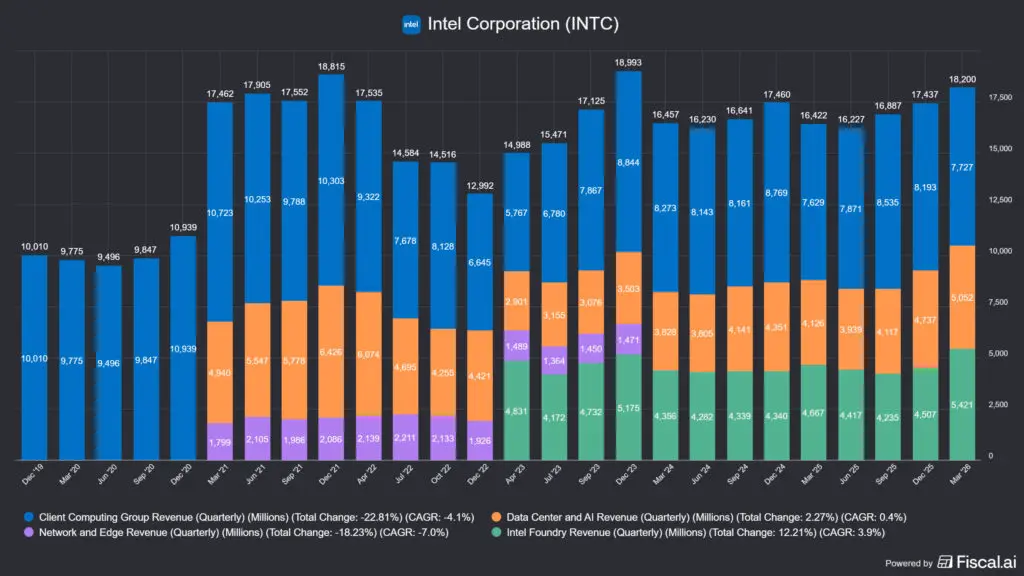
Since its founding in 1968, Intel Corporation has been a dominant player in global chip manufacturing. As the creator of the x86 processor architecture, it dominated the PC and server market for decades from a near-monopoly position. Today, the business rests on four main pillars:
- The first and largest is the Client Computing Group (CCG): it consolidates the set of Core and Core Ultra processors used in laptops and desktops, this accounts for almost half of the total revenue.
- The second is Data Center and AI (DCAI): server and AI chips, where Intel competes with AMD's EPYC series and NVIDIA's GPUs.
- The third is Intel Foundry: the heart of the IDM 2.0 strategy, where Intel opens its own factories to external customers in order to compete with TSMC.
- The fourth is the Network and Edge (NEX) and Mobileye self-driving chip business, which is currently negligible compared to the other pillars and Intel no longer officially reports this with a separate indicator.
The basic thing to know about chip manufacturing is that public discourse confuses three categories:
- (I.e.IDM (Integrated Device Manufacturer): who design AND manufacture, e.g. Intel, Samsung, Texas Instruments, etc.;
- 🗺️Fabless: those who only design, e.g. NVIDIA, AMD, Apple, Qualcomm, MediaTek, Broadcom, Marvell, ARM, they outsource the manufacturing;
- 🧇Foundry: only contract manufacturers, e.g. TSMC, GlobalFoundries, i.e. they do not have their own products;
So these companies should not be treated as a single set.
📌 In practice: Intel is the only major chip manufacturer that designs and manufactures at the same time (IDM – Integrated Device Manufacturer). AMD and NVIDIA design chips, but TSMC manufactures them using ASML machines. This represents both a strategic advantage and an extraordinary capital requirement, the latter being one of the main reasons for the weakness of recent years. At first, only AMD ate Intel's bread and butter, primarily in the CCG segment, but later TSMC gained a huge technological advantage. Since relatively few companies in the world manufacture logic chips, processors, and NPUs, after the Top 3 manufacturers – TSMC, Samsung, Intel – only Far Eastern, second-tier manufacturers – e.g. SMIC, GlobalFoundries, UMC, etc. – remain, so being at the forefront of chip manufacturing is both political and economic power.
🏆 Intel's current situation and competitors 🏆
Intel produced one of the most spectacular stock market comebacks in the technology sector in 2025. Lip-Bu Tan's appointment in March 2025 marked a turning point: the former CEO of Cadence Design Systems, a chip design software company, took immediate, visible steps: layoffs, portfolio cleanup (selling Altera stake to Silver Lake), and restoring the engineering-first culture.
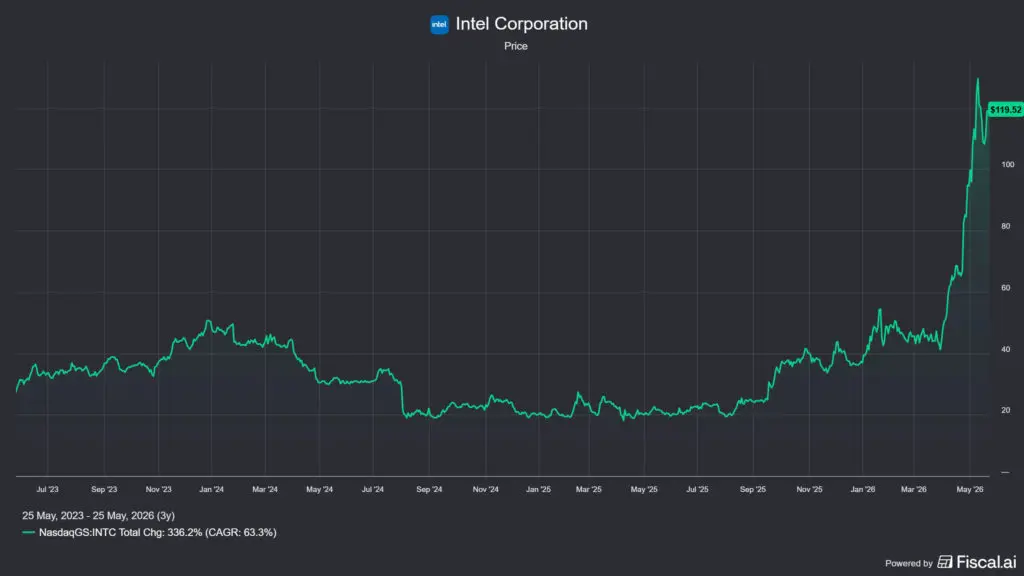
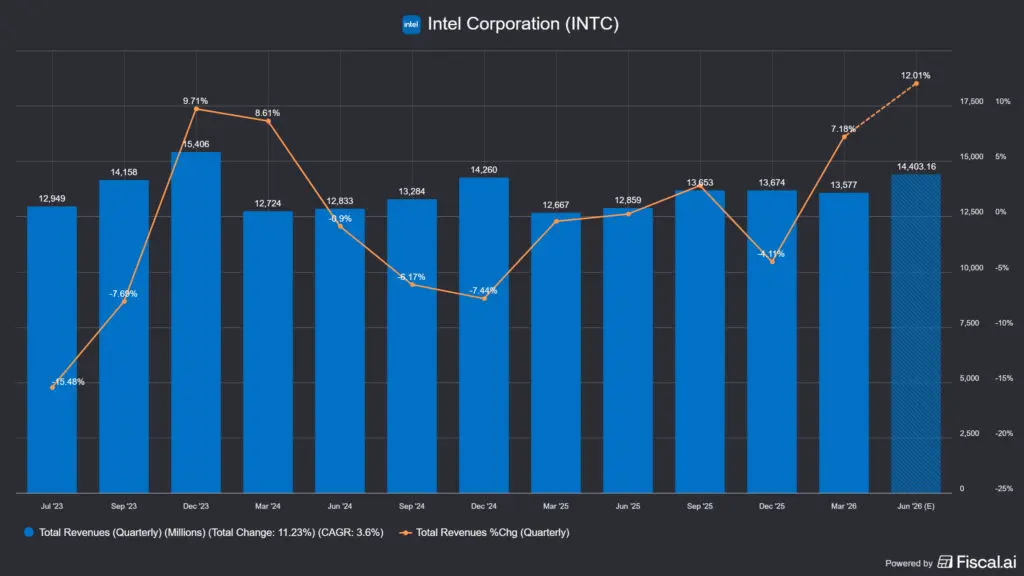
The first quarter 2026 results (13.6 billion USD revenue, +7% year-on-year growth) and the inverted FCF curve show that stabilization has begun, but the road is far from over. However, the situation of competitors is mixed:
- 💻AMD: continues to dominate the x86 server market and take Intel's share, EPYC consistently outperforms Intel Xeon 6 in Turin benchmarks.
- 🌐NVIDIA: has a near monopoly with 80-90% market share of data center AI chips; Intel's Gaudi accelerator is technically competent, but the ecosystem disadvantage is structural.
- ⚙️TSMC: with the 2 nm stripe width technology, Intel 18A – 18 angstroms, or 1,8 nanometers – has found a serious competitor; the market is currently skeptical whether Intel's foundry will be able to convince external customers to choose their product.
The American government background is, however, unique: Intel receives a total of $11.1 billion in federal funding for factories in Arizona and Ohio under the CHIPS Act, and the US government has also acquired a stake in Intel (INTC). This geopolitical “tailwind” minimizes the risk of bankruptcy, which investors do not see with either AMD or NVIDIA.
📌 In practice: Intel's current situation is a turnaround story, where the change has begun, but the hard work, acquiring Intel 18A customers, restoring profitable free cash flow, is still ahead of them. So, it is mostly faith and the US government's guarantee that investors can trust, not mere numbers, as you can see below.

🎢 Intel Stock Metrics 🎢
| Indicator | Intel (INTC) – LTM / current |
|---|---|
| Share price | 119.52 USD |
| Market capitalization | 602 billion USD |
| EnterpriseValue | 628 billion USD |
| Annual revenue (LTM) | 53.76 billion USD |
| Gross margin | 35.4 % |
| Operating margin (GAAP) | – 9.4% |
| Net Margin (GAAP) | – 6.3% |
| Adjusted EPS (2025) | 0.42 USD |
| Adjusted EPS (2026E) | 1.09 USD |
| Adjusted EPS (2027E) | 1.54 USD |
| P/E (TTM, GAAP) | –193x (loss) |
| Forward P/E (NTM) | ~113x |
| Forward P/E (2027E) | ~77.8x |
| P/B | 5.4x |
| EV/EBITDA (LTM) | 88x |
| Free cash flow (LTM) | –3.1 billion USD |
| Adjusted FCF (2027E) | 2.4 billion USD (first positive year) |
| CapEx (2025) | 14.6 billion USD |
| Net debt | 11.93 billion USD |
| Cash | 32.79 billion USD |
| ROIC (5-year average) | 0.7 % |
| Dividend yield | 0% |
What is clear from the table above: the GAAP valuation is completely meaningless (loss-making company, negative EPS), the future-pricing metrics are not cheap either (77–113x P/E), and free cash flow is not expected to turn positive until 2027, according to analyst consensus. This is a stock that the market is pricing based on the future, which is more like a punch in the gut.
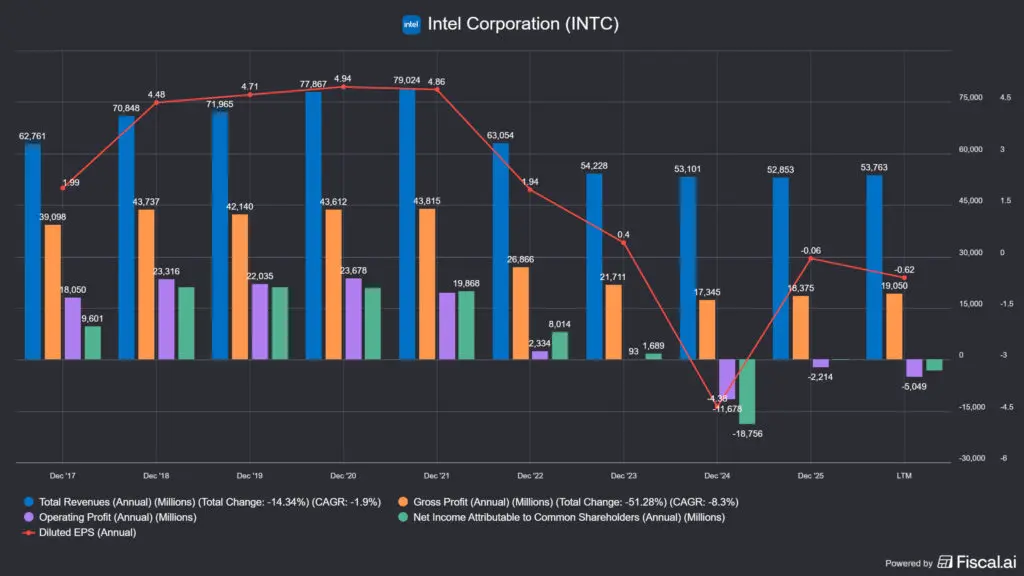
However, Americans are filled with national sentiment to revive domestic chip production, and since China is constantly threatening Taiwan, there is also a geopolitical reason for this: if China invades the island, the world's chip production will simply stop. However, there is no numerical sign of Intel's resurrection yet, the company is only swallowing money, but two-thirds of the price is made up of faith in expectations.
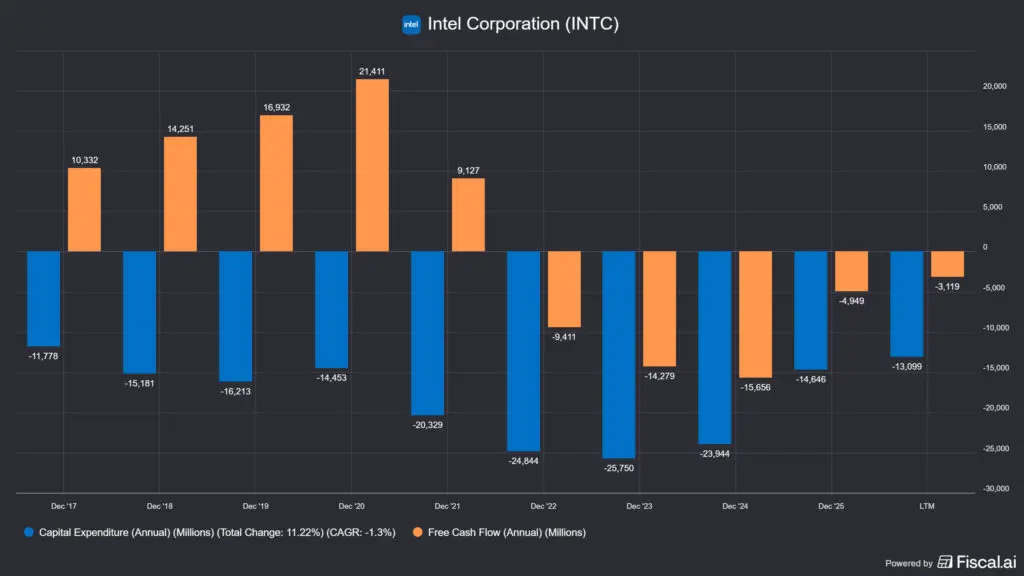
📌 In practice: the top owners are BlackRock (8.9%), Vanguard (8.2%), State Street (4.3%) and Capital Research (3.3%), so institutional investors have backed Intel, but we do not see much insider buying. The government presence is realized through the CHIPS Act agreement, but this is not share ownership in the traditional sense, but a warrant agreement: the US government (the Commerce Department / CHIPS Program Office) is given the right to buy shares at a predetermined price if certain conditions are met. CEO Lip-Bu Tan himself holds ~468 thousand shares, which is more symbolic than a huge commitment.
🔥 The big question: is Intel stock worth it at $119? 🔥
This question is fundamentally different from a year ago. Intel's share price has tripled, with a market capitalization of 602 billion. So anyone buying now is not buying a deeply undervalued turnaround story, but is paying upfront for a successful narrative, partly backed by a "state guarantee."
- 🏭 Intel 18A: the process on which everything depends: Intel 18A combines RibbonFET transistor technology and PowerVia backplane power supply, and according to the company is competitive with TSMC's 2-nanometer technology. The first product, the Panther Lake processor, entered mass production at the end of 2025. The key question in the investor thesis is whether Intel 18A will attract external customers, for now Microsoft and a few smaller partners are experimenting, but no big-name customers (Apple, Qualcomm, NVIDIA) are on the list.
- 🤖 AI chips: good product, bad ecosystem: Intel's Gaudi 3 AI accelerator is competitive in performance/price with NVIDIA's H100. The problem is the use of CUDA, which locks consumers into NVIDIA's ecosystem, which is so deeply embedded in AI developers' workflows that a better chip alone is not enough to make a breakthrough. Intel's open OneAPI strategy requires years of investment and even then, it may not lead to results.
- 💻 PC market: stable revenue bastion, but not a driving force: the Core Ultra series and NPU-enabled Copilot+ PC compatibility provide an important position in the Microsoft ecosystem. This provides a stable foundation, but is not a source of rapid growth, the server market is the more important market segment for the company.
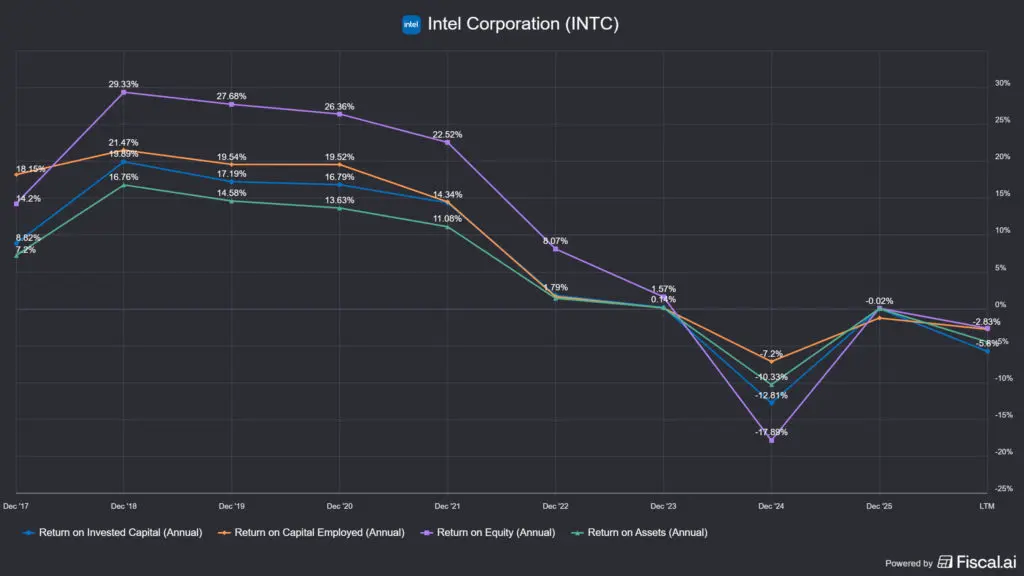
📌 In practice: back in high school, about 30 years ago, we had big fights with each other in the Intel vs. AMD debate, but about 10 years ago AMD was so strong in the PC market that I think this competition is over. They gave better performance for less money and this is more or less the case to this day, while Intel is constantly chasing the leader TSMC in manufacturing. The 119 USD share price and the 602 billion USD market capitalization price a perfectly executed turnaround, when Intel completely dominates the market and destroys its competitors. If Intel's 18A foundry business does not attract serious external customers, and free cash flow does not turn positive by 2027, the current valuation is difficult to defend and I think Intel's share price will return to where it started 1.5 years ago, but in the meantime: the value destruction will remain, as you can see in the picture above.

✅ Intel stock: will you get used to it or will you run away? ✅
Most people buy Intel stock based on the phenomenon of “wishful thinking”: they believe in advance that everything will be fine here, but most of all they don’t want to miss out on the next big story. We call this phenomenon FOMO, but let’s see what is said for and against the company!
What is next to it 🟢
- 🏛️ A geopolitical tailwind that no one else gets. $11.1 billion in CHIPS Act funding, construction of factories in Arizona and Ohio, government acquisitions, the US treats Intel as a strategic partner. This de facto reduces the risk of bankruptcy.
- (I.e. The IDM model can create a unique competitive advantage. If Intel 18A is truly competitive, it will give the company a position that no one else in the Western world can replicate: running its own product on the best technology and offering it as a contract manufacturing option.
- 📈 The numbers will be better. The analyst consensus expects revenue growth of 11% by 2026 (58.6 billion USD), the adjusted EBITDA margin is expected to increase to 33% by 2027, and free cash flow could turn into +2,4 billion USD in 2027 (which is bad in itself, I have to emphasize: this is a positive number, not a negative one).
- 🇧🇷 Lip-Bu Tan has delivered so far. He backed up his words with actions: layoffs, portfolio cleaning, restoring engineering culture, and the first quarters justify the narrative.
What is worrying 🔴
- ???? The current price is pricing perfection. With a market cap of $602 billion, a forward P/E of 77-113x, and a negative FCF, this is pricing in a perfectly executed turnaround. Any slippage or lag could push the price even lower.
- (I.e. The foundry business is a money sink for now. Intel Foundry also generated billions in operating losses quarter after quarter in 2025. There are no serious external customers (Apple, Qualcomm, NVIDIA). Even in an optimistic scenario, the profitability date is 2027–2028.
- ⚔️ The competitive advantage between AMD and NVIDIA has deepened. AMD EPYC Turin outperforms Intel Xeon 6 in many tests. The insurmountable network impact of NVIDIA's CUDA ecosystem in the AI market is a structural barrier that Intel Gaudi cannot easily overcome.
- (I.e. TSMC is constantly advancing in the field of chip manufacturing. TSMC's 2nm process technology is starting earlier than Intel expected, and TSMC's manufacturing quality is also higher. If Intel's 18A profitability is low, it will call into question the whole foundry thesis.
📌 In practice: Intel is not the “everyone is mourning” stock it was in the early 2020s, but a $600 billion narrative that the market seems to have bought into. Anyone who takes a position in the stock now is betting on profitability in 2027-2028. That is possible, but far from certain, and there is little room for error in the price. In the words of Warren Buffett: "Turnarounds rarely turn," meaning that a turnaround occurs more rarely than not.
📝 Intel thesis summary 📝
Intel stock was one of the biggest stock market surprises of the past year. The jump from USD 18 to USD 119 shows that the market believed Lip-Bu Tan's narrative: Intel is back, chip production is restarting, the geopolitical tailwind is real. The question is whether the fundamentals can catch up with the $602 billion market cap. To do so, Intel 18A needs to get serious external customers, the foundry business needs to approach breakeven by 2027, and the EPS curve needs to truly skyrocket.
☝️For me, this is quite the category of waiting for a miracle, and even if it happens, investors will still buy the already priced potential, so they will be at roughly zero.
If this is achieved, long-term investors can still do well. If the plans are delayed, the current pricing could fall significantly. In other words: the risk is asymmetric, and unfortunately not in the right direction, I think most of the rise is already over for the paper.
If you want to analyze further, use iO Charts' stock finder and portfolio manager, which you can access here: iO Charts.
❓Frequently Asked Questions: Intel Stock❓
Why did Intel's stock price rise so much in 2024-2025?
Intel's share price rose from $18 to $119 by the end of 2024, driven by multiple, mutually reinforcing catalysts. Lip-Bu Tan's appointment brought rapid and visible action: layoffs, portfolio cleanup, and the sale of the Altera stake. Added to this was the $11,1 billion CHIPS Act, which gave geopolitical legitimacy to Intel's turnaround narrative. The market essentially priced in the successful turnaround that fundamentals must now deliver.
Is it worth buying Intel stock now that it has risen so much?
At $119 and a market cap of $602 billion, Intel is pricing in a perfectly executed turnaround. Forward P/E is in the 77-113x range, and free cash flow is still negative. This is not a “cheap value investment” category, but rather a narrative-based bet that Intel’s 18A foundry business will become profitable by 2027 and attract serious external customers. If you believe this, it may have a place in your portfolio; if you don’t, the price will seem high.
How does Intel compare to AMD in terms of chip production and investment?
The difference between Intel and AMD today is structural: AMD operates in a foundry-less model (TSMC manufactures its chips), so it has lower capital expenditure, higher FCF and a more flexible operating model. AMD stock has a simpler story: design good chips → TSMC manufactures them → profit. Intel, on the other hand, bets on its own factories, which means higher risk and capital requirements, in exchange for a unique geopolitical position. The two represent different risk profiles in the same industry.
What is Intel 18A and why is it a key issue for Intel stock?
Intel 18A is Intel's most advanced chip manufacturing node, combining RibbonFET transistor technology and PowerVia backplane power, and Intel says it is competitive with TSMC's 2nm technology. It is the cornerstone of Intel's stock thesis because if Intel 18A can be reliably produced in high volume, it will put the company back at the forefront of global chip manufacturing and make the foundry business attractive to outside customers. If it slips or the returns remain low, the entire investment narrative is questionable.
What impact does the CHIPS Act have on Intel stock?
Under the CHIPS and Science Act, Intel will receive $11,1 billion in federal funding—out of a $280 billion budget—to expand its chip manufacturing capacity in Arizona and Ohio, and the U.S. government will also take a stake in the company. In the short term, this will reduce Intel’s capital financing burden and lend credibility to its foundry strategy. The government presence also minimizes the risk of bankruptcy, providing a safety net for Intel stock that neither AMD nor NVIDIA enjoy.
Legal and liability statement (aka. disclaimer): My articles contain personal opinions, I write them solely for my own entertainment and that of my readers. The articles published here do NOT in any way exhaust the scope of investment advice. I have never intended, do not intend, and am unlikely to provide such in the future. What is written here is for informational purposes only and should NOT be construed as an offer. The expression of opinion is NOT in any way considered a guarantee to sell or buy financial instruments. You are SOLELY responsible for the decisions you make, and no one else, including me, assumes the risk.