

Introducing the Revolut broker
The current Revolut in-depth analysis now includes company data published on 2026-03-24.
Revolut was founded in London in 2015 by two founders, British-Russian Nikolay Storonsky and Ukrainian Vlad Yatsenko. Storonsky, who previously worked at Lehman Brothers and Credit Suisse, experienced one of the key problems firsthand: Traditional banks charge incredibly expensive currency exchange and transfer fees. This frustration led to the birth of the first Revolut product, a pre-loaded debit card that used mid-market exchange rates for currency conversions. Today, more than a decade later, Revolut is one of the most well-known and feature-rich fintech companies in Europe and across multiple regions of the world.
The company currently has approximately 68 million registered users, and annual revenue exceeds $6 billion. Revolut first became profitable in 2021 and has been consistently profitable since then, but aggressive growth and global expansion previously led to years of loss-making operations. For comparison: Wise has been profitable since 2017 and is listed on the stock exchange, so they are not competing on the same level in terms of financial transparency. Revolut remains a private company, while in 2026 the company was valued at $75 billion, making Revolut one of the most valuable European fintech companies.
What makes Revolut truly special compared to its competitors: It offers bank account services, currency exchange, stock market investments, crypto, insurance and many other functions all in one application. It's a Swiss Army knife: it knows something about everything, but it's not the best at everything. I'll examine this dual role separately in the analysis, as I've gained a lot of experience over the past 8 years that I've been their client.
🧠IF YOU WOULD LIKE TO TRY REVOLUT'S SERVICES, CLICK ON THE LINK BELOW: AVAILABLE HERE.
TL;DR Summary – the most important information in 3 minutes Don't want to read the entire analysis? Click here for a short summary.
- What is this company?Revolut is a British-Lithuanian fintech company founded in 2015, which obtained its EU (Lithuanian) and UK banking licenses in 2024. It currently serves ~68 million customers, is a private company, and its 2021 valuation was $45 billion, which has now increased to $75 billion.
- Financial service providerIt is excellent for everyday bank account needs, travel and currency exchange. In the standard package, currency exchange is free on weekdays up to 350000 HUF/month, HUF transfers are free domestically, and it does not currently pass on Hungarian transaction taxes - unlike Wise.
- brokerStocks, ETFs and 200+ crypto assets (excluding Hungarian clients) are available from a single app. Spread-based pricing and 1 free transaction in the Standard package. No TBSZ, no options, few instruments, Lightyear and IBKR are stronger alternatives as brokers.
- AwardsStandard package: free. Currency exchange on weekdays above the limit: 1%. Weekend surcharge: ~1%. Cash withdrawal above the limit: 2%. Non-SEPA transfer: 150–2000 HUF. Broker: spread + fee for each transaction.
- Security100,000 EUR deposit insurance (Lithuanian VDI, EU), 22,000 EUR investor protection for securities. 85,000 GBP FSCS protection in the UK. This is a higher level of protection than that provided by non-bank fintechs (Wise, Lightyear).
- RisksPrivate company, not publicly audited. Spread-based brokerage model, sometimes opaque fees. No TBSZ. Lithuanian IBAN on HUF account, but Hungarian IBAN number is coming. Customer service has mixed reviews. Only made a profit since 2021.
- Who is it recommended for?Excellent for everyday finances, travel, travel insurance. For Hungarian investors, Lightyear (TBSZ, free ETF) and IBKR (professional tools) are better choices as brokers. The ideal combination: Revolut + Wise + Lightyear + Interactive Brokers.
📒Table of Contents📒
I have created a table of contents to make it easier for you to navigate the longer articles:
- 💰Revolut plans and fees
- (I.e.Revolut interfaces
- 💵Extra features of Revolut accounts
- 🤵What strategy is best for Revolut
- 🆚Competitors: Revolut's opponents
- ✅Revolut benefits
- ❌Disadvantages of Revolut
- 📝Revolut Summary
🙋♂️Revolut Basics🙋♂️
❗The information below reflects the status as of March 2026. Revolut has an extremely rapidly changing product portfolio, so it is worth checking the specific fees and conditions directly in the Revolut app or on their official website before making any financial decisions.❗
Revolut has now become an institution boasting a real banking license. This means that it has a license under which it can also provide customers with credit services, such as personal loans, mortgages and overdrafts and so on. Of course, as a bank, they also have to comply with much stricter capital requirements, transparency and other rules. These fundamentally differentiate Revolut from providers such as Wise or Lightyear. In the EU, Revolut Bank UAB in Lithuania has a banking license, and in the UK they managed to obtain a British banking license in 2024. This means a higher level of regulation on the one hand, and it also includes real deposit insurance on the other.
Revolut is not only a bank and financial services provider, but also a broker. In the ranking of online discount brokers based on assets under management, Revolut occupied the following position in 2025:
- 💼 Interactive Brokers: ~757 billion USD
- 📈 robinhood: ~255 billion USD
- 💰 Trading 212: ~30–35 billion USD
- 🌍 eTorus: ~17,5 billion USD
- (I.e. Revolution: ~8,5 billion USD (brokerage services)
- 📊 XTB: ~7 billion USD
- 🚀 Lightyear: ~1 billion USD
I moved the data from here: Interactive Brokers analysis.

As a financial services provider, Revolut's total customer assets (including deposits and savings) could be much higher, but this is not disclosed. The number of customers is growing by about 1 million every 17 days, and the company has set a target of 100 million customers by mid-2027, up from the current ~68 million.
🛡️ Investor protection and regulation
Revolut bank has a deposit insurance policy, which protects customers' money. It is worth knowing that financial service providers such as Wise also provide some kind of deposit insurance through intermediary banks, since account management institutions are also banks, so there should be deposit insurance there too. So there is no need to overthink it, the point is that cash is also insured in the case of Revolut (how much money is in the fund, from which losses can be covered in the event of a problem, is another question).
Protection for bank deposits:
- 🇱🇹 EU customers (Revolut Bank UAB, Lithuania): the State Deposit Insurance Fund of Lithuania (VDI) 100 000 EURIt protects customers' money for up to 10 years in the event that Revolut Bank becomes insolvent. This is exactly the same protection as you would get at a traditional Hungarian bank through the OBA, which is the same in every EU member state.
- 🇬🇧 UK customers: the British Financial Services Compensation Scheme (FSCS) 85 000 GBPprovides compensation up to (non-EU member state).
Protection for investments (securities):
- 🇱🇹 Securities of EU clients are subject to the Lithuanian investor protection system 22 000 EUR It provides protection up to a limit in the event of a broker's insolvency. This is lower than Lightyear's $500000 SIPC protection for US securities, but is in line with the EU's basic level of regulation.
- Shares and ETFs are registered in Revolut's street name, and custody is handled by third parties.
The above really makes sense when you understand why it's good that Revolut manages your money itself. With every service provider where the financial institution outsources money management to a bank, the risk of another institution is added to the chain, meaning Revolut runs one less layer of risk. What this means in practice is that if you check your account details in the Revolut app, you will see that they all belong to Revolut bank:
- 💶EUR: Revolut Bank UAB (Konstitucijos ave. 21B, 08130, Vilnius, Lithuania) – Lithuania
- 🇭🇺HUF: Revolut Bank UAB (Konstitucijos ave. 21B, 08130, Vilnius, Lithuania) – Lithuania
- 💵USD: Revolut Bank UAB (Konstitucijos ave. 21B, 08130, Vilnius, Lithuania) – Lithuania
- ???????? CHF: Revolut Bank UAB (Konstitucijos ave. 21B, 08130, Vilnius, Lithuania) – Lithuania
- 🇨🇦 CAD: Revolut Bank UAB (Konstitucijos ave. 21B, 08130, Vilnius, Lithuania) – Lithuania
- (I.e.GBP: Revolut Bank Ltd., 30 South Colonnade, E14 5HX, London, United Kingdom – UK
❗Important: Investor protection schemes only protect against bad faith or insolvency of the broker or bank. Any market exchange rate losses you suffer are not covered by any insurance.❗
📌In practice: My personal opinion is that the people I've spoken to are much more concerned about having an account and investor protection than they should be. The greatest protection is provided if the service provider has a clean background, transparent data, and is profitable. Deposit insurance is just a legal obligation, it doesn't mean that they would be able to compensate customers in an actual situation. For this reason, I wouldn't keep a lot of cash with Revolut, while I would go through the statements related to the securities every month so that I have something in my hand that proves that you bought it. Nevertheless, I think there is no need to overthink this topic, but it is always worth diversifying among service providers.

💰 Revolut subscription plans and fees 💰
To understand Revolut's fee structure, you first need to understand the system of subscription plans, because there are five of them. Since I have only used the Standard, or free, plan so far, I only have real experience with it, but of course the fees for the other 4 plans are also available on Revolut's website, but the provider is quite inconsistent in displaying the data. You can find the detailed fees for the different plans here:
You can find all packages, including the Joint Account, Revolut X, at the link below: all packagesThere is also a comparison page where you can see everything at once, but the data here is fake: package finder.
📦 Subscription packages (prices as of March 2026)
| Package | Monthly fee (EUR) | Main features |
|---|---|---|
| Standard | free | Basic features, monthly currency exchange limit, one free order |
| Plus | ~ 3,99 | Higher limits, priority customer service |
| Premium | ~ 9,99 | Higher limits, travel insurance, lounge access |
| Metal | ~ 15,99 | Highest limits, cashback, metal card, premium insurance |
| Ultra | ~ 45 | Unlimited currency exchange, exclusive card, highest cashback |
💡 The exact current prices and package contents may change, so always check the website at this link: packages.
💸 Standard package fees – what Revolut customers don't pay for
The Standard package is free and includes the following as of March 2026:
- ✅ account opening and management: free,
- ✅ mobile app notifications for all payments and transfers: free,
- ✅ HUF transfer within Hungary: free,
- ✅ SEPA transfer within the eurozone: free,
- ✅ bank card (physical): free (delivery fee: ~2100 HUF),
- ✅ virtual card: free,
- ✅ currency exchange on weekdays in 30+ currencies: Free up to 350000 HUF/month (with Standard package),
- ✅ cash withdrawal: Up to 75,000 HUF/month and 5 times free (but they don't have their own ATM network),
- ✅ small amount crypto purchase: available,
- ✅ interest-bearing account (savings vault): available.
It is worth knowing that the currency exchange limit was 350000 HUF, but in some parts of the Revolut website it says 380000 HUF, this is false information, it probably stems from the conversion of 1000 EUR to HUF, but in practice the first value is correct. The monthly limits always reset to zero at the end of the month and by clicking on the package in the top left you can see where you are using your balance. It is also worth knowing that some banks may charge a fee for cash withdrawals with the Revolut card, and Revolut does not have its own ATM network.
🫰 What Revolut charges for (Standard plan)
| Operation | Award |
|---|---|
| Currency exchange on weekdays, over 350000 HUF | 1% |
| Currency exchange on weekends | 1% (weekend surcharge) |
| Cash withdrawal above the limit | 2% |
| Non-SEPA transfer | 150 HUF |
| SWIFT USD transfer | ~1500 HUF |
| Other currencies via SWIFT | ~2000 HUF |
| Brokerage service | spread + one free order |
⚒️Revolut's uses based on practical experience
????Currency exchange
The Standard plan is perfect for those who use Revolut primarily for currency exchange and everyday payments. If you exchange up to 300-350 EUR per month (which is enough for most private users), you will not pay any exchange fees at all during the weekdays. This is one of the best deals on the market. When can you use it best? For example, when traveling or on vacation, and since there is cashback, part of your spending actually comes back, although this is negligible in the case of the Standard package. It is also worth opening a Wise account in addition to Revolut, because on the one hand you can use the limits of two accounts, and on the other hand you can set up the services in two ways.
It's also worth knowing that card top-ups to Revolut are usually free, for example from Wise. What can you use this for? You can exchange currencies up to the Revolut limit, and then use Wise, as they exchange for less than 1%.
💡 Pro tip: If you are planning to exchange a larger amount of currency, e.g. before a vacation, do it on weekdays, not weekends. The weekend surcharge is always an additional 1% at Revolut, while there is no such distinction at Wise.
???? ️Online shopping
Revolut is much better than its competitors for online shopping, as you can create 20 different virtual cards, and there is also a card that destroys itself immediately. However, not all providers accept these virtual cards, simply because they would not be able to deduct the monthly or annual fee after the trial days, so try it out and see if it works or not.
💡 Pro tip: If you want another layer of protection but don't want to constantly have to deal with replacing cards that are about to be destroyed, register a virtual bank card with PayPal. From then on, if you pay with PayPal and in the meantime block the card on Revolut, it's very difficult to steal your money.
📈Remittance to broker
Most people invest in USD on the stock exchange, but they don't get paid in it, so you have to convert the base currency to USD. You can do this in two places, at the broker or at an external service provider. The other task is to deliver the money to the broker.
If you exchange your currency on Revolut, you can convert approximately 350000 HUF per month into ~1000 USD or ~900 EUR, which is 12000 USD or 11000 EUR per year, which is enough for most small investors. If this is not enough, in the Plus package the same amount is 1050000 HUF, which means 3300 USD or ~2800 EUR per month, over 1 year this is ~40000 USD or ~34000 EUR. The monthly fee of the Plus package is so low that the amount can often be recovered due to the lack of a 1% exchange fee, while in the case of the Premium package the exchange limit is infinite.
💡 Pro tip: Did you know that SEPA transfers within the Eurozone are free? This means that even if your broker is not Revolut, you can still transfer money to their account.
If you invest less than the above, you can exchange currencies for free with Revolut and invest your capital in 30+ currencies. It is clear from the above that in Europe, Revolut competes mostly with Wise, although the two providers are basically good for different purposes, you can find an analysis of that here: Wise: fees, account, card and Revolut comparison.
🏢 Revolut Business – business account
Of course, Revolut hasn’t been left behind in the business account market either. Revolut Business plans are also available in a tiered structure, from Basic to Grow, Scale and Enterprise. These include team member management, bulk payments, automated transfers, ERP integrations and card issuance options. Prices and limits can vary greatly from company to company, so we won’t discuss this in detail, but it’s worth knowing that Wise and Revolut Business are the strongest competitors in this area against traditional banking solutions.
My personal experience with Revolut Business is that the 8-person SME I work for, Grow, has been using the Scale plan for over 5 years. The main difference between the two is that you can exchange more currencies in Scale, and since our company uses more currencies, we switch between plans depending on our turnover.
📌In practice: We chose Revolut Business at the time because they are much faster than legacy banking providers, we have never had any problems with them, you don't have to go to a physical branch and sign dozens of papers, and their fees were much more favorable than their competitors. Payment transfers are also made from there, and there have never been any problems with this, everything has been done with clockwork precision so far.
🎢Revolut interfaces🎢
Revolut was designed primarily as a mobile app, and it shows in the interface, which is clearly the best part of their service. There is also a browser-based web interface, but it does much less than the mobile app.
📱 Revolut mobile app
The Revolut app is one of the most well-known and modern fintech applications in Europe, and it's no coincidence. There was a year when it was the most downloaded application in 19 countries in the European Union, which shows its popularity. The interface is intuitive, fast, visually clean, very easy to understand and navigate. The design is clearly made in the Z-generation style: animations, dark mode, instant push notifications, one-touch functions. Anyone who has a Revolut account almost certainly manages it on their mobile phone, and they do it well. This is probably the only application where I use the mobile interface 99% of the time instead of the desktop, the other one is Lightyear, which I wrote more about here: Lightyear: the best cheap broker in 2026? Prices, features.


What the app does well:
- 💱 fast, clear currency exchange, can be done in a few seconds,
- 📊 automatic cost analysis and categorization (shows what you spent on and how much),
- 🔒 Instant card locking and unlocking at the touch of a button,
- 📲 instant payment notifications,
- 👨👩👧 child account management (Revolut <18) for one child,
- 🔗 sharing payment links,
- 🎯 savings goals and vaults (this is a kind of locked set for savings),
- 💹 buy shares and crypto with a few clicks (crypto is prohibited in the Hungarian market),
- ✈️ activation of travel insurance (for premium packages).
Where the app is less strong:
- 🔍 investment data: very basic fundamental information, almost equal to zero,
- 📉 no serious charting or technical analysis options,
- 🌐 The web interface is far behind the mobile app in functionality.
🌐 Web interface
Revolut has a web interface, but I think it's intentionally limited. You can manage basic transactions, balances, and settings from there, but more complex features, investments, and detailed crypto management are typically only fully accessible from the app. This is a distinctly different approach than, say, Interactive Brokers, where the desktop client is the primary interface, and the app is more of a "must-have" option. But their target audience is different, Revolut's main competitor is Lightyear, and their interface is similar.
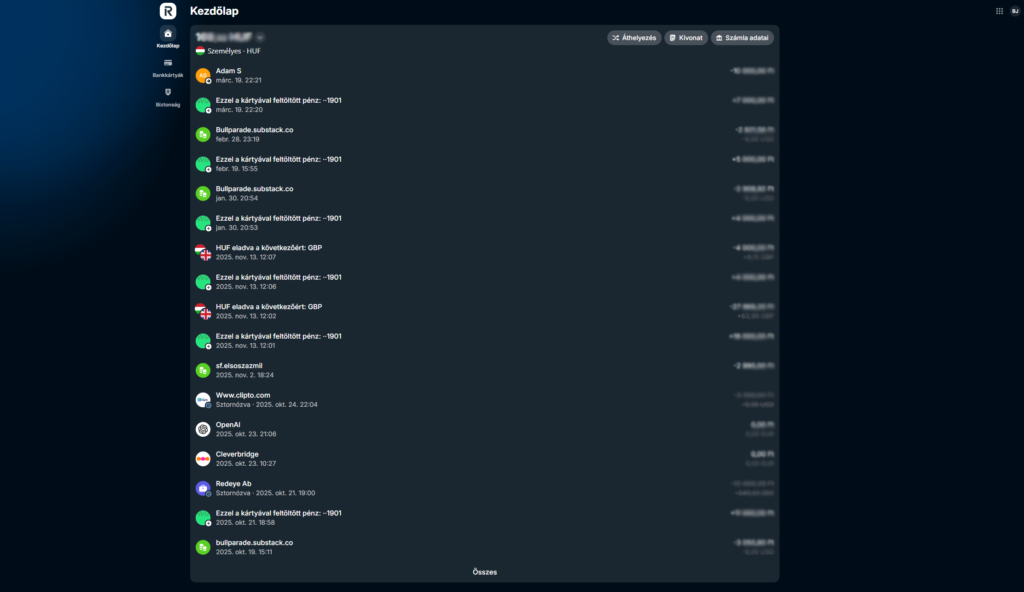
📌 In practice: Revolut is best used on mobile only. Only use the web interface when you need to quickly check something on your desktop, but do all your important work from the app. This is especially true when I'm abroad, it's nice to have a combined solution in my pocket.
💵 Extra features of Revolut accounts 💵
This is where Revolut far surpasses most of its competitors, and where the Swiss Army knife analogy really applies. Revolut is both a bank and a discount broker, but I’ve separated these two functions into two separate sections. Let’s start with the bank, for which the following is true:
🏦 Bank account-like features
- 🌍 Balances available in over 30 currencies (Wise offers 50+ currencies, but Revolut covers the most commonly used ones).
- 🏦 IBAN number in multiple currencies, including a HUF account (with a Lithuanian international account number, not a dedicated Hungarian one, but they promise that this will change in the next 2 months, and from now on there will also be a full Hungarian IBAN number).
- (I.e. Multiple physical and virtual cards: up to 20 virtual cards in the Standard package.
- 🛡️ Single-use virtual cards for online purchases. It generates a new card number with every purchase, which is extremely secure.
- 🔔 Instant notifications for every transaction, which essentially means a push message.
- 📊 Automatic categorization and monthly reports.
- 🇧🇷 Revolut <18: 1 child account with parental controls.
- 🤝 Revtag: quickly send money to other Revolut users via a unique ID.
- 📱 Apple Pay and Google Pay support.
Revolut RevPoints
RevPoints is Revolut's own loyalty points system, a kind of cashback program, but it is not measured in money, but in points. Revolut competes with traditional bank credit card cashback programs, only on an app basis, without card fees.
How do you collect points?
- (I.e. When paying by card: you earn points for every amount spent, the amount depends on the subscription package.
- (I.e. When exchanging currency: in certain cases, points are accumulated even after switching.
- 🎯 When completing various Revolut promotions and challenges.
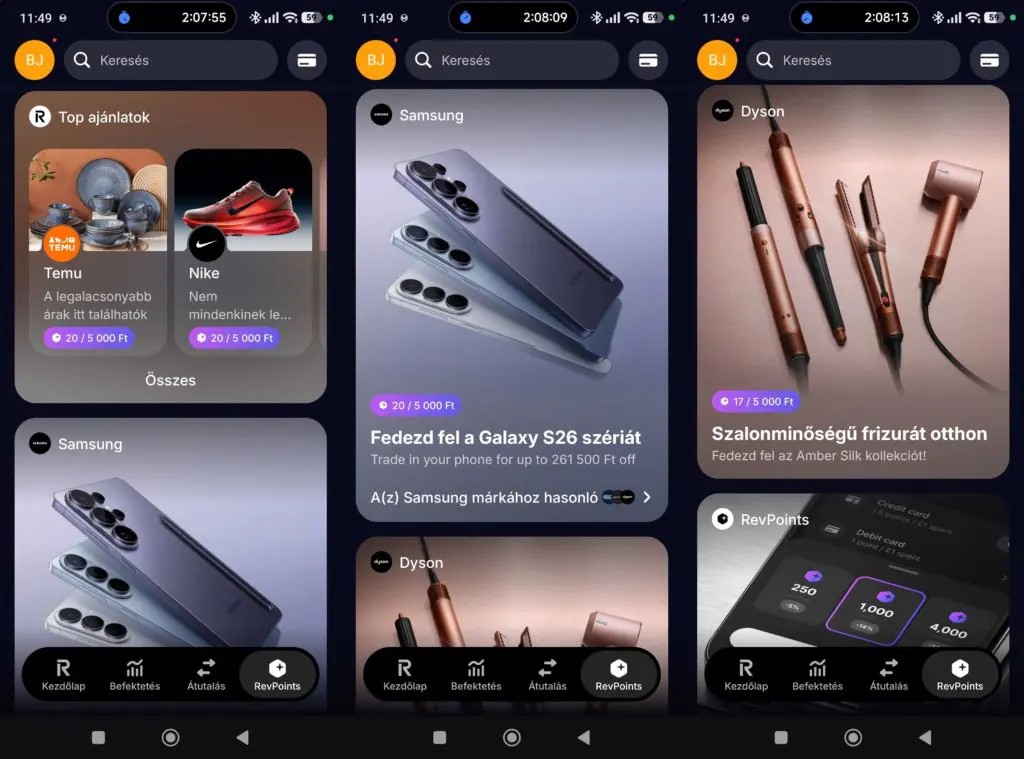
What can it be redeemed for?
- ✈️ Flight and accommodation: via Revolut's travel portal.
- 🛋️ Airport lounge passes.
- 🎁 Partner discounts: at various dealers.
- (I.e. Can be converted to crypto or foreign currency, in certain markets.
- 🛒 For purchases within the Revolut Shop.
In the premium plans (Metal, Ultra) you get significantly more points for the same amount of spending than in the Standard plan. My opinion is that Revolut is trying to build an ecosystem and better connect consumers to their services, but I wouldn't call this a very big extra. Regardless, it's worth trying.
💰 Savings features
- (I.e. Savings Vault, i.e. a safe deposit box for savings: interest-bearing savings set aside for various purposes. The amount of interest depends on the current central bank interest rate, and at the time of writing it varied between 1,25-4,75% depending on the currency and Revolut package.
- (I.e. Round-up function: rounds up the amount for each payment and automatically saves the difference.
- ⏰ Automatic savings: saves the owner a specified amount at regular intervals.
✈️ Insurance features (in premium packages)
The Premium and Metal plans also include travel insurance, health insurance, mobile device insurance, and accident insurance. This is one of the best-rated features of the Premium plans, as these insurances would usually cost more if purchased separately. If someone travels a lot, the monthly fee of the Premium plan is easily reimbursable, but I have never used it because it would be quite complicated to compare the services of all domestic insurance companies with Revolut's own. However, this is an untapped area, it is worth looking into, because in principle Revolut's insurance is also valid for winter sports, e.g. skiing.
📌In practice: In my experience, everyone uses Revolut, but for a slightly different purpose, but almost all crypto beginners pushed Revolut, until July 2025, when Revolut withdrew its crypto options from the Hungarian market due to domestic regulations. The problem with this is exactly what I mentioned above, but I think it's perfect to learn about the topic. For Hungarian readers, you can find the special domestic regulations in the "Section for Hungarian investors" section.
📈 Revolut as a discount broker – available instruments 📈
Revolut is not only a bank and financial service provider, but also a broker, and you could also buy crypto instruments on the site. Since I also have a stock portfolio built from individual stocks, I looked at how many stocks I could buy from my 26-item portfolio on Revolut. This also revealed which countries' stock markets the provider supports and which ones it doesn't. Incidentally, I also played this in connection with the Lightyear test, so I think the comparison is fair: Lightyear: the best cheap broker in 2026? Prices, features.
I could have bought 18 of my 26 shares on Revolut (20 on Lightyear, all of them on IBKR), from which it is easy to guess that smaller markets are not served. There is no Polish market, the Canadian, Australian, Swedish and Chinese markets only appear as ADRs, that is, if the stock is listed on the US stock exchange, then it is, otherwise it is not. This will not be a problem for novice investors, but for those who want to deal with individual stocks a little more seriously, it will be. However, this affects a fairly small part of the users, this is not the target group.
✅ Revolut financial instruments
- 📈 Shares: mainly US and European stocks, a few thousand instruments in total, but there are also ADRs. The better known ones like Apple, Tesla, Amazon, NVIDIA, SAP, etc. are available (but there is definitely no Polish, Swedish, Canadian, Australian, Hungarian market).
- (I.e. ETFs: Limited offering, typically the most popular US and EU ETFs (e.g. iShares, Vanguard products). ETF offering is narrower than on Lightyear, where ~300 ETFs are available for free.
- 🪙 Cryptocurrencies: 200+ crypto assets, including altcoins available in most markets (no longer available to Hungarian customers due to domestic regulations).
- 🔀 Fractional share: is available, so you can buy shares for a small amount (e.g. 0.01 shares instead of 1 Amazon share).
- 💰 Savings safes: You can earn interest on your uninvested money through money market funds.
- 📜Bonds: Bond trading is allowed on the EEA market, but there are not too many.
- ➖CFDs: contract for difference, is also available in the EEA market (which is not necessarily a positive thing, as CFDs represent a counter-interest market model because the broker is the market maker, and Revolut also states that 62% of customers lose on such transactions).
☝️It is important to emphasize that Revolut only acts as a market maker for CFDs, otherwise it purchases instruments in its own name, but for the benefit of its clients, this is the already mentioned "street name" format.
One indirect proof of this is if you receive a letter stating that you vote for your shares in proportion to your ownership (in the case of fractional shares, this may differ), as a market maker broker does not send this. The point is that at Revolut, except for CFDs, the assets are actually purchased, they can be reclaimed in the event of bankruptcy and the owner of them is the client and not the broker.
💸 Revolut broker fee structure
This is an area where Revolut clearly falls short of Lightyear and Interactive Brokers. Revolut spread-based applies a fee, in addition to which you receive 1 free order as part of the Standard package. This means that:
- 🤔The difference between the buying and selling price (spread) is usually larger than with the brokers mentioned above.
- 🔢However, it is smaller than in legacy, physical banks. I can mention Erste as an example, where a transaction costs 7 EUR/USD, but CIB and KBC also work at similar prices, so even though Revolut's spread is higher than average, it still comes out cheaper.
- 💰Premium packages include more free transactions per month.
❗Always check the fee structure as it may change! You can do this here: packages.❗
📌 In practice: Revolut's brokerage service is most useful if you already use Revolut for your finances and want to buy stocks or crypto occasionally, in small amounts. The all-in-one logic is more valuable to users than fee optimization if the amount is not significant. However, if you are investing a significant amount, regularly, or building an ETF-oriented portfolio, Lightyear and Interactive Brokers are clearly a better option. But, as I wrote in my previous broker analysis, you can always diversify, and opening a Revolut account is free, so why wouldn't you do it?
🤵What strategy is Revolut best for?🤵
Revolut is best for two distinct things, which are worth separating:
As a financial service provider: what is it ideal for?
- ✅ For travel: Revolut is almost unbeatable in this. Free currency exchange up to the limit on weekdays, multi-currency account, instant notifications, card blocking on the go, all in one app. It has worked perfectly for me everywhere in Europe so far, and it can also make payments in several different currencies if there is not enough coverage in one.
- ✅ As an everyday bank account: If someone doesn't want a traditional bank account, Revolut is a reliable alternative, especially after obtaining a banking license.
- ✅ For diversified digital finance: Savings, insurance, crypto, investments, all from one app, no need to switch back and forth between providers.
- ✅ For online purchases: Virtual cards, especially single-use ones, provide an excellent layer of security and can be combined with PayPal. Plus, if you only top up with the amount of money you need to pay for a given product or service, they can't take more money if your information is stolen.
- ✅ Up to ~350000 HUF/1000 USD currency exchange per month: this is more than enough for most users, and switching is completely free on weekdays.
As a financial service provider: what is it not ideal for?
- ❌ For frequent, large international transfers: Wise is better for this, it's cheaper, faster and handles more currencies.
- ❌ For many currencies, a dedicated IBAN is required: Wise provides real, dedicated account numbers in multiple currencies, Revolut's HUF account currently has a Lithuanian IBAN, but this seems to change in the near future.
As a broker: what is it ideal for?
- ✅ For occasional stock or crypto purchases in a small amount, if you use Revolut anyway.
- ✅ For beginners who want to get acquainted with the stock markets and they want to do this within some familiar framework.
As a broker: what is it not ideal for?
- ❌ For long-term, independent management of cryptos: There is no cold wallet transfer, which is a basic requirement in the crypto community.
- ❌ For ETF-based passive investment: Lightyear is much better for this (free ETF trading, TBSZ).
- ❌ For serious, active portfolio building: Interactive Brokers is much better suited for this (more markets, more instruments, real stock market orders, very low fees and spreads).
- ❌ For Hungarian tax residents, for investments in a TBSZ account: Revolut does not currently offer TBSZ.
📌 In practice: I think Revolut is a service provider that can be taken seriously as a financial service provider, but less so as a broker. There are two reasons for this, one is that they list relatively few financial instruments, the other is that they do not have serious customer service, you can basically write to them in the chat within the application, or write them an email. This is very similar to the solution of Wise or Lightyear, typically a sign of cheapening. This is not a problem as long as you do not keep a lot of money with them, but do not entrust them with the majority of your assets.
🆚Competitors: Revolut's opponents🆚
Due to the dual nature of Revolut, it is worth making two comparisons: one with competing financial service providers (Wise), and one with brokers (Lightyear, IBKR). As a Hungarian tax resident, I can compare this primarily in Hungarian terms, but for those whose tax jurisdiction is not Hungarian, the fees and perhaps the criteria will be different.
🔵Revolut vs. 🟢Wise – as a financial service provider
| Point of view | 🔵 Revolut (Standard PACKAGE) | 🟢 Wise |
|---|---|---|
| Registration fee | 0 | 0 |
| Monthly fee | 0 | 0 |
| Banking license | Yes (LT, EU + UK) | No (but financial instruments are held by banks and custodians) |
| Deposit insurance (as a bank) | €100,000 (LT) / £85,000 (UK) | There is no state deposit insurance, but partner banks do have it. |
| Available currencies | 30+ | 50+ |
| Dedicated IBAN | HUF: Lithuanian IBAN (but this is changing) | HUF: real Hungarian IBAN |
| Currency exchange fee (weekdays) | 350000 HUF/month free, above that 1% | ~0,35% (this depends on the amount and currency pair) |
| Currency exchange fee (weekends) | ~1% surcharge | No weekend surcharge |
| HUF transfer domestic | Free | Free up to 50,000 HUF, with transaction tax on Mo. |
| Transaction tax transfer (HU) | Not being transferred yet | Transferred to customers since 2025.02.17 |
| Card cost | First card: ~2100 HUF delivery, no annual fee | ~2420 HUF one-time, no annual fee |
| Virtual cards | 20 db | 3 db |
| Single-use card | Yes | Yes |
| Child account | Yes (Revolut <18) | nincs |
| Investment service | Yes | Does not offer financial instruments |
| Insurance | Yes (in premium packages) | Does not offer insurance |
| Crypto | Yes (not available Mon–Fri) | Does not offer financial instruments |
| Interest on account balance | Only as a savings service (savings vault) | EUR, GBP, USD balance also available |
| Profitable | Yes, since 2021 | Yes, since 2017 |
| Listed on the stock exchange | No (private) | Yes (LSE: WISE) |
The two services are not for the same purpose. Wise is unbeatable for cross-border transfers: more currencies, dedicated IBANs, better exchange rates for large transfers, no weekly limits. If your main need is to send money abroad cheaply and quickly, choose Wise. However, if you are looking for an all-round everyday bank account that comes with insurance, crypto purchases, investment options and a modern, fast app, Revolut is the better choice. The best solution is of course both at the same time, and this combination is very powerful indeed.
💡 Important difference since 2025: Wise will pass on Hungarian transaction taxes to Hungarian customers from February 17, 2025, which will make some of its services noticeably more expensive. Revolut does not currently pass on these costs, so Revolut's conditions are more favorable, especially when it comes to transfers and exchanges.
📊Revolut vs. Lightyear vs. Interactive Brokers – as a broker
| Point of view | 🔵 Revolut (Standard) | 🚀 Lightyear | 💼 Interactive Brokers |
|---|---|---|---|
| Place of entry | UK/Lithuania | Estonia | USA (EU: Ireland) |
| Managed client assets | ~8.5 billion USD | ~1 billion USD | ~757 billion USD |
| ETF fee* | Spread-based (not free) | Free | 0.05% or free |
| Share price | Spread (1 free transaction) | 0.1% (US), 1 EUR (EU) | 0.005 USD/pc (min. 1 USD) or 2 USD/EUR transaction |
| Currency exchange | ~1% (above limits) | 0.35 % | Close to Interbank |
| TBSZ | nincs | Free | 2000 HUF/month, but can be purchased |
| Crypto | Yes, 200+ (not available on Mo.) | Gender | Limitedly |
| Options | Gender | Gender | Yes |
| Bonds | Limitedly | 27 bonds | ~1 million |
| Hungarian market (BSE) | Gender | Yes (approx. 15 companies) | Yes |
| Canadian, Australian market | Gender | Gender | Yes |
| Fundamental data | Alap | Alap | Morningstar, EVA, TipRanks, etc. for free |
| Investor protection, per capita (EU) | 22000 EUR (LT) | EUR 20000 (EFSA) + USD 500000 (US, SIPC) | 20000 EUR (ICC, EU) |
| Interface simplicity | ⭐⭐⭐⭐⭐ | ⭐⭐⭐⭐⭐ | ⭐⭐ |
| Listed on the stock exchange | Gender | By transfer (STRT Holding Plc.) | Yes (NASDAQ: IBKR)* |
* not including the annual maintenance fee for ETFs, this fee is collected by the fund manager, not the service provider.
The table clearly shows that Revolut's brokerage service is the least competitive of the three in terms of fees. The spread-based model and monthly free transaction limit do not compete with Lightyear, which offers ETF trading completely free. Compared to IBKR, the asset offering is a fraction of what it is, and the data provision is almost nonexistent. However, there is one important caveat regarding Interactive Brokers: since it is a professional platform, unlike Revolut, you can trade on it and hold securities for the long term, so you can usually choose from two types of fees - banded and fixed - and I naturally used the fixed one as a basis here. You will run into a lot of these at IBKR, it is quite difficult to figure out their fee structure because it is often not clear what costs how much. For the sake of fairness, below you will find the fee rates of all three providers:
- (I.e.Revolut: fee schedule.
- (I.e.Lightyear: fee schedule.
- 🔴Interactive Brokers: fee schedule.
☝️However, the Revolut broker has one undeniable advantage: integration. When your monthly currency exchange, savings, crypto, and occasional stock purchases are all accessible from the same app, simplicity creates value.
🇭🇺Section for Hungarian investors (and others)🇭🇺
🏦 Revolut has obtained Hungarian license to open an account
🔢 Transaction tax and Revolut
🧮 TBSZ at Revolut
🔢 Taxation on returns generated on Revolut
📊 Currency exchange for Hungarian investors
Buying crypto on Revolut and Hungarian regulations
✅Revolut Benefits✅
In fact, I have already written everything about Revolut, but let's summarize once again what advantages the provider has as a financial service provider:
- ✅ banking license in the EU: 100000 EUR deposit insurance, which is unique among neobanks and fintechs,
- ✅ all-in-one ecosystem: manage your bank account, savings, investments, insurance, crypto, from a single app
- ✅ the best companion for travel: instant notifications, simple card blocking, free currency exchange up to the limit,
- ✅ free HUF transfers within Hungary, without transfer of transaction tax (compared to Wise since February 2025),
- ✅ child account: Revolut <18, for 1 child,
- ✅ up to 20 virtual cards: In standard packaging, including disposable ones,
- ✅ insurances: premium packages also include travel, health, and mobile device insurance,
- ✅ modern, intuitive mobile app: one of the best user experiences in its category,
- ✅ Google Pay and Apple Pay aid.
As a broker
- ✅ It can be used simply and quickly for occasional, small investments.
- ✅ Fractional shares available.
- ✅ All financial functions in one app.
- ✅ Multiple instruments are available at the same time, in one place.
🧠IF YOU WOULD LIKE TO TRY REVOLUT'S SERVICES, CLICK ON THE LINK BELOW: AVAILABLE HERE.
❌Disadvantages of Revolut❌
In fact, I have already written everything about Revolut, but let's summarize once again what disadvantages the provider has as a financial service provider:
- ❌
Lithuanian IBAN on HUF account: some employers and domestic service providers do not accept foreign account numbers(this is currently under change, may be removed shortly), - ❌ less foreign currency: ~30 pcs available, in contrast to 50+ pcs at Wise, so weaker in exotic currencies,
- ❌ weekend currency exchange surcharge: ~1%, competitors are cheaper than this,
- ❌ monthly currency exchange limit: in the Standard package, anyone who changes more than this pays, but this can be replaced with paid packages,
- ❌ private company: no stock exchange listing, financial data is not publicly verifiable,
- ❌ It was loss-making for many years before 2021: profitability is a new development, long-term sustainability has yet to be proven, but it has been able to do so for 5 years, which is not that little,
- ❌ the customer service has mixed reviews: many people complain about slow response times and the limitations of automated chatbots, but this is true for all discount providers,
- ❌ complex subscription system: users can easily get lost in comparing packages.
As a broker
- ❌ No TBSZ: this is the biggest disadvantage for Hungarian investors.
- ❌ Spread-based remuneration: less transparent and typically more expensive than Lightyear's fixed fees.
- ❌ Limited ETF offerings: ETF trading is also not free (unlike Lightyear).
- ❌ No options, bonds, futures products: truncated offering compared to IBKR.
- ❌ Very little fundamental data: Within IBKR, Morningstar, EVA, and TipRanks are available for free.
- ❌ No desktop broker client: not suitable for managing a serious portfolio, but there are external service providers for this.
Structural, non-trivial disadvantage
🤔 The Swiss Army Knife Trap: Revolut wants to be good at many things at once, but it can't specialize in any one. If you're looking for a bank account, a broker, and insurance in one place, you'll probably find something better in each area if you manage them separately. The question is, is it worth the compromise in convenience that means giving up a bunch of better-used services?
📝Revolut Summary📝
Revolut is the only financial service provider that offers both bank account services, investment platform and It also provides insurance, and even crypto services in markets luckier than Hungary, in an easy-to-use format. This in itself is a huge value and explains why it has become one of the most well-known fintech companies in Europe with ~68 million users.
🆚As a financial service provider, Revolut compared to Wise: the two providers are strong in other ways. If you make frequent, large-value, cross-border transfers, if you need a lot of currencies and want a real IBAN for each currency, Wise is the better choice. Important information for Hungarian tax residents is that Wise has been transferring Hungarian transaction taxes since February 2025, which has made certain of its services more expensive. From this perspective, Revolut currently has a more favorable picture, especially with the opening of a Hungarian branch and the Hungarian IBAN number. Revolut's strength is its complex ecosystem, insurance, crypto, and higher level of deposit insurance resulting from its banking license.
🆚As a broker, versus Lightyear and Interactive Brokers: Revolut's investment platform is the least competitive of the three, if we evaluate it solely based on brokerage performance. Lightyear offers free ETF trading, TBSZ and a transparent fee structure, while IBKR offers professional tools, ~150 markets and a lot of other instruments. In fact, I don't think Revolut is worth opening just for the brokerage services, it's not good for a primary broker because it has a big tax disadvantage and there are few tradable assets, but it is perfect for diversification, currency exchange, and travel.
Since opening a Revolut account is free, everyone should open one, there are no disadvantages, and you will also receive a 10000 HUF (~25 USD) bonus when opening an account, which you can do here: account opening!
For the Hungarian investor, the following combination will probably give the best results:
- (I.e.Revolution: everyday payment, travel, currency exchange within the monthly budget.
- 🢢Wise: cross-border transfers, business account, handling of many currencies.
- 🚀Lightyear: free ETF trading, TBSZ account, regular passive investment.
- 💼Interactive Brokers: more serious portfolio, exotic markets, individual stocks, fundamental analysis tools, and here too there is a TBSZ account.
This combination maximizes the strengths of each provider, while diversifying assets across different platforms and without any extra costs. For those who would like to delve deeper into the other providers, it is worth reading our previous articles:
- 🢢Wise: fees, account, card and Revolut comparison
- 🚀Lightyear: the best cheap broker in 2026? Prices, features
- 💼Interactive Brokers (IBKR) Account: Fees and Features
Frequently Asked Questions (FAQ)
What is the difference between Revolut and Wise?
The two providers are strong in other areas. Wise is better at cross-border transfers: more currencies, dedicated IBANs in all currencies, no weekend surcharges and no monthly exchange limits. Revolut, on the other hand, offers a broader ecosystem: bank account, insurance, investment and crypto in one app. From a financial perspective, Revolut has a banking license (100,000 EUR deposit insurance), Wise is not a bank.
Does Revolut have a TBSZ?
Currently none. Revolut does not offer a Long-Term Investment Account (LTIA) for Hungarian customers. Lightyear and Interactive Brokers are suitable alternatives for LTA.
How safe is Revolut?
Revolut has a banking license in the EU (Lithuania) and the UK. EU customers are covered by a deposit insurance of EUR 100,000 and an investor protection of EUR 22,000 for securities. This is a higher level of protection than that offered by non-bank fintechs (Wise, Lightyear).
Revolut or Lightyear as a broker?
Lightyear is clearly a better broker for ETF investors: free ETF trading, TBSZ, transparent fixed fees. Revolut's brokerage service is worth it if you already use Revolut and want to invest small amounts occasionally.
Do I have to pay for the Revolut Standard plan?
The Standard package is completely free. Account management, SEPA transfer, the first bank card (excluding delivery fee) and currency exchange within the monthly currency exchange limit are free of charge.
Can I withdraw crypto purchased on Revolut to an external wallet?
Not currently. Crypto assets purchased on Revolut remain within Revolut's system and cannot be transferred to a cold wallet (hardware wallet). This is a fundamental limitation for serious crypto investors. Moreover, crypto services will no longer be available to customers in Hungary at the end of 2025.
How do I pay taxes on returns earned on Revolut?
Revolut provides tax documents that can be downloaded from the app. 15% personal income tax is payable on exchange rate gains, 15% personal income tax + 13% socho on interest and dividends. Revolut does not provide tax return assistance, the documents are required for self-filing.
Legal and liability statement (aka. disclaimer): My articles contain personal opinions, I write them solely for my own entertainment and that of my readers. The articles published on iO Charts do NOT in any way exhaust the scope of investment advice. I have never intended, do not intend, and am unlikely to provide such in the future. What is written here is for informational purposes only and should NOT be construed as an offer. The expression of opinion is NOT in any way considered a guarantee to sell or buy financial instruments. You are SOLELY responsible for the decisions you make, and no one else, including me, assumes the risk.