
🤔What is the Market Momentum column about?🤔
I don't know if you're aware of this, but a thorough fundamental in-depth analysis can take 40-50 hours. As an investor, it's impossible to put that much energy into analyzing each company if you want to effectively manage a long enough watch list. That's why I created the Market Impulse column, which provides a snapshot of each stock, especially Tesla, and roughly outlines current events. It is not an in-depth analysis, but rather just food for thought based on the current state.
My goal is not to give daily trading tips or analyze technical patterns. Instead, I provide quick, to-the-point fundamental mini-analyses that help you filter. These impulses help you keep in mind whether the current price action of Tesla (TSLA) or another market participant is worthy of deeper investigation or is just a passing market phenomenon.
You can find the share subpage with detailed information here: TSLA stock page
If you are looking for in-depth analyses of the site, click on the link below: iO Charts stock analyses
📒 Table of Contents 📒
I have created a table of contents to make it easier for you to navigate the content:
- 🚗 What is Tesla (TSLA) doing?
- 💡 Tesla (TSLA) current situation and its competitors
- 🎢 Tesla (TSLA) metrics
- ✅ Tesla (TSLA): will you get used to it or will you run away?
- 📝 Thesis summary
❓ What is Tesla (TSLA) doing?❓
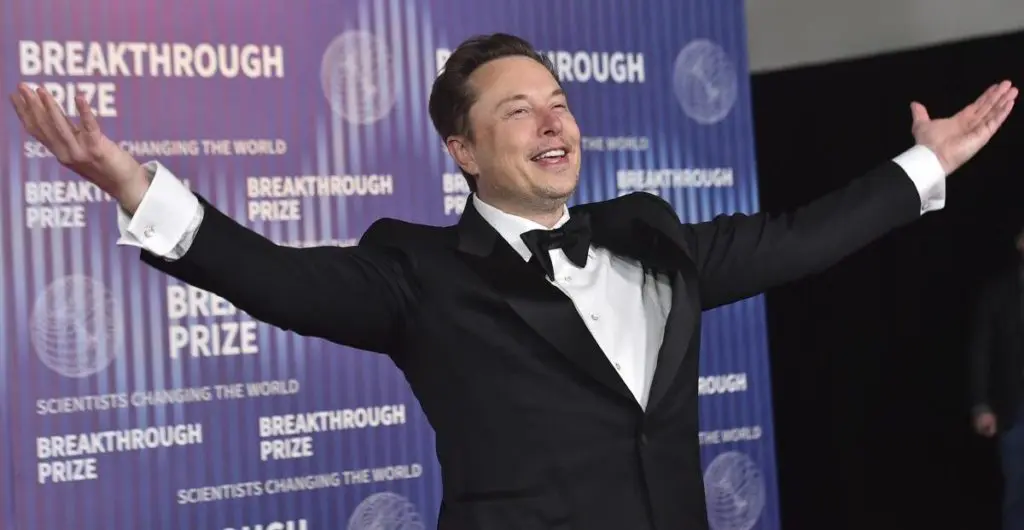
Tesla (TSLA) is a company that has been continuously redefining itself since its founding in 2003, and in 2025, this process opened a completely new chapter. The Austin, Texas-based company started out as a pioneer in electric car manufacturing, but Elon Musk has since consistently tried to position the company as the “Apple of cars,” then the “clean energy company,” then the “AI and robotics giant.” In 2025, the most ambitious repositioning to date took place.: Tesla is not just a car manufacturer, but also a pioneer in robotics and artificial intelligence.
The business model is built on three pillars. The first and most well-known is car production: the Model 3 and Model Y are the backbone of the mass market, while the Cybertruck is trying to push into the special car segment. At the end of the 2025 financial year, Tesla announced that it would stop producing the Model S and Model X, and that it would convert the Fremont factory to produce Optimus humanoid robots. The second pillar is energy storage and solar energy: Megapack industrial batteries, Powerwall home systems, and the Supercharger network, a segment that set records in 2025. The third pillar is the real novelty: autonomous software, the Robotaxi service, and the Optimus robot, which generate minimal revenue for now, but these options drive the vast majority of the stock's valuation.
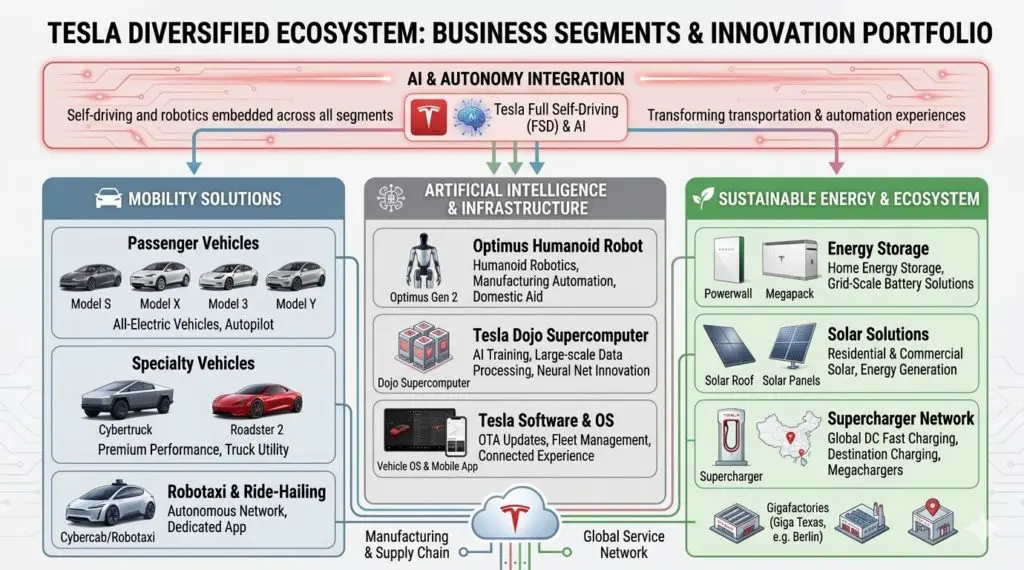
In terms of free cash flow, Tesla's model is both CAPEX-intensive (factories, charging network, AI infrastructure) and relies on software-based revenues in the future (FSD subscriptions, Robotaxi commissions, Optimus sales). This hybrid nature is what makes the company almost incomparable to any other market player, and is both the strength and weakness of the investment thesis.
📌In practice: Tesla, as I've been following it, is a typical love or hate company. Its fans adore it, its haters can't stand it, and the antagonistic leader, Elon Musk, plays a big role in this. Elon made his reputation with PayPal, but he is also associated with the acquisition of Twitter, which is now known as X, and Space-X, which is striving to conquer space, but sometimes they even send a Tesla beyond the Earth. There are an awful lot of contradictions surrounding the company, which can be interpreted in a hundred different ways. One thing is for sure, its valuation has been at extreme heights for years, so this has essentially become normality, as you will see.

🏆 Tesla (TSLA) Current Status and Competitors 🏆
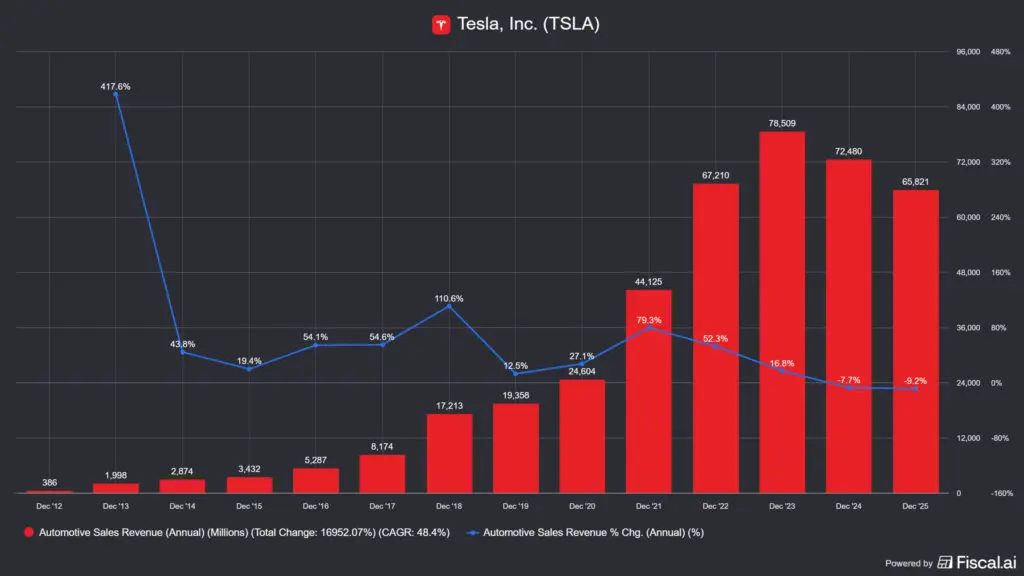
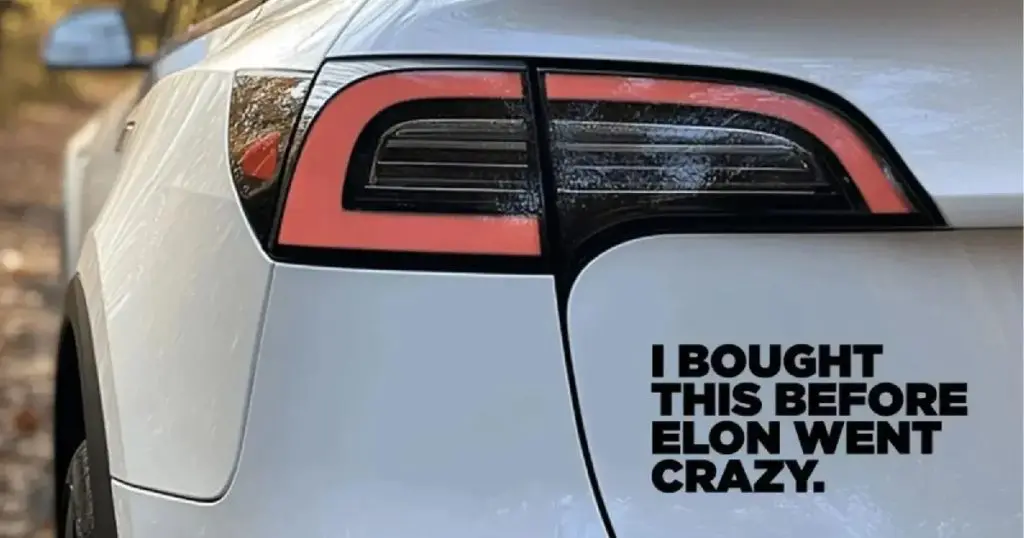
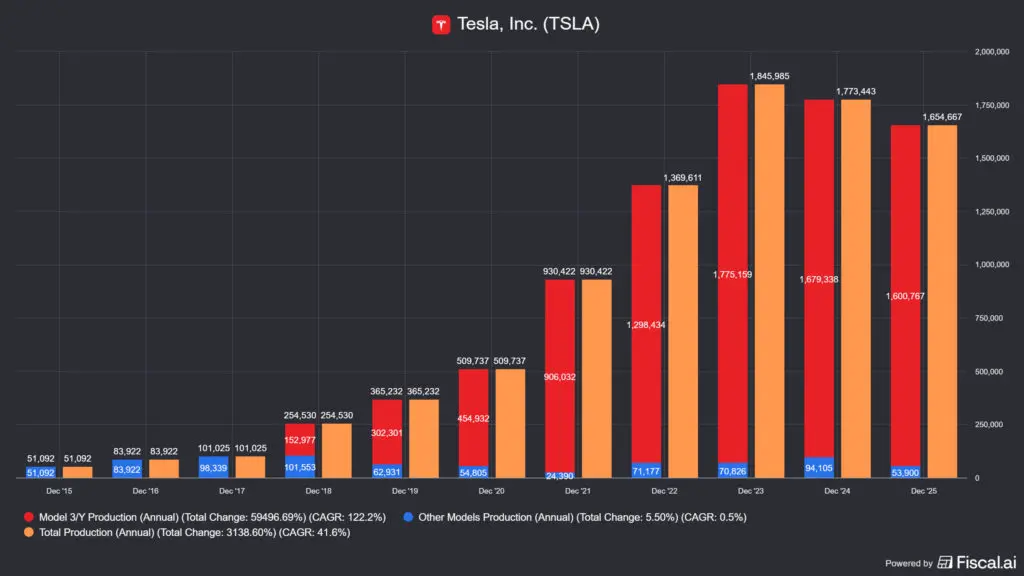
Tesla’s position in the EV market came under serious pressure in 2025. Annual deliveries fell for the second time in a row: 1,65 million vehicles delivered in 2025 was a roughly 8,6% drop compared to the previous year. European registrations fell by 39% in the first 11 months, partly due to BYD’s 240% European growth and partly due to consumer resistance to Musk’s political involvement. It’s no coincidence that stickers appeared on Teslas that read: “I bought this before Elon went crazy!” This is not a small wave: this is structural pressure.
The competitors can be divided into three groups. The first group is made up of Chinese manufacturers: BYD leads the global market in terms of the number of electric cars shipped, but Xiaomi and Geely are also expanding rapidly. The second group is made up of traditional European and Japanese manufacturers who have also entered the electric segment: Volkswagen's ID series, Hyundai's Ioniq, BMW's i series all compete in the EV market. The third group is made up of American rivals: Rivian and Lucid are trying to establish themselves in the upper segment, but they are extremely small competitors for now.
Which, however, takes the Tesla thesis to a completely different dimension: Robotaxi and Optimus have almost no direct competitors in the field of robotics, at least in scale and vertical integration. Google-owned Waymo is also building an autonomous fleet, but Tesla's FSD database - which it collects from its 6 million+ active vehicles - is a competitive advantage that will be extremely difficult for anyone else to replicate. The essence of the investment thesis is therefore no longer whether Tesla can sell enough cars, but whether the AI/robotics bet pays off.
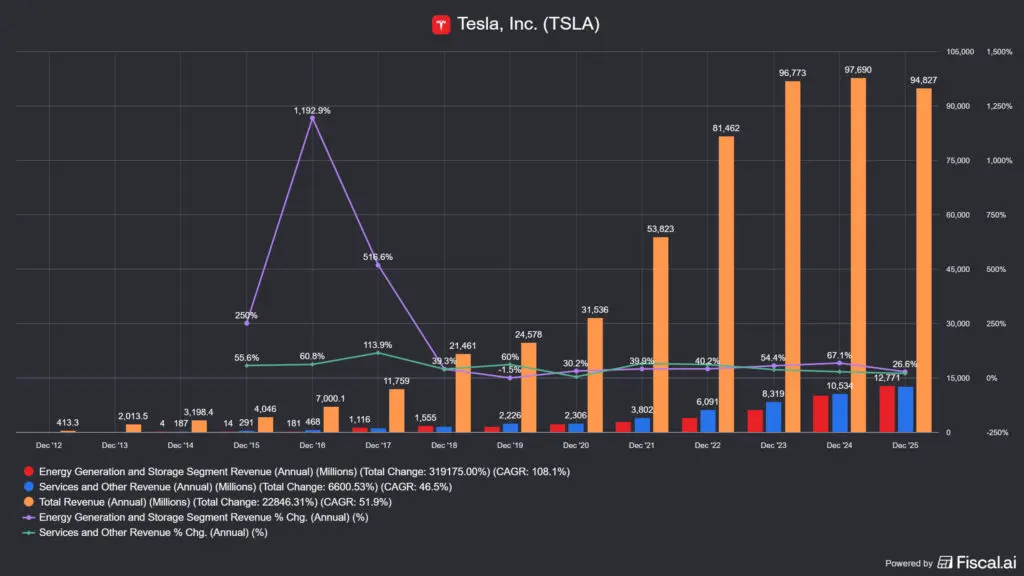
Meanwhile, the energy sector has quietly exploded: in the fourth quarter of 2025, energy revenue grew by 25% year-on-year to $3.8 billion, with full-year energy revenue approaching $12,8 billion. If this trend continues, the energy segment could become a major revenue driver within a few years.
📌In practice: Tesla and Elon Musk, because I think the two are inseparable, were at the forefront of many things and were ahead of their time, but the "first movers advantage" has passed in certain areas and competitors are starting to catch up to Tesla, and this is especially true in the automotive industry. Therefore, the company is constantly making progress in several areas, but this also means that, for example, the company must be just as successful in the Robotaxi or Optimus business lines as it has been so far. This pricing for perfection is not good for the share price, while the CEO's political involvement also adds question marks to the equation. The market does not like uncertainty and trouble.

🎢 Tesla metrics 🎢
📊 Exchange rate and the Musk factor
Tesla's share price reached a high of $489-490 in December 2025, and then began to fall sharply in early 2026. Currently, in mid-March 2026, the stock is trading around $390-400, which is a decline of almost 20% from its ATH - but not much has happened compared to the February low. The 12-month return is still over 50%, which is an extraordinary achievement.
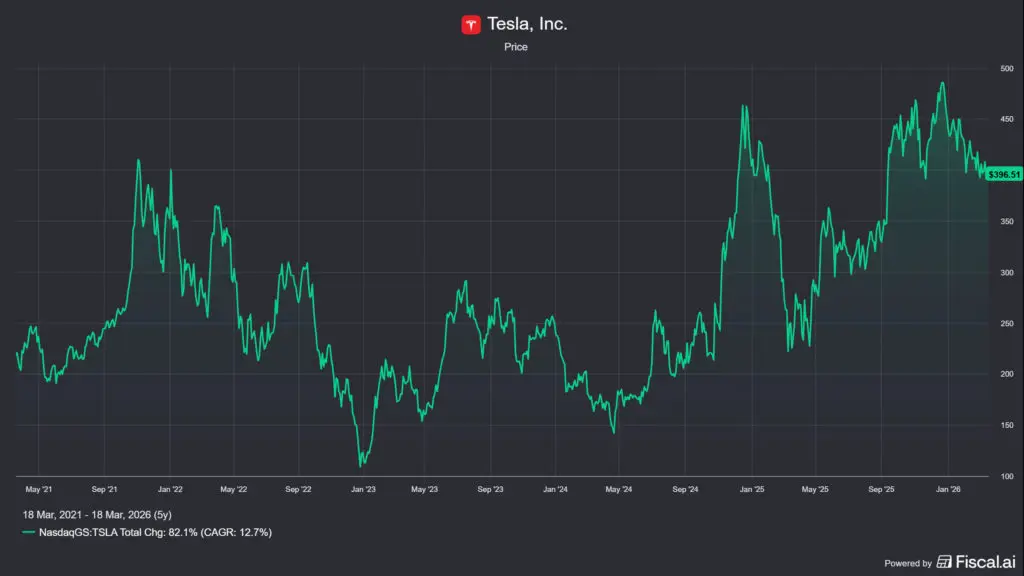
The catalysts for the fall are well identified: Musk's political involvement on the DOGE peg, falling EV sales in Europe and the US, the first annual revenue decline in the company's life in 2025, and an extremely high valuation that is immediately punished by any negative news. Bank of America upgraded the stock's outlook with a $460 target price and a Buy rating in recent weeks, partly due to the launch of Cybercab and Musk's DOGE withdrawal - which briefly halted the decline. But why am I writing this when I haven't mentioned it in my previous 20+ stock analyses?
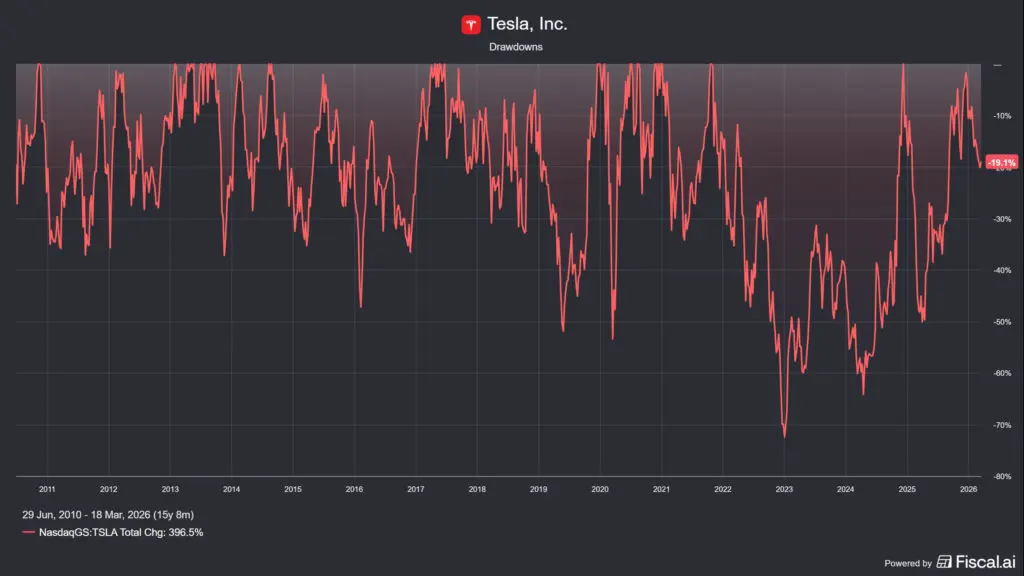
Because Tesla's share price is largely driven by short-term effects like this and similar ones, rather than serious fundamental changes, which would only be incorporated into the share price over years. However, in the case of Tesla (TSLA), something always happens over a 3-5 year period, so quick effects can be identified more by technical signals, which is not very fortunate for those who want to invest on fundamental grounds for the longer term.
📌 In practice: Tesla is one of the most volatile large-cap stocks on the market, with 30-50% declines not uncommon, with the stock having fallen as much as 75% in the past. Anyone holding the stock needs to mentally prepare themselves for this roller coaster ride.
🪙Valuation: NOPAT yield and belief in expectations
When discussing Tesla's valuation, the first number that comes to mind is the P/E, which was around 340 at the time of writing, while at the end of 2025 it was around 390-400. Although I don't like this indicator, I included it for demonstration purposes, because it is practically incomprehensible that something would pay for itself in 370 years. This is absurd for a car manufacturer, and high for an AI company - in fact, this multiplier expresses that the market is not pricing the current business, but a future one, which no one really knows when it will generate revenue at all.
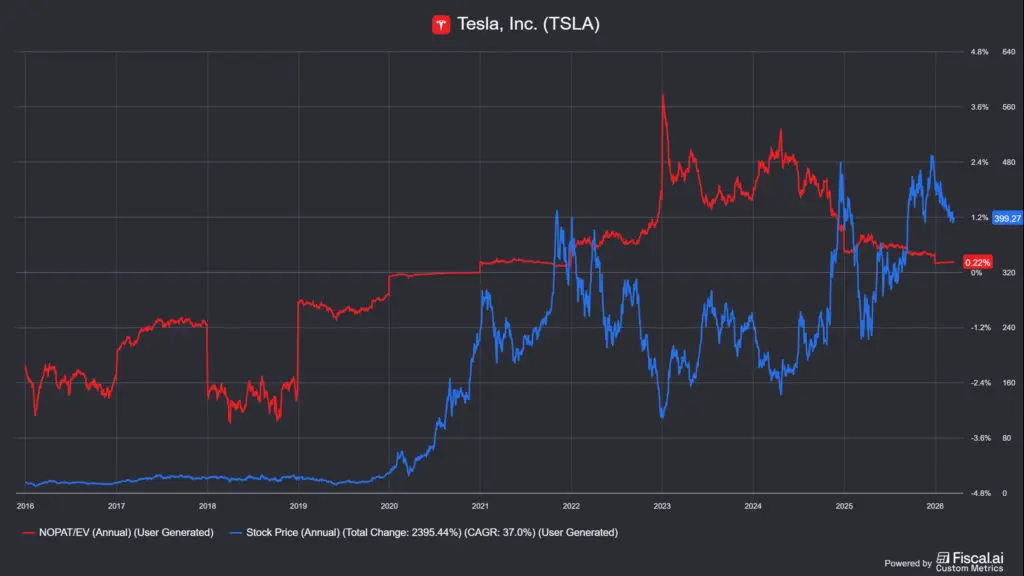
Let's take the usual NOPAT yield to determine whether a stock is cheap based on another metric. I've compared the current numbers to historical averages to give you some idea of what the valuation was like in the past:
- 🎯NOPAT yield currently: 0.2% (December 2025)
- 🕒NOPAT yield 3-year average: 1.07%
- 📊NOPAT yield 5-year average: 1.24%
- 🗓️NOPAT yield 10-year average: negative (Tesla (TSLA) did not generate revenue until 2019)
- 📜NOPAT yield 20-year average: negative (Tesla (TSLA) did not generate revenue until 2019)
We get the usual, difficult-to-interpret valuation in this case as well, but it is much higher than even the usual extreme numbers. Tesla's current price basically reflects the price of an option: you're betting that the robotics/autonomous software thesis will work. If it doesn't, the market will punish you mercilessly and the price will crash.
🫰 Revenue and profitability
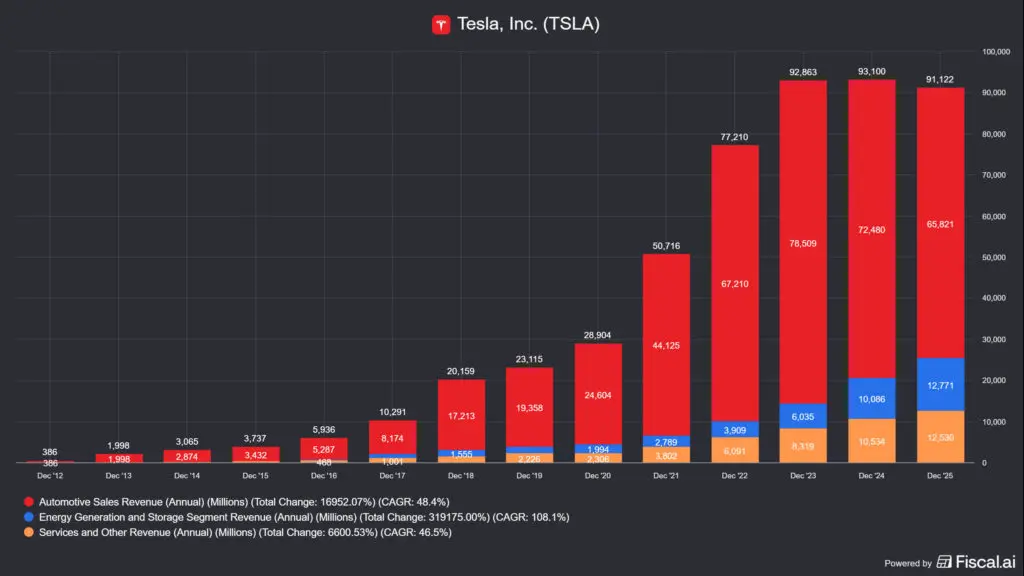
Fiscal 2025 is a mixed bag. Total annual revenue was $94.83 billion, down nearly 3% from 2024, the first annual revenue decline in Tesla's history. The automotive segment dragged down the numbers, while the energy and services segments grew, but they account for a smaller share of the mix, with the ratio roughly as follows:
- 🚗car manufacturing: 72.2%,
- 🔋energy segment: 13.9%,
- 🛍️services: 13.9%.
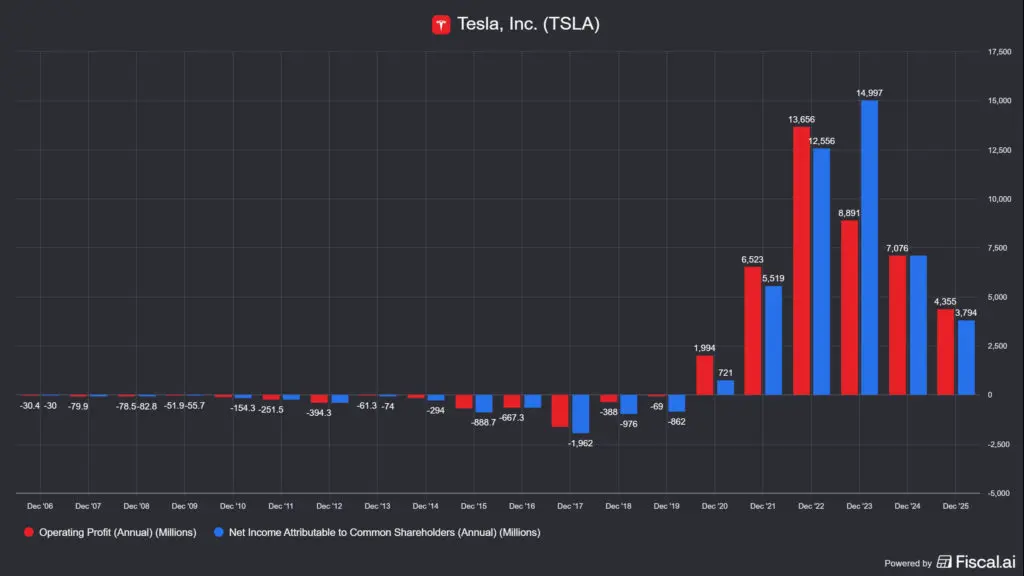
GAAP operating income for the full year was $4,4 billion (vs. $7,1 billion in 2024), and GAAP net income was $3,8 billion (vs. $7,1 billion in 2024). That's a big drop, but it's important to put it into context: non-GAAP net income remained at $5,9 billion, which is not a negligible difference, but it shows that Tesla doesn't have nearly the margins of the other big tech companies I've written about before:
- Netflix (NFLX) stock: fundamentals vs Warner Bros deal
- Alphabet (GOOGL) Stock: AI Betting and CAPEX Risk
- Meta (META) Stock Analysis and AI Investment in 2026
- Amazon (AMZN): growth machine or capital-hungry giant
- Nvidia (NVDA) Stock 2026: AI Engine or Bubble?
Regulatory credits revenue is also increasing: these are paid to Tesla by other automakers for failing to meet emissions quotas. This is not a problem for a company like Tesla (TSLA), which only produces electric cars. It is worth noting that Tesla also essentially lives off the sales of the Model 3 and Model Y, with the number of other models practically negligible. The problem is that the company also has to swallow failures like the CyberTruck, which by now can be said to have not become a favorite of the public, and in fact the whole thing looks like a huge failure.
📌In practice: No matter where I look at it, regulatory credits are a stable, almost zero-cost revenue stream, but they also carry risk because the regulatory environment can change. Plus, as other manufacturers increase their share of electric vehicles, this revenue leg will inevitably decline. But it won't happen tomorrow, I think it will be years before the electric slice of the pie is big enough to really threaten Tesla's (TSLA) revenue.
🤞 Efficiency: ROIC and free cash flow
Tesla’s ROIC – return on invested capital – was 4.9% in 2025, while its WACC (cost of capital) is around 9-12%, the rule of thumb is to assume 10% if it’s not clear. This mathematically means that Tesla is currently destroying value on its capital: every dollar invested brings in less than it costs to finance it. However, this was not the case 2-3 years ago, when ROIC exceeded the cost of capital by three times. This also means that competition is likely to make TESLA (TSLA) more competitive than before. This is usually not a good sign, which is why the company has moved into other market segments.
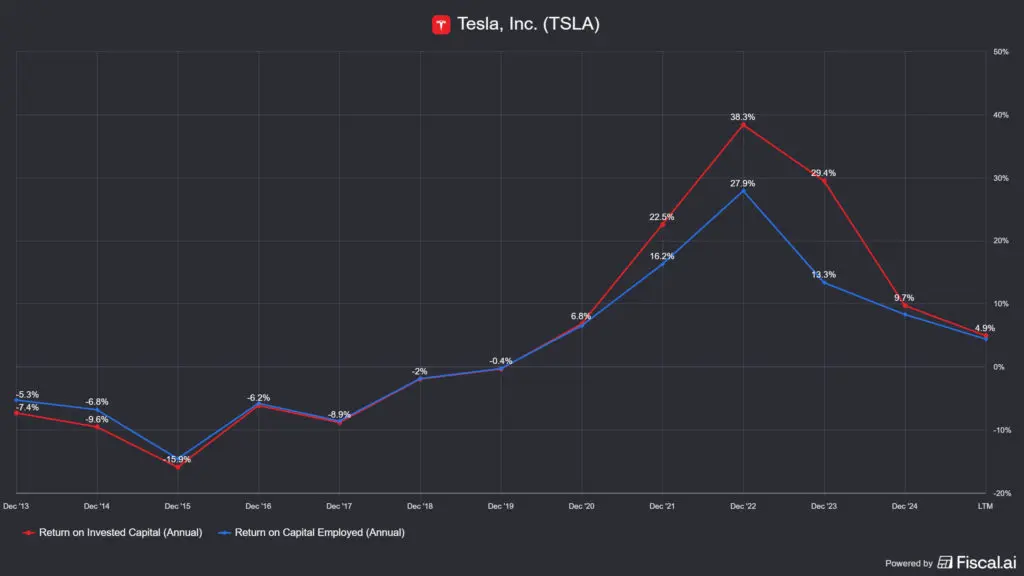
The ROIC So the question is: do you trust that the capital spent today will return? Before anyone misunderstands, other technology companies are also making similar investments right now, as I have written about in other Market Impulse articles.
Tesla, Inc. (TSLA) — ROIC vs. WACC
Free cash flow, on the other hand, came as a positive surprise: in 2025, FCF was generated at USD 6.22 billion, a 73.7% increase compared to USD 3.58 billion in 2024. Operating cash flow was at USD 14.7 billion, and cash and investments increased to USD 44.1 billion. This gives the company serious financial security.
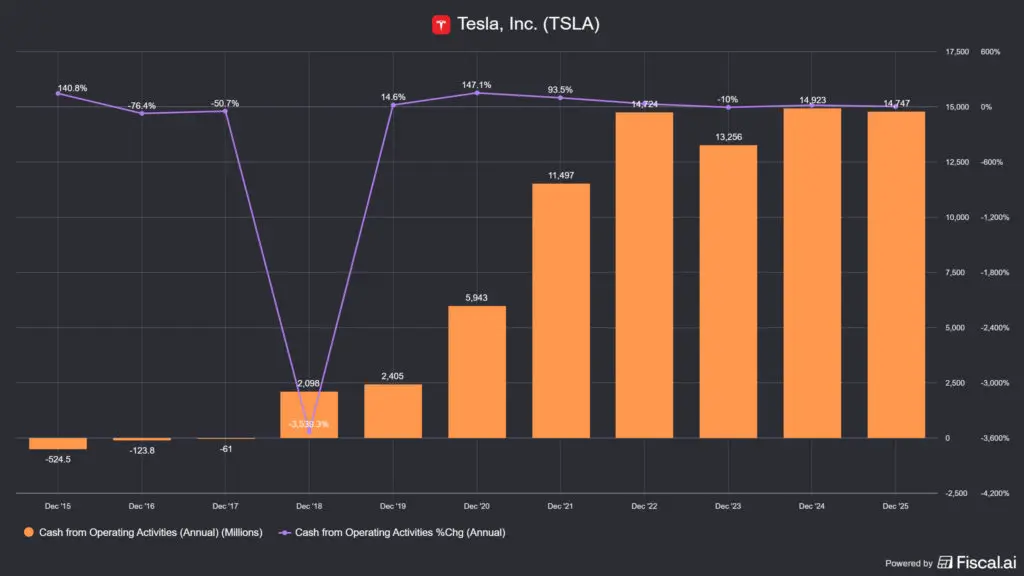
However, CAPEX levels are also rising: Tesla plans to launch six new production lines (vehicles, robots, energy storage, batteries) in 2026. This is necessary in the long term, but will depress FCF in the short term.
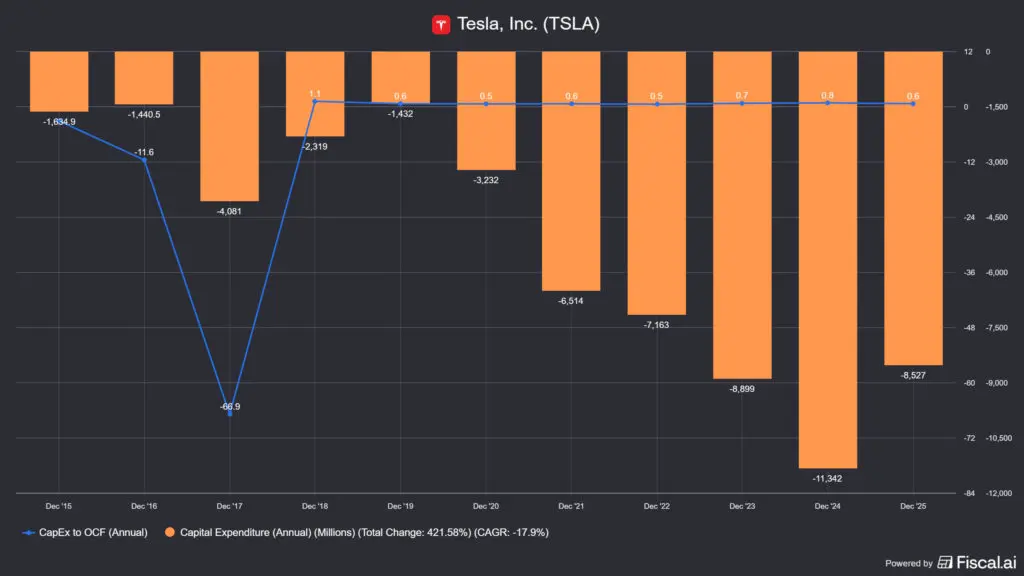
📌In practice: Tesla (TSLA) is playing the usual tech company scenario: rushing ahead with capital investments into the future and pouring money into development. The problem with this is that while sunk costs are a sure thing, future returns are not. Moreover, if you look at the numbers, Tesla is the "underdog" next to a Google, an Amazon or a Microsoft, because these companies generate much more money, with much higher profit margins. And in the self-driving space, the AI segment or robotics, these companies are also moving, but they are currently on much more solid footing than Tesla (TSLA). So I wouldn't bet big money on them, especially not at this valuation.
🎲 Risk factors: Musk premium, Chinese competition and overvalued valuation
Tesla's risk profile is determined by four main factors:
- 💸 The valuation: a $1250 trillion market cap generating $6.22 trillion in FCF is trading at a P/FCF multiple of 222x. If future robotics/autonomous software revenues don’t materialize as expected, the repricing could be catastrophic. In other words, the reward-to-risk ratio isn’t exactly in the investor’s favor.
- 🇨🇳 Chinese competition and geopolitical risk: BYD will have sold more electric cars globally than Tesla in 2025. Tesla's market share in China is under pressure, while tariff war risks are also affecting production at the Gigashanghai factory. If US-China trade tensions intensify, this could affect Tesla's Chinese factory. Of course, the Musk-Trump relationship is quite hectic, at first they patted each other on the back, now they just don't like each other, there's a bit too much drama around Tesla (TSLA) for me.
- 👤 Musk risk: The 2025 European sales slump and consumer boycott are partly due to Musk’s political activism. This is difficult to measure, but it has a real impact: brand damage among premium and ESG-conscious buyers. Musk’s withdrawal from DOGE in 2025 represents some mitigation of this risk, but the brand damage cannot be reversed overnight.
- 🤖 Cybercab/Optimus execution risk: Serial production of the Cybercab will start in April 2026, and the production-ready version of the Optimus is promised to be produced by the end of 2026. But product launch delays - Cybertruck, Model 3 - are not unknown in Tesla's history. Delays, quality problems or regulatory obstacles (NHTSA, European approvals) would have a serious impact on prices.
📌 In practice: Tesla's risk profile is both broader and deeper than most stocks. Holding this stock is essentially a venture capital-style bet disguised as a public stock. However, given its high valuation, it's hard to imagine the stock taking a startup-like leap from here. Of course, the stock has proven this a few times in the past, so who knows what the future holds.

💵 Tesla (TSLA): will you get used to it or will you run away? 💵
In the case of Tesla, the market debate is taking place with almost religious war intensity, ironically called a "religion stock." The basic question is simple: would you pay a price of $125 trillion today for a company that is valued at ~$100-1250 billion as an automaker, hoping that the robotics/autonomous AI bet will pay off?
🐂 Bulls say (Optimistic scenario):
- 🤖 Optimus could be the biggest deal of the decade: According to Elon Musk, Tesla has the potential to generate $10 trillion in revenue in the humanoid robot market over the long term. If Optimus is producing 100,000 units per year by 2027 and selling for $20,000-30,000 per unit, that alone could be a $2-3 billion revenue stream, and that's just the beginning. There's currently no other company that is vertically integrated, with its own chip and AI model, approaching this task.
- 🚕 Cybercab as a disruptive force: If Tesla can actually operate self-driving taxis at $0.20-$0.30 per mile (versus Uber's ~$2), it could be a game-changer. Austin, Texas, and the Bay Area, California, have already launched, and seven more cities are planning to launch the service in the first half of 2026. The first Cybercab rolled off the assembly line in 2026, and YouTube is already full of videos of the service being tested, albeit using Model Ys.
- ⚡ The energy segment is quietly racing: Megapack energy storage business set records in 2025, Powerwall demand is also growing, Megafactory Shanghai has started production. This is a less "sexy" but stable and fast-growing business that is not dependent on the Musk narrative, as people typically view this segment as something neutral but necessary.
- 💰 USD 44 billion cash reserves: Tesla has an extremely solid balance sheet. Its $44 billion in cash and investments will help it weather most future market shocks and will allow it to fund robotics developments without having to dilute its stock.
🐻 Bears say (Pessimistic scenario):
- 💸 The current price has priced in the perfect future: A P/E of 340x and a P/FCF of 222x can only be justified if almost everything, Cybercab, Optimus, FSD monetization, goes according to the best-case scenario. If any of them suffers a significant delay or becomes less profitable than expected, the repricing could be drastic, meaning the share price will start to fall sharply. ROIC (~5.59%) today is significantly lower than WACC (9-12%), meaning Tesla is currently a net value-destroying capital user.
- 🇨🇳 The EV business is structurally weakening: annual deliveries have been declining for two years, the European market is set to shrink by 39% in 2025, and Chinese competition is not going to ease. In addition, Chinese buyers increasingly prefer domestically produced products, where competition is fierce and consumers have a wide range of options to choose from. The traditional car business, which currently accounts for the vast majority of revenue, is slowly but surely eroding margins and the numbers are also on a downward trend.
- 👤 The Musk premium is a double-edged sword: The same leader who sent Tesla’s stock soaring has now become an active brand destroyer. If Musk’s political involvement escalates, his impact on the brand will become increasingly difficult to manage. What’s more, some of Tesla’s executive capital and attention is now being diverted to xAI, SpaceX, and other ventures.
- 🏭 The risk of manufacturing difficulties is real: Tesla is waiting for regulatory approval to launch FSD in Europe, Cybercab mass production has only just started, the Optimus production chain is extremely complex and as they will be the first company to enter the segment, they have to blaze the trail and fight their way through childhood diseases. As we saw with the Cybertruck, deadlines are slipping and the launch is always more expensive and slower than planned.
📌 In practice: I think that as a conscious investor, it is not very beneficial when the risk is much greater than the expected profit, in which everyone imagines what they want. But, let's not forget that Musk has already done the miracle a few times, it is not by chance that there are Starlink satellites in the sky, but Teslas have also been running the roads for years and I could list more. I think that from now on it is a question of faith: do you see the above in the next few years of Tesla (TSLA) or not? Everyone can decide this for themselves.
📝 Tesla (TSLA) Situation Summary 📝
Tesla went through an ambivalent period in 2025: the car business slowly but surely weakened (first annual revenue decline, delivery decline, European market loss), while the AI/robotics narrative persisted, so the stock still has a market cap of $1250 trillion and the balance sheet is extremely strong (cash on hand of $44.1 billion).
The investment thesis for 2026 is roughly this: the market is pricing Tesla (TSLA) not as a car manufacturer, but as a spawner company that will pioneer AI, robotics, and self-driving. This is an option bet that the Optimus robot, Cybercab, and FSD monetization will generate meaningful revenue and profit by the end of the decade. If that happens, the current price could prove to be cheap over a 10-year horizon. If not, gravity will prevail and the stock price could plummet like an unfathomable axe.
🤞Those who own or want to buy a Tesla no longer have to decide whether they trust electric cars. They have to decide whether they trust Tesla to deliver on its promises.
Remember, this mini-analysis is not a substitute for your own research, but it will help you decide whether it is worth devoting dozens of hours to an in-depth analysis of Tesla (TSLA) or whether it is enough to just keep the paper on your watchlist.
If you want to analyze further, use iO Charts' stock finder and portfolio manager, which you can access here: iO Charts.
Frequently Asked Questions: Professional Questions About Tesla (TSLA)
What is Cybercab and why is it important for Tesla stock?
Cybercab is Tesla's fully autonomous, steering wheel-less robo-taxi vehicle, which will begin mass production in April 2026 at the Gigafactory in Texas. According to management, operating costs would be around $0.20-$0.30 per mile, a fraction of the ~$2 per mile cost of Uber/Lyft, its biggest competitors. If Cybercab can truly build a profitable business, it would represent a completely new, software-based revenue stream that is also highly scalable. The Austin and Bay Area pilots are already running, and the service is planned to launch in seven additional cities in the first half of 2026.
What is Optimus and does it really have a chance of reaching $10 trillion in revenue?
Optimus is Tesla's humanoid robot, which the company plans to mass-produce by the end of 2026, and Tesla (TSLA) is converting its Fremont factory for this purpose. The $10 trillion estimate is Musk's best-case long-term forecast, based on the assumption that humanoid robots could replace a significant portion of the global labor market. This is an extreme assumption and it is very difficult to estimate the true size of the market, so it is difficult to conclude how much of it robots could occupy. The more realistic short-term question is how much Tesla can sell Optimus for and what the margin will be on it, which is not yet known, but the numbers include the company's own internal production goals and B2B sales.
Why did Tesla's revenue decline in 2025, and is this a lasting trend?
The revenue decline in 2025 (~3% drop to $94.83 billion) is due to several factors: lower average selling prices (ASP) in the car segment, a demand slowdown, especially in Europe (where the Musk factor and BYD competition combined to reduce sales), and the end of the $7500 EV tax credit in the US in September 2025, which helped demand. The key question for the sustainability of the trend is whether the updated Model Y, the new Cybercab and the expected lower-priced model (on a cheaper Y) can reverse the delivery trend.
Why is Tesla's P/E so high and how can it be justified?
The ~340 P/E cannot be justified based on current business performance, it is a valuation reflecting future earnings potential. The market is "discounting" the future cash flows from the Robotaxi business, Optimus sales, and FSD subscriptions. If these "bets" work out, the current price may look cheap retroactively. If not, the stock price must necessarily fall. This type of valuation is typical of technology and biotech start-ups, and it is precisely for this reason that one might treat Tesla more as an option-type exposure than as a classic value-based equity investment.
What impact does Elon Musk's DOGE involvement have on Tesla's stock price?
Musk's political activity in 2025 regarding DOGE (Department of Government Efficiency) affected Tesla shares through two channels. On the one hand, directly through the perception of the brand: boycott movements and declining consumer confidence (especially in more liberal markets) noticeably contributed to the decline in European and partly North American deliveries. On the other hand, investors never like uncertainty: the market is worried that Musk's capacity and attention will be divided between Tesla, SpaceX, xAI. The exit from DOGE in mid-2025 had a positive effect on the share, which in itself shows how much of an impact the Musk premium has on Tesla's (TSLA) share price.
Legal and liability statement (aka. disclaimer): My articles contain personal opinions, I write them solely for my own entertainment and that of my readers. The articles published here do NOT in any way exhaust the scope of investment advice. I have never intended, do not intend, and am unlikely to provide such in the future. What is written here is for informational purposes only and should NOT be construed as an offer. The expression of opinion is NOT in any way considered a guarantee to sell or buy financial instruments. You are SOLELY responsible for the decisions you make, and no one else, including me, assumes the risk.