

?What is the Market Momentum column about??
Volkswagen shares have been plummeting like an unswallowed axe for more than 5 years, but will it rise like a phoenix or will the struggle continue? This question is on the minds of many who are stuck in it, don't want it in their backs, and others say it's too cheap. But what is the truth?
I don't know if you're aware of this, but a thorough fundamental in-depth analysis can take 40-50 hours. As an investor, it's impossible to put that much energy into analyzing each company if you want to effectively manage a long enough watch list. That's why I created the Market Impulse column, which provides a snapshot of each stock, especially Volkswagen, and roughly outlines current events. It is not an in-depth analysis, but rather just food for thought based on the current state.
My goal is not to give daily trading tips or analyze technical patterns. Instead, I provide quick, to the point fundamental mini-analyses that help you filter. These impulses help you keep in mind whether the current price movement of Volkswagen stock is worthy of deeper investigation or is just a passing market phenomenon.
You can find the share subpage with detailed information here: VOW3 stock page
If you are looking for in-depth analyses of the site, click on the link below: iO Charts stock analyses
?Table of Contents?
I have created a table of contents to make it easier for you to navigate the content:
- ❓What is Volkswagen doing?
- 💡 Volkswagen's current situation and competitors
- 🎢 Volkswagen metrics
- ✅ Volkswagen stock: will you get used to it or will you run away?
- 📝 Thesis summary
?What is Volkswagen doing?
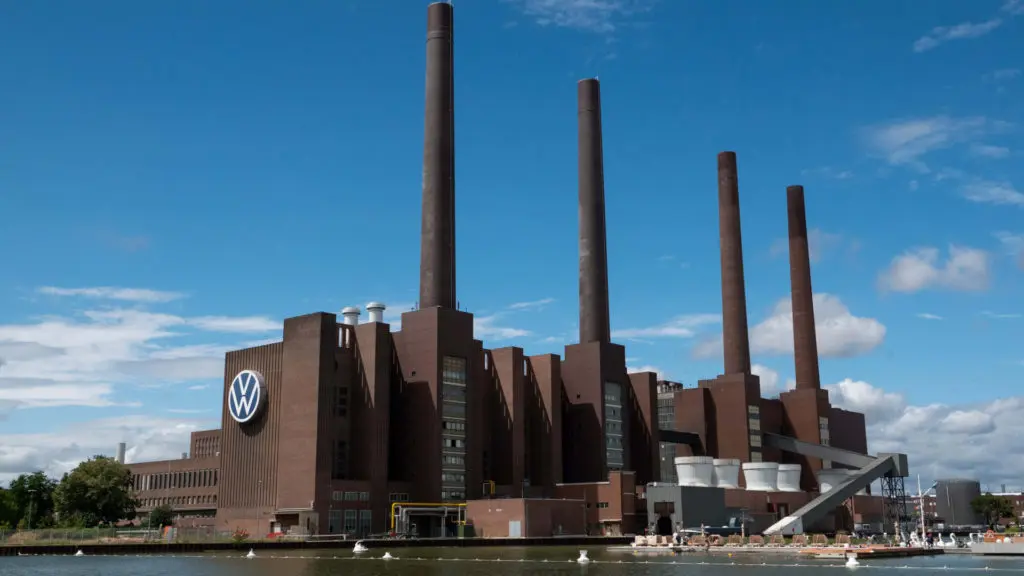
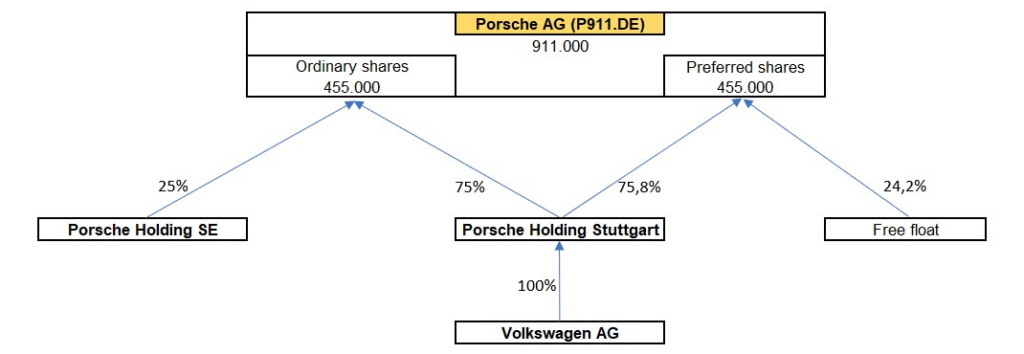
Volkswagen AG is the largest player in the European automotive industry, a concern based in Wolfsburg, which has grown into one of the best-known car manufacturing groups in the world since its founding in 1937. The company's name means "people's car", a name that is now somewhat ironic, since the group's portfolio includes both the EUR 20000 Polo and the EUR 250000 Lamborghini Huracán. The concern includes 12 brands from 7 European countries: in addition to the mass-market Volkswagen, Škoda, and the chain built from SEAT/CUPRA acquisitions, the group also includes Audi, Porsche, Bentley, and Lamborghini in the premium segment. In addition, in the commercial vehicle market, MAN, Scania, and Volkswagen Commercial Vehicles also operate under the VW umbrella. Interestingly, although VW and Porsche cross-own each other, the latter is still listed as a separate company under the ticker P911. We have prepared an in-depth analysis of Porsche, which is also worth reading.
Volkswagen's business model has four main pillars. The first and largest is mass-market passenger car production, which is brought together by the Brand Group Core (VW, Škoda, SEAT, CUPRA). The second pillar is the premium and luxury segment, primarily Audi and Porsche, which have historically provided the lion's share of the group's profits, as I wrote more about in my DAX article.
The third pillar is the commercial vehicle division (TRATON: MAN, Scania), which is the only segment where there was real growth in 2025. The fourth and most problematic pillar is the CARIAD software and digital business, which VW created in 2020 with the aim of putting the entire group's cars on a single software platform, and which has since written itself into the history of the concern with billions of euros in losses, delays and internal frustration.
Volkswagen shares are traded in two forms on the Frankfurt Stock Exchange: The VOW common share has voting rights, while the VOW3 preference share does not have voting rights, but entitles to minimum and additional dividends. The two shares fundamentally represent nearly the same value, but the market pricing sometimes creates a 10-25% discount to the preferred stock, which some investors view as an arbitrage opportunity.
📌In practice: The complexity of the VW Group is both its strength and its weakness. Unlike a BMW or Mercedes, you can never simply say that “premium brands drive profits” at VW, because in some years this is true, but in others it is very much not, such as in 2025, when Porsche closed with almost zero results. This and the complexity of the ownership structure are difficult for analysts to price, which partly explains the persistently low valuation.
? Volkswagen's current situation and its competitors
Volkswagen reached the turning point in 2025, amidst a profit decline of approximately 35%, which will determine whether the company starts the next decade consolidating or stagnating. Net profit fell to €7.3 billion from €11.3 billion the previous year, the company’s worst year since the diesel scandal in 2016. Sales stagnated at around €260 billion (-2.3%), and operating margin fell from 6.7% to 4.1%. The catalysts are both structural and cyclical: US tariffs, one-off impairments from Porsche’s strategy change, loss of market share in China and billions charged to CARIAD all combined to destroy profits.
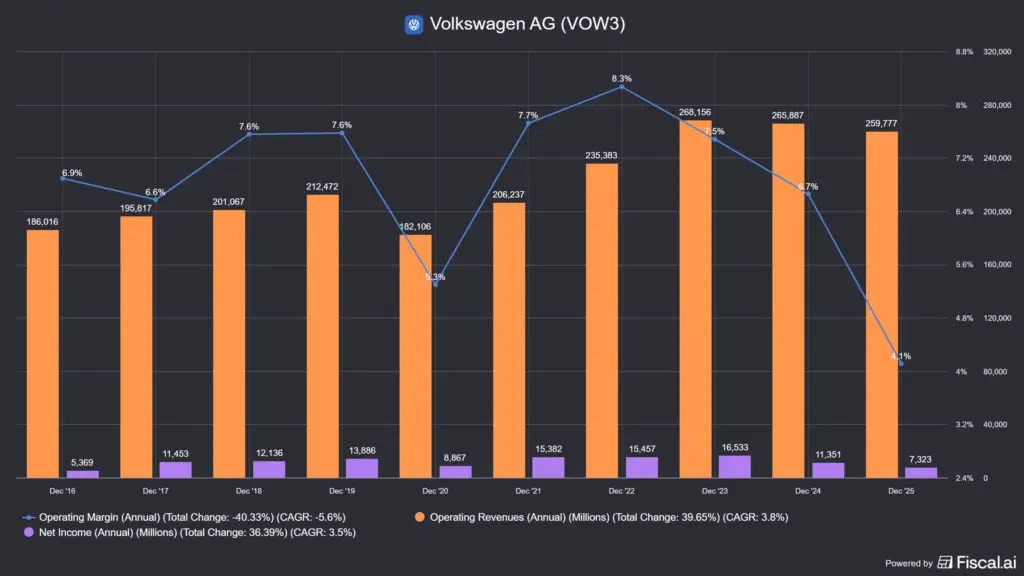
The answer from management is clear: 50000 job cuts in Germany by 2030, factory shutdowns and an aggressive cost-cutting program. Thomas Schäfer, head of Brand Group Core, and CFO Arno Antlitz both indicated that the current profit level is not sustainable in the long term. CEO Oliver Blume is targeting an operating margin improvement of 4-5.5% by 2026, while also stepping down as CEO of Porsche to focus on Volkswagen.
Competitors are pressing VW from three directions. The first and most serious threat is China, where BYD and other domestic manufacturers (SAIC, Geely, NIO, Li Auto) are losing market share from VW at a dramatic pace. The Chinese market used to account for around 35-40% of VW's global sales, but this has now turned into a permanent downward trend. The Chinese are simply developing electric and hybrid models faster, at lower prices and better adapted to local consumer preferences.
| Company | 2025 sales | Change | Position change |
|---|---|---|---|
| toyota motor company | 11.21 million | + 4.8 % | |
| Volkswagen Group | 8.68 million | -0.5% | |
| Hyundai-Kia | 7.27 million | + 0.8 % | |
| General Motors | 6.18 million | + 3.0 % | |
| Stellantis | 5.48 million | + 1.3 % | |
| BYD | 4.60 million | + 7.7 % | +1 |
| Ford | 4.40 million | -2.0% | -1 |
| Geely Group | 4.12 million | + 23.4 % | +2 |
| Honda | 3.46 million | -9.2% | -1 |
| Nissan | 3.21 million | -5.6% | -1 |
The second threat is the slowness of the electric transition. VW entered the EV market with the ID series (ID.3, ID.4, ID.7), but drivers in Europe and North America are switching to electric vehicles slower than expected, which is reducing factory utilization and preventing development costs from being recovered. The turmoil surrounding the CARIAD software platform (delays, errors, shutdowns) has also hindered the digital transformation of the entire group, which is why VW decided in 2024 to partially open its doors to Rivian's software solutions. The third threat is Tesla, which continues to hold strong positions in the European and North American premium EV segments and whose manufacturing efficiency is structurally superior to VW's.
? In practice: Volkswagen’s situation is reminiscent of what we saw with Nokia or Kodak in transition periods, a dominant company with a strong balance sheet struggling to remain relevant in the midst of a technology platform shift. The difference is that VW’s balance sheet is solid, its brand portfolio is valuable, and it has the resources to make the transition. The question is whether the company will move quickly enough to develop new technologies.

? Volkswagen stock metrics
? Exchange rate and the bottom narrative
Volkswagen's share price peaked in 2021 at around EUR 230-240 (VOW3), and has been in a persistent downward trend since then. At the time of writing, in March 2026, the instrument with the VOW3 ticker is trading around EUR 86, which is a decline of around 65% compared to the ATH, and this is not a one-off correction, but a fundamentally supported devaluation process lasting several years. The profit collapse in 2025 only pushed the share price down further, which also shows a negative performance in a 5-year review, representing around -24.1% for the entire period.
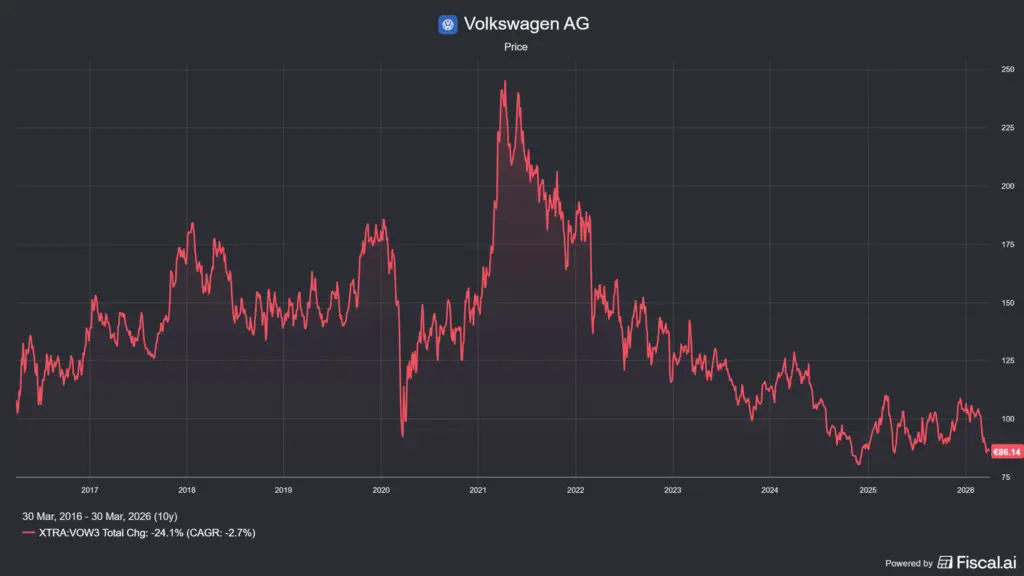
If you look at the price chart, you will see that the VW share tried to recover several times during 2025 near the 100-110 EUR levels, but each time the Volkswagen share price fell back. The announcement of 50000 job cuts in early 2026 caused some positive market reaction, the market interpreted this as a message that "it is finally taking cost reduction seriously", but this did not bring the paper back above 100 EUR permanently. The situation is so bad with the share price that I had to switch from a 5-year time horizon to a 10-year one so that you can see the previous peak in the pictures.
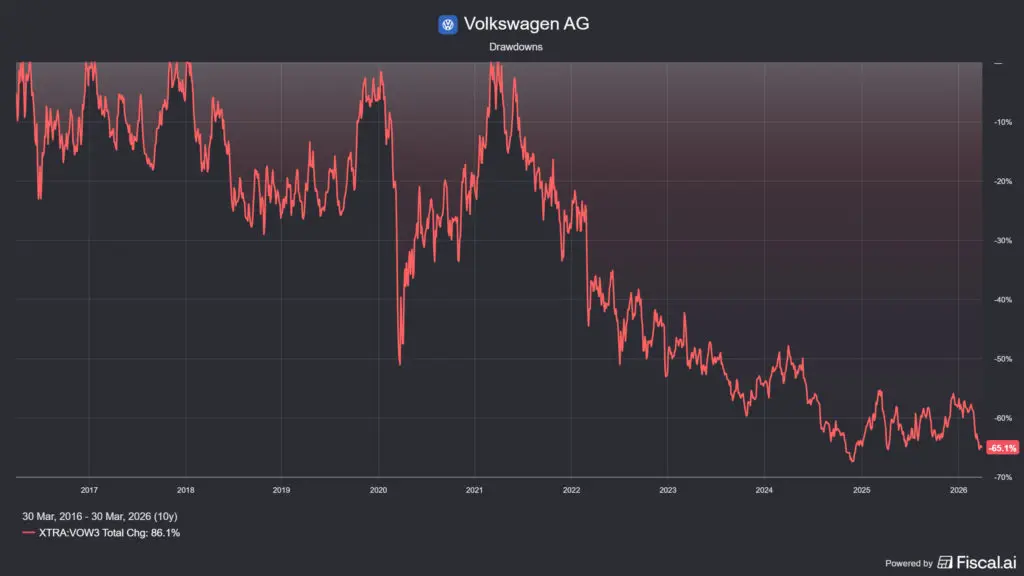
? In practice: After a price drop like this, the first thing you think is, “The paper must be cheap now.” But as with most value investing traps, the real question is: why is it cheap, and is the market pricing the risks correctly? Because if not, you could be walking into a falling knife.
? Valuation: P/E, P/B and the danger of the value trap
Volkswagen's valuation ratios are very low on paper. The P/E ratio is currently around 6.4, and the EV/EBITDA is 9.8, which is also low. Only the P/B ratio is worse, which is barely 0.2, which means that the market values the company at 20% of its book value. This is not only depressed for car manufacturers, but would be the case for almost any company. However, I have previously spoken several times about the value trap, or as it is more professionally called: the value trap. This means nothing more than a value-based investor buying the paper because it looks terribly cheap, but the constantly falling fundamental numbers always follow the low valuation.
That is why these indicators by themselves do not mean much. The problem is that low P/E and P/B in themselves are no guarantee of anything, if profits are permanently declining, then the multipliers are not cheap, they just annak they are visible. Since the struggle has been going on for almost 6 years, that's a long enough time frame even for someone who holds stocks for a longer time horizon. I'm not saying the situation will never change, just that it looks pretty bad right now.
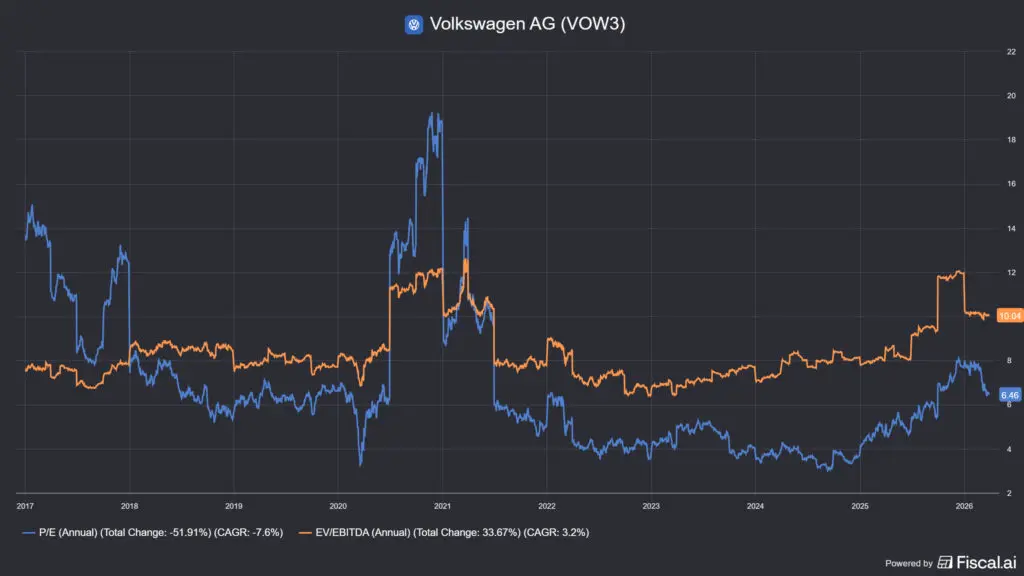
The indicators developed as follows:
- ?current P/E: ~6.4
- ⏳ 3-year average P/E: ~5.06
- ⏳ 5-year average P/E: ~5.2
- ? current EV/EBITDA: ~9.8
- ⏳ EV/EBITDA 3-year average: ~8.3
- ⏳ EV/EBITDA: ~8.06
From the above, it can be seen that the market rewarded poor metrics with depressed valuations, the last time the stock was trading at a higher valuation was right around the peak, somewhere around EUR 240. So the fundamental performance is essentially followed by a realistic price, the stock is trading at a roughly fair value if you look at the P/E or EV/EBITDA ratios. I made one last attempt, I put together a formula for the NOPAT yield with the fiscal.ai stock selection service, but it didn't show any different numbers either. This is an inverse metric, meaning that a low value here means that the company is not really cheap.
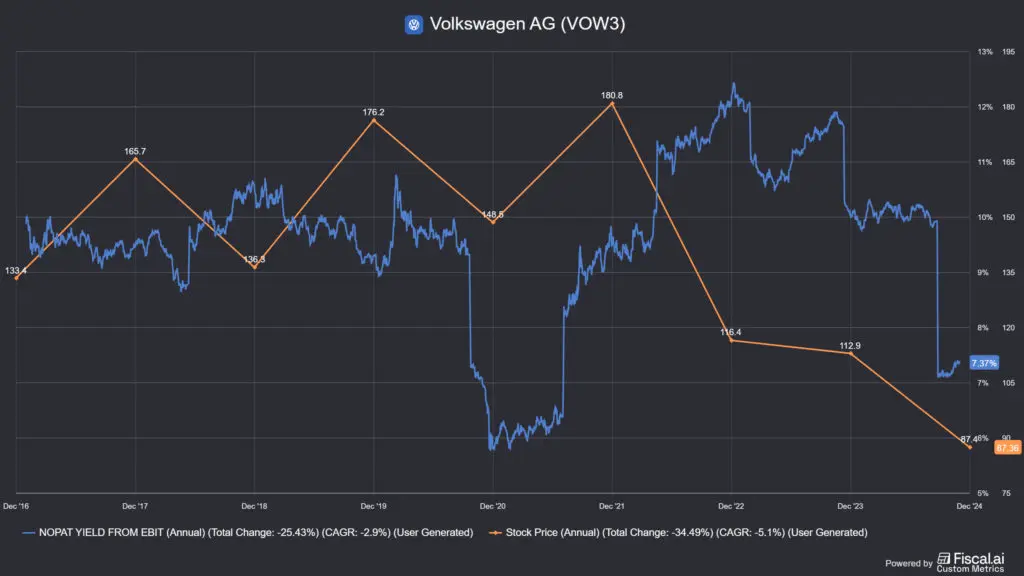
? In practice: A P/B of 0.2 means that the market values the company at a fraction of its equity, but in all other respects it is around fair value. When would book value be relevant? If Volkswagen went bankrupt and the company's assets were sold off, the investor would be fine, but it is not a net/net stock, so in this case it is not worth drawing many conclusions from it.
? Revenues and profitability
The numbers for 2025 show a clear picture:
- ?Operating income: EUR 260 billion (-2.3% YoY)
- ?Operating profit: EUR 13.2 billion (-38.8% YoY)
- ?Net profit: EUR 7.3 billion (-35.5% YoY, worst since 2016)
- ?Operating margin: 4.1% (2024: 6.7%)
- ?Vehicles delivered: 8.68 million units (-0.5% YoY)
The sources of deterioration are easily identifiable. Porsche, previously the group's best-performing segment in terms of profit, saw its operating profit fall from EUR 5+ billion to just EUR 90 million, which is explained by one-off impairments and the costs of rewriting the EV strategy, but the numbers still look terrible. Audi and Lamborghini also had a weaker year than before. US tariffs imposed a burden of EUR 1.4 billion on the entire group. The only bright spot was the TRATON truck division, which was able to increase its results.
The outlook for 2026 promises a cautious improvement: management is targeting a slightly improving operating margin, which if achieved could increase operating profit to around EUR 13-18 billion, but this is still light years away from what VW previously put on the table. In light of this, I would not expect Volkswagen's share price to soar, and I think investors can expect a prolonged struggle.
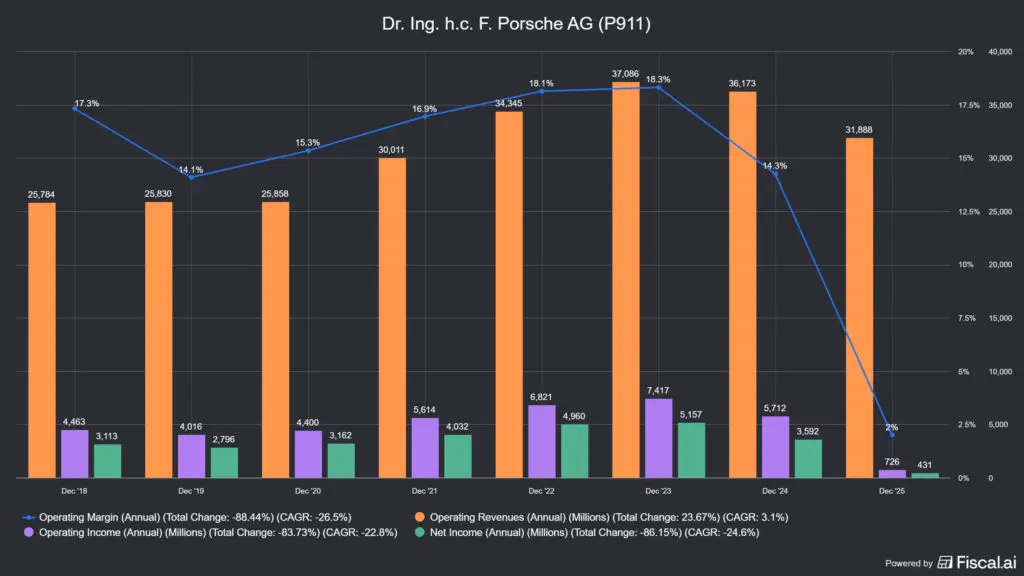
? In practice: The biggest problem with car manufacturers is that they operate in a capital-intensive segment, where competition is extremely cutthroat due to the intrusion of Chinese manufacturers. It is not really clear how Volkswagen could stand up to technologically more advanced electric cars, the tailwind and political will of the Chinese state, and Porsche is not in a better position either, although it is perhaps a bit easier to do this in the premium category. But the two companies are strongly tied to each other due to their similar ownership.
? Efficiency: ROIC and the curse of capital intensity
The automotive industry is structurally a capital-intensive industry: you have to maintain factories, develop platforms, build battery production. VW's ROIC has historically been around 5-8%, which is well below the required cost of capital, which we typically set at 10% when specific data is available. This means that the company is structurally destroying value, not creating it, which is why I never buy shares of automotive companies, unless there is a special case, which is not the case now. With the deterioration of earnings in 2025, this indicator has fallen further.
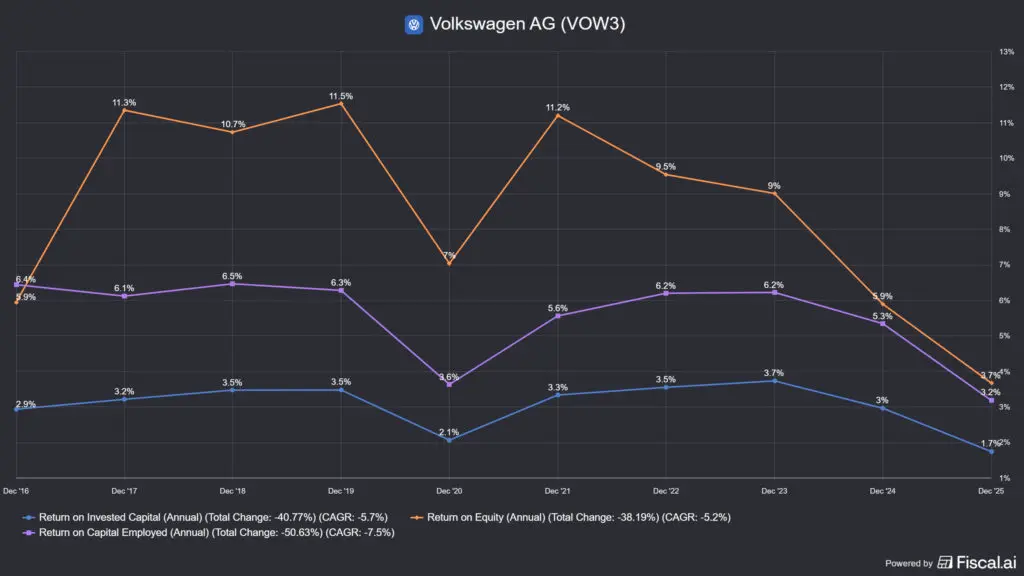
The free cash flow of the automotive business in 2025 shifted strongly to the negative in the automotive segment due to one-off items, impairments and investments. The group maintains ~65 billion EUR in bond and cash reserves on a consolidated level with a net debt of 200 billion EUR, which is roughly enough to pay down the loans, but this is not the capital structure I would like to see in my own portfolio.
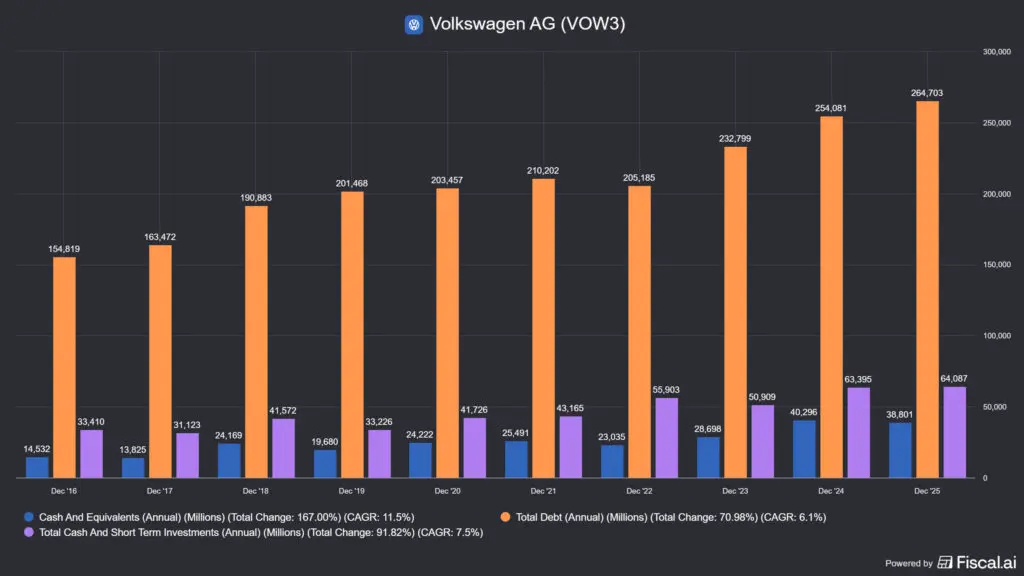
? In practice: The automotive industry has always been an industry with poor ROIC, including the best players, with the only exceptions being Ferrari (RACE) and Tesla for 2-3 years. In VW's case, this is further exacerbated by the investment requirements of the electric transition. However, those who believe in mean reversion tactics can try to hold the stock with great conviction, but I think Volkswagen stock will move down rather than up in the near future.
? Risk factors: China, tariffs, electric transition and the holding structure
- ? Labor tensions: The plan to cut 50000 jobs is generating serious conflict with the IG Metall union. German labor laws offer strong employee protections, so the restructuring will be slower and more expensive than expected.
- ?? Loss of market share in China: This is VW's biggest structural challenge. The Chinese market used to account for ~35-40% of global sales, and this share is steadily decreasing in favor of domestic manufacturers (BYD, Geely, SAIC). The pace of development of the Chinese EV market shows that VW will not be able to regain its lost positions there anytime soon, or if it does, it will only be at the cost of price discounts, which will worsen margins.
- ? Electrical switching and CARIAD risk: The long delay and billion-dollar losses of the CARIAD software platform indicate that the group's software competence is not yet meeting expectations. The Rivian partnership may alleviate this, but this is also a factor of uncertainty.
- ? Porsche-Piëch holding structure: Volkswagen is controlled by the Porsche-Piëch family through the holding company Porsche SE. This leads to internal conflicts of interest (e.g. the 2022 IPO of Porsche AG would have resulted in huge premiums for Porsche SE) and means that small investors have minimal voting power. This governance structure generates a permanent valuation discount.
- ?? Customs risk: The import tariffs imposed by the US will have an impact of EUR 1.4 billion on the group in 2025. If trade tensions remain at a persistently high level or escalate, this will mean a permanent loss of margins.

Volkswagen stock: will you get used to it or will you run away?
The investment debate surrounding Volkswagen stock is not as emotional as Tesla's, but it is more fundamental. The question is: is a company with operating income of EUR 260 billion and a market capitalization of EUR 44 billion cheap or does it deserve a structurally low valuation?
? Bulls say (Optimistic scenario):
- ? Extremely low rating: The P/B is ~0.2, meaning the market is paying less for the company than its factories, brands, and assets are worth on book. If management manages to normalize margins by 2026-2027, the current price will look extremely cheap in retrospect.
- ? TRATON and the truck division: The undervalued TRATON group (MAN, Scania) is showing growing results and is also listed on the stock exchange. This segment represents a kind of safety net against the fluctuations of the passenger car business.
- ? EV portfolio and platform: VW ID models have a real market presence in Europe, the battery production program (PowerCo) could become a competitive advantage in the long term if the transition accelerates and the Chinese do not get even bigger.
- ✂️ Serious cost reduction program: The 50000 job cuts and factory closures are painful in the short term, but if implemented, the group's fixed cost structure could generate annual savings of EUR 5-6 billion.
? Bears say (Pessimistic scenario):
- ?? China is structurally lost: The competitive advantage of BYD and Chinese manufacturers (shorter development cycle, lower price, local preference) is not a cyclical phenomenon, but a sign of the development of a permanent competitive disadvantage. VW's Chinese share will probably not return to its previous level of 35-40%.
- ? The CARIAD problem is a symptom, not a cause: The lack of software competence is not only the failure of CARIAD, but also the fact that VW's cars are lagging behind Tesla and Chinese manufacturers in the software-defined vehicle (SDV) era. Today, a car is not about the driving experience, the feeling of shifting, but rather a tech gadget: what software functions it has that sell it to the consumer. This is a development disadvantage of many years, which is difficult to overcome.
- ?️ Holding structure and management: The control exercised through Porsche SE is unfavorable for retail investors and justifies a permanent discount in valuation.
- ? Danger of value trap: A low P/E is cheap if profits normalize. If structural problems (China, EV transition, software) are not resolved and profits remain low for a long time, then the seemingly depressed but not otherwise depressed valuation will remain persistent, and mean reversion will not occur.
- ⚙️ Cyclical industry, unfavorable macro: The automotive industry is one of the most cyclical segments. If the European economic slowdown deepens or consumer confidence continues to decline, sales numbers will deteriorate quickly, and VW's high fixed costs will cause profits to fall even faster.
? In practice: VW stock is a typical case of something “valuable, but not necessarily value-creating.” I don’t really like the auto industry, it’s simply too capital-intensive, too cyclical, and the competitive disadvantage in the Chinese market is too structural. If I were looking for European auto exposure, I would take a closer look at Ferrari (RACE), which positions itself as a luxury manufacturer, and pass on Volkswagen stock, but I would do so even if the bulls weren’t on them.

? Summary of Volkswagen stock situation
Volkswagen's share price has been trending downward for 6 years, and it's not very clear what would change this. A brutal profit drop, the collapse of the Porsche division, and the loss of market share in China hit the group all at once. Looking behind the numbers, it's not very clear what exactly should cause things to turn around: revenue and profit drop, mass layoffs, factory closures, this looks pretty bad and I don't think there would be much change in this in the short term.
? Anyone holding or looking to buy Volkswagen shares today doesn't have to decide whether the auto industry has collapsed. They have to decide whether the largest player in the European auto industry can adapt quickly enough to the competitive environment created by Chinese manufacturers and the EV transition.
Remember, this mini-analysis does not replace your own research, but it will help you decide whether it is worth devoting dozens of hours to an in-depth analysis of Volkswagen, or whether it is enough to just keep the paper on your watch list.
If you want to analyze further, use iO Charts' stock finder and portfolio manager, which you can access here: iO Charts.
Frequently Asked Questions: Professional questions about Volkswagen shares
Why did Volkswagen's share price fall so much?
Volkswagen's share price has fallen by nearly 65% since 2021. The decline is driven by several mutually reinforcing factors: the loss of market share in China (where BYD and other domestic brands are losing share), the investment burden of the electric transition, billion-dollar losses from the CARIAD software platform, the impact of US tariffs, and the dramatic drop in profits in 2025. All of these factors together explain the persistent valuation devaluation.
What is the difference between VOW and VOW3 shares?
VOW is the common share of Volkswagen AG, which carries voting rights. VOW3 is the preferred share, which does not carry voting rights but entitles to minimum and additional dividends. Fundamentally, the two shares represent nearly the same value, but in market pricing, the preferred share typically trades at a 10-25% discount to the common share.
What brands belong to the Volkswagen Group?
The VW Group comprises 12 brands: Volkswagen, Škoda, SEAT and CUPRA in the mass market segment; Audi, Porsche, Bentley and Lamborghini in the premium segment; MAN, Scania and Volkswagen Commercial Vehicles in the commercial vehicle sector. The group also includes the commercial vehicle holding TRATON and the financial division VW Financial Services.
What is CARIAD and why is it a problem for Volkswagen?
CARIAD is a software subsidiary of Volkswagen founded in 2020 with the aim of putting the entire group's cars on a single digital platform. The project has produced a series of delays, billions in losses and internal conflicts, and has shown the shortcomings of the entire group's software competence. In 2024, VW partially opened CARIAD to Rivian's software solutions, indicating that it could not solve the problem alone.
Does Volkswagen stock pay dividends?
Volkswagen has historically been a regular dividend payer, but the dramatic drop in profits in 2025 raises the question of whether the dividend rate will be reduced next year. The preference share (VOW3) entitles to a minimum dividend, but the actual dividend rate depends on the decision of the general meeting from year to year. Investors must definitely price in this uncertainty.
How does the Chinese market affect Volkswagen's investment thesis?
The Chinese market used to account for 35-40% of VW's global sales, and this share is steadily declining. BYD, Geely, SAIC and other Chinese manufacturers are developing electric models faster, at lower prices and better tailored to local consumer needs. This competitive disadvantage is not cyclical but structural and represents one of the most serious risks to VW's profitability in the medium term.
Legal and liability statement (aka. disclaimer): My articles contain personal opinions, I write them solely for my own entertainment and that of my readers. The articles published here do NOT in any way exhaust the scope of investment advice. I have never intended, do not intend, and am unlikely to provide such in the future. What is written here is for informational purposes only and should NOT be construed as an offer. The expression of opinion is NOT in any way considered a guarantee to sell or buy financial instruments. You are SOLELY responsible for the decisions you make, and no one else, including me, assumes the risk.