

- The point: A stablecoin is a cryptocurrency whose exchange rate is pegged to a traditional asset (most often the US dollar), thus free from the extreme volatility typical of Bitcoin or Ethereum.
- Types: There are centralized (backed by bank dollars), decentralized (overcollateralized by cryptocurrency), and the new generation of delta-neutral stablecoins.
- The cornerstone of DeFi: Stablecoins form the backbone of decentralized financial infrastructure. They provide a risk-free foundation for lending markets, stock exchanges, and yield farming.
- Risks: The main risks are “de-peg” (when the exchange rate breaks away from $1), regulatory risks, and the freezing power of centralized issuers.
Bitcoin and Ethereum are huge innovations from a technological perspective, but as financial instruments they suffer from a huge problem: extreme exchange rate fluctuations (volatility). If you trade an asset or borrow money in a smart contract, you can't use a currency as a unit of account whose value can fluctuate by 10-20% daily. A bridge was needed between the traditional financial world (TradFi) and blockchain technology.
Stablecoins filled this void. These are digital tokens that exist on the blockchain, but their value is artificially tied to, for example, 1 US dollar, the euro, or even the gold price.
By 2026, stablecoins will have become more than just simple means of payment, but the lifeblood of the entire multi-billion dollar DeFi ecosystem. But how can a cryptocurrency remain stable, and what are the business models behind it?
💲3 main categories of stablecoins
Not all stablecoins work the same way. The most important difference between each stablecoin is the mechanism by which they ensure that their tokens can track the exchange rate of the US dollar (or other asset), this is called the pegging mechanism. We currently distinguish four main categories:
🪙1. Centralized, fiat-backed stablecoins
Let's take a closer look at the business models of the largest traditional companies in the sector. Stablecoin issuers accept fiat deposits (dollars, euros, etc.), invest them in short-term government securities, and in return issue blockchain-based tokens (stablecoins). For example, the USDC token issued by Circle fluctuates around a very narrow value of $1 on the blockchain, as the company issues 1 USDC when $1 is available as a reserve in their traditional bank account, so 1 USDC can be directly redeemed for $1 at any time.
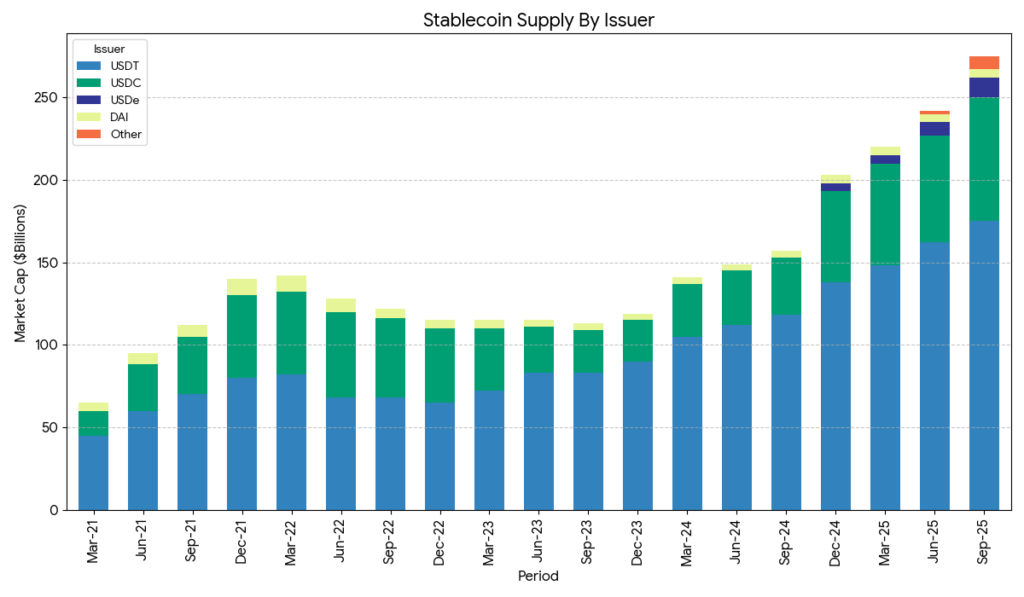

The two largest players are Tether and Circle, which are issuers of the dollar-based stablecoins USDT and USDC.
💡Recently, a few crypto-native projects have also started moving in this direction, and although the business is not conducted through a traditional company like Circle and Tether, the stablecoin issuance and collateral management work in the same way. For example, Frax Finance's new stablecoin, frxUSD, is also based on this (frxUSD).
If the price of a token regularly deviates from $1, investors will not use it for this purpose, since the point is that the price does not fluctuate. Fortunately, the pegging mechanism of Circle and Tether is very safe, and the tokens can be redeemed at any time for the traditional currencies or assets that represent them.
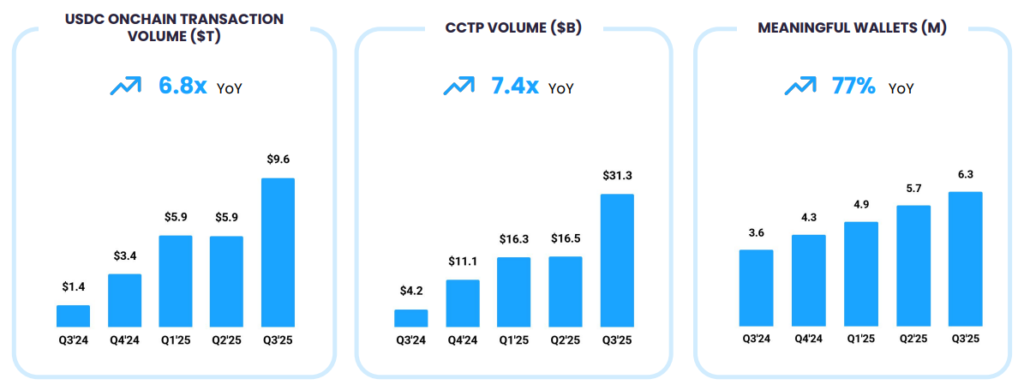
Stablecoins have now become one of, if not the most important assets of the blockchain network, with the majority of transactions on the networks being carried out with some kind of stablecoin. As can be seen in the chart below, USDC's usage has grown rapidly over the past year, along with its market capitalization, and this is supported by all industry data.
- The advantage of the model is extreme liquidity and stability. These are huge companies with a huge amount of tokens in circulation (USDC, USDT).
- The risk is that these companies are centralized. If the authorities decide to do so, Circle or Tether can freeze the tokens in your wallet with the click of a button, as has happened before. This has been done in the case of illegal activities, of course, but it still goes against the basic philosophy of blockchain, which is that the owner has complete control over their assets.
💡Circle also issues euro-based stablecoins (EURC), and Tether also issues Chinese yuan (CNHT), Mexican peso (MXNT), and gold (XAUT)-based ones, but their overall size dwarfs that of USDC and USDT.

In 2026, 99+% of stablecoins on the blockchain will track the US dollar exchange rate, 0.5% will track the EUR, while the share of all other currencies will be negligible.
2. ⛓️Decentralized, overcollateralized stablecoins
These are not issued by a company, but by smart contracts. To guarantee the $1 value, users must deposit another cryptocurrency (e.g. Ether or Bitcoin) as collateral. Since the price of Ether fluctuates, the system is over-collateralized: For example, you would need to deposit $150 of ETH to generate (mint) $100 of stablecoin. If the price of ETH falls, the smart contract will automatically sell (liquidate) your collateral to preserve the value of the stablecoin.
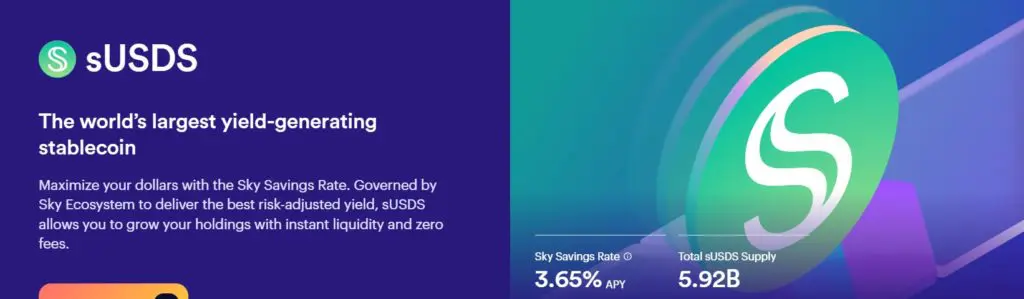
One of the earliest players in overcollateralized stablecoins was MakerDAO, with the DAI stablecoin (the very first was BitUSD, but that project did not survive), where ETH tokens were initially used as collateral, and other assets were later made available, including the USDC stablecoin (issued by a traditional company, Circle, more on that in the previous section). For this reason, MakerDAO received a lot of criticism, as many saw it as going against the crypto ethos and DAI was no longer only backed by crypto-native assets. Despite this, the project is one of the most successful crypto projects to date. In the meantime, they changed their brand and MakerDAO became Sky, and instead of DAI, they are issuing a new stablecoin, sUSD. (although DAI is also in parallel circulation) (Sky.money, SKY)
The Liquity project works on the same principle, where the focus is on the entire crypto-native mechanism and the system only uses ETH tokens as collateral. This project is one of the most independent from regulatory risk. It is the issuer of LUSD and BOLD stablecoins. (Liquidity, LQTY)
It is worth mentioning the crvUSD token issued by Curve Finance, which ensures exchange rate stability through an innovative mechanism (crvUSD, CRV). While in other projects, if the collateral value drops below a critical level, the system usually liquidates the entire position (which is one of the most unpleasant things for borrowers), in the case of crvUSD, the system continuously adjusts the collateral value as prices change. This is convenient for borrowers on the one hand, as they do not have to constantly monitor the value of the collateral, and on the other hand, there is never a sudden liquidation.
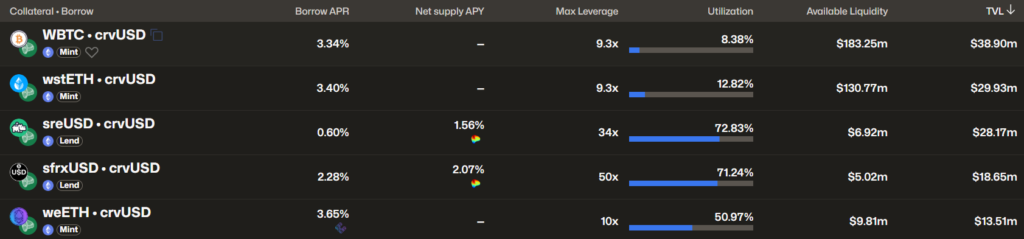
The model has many other representatives, at the time of writing the largest crypto project, Aave, has also issued its own stablecoin, GHO, which can be minted against an existing Aave lending position (AAVE). A few of the early projects are still in operation, such as Abracadabra, whose stablecoin has been heard of by almost everyone in the crypto community (the token is called MIM, or Magic Internet Money).
However, a serious problem with this model is that the maximum amount of stablecoins that can be issued on this basis is limited by the size of the crypto market. Since a minimum of $1.2-1.3 worth of collateral is required to issue 1 stablecoin, even if all existing crypto assets were used as collateral in such smart contracts, only 70-75% of the total crypto market capitalization could be issued in stablecoins. And considering how many other things crypto assets can be used for, this number is significantly lower in practice.
So, while it is a great mechanism, it is impossible to rely on this single emission system in practice.
💡It is worth mentioning here those tokens that are generally considered stablecoins, but in practice their value fluctuates much more than the above-mentioned assets. An example is Alchemix Finance's token, alUSD, which is intended to loosely follow the exchange rate of the US dollar, but the essence of the system's design is that it should always be worth a few percentage points less (Alchemix fixed-yield product).

Another interesting example is the RAAC project that issues pmUSD, which uses gold as collateral for pmUSD. The problem is that if the price of gold drops dramatically, the collateral cannot be liquidated as easily as in the case of fully crypto-native protocols. The collateral can be liquidated and repaid through lengthy legal proceedings. That is why at the time of writing the article, the price of pmUSD is $0.87, despite the fact that the system is over-collateralized by 120%.

It's worth talking about these unique mechanisms because, as you can see, we can't always be sure that when we buy a stablecoin, its value will actually be $1 when we want to sell it.
3. ↕️Synthetic and delta-neutral stablecoins
Important innovations for the period 2024-2026. The system maintains the $1 price by taking an opposite (short) position in the futures market (perpetual futures) in parallel with the deposit made in the smart contract. So if the crypto market falls or rises, the two positions cancel each other out (delta-neutral), and the value remains at $1.
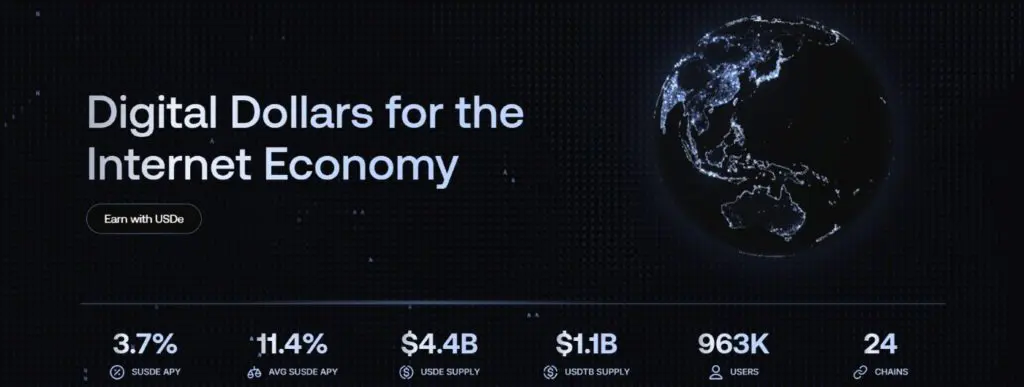
The most important current representatives of this system are Ethena and the USDe token. Here, similarly to the previous ones, there is collateral in the smart contracts, but instead of liquidation occurring in the event of a decrease in the value of the collateral, the system ensures that this never has to be resorted to, as it stabilizes the value of the collateral with hedging mechanisms.
The project generates returns on the assets used as collateral, which it distributes back to USDe owners.
4. 🎢Other stablecoins
When DeFi first started, countless projects were launched with the goal of creating a working stablecoin. In general, they tried to solve the above problem, namely that collateral is needed to create a stablecoin. There were several imagined solutions, but in most cases a dual-token structure was intended to solve the problem.
The essence of the dual-token structure is that a project creates two tokens: the stablecoin itself and a governance token. The governance token effectively offers control over the project, in the traditional sense it would be equivalent to a share in a company. Governance tokens are still used today, most crypto-native projects issue such tokens (More details here: Crypto Fundamental Analysis Guide and Tips). By purchasing and burning (destroying) the governance token, we can print (mint) the project's stablecoin. For burning $1 worth of governance token, we get 1 stablecoin.
This works very well as long as the price of the governance token goes up. If someone wants to get a stablecoin, they have to buy it from the governance token, which constantly increases the price of the governance token and more and more stablecoins can be printed for 1 governance token. However, if the owners want to leave the system and convert their stablecoins back, the system prints governance tokens (minting) in exchange for burning the stablecoin. This governance token is sold by the user, thereby reducing its price. If many people leave the system, it causes hyperinflation and the governance token becomes completely worthless. At this point, the system becomes insolvent, there is no collateral behind the issued stablecoins and the value of the stablecoin itself collapses.
Perhaps the most famous representative of this, but certainly the one that caused the largest crypto market crash, was the TERRA-LUNA project, which began to collapse in May 2022 after issuing a stablecoin worth $18 billion (UST) and based on the mechanism described above, the price of the governance token first fell to zero, and then, at the same time, the price of the UST. More on Wikipedia: Terra (blockchain)
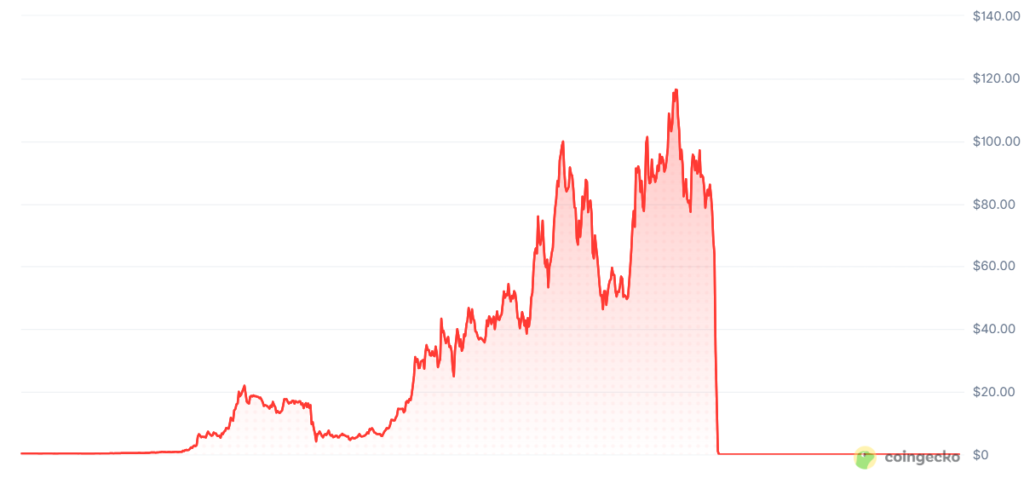
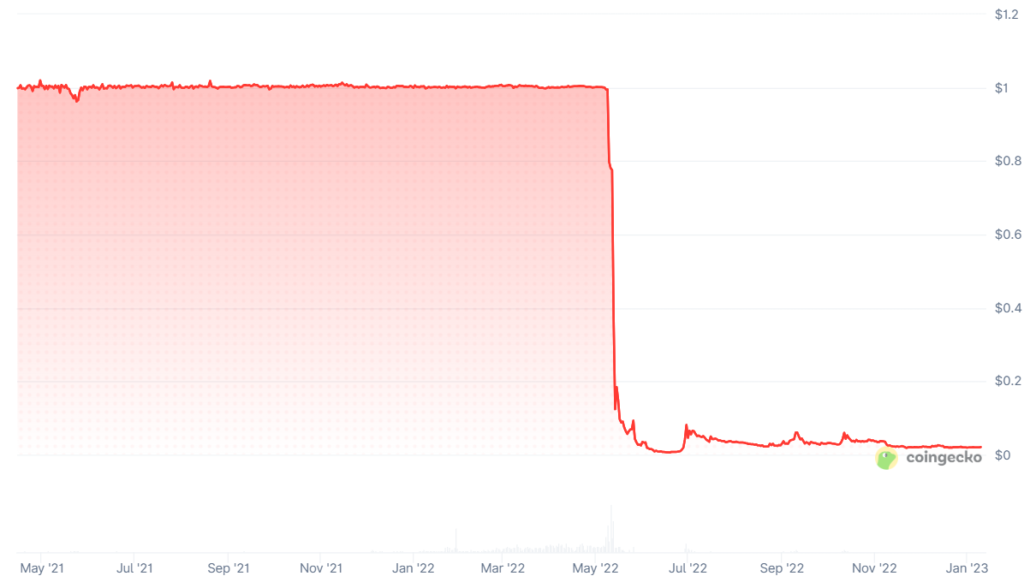
This same scenario has played out before, but in this case the crash took the entire crypto market with it due to its sheer size. After that, everyone became much more cautious about projects operating on a similar principle, and now almost all projects use more traditional, proven methods.
💰How can you make money with stablecoins?
Stablecoins aren’t just for temporary use. Since their exchange rates don’t fluctuate, they’re perfect for risk-averse investors. Instead of keeping your dollars in the bank for 1-3% interest per year, you can lend a stablecoin through an Aave smart contract or provide liquidity to a USDC/USDT pair on Curve, generating a stable, dollar-based, 5-15% annualized passive income (APY) without having to worry about Bitcoin’s price falling.
This is how most traditional investors get introduced to the world of crypto through stablecoins. They can try out blockchain technology without having to worry about price fluctuations.
💡We wrote about yield farming in detail in a previous article, you can read it here: How can your assets generate money? What is yield farming?
👁️Risk management and transparency
It is very important to keep risk management in mind when using crypto. Hacker attacks occur every day, resulting in the permanent loss of users' capital.
In addition to proper preventive research, smart contract risks can only be reduced through diversification. The goal is to prevent all of your assets from being lost due to a hidden bug in a smart contract. This means that you are forced to hold your assets in multiple places and in multiple tokens (most tokens are smart contracts themselves, so they carry their own risks, even if this risk is lower than in the case of complex smart contracts). However, tracking a properly diversified portfolio is not trivial, and you will definitely need a portfolio tracker where you can see your exposure to each token or project. It doesn't hurt to be able to track the value of your rewards as well.
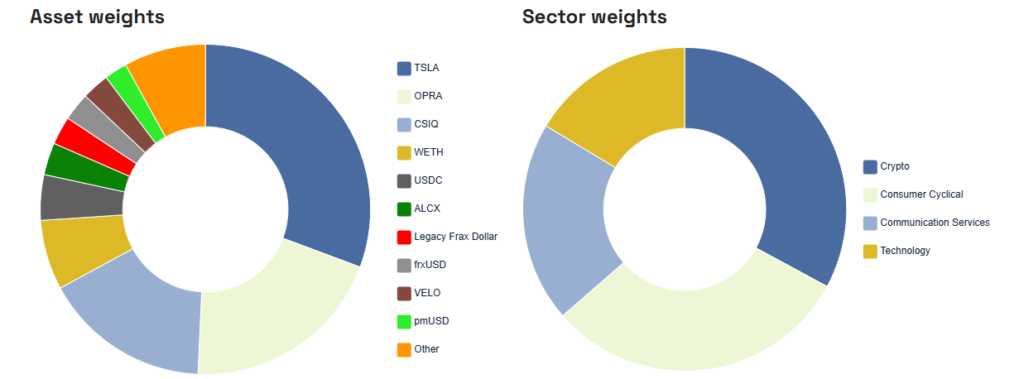
We can help you with this with our portfolio tracker specialized in DeFi projects, where you can track the contents of multiple web3 wallets at once, along with your stocks and ETFs, providing full coverage for your financial portfolio.
💡Diversification and proper portfolio tracking together make DeFi risks manageable. Try our Portfolio Tracker: iO Charts Portfolio Manager
Frequently Asked Questions about stablecoins
Answers to the most common questions
Would you like to use a stablecoin but don't understand how it can hold the dollar? Here you'll find concise answers to the most frequently asked questions: can a stablecoin lose its $1 value, how does Tether differ from Circle, what kind of returns are realistic in DeFi, how to convert traditional money to stablecoins, and are decentralized versions safe.
Click on any question and the answer will open. These are intentionally brief summaries: if you are interested in the details — from the four pegging mechanisms to the hedging mathematics to the collapse of TERRA-LUNA — we will expand on them in more detail in the appropriate sections of the article.
Can a stablecoin lose its $1 value?
Yes. This is called “de-peg.” If the issuing bank goes bankrupt (as happened briefly with USDC during the Silicon Valley Bank crisis) or the code fails on a decentralized token, the price can drop below $1. However, well-structured stablecoins have always recovered their value.
What is the difference between Tether (USDT) and Circle (USDC)?
Both are centralized, fiat-backed stablecoins, but they differ in transparency and regulation. USDC is issued by a US-based company (Circle), subject to strict US financial regulations and regular audits. Tether (USDT) is the most liquid and largest token, but it operates in an offshore structure and has historically had less transparency in its collateral.
What kind of returns can be achieved with stablecoins in DeFi?
It depends on the market cycle. In a bull market (when many people borrow to trade with leverage), stablecoin lending rates can be as high as 10-20% per year. In calmer, more consolidated markets, this is usually in the 5-8% range, which is still significantly higher than traditional bank dollar rates.
How can I convert my traditional currency (fiat) to stablecoin?
The easiest way is to use a regulated, centralized exchange (like Kraken, Coinbase, or Binance). Here you top up your euros or dollars with a traditional bank card payment or SEPA bank transfer, then convert them to USDC or USDT with one click, which you can then withdraw to your own DeFi wallet (e.g. MetaMask).
Are decentralized stablecoins (e.g. DAI/USDS) safe to use?
MakerDAO’s system is one of the oldest, most tested, and most resilient smart contract networks in DeFi. With no central bank account that a government can freeze, many investors see decentralized stablecoins as the true, censorship-resistant “crypto dollar.” However, there is always the risk of coding (smart contract) errors.
Legal and liability statement (aka. disclaimer): My articles contain personal opinions, I write them solely for my own entertainment and that of my readers. The articles published here do NOT in any way exhaust the scope of investment advice. I have never intended, do not intend, and am unlikely to provide such in the future. What is written here is for informational purposes only and should NOT be construed as an offer. The expression of opinion is NOT in any way considered a guarantee to sell or buy financial instruments. You are SOLELY responsible for the decisions you make, and no one else, including me, assumes the risk.