
The evolution of blockchain technology over the past decade has largely been confined to the digital space. Decentralized finance (DeFi) has revolutionized lending and NFTs have revolutionized digital ownership, but the physical infrastructure of the real world has remained untouched. Until now. By 2026, DePIN (Decentralized Physical Infrastructure Networks) has emerged as one of the most important, fundamental value-creating sectors of the crypto economy.
This article provides a comprehensive, data-driven, and investor-focused analysis of what DePIN is, how it is transforming the global telecommunications, computing, and energy markets, and details the best DePIN projects in the current market environment.
⚙️How does DePIN work?
Traditional physical infrastructure – whether it’s a 5G mobile network, a cloud-based data center (AWS, Google Cloud) or global map databases – is built by giant corporations. This model requires incredible capital expenditure (CapEx), is slow to scale, and creates monopolies that result in high prices for end users.
DePIN, on the other hand, is a bottom-up model. The network is not owned by a single company, but is built by independent individuals and smaller companies. They buy and operate the hardware – servers, routers, sensors – and are (usually) rewarded for this work with the network’s own cryptocurrency or other tokens.
💡These projects are based on real economic value creation, so fundamental analysis based on financial results can be effectively applied. However, fundamental analysis works specifically for crypto projects compared to a traditional stock, as we wrote about in detail in our previous article: Crypto Fundamental Analysis Guide and Tips
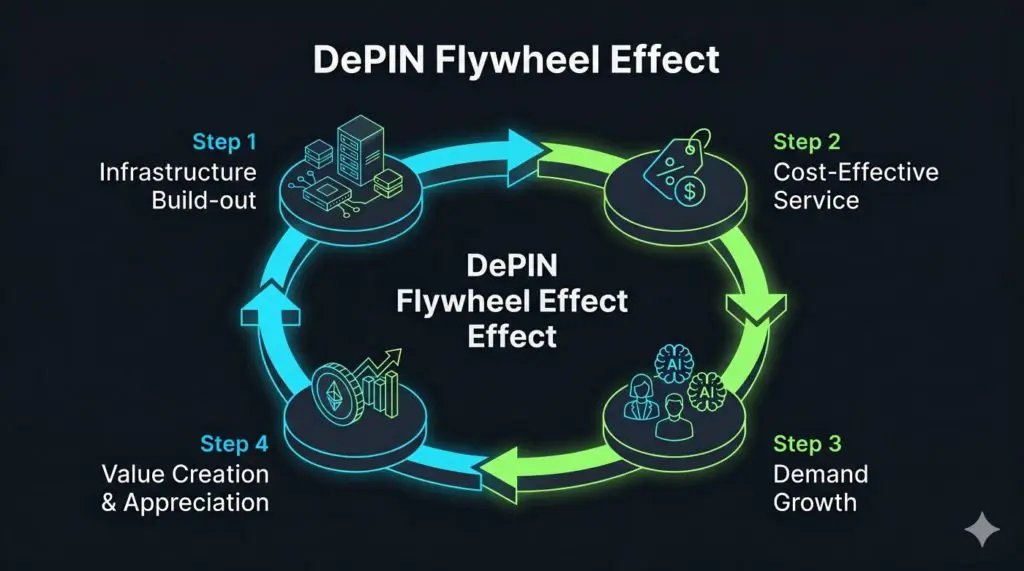
🛞The DePIN flywheel economic model
The sustainability and explosive growth of the sector is based on a token-based incentive system, the so-called flywheel effect:
- 🏗️Infrastructure development: When a project is launched, token rewards make it attractive to join early. Operators buy hardware, trusting that the token will appreciate in value (or at least maintain its value) in the future.
- (I.e.Cost-effective service: Because the network has no central real estate and overhead costs, the service it provides (e.g., cloud storage or bandwidth) can be offered at a fraction of the market price (often 70-90% cheaper).
- 🫱Demand growth: Low prices attract real users and enterprise customers (Web2 companies, AI developers).
- ↗️Value creation and token appreciation: Paying customers pay for the service with dollars or other fiat money, which the protocol uses behind the scenes to buy tokens and often burn them (Burn-and-Mint). This drives up the price, which attracts more hardware operators. This is of course just one popular model, but there are other mechanisms. The point is to have users who pay for the service, because that’s what makes it truly valuable.
💡The tokens issued by these projects are created on the blockchain, where they are owned by users and can be bought, sold, and used for other financial transactions. To implement these, a financial infrastructure is needed, which is why DeFi (Decentralized Finance) was created. If you are new to this topic, read our article introducing the sector: DeFi Guide for Investors
⛓️PRN and DRN: The two main types of networks
Analysts classify the DePIN market into two basic categories based on the nature and location of the physical devices:
- 📍PRN (Physical Resource Networks): These networks require stationary hardware. A 5G antenna or a weather sensor can only create value where it is physically deployed. This includes wireless networks, energy systems, and mapping drones/cameras.
- 💻DRN (Digital Resource Networks): These networks provide interchangeable, location-independent resources. It doesn't matter to the user whether the server that trains the AI model is in Iceland or Tokyo. This includes cloud computing, data storage, bandwidth sharing, or VPN services.
🔝What are the best DePIN projects in 2026?
The maturity of the sector is indicated by the fact that by 2026, "blue-chip" projects will have real market revenue (Demand-side Revenue) in the tens of millions of dollars. Let's see the leaders of the categories.
💡You can find detailed descriptions of each project in the reports published by Messari: State of DePIN report
1. 💻Computing capacity and AI (Compute/GPU)
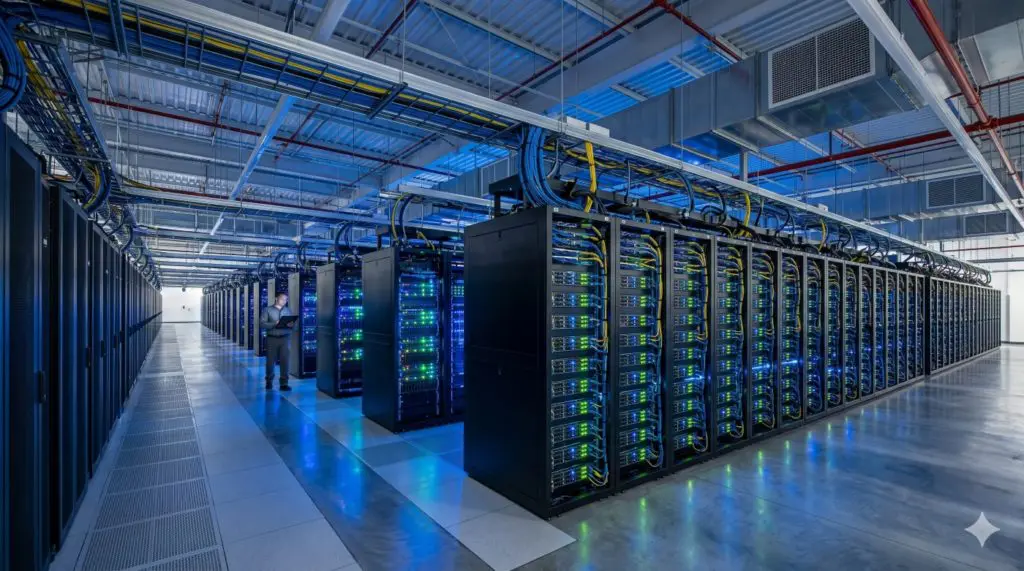
The development of the artificial intelligence industry has created an unprecedented shortage of GPUs (video cards) in the world. DRN networks solve this shortage by aggregating the world's unused server capacities.
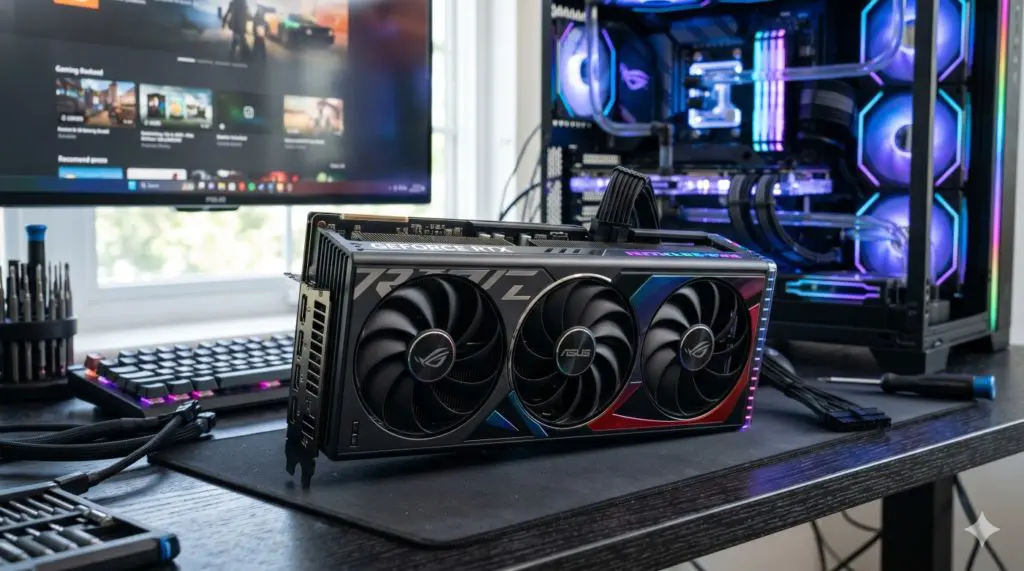
- Render Network (RENDER): Originally created to decentralize Hollywood-level 3D graphics rendering, it has now become one of the biggest winners of the AI boom, connecting people with spare GPU capacity around the world with those who need to perform complex computational tasks.
- Akash Network (ACT): Often referred to as the “Airbnb of cloud servers.” An open source super cloud that allows developers to rent CPU and GPU capacity securely and at a fraction of the price of AWS. In 2026, Akash’s stable USDC-based settlement system will be a huge draw for large Web2 enterprises.
- Bittensor (TAO): While Render provides raw hardware, Bittensor decentralizes the intelligence itself. A peer-to-peer intelligence marketplace where networked machine learning models evaluate each other, and the most efficient models receive the largest token rewards. The network has become the world’s largest open AI research hub.
- io.net (IO): A high-throughput GPU aggregator running on the Solana network. It creates clusters of independent data centers and crypto miners capable of performing the most demanding AI training tasks (e.g. large language models, LLM training) with very low latency.
- Aethyr (ATH): A project specializing in cloud gaming and enterprise AI needs. Aethir focuses not necessarily on home users, but on Tier-1 data centers, guaranteeing continuous availability and high-end (e.g. NVIDIA H100) infrastructure.
2. 🔌Storage and bandwidth
Data storage and transmission are the cornerstones of the modern internet. Centralized cloud storage is subject to censorship and is vulnerable to outages.
- Filecoin (FIL): The absolute market leader in decentralized data storage, with exabytes of capacity. It uses cryptographic proofs (Proof of Spacetime) that guarantee that service providers actually store the data entrusted to them. Complete applications now run on the Filecoin Virtual Machine (FVM).
- Arweave (AR): While Filecoin focuses on storing dynamic, frequently modified data, Arweave is the creator of the “Permanent Web.” For a one-time fee, the protocol guarantees unalterable storage of data for hundreds of years. It is a key infrastructure for NFTs and historical archives.
- Grass (GRASS): One of the fastest growing projects of 2025/2026. Through a simple browser extension, users can sell their unused internet bandwidth. The network uses this bandwidth to collect public data from the web (web scraping), which is then purchased by artificial intelligence development labs to train their models.
- TheGraph (GRT): The “Google” of blockchains. Although it appears to be a software protocol, its operation is based on a network of independent physical indexing servers (Nodes). These servers organize and make data on different blockchains queried for decentralized applications (dApps). It is used through the graphql language.
3. 📞Wireless and telecommunications networks (DeWi)
Telecommunications is one of the most expensive industries. Decentralized wireless (DeWi) networks use the power of the community to build what was previously only possible through national telecommunications companies.
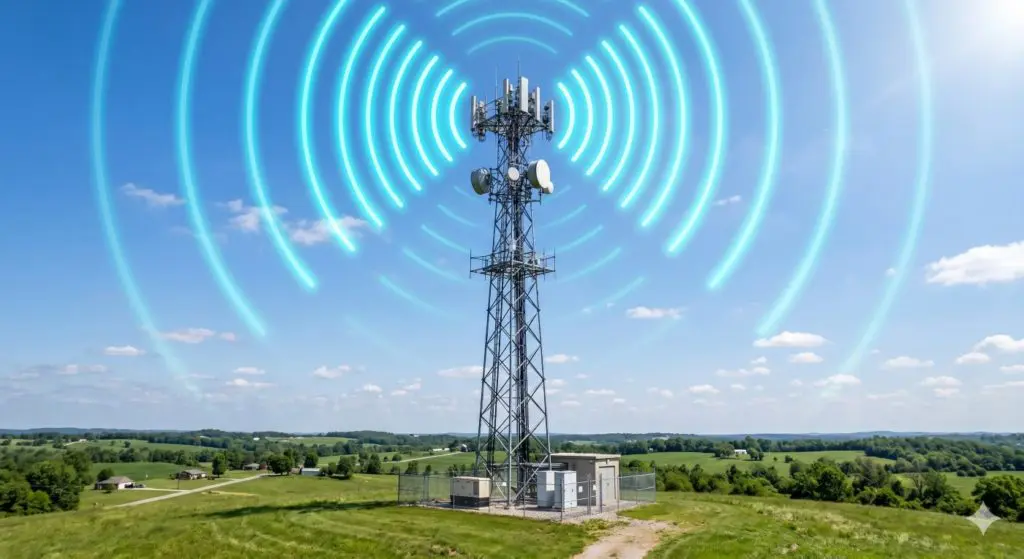
- Helium (HNT): The best-known pioneer of the DePIN movement. Originally creating a global IoT (Internet of Things) network using hundreds of thousands of home LoRaWAN routers, by 2026 the focus had shifted to Helium Mobile, which uses community-deployed 5G hotspots to dramatically reduce the cost of smartphone cellular data plans in the United States and beyond.
- Nodle (NODL): An ingenious concept that requires no extra hardware: it uses the Bluetooth Low Energy (BLE) module of users' smartphones. The phones act as a network running in the background, capturing tracking signals from smart devices, scooters or logistics packages, creating a global mesh network.
- Andrena / DAWN: They focus on providing decentralized broadband internet. Home users can share the excess capacity of their optical internet with their neighbors via wireless antennas, completely bypassing the monopoly of local internet service providers.
- XNET: A distinctly professional, enterprise (carrier-grade) approach to the DeWi market. They focus not on home users, but on building quality 5G and Wi-Fi networks, entering into roaming agreements with major telecommunications providers (like AT&T or T-Mobile) to cover dead spots with decentralized hotspots.
4. 📷Sensors and real-world data collection
Owning data is power. PRN sensor networks give that power back to the people who actually generate the data in the physical world.
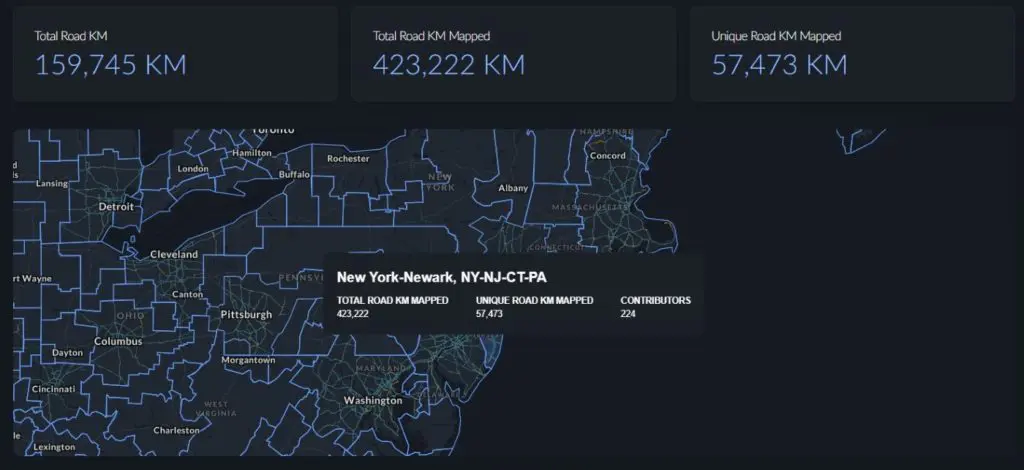
- Hivemapper (HONEY): A community-based, decentralized mapping project that has issued an open challenge to Google Street View. Drivers purchase a special 4K dashcam that continuously captures images of the roads while driving. The fresh, constantly updated database is purchased by logistics companies and self-driving car companies, and the drivers are rewarded from the revenue.
- DIMO: “Smarting your car” and monetizing its data. Drivers plug a small device into their vehicle’s diagnostic (OBD) port that reads telemetry data (battery status, consumption, error codes). The data remains with the user, who can decide to sell it to insurance companies or repair shops in exchange for discounts and tokens.
- GEODNET: A specialized, centimeter-accurate global positioning (RTK GPS) network. Satellite signals from space are refined by base stations mounted on users' rooftops. This infrastructure is critical for precision agriculture (robot tractors), drone logistics, and self-driving vehicles.
💲New investment trend in 2026: stable-yield DePIN
One of the biggest barriers to institutionalization (Enterprise Adoption) of the DePIN sector has long been the volatility of cryptocurrencies. A hardware operator with stable monthly electricity and server lease bills paid in dollars cannot afford to have the price of the native token they receive as a reward drop by half overnight.
The emergence of InfraFi (Infrastructure Finance) and Stable-Yield models provided a solution to this problem.
Broker protocols have emerged that collect real-world rents generated by high-performance hardware (e.g., fleets of H100 GPUs) from AI companies (in dollars or USDC), and then distribute this cash flow as stablecoin yields (Yield) to liquidity investors. For example, in the case of USD.AI, we buy the system’s stablecoin (USDai, which tracks the US dollar), with which the project buys GPUs. The revenue from the use of these GPUs goes to the USDai owners (USD.AI project).
This model separates infrastructure investments from speculative crypto prices. The investor realizes a return in stablecoins, which are not backed by a Ponzi-like algorithm, but by physical hardware, electricity consumption, and real technology demand. This paradigm shift has opened the door for Wall Street institutional capital to enter the DePIN sector.
⚠️Investor risks and sustainability
However, we must also mention systemic risks. DePIN has huge potential, but it is not without pitfalls.
- 🔧Hardware Amortization and Technological Obsolescence: PRN and DRN networks are built on physical assets. This is especially true for GPU networks: the market value and “rentability” of a high-end AI server today drops drastically within 2-3 years as new chips come out. Investors need to accurately calculate the return on investment (ROI) and ensure that token returns exceed hardware depreciation.
- 🪙Token Economy and Inflationary Spiral: Projects that only pay hardware operators by printing (issuing) new tokens will eventually become worthless. The key to lasting success is the existence of real demand (Demand-side Revenue) and the use of “Burn-and-Mint” mechanisms. If there are no external buyers in the network paying with fiat money, the economic model is unsustainable.
- 🧾Regulatory Environment (Compliance): The decentralization of the physical world inevitably clashes with government regulations. Wireless networks (Helium, XNET) must comply with strict radio frequency laws, energy market DePIN projects with energy agency regulations, and mapping networks with global data protection standards like GDPR.
📍Summary: The future of physical infrastructure
DePIN is not just another crypto narrative. It is a real value-creating use case for blockchain technology. With the right token incentives, the masses can build the physical networks needed to run the modern world faster, cheaper, and more efficiently than bureaucratic giants.
By 2026, the question is no longer whether DePIN works, but which network will reach the critical mass that will finally break the hold of Web2 tech monopolies. The task for investors now is to carefully analyze the fundamentals (real revenues, sustainable token economics, and industry partnerships).
💡If you want to know how your crypto assets can generate returns outside of DePIN projects, read our article about it: DeFi: How can your assets generate money? What is yield farming?
👁️Risk management and transparency
While diversification is key for stocks and other assets, it is absolutely critical for DePIN projects, as they are mostly brand new, risky projects. In addition, one must always keep in mind the inherent smart contract risk in crypto projects and tokens, which is a basic feature of all crypto projects.
This forces us to hold our assets in countless places and in many different tokens. However, tracking a properly diversified portfolio is not trivial, and for this you will definitely need a portfolio tracker where you can see your exposure to each token or project. It doesn't hurt to be able to track the value of your rewards as well.
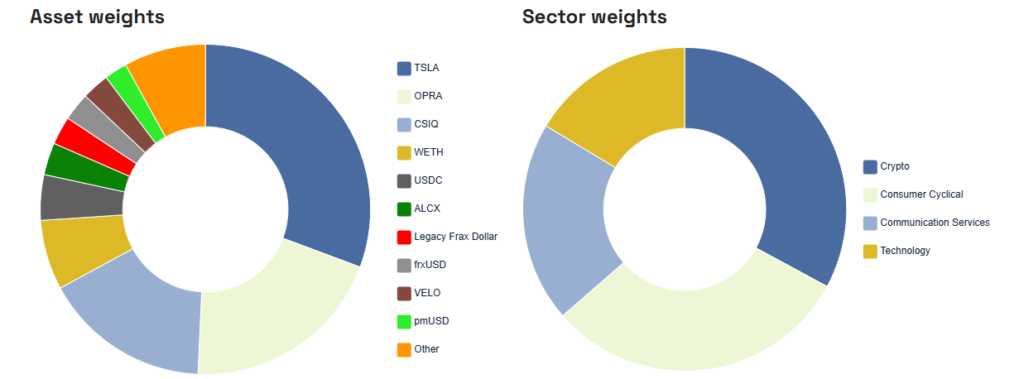
We can help you with this with our portfolio tracker specialized in crypto projects, where you can track the contents of multiple web3 wallets at once, along with your stocks and ETFs, providing full coverage for your financial portfolio.
💡Crypto fundamental analysis and proper portfolio tracking are critical. With the right strategy and the right professional tools, these risks become manageable. Try our Portfolio Tracker: iO Charts Portfolio Manager
Frequently Asked Questions about the DePIN sector
Answers to the most common questions
Would you invest in a DePIN project or operate hardware in the networks? Here you will find concise answers to the most frequently asked questions: what kind of return can you expect, what is the biggest systemic risk, how projects handle regulation, why stable-yield models are attractive to institutions, and how sustainable token rewards are.
Click on any question and the answer will open. These are intentionally brief summaries: if you are interested in the details — from the flywheel model to the PRN/DRN distinction to specific projects — we will expand on them in more detail in the appropriate sections of the article.
What return on investment (ROI) can a DePIN hardware investor expect in 2026?
The return depends on the sector: for GPU-based computing networks (e.g. Akash, io.net), the net return on an annual basis typically ranges between 10-20%, which already includes the deduction of electricity costs and software commissions. Sensor-based PRN networks (e.g. Hivemapper, DIMO) start with lower capital requirements, but offer more volatile theoretical returns of between 30-50%, where a significant part of the profit comes from the future appreciation of the token (capital gains).
What is the biggest systemic risk in DePIN portfolios?
The most significant risk is technological depreciation: physical hardware becomes obsolete quickly. As an investor, you should always consider whether the value of the tokens produced can offset the depreciation of the asset. In addition, there is a serious risk of “network depopulation”: if the demand side does not arrive despite cheap supply, the network’s own token inflation eats up investors’ returns.
How do DePIN projects address regulatory and legal compliance issues?
Successful DePIN networks will face a dual compliance challenge in 2026: they will have to adapt to tightening cryptocurrency laws (e.g. European MiCA regulation) and strict industry regulations (telecoms, energy). The safest investment targets are provider-agnostic platforms that act only as a connecting technology layer. To attract institutional clients, networks are now integrating robust KYC/KYB (Know Your Customer/Business) checks into payment processes.
Why do institutional investors prefer “stable-yield” DePIN models?
Professional, highly leveraged investors (and hardware fleet operators) don’t like unpredictable volatility. Stable-yield models exchange the physical cash flow generated by hardware (such as cloud rent paid by AI companies) directly into stablecoins (such as USDC). This provides a predictable return free of daily exchange rate fluctuations, which is economically closer to an infrastructure corporate bond than a speculative cryptocurrency.
How sustainable is the token issuance model of DePIN projects?
The market consensus in 2026 is clear: models based on infinite inflation are doomed. The sustainability of blue-chip DePIN projects is guaranteed by “Burn-and-Mint” models. The essence of these is that the network only issues a significant amount of new tokens if it is justified by real network traffic, and a part of the incoming revenues is withdrawn from circulation in order to reduce the supply (burn). As an investor, it is worth examining only protocols where transparent data proves the presence of external paying customers (demand).
Legal and liability statement (aka. disclaimer): My articles contain personal opinions, I write them solely for my own entertainment and that of my readers. The articles published here do NOT in any way exhaust the scope of investment advice. I have never intended, do not intend, and am unlikely to provide such in the future. What is written here is for informational purposes only and should NOT be construed as an offer. The expression of opinion is NOT in any way considered a guarantee to sell or buy financial instruments. You are SOLELY responsible for the decisions you make, and no one else, including me, assumes the risk.