
In the second part of the stock portfolio building article, I will categorize my individual stocks, but if you missed the first part, you can read it here:
I tried to categorize companies in my own subjective universe because it makes it easier for me to understand and narrows down my targets. One of the basic mistakes when you want to build a stock portfolio is to have too many targets at once. 99% of companies don't hit the right level, which means that 1 out of 100 actually makes it into my portfolio.
Basically, I look for “perpetual compounder” stocks that outperform the market.
☝️Perpetual compounder is a difficult term to translate, but it roughly means that, using the principle of compound interest, the company reinvests the cash it generates back into its own business, thus creating more and more value, ideally indefinitely.
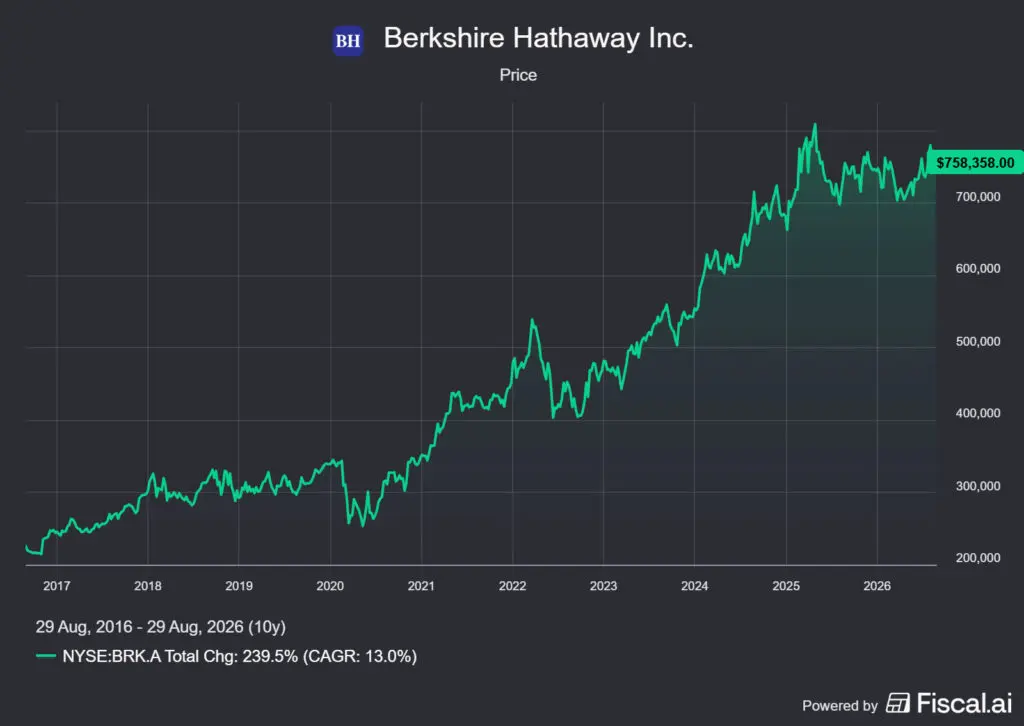
Obviously, the above definition is a utopia, since no company has an infinitely long time horizon, especially not while outperforming its own benchmark, such as the S&P 500. A good example of this is Warren Buffett's conglomerate, the often-mentioned Berkshire Hathaway, which has not been able to beat the S&P 500 in the past 10 years, simply because it is very difficult to achieve high returns on such a large amount of money.
It is also important to note that the internal rate of return (IRR) of a company is not a constant number, but fluctuates, so you will definitely not achieve the returns calculated on paper, no matter how many scenarios you simulate. Or not in the way, with the names, and with the portfolio weighting you planned, because life never turns out exactly as you imagined it in your head.

The best companies in the stock portfolio: a pure perpetual compounderek
These are the companies mentioned above that invest the free capital they generate into their own business. Here are a few examples of what you can expect to see as perpetual compounders:
- 🤝 high skin in the game, key executives (board of directors and management) hold a large proportion of the company's shares,
- 👑 often a founder-led company,
- 🧬 a unique corporate culture that is different from competitors, which is difficult or impossible to reproduce (Helmer's Cornered Resources),
- 🌱 the vast majority of growth comes from organic growth,
- 📊 high ROIC, ROCE or other internal rate of return indicators,
- 🪶 capital-friendly business, high margins,
- 🚫 they do not pay dividends or only pay them very rarely (since this can only be paid out of free cash, which then leaves the cash flow and will be lacking for growth),
- 🤐 they have no or very rare acquisitions,
- ♻️ they buy back their shares opportunistically,
- 🛡️ they almost never dilute their shares,
- 💵 management incentives are typically not based on stock-based compensation or are low in amount,
- 🛒 executives also buy company shares from the cash portion of their salary.
The above list is also special because 99% of companies on the stock market are not like this. Unfortunately, it is quite difficult to filter for such qualitative characteristics, so finding them requires a lot of reading.
Example of pure perpetual compounders in a stock portfolio: Kinsale Capital, Cerillion plc, Mastercard, Visa, Copart, Dino Polska.

Perpetual compounder, serial acquirer
Serial acquirers are a very special breed of perpetual compounders. In fact, serial acquirers are the ideal companies for me. Why don't I just buy companies like that? On the one hand, because they are very rarely cheap, although the market provided a large number of buying opportunities in 2026, and on the other hand, because the number of targets that can be acquired is often finite.
🤔The third factor is that they are quite difficult to analyze fundamentally because accounting cannot really handle their operation well (which is why the market misprices most of them)..
A few typical characteristics of serial buyers:
- 🏦 debt interest is used as a factor to reduce the cost of capital, debt is used as leverage (of course, this is true for other companies as well, but it is most often seen here),
- 🧬 they often have a unique corporate culture, use special indicators,
- 🧮 are very sensitive to the valuation of acquisitions, often building in safeguards for the future (options, earn-outs, debt and cost shifting),
- 🔧 if the internal rate of return is high, they will also acquire loss-making companies,
- 🧩 They buy up small, monopoly companies in a series, avoiding competition with private equity funds,
- 🏠 They almost never sell any acquired companies (permanent home effect).
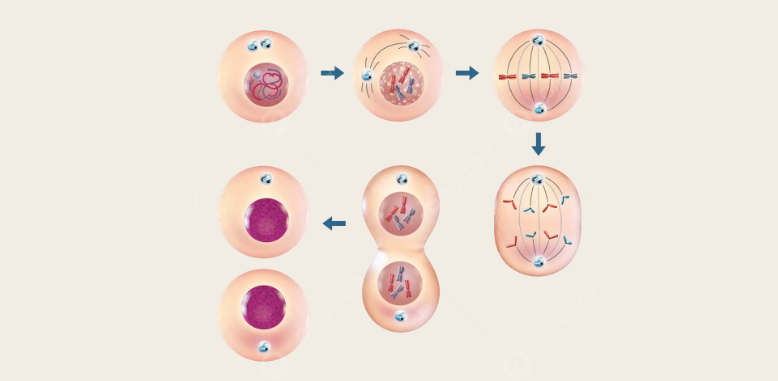
The good thing about serial acquirers is that as long as there is an acquisition target, their activities continuously achieve internal diversification, Therefore, they are ideal subjects for a stock portfolio. Constellation Software, for example, has 1600 companies, if one fails, nothing happens. And if they grow too big, they spin off a part of themselves, this is a spin-off, which continues the core business as a separate company. The best analogy I've heard for serial acquirers is mitosis, or cell division, and that's actually what they do.
Example of perpetual compounder, serial acquirer companies in the stock portfolio: Constellation Software/Topicus/Lumine, Kelly Partners Group, Röko AB, Computer Modeling Group.

Perpetual compounder, spawner
If serial acquirers are so good, why don't I just buy companies like that? Because the number of targets is finite, and for such a company to continue to grow, they have to acquire more and more or larger companies, which reduces the internal rate of return and obviously cannot last indefinitely.
This is where spawners come in, spending the cash they generate not only on acquisitions but also on creating and financing new businesses. The more startups they create, the more free tickets they get to participate in the next big craze. Characteristics of spawner companies:
- 👑 oligopoly/duopoly position in their own area, even if it is a horizontal market like software,
- ⚔️ competitors are either acquired or lose their market share through organic growth,
- 🌱 they fund a lot of startups, these are typical low-hanging fruits,
- 🌍 They are present in more and more markets, their basic business process changes over time,
- 🚀 Growth accounts for a large portion of their capital allocation.
One of the best examples of the above is Amazon, What started as a bookstore became an online store that sells almost everything, then came online streaming, cloud storage, and now artificial intelligence. It's no coincidence that these companies have grown to this size, that's the essence of being a spawner.
Example of perpetual compounder spawner companies in my stock portfolio: Meta, Alphabet, Amazon, Microsoft, Tencent.
Perpetual compounder, self-reinforcing moat
A self-reinforcing moat roughly means a self-reinforcing economic moat. What is a self-reinforcing economic moat? There are companies that operate in a segment of the market that is simply impossible to avoid. This is also called a choke point, no matter what you do, you have to go to them in the end. These companies typically work with relatively high capital requirements, which was an exception in the first list, but in doing so they continuously strengthen their own competitive advantage and put their partners in an increasingly serious dependent relationship. Typical features of companies with self-reinforcing moats:
- 🏗️ higher capital requirements, but they invest in themselves,
- 🔬 very strong, almost irreplaceable technological competitive advantage,
- 🔗 partners are asymmetrically dependent on them,
- 📋 usually huge backlog, demand-based pressure in the market,
- 🥇 Almost complete monopoly on the market.
The best example of the above is perhaps ASML, which has a complete monopoly in its own market, while all partners have to buy the chip manufacturing machines. It doesn't matter if Nvidia, Google, Amazon, AMD, or whoever wants to design chips, they will be manufactured with ASML machines, most likely in TSMC's factories.
Example of self-reinforcing moat companies in a stock portfolio: Taiwan Semiconductor.
Perpetual compounder, cannibal stock
Cannibal stocks are a sub-species of ordinary perpetual compounder companies. They do nothing but simply buy back their own shares, in accordance with their excellent capital allocation credo. Their characteristics:
- ✅ everything that is basic for perpetual compounder companies,
- 🚫 they don't pay much in dividends,
- 🍽️ they buy back a significant portion of their own shares opportunistically.
Example of cannibal stock companies in a stock portfolio: Adobe, but among my previous positions, PayPal and that Evolution AB there were some like that.
Other elements of the stock portfolio
In my 24-stock portfolio, there are 5 companies that do not fall into any of these categories, but I bought them because of some special market situation. These are typically the exception-the-rule category, but there are market situations where you will buy some names and they become part of the stock portfolio, and not because they fit the framework anyway. It is important to note that these are extreme risk/reward situations, but that is not the case.
Philip Morris (melting ice cube with a phoenix option)
The tobacco company is well-known to almost everyone and was trading at a completely unrealistic valuation in 2020, so it became part of the stock portfolio. The phoenix option here refers to the fact that they were essentially able to reform their own declining industry with heat-not-burn technology and rise from their own ashes, which is almost symbolic for a tobacco company. Plus, because of their 80/20 classification, I have to pay very little tax on their dividends.
Would I buy it right now: not! Basically, it would fail on the valuation multiple, but the significant debt also bothers me, regardless, I consider it an excellent company, and it is worth adding that from a quantitative point of view it is relatively difficult to get involved. It has generated a total return of +140% (16.14% CAGR) over a full six years, on top of the 6-7% annual dividend yield (+36-42%), beating the S&P 500's 154.88% (17.4% CAGR) return (at the current exchange rate, the values in the table differ from this).
Simon Property Group (REIT)
I generally don't buy property management companies because of their capital allocation, SPG being the exception. It was added to the stock portfolio along with PM in 2020, with unrealistic valuations and extremely high dividend yield expectations. Since I get a 9.9% return on the stock even after taxes, which is roughly the 120-year average return of the US stock index, it wasn't difficult to outperform the market with it.
Would I buy it right now: not! Basically, it would fail on the valuation multiple, which also affects the dividend, but it will probably be the last REIT in my portfolio anyway. However, as I mentioned before, it is difficult to get involved in the company from a fundamental point of view, and the management is exceptionally good. It has generated a total return of +239% (+22.42% CAGR) over a full six years, on top of which comes an annual dividend yield of 9-10% (+54-60%), beating the S&P 500's 154.88% (+17.4% CAGR) return. (at the current exchange rate, the values in the table differ from this).
Novo Nordisk
Novo Nordisk is a biotech company, which should be a major exclusion. However, there are only two companies competing in the diabetes market, NVO and Eli Lilly, and the weight loss drug market has realized this, and it could grow a hundredfold in the coming years. Novo Nordisk can be considered a perpetual compounder, The problem is the same as for all pharmaceutical companies: you can't know when and what drug under development will be released or will fail (this is called pipeline risk). They say it's boom and bust: it either works or it doesn't.
Would I buy it right now: Yes! This is a very good quality company at a bargain price. The thesis needs to be given time and its valuation is still OK at the time of writing, although when it became part of the stock portfolio, I didn't expect it to suffer so much. But my conviction is strong, so there's no reason for me to sell it, however, it has yielded a return of −25.72% (−23.97% CAGR) at the time of writing. (at the current exchange rate, the values in the table differ from this).
BlackRock
BlackRock is the world's largest fund manager, second in terms of assets under management in ETFs, surpassed by Vanguard not long ago. The problem with asset managers is that their capital structure is very difficult to analyze, they are relatively cyclical, but the biggest problem in the case of BLK is that its own operating model is eroding margins. Since most of the money flows from higher-cost, actively managed funds to cheaper, passively managed ETFs, this puts constant pressure on margins for BlackRock. That's why it buys companies that own actively managed funds, which is actually a necessity to maintain their strong pricing. On top of that, it has to compete with other fund managers, and its switching costs are not as high as I thought.
Would I buy it right now: not! The problem lies in the company's business operations, which is a self-defeating process. It yielded a return of +77% in a full 4 years (+13.55% CAGR), coupled with an annual dividend of 2.55%, which provided roughly an extra 10% return, so I also beat the S&P 500, which yielded a total return of 62.7% (+12.9% CAGR) during this period. (at the current exchange rate, the values in the table differ from this).
Alibaba
Alibaba wanted to be the Chinese Amazon a few years ago, but for the 5 years since I took my first position in the company, it has essentially been underperforming. The brutally strong Chinese competition is stifling the webshop segment - think of Temura -, the development of cloud services is just starting, they also have an artificial intelligence industry, but it looks more like a big flop than the new Google. There are also special risks for Chinese companies, shareholding through the VIE structure, the unpredictability of state regulation, and the fact that other investors know this, so the "China risk" often means that the fundamental improvement in the price simply does not appear.
Would I buy it right now: not! The problem lies in the company's business operations, which is a self-defeating process. It yielded a return of −36% over a full 4 years (−9.37% CAGR), coupled with a negligible dividend of less than 1%, so I badly underperformed the S&P 500, which had a total return of 62.7% (+12.9% CAGR) over this period. (at the current exchange rate, the values in the table differ from this).
From the above, it can be seen that out of the 5 shares:
- 💰 I wouldn't buy 2 stocks (PM, SPG) because of the valuation multiple (but it doesn't fit my framework anyway), even though it outperformed the S&P 500,
- 🔁 I would buy 1 share (NVO) again, even though it underperformed the S&P 500,
- 🏦 I wouldn't buy 1 share (BLK) due to business conditions, even though it outperformed the S&P 500,
- 📉 I wouldn't buy 1 piece (BABA) due to business conditions, and I also underperformed the S&P 500 badly.
☝️So portfolio building is not a black and white thing, there can be countless reasons why a company is included or not.
Distribution of the stock portfolio
Currently, I have 24 shares in my stock portfolio, with 3 providers, in 5 different TBSZ accounts, to reduce institutional risk and tax burden. Since the table below only reflects a momentary state and does not show the companies that I have already sold, no far-reaching conclusions can really be drawn from it. However, the purpose of this series is to look back on the portfolio roughly every six months and share my experiences with you, so you can follow the changes.
| # | Ticker | Yield | Multiplier | CAGR | Dividend | On cost | Portfolio | Buy | Ev | Comment |
|---|---|---|---|---|---|---|---|---|---|---|
| 1 | SPG | + 245.05 % | 3.45x | + 22.9 % | 14.28 % | 0.51 % | 1.74 % | 2020-08-18 | 6.00 | NOT a compounder |
| 2 | PM | + 134.95 % | 2.35x | + 15.8 % | 7.44 % | 1.96 % | 4.62 % | 2020-10-22 | 5.82 | melting ice cube with a phoenix option |
| 3 | V | + 80.68 % | 1.81x | + 13.3 % | 1.34 % | 0.64 % | 1.15 % | 2021-11-19 | 4.74 | perpetual compounder |
| 4 | GOAL | + 143.17 % | 2.43x | + 21.6 % | 0.88 % | 3.20 % | 7.78 % | 2022-02-02 | 4.54 | perpetual compounder, spawn |
| 5 | BABA | −33.42% | 0.67x | −8.7% | 0.57 % | 3.20 % | 2.13 % | 2022-02-18 | 4.49 | NOT a compounder |
| 6 | BLK | + 76.95 % | 1.77x | + 13.7 % | 3.48 % | 1.05 % | 1.86 % | 2022-03-04 | 4.45 | NOT a compounder |
| 7 | TCEHY | + 19.72 % | 1.20x | + 4.6 % | 1.29 % | 3.49 % | 4.18 % | 2022-08-12 | 4.01 | perpetual compounder, spawn |
| 8 | MSFT | + 110.40 % | 2.10x | + 20.7 % | 1.58 % | 1.32 % | 2.79 % | 2022-09-01 | 3.96 | perpetual compounder, spawn |
| 9 | MA | + 87.15 % | 1.87x | + 17.4 % | 1.15 % | 0.68 % | 1.26 % | 2022-09-22 | 3.90 | perpetual compounder |
| 10 | TSM | + 401.01 % | 5.01x | + 51.5 % | 5.21 % | 2.54 % | 12.72 % | 2022-09-30 | 3.88 | perpetual compounder, self-reinforcing moat |
| 11 | GOOGL | + 222.86 % | 3.23x | + 36.2 % | 0.83 % | 2.89 % | 9.34 % | 2022-11-02 | 3.79 | perpetual compounder, spawn |
| 12 | AMZN | + 99.77 % | 2.00x | + 20.8 % | 4.18 % | 8.35 % | 2022-12-19 | 3.66 | perpetual compounder, spawn | |
| 13 | DNOPY | −6.12% | 0.94x | −2.6% | 2.53 % | 2.38 % | 2024-03-22 | 2.40 | perpetual compounder | |
| 14 | CMG.TO | −42.23% | 0.58x | −36.2% | 0.59 % | 4.03 % | 2.33 % | 2025-05-28 | 1.22 | perpetual compounder, serial acquirer |
| 15 | NVO | −26.35% | 0.74x | −25.3% | 2.93 % | 4.00 % | 2.95 % | 2025-07-30 | 1.05 | NOT a compounder |
| 16 | ROKO-B.ST | −0.97% | 0.99x | −1.2% | 0.66 % | 0.65 % | 2025-10-24 | 0.81 | perpetual compounder, serial acquirer | |
| 17 | LMN.V | −3.47% | 0.97x | −4.4% | 3.12 % | 3.01 % | 2025-11-04 | 0.78 | perpetual compounder, serial acquirer | |
| 18 | KPG.AX | −10.87% | 0.89x | −19.4% | 5.38 % | 4.79 % | 2026-02-03 | 0.53 | perpetual compounder, serial acquirer | |
| 19 | TOI.V | −3.86% | 0.96x | −7.1% | 2.72 % | 2.62 % | 2026-02-03 | 0.53 | perpetual compounder, serial acquirer | |
| 20 | CPRT | −19.09% | 0.81x | −35.3% | 4.45 % | 3.60 % | 2026-02-20 | 0.49 | perpetual compounder | |
| 21 | KNSL | + 7.16 % | 1.07x | (+ 26.3%) | 0.28 % | 3.25 % | 3.49 % | 2026-05-01 | 0.30 | perpetual compounder |
| 22 | CSU.TO | + 6.15 % | 1.06x | (+ 25.5%) | 0.20 % | 7.27 % | 7.71 % | 2026-05-13 | 0.26 | perpetual compounder, serial acquirer |
| 23 | Adbe | + 27.50 % | 1.27x | (+ 328%) | 1.41 % | 1.79 % | 2026-06-17 | 0.17 | perpetual compounder, cannibal stock | |
| 24 | CER.L | −3.43% | 0.97x | did | 1.70 % | 1.47 % | 1.42 % | 2026-08-13 | 0.01 | perpetual compounder |
| Shares | + 43.5 % | 1.44x | 1.10 % | 65.95 % | 94.66 % | 24 positions | ||||
| Cash | 5.34 % | 5.34 % | cash balance | |||||||
| Altogether | 0.73 % | 71.29 % | 100.00 % | based on market value |
Yield = unrealized exchange rate gain compared to the cost price. Multiplier = current value of the position as a multiple of the invested amount. CAGR = annualized return; holdings shorter than one year in parentheses, where annualization is mathematically correct but not informative. Dividend = current declared dividend level compared to the cost price (on cost), in local currency, gross, excluding withholding tax. Purchase = date of last purchase, Year = time elapsed since then. The denominator of both the “On cost” and “Portfolio” columns is the total market value of the portfolio, therefore only the latter sums to 100%. Not investment advice.
I have a few additions to the above:
- ⏳ The holding time is actually longer, as shown in the table: the date shows the last position taken in the given stock, but there were some that I bought in several installments over 6–12 months.
- 📈 It is clear that the longer holding period resulted in higher returns, In other words, the previously mentioned principle that over time, better quality actually becomes more expensive is also reflected in this portfolio.
- ⚖️ TSMC is the biggest gainer with +401%, and in the biggest fall, CMG fell by −42%. This shows the advantage of the long-only philosophy: the room for upward price appreciation is infinite, but the room for downward price appreciation is limited.
- 🎯 My Top 5 largest positions account for 45.9% of the portfolio, or almost half if I take Constellation Software, Topicus, and Lumine as just one company (51.53% by the way). It's enough to hit a few names that will go big, you don't have to be right all the time, just make small mistakes along the big winners.
- 🏋️ Position size is almost more important than what stocks you choose. TSMC only accounted for 2.54% of the portfolio at cost, but now accounts for 12.72% of the portfolio at market price.
- 🔗 Although the list includes CSU, TOI and LMN separately, the latter two are its first spin-offs, with significant cross-ownership, and together they account for 13.11% at cost.
One of the key points of building a stock portfolio is that you have to let the winners run. I could have sold my Taiwan Semiconductor position many times, but it wouldn't have been able to grow 5x. SPG and PM were able to go as high as they did because I bought them during COVID, which was a completely different market situation than now, and they weren't the best performers. There were several stocks that I bought along the way, which made the returns seem to decrease. So I should actually break down the stocks by position, but that would have ended up being a very long and opaque table. Based on the above, the stock portfolio looks like this on two interactive pie charts:
Distribution of the stock portfolio by position
Distribution of the stock portfolio by sector
Percentages are based on the total market value of the portfolio, including cash. Sector classification according to GICS logic. Not investment advice.
Long-term goals of the stock portfolio
I mentioned a few names above that I wouldn't buy again, such as Alibaba and BlackRock because of the companies' operating principles, so I'll sell them at a better valuation. In the case of Adobe, I sold the stock at 363 USD and then bought it back at 200 USD because I thought its valuation was unrealistically low.
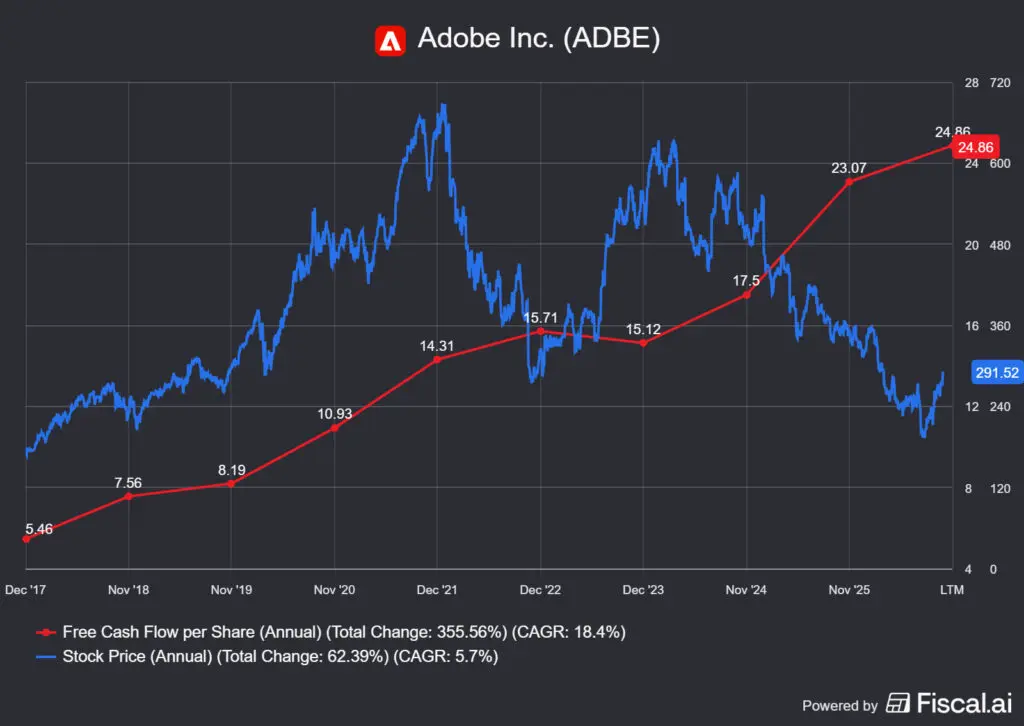
The chart above also shows that the price intersects free cash somewhere around USD 460, and the price is currently around USD 292. If the price had followed the fundamentals, the price should now be around USD 620. If the valuation corrects, I'll consider getting rid of it, because I'm not basically looking for companies like that.
On the other hand, there are names that I would like to see in my portfolio (I won't reveal which ones), but either their analysis is not ready or their valuation is not attractive enough. What should you do in such a case? Nothing, just wait patiently until the market offers the opportunity.
I'll be back with the next installment in January 2027, we'll see what opportunities Mr. Market has in store for us until then.
☝️Until the update arrives, I recommend our stock portfolio manager on our site: iO Charts.
Frequently Asked Questions about share classes
This section is about the types of companies I look for and why. Here you'll find concise answers to the most frequently asked questions: what is a perpetual compounder, what makes a serial acquirer different, what are spawners and self-reinforcing moats, why does a cannibal stock buy back its own stock, and what are some of the companies in my stock portfolio that don't even fit my own framework?
Click on any question and the answer will open. These are intentionally short summaries: if you are interested in the details, I will expand on them in more detail in the appropriate sections of the article. Important: what is described here reflects my own practice, it does not provide a general recipe.
What is a perpetual compounder?
It's a difficult term to translate, but it roughly means that the company, using the principle of compound interest, reinvests the cash it generates into its own business, thus creating more and more value, ideally indefinitely.
The definition is obviously utopian, as no company has an infinitely long time horizon, especially not while outperforming its own benchmark. Berkshire Hathaway is a good example of this: over the past ten years, it has barely been able to beat the S&P 500, simply because it is very difficult to achieve high returns on such a large amount of money.
How can you recognize a perpetual compounder?
High skin in the game, meaning that key executives hold a large proportion of the company's shares, the company is often founder-led, a unique and difficult-to-reproduce corporate culture, predominantly organic growth, high ROIC or ROCE, capital-friendly business operations, and high margins.
Additionally, they typically pay no or only infrequent dividends, rarely engage in buybacks, opportunistic share buybacks, almost never dilute, and management incentives are not primarily equity-based. 99% of companies on the stock market are not like this, and it is difficult to filter for these qualitative characteristics, so it requires a lot of reading.
What is a serial acquirer and why is it an ideal investment?
Serial acquirers are a special breed of perpetual compounders: they buy small, monopolistic companies in series, avoid competition with private equity funds, are sensitive to the valuation of their acquisitions, and almost never sell any of the acquired companies. They use debt as leverage and interest as a factor to reduce the cost of capital.
They are ideal because as long as there is an acquisition target, their activities continuously achieve internal diversification, making them ideal subjects for a concentrated stock portfolio. Constellation Software, for example, contains about 1600 companies: if one fails, nothing happens.
Why don't I just buy serial buyers?
For three reasons. First, they are very rarely cheap, although the market provided a good number of buying opportunities in 2026. Second, the number of acquisition targets is often finite, and as the company grows, it has to buy more and more or larger companies, which reduces the internal rate of return.
Third, they are quite difficult to analyze fundamentally because accounting cannot handle their operation well. This is also an opportunity, as the market misprices most of them.
What is a spin-off and why do series buyers do it?
If a serial acquirer grows too large, it spins off a division that continues its core business as a separate company. The best analogy for this is mitosis, or cell division.
This is clearly visible in my stock portfolio: Topicus and Lumine are spin-offs of Constellation Software, with significant cross-ownership. Therefore, the three names are actually less independent than the list suggests.
What is a spawner company?
Spawners spend the cash they generate not only on acquisitions but also on creating and funding new businesses. The more startups they launch, the more free tickets they get to participate in the next big craze.
Their characteristics: oligopoly or duopoly position in their own field, they acquire competitors or lose their market through organic growth, they are present in more and more markets, and growth accounts for a large part of their capital allocation. The best example is Amazon, which started as a bookstore, then came the web store, streaming, cloud-based data storage, and now artificial intelligence.
What is a self-reinforcing economic moat?
These are companies that operate in a segment of the market that is simply impossible to avoid. This is also called a bottleneck: no matter what you do, you end up having to go to them. They typically operate with higher capital requirements, but in doing so they strengthen their own competitive advantage and make their partners increasingly dependent.
Their typical features: an almost irreplaceable technological competitive advantage, asymmetric dependence on partners, a huge backlog and demand-based pressure. The best example is ASML, whose machines every chip designer has to buy, most likely through TSMC's factories.
What is a cannibal stock?
Cannibal stocks are a sub-species of regular perpetual compounders. They do nothing but opportunistically buy back their own shares in accordance with their capital allocation credo, and typically do not pay dividends.
Adobe is currently one of these in my stock portfolio, and my previous positions included PayPal and Evolution AB.
Why is there a company in my portfolio that doesn't fit the framework?
The 24-stock portfolio includes five names that do not fall into any category but were included due to some special market situation: Philip Morris, Simon Property Group, Novo Nordisk, BlackRock, and Alibaba. These were extreme risk/reward situations, not choices according to the framework.
The lesson is mixed. I wouldn't buy PM and SPG today because of the valuation multiple, even though they outperformed the S&P 500. I wouldn't buy BLK and BABA because of the business, the former outperformed, and the latter badly underperformed the index. The only one I would buy again is Novo Nordisk, even though it has underperformed so far.
Why is position size more important than stock selection?
This is reflected in concrete numbers in my own stock portfolio. Taiwan Semiconductor was only 2.54% at cost, but now accounts for 12.72% of the portfolio by market value. My top five positions together account for 45.9% of the portfolio.
This means that you only need to hit a few names that will make a big difference. You don't have to be right all the time, you just have to make small mistakes along the way to the big winners. But you have to let the winners run: I could have sold my TSM position many times, but it wouldn't have grown fivefold.