

We wrote about investing in government securities a long time ago, around the beginning of 2020. Another article was also written at that time, which here could reach. Since then, a lot of water has flowed down the Danube, and the political and economic situation has changed quite a lot. At the beginning of 2023 Topped by 25,7% peak interest rates paid on government securities based on inflation – also known as the consumer price index Peaked at 19,1%The interest on government securities is slowly being returned to the population, and from there to the market, so you are right to ask: what should I invest the interest on government securities in 2025? We looked at these alternatives!
contents
I have created a table of contents to make it easier for you to navigate the longer articles:
- When do government bonds pay interest?
- What government securities are attractive in 2025?
- What are the best government bonds?
- Invest the interest on government bonds in real estate
- Government bond interest should go into precious metalsa
- Put the interest on government bonds on the stock market
- Frequently Asked Questions (FAQ)
Government Securities and Inflation – What's Happening Right Now?
It is worth taking a moment to reflect on the current economic situation, which Status as of March 2025 reflects when this article was written. Let's start with why so many people are now interested in what investment opportunities are available in the market.
Inflation in Hungary It peaked at 2023% in January 25,7, but it was above 2022% throughout the period between September 2023 and June 20. This is according to the Central Statistical Office – alias KSH – consumer price index data subpage you can check it out. In order for the government to cover its costs, it issues bonds, in which it undertakes to pay off loans, since A bond is nothing more than a security representing a debt relationship. The bond issued by the government is a government bond or a discount treasury bill.
☝️Sure, variable interest rate government securities products up to 19,1% interest rate They also paid 10% of their nominal value, which is already a nice sum, despite the fact that in real terms even this is considered negative interest.
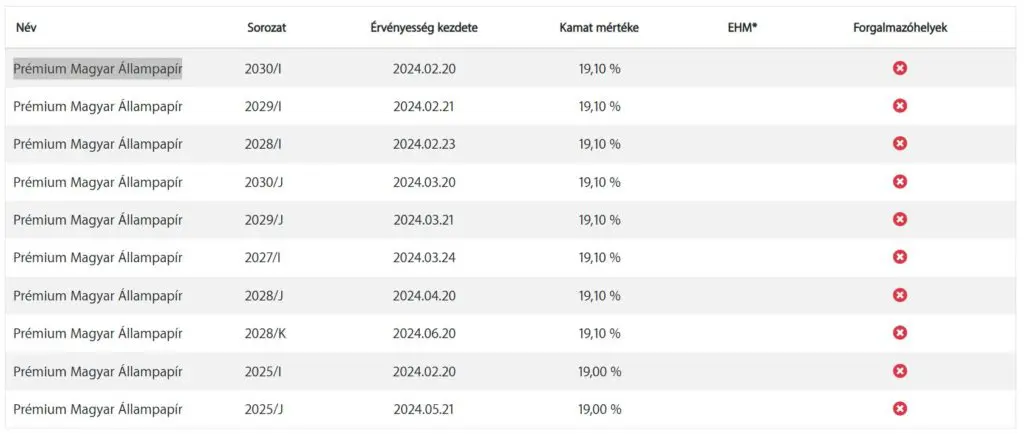
Az allampapir.hu On this page you can request all types of domestic government securities, and On this link You can also list the interest rates of certain government securities, but I have included a picture to make things clearer. As you can see, some Premium Hungarian Government Securities – PMÁP – series up to 19,1% interest They also paid. These are actually floating rate bonds, their interest premium is 1,5%Thus, where inflation is high, even with this relatively low premium, high interest rates are achieved.
What is a public offering document for government securities?
Every government bond has a public bidding document, where you can check what conditions the state undertakes regarding the bond, these in the case of PMÁP I will reach you hereFor example, the public offering document for the Premium Hungarian Government Bond 2029/I series On this link I will reach you.
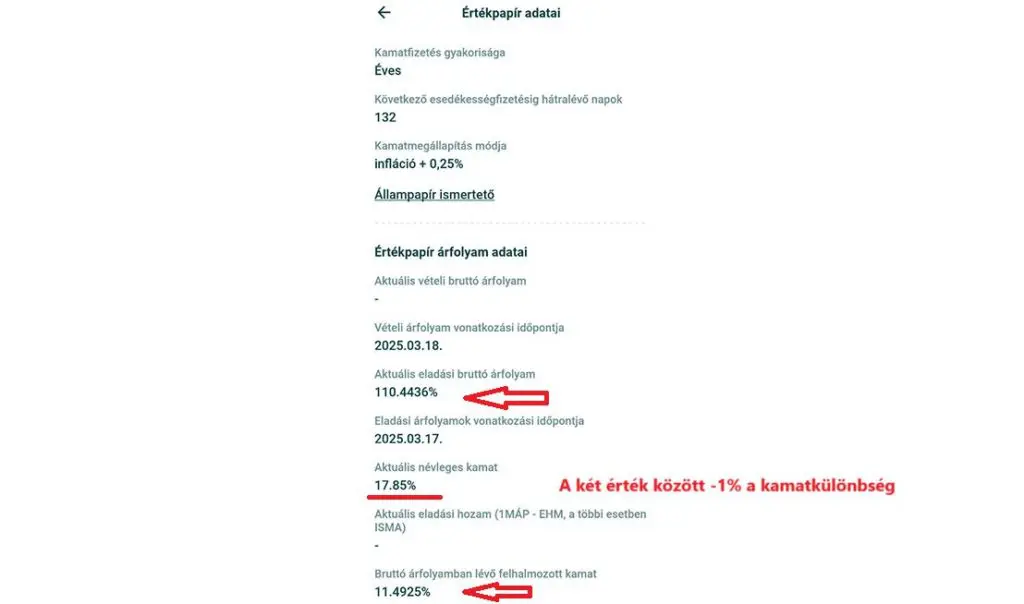
☝️The public offering is only an abbreviated document, so all the rules related to financial instruments are included in the description discusses, for example, the description of the above-mentioned Premium Hungarian Government Bond 2029/I series this document.
The Hungarian state not only returns the nominal value at the end of the term, but also approx. -1% penalty interest redeems the instrument. Of course, the paper can still be sold on the secondary market, so you can even realize a price gain/loss there.

When do government bonds pay interest?
Staying with the 2029/I PMÁP series above, you can find the following interest payment dates in the offer (this may vary by series):
- February 2023, 21 (11,75%, this was recorded in the document)
- February 2024, 21 (19,1%, i.e. 17,6% annual inflation + 1,5% interest premium)
- February 2025, 21 (5,2%, i.e. 3,7% annual inflation + 1,5% interest premium)
- February 2026, 21
- February 2027, 21
- February 2028, 21
- February 2029, 21
💡 This is what happens in practice: the above numbers came out as On this link The Hungarian Central Statistical Office (KSH) publishes the annual average of the consumer price index, which is what the PMÁP's 1,5% interest premiumSince PMÁP is a government bond with a variable interest rate, it was no longer very attractive to hold the bond in 2025. For this reason, several thousand billion forints of government bonds have an interest rate of nearly 20% – which is roughly HUF 1200 billion – will find its place in the market. Of course, some people redeemed it with penalty interest or sold the entire package on the secondary market, so in reality more capital was released. But money always finds a way, the only question is where it goes. In 2025, interest will have to be paid on an additional 7000 billion forints of government securities., which will also be no small item for the public finances.
Stay in government securities or discount treasury bills
Government securities – which are actually bonds – are practically a risk-free investment, because the state cannot go bankrupt in its own currency, maximum prints even more money. You basically have two options to invest in government securities:
- with quotation (in this case you will receive the paper at face value)
- a by purchasing on the secondary market (at daily exchange rate)
☝️The difference between the two is that With a subscription, you can only buy government securities that have just been issued, where you pay face value.
In the secondary market, there is a daily exchange rate that is determined by whether inflation – and therefore interest rates – are falling or rising. The correlation is inverse, if inflation rises, then the exchange rate falls.
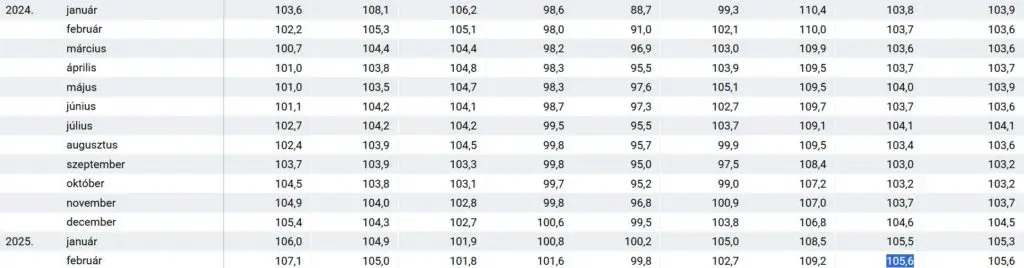
To do this, it is worth monitoring the aforementioned inflation, which has developed as follows over the past year. It is rising again, In February 2025 it was 5,6% (meanwhile The base rate declared by the MNB is 6,5%):
💡This is what happens in practice: To illustrate the situation with an example, if you have a fixed-interest bond paying 5% interest and inflation rises from 3% to 4%. In this case, the price of the government bond decreases, since inflation must be subtracted from the yield, so you receive less interest in real terms when paying interest, only 2% instead of the previous 5% – 3%-1%. Since the interest rate on newly issued bonds will likely be higher than the previous ones, this will further push down the price of previously issued, lower-interest series. The same is true vice versa, if inflation decreases, the exchange rate increasesThen who knows when the Hungarian National Bank will intervene to protect the HUF.

What government securities are attractive in 2025?
First of all, we will only be talking about retail government securities. What aspects should be taken into account?
- My foreign currency: forint or euro-based. If you speculated that the forint would depreciate against the euro, you could also subscribe to government securities in euro currency (and the Hungarian state cannot inflate this, because it cannot issue EUR), in return the interest rate in euro is always lower.
- Interest rate type, fixed or variable: the government bond pays an interest premium on inflation, or pays a fixed interest rate set in the offer (but it can still increase periodically, at a fixed rate). If you speculated that inflation will rise, the former is more advantageous, if it will fall, the latter is more advantageous.
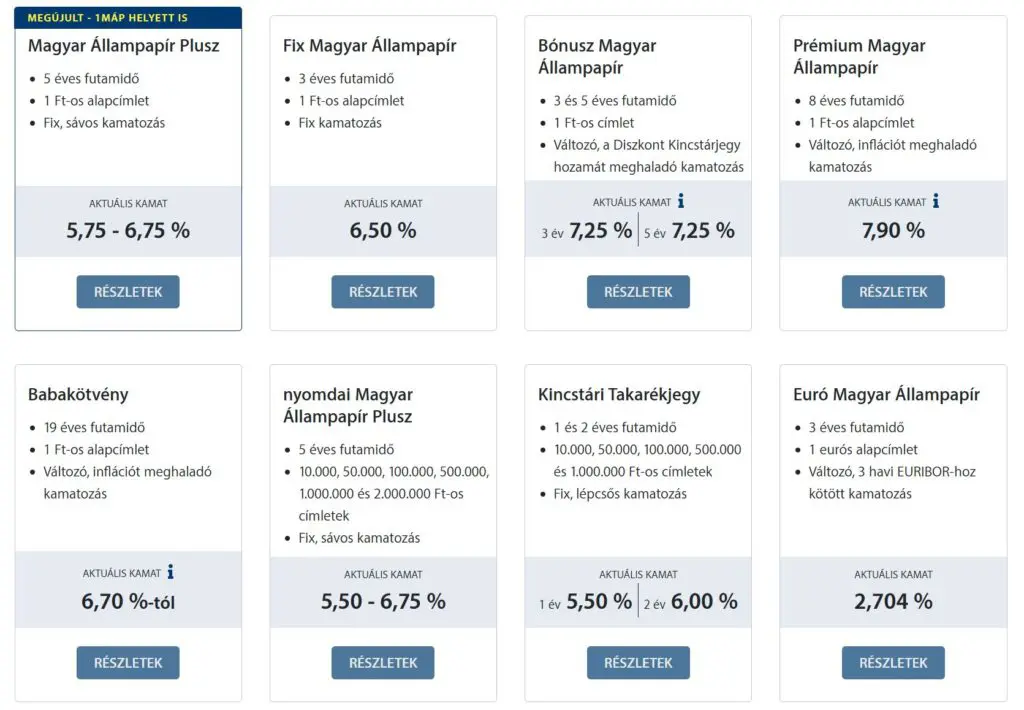
- Interest: obviously everyone is looking at this primarily, that is, the interest rate. Since you see the current interest rate in the picture below, this may change in the long term.
- Term: when the government bond matures. It is worth choosing this based on when you will need the money, but the bonds can usually be redeemed with penalty interest or sold on the secondary market as long as there is liquidity (so almost always).
In the picture below you can see the types of government securities offered for subscription, the printing company only indicates that they will physically print the instrument for you. However, the interest rates here are definitely not 19,1%, but of course it is always appropriate to take into account the real interest rate – government securities interest rate inflation.
🔰Hungarian Government Securities Plus🔰
(5 years, fixed interest rate, increasing, maximum HUF 10 million/distributor)
If you don't need the money in the long term, and you are betting on inflation falling, then the Hungarian Government Bond Plusz – alias MÁP+ or MÁP Plusz – a good choice. What are the dangers of Hungarian Government Bond Plus? For example, when buying real estate or building in the future, if inflation rises and exceeds the interest rate of MÁP Plus, the real yield will be negative.
🔰Fixed Hungarian Government Bond🔰
(3 years, fixed interest rate, maximum HUF 50 million/distributor)
The Fixed MÁP is similar to the MÁP+, which has roughly the same problem as the MÁP+, but here the interest rate does not increase, in exchange for which you pay more in principle. Probably, if you want a fixed interest rate, the shorter term and higher interest rate of the Fixed MÁP will be the winner, but of course no one knows where inflation will go.
🔰Bonus Hungarian Government Securities🔰
(3 or 5 year term, variable interest rate (3 month DKJ+1,5-2,5%, maximum HUF 100 million/distributor)
The Bonus Hungarian Government Bond also available with two terms, and depending on this, it pays a yield of 1,5-2,5% above the DKJ yield. The problem is that It is not very possible to estimate what the yield on the discount treasury bill (DKJ) will be., so the BMÁP is a pretty big “gamble”. In addition, the nominal bonus of the DKJ can be lower than inflation, meaning it can even be negative in real terms. This paper tracks changes the fastest, but the real risk is inflation, so it is better to fix the interest rate to it than to the DKJ yield.
🔰Premium Hungarian Government Securities🔰
(8-year term, variable interest rate (inflation + 0,5-1% premium), maximum HUF 25 million/distributor)
The new Premium Hungarian Government Bond is similar to the BMÁP, but is a relatively long-term premium government bond, which is good for the state because it only has to repay the nominal value after 8 years. The interest rate is fixed to inflation, the premium is +0,5-1%. For those who want to preserve real value in the long term, it may be good, and they do not have to speculate on the yield of the DKJ, as is the case with the BMÁP. The problem is that FIX MÁP seems better in a falling inflation environment, especially over a 2-3 year period.
🔰Euro Hungarian Government Securities🔰
(3-year term, variable interest rate (3-month EURIBOR), maximum EUR 500K)
Euro-denominated government securities the problem is the EUR/HUF currency risk, that is, if the forint strengthens against the euro, the real yield is negative, but this has not been the trend in the long term so far. However, anything can happen over a 3-year period, but anyone who believes in the primacy of the euro over the forint can choose this too. Its interest rate is fixed to the EURIBOR interest rate.
Az EURIBOR (Euro Interbank Offered Rate) one of the eurozone's interbank lending rates, which shows the interest rate at which European banks are willing to provide each other with short-term loans.
🔰Discount Treasury bill🔰
It is important that Discount treasury bills do not pay interest like other bonds and government securities.Instead, they could have booked a capital gain, since the discount treasury bill is issued by the issuer at a discount below par value. This means that when the discount treasury bill matures, the face value of the bond is paid out, not interest.
- For example: if the nominal value of the DKJ is 10 HUF - this is what the state pays upon redemption - but you have to pay 000 HUF for the paper upon subscription, which represents a 9524% exchange rate gain compared to the nominal value. The math comes out like this: 5*9524 corresponds to approximately 1,05 HUF.
💡This is what happens in practice: Since the discount treasury bill does not pay interest, but is written below par value – meaning the paper is traded at a discount, which is why it is called a discount treasury bill – this represents a price gain – but this is also expressed as a percentage, so it is not visible at first glance – which is taxed differently than interest. This is not relevant in Hungary because Hungarian citizens do not have to pay taxes on interest or exchange rate gains on government securities. However, the same would not be true for the “American discount treasury bill” – T-Bill, for example, and it is worth knowing this.
It is worth choosing a discount treasury bill when you want to lock up the money for a period of less than 1 year. In practice, you could see it as a cash substitute, It is better to have it in a savings account than in a bank account. 3-6 months of emergency funds It is also usually held in DKJ.
????What are the best government bonds?????
💡Summarizing the above: since From an inflation perspective, we are in a falling environment, so the fixed-interest MÁP Plusz may probably be the winner (of course, no one knows for sure), but of course, your time frame and goals will largely determine which one you should choose. DKJ is good as a cash substitute and emergency reserve, but for those who believe in the power of the euro, Euro Hungarian Government Bonds will be their favorite instrument.
💡In a rising inflation environment, PMÁP will be the winner, So it really depends on the outcomes, which paper you do best with. The treasury savings note was left off the list, which is a one-year Hungarian government bond – there is also a 2-year version - but here you could look at this too. The The interest rate on one-year Hungarian government bonds is currently 5,5%., meaning that based on the February inflation data, it is not really worth investing in it.
🧮Hungarian Government Securities Calculator🧮
There is also a guide for calculating the yield and interest rates of Hungarian government securities, which here I achieved it. You can parameterize the whole thing quite well, with all kinds of paper, so it's definitely worth trying.
Government securities, bonds abroad
It occurred to me on this topic that anyone who has Interactive Brokers account, it can also buy American discount treasury bills, which T-BillIt's called. This doesn't require an American social security number (SSN), while the T-Note, which is the longer-term bond, does. To do this, you need to type the word "Bond Scanner" on the IBKR web interface, and then under the US Treasuries tab, you can list the bonds based on maturity. Unfortunately, the Hungarian translation of the interface is pretty bad, it's better to use English.
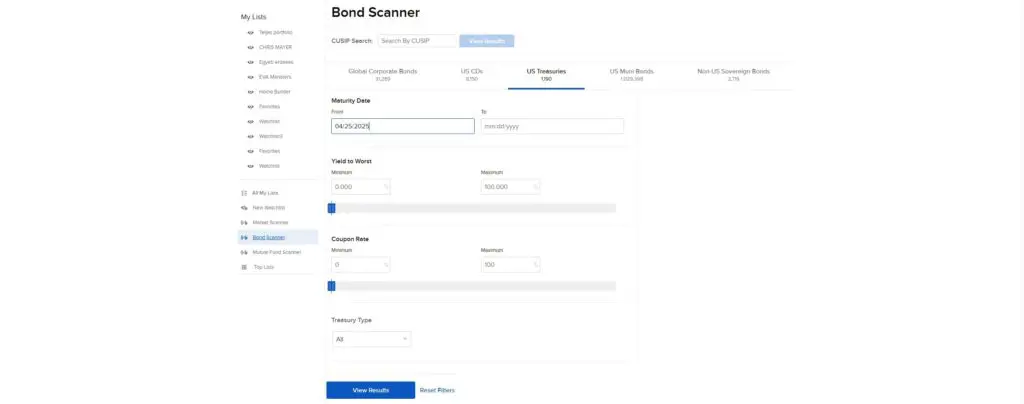
because the liquidity is huge, so they could buy T-Bills for up to 1 month at 4-4,5% interest, but of course this bond follows American inflation. The problem with the Euro Hungarian Government Bond is that you run the USD/HUF currency riskHowever, over the long term, the forint typically weakens against the dollar, but this is a shorter term.
It is important that The American T-Bill does not pay interest, but as I already wrote about the discount treasury bill, they can record exchange rate gains. Since the tariff with the USA has been abolished since January 2024, XNUMX Double Taxation Agreement, therefore, the US government withholds 30% tax – withholding tax – on all interest income. You won’t get this either, so it’s not really possible to claim it back. Unless it appears as an exchange rate gain, in which case you will have to pay tax on it later according to Hungarian law. If If you take the T-Bill to a TBSZ account, it is tax-free, Thus, its current yield of approximately 4,5% already beats that of euro-based government bonds.
❗Difference between nominal and real yield❗
It is worth mentioning the difference between nominal and real yields in relation to the interest rates on government securities for a few sentences. To simplify things:
Nominal yield
- The investment generated measured in actual monetary amounts hozam
- Does not take into account the effect of inflation
- This value is included in most investment products, bank deposits, and bonds.
- This is the “visible” return that we experience directly.
Real yield
- Inflation-adjusted return
- The investment change in purchasing power shows it
- It indicates how much more we can actually buy as a result of our investment
How do you calculate the real return from the nominal return? Subtract the inflation from the nominal return. For example, if the nominal return is 10% and the inflation is 5%, the real return will also be 5%.
🏡Invest the interest on government bonds in real estate🏡
According to an interesting statistic, both Generation X and Generation Y rank real estate investments first among investment forms. In our country owning real estate is almost a matter of prestige, We like to invest in brick and mortar, more than 90% of families live in their own homes, less than 10% rent, while in Germany the same is roughly 50-50%. The reason for this is that in our country the rents are relatively high compared to the salary, they can even reach 50%. However, fewer and fewer people can afford to buy an apartment/house due to the high prices per square meter.
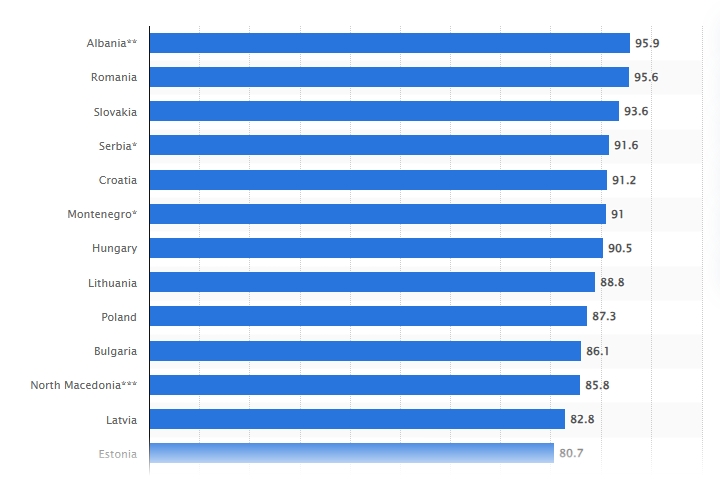
This is why investing in real estate is attractive because there are many tenants and therefore the tenants can be made to pay off the loan installments, On the other hand, it is possible to get a loan for a home with a relatively small down payment. This actually works as a “capital leverage”, since You can get a loan for a 10 million apartment with a 50 million down payment, which acts as a 5:1 leverage. However, the price does not fluctuate like in the case of stocks, you do not get a margin call - this occurs when the value of the capital (own money) in an investor's margin account falls below the minimum required level -, they do not liquidate your positions, If you don't put in more capital, I could list more.
! ️Problems with investing in real estate! ️
Although this article is not about investing in real estate, but rather about investing the interest on government bonds somewhere, it is worth mentioning its risks. One of them is that Real estate is an illiquid investment form, so if you need the capital quickly, you can't withdraw it.
The other is a high appreciation, since real estate prices have increased many times over the past 10 years. This also means that the yield available from renting has fallen. What does this mean in Budapest, for example? The price per square meter can easily be 1 million HUF in an unpopular area, while in Buda, in the case of newly built properties can reach 3 million! HUF, as I saw on a billboard the other day.
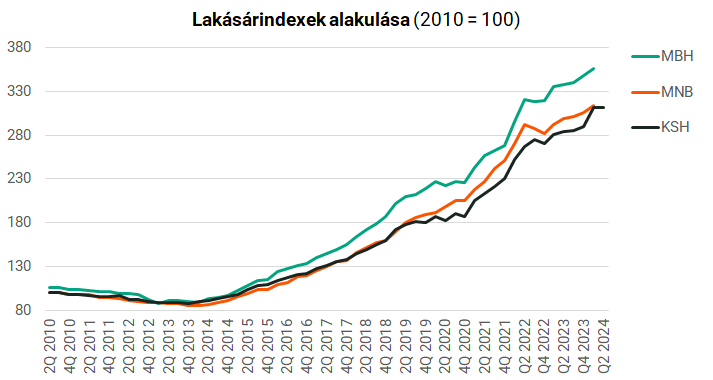
Let us now consider the first case, an average 35 square meter studio apartment costs 35 million HUF, and can be issued for approximately 200 HUF - this is the interest -, 000 million HUF per year. Of this tax must be deducted – approx. 1 month's cost – depreciationand it must be taken into account that will not always be releasedThis is usually expressed in 1 month per year, and then nothing has broken yet, the tenant is reliable, the apartment is not depreciating particularly much, there are no external circumstances – e.g. aggressive, loud neighbors - that would hinder rentability, etc. Deducting two of the 12 months leaves 2 million HUF, this 17,5 years! means a return on investment – with all other parameters changing – but after all this time, you will almost certainly have to spend money on renovation.
It is also worth knowing that as the size increases, the rent cannot necessarily be increased proportionally, It is not certain that a 105 million apartment can be rented out for 600 per month. It is also not certain that it is true that the rent of a luxury apartment priced at 000 million per square meter can be increased three times because its purchase cost was three times higher. Simply put, these there will not be enough solvent demandand the oversupply is pushing prices down.
🎉When is it worth investing in real estate? instead of government bonds🎉
As you can see, the above reflects a relatively optimistic calculation, however I didn't count on the increase in property prices. – which is equivalent to the exchange rate gain of other instruments – which is the more significant amount in the long run. So there are still cases when it is worth investing in real estate.
One of these, if a They bought an occupied apartment in an area that they picked up on the fly and the significant price increase It is also important that you are handy people and you understand the renovation, then you don't have to pay for the terribly expensive labor, just the material cost. Of course their own wages – your time and expertise – should also be priced in, as an opportunity cost, but let's ignore that for now.
Here are some ideas that can help you make quite a good profit from real estate, if there is demand:
- To be renovated apartment renovation practically at material costObviously you have to price your own work here, but it's still cheaper than sending a crew there.
- Think about what size apartments work well. Generally there is a greater demand for smaller studios, which can be taken out by both singles and couples, 35-40 square meters the ideal.
- Olyan one-room, larger studio apartment, which can be converted into a 1+1 half-room apartment or it can be gallery-styled. This way you can gain a lot of valuable space, which can be priced well.
- Around universities apartments are always much easier to rent out than, say, behind a garbage incinerator. There is simply more demand, but you have to factor in the periodicity also, for example, students go home in the summer. Another place is around large office buildings.
- To speculate that the area will be trendy. For example, the construction of the new unit of the Paks nuclear power plant will attract a lot of labor to the area - moreover, the apartment can also be rented out to companies employing construction workers, not just private individuals - who need to live somewhere, but apartments in the Austrian border towns have also increased in value in the past few years. Similar price increases were also observed in Budapest's Corvin Köz.
- Home staging courses: as they say, it's what comes first. You can make millions when renting/selling an apartment if it looks better than its competitors.
The point is that Be sure to go around the thing., calculate the expected return and don't rely on the crazy rise of the last 10 years. Trees don't grow to the sky, think of the 2008 real estate crisis.
🪙Go to into precious metals interest on government securitiesthe🪙
In the past few years, investing in gold and other precious metals has become popular, which can also be an alternative for those who want to invest the interest on government securities. In this case, you don't have to imagine that you are buying raw gold bars, but either investment grade, so-called four-nines – 99,99% pure – gold or gold alloy coins, the gold content of which is guaranteed by the distributor. The latter are easier to carry and harder than investment gold, which is a relatively soft metal, and are therefore usually provided with a security foil.
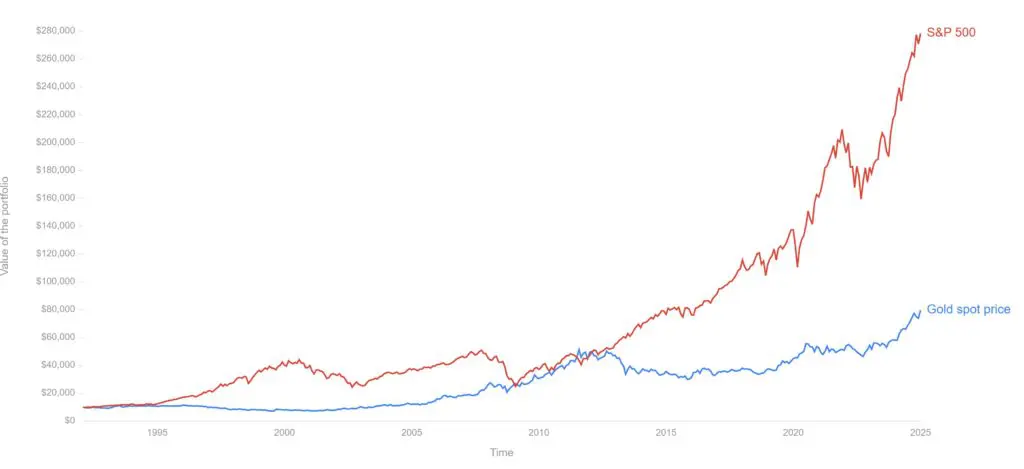
But why is gold investing so popular?? This is clearly visible in the image above, in the last 1 year – i.e. in 2024 – its price has increased by 42,8% according to the Curvo website.

There are two problems with investing in gold: not a productive asset, does not produce value, so does not earn interest, and the increase in value usually comes from the fear of devaluation. After all We buy gold when we want to avoid loss of value.Since the amount of gold that can be mined is limited, it does not lose its value, we cannot produce it by chemical processes, so it cannot be duplicated. Value-preserving, "flight currency", but it is not worth holding in the long term, but you can speculate on its price. In the chart above, you can see the US stock market index - S&P 500 - and the value of gold expressed in dollars compared to each other, not adjusted for inflation. To put it mildly, gold did not win. However, in the event of a major stock market crash, the price of gold usually rises, so in the middle of a crisis, it can usually do well in the short term.
〽️Do it interest on government securities to the stock market〽️
A The stock market traditionally outperforms other asset classes. However, extra returns come with extra risk, which many people associate with volatility. I can tell you from experience that The stock market is 10% head and 90% stomach, You have to endure the ups and downs, otherwise don't invest here.
Az The 150-year average of the US stock market has produced a return of somewhere around 9,3%, nominally. But back then it was still full of companies that produced physical products, worked with high costs, and had difficulty scaling. If you looked at a shorter time frame than that, then over the past 20 years – in which there were two crises – the same is 10,6%, and over ten years it is 13,8%. The last one 5 years was even more extreme, with an average annual return of 15,2%!. The and the S&P 26,4 has already returned 500% in the past year, the American stock market index. Of course, these are nominal numbers, they have to be adjusted for inflation, but they still end up being nice percentages.
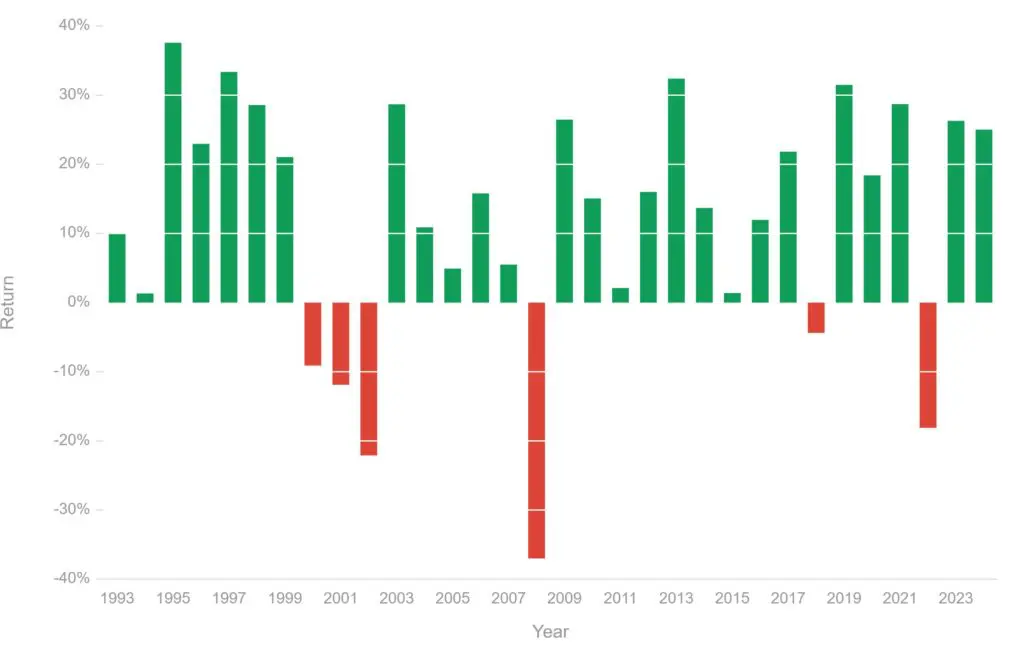
However, a minor correction has arrived this year, and In the last month – March – the US market fell by roughly 1%.Of course, no one knows where the S&P 500 will go, but stocks have always been the winners in the long run. These effects are discussed in valuation of shares, valuation we wrote about in our article earlier.
I've heard the excuse quite often that "I don't trade the stock market because I don't know how to do it," which is a real reason, because people are full of fear. But No one is born with an understanding of real estate, gold, or government bonds. and This is exactly the case with stock investing. That's why I usually recommend to the inexperienced to open a brokerage account, including a TBSZ invoice (LightYear, Erste, K&H Értékpapír (formerly KBC) and Interactive Brokers also offer this), deposit “play money” and buy a index-tracking ETFFor example, the American S&P500 – article here – ETF or the German DAX index – article here – ETFs can be a good choice. Hold them for 10-20 years and don't try to guess which individual stock will be the winner or where the market will go. And for those interested in the relationship between inflation and stock market returns, read this article.
💡But what is an ETF? The ETF (Exchange-Traded Fund) egy exchange-traded fund, which tracks a specific index, industry, asset class or strategy.
ETFs, like stocks, trade on stock exchanges, so they can be bought and sold at any time during the day, as they are highly liquid. Where can you find ETFs? For example, JustETF is a pretty good search engine, but there are a few more.

💰What is more important is that they are cheap, with an average annual cost of 0,3-0,5%, this must be deducted from the annual returns mentioned above, and they are also diversified. And That's about it, you don't need to do anything else with them. Within this, who believes in what – EU or USA, perhaps emerging market, sectoral, growth stock ETFs, etc. – is a matter of individual preference.
And those who are reluctant to learn how to invest in stocks should consider the following:
- A The movement of precious metals correlates with the companies that extract them. (e.g. companies that own gold mines), then why not buy them?
- Az property management companies (REIT) own apartments, houses, factory buildings, malls and other properties, but you don't have to worry about tenants and renovations. They pay dividends (this is the rent for the apartment) and their exchange rate is rising (this is the increase in the value of the apartment), so it's pretty much the same thing as if you physically owned multiple apartments, only it remains liquid.
- Are US Treasury ETFs, so you can actually buy long-term US bonds that you wouldn't otherwise be able to.
So almost all other instruments can also be written off with stocks or ETFs, then why not invest in it for the long term? There is one exception: if you need the money within a few years. Then It is not worth buying stocks or ETFs., this means a longer-term commitment, at least 10 years, but of course such instruments can last for any length of time.
Government securities summarye
Above, we have discussed what it is worth investing the interest from government securities in, but in reality there is nothing new under the sun. The only thing that has changed is that a large amount of money has entered the market due to the interest rates on government securities, and this is now looking for its place. The point is that you have to endure the stress caused by investments, so it should be more stomach than head. Follow the KISS principle - Keep it Simple, Stupid -, i.e. Invest in what you have minimal visibility into.
Some good advice at the end: Investing in HUF is not a good idea in the long term due to high inflation. – but in the short term it can be good for speculation -, i.e. your investments must beat inflation (PMÁP) or it must be built into its value (real estate). If you invest in another currency rather than in forint, you will be able to get away with it (at the end of 1989 58,46 HUF was 1 USD, now...) as bad, at least in the long term the exchange rate risk is not in favor of the forint.
Always consider that What time frame do you want to invest in? (when will you need the money) and how What is your risk-taking capacity?Of course, this is usually only revealed live, so it is worth starting with smaller capital and gradually increasing the amounts.
🤑If you are interested in what brokers we use, read our articles below:
(I.e.Interactive Brokers broker account analysis – Professional for professionals
📈LightYear Broker Account Analysis - Simplicity and cheapness go hand in hand
Frequently Asked Questions (FAQ)
What is PMÁP?
PMÁP is the abbreviation for Premium Hungarian Government Bond. PMÁP is an 2025-year, variable-interest, inflation-tracking government bond with a maturity of 8, the interest rate of which is linked to inflation, the interest rate is 0,5-1%, which pays an interest rate of 7,9%. It can be subscribed as a private individual for a maximum of HUF 25 million.
What is the BMA?
BMÁP is the abbreviation for Bonus Hungarian Government Bond. BMÁP is a 2025- and 3-year, variable-interest bond in 5, the interest of which is tied to the interest of the 3-month discount treasury bill, the interest margin is 1,5-2,5%. It pays 7,25% interest in 2025. It can be subscribed as a private individual for a maximum of HUF 100 million, which is the largest amount of government bonds.
What is Fixed Hungarian Government Bond, Fixed MÁP?
Fix MÁP is the abbreviation for Fix Hungarian Government Bond. Fix MÁP is a 2025-year fixed-interest bond maturing in 3, paying 6,5% interest. It can be subscribed for up to HUF 50 million as a private individual.
What is Hungarian Government Bond Plus?
The Hungarian Government Bond Plusz 2025 is a 5-year fixed, rising interest rate bond that pays 5,75-6,75% interest. It can be subscribed for up to HUF 10 million as a private individual.
What is DKJ?
DKJ is the abbreviation for Discount Treasury Note, which is also a type of government bond. The difference compared to bonds issued by other governments is that in the case of DKJ, interest is not paid on the face value, but the paper can be subscribed below the face value.
How is the "interest rate" determined for Discount Treasury Bills?
The actual interest rate (yield) of the DKJ is ultimately determined by market participants at auctions, where all of the above factors are incorporated into their pricing decisions. The interest rate of the Discount Treasury Note (DKJ) is determined by a combination of several market and macroeconomic factors:
- Central bank base rate: the base rate level set by the MNB (Magyar Nemzeti Bank) is a fundamental benchmark. The yield of the DKJ generally follows its changes.
- Inflation expectations: if market participants expect higher inflation, they will demand higher returns on their investments to preserve the real value of their capital.
- Supply and demand conditions: the price is determined based on investors' bids at auctions organized by the ÁKK (Government Debt Management Center). If there is high demand for DKJs, the yield will be lower.
- Maturity structure: there is a yield difference between shorter and longer-term DKJs, as shown by the yield curve.
- Country risk: Hungary's economic perception, debt rating, and political stability all influence the risk premium expected by investors.
- Liquidity situation: the liquidity situation of the banking system and secondary market turnover affect pricing.
- International interest rate environment: global financial market trends, especially the interest rate levels of the eurozone and the USA, also influence the pricing of Hungarian government securities.
- Public finance situation: the size of the public debt and the development of the budget deficit affect the state's financing needs and investor confidence.
What is the difference between a government bond and a bond?
In fact, government securities are a set of bonds – all government securities are bonds, but not all bonds are government securities – the difference between the two is that a government security is a bond issued by a state body – in Hungary, government securities are issued by the State Debt Management Center Ltd. (ÁKK Ltd.) – issues. ÁKK Zrt. acts on behalf of the Hungarian state and is responsible for managing the state debt and ensuring the financing of the state. By issuing government securities, the state creates resources to finance the budget deficit or to renew maturing debt.
Are there government bond calculators?
Yes, there are several that you can use. The most well-known is allampapirkalkulator.hu, where you can calculate with all government securities.
Which is the best government bond?
This primarily depends on the time horizon planned for the government securities and whether inflation is rising or falling. Based on these:
- if inflation rises, the price of older, fixed-interest government securities falls (inverse proportionality): in this case, floating-interest securities are more advantageous, e.g. Bonus Hungarian Government Securities, PMÁP
- if inflation falls, the price of older, fixed-interest government securities rises: in this case, fixed-interest securities are more advantageous, e.g. MÁP Plusz, Fix Magyar Állampapír
- for the shorter term, short-term papers are better than DKJ
- if you appeal to the weakening of the forint, then government securities denominated in foreign currencies are more advantageous, e.g. Euro Hungarian Government Securities
💡Always check the expiration date!
What does the Hungarian State Treasury do?
A Hungarian State Treasury (short: State Treasury) is a state institution that performs a number of important tasks in order to support the financial and economic operation of the Hungarian state. The activities of the State Treasury are related to the operation of public finances, the management of retail government securities, and the processing of various state subsidies and payments.
From our point of view, the point is that every Hungarian citizen can open a securities account at the Hungarian State Treasury for free! Either physically, at one of their locations, or electronically, at customer portal via. There is also an application, Mobile treasury As.
What is ÁKK Zrt doing regarding government securities?
Az State Debt Management Center Ltd. (ÁKK Ltd.) is a state-owned economic entity whose main task is to manage the state debt and ensure the financing of the state. ÁKK Zrt. acts on behalf of the Hungarian state and its activities are of key importance for the operation of public finances. ÁKK Zrt.'s main tasks are:
- public debt management
- Issuance of government securities (i.e. the listed government securities are purchased from the ÁKK through the Hungarian State Treasury)
- presence in financial markets (conducting government bond auctions)
It also has other tasks, such as contact and communication, strategic planning, and the like.
Buying government securities: what do you need?
Firstly, Hungarian citizens can open a securities account free of charge, and secondly, you can open an account in person or through the aforementioned customer portal. After that, you must transfer the amount of money to the account number you received, and then subscribe to the newly issued paper or buy it on the secondary market.
How will government bond interest rates change in 2025?
Two things influence the change in interest rates on government securities:
- term, usually the shorter one pays less interest per 1 year
- inflation, if the interest rate is variable
The interest rate on fixed-rate government securities either does not change or changes at a predetermined rate. You can find the rate in the offer form.
What are the risks of Hungarian Government Bonds Plus?
A Hungarian Government Bond Plus (MÁP Plus), often referred to as “super government bonds,” is a popular investment among the general public because it offers a fixed, staggered interest rate and is considered a relatively low-risk investment. Of course, it also has some risks:
- inflation risk: due to the fixed interest rate, if inflation rises, they could even "achieve" a negative real return
- liquidity risk: although liquidity is almost always given due to the state's involvement, redemption is not done at full value, the state charges a 1% penalty interest on the paper (99% exchange rate)
- public risk: although this is extremely low, the state's solvency is infinite in its own currency, but for example, in the case of a euro-based paper, this would no longer be true.
- alternative cost: a better return can be achieved with other instruments over a given term
- currency risk: MÁP Plusz is a government security denominated in forint, so investors may be faced with changes in the forint exchange rate if they think in foreign currency (if the forint weakens, other currencies strengthen).
Government bond redemption: how much is the penalty interest?
The penalty interest is 1%, but the state can change this arbitrarily, and it is not obligated to redeem the bonds before maturity.
Legal and liability statement (aka. disclaimer): my articles contain personal opinions, I write them solely for my own entertainment and that of my readers. Az Articles appearing on iO Charts in any form NO they exhaust the subject of investment advice. I have never wanted, do not want and am unlikely to give such advice in the future.. The information provided here is for informational purposes only and NO may be interpreted as an offer. The expression of opinion in any form NO can be considered as collateral for the sale or purchase of financial instruments. For the decisions you have made ONLY YOU You are responsible, no one else, including me, will take the risk.