

?What is the Market Momentum column about??
The Appeninn share price fell 18% in one day in 2025, then fell roughly 39% from its all-time highs, and is currently at around 605 HUF. What is the reason for this, what are the underlying drivers of the share price, and what should anyone interested in this stock pay attention to?
I don't know if you're aware of this, but a thorough fundamental in-depth analysis can take 40-50 hours. As an investor, it's impossible to put that much energy into analyzing each company if you want to effectively manage a long enough watch list. That's why I created the Market Impulse column, which provides a snapshot of each stock, especially Appeninn, and roughly outlines current events. It is not an in-depth analysis, but rather just food for thought based on the current state.
My goal is not to give daily trading tips or analyze technical patterns. Instead, I provide quick, to the point fundamental mini-analyses that help you filter. These impulses help you keep in mind whether the current price movement of Appeninn or another market participant deserves deeper investigation or is just a passing market phenomenon.
You can find the share subpage with detailed information here: APPENINN stock page
If you are looking for in-depth analyses of the site, click on the link below: iO Charts stock analyses
?Table of Contents?
I have created a table of contents to make it easier for you to navigate the content:
- ❓What does Appeninn do?
- 💡Appeninn's current situation and competitors
- 🎢Appeninn metrics
- ✅Appeninn: will you get used to it or will you escape?
- 📝Summary of the thesis
What does Appeninn do?
Appeninn Vagyonkezelő Holding Nyrt. (commonly known as Appeninn) is a Budapest-based real estate investment holding company, trading on the Budapest Stock Exchange under the ticker APPENINN, and operating as a regulated real estate investment trust (SZIT). This company form is the Hungarian equivalent of the internationally known REIT (Real Estate Investment Trust) structure. This latter status is key: SZITs are required by law to pay out at least 90% of their profits as dividends, or at least to propose them. What happens next is decided by the general meeting, and in the case of Appeninn, this has caused surprises more than once.
The company operates in two main segments:
- ? Office and warehouse rental: The backbone of the portfolio is office complexes and warehouses in Budapest, which are operated under long-term leases. This segment generates stable, predictable rental income.
- ? Regional expansion: Appeninn has been actively building its foreign portfolio since 2023. It first purchased the Wiśniowy Business Park office complex in Warsaw, and then in early 2026 acquired a 56343 square meter Goodyear logistics center in Tarnów, Poland, under a long-term lease, one of the largest such transactions in the company's history.
? In practice: Appeninn operates in a clean, easy-to-understand model: it buys properties, rents them out, and lives off the rental income, a classic REIT. There is no pharmaceutical pipeline risk, no oil exposure like MOL, for example, and its balance sheet is relatively transparent. The question is whether the quality of the portfolio, the length of the leases, the availability of the properties, and the predictability of the dividend policy are sufficient to ensure Appeninn's share price movement is upward in the long term.
? The situation of the Appeninn and its competitors
The real estate market, especially the office segment, has faced dual pressures in recent years: in the post-COVID period, the spread of home office has reduced the demand for traditional offices, while inflation and the interest rate environment have increased financing costs. Appeninn's share price may also reflect these macro effects. Anyone familiar with the US REIT market knows that it is very important whether such a company manages and leases residential properties, industrial areas, server parks or what, these must be considered separately when analyzing.
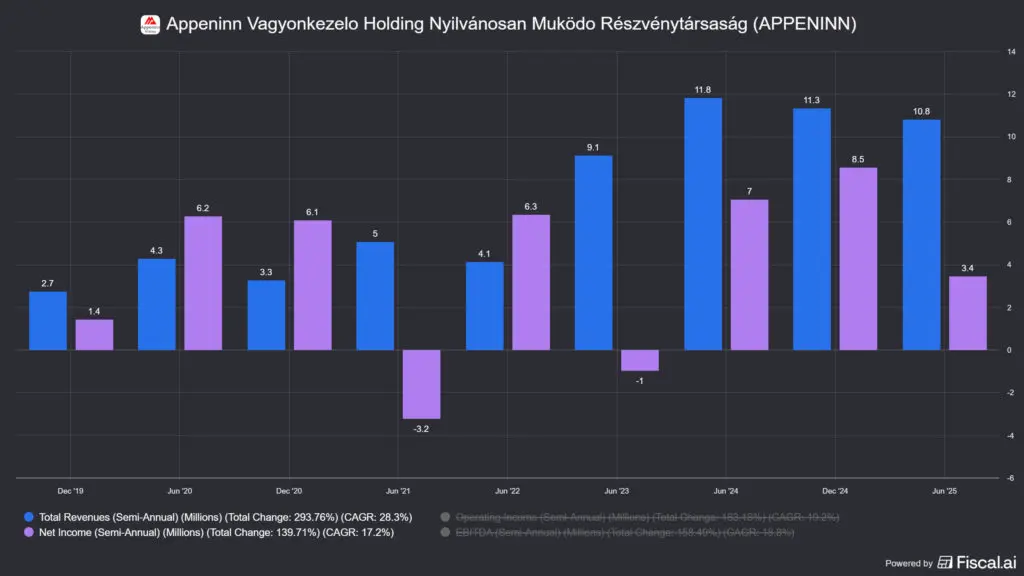
According to the first half of 2025 data, rental income was EUR 10,8 million, and after-tax profit was EUR 3,4 million, both of which were lower than the same period of the previous year. This is not dramatic in itself, but it indicates that the growth trajectory is not linearly upward. Why do you see half-yearly data and why in EUR? Because the company reports this way due to its international portfolio, and revenues from different currencies are consolidated in EUR.
? Competitors
- ? Biggeorge REIT Plc.: is also a domestic real estate investment company listed on the BSE, with a similar SZIT structure. The comparison is natural, but there are differences in the composition of the portfolio and the geographical focus, as they are mainly involved in residential and logistics developments. The difficulty in analyzing SZITs is that the companies work with quite different types of real estate assets even within the category.
- ? Warimpex, CA Immo (regionally): larger regional players active in the Central European office and logistics real estate market, which serve as a benchmark for Appeninn rather than a direct competitor.
- ? ️ Wing Zrt. (non-listed): is a leading player in Hungarian premium office and logistics developments, but is not listed on the stock exchange.
? In practice: Appeninn is a medium-sized player in the BSE real estate sector based on its market capitalization of HUF 31 billion, where the range of comparable stock market competitors is narrow. The investor decision is mostly about the quality of the portfolio and the dividend potential of the SZIT structure.

? Metrics of the Appeninn
? Appeninn exchange rate and catalysts
The price of Appeninn is one of the most illustrative examples of how a single piece of news can cause a huge swing in the price of a smaller stock. In early 2025, the share nearly doubled in a year, from 500 HUF to 987 HUF, and then fell sharply in a day due to a dividend-related reversal. This volatility reflects both the liquidity constraints resulting from the narrow public shareholding ratio and the price-influencing power of dividend expectations.
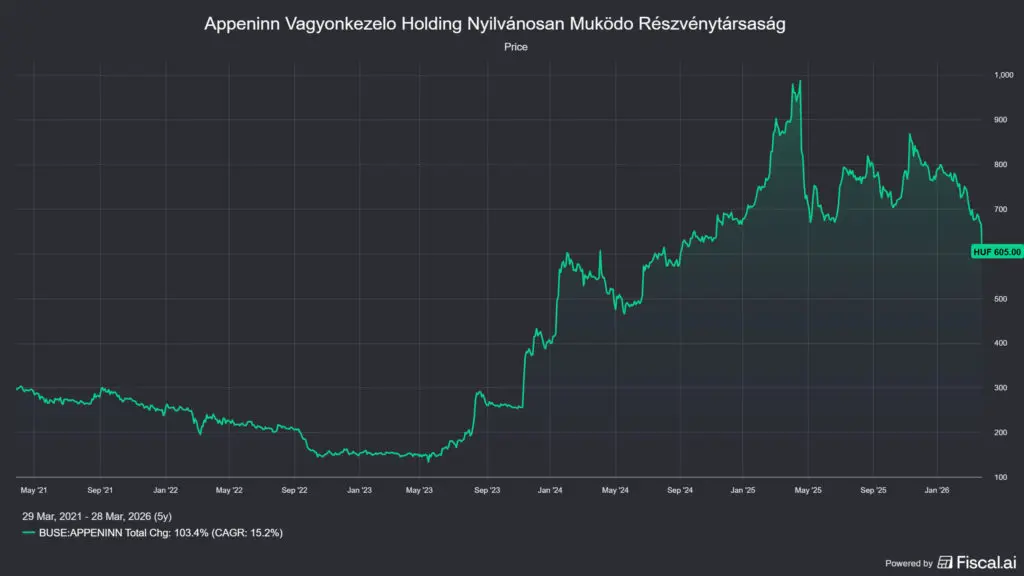
In mid-2025, Appeninn announced that it would not pay dividends after its 2025 results, which was not really appreciated by investors. This clearly shows why most people held the stock: due to the high dividend yield, which paid zero instead of the previously expected 12% at a price of approximately HUF 880, this would have meant approximately HUF 105 per share. However, the board of directors proposed 3 different scenarios, but the large shareholders voted them down.
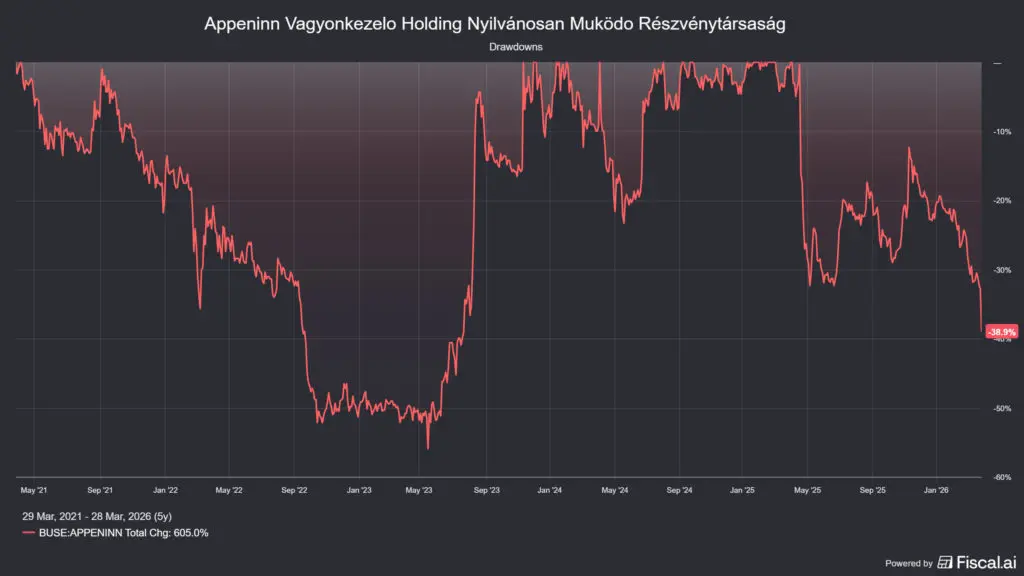
Appeninn's share price is driven by three factors in the short term: dividend announcements and general meeting decisions, acquisition news (which usually has a positive effect), and broader domestic real estate market and interest rate movements. I think that in many people's minds, before the dividend was discontinued, Appeninn functioned as a kind of bond replacement instrument, and when the company's dividend significantly exceeded the interest rate on 3- and 5-year Hungarian government securities, investors channeled their capital there. However, this theory was overturned in the middle of last year, which shows that stocks behave completely differently than bonds.
? Rating
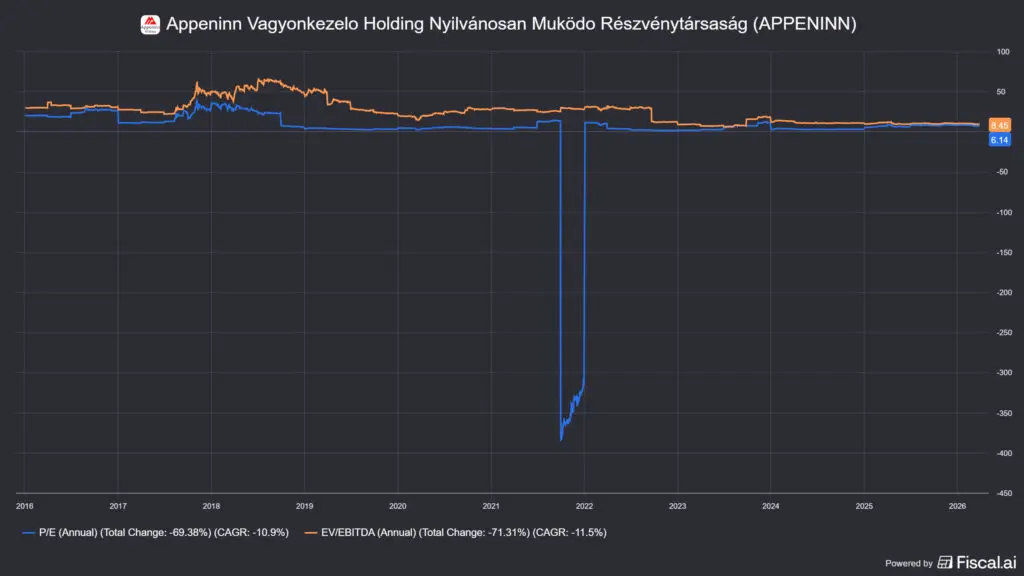
How should SZIT/REIT companies be valued and why is it difficult to draw any conclusions from the movement of the Appeninn share price? Because traditional P/E, EV/EBITDA and similar indicators are not suitable for determining the underlying value of the share, because they are terribly distorted, among other things due to the depreciation of real estate. The dividend could also be used to see what level it is now compared to historical values, but you can't do that here either, since there was no dividend payment in 2025. It is still too early to say whether there will be in 2026, since no such document has been published for the closed year and the issue has not even been put to a vote.
What can be done in this case? Use the FFO and AFFO metrics. FFO (Funds From Operations) returns depreciation from net income and filters out gains/losses on property sales (because these are one-time items), thus showing the actual cash-generating ability of the rental business. AFFO (Adjusted FFO) is even more precise: it also subtracts maintenance and renovation capital investments from FFO, so it measures sustainable, disbursable cash flow. The AFFO payout ratio is the relevant indicator for examining dividend coverage, but this is only interesting at the level of mention in this case. The NAV, or net asset value, should also be calculated, which shows how much the stock is trading for compared to the estimated market value of the portfolio.
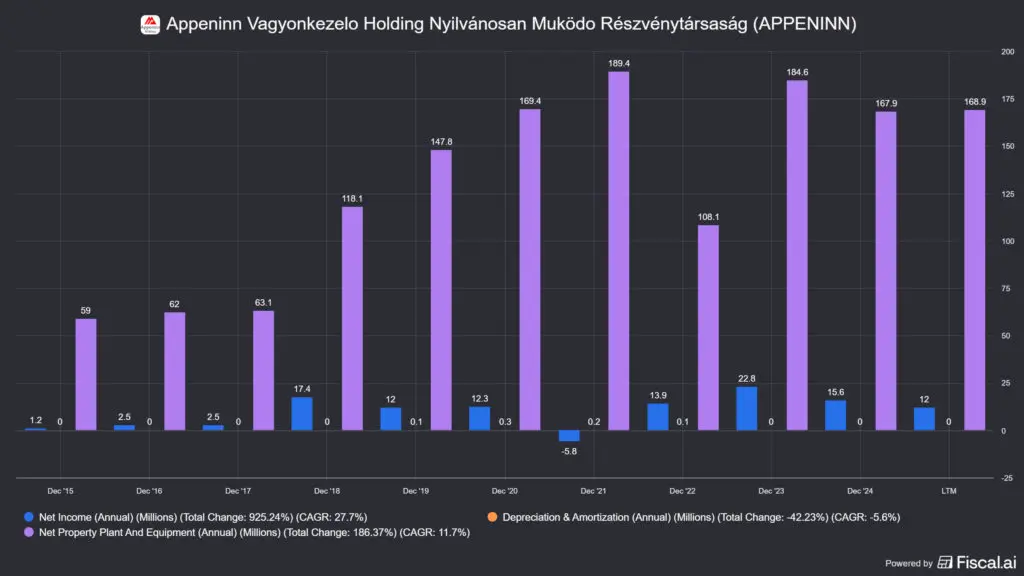
Since, to my knowledge, Appeninn does not publish such data – it is not mandatory according to Hungarian regulations – I was not able to extract this from my data source either. But, if you want to calculate it, you can try it as follows: FFO ≈ Net profit + depreciation − real estate revaluation gain. To do this, use the Appeninn investor data subpage, where you can access the reports: Reports.
☝️To briefly summarize the valuation issues: interpreting the Appeninn price movement, calculating the valuation, and determining the net asset value are incredibly difficult and require serious research and calculations if you want to see it clearly.
?️ Ownership structure
The largest known shareholder is Avellino Holding, with a stake of approximately 24%, while Sequor Holding and OTP Real Estate Investment Fund are also significant owners. Avellino Holding is the one that initiated the withholding of dividends in 2025, a decision that immediately and significantly affected Appeninn's share price. You can see the ownership structure of Appeninn in the image below, which is also published on the company's website.
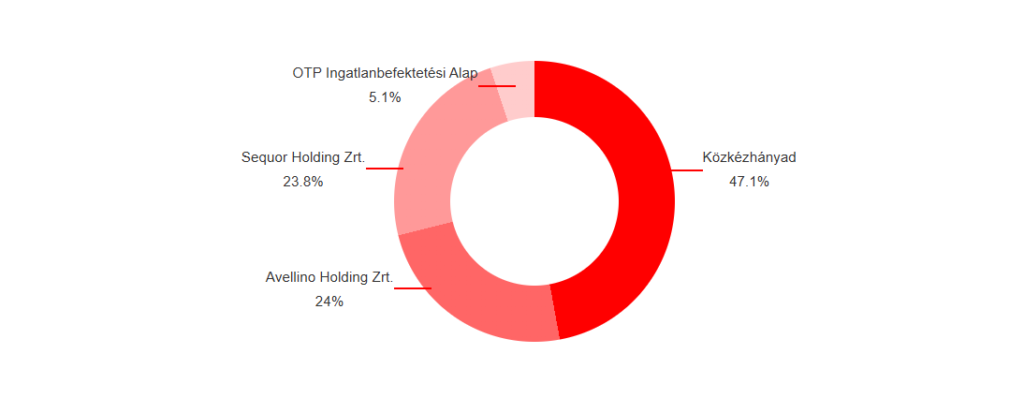
What can you read from the above figure? That the public share, i.e. the amount of shares owned not by owners with more than 5%, but by public and small shareholders, is below 50%. In other words, the large shareholders have total control over Appeninn, as the three companies have a 52.9% stake. This is also a risk because, as you could see earlier, you could lose out on dividends, which is one of the biggest risks for those who want stable, passive income through a stock.
? Risk factors
- ? Dividend uncertainty: The SZIT status promises a high dividend yield on paper, but the 2024 results ultimately resulted in a zero HUF dividend. This raises a serious trust issue: if the company does not pay dividends despite the legal obligation, it rewrites the valuation logic.
- ? Office market structural challenges: Home office and flexible working have permanently reduced the demand for traditional offices. Part of Appeninn's portfolio is based on this segment, which means structural rental pressure.
- ? Low liquidity: Due to the narrow free float and small market capitalization, Appeninn's price movement is difficult to predict. It moves easily even with low turnover, which poses both entry and exit risks for smaller investors, but it can also freeze if there is no other party on the other side of the transaction to provide liquidity.
- ? Regional expansion implementation risk: Polish acquisitions are promising, but entering a foreign market also brings with it financing and operational challenges.
- ? Currency risk: Rental income is generated in EUR, the share is traded in HUF, the strengthening of the HUF worsens the result expressed in HUF.
?In practice: The risk of a stock can be reduced in several ways. The first is diversification, you simply need to hold more stocks in the portfolio. The second is to reduce the position size there, where your convictions are less. The third, that a larger safety margin should be maintained at the entry price compared to the fair value (since the price is not equal to the underlying value), Unfortunately, it is very difficult to determine the real value here, and I see this as the biggest risk for Appeninn.

? Appeninn: will you get used to it or will you escape?
? Bulls say (Optimistic scenario):
- ? Regional expansion creates value: Polish logistics and office acquisitions diversify the portfolio and generate stable, EUR-based rental income. The Goodyear logistics center, for example, has a long-term exclusive lease, which means predictable cash flow.
- ? If dividend policy normalizes, the share price will also react: Due to the SZIT structure, the market is constantly pricing in a potentially high dividend. If management and major shareholders decide to pay it out, Appeninn's share price movements can become unpredictable and react quickly. The high one-day rally in 2025 proved this (but the share price also moved in the opposite direction on the news of the dividend cut).
- ? Many physical devices: one of the advantages of SZITs is that there are a lot of physical assets in the portfolio, which are much easier to value than, say, royalties, goodwill, trademarks, brand power, etc. Moreover, the pricing of the real estate sector is much more stable than, say, MOL, which is dependent on the oil price.

? Bears say (Pessimistic scenario):
- ? Dividend uncertainty would justify a discount: If the company does not pay dividends despite the SZIT obligation, the investor is essentially sitting on a low-liquidity, non-dividend-paying real estate company, which rewrites the risk-return profile.
- ? The office segment is structurally weakening: The long-term impact of home office has not disappeared, and the rental prices and occupancy of non-premium office buildings may be under sustained pressure.
- ? Transparency limits: The lack of transparency in Avellino Holding's ultimate ownership structure and the unexpected decision-making logic of the major shareholder pose a risk that is difficult to price.
? In practice: Appeninn is a seemingly simple investment thesis, but surprisingly complex due to its dividend policy. For those who expect stable, predictable income from real estate companies, the SZIT structure is attractive, but only if the major shareholders actually pay out a significant portion of the free cash. Appeninn's share price reacts sensitively to this, which is a double-edged sword: it contains both opportunity and risk, but in the current situation you should rather run the latter.

? Summary of the situation in the Appenines
Appeninn's share price movement is primarily driven by dividend policy and acquisition news rather than fundamentals in the short term. The quality of the portfolio and the direction of regional expansion can be positive factors, and the Polish logistics and office acquisitions can create value, provided you can calculate how much these assets are worth.
At the same time, uncertainty around dividend policy and liquidity constraints due to the narrow public equity ratio pose serious risks. Anyone watching Appeninn's share price should follow the general meeting calendar and Avellino Holding's announcements at least as closely as the quarterly financial data. However, assuming that the company did not pay a dividend in 2025, the biggest advantage of the SZIT/REIT structure is lost: the stable dividend, so I think investors will move the same capital into other stocks that promise higher price appreciation. This will rather drive the price down, and we have actually seen this in the past 9 months: the paper corrected from 987 to 605 HUF, which is roughly a 39% drop.
If you want to analyze further, use iO Charts' stock finder and portfolio manager, which you can access here: iO Charts.
Frequently Asked Questions: Professional questions about Appeninn
What is SZIT and why is it important for the Appeninn exchange rate?
A SZIT (Regulated Real Estate Investment Company) is a special legal status that grants real estate companies tax breaks in exchange for paying out or proposing to pay out at least 90% of their profits as dividends. Appeninn operates as a SZIT, which in theory promises a high dividend yield. In reality, however, the general meeting can override this proposal, which has a huge impact on Appeninn’s share price: the 2025 general meeting did exactly that, resulting in the expected dividend yield of around 12%.
Why did the Appeninn exchange rate fall so much in 2025?
At the suggestion of the major shareholder Avellino Holding, the general meeting decided not to pay a dividend from the 2024 after-tax profit, but to place the amount in the retained earnings. This was surprising because the board of directors had previously proposed a dividend of approximately 105 forints per share, which at the then exchange rate would have meant a yield of approximately 12%. Upon the news of the dividend cut, the Appeninn share price immediately and sharply started to move downwards, and this has continued ever since.
How liquid is the Appeninn share?
It is a relatively small-capitalization, low-liquidity paper: due to the narrow free float and small market capitalization (~31 billion HUF), daily turnover is limited. This means that Appeninn's price can react quickly to even small capital movements, which allows for both rapid increases and rapid decreases. Building and dismantling a meaningful position is only possible carefully, spread over time.
What does the expansion in Poland mean for Appeninn's share price movement?
The Polish portfolio development, which includes the Warsaw office building and the Goodyear logistics center in Tarnów, diversifies revenue sources and generates cash flow based on long-term leases in EUR. If the expansion continues successfully and the quality of the portfolio improves, it will have a positive impact on both Appeninn's share price and NAV in the medium to long term.
Does Appeninn pay dividends regularly?
Despite the SZIT status, dividend payment is not automatic. The general meeting has decided several times to withhold dividends, most recently in 2025 regarding the 2024 results. Appeninn cannot therefore be considered a reliable dividend-paying security at the moment, and investors can treat the dividend yield potential as an option value, not a guaranteed return.
Legal and liability statement (aka. disclaimer): My articles contain personal opinions, I write them solely for my own entertainment and that of my readers. The articles published here do NOT in any way exhaust the scope of investment advice. I have never intended, do not intend, and am unlikely to provide such in the future. What is written here is for informational purposes only and should NOT be construed as an offer. The expression of opinion is NOT in any way considered a guarantee to sell or buy financial instruments. You are SOLELY responsible for the decisions you make, and no one else, including me, assumes the risk.