

🤔What is the Market Momentum column about?🤔
I don't know if you're aware of this, but a thorough fundamental in-depth analysis can take 40-50 hours. As an investor, it's impossible to put that much energy into analyzing each company if you want to effectively manage a long enough watch list. That's why I created the Market Momentum column, which provides a snapshot of each stock, especially Apple, and roughly outlines current events. It is not an in-depth analysis, but rather just food for thought based on the current state.
My goal is not to give you daily trading tips or analyze technical patterns. Instead, I provide quick, to-the-point fundamental mini-analyses that help you filter through the data. These impulses help you keep in mind whether the current price action of Apple (AAPL) or another market participant is worth investigating further or is just a passing market phenomenon.
You can find the share subpage with detailed information here: AAPL stock page
If you are looking for in-depth analyses of the site, click on the link below: iO Charts stock analyses
📒 Table of Contents 📒
I have created a table of contents to make it easier for you to navigate the content:
- 🍎 What is Apple (AAPL) doing?
- 💡 Apple (AAPL) current situation and competitors
- 🎢 Apple (AAPL) metrics
- ✅ Apple (AAPL): will you get used to it or will you run away?
- 📝 Thesis summary
❓ What is Apple (AAPL) doing? ❓
Apple (AAPL) is the company that has been able to reinvent itself time and time again since its founding in 1976, and in 2025 it opened a completely new chapter in its own history. The Cupertino, California-based company started out in Steve Jobs' garage and went on to become the undisputed king of consumer electronics with the Mac, iPod, iPhone, and iPad. Now, under Tim Cook and in the shadow of the upcoming search for a successor, Apple is increasingly positioning itself as an ecosystem company: the company says its Apple Intelligence AI platform is not just a feature, but the next evolutionary step in the entire ecosystem. This narrative is broadly in line with what other tech companies, such as Google (GOOGL), have been doing in the past few years, as I wrote about here:
The business model is built on five pillars. The most famous is the iPhone, which accounts for nearly 52% of revenues, but in terms of total gross profit, the Services segment took over first place by the end of 2025. The second pillar is Mac and iPad, which maintain their premium position in the professional and education markets thanks to Apple Silicon chips. The third pillar is the Wearables and Home Accessories category (Apple Watch, AirPods, Vision Pro, etc.), where the Vision Pro virtual reality glasses are more of a milestone than a mass product for now. The fourth pillar is Services: the App Store, iCloud+, Apple Music, Apple Pay, Apple TV+, and Google deal (which generates approximately $20 billion in search default fees annually) together represent the company's highest-margin, most scalable segment. The fifth and newest pillar is Apple Intelligence: This category summarizes on-device and cloud-based AI capabilities, which the company believes could become its next driving force.
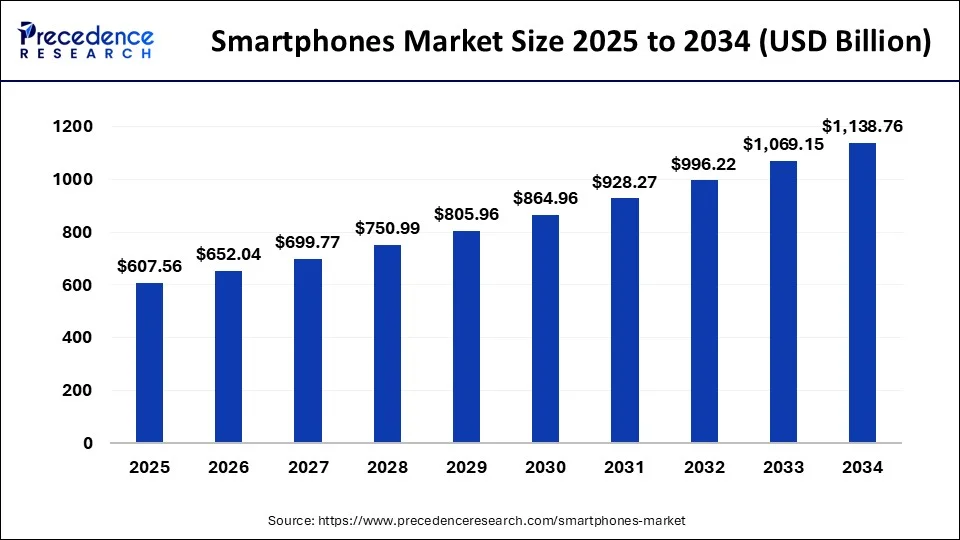
In terms of free cash flow, Apple's model is fundamentally different from CAPEX-intensive tech giants: while Amazon, Meta, and Microsoft are collectively spending nearly $700 billion on AI infrastructure by 2026, Apple plans to invest just $14 billion in capital. Instead, Apple is implementing AI not through its own model building, but through ecosystem integration, hardware-software convergence, and partnerships (Google Gemini, OpenAI). This “AI landlord” strategy represents both Apple’s biggest competitive advantage and its most serious investor question: can the premium be maintained in the long term without its own LLM capabilities?
📌 In practice: In connection with the above, the thought occurred to me: how dependent will Apple (AAPL) become if its services are launched, but are tied to, say, Google, then it will be difficult to remove this from the ecosystem. What happens if Google or Microsoft raises prices through OpenAI and Apple cannot pass that on to consumers? I think this is an advantage in the short term, but a disadvantage for the company in the medium and long term.
Apple is the stock that everyone thinks they understand, but then turns out they don't. Many compare it to an automaker because of its hardware cycle dependency, others value it as a software company based on its Services margins, and still others position it as an AI platform in hopes of future Apple Intelligence monetization. The reality is that Apple is all three at once, and this incomparability is what keeps the valuation debate going year after year. So if you want to analyze the company in more depth, you have to separate these segments, examine their revenue and margins, and then weight them together to get the final result.

🏆 Apple (AAPL) Current Status and Competitors 🏆
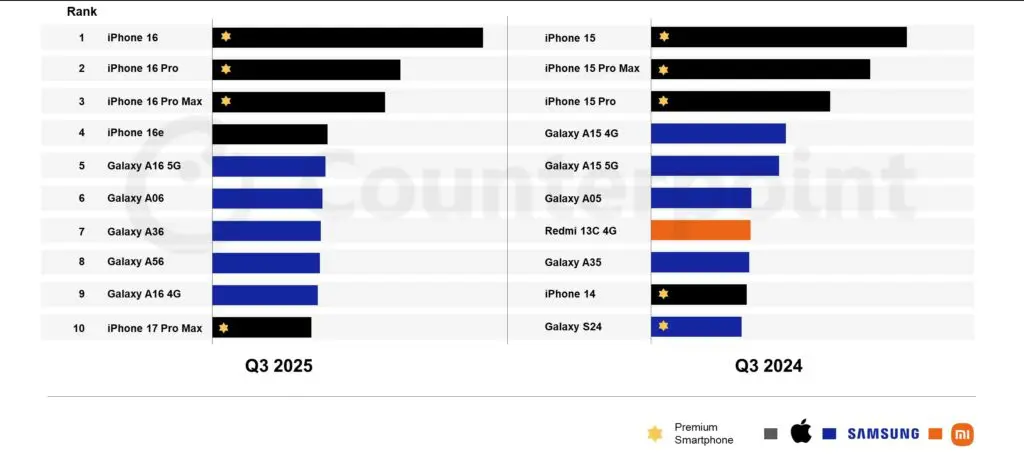
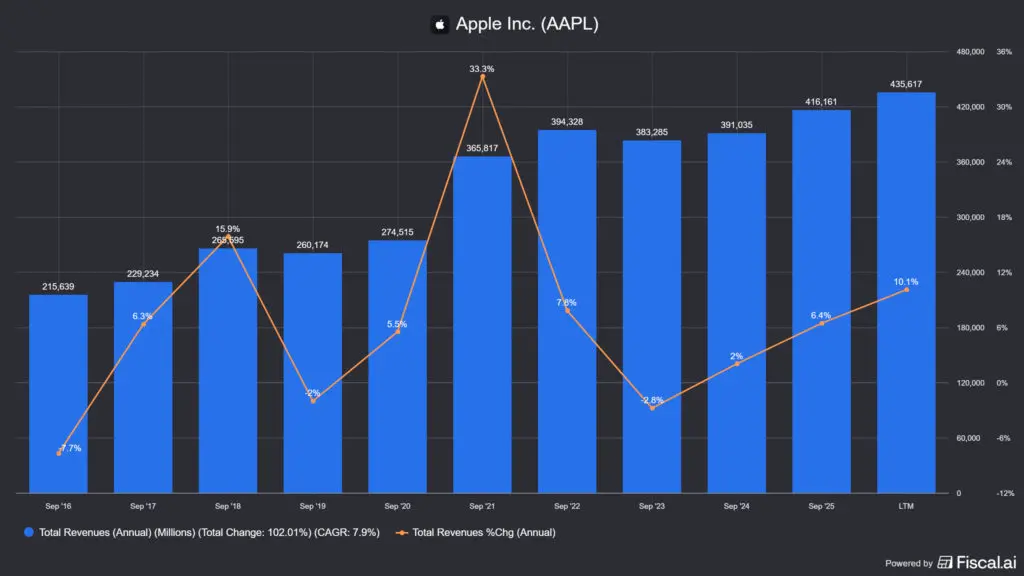
Apple's market position in 2025 was rock solid, with record-breaking revenue, but the challenges are also record-breaking. Fiscal year 2025 brought in revenue of $416.2 billion, a 6.4% increase over the previous year. The company sold 17 iPhones, and according to IDC, Apple reached a 19.4% global market share in 2025, making it the world's leading smartphone manufacturer. This has been the case for the past few years, with Samsung, Xiaomi and Apple swapping places in the top 3. In the first fiscal quarter ended in December 2025 (Q1 FY2026), revenue was $143.76 billion, a 15.65% year-on-year increase, a record quarter in the company's history.
The competitors can be divided into three groups. The first group is hardware market rivals: Samsung is the largest smartphone manufacturer globally in terms of volume, Google Pixel is pushing with increasingly aggressive AI-first marketing, and in China, Huawei is strengthening its position with its own chips and some nationalistic sentiment (the Chinese like to buy domestic brands, this is clearly visible in car brands). Apple's Indian factory (by the end of 2025, 20% of iPhones will already be manufactured in India) is partly a strategic issue for this reason: reduces Chinese supply chain risk and tariff war exposure.
The second group is the competitors of the Service segment: Spotify against Apple Music, Netflix against Apple TV+, Google and Microsoft against the monopoly position of the App Store. The latter is especially interesting because the EU Digital Markets Act has made the opening of alternative app stores mandatory in Europe, which is a direct revenue risk for the App Store's 30% commission. We have seen something similar before in the debate over Apple's proprietary connector standards versus Type-C: in Europe, only the latter can be used to market phones.
The third and most exciting group is made up of AI rivals: Google, Microsoft, Meta and Amazon will invest a total of around USD 700 billion in AI infrastructure by 2026. Apple, on the other hand, has chosen the path of ecosystem integration: Apple's on-device processing of Intelligence and the "Security First" narrative are the competitive advantages that users perceive, but investors have difficulty translating into numbers. I have written about almost all of the above companies before, you can access them here:
- Alphabet (GOOGL) Stock: AI Betting and CAPEX Risk
- Meta (META) Stock Analysis and AI Investment in 2026
- Amazon (AMZN): growth machine or capital-hungry giant
- Microsoft (MSFT) stock 2026: after a fall?
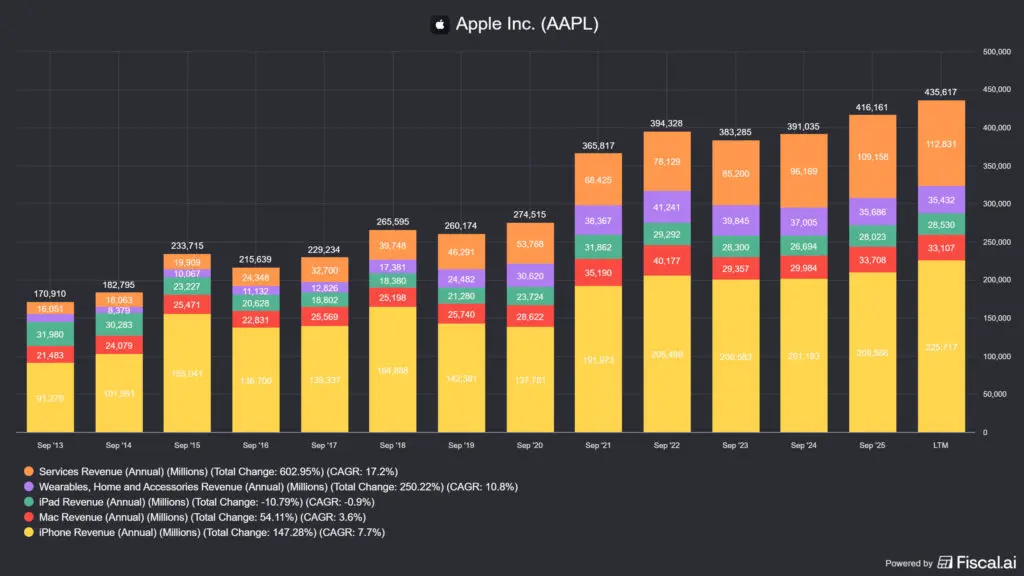
What best rewrites Apple's thesis for 2025-2026: The Services segment took over the top spot from the iPhone in terms of profit at the end of 2025. This is not just a one-time milestone: it signals that Apple's revenue mix is gradually shifting towards higher-margin, recurring Services revenue, which structurally dampens traditional hardware cycle volatility.
📌 In practice: Apple's strength is its ecosystem, but it is also its weakness. Once you are in it (iPhone, Mac, iCloud, AirPods), switching would involve an implicit cost of over 10,000 USD. Those who are left out are almost impossible to get in due to the premium pricing, it is not by chance that the Android vs. iOS debate among users has been going on for a decade. It is a self-reinforcing but slowly growing closed system, which is an excellent source of cashflow, but it is increasingly difficult to conquer anew.

🎢 Apple metrics 🎢
📊 Exchange rate and the impact of the AI narrative
Apple's share price peaked at around $285 in December 2025, before correcting back in early 2026. At the time of writing, in mid-March 2026, the stock is trading around $248, down nearly 13% from its ATH, following the broader tech sector's downward trend. The 12-month trailing return is still just over 12%, which is healthy but far below Nvidia's performance over the same period.
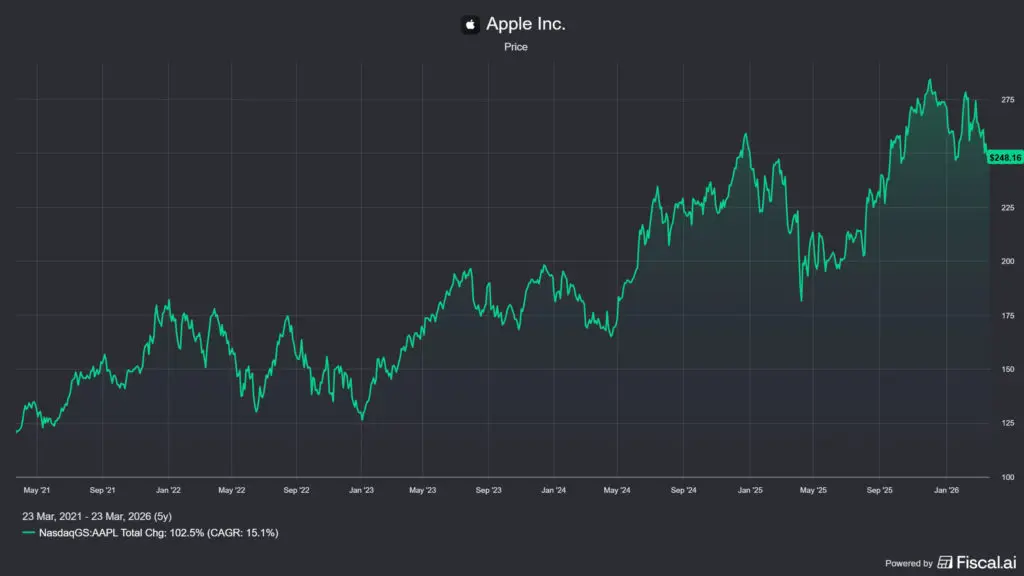
The direct catalysts for the fall can only be guessed at, I think it could be a simple market correction, but for those looking for a specific reason, here are a few: Apple Intelligence rollout is slower than expected, Siri redesign is delayed, EU regulatory compliance (the DMA Act) poses a direct risk to App Store revenue, and competition in the Chinese iPhone market is intensifying. At the same time, the following concern has emerged: Apple seems to be an “AI laggard” compared to Google, Microsoft and Meta, who are pushing ahead with spectacular LLM launches and aggressive CAPEX programs. This is also reflected in the share price: while the “AI investor favorites” soared in 2025, Apple remained relatively subdued. However, this is a fairly common narrative at the moment, with most analysts justifying everything with this jolly joker card over the past 1 year.
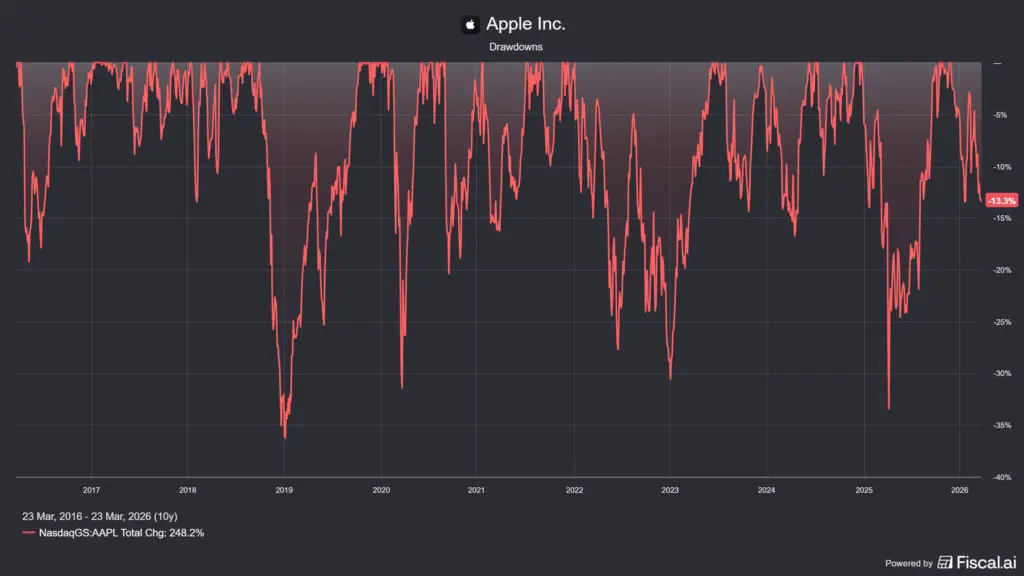
An important context, however, is: theApple's share price has roughly tripled since the 2022 market decline of over 30%. Those who bought at the bottom realized extraordinary returns, but this has been the case with many stocks, including Meta. This does not mean that this can be repeated, but it illustrates that Apple's price has historically been rewarding for long-term investors, despite cyclical downturns.
📌 In practice: Apple is one of the least volatile big tech stocks, with a beta of 1.12 according to Finviz, which is around the industry average. This also means that you shouldn't expect an Nvidia-like surge, Apple isn't for that. Those looking for stability over the long term will do well with a decent valuation, but I don't think this is the time when Apple (AAPL) is trading at a promotional price, as you'll see below.
🪙 Valuation: NOPAT yield and Services premium
When discussing Apple's valuation, the first number that comes to mind is the P/E, which currently hovers around 31-32, which doesn't sound extreme for a growth tech stock, but it's misleading without context. Apple's 2025 EPS (TTM) is $7.92, and its market cap is about $3700 trillion. Let's look at the NOPAT yield, which is my preferred metric and a much better indicator of the fundamental performance behind the valuation:
- 🎯 NOPAT yield currently: approx. 3,0% (Based on FY 2025, based on market price)
- 🕒 NOPAT yield 3-year average: approx. 3.1%
- 📊 NOPAT yield 5-year average: approx. 3.44%
- 🗓️ NOPAT yield 10-year average: approx. 4.37%
- 📜 NOPAT yield 20-year average: approx. 5.22%
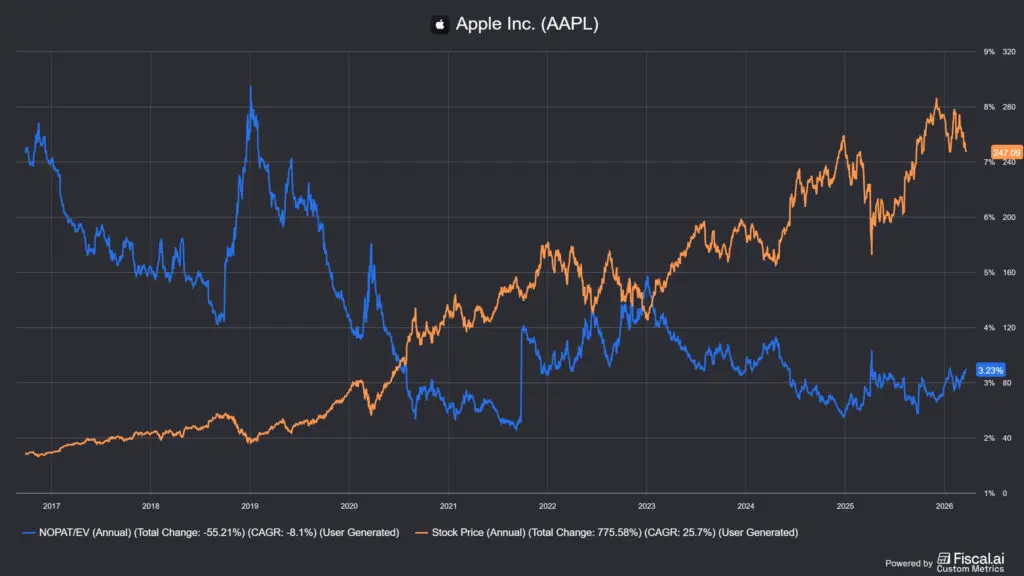
Based on the above, Apple is certainly not cheap at the moment, although the longer I looked at the horizon, the higher the NOPAT yield I got, as the company has been very expensive for some time. This is consistent with what the 32 P/E and 3% NOPAT yield suggest: the market is pricing in a predictable, but not explosive, growth trajectory. The real question is whether the Services segment's margin differential and Apple Intelligence monetization can boost NOPAT by 2027-2028 - because if so, the current multiple will look cheap in retrospect. But, it is certain that this is not a bargain stock at the moment, the valuation multiple is more of a headwind for investors.
🫰 Revenue and profitability
Fiscal 2025 set records. Total revenue was $416.2 billion (up 6.43% year-over-year), operating margin increased to 32.4%, net profit reached $112 billion (+19.5% YoY), and EPS increased to $7.46 (+22.7% YoY). Gross margin closed at a record 46.9%, driven in part by higher sales of Pro and Pro Max models and an increase in the role of Services in the revenue mix.
The revenue mix in FY2025 was as follows:
- 📱 iPhone: 52 %
- 💼 Services: 26.3% (109.2 billion USD, +14% YoY)
- 💻 Mac: 8%
- 📱 iPad: 5%
- ⌚ Wearables, Home, Accessories: 8.7 %
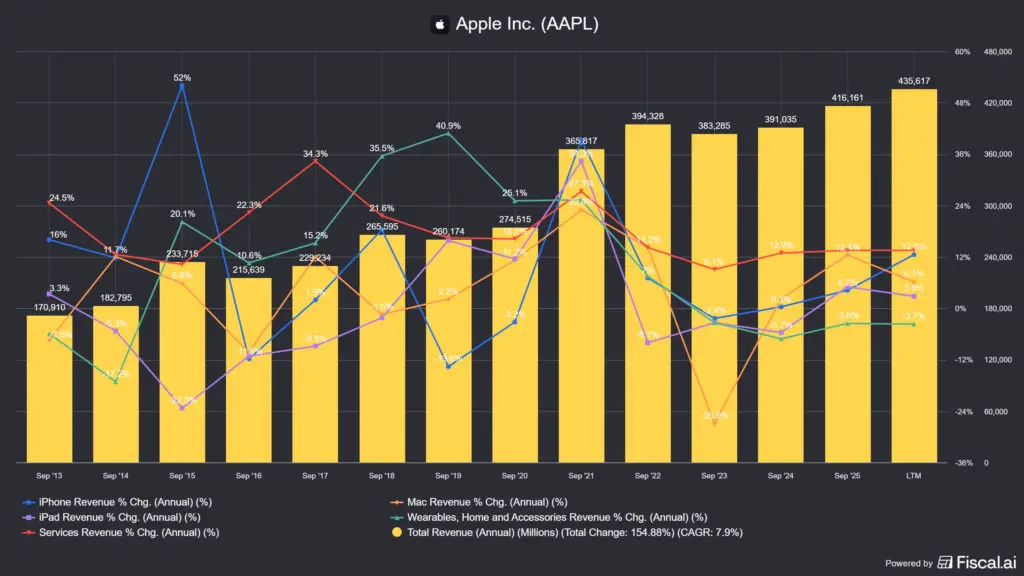
The most important trend line is the Services segment: the App Store, iCloud, Apple Music, Apple Pay, Apple TV+ and the search deal generated a total of $109.2 billion in revenue in 2025, accounting for more than half of Apple's entire operating profit due to higher margins. Services gross margin is nearly 75%, compared to ~38% for iPhone. This is not surprising, hardware manufacturing has always been a more capital-intensive industry than software development. There is a less-mentioned but significant number: Apple could pocket over $1 billion annually in App Store commissions by 2026 from 15-30% of subscriptions to third-party embedded AI apps (ChatGPT, Claude, Perplexity, etc.). This “AI landlord” position does not require any of its own model development CAPEX, in fact the company rents out its interfaces to external service providers.
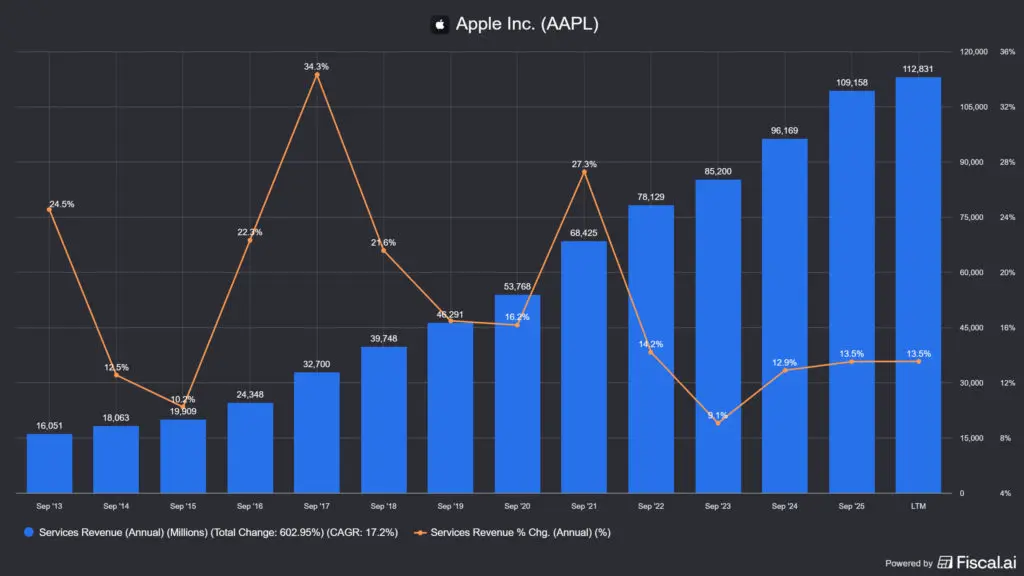
📌 In practice: Apple's profitability is among the best in the industry. A 32% operating margin for a $416 billion company is a pretty impressive number. The question is how long this margin can be sustained if EU and US antitrust pressure weakens the App Store's monopoly position. And the fact that the Services segment produces with greater profitability than hardware production should not surprise anyone, which is why Cisco Systems (CSCO) once steered its customers away from physical firewalls and other networking devices towards its software solutions.
🤞 Efficiency: ROIC and free cash flow
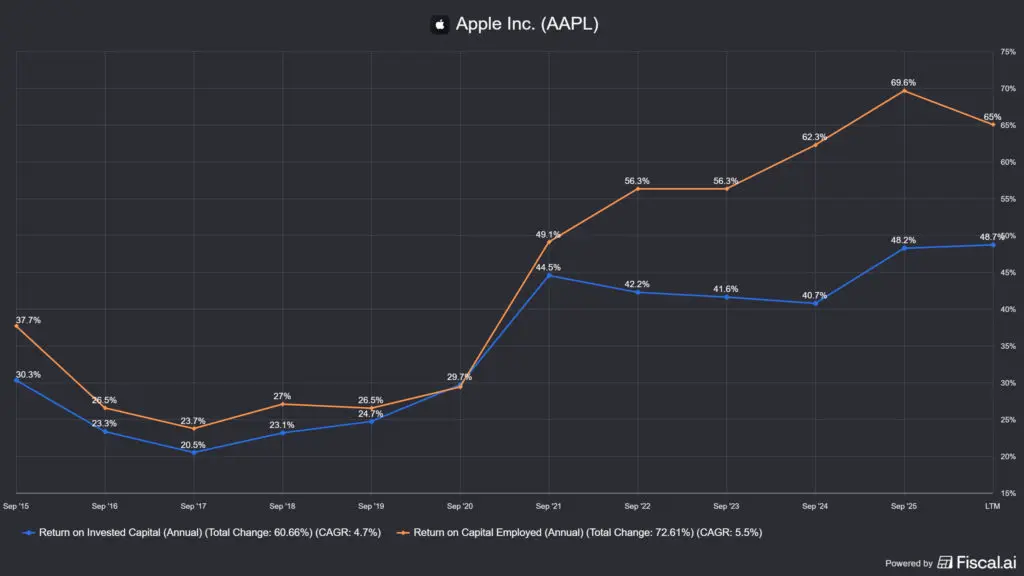
Apple's ROIC is one of the best in the industry: return on invested capital is no question, with an ROIC of 48.7%, assuming a WACC of the usual 10%. This seems extremely high, and it is, the trick is that Apple buys back a lot of shares with cash, which reduces the denominator of the ROIC ratio (ROIC=NOPAT/Invested Capital), i.e. pushes the numbers up. This also means that Apple buys back its shares even when they are overvalued, essentially destroying shareholder value, but on the graph the ROIC value looks much better.
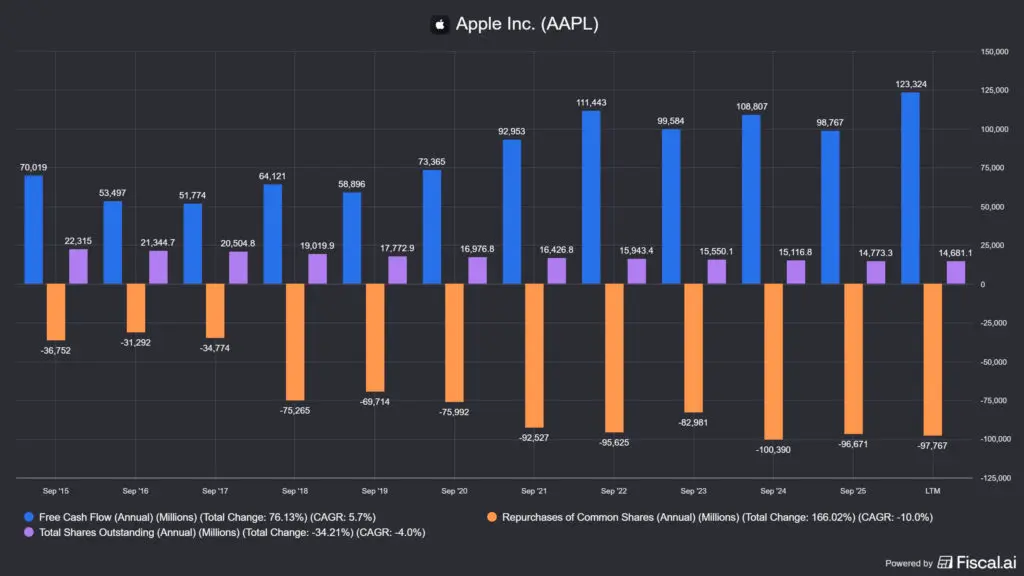
The other side of the coin is that Apple generates an awful lot of cash that cannot be effectively reinvested into the business. Free cash flow was $98.8 billion in FY2025 (-9.2% YoY compared to the previous year's extraordinary level, but has since rebounded to record highs). Capital expenditure (CAPEX) was just $12.72 billion, with the company planning $14 billion for 2026, a fraction of the level of its AI rivals. As a result, Apple's free cash flow can be almost entirely redistributed: in FY2025, the company returned $104.7 billion to shareholders in the form of share buybacks and dividends. The buyback program will continue in 2026 with a $100 billion limit, with the dividend increasing to $0.26 per share (+4%).
The balance sheet is also strong: cash and marketable securities exceed ~67 billion USD (companies do not hold physical cash, but rather short-term government securities), resulting in net debt of $23.6 billion (i.e. cash positive). This represents a comfortable financing position, and the balance sheet is very strong.
📌 In practice: Apple is apparently the champion of redistribution. For those who rely on a stable, slowly growing dividend and regular buybacks, this is the ideal investment. The danger is that the buyback is only value-creating until the share price becomes unrealistically expensive. However, I wouldn't call it opportunistic either, since they don't accumulate a large mountain of cash and buy back shares when the company is undervalued, but rather work periodically with pre-allocated amounts. Although I am significantly more picky than average about capital allocation, many investors simply don't care about this, they just want to see Apple's share price increase for years.
🎲 Risk factors: AI lag, DMA risk, China and CEO succession
Apple's risk profile is determined by four main factors:
- 🤖 The AI narrative lag: The market has priced in Apple Intelligence as the next engine of the iPhone software update cycle. If the Siri rebuild and the rollout of Intelligence features continue to be delayed, or if users simply don't upgrade to newer models for the AI capabilities, Apple could face a loss of growth story that would hit the stock through multiples.
- ⚖️ EU Digital Markets Act and DMA risk: Antitrust pressure against the App Store's 30% commission model is growing in both the EU and the US. If alternative app stores expand beyond Europe, a significant portion of the Services segment's margins could be at risk. This won't happen tomorrow, but it is a real threat in the 3-5 year term.
- 🇨🇳 Chinese risk: Apple generates about 15-18% of its revenue from China, and Huawei's return (with its own chip, domestic brand preference) will erode iPhone market share, and we haven't even talked about Xiaomi yet. Any escalation in the trade war could also affect Chinese manufacturing capacity, although India's "Plan B" partially covers this risk.
- 👤 Tim Cook succession risk: COO Jeff Williams and several key executives (Lisa Jackson, Kate Adams, John Giannandrea) will leave or retire at the end of 2025 and during 2026. Tim Cook himself has stated in the shadow of the upcoming 50th anniversary that he does not plan to retire, but investors know: Apple has already successfully managed a CEO change after Steve Jobs, so this is perhaps the smallest risk that the market can price.
📌 In practice: I was wondering, and this might be a good test for you, how many of your friends mention Apple when talking about AI. The ones I hear about regularly are ChatGPT (Microsoft-backed OpenAI), Claude (Anthropic, funded by Google and Amazon), and Gemini, which is Google's in-house solution. Since this dominates the market narrative, and Apple's developments in this direction are not even heard of, this could hit the company's share price in the short term.

💵 Apple (AAPL): will you get used to it or will you run away? 💵
The market debate for Apple is less religious than for Tesla, but more intense than for other, less “sexy-fancy” companies. In fact, Apple fits into the “religion stock” category, with its followers blindly trusting its products and services. The basic question is whether you would pay $248 today for shares of a company with a market capitalization of $3700 trillion, which can be interpreted in two ways: The positive side calls it the world's best FCF generating machine, while the negative side calls it a service provider lagging behind in the AI revolution. Let both sides argue!
🐂 Bulls say (Optimistic scenario):
- 📱 The iPhone 17 supercycle has just started: The software update rate of AI-powered iPhones could be historically high in 2026-2027, especially among the non-biannual user base (active devices exceeded 2,2 billion). Every 1% increase in software update rate could mean billions in revenue growth, but I really don't believe that, since this doesn't immediately lead to additional service monetization.
- 💼 The Services segment is far from saturated: The Services segment revenue of $109 billion is impressive, but ARPU globally lags far behind developed markets in emerging regions. If iCloud+, Apple TV+ and Apple Music penetration increases in India, Brazil and Southeast Asia, this will open up tens of billions of USD in organic growth annually.
- 🤖 The “AI landlord” position is cheaper than the AI investor position: While hyperscalers are expected to spend nearly $700 billion on AI infrastructure in 2026, Apple is expected to spend $14 billion in CAPEX and collect billions of dollars in subscription fees for AI apps through the App Store. This asymmetric position could be extremely valuable in the long run if competitors’ AI infrastructure investments fail to pay off.
- 💰 The redistribution mechanism seems unbreakable: Apple returned $104.7 billion to shareholders in FY2025. The $100 billion buyback cap for 2026 is sustainable and could even be increased if FCF remains consistently above $90-100 billion. This represents a share count reduction of about 2.5-3% per year, which is a significant yield-enhancing effect in the long term, but I've said before what my problem is with this.
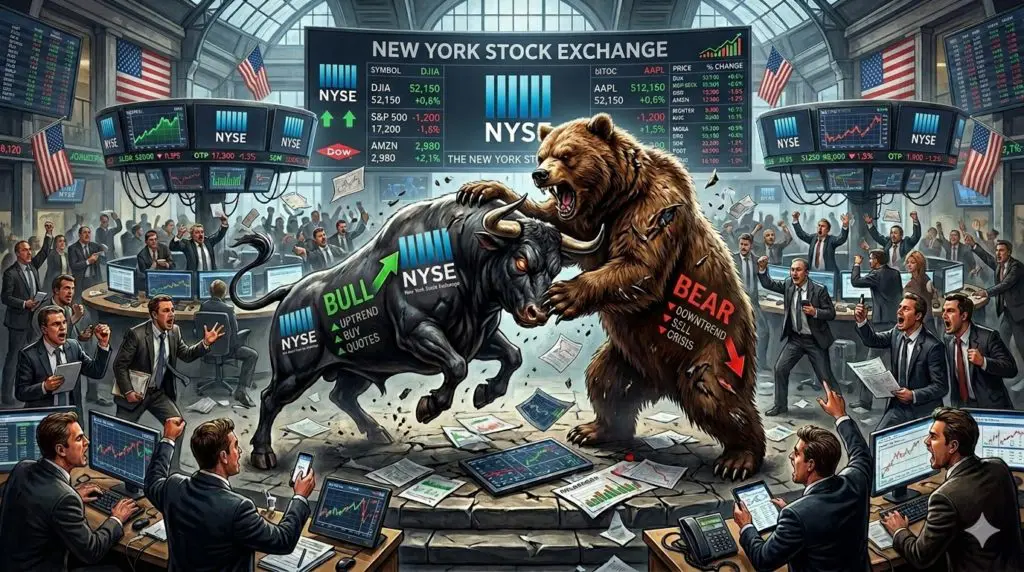
🐻 Bears say (Pessimistic scenario):
- 🤖 Real AI lag means exchange rate risk: Google Gemini, Microsoft Copilot, and Meta AI are all more aggressively integrating LLM capabilities into their ecosystems. If AI becomes the iPhone’s differentiator and Apple’s intelligence remains significantly weaker than its competitors, then the $3700 trillion valuation is unlikely to be sustainable, and a price drop is bound to follow.
- ⚖️ Antitrust pressure is a structural revenue risk: The EU DMA has already made alternative app stores mandatory in Europe; if the US FTC, UK CMA and other authorities move in a similar direction, the 30% App Store commission model that currently provides high margins for the Services segment could be severely eroded. Apple is currently fighting a legal battle over these revenues, but the regulatory trend is not favorable.
- 🇨🇳 China risk is asymmetric: If the US-China trade tensions escalate, Apple will face both higher manufacturing costs (Chinese supply chain) and falling local demand (Huawei preference + possible boycott). Manufacturing in India is a real step forward, but in 2026, 80% of iPhones will still be made of Chinese-made components. However, in the current situation, it seems more likely that the US and China will simply come to an agreement in the long run, because their interests are mutual.
- 👤 Post-Cook Apple uncharted territory: Tim Cook was at the helm during Apple's greatest value creation cycle. If the succession is not smooth, the stock could be discounted in the short to medium term due to uncertainty, as it was around the death of Steve Jobs, although Apple has since multiplied in value.
📌 In practice: Apple is not a love-it-or-hate-it stock like Tesla, but rather a “do you believe that Apple will remain the undisputed master of the world’s premium ecosystem in the next 5 years?” type of investment. This is not a question of faith, but of the market: the ecosystem is strong, the numbers are extremely good, but the next phase of the growth engine, the AI supercycle, is still just a promise.
📝 Summary of Apple (AAPL)'s situation 📝
Apple set records in all measurable financial metrics in 2025: revenue of $416 billion, net profit of $112 billion, free cash flow of ~$99 billion, gross margin of 46.9%. The Services segment grew to $109 billion and took over the top spot from iPhone in terms of profit, a structural transformation, not a one-off event. The balance sheet is strong: $67 billion in cash and securities, $100 billion in buybacks through 2026.
The investment thesis for 2026 is roughly the following: Apple today is neither a classic growth stock nor a classic value stock. It's somewhere in between: an extraordinary FCF-generating machine that steadily adds shareholder value through distributions, and whose next growth option could be the monetization of the Apple Intelligence ecosystem. However, it does this not in a particularly sophisticated way, but in a predetermined manner, which may be disconcerting to investors with a capital allocation approach.
🤞 Those who hold or want to buy Apple today don't have to decide how many iPhones the company will sell in the future. They have to decide whether they trust Apple to maintain its position during the AI revolution and protect its margins against regulatory pressure by renting out its own ecosystem to other AI providers.
Remember, this mini-analysis is not a substitute for your own research, but it will help you decide whether it is worth devoting dozens of hours to an in-depth analysis of Apple (AAPL) or whether it is enough to just keep the stock on your watchlist (I would vote for the latter at the moment).
If you want to analyze further, use iO Charts' stock finder and portfolio manager, which you can access here: iO Charts.
Frequently Asked Questions: Professional Questions About Apple (AAPL)
What is Apple Intelligence and why is it key to the stock?
Apple Intelligence is Apple's on-device and cloud-based AI platform, which was launched in late 2024 and expanded to all compatible devices in 2025. The platform ranges from a Siri rebuild to text and image generation to system-wide contextual learning. It's a key investment opportunity because the market expects this to happen behind the next major iPhone refresh cycle: as users trade in their older devices for AI capabilities, Apple's revenue and margins will grow significantly.
Why is the Services segment so important and how sustainable is it?
The Services segment (App Store, iCloud+, Apple Music, Apple Pay, Apple TV+, search deals, etc.) generated $109.2 billion in revenue in FY2025, with a gross margin of ~75%, compared to iPhone’s gross margin of ~38%. This means that Services has already taken over the top spot in terms of profit. The sustainability issue is partly antitrust: EU DMA and US competition pressure threaten App Store commissions. If the 30% commission model were to be reduced to 15-20% globally, it would mean a revenue loss of $10-15 billion per year.
What does the “AI landlord” position mean for Apple?
Apple is the gatekeeper of the smartphone and tablet ecosystem with 2.2 billion active devices. For every ChatGPT, Claude, or Perplexity subscription an iPhone user purchases through the App Store, Apple receives a 15-30% commission, essentially without its own AI development CAPEX. By 2026, App Store commissions from AI apps are expected to exceed $1 billion (but the company doesn’t disclose this).
Why is Apple buying back so many of its own shares and is it good for investors?
Apple returned $104.7 billion to shareholders in FY2025 (buybacks + dividends). Buybacks reduce the number of shares outstanding, so EPS increases even with stagnant net profit. Over the past 10 years, Apple's share count has decreased by nearly 40% due to buybacks, which in itself has increased the return of those who held the stock by nearly 40%. Buybacks create value if the stock is not trading at an unrealistic price, but I think that considering historical averages, the stock is not cheap at all.
What is the Chinese risk at Apple and how is the company managing it?
Apple generates about 15-18% of its revenue from China, and the vast majority of its manufacturing was previously based in China. The risk is twofold: Huawei’s return with the Kirin chip will reduce iPhone market share in China, and the US-China trade tensions pose a tariff risk. Apple responded by moving production to India: by the end of 2025, 20% of iPhones will be made in India, and this proportion will continue to grow. The India strategy reduces, but does not eliminate, Chinese exposure; full diversification is a 3-5 year program, not a one-time step.
Legal and liability statement (aka. disclaimer): My articles contain personal opinions, I write them solely for my own entertainment and that of my readers. The articles published here do NOT in any way exhaust the scope of investment advice. I have never intended, do not intend, and am unlikely to provide such in the future. What is written here is for informational purposes only and should NOT be construed as an offer. The expression of opinion is NOT in any way considered a guarantee to sell or buy financial instruments. You are SOLELY responsible for the decisions you make, and no one else, including me, assumes the risk.