

? What is this article about?
Although nothing excites the majority of Hungarian investors more than the changes in the BUX index price, it is worth learning about the history of the stock exchange index, its composition and tax issues. If you have ever heard of the BUX index or the Budapest Stock Exchange, but were not sure exactly what these terms mean, or whether they are even worth dealing with as an investor, then you have come to the right place. This article discusses the structure and operation of the BSE and BUX indices, investment opportunities, and also serves as a kind of navigation point: Here you can find all our BSE stock analyses collected.
For those who are already familiar with the general functioning of stock market indices, I recommend my article below as background reading, because there I discussed in detail some related things, such as the problem of capitalization-weighted indices:
If you are looking for in-depth analyses of the site, click on the link below: iO Charts stock analyses
?Table of Contents?
I have created a table of contents to make it easier for you to navigate the content:
- ?? What is BÉT? – A little Hungarian stock exchange history
- ? Composition and operation of the BUX index
- ? BSE shares – analyses and the full list
- ? How to invest in the BUX index?
- ? Taxation as a Hungarian investor
- ? BUX compared to other indices – is it worth it?
- ? Summary
- ❓ FAQ
?? What is BÉT? – A little Hungarian stock exchange history
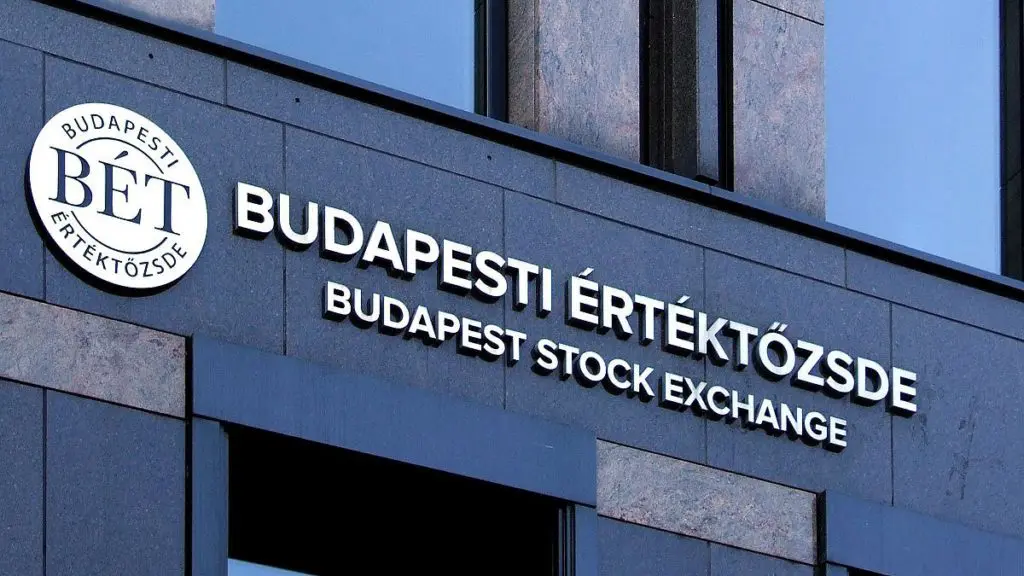
The Budapest Stock Exchange, commonly known as BÉT, is the only regulated stock exchange in Hungary. The institution's roots go back to 1864, when a commodities exchange opened in Budapest, but the modern-day BÉT was re-established on June 21, 1990, as part of the transition to a market economy after the change of regime. This is not just an interesting economic history: the opening of the BÉT also symbolically signaled that Hungary was opening up to free capital markets, which it had not had the opportunity to do due to the previous socialist state structure.
In the first decades after its re-establishment, the BSE developed dynamically, with the shares of many privatized state-owned companies being listed on the market. However, after the turn of the millennium, the development of the stock exchange slowed down, and in some respects even regressed: the number of companies listed gradually decreased, while regional competitors, such as the Warsaw GPW, grew into a much larger and more liquid market. However, if we look only at the increase in the BUX index price, it soared, one of the reasons for which is its high concentration, which I will return to later.

Today, the BSE is one of the smaller stock exchanges in the region, dominated by a few large-cap companies. The stock exchange consists of two main segments in terms of shares: the Premium category brings together large companies that meet the highest transparency and data reporting requirements, while the Standard category operates under less stringent conditions.
? BSE in a regional context
If we place the BSE among the Central and Eastern European stock exchanges, it is immediately clear how big the difference in size is. The market capitalization of the Warsaw Stock Exchange (GPW) is several times that of Budapest, while the Prague PX index and the Vienna ATX also represent larger markets. This does not mean in itself that the BSE is a bad investment venue, but its size must be taken into account when it comes to liquidity, the presence of institutional investors or the flow of international capital.
?In practice: The size of the BSE is both a disadvantage and a unique opportunity. A disadvantage, because institutional investors rarely cover smaller stocks thoroughly, which can cause price distortions. An opportunity, because those willing to look into lesser-known names can sometimes find surprisingly high-quality companies at relatively favorable valuations. The problem is that even if you find the targets you like, liquidity will still be low. This can result in two things:
- ?or the orders are not fulfilled because there is no other party on the other side,
- ?or they are executed very slowly because there is little paper circulating on the market from which transactions could be made.
A good example of the latter is that most companies have a relatively low free float, meaning that only a small portion of the company's shares float on the stock market, with the rest in the hands of owners who own more than 5%, where the turnover rate is either very low or zero.

? Composition and operation of the BUX index
The BUX index, the leading stock index of the Budapest Stock Exchange, started on January 2, 1991, from a base value of 1000 points and recently crossed 130000 points. Currently, the BSE contains 50 stocks, but the BUX index only includes 17 stocks. The BUX is a capitalization-weighted index, which means that the movements of companies with larger market capitalizations have a much stronger impact on the value of the index than those of smaller ones. In this respect, it is similar to the S&P 500 US stock index, which suffers from similar problems, only the number of stocks there is much higher, so the Top 3-4 papers cannot be weighed as heavily. You can read more about them here: Meaning, use and role of stock index.
Top stocks of the BUX index
The table below shows the 4 largest blue chip stocks in the BUX index by market capitalization with their weights in the BUX Index Tracking ETF*:
| ? Ranking | Ticker | Company name | Approximate weight in BUX |
|---|---|---|---|
| 1. | OTP | OTP Bank | Up to 38% |
| 2. | MOL | MOL Plc. | Up to 24.1% |
| 3. | RICHTER | Richter Gedeon | Up to 21.1% |
| 4. | MTELEKOM | Magyar Telecom | Up to 7.8% |
*The real market capitalization of stocks in the BUX index changes continuously according to current prices.
? The “four-company problem”
As I wrote in our OTP Bank analysis, OTP Bank, MOL, Gedeon Richter and Telekom together account for nearly 90 percent of the value of the BUX index. This is an extremely concentrated index, especially when you look at the weight of the top three companies in the S&P 500 for comparison, which is around 20 percent.
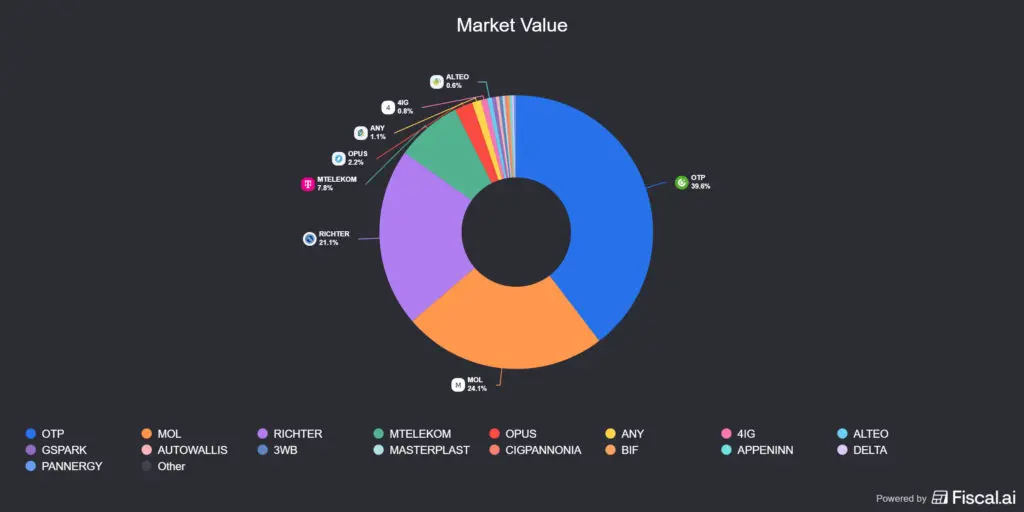
What does this mean in practice? Anyone who buys the BUX index is essentially buying mainly OTP shares, spiced up with some MOL and Richter. The remaining ten or so companies barely move the index overall. This represents both sectoral and company-specific concentration risk.
? Conditions for inclusion in the BUX index
The composition of the BUX index is reviewed semi-annually by the Index Committee of the Budapest Stock Exchange. To be included, a stock must meet the following conditions:
- be listed in the Premium or Standard category of the BSE,
- demonstrate sufficient stock market turnover and liquidity in the recent period,
- an appropriate proportion of shares should be freely tradable (sufficient free float),
- the company must regularly fulfill its data provision obligations.
?In practice: Entry and exit events are infrequent and less sharp in the case of BUX than, for example, in the S&P 500, where huge capital moves due to mechanical buying/selling of index-tracking funds. There is a simple reason for this: the market for investment products covering BUX is relatively narrow.

? BSE shares – analyses and the full list
You can find all listed shares of the BSE on the official website of the Budapest Stock Exchange, where the current BUX index exchange rate data and the instant market price of the shares are also available: Spot market, stocks.
In the table below, I have collected the BSE stocks that we have analyzed so far in the Market Momentum column. These are not in-depth analyses, as the column's name suggests, but rather thought-provoking snapshots, but they provide a good starting point for deciding which companies are worth taking a closer look at.
| Company | Sector | Market Momentum Analysis |
|---|---|---|
| ? OTP Bank | Finance / Banking | OTP Bank analysis |
| ?️ MOL Plc. | Energy / Oil & Gas | MOL analysis |
| ? Gideon Richter | Pharmaceutical industry | Richter analysis |
| ? Hungarian Telecom | Telecommunications | Magyar Telekom analysis |
| ?️ OPUS Global | Conglomerate / Energy | OPUS analysis |
| ⚡ Alteo | Renewable energy | Alteo analysis |
| ? Rába Plc. | Automotive / Defense Industry | Raba analysis |
| ? Apennines | Real estate / SZIT | Appenine analysis |
?If you are looking for a BSE stock that we have not yet written about, you can find data on all listed companies on the BSE website: spot market.
? How to invest in the BUX index?
This is one of the most frequently asked questions about the BSE, and the answer is a little more disappointing than one might expect. Unfortunately, there is nowhere near as much variety as in the case of US or EU stocks, where there are countless financial instruments available. Instead, you can use the options below.
?ETF opportunities – the scarce supply
In the case of the BUX index, ETF investment options are extremely limited, especially when compared to the offerings of the S&P 500 or the DAX. You can hardly find a European UCITS ETF that would follow the BUX on the market, the liquidity and market size simply do not attract the large ETF providers. Moreover, since their liquidity is also low, they are difficult to buy and sell, and their costs are also high. This is one of the most significant structural differences between BUX and developed market indices:
- ?? DAX index,
- ?? S&P 500 Index.
?Individual share purchase – the more realistic way
Most private investors who want to invest in the BSE do so by buying individual stocks. This has the advantage that you don't have to buy the entire index, that is, you don't have to buy all the stocks, including those that you don't find attractive. For example, if you only want OTP and Richter, you can buy them without forcing all the other illiquid stocks into your portfolio. Since 4 stocks make up 90% of the market capitalization anyway, buying them is essentially the same as betting on a breakout of the BUX index.
?In practice: BSE shares are available at major discount brokers, where Hungarian securities are listed with the BUD suffix (e.g. OTP.BUD), as you can see on our website: iO ChartsThe broker Lightyear also allows trading of certain BSE shares since the end of 2025.
?CFD and certificate – only if you know what you are doing
Some brokers offer BUX index CFDs or certificates, which allow you to trade the price movement of the index. These are short-term, leveraged products that I definitely do not recommend for long-term investment purposes. If someone does reach for these, it is worth reading the product description and the associated risks carefully before doing so.
?In practice: The problem with CFDs and other derivatives is that the underlying product is not purchased for you by the broker. It is not in your name, it is not held by a custodian, but is recorded by the broker, and in fact, the broker becomes the market maker and the price maker. It is not difficult to see that in this case they are not on the same side as the investors, so I would avoid leveraged CFDs by far.
? Taxation as a Hungarian investor
The taxation of BSE shares is significantly simpler than that of foreign securities, and this is one of the most tangible advantages of domestic investments. I have highlighted the gist below, but you can read about it in detail here: Dividend taxation 2025: SZJA, SZOCHO and double taxation.
- ✨ Exchange rate gain: as a controlled capital market transaction, it is subject to 15% personal income tax.
- ✨ Dividend: 15% personal income tax + 13% SZJO, this is a total of 28%, which is not a small amount.
- ✨ TBSZ account: The 15% personal income tax on exchange rate gains can be saved if you hold the securities in a TBSZ account. After a 5-year term, the exchange rate gains are completely tax-free, and the SZOCHO on dividends is not charged on the transaction either. This is one of the most important tools available to domestic equity investors to legally reduce their tax burden.
- ✨ Withholding tax: There are no foreign withholding tax problems with domestic shares, as opposed to the 26,38% German withholding tax discussed in my DAX article. This is a serious administrative and financial advantage.
? The forint risk as a special factor
BSE shares are listed in forints, and your returns are also generated in forints. If you think about your assets in foreign currencies in the long term, which is completely reasonable, since many people keep their portfolios in USD or EUR, then the depreciation of the HUF can seriously bite into your real returns. It is no coincidence that this point was also highlighted as a risk in my OTP analysis, but in the end, the currencies collected by the underlying product will decide.
In other words, if a Hungarian company earns the majority of its revenue not in HUF, then your exposure will not be in HUF either, because if the Hungarian currency weakens, the others will strengthen in comparison. So when the company summarizes the figures in forint in the balance sheet and income statement, the strengthening of foreign currencies will pull them up. From this point of view, the best bet is OTP, where two-thirds of its revenue comes from abroad.
? BUX compared to other indices – is it worth investing in?
Historical return
The BUX index has produced decent returns in forint terms since its launch in 1991, with an average annual growth rate of around 14.6% CAGR over the long term. Let's compare how this would look compared to larger stock market indices over the same period:
- BUX index: 14.6% CAGR since launch; 16.58% CAGR over 10 years, 22.23% CAGR over 5 years (calculated in HUF)
- DAX index: 7.5% CAGR over 20 years; 10.6% CAGR over 10 years, 12.4% CAGR over 5 years (calculated in EUR)
- S&P 500 index: 10.9% CAGR over 20 years; 14.6% CAGR over 10 years, 14.8% CAGR over 5 years (in USD)
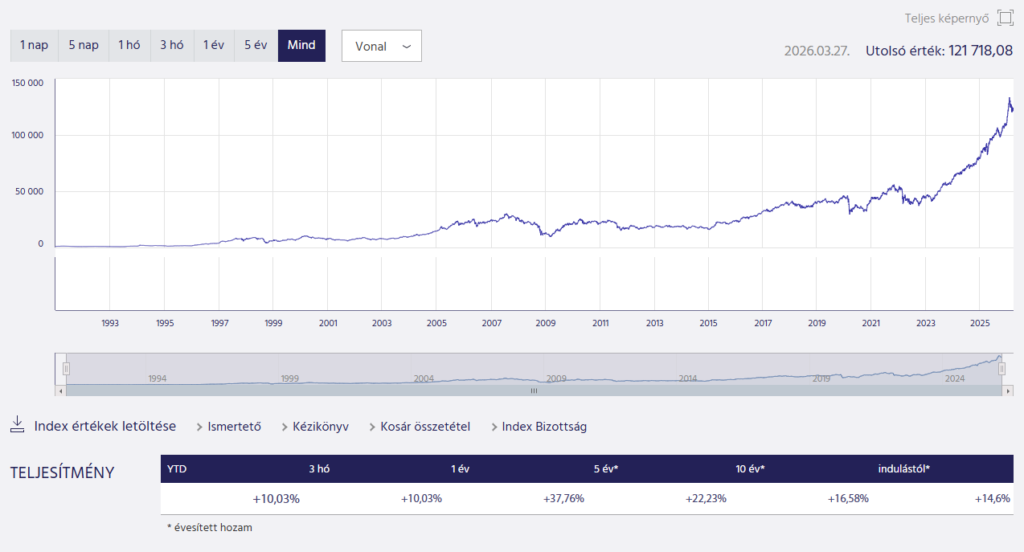
The above numbers look good on paper, as the BUX index's price growth is much better than the German or American index, but here comes the twist. If you look at the same period in EUR or USD, the picture is significantly more nuanced, as the purchasing power of the HUF has decreased significantly compared to the EUR and USD over the past three decades. You can check the exact exchange rates on the MNB website: historical exchange rates.
To put the numbers into concrete terms, if you don't want to search the MNB database, you should invest in the following yield headwinds at the time of writing this article:
| USD | EUR | Annual CAGR headwind | |
|---|---|---|---|
| Mai | 338,77 | 389,48 | |
| Year 5 | 309,14 | 363,11 | ~1,8% / ~1,4% |
| Year 10 | 276,99 | 313,55 | ~2,0% / ~2,2% |
| Year 20 | 220,28 | 265,74 | ~2,2% / ~1,9% |
It should also not be forgotten that the USD was quoted at 434 HUF at the end of 2022, while the EUR was around 432 HUF. So the currency risk is significant in the case of the HUF, which restrains the return at the portfolio level, but this is what diversification is for, as non-Hungarian investment assets act as a currency hedge.
? The bull case for BUX
- ? Concentrated quality: OTP Bank, Gedeon Richter and MOL are outstanding companies at the regional level, with solid fundamentals and growing profits.
- ? Dividend-paying culture: BSE blue chip stocks typically pay regular dividends, which is an important return component in the long term.
- ? Low rating: BUX trades at historically low P/E and P/B ratios compared to developed markets, which may be attractive from a value investor perspective.
- ?️ TBSZ advantage: Domestic securities can be managed tax-efficiently when held in a TBSZ account, which provides an extra advantage compared to foreign shares for investors who think in forints and love dividends.
? The bear case for BUX
- ? Forint risk: The long-term weakening trend of the forint is continuously eroding the real return measured in foreign currency.
- ? Extreme concentration: 4 companies account for ~90% of the index, which effectively means sectoral and company-specific risk instead of diversification.
- ?️ Regulatory unpredictability: The risk of special taxes, sectoral burdens and state intervention is particularly relevant for BSE blue chips, OTP, MOL and Magyar Telekom have all faced this.
- ? Low liquidity: For smaller BSE securities, the bid-ask spread can be wide, and it is difficult to move larger positions without moving the price.
- ? Regional neglect: Global institutional capital rarely targets the BSE independently, appearing mostly within the framework of CEE emerging market ETF funds, which also limits pricing.
?In practice: I do not treat BUX as an alternative to the S&P 500 or even the DAX, but as a complement to it, primarily because of the few quality individual companies. If someone is a Hungarian tax resident and holds 1–3 BÉT blue chip shares in their portfolio on a TBSZ account, I consider it a completely reasonable strategy. However, if someone keeps their entire savings in BUX without any foreign exchange exposure, I think they are taking on unnecessarily concentrated risk.
There is also another problem with the BUX index: similarly good or much better quality companies can be found in the USA or the European Union with less political risk. There is also a lot of data available for these, and you can even read more analyses, because the analyst coverage is much better and the data sources also publish their data more accurately. At home, you have to dig around for the numbers more, for example, you can't directly look at the weight of the companies in the BUX index, which is simply ridiculous.
I certainly wouldn't invest in BUX at the index level, but for those who are more comfortable holding Hungarian stocks, OTP has been the "best bet" over the decade, MOL has also been a good bet in the past few years, while Richter's Gedeon AbbVie partnership is targeting the American market. Telekom, similarly to foreign telco companies, is considered a stable company that is difficult to dislodge from its position, but operates with a higher margin in Hungary.
? Summary
The Budapest Stock Exchange and the BUX index are a unique, small but fundamentally significant market. In the case of BUX, the point is not the index as a whole, but the individual companies., OTP Bank, Gedeon Richter, MOL, Magyar Telekom and other BSE stocks all require an independent investment decision, it is not enough to just “buy BUX”. The reason for this is the extreme concentration, the Top 4 companies provide 90% of the index's capitalization.
Those looking for opportunities on the BSE should consider the forint risk, low liquidity in smaller securities, and the unpredictability of the regulatory environment. In return, the tax advantage of the TBSZ account, the low valuation, and some truly regionally outstanding companies may be serious arguments in the other pan of the balance sheet. Dividend-focused investors can avoid withholding tax, as there is none in Hungary, but in return they have to run the forint exchange rate risk.
If any BSE stock has piqued your interest, you can find all our analyses in the table above. If you are looking for something we haven't written about yet, then you can find them on the official stock list of the BSE.
If you want to analyze further, use iO Charts' stock finder and portfolio manager, which you can access here: iO Charts.
❓ Frequently Asked Questions (FAQ)
How to interpret the change in the BUX index exchange rate?
The BUX index price movement changes in real time on trading days. The current BUX index price can be found on the official website of the Budapest Stock Exchange: bet.huYou can also follow the price movement on the TradingView platform or any stock tracking application. The index started on January 2, 1991, with a base value of 1000 points.
What is the difference between BSE and BUX?
The Budapest Stock Exchange is the institution and trading venue where Hungarian stocks, bonds and other securities are traded. The BUX index, on the other hand, is a measure: it aggregates the prices of the leading stocks listed on the BSE into a single indicator, weighted by the market capitalization of the companies. The relationship is similar to that between the Frankfurt Stock Exchange and the DAX index.
How could you invest in the BUX index?
You cannot invest directly in the BUX index, just like you cannot invest in any other stock market index, instead there are index-tracking ETFs that you can use. The easiest way is to buy individual BÉT shares at a discount broker, such as Interactive Brokers or Lightyear. Liquid UCITS ETFs tracking the BUX index are currently available in very limited numbers, so most private investors choose to buy individual shares. There are also ETFs on the market that only track the BUX index: Expat Hungary BUX UCITS ETFThe problem is the cost, usually the annual maintenance cost of such ETFs is high, which defeats the point.
What is the historical return of BUX?
Measured in HUF, the BUX index has produced an average annual exchange rate increase of around 14.6% since its launch in 1991. Calculated in EUR or USD, this value is significantly lower, as the HUF has lost significantly of its value compared to the major currencies in the last thirty years. Therefore, it is always worth examining the BUX return adjusted in foreign currency before comparing it with other markets, which of course will give different results depending on the time period.
When does the Budapest Stock Exchange open and close?
The trading hours of the BSE are from 9:00 to 17:00 Central European Time on weekdays. There is no trading on weekends and on Hungarian stock exchange holidays. The trading calendar can be checked on the official website of the BSE: BSE trading calendar.
What stocks are in the BUX index?
The BUX index currently contains 17 stocks, the largest of which are OTP Bank, MOL Plc., Gedeon Richter and Magyar Telekom. The composition of the index is reviewed every six months. The list of all BSE stocks can be found here: spot market.
Why is the BUX index so concentrated?
The BUX index is capitalization-weighted, meaning that companies with larger market capitalizations have a greater influence on the index's movements. As the Hungarian stock market is relatively small and dominated by a few large companies, OTP Bank, MOL, Gedeon Richter and Magyar Telekom together account for nearly 90 percent of the index's value. This concentration is a structural characteristic of small emerging market indices.
Is the TBSZ account also advantageous for BÉT shares?
Yes, and this is one of the most important arguments in favor of domestic shares for Hungarian tax residents. In the case of BÉT shares held in a TBSZ account, the 15% personal income tax on exchange rate gains does not have to be paid after 5 years of holding. SZOCHO on dividends can also be saved. There is also a TBSZ advantage for foreign shares, but the problem of foreign withholding tax typically remains, while this cost does not apply to domestic securities.
Legal and liability statement (aka. disclaimer): My articles contain personal opinions, I write them solely for my own entertainment and that of my readers. The articles published here do NOT in any way exhaust the scope of investment advice. I have never intended, do not intend, and am unlikely to provide such in the future. What is written here is for informational purposes only and should NOT be construed as an offer. The expression of opinion is NOT in any way considered a guarantee to sell or buy financial instruments. You are SOLELY responsible for the decisions you make, and no one else, including me, assumes the risk.