

What does the stock market report section contain?
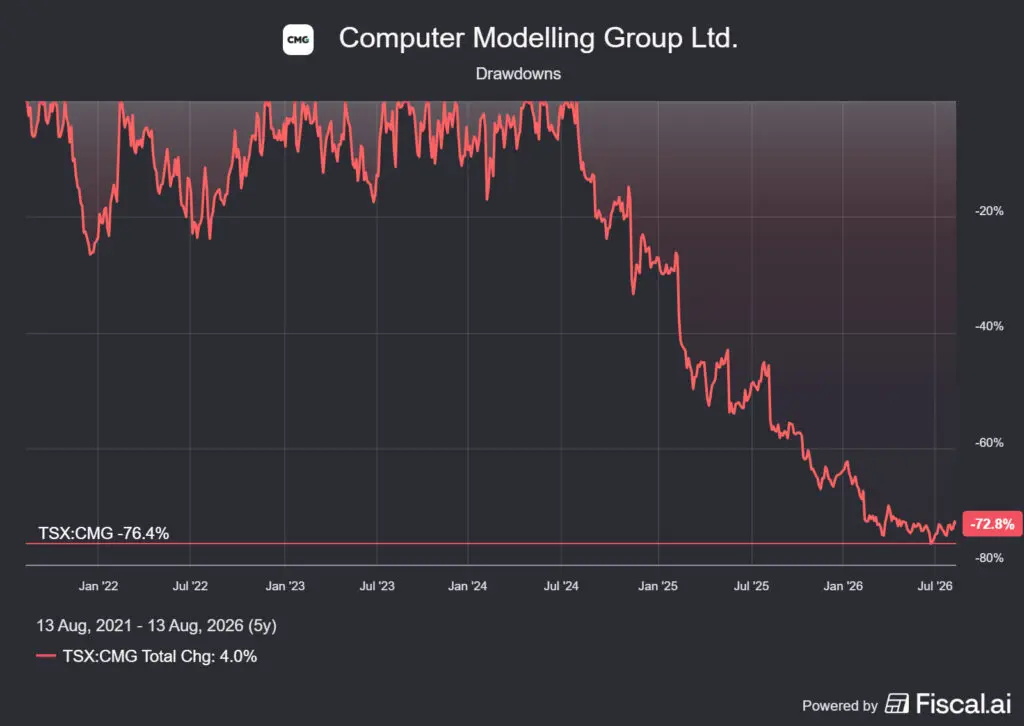
The stock price has been in a steady decline ahead of the Computer Modelling Group's 2027 Q1 report, as the transformation of the mature oil company into a serial acquisition company is taking longer than expected. That's why it deserves a place in the "Reporting from the Stock Exchange" section, which is always an update on fundamental analysis. But what is it all about?
The column is a kind of compass for investors, helping them navigate the dense data set of listed companies. The essence of the column is not just to report raw numbers, but to professionally process the latest quarterly or annual report of the given company. During each such analysis, we put the most important financial indicators (such as sales, profit, ROCE or ROIC) into context, comparing them with previous expectations and, in some cases, with the performance of competitors. Now I will give my opinion on the previously analyzed Computer Modelling Group (TSX:CMG) 2026, which ended in April in the case of CMG, so it will continue in 2027.
☝️An important technical note at the beginning, because without it it's easy to get lost: CMG's fiscal year ends on March 31, so the "2027 Q1" discussed here is actually the period from April to June 2026. If one thinks in terms of a calendar year, this is the last closed quarter.
Beyond the dry data, the column pays special attention to reading between the lines: it analyzes management's expectations and future market prospects. We examine how global economic trends, technological shifts, or industry specifics can affect the company's long-term growth trajectory. The column aims to provide investors with not only a snapshot of what has happened in the past few months, but also what to expect in the market in the coming period. The given quarterly report will also be linked to the in-depth analysis of the stock, if this has already been done on the iO Charts blog. In this case, you can read it at the link above.
In the "Practice" section, you can find my comments beyond mere numbers, which take into account qualitative rather than quantitative aspects.
Computer Modelling Group Q1 2027 Performance Analysis
Let's start with the bottom line: it wasn't a pretty quarter. Total revenue fell 6% to CAD 27.8 million, and the breakdown is even more unpleasant: the organic decline is 16%, which was mitigated by the 10% contribution of acquisitions. Earnings per share halved from CAD 0.04 to CAD 0.02, and net profit fell by 60% to 1.3 million CAD. Analysts' consensus was expecting EPS of CAD 0.037, so this is a significant miss compared to expectations.
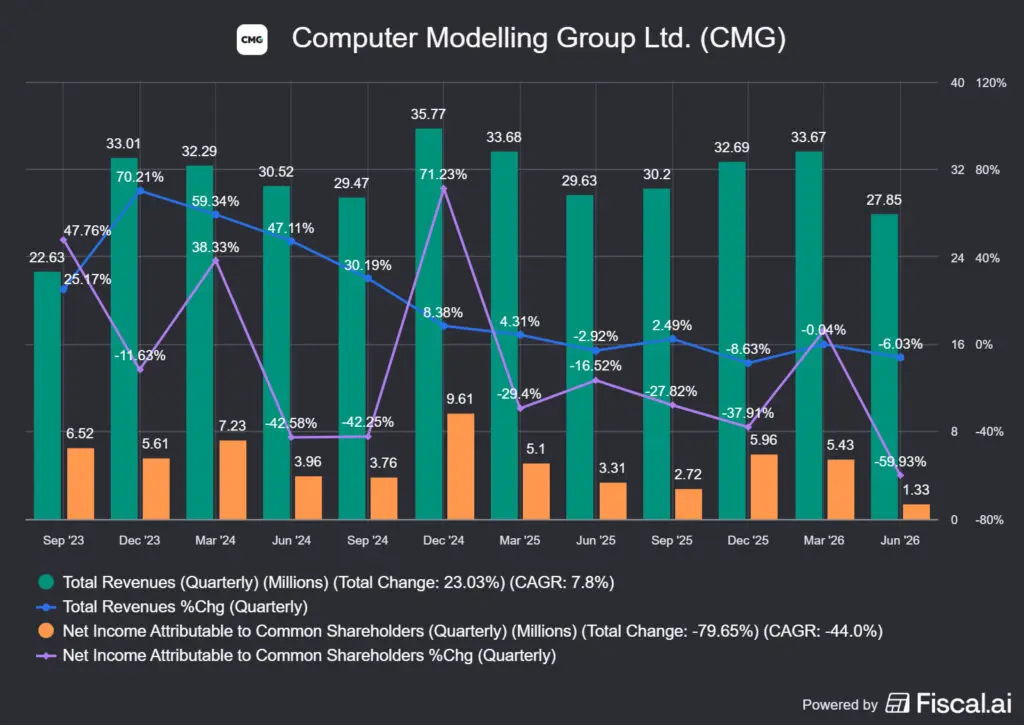
🤔However, it is worth dividing the picture into two layers, because behind the above numbers are partly items that management announced in advance, and partly items that will not be repeated in the future.
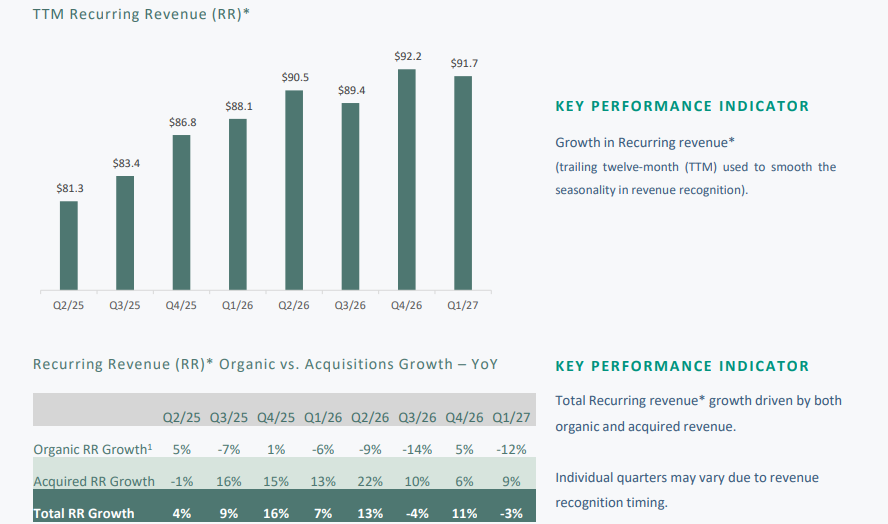
The first layer is recurring revenue, which decreased by 3% to CAD 20.3 million. Within this, acquisitions brought +9%, while the organic part fell by 12%. The vast majority of this 12% is a large customer lost in the second quarter of the 2026 financial year, and this current quarter was the last, in which this base effect appears. According to management, from now on the year-on-year comparison will normalize, this is a concrete, verifiable promise that you can check in the next report.
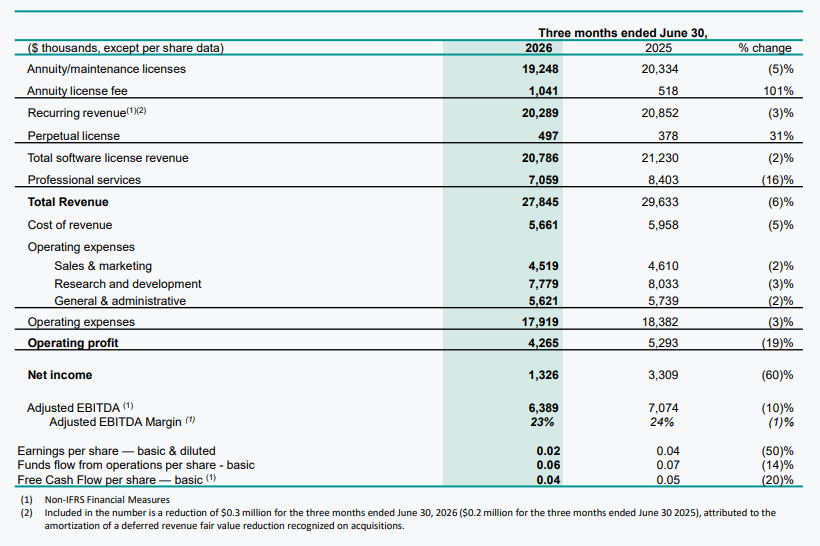
The second tier is professional services, which fell 16% to CAD 7.1 million (-29% organically, +13% from acquisitions). Two things happened here: firstly, the development funding related to CoFlow, which was reported as revenue last year, expired, and secondly, the non-core services business of Bluware, acquired in 2023, is being consciously phased out. The latter is entirely intentional: CMG bought Bluware for its software growth potential, and the services leg was priced to be phased out from the start.
Adjusted EBITDA decreased by 10% to CAD 6.4 million, with margin narrowing from 24% to 23%. Free cash flow fell by 22% to CAD 3.5 million, driven not only by lower revenue but also by higher tax burden (CAD 1.5 million vs. CAD 0.9 million last year, including a prior-period adjustment of CAD 0.4 million).
📌In practice: Those who have read my analysis will not have been surprised by the above, but the scale is still striking. The Computer Modelling Group's 2027 Q1 report is essentially determined by the need to turn a slow mammoth company into a serial acquirer. Warren Buffett said that "Turnarounds rarely turn", meaning that it is much more difficult to turn the ship around than not. In this case, however, there are capital allocators with a specific weight behind the steering wheel who do have a chance to transform the company. This will be discussed below.

Computer Modelling Group 2027 Q1: key financial indicators
- 💵 Total revenue decreased by 6% to CAD 27.8 million (organic -16%, acquisition +10%).
- 🔁 Recurring revenue decreased by 3% to CAD 20.3 million (organic -12%, acquisition +9%).
- 🛠️ Professional services revenue fell 16% to CAD 7.1 million (organic -29%, acquisition +13%).
- 📊 Adjusted EBITDA decreased by 10% to CAD 6.4 million, margin 23% (previous year: 24%).
- 📉 Operating profit fell by 19% to 4.3 million CAD, and net profit fell by 60% to 1.3 million CAD.
- 💰 Free cash flow decreased by 22% to CAD 3.5 million, from CAD 0.05 to CAD 0.04 per share.
- 🧾 EPS halved from 0.04 CAD to 0.02 CAD.
- 🏦 Cash balance decreased from CAD 24.1 million to CAD 17.7 million, credit line drawdown was CAD 7.8 million.
- ✂️ The weighted average number of shares decreased from 83.1 million to 78.0 million in one year, a decrease of 6.1%.
- 🎯 The dividend remains unchanged at 0.01 CAD/share per quarter.
📌In practice: The most important line in this list is not income, but the penultimate one: the number of shares decreased by 6.1% in one year. This is the kind of item that rarely makes headlines in a quarterly summary, but in the long run it is what determines the return. The 60% drop in net income is not an operational collapse: adjusted EBITDA fell only 10%, the difference being due to increased amortization after acquisitions (2.7 million CAD), a 0.8 million CAD exchange rate loss, lost interest income (from 0.3 million to 0.04 million because cash went into acquisitions) and the interest expense that appeared.
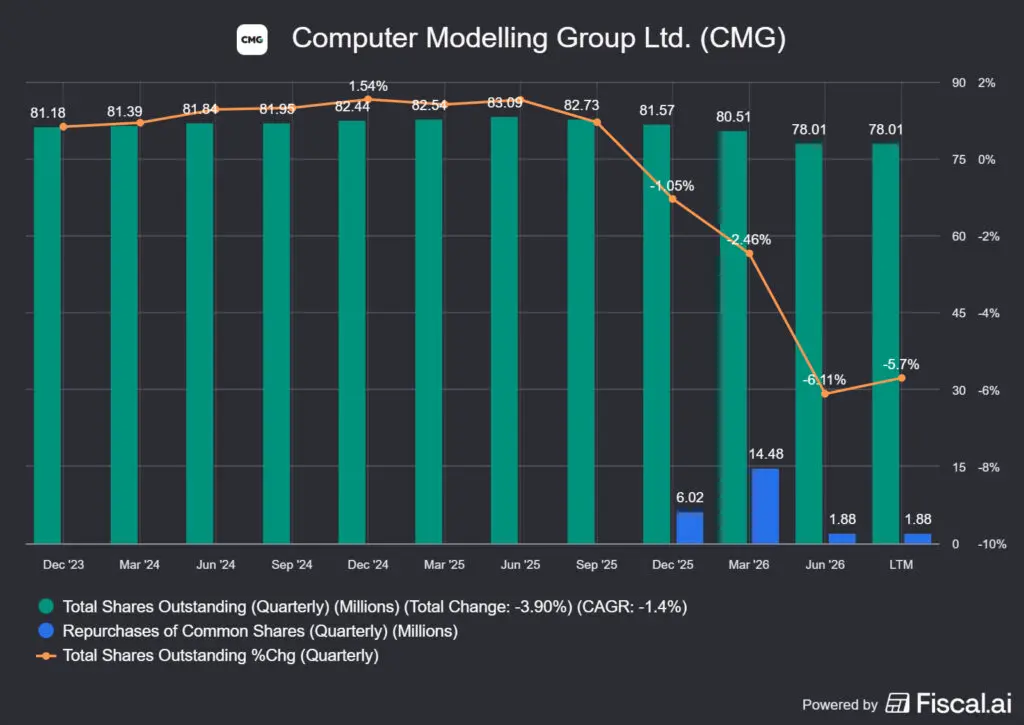
These are largely accounting and capital structure items, not a deterioration of the core business. Still, the organic 16% is real and cannot be explained. However, as you can see, the old businesses are being phased out, which are dampened by the cash flow generation capacity of the acquired companies, as can be seen, for example, in the -16% and +10% changes in total revenue. In other words, the company is reinvesting the revenue into businesses purchased at depressed prices, which have a higher internal rate of return, and is cutting out unnecessary, lower-margin units.
Computer Modelling Group 2027 Q1: key findings
The company is transforming: from a single-product company to a serial acquirer
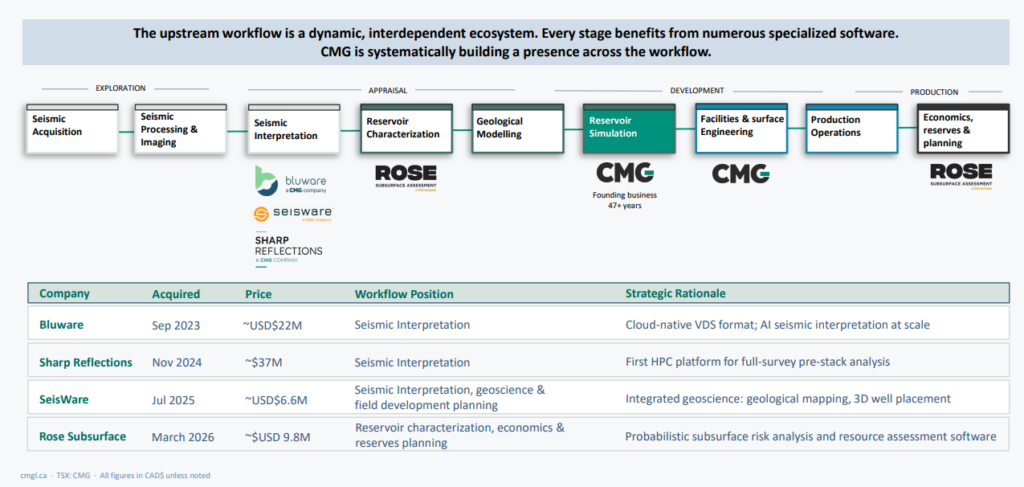
The main messages of CMG’s Q1 presentation were not quarterly numbers, but a status report on its “CMG 4.0” strategy. The company allocated more than CAD 90 million over 34 months to four acquisitions, which together generated roughly CAD 60 million in annual revenue:
- 🌊 Bluware (September 2023, approximately USD 22 million): seismic data processing,
- 🔷 Sharp Reflections (November 2024, approximately CAD 37 million): seismic interpretation,
- 🗺️ SeisWare (July 2025, approx. 6.6 million USD): geological/geophysical software,
- 📐 Rose & Associates (March 2026, approx. USD 9.8 million): risk analysis, resource estimation.
From the above purchase prices and revenue, you can now calculate EV/Sales, which comes out to 1.5X. The portfolio as a whole comes out to a revenue multiple of roughly 1.5x, which is cheap for vertical software, but the company does not disclose the margin profile, so we do not know what this multiple is on an EBITDA basis.
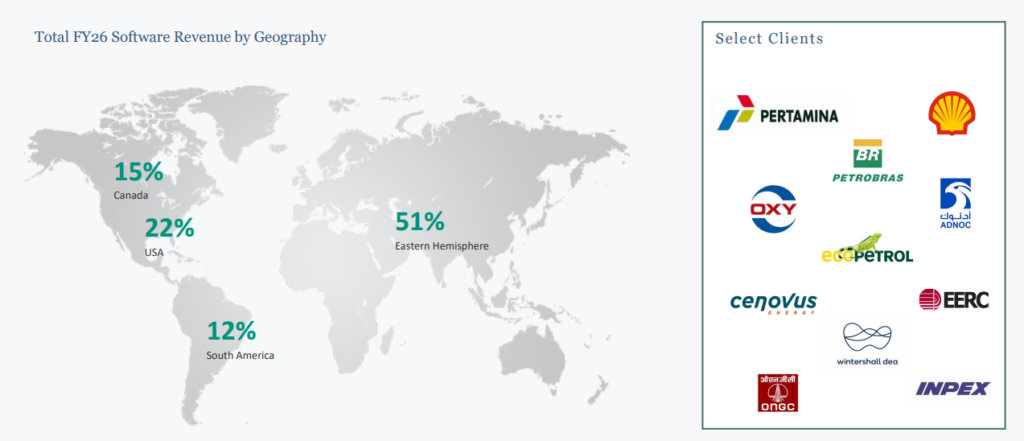
The logic is that the above four companies cover the entire upstream workflow of the oil market, from seismic to reservoir simulation to economic planning. According to management, the acquired companies will retain their own brands and product roadmaps, a decentralized model familiar from Constellation Software, and it is no coincidence: In February 2026, Christopher Wright, who spent 35 years at Roper Technologies, one of the most famous serial acquirers, joined the board.
☝️The real novelty is portfolio sales: CMG now offers joint offerings to companies, where two or three of the acquired companies offer a technology package together.
📌In practice: The above requires some explanation. The gigantic oil companies known as supermajors have been customers of Computer Modelling Group (TSX:CMG) before, but until now the company has mainly only sold simulation software to its partners. The merger of the four companies is actually nothing more than a kind of upselling: the decentralized organization combines several products and offers them. Each new acquisition strengthens CMG's position as it consolidates more and more of the oil industry's software from upstream to midstream to downstream. It makes sense, then, why it would be worth transforming the Computer Modelling group into a serial acquisition company, following the logic of Constellation Software's VMS.
Capital allocation: CAD 20 million buyback from loan
This is the most controversial decision of the quarter, but I personally agree with it. The board of directors has approved a substantial issuer bid (SIB) scheme in which the company will repurchase and retire up to CAD 20 million of its own shares at a price between CAD 4.00 and 4.50. The offer starts on August 14, 2026 and expires on September 21. Financing is not done from cash, but from drawing down the credit line.
What is SIB?
SIB roughly stands for Significant Underwriting Offer. It is a form of Canadian securities law where a company makes a formal, public offer to purchase its own shares, with a deadline and offering document. This is different from an open market buyback (NCIB in Canada), where the company quietly makes purchases on the stock exchange in small increments over months.
CMG uses the modified Dutch auction version. The steps:
- ➡️The company provides a price range and a budget. Here: 4.00–4.50 CAD, up to a total value of 20 million CAD.
- 📈The shareholder decides whether to participate and at what price. Either you name a specific price within the range (e.g. I won't sell it cheaper than this), or you make a "strike price" offer, meaning you accept the price that ultimately develops.
- ⏳After the deadline, the company will aggregate the offers from the bottom up until the number of shares required to purchase the 20 million CAD is collected. That price will be the purchase price.
- 💰Everyone gets the same uniform price, even those who would have given it away for 4.00. The point is: it doesn't happen that everyone gets their own bid price.
Some numbers for context. The stock was trading at CAD 3.82 the day after the report, which is about 44% below its 52-week high of CAD 6.85. This represents a market capitalization of about CAD 300 million. Rolling 12-month adjusted EBITDA is CAD 35.4 million (vs. Q4 2025's CAD 44.0 million), and rolling free cash flow is about CAD 20 million. With these calculations:
| Indicator | Value |
|---|---|
| Capitalization (approx.) | CAD 300 million |
| Net cash position (excluding leases) | approx. +12 million CAD |
| EV / rolling adjusted EBITDA | about 8x |
| Rolling FCF yield | about 6.7% |
| SIB size as a % of capitalization | about 6.7% |
| Dividend yield | about 1.0% |
According to Vipin Khullar, the CFO, the free cash flow for the 2027 financial year will be more than enough to repay the loan portion drawn on the SIB. The CEO emphasized that acquisitions and buybacks are not mutually exclusive, and the acquisition pipeline is active, but they are sticking to their price and yield expectations, which is why fewer transactions are closing successfully.
📌In practice: Two things stand out. One is that SIB's floor price (4.00 CAD) is above the market price, meaning management is willing to pay a premium compared to where the stock was trading. This is a strong indication of what they think the stock's true value might be, but it is not proof of anything in itself.
The other is that CMG is giving up its net cash position: The $20 million call comes on top of the $7.8 million CAD call, and the balance sheet turns into a slight net debt. With a net debt/EBITDA of around 0.2x, this is financially insignificant, but it is a change in principle: up until now, CMG has been buying back with its own money, now with a loan. If organic stabilization does not work out, then it will have to repay debt, pay acquisitions, and maintain dividends at the same time, in the order that management prioritizes.
How worrisome is the above? Based on my experience with previous serial acquirers: not at all. A few thoughts on the above:
- 💰Almost all serial acquirers have light debt because it is capital efficient. The interest expense on debt can be written off from taxes, thus improving the WACC, i.e. the cost of capital (debt actually acts as leverage),
- 💸debt spent on acquisitions can be reduced from the acquired company's free cash flow, which is a very effective way to create value if the acquisition price is low (I wrote above that it is),
- 📉the share price is so low that share buybacks are a more efficient capital allocation solution than acquisitions, meaning the company is significantly undervalued according to management,
- 🪙If the dividend is cut to zero, nothing will happen either, most serial acquirers, such as Constellation Software, Topicus, Lumine, Kelly Partners Group, Teqnion, Röko AB, etc., do not pay dividends either.
🤔In other words, the above typically follow the pattern produced by standard serial acquisition companies, but the market generally does not recognize or misunderstand them.

Computer Modelling Group 2027 Q1: forecast
Management reaffirmed its full-year outlook and provided separate guidance for the next quarter:
- 🔁 Recurring revenue increases sequentially in Q2 because a larger portion of the renewal cycle falls during this period. At CMG, Q1 is typically the weakest quarter and Q4 is the strongest.
- 📉 Professional services revenue will bottom out in Q2, the Bluware exit will be completed, plus the lower activity of the summer months will also take effect.
- 🧮 Adjusted EBITDA and margin decreased sequentially and year-over-year in Q2, partly due to the service bottom and partly due to agent commissions tied to renewals.
- 📅 For the whole year: stable organic recurring revenue, no adjusted EBITDA decline compared to 2026, and improving free cash flow.
- ⚠️ The expectation for the annual decline in professional services has been lowered to 6-7 million CAD from the previous 6 million.
📌In practice: Note that management has practically asked investors not to look at Q2. They have announced in advance that the next quarter will be the bottom of the services segment, with deteriorating margins, while promising stability for the full year. This means mathematically that H2 should be big. If one really wants to test this thesis, then there is one line worth looking for in the November Q2 report: the change in organic recurring revenue. If it is around zero or positive, the turnaround story has really started to turn. If it's still in the red, then the base effect explanation hasn't stopped and you're dealing with something else. That's the kind of concrete, refutable claim that's worth reading quarterly reports for.

Computer Modelling Group 2027 Q1: management change
One of the strongest arguments in favor of Computer Modelling Group (TSX:CMG) is that it is full of very experienced executives who have either been with Constellation Software or other serial acquirers. There have been significant changes compared to the previous situation, especially in 2025, but I think the reason for the departures was compelling, while the new ones significantly strengthen the company's leadership. Although the turnover is quite hardcore based on Computer Modelling Group's 2027 Q1 report and previous quarters, I think it is a necessary and sufficient condition for the company to become a true serial acquirer. Let's take a look at the key players in this process!
CMG's departures
- Mark Miller: Director since 2019, President since 2022. No longer on the list of candidates for the September 4, 2025, AGM. Three weeks later, on September 25, 2025, he was appointed President of CSU following the resignation of Mark Leonard for health reasons. Background: Co-founder of Trapeze Group (1988), first acquisition of CSU in 1995; 30+ years at CSU and Volaris; Chairman of the Board of Lumine. This was the strongest CSU-operator relationship.
- John Billowits: its presentation was included in the 2023 information circular; CSU Director since September 2020, previously President of Jonas Operating Group, Director of Togetherwork and Topicus. He is not on the current board. I was unable to find the exact date and reason for the departure.
- Mohammad Khalaf: Head of Corporate Development since 2022. Seven years as Vice President of M&A at one of CSU's operating groups.

Current CMG Board Members
- Andrew Pastor: Chairman of the Board of Directors since September 4, 2025. CSU Director, EdgePoint Portfolio Manager. EdgePoint collectively manages ~27% of CMG shares, and he personally holds ~0.75% stake.
- Birgit Troy: Director since 2024. Volaris CFO → Constellation CFO → Incognito Software Systems CFO (2015–16) → Lumine Group CFO / Portfolio CFO (2016–21), where he led the acquisition and integration of 16 vertical market software companies. The deepest real CSU operator connection on the board.
- Christopher Wright: Director since February 10, 2026. 35 years on the board of Roper Technologies, where 60+ acquisitions took place and EV grew to over $60 billion; co-founding director and major external investor of Idox plc. Not a CSU, but a Roper school, which is a roll-up but also a serial acquirer.
- Alex Davern: Director since May 2024. Ex-National Instruments CEO/COO/CFO, ex-ESI Group President. Not a serial acquirer background, but an enterprise software operator, which comes in handy in the VMS space.
CMG's current managementimportant members of the choir
- Vipin Khullar: CFO, since July 28, 2025. He comes from CSU's Perseus Operating Group, where he was most recently CFO; Eight years of acquisition and shared-services experience. New arrival, reinforcement from Constellation Software.
- Matthew Miller: VP, Corporate Development. He has ties, but not to CSU. According to his own description, he was previously a senior analyst at Old Well Partners, a global investment firm focused on high-quality, growth companies, including software companies, and before that, he was a co-founder of Boyles Asset Management, a global small-cap investment firm. He was previously VP Strategy at CMG, before taking over corporate development.
📌In practice: Mark Miller was forced to leave because he became the CEO of the world's largest serial acquisition company. In return, they stuffed the board and management with presidents who carry Constellation genetics. In fact, the old guard - Ken Dedeluk, Peter Kinash - remained on the board, but the rest of the members already have strong ties to serial acquisition companies. Since a CSU director owns more than 27.45% of the company through the EdgePoint portfolio manager, not counting the additional 0.75% in his own name, they essentially determine what happens at CMG. A blocking minority requires ~33%, but the general meeting usually has 65-70% of the votes, including small shareholders, so in reality EdgePoint often decides, but if not, it can still block.
☝️To summarize the above: It would be very difficult to wrest control of the Computer Modelling Group from the hands of Constellation members, so it is expected that the positive practices of the CSU will be introduced here as well.
In addition to the above, they have also packed the Computer Modelling Group with people who either know about the oil industry or small business acquisitions. It is important to note that these are VMS software in some ways, they are quite specialized, but the acquisition methodology will probably be roughly the same as what you will see in the CSU universe.
Computer Modelling Group 2027 Q1: summary
I won't sugarcoat it: CMG is in the middle of a transition period, and this transition has been more expensive and slower than the market wanted, punishing the company with a brutal share price drop. The rolling adjusted EBITDA margin has narrowed from 34% to 28%, the stock is ~73% below its all-time high, and the organic part of the original reservoir simulation business is also shrinking.
🤔However, I don't think that's the point. The question is whether we are halfway through a capital allocation-driven transformation, or whether we are witnessing a slow decline disguised by expensive acquisitions.
The arguments in favor: the core business has been around for 48 years, is mission critical, is built into regulatory filings, and the organic decline is documented to be tied to a single lost contract that has just expired. Constellation-DNS (Wright from Roper, decentralized model, ROIC-based incentives) is real, not just marketing hype, and the number of shares is also decreasing, not increasing.
The arguments against it are also real: running four integrations in parallel with a shrinking core business is not trivial, margin squeeze has not stopped, and debt-financed buybacks always carry risks. I still consider Computer Modelling Group (TSX:CMG) a patience thesis, where time works against the investor until organic growth is replaced by cash flow from acquisitions. It will be clear in two to three quarters whether there will be a Constellation software-like serial acquisition company in the oil industry.
And if you would like to learn more about the Computer Modelling Group, read the original analysis at this link: Computer Modelling Group stock analysis.
🤑If you are interested in what brokers we use, read our articles below:
(I.e.Interactive Brokers broker account analysis – Professional for professionals
📈LightYear Broker Account Analysis - Simplicity and cheapness go hand in hand
Frequently Asked Questions about Computer Modelling Group stock
Answers to the most common questions
Do you hold Computer Modelling Group shares or just want to understand what happened after the 2027 Q1 report? Here you will find concise answers to the most frequently asked questions: why did the share price fall so much, what does the debt-financed share buyback mean, is the company really becoming a serial acquirer, who is behind the capital allocation, and when will it become clear whether the turnaround is really happening.
Click on any question and the answer will open. These are intentionally short summaries: if you are interested in the details, I will expand on them in more detail in the appropriate sections of the article. Important: CMG is in the middle of a transformation, the data reflects the time of writing of the article.
Is Computer Modelling Group stock a good investment now?
This is a patience thesis, not a proven compounder. The pricing is not expensive: about 300 million CAD capitalization, about 8x EV/rolling adjusted EBITDA and a 6.7% FCF yield, while the share count has decreased by 6.1% in one year. The inputs are good – capital allocator management, decentralized structure, acquisitions bought cheaply – but the outputs are not yet there, and the end market is cyclical. Time is against the investor until cash flow from acquisitions makes up for the organic decline.
Why did CMG's share price fall so much after the report?
The Q1 2027 report reported a 16% organic revenue decline and a 12% organic decline in recurring revenue, with EPS halving from CAD 0.04 to CAD 0.02, versus the analyst consensus of CAD 0.037. The market also saw management’s previous promise of positive organic growth in fiscal 2027 change to “stable” organic revenue. Such a shortfall in an already depressed and controversial story is causing double-digit share price movement.
What does substantial issuer bid (SIB) mean, and what should you do with it?
A SIB is a Canadian securities law form in which a company makes a formal, forward bid for its own shares, as opposed to a silent buyback (NCIB). CMG is using a modified Dutch auction in a range of CAD 4.00-4.50, up to CAD 20 million, from August 14 to September 21, 2026. Those who do not tender shares will automatically have their ownership increased.
Important tax information: the consideration received in the SIB may be considered a deemed dividend in Canada, from which non-resident shareholders may be subject to withholding tax. It is worth checking this in the offering circular and your broker's corporate action notice before anyone submits.
Is Computer Modelling Group really becoming a serial acquirer?
Four acquisitions have closed in 34 months (Bluware, Sharp Reflections, SeisWare, Rose & Associates), with over $90 million in committed capital and approximately $60 million in annualized revenue, representing a revenue multiple of approximately 1.5x. The acquired companies retain their own brands, product roadmaps, and general managers, a truly decentralized structure. The transformation has begun – but four deals are not a proven machine, and the size, multiple, and rhythm of the next 2-3 transactions will determine whether they are a repeatable engine or occasional purchases.
Are the people from Constellation Software really running CMG?
Partly. The board includes Andrew Pastor (CSU Director, EdgePoint Portfolio Manager) as chairman, and Birgit Troy, with the deepest operator connections: CFO of Volaris and Constellation, and then CFO of Lumine Portfolio, where she led the acquisition of 16 vertical software companies. In management, CFO Vipin Khullar came from Perseus Operating Group.
However, the most powerful CSU operator, Mark Miller, left in September 2025 to become president of Constellation. CEO Pramod Jain has no CSU background (Sabre, Plusgrade), and Christopher Wright came from Roper, not Constellation. So the DNA is real, but more mixed than most analyses suggest: multiple serial acquirer schools are sitting at the table at the same time.
Are you worried that shares are being bought back using credit?
Financially, barely: the balance sheet is turning into a slight net debt, with a net debt/EBITDA of around 0.2x. However, it is a change in principle that CMG has been buying back with its own money so far. Most serial acquirers intentionally keep a slight debt because interest expense reduces the tax base and can be repaid quickly from the cash flow of the acquired companies. The risk is acute if organic stabilization fails: then debt must be repaid, acquisitions must be paid and dividends must be maintained at the same time.
When will it become clear whether the turnaround is really happening?
In the Q2 report for November 2026, in one line: the change in organic recurring revenue. According to management, the base effect of the large lost customer has now run out, so the year-on-year comparison should normalize from here. If this number is around zero or positive, the thesis is valid. If it is still negative, then the base effect explanation has not stopped. Also, watch the margin: the 23% should start to rise again as the acquisitions mature.
What are the biggest risks of Computer Modelling Group stock?
Four main issues: the single, cyclical and consolidating end market (upstream oil and gas industry, where every E&P merger automatically means seat consolidation), high customer concentration (a single lost contract dramatically reduced the recurring revenue of the entire company), four integrations running in parallel alongside a shrinking core business, and the deterioration of the margin mix, because lower-margin seismic revenue is driving higher-margin reservoir simulation.
Why is CMG's financial year confusing?
CMG’s fiscal year ends on March 31st and is marked as the closing calendar year. Therefore, “Q1 2027” published in August 2026 is actually the period from April to June 2026. The media regularly gets it wrong: several news outlets have titled the same report “Q1 2026”. When looking at CMG numbers anywhere, always check the quarter-end date, not the label. Next report: Q2, ending September 30th, 2026, expected in early November.
Legal and liability statement (aka. disclaimer): My articles contain personal opinions, I write them solely for my own entertainment and that of my readers. The articles published here do NOT in any way exhaust the topic of investment advice. What is written here is for informational purposes only and should NOT be construed as an offer. You are SOLELY responsible for the decisions you make.