Our articles so far have typically been about the American market, but we have also analyzed German stocks, for example: Porsche AG (P911) Stock AnalysisWhy haven't we written about the specifics of the DAX index yet? There's a simple reason for this: there is much more data available about US companies and stock exchanges. Of course, this doesn't mean that there aren't great companies in Europe, and if you want to invest in them, the German market is almost unavoidable. And when it comes to the German market, knowing the DAX index is a very important element, but today we will not only talk about that, but also about some interesting companies that are included in the index and have caught my attention.
🇩🇪DAX index: a little German history
The DAX index, which is an abbreviation for Deutscher Aktienindex, does not have a history as old as, say, the DJIA, the American index. This is mainly due to historical reasons, but the main point is that it was created in July 1988 and is operated by Deutsche Börse, which was founded in 1992. Interestingly, Deutsche Börse, which is listed under the ticker DB1, is also included in the DAX index, just as the Standard & Poor's company is included in the S&P 500 (SPGI), which operates the S&P 500. By the way, I wrote about this in this article: The essence and use of the S&P 500 index.
The DAX index, also known as the DAX 30 index or Germany 30, was a capitalization-weighted index of 30 companies. Only stocks that are freely floating, i.e. tradable, are included in the weighting. Then, at the end of 2021, the number of companies included in the index was increased to 40. This is an aggregate indicator that tracks the stock market status of the 40 most important companies in Germany. Based on market capitalization, the 30 companies represented roughly 80% of the market, and it has become even higher since the number of companies was increased to 40. The companies are listed on the Frankfurt Stock Exchange (Frankfurt Stock Exchange), and the trading system is called Xetra.
🏦DAX index entry conditions
Just as Standard & Poor's has created a kind of pre-screening for the inclusion criteria for the S&P 500 index, the DAX index also has such criteria, although the points on it are quite different from the American list. Companies that want to be included in the index must meet the following:
- ☝🏼listed on the Frankfurt Stock Exchange
- ☝🏼meets the Frankfurt Stock Exchange Prime Standard criteria, which primarily means transparency requirements (Premium Standard)
- ☝🏼submitted annual and semi-annual reports and quarterly figures to the supervisory authority
- ☝🏼has had a positive EBITDA value for the last 2 years
- ☝🏼Continuous trading is possible via the Xetra system
- ☝🏼at least 30 days have passed since the initial listing
- ☝🏼at least 10% of the company's shares are publicly traded (e.g. the state does not own it)
- ☝🏼the company is headquartered in Germany or the majority of the company's shares are traded in Frankfurt and the company is headquartered in the EU
Some comments on the above: It is not only German securities that can be traded on the Frankfurt Stock Exchange. You have seen an example of this before in the case of the American stock exchanges, where foreign shares are listed as ADRs, including those of German companies, and this can also work the other way around. And with the last clause, they have nicely outlined that in fact EU companies can be listed on the DAX index. The other requirements are similar to the requirements of the S&P 500 index.
📊DAX index participants
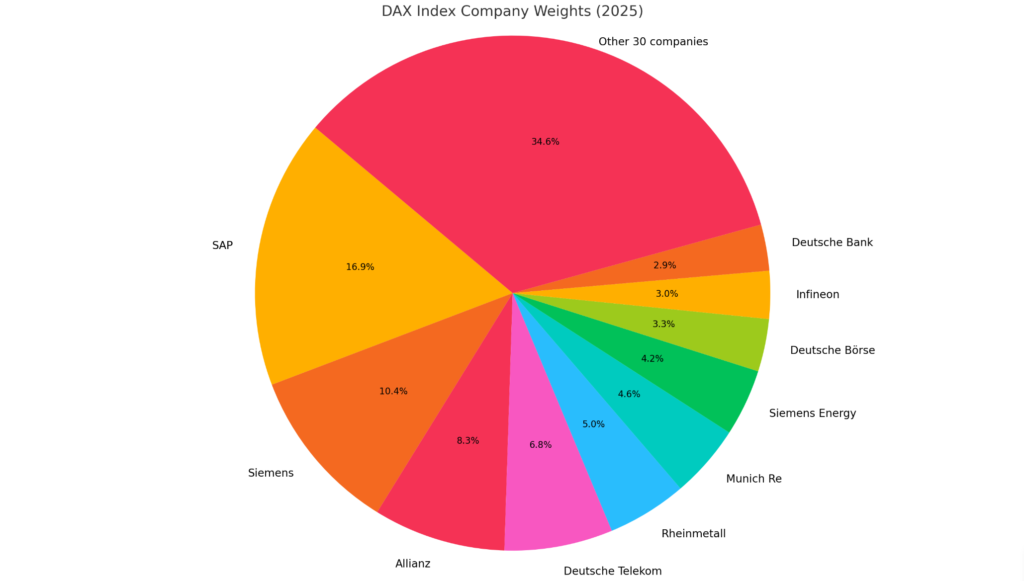
I won't list every company that is included in the DAX index, but it's worth knowing the few that really dominate the index, based on the mid-2025 status.
- SAP SE (SAP): ~16.9 %
- Siemens AG (SIE): ~10.4 %
- Allianz SE (ALV): ~8.3 %
- Deutsche Telekom AG (DTE): ~6.8 %
- Rheinmetall AG (RHM): ~5.0 %
- Munich Rück (MUV2): ~4.6 %
- Siemens Energy AG (ENR): ~4.2 %
- Deutsche Börse AG (DB1): ~3.3 %
- Infineon Technologies AG (IFX): ~3.0 %
- Deutsche Bank AG (DBK): ~2.9 %
You can see the full list in alphabetical order here: DAX Index.
Of course, there are also withdrawals and additions from the DAX index here: this is for example the latest.
📌DAX index interesting facts: VW AG (VOVW3) and Porsche AG (P911) are also missing from the above list, due to their very low valuations. However, as the companies are cross-owned, the actual weighting is a bit misleading. Volkswagen AG (VOW3) has a weight of around 2.5% in the DAX index, with EUR 48.5 billion, while Porsche AG (P911) has around half that, with a weight of around 1.2% and EUR 20 billion.
What makes this all interesting? The fact that the companies are brought together by a holding company, which is listed separately in the DAX index, under the identifier PAH3, with a market capitalization of around EUR 10 billion, I wrote about this here: Porsche AG (P911) Stock Analysis. The connection is so strong that Oliver Blume is the CEO of both VW and Porsche. That means the total capitalization of the companies is roughly EUR 78 billion at the time of writing, which would put them somewhere in the 7th-8th place. Or not? Because most of the companies' shares are not freely traded, their real weight in the index is significantly smaller than you might expect.
🏢How does the DAX index work?
As I mentioned earlier, the S&P 500 index is a capitalization-weighted index, as is the DAX index. What does this mean in practice?
Capitalization-weighted indices: It is based on the size of the companies, also known as market capitalization. This is a value derived from the product of the share price and the number of free-floating shares, so larger companies have a greater influence on the movement of the index than smaller ones due to their larger market capitalization. Of course, this method also suffers from problems, for example, the price movements of companies that grow too large mask the possible opposite movements of smaller ones. The DAX index is a capitalization-weighted index, as are most modern indices. We wrote about stock market indices in detail in this article: Meaning and use of stock market indices
That is why it is worth looking at which companies are included and how much weight they have and how they distort the DAX (as of July 2025):
- 💫Largest company: ~16.9% – S&P 500 ~7.3%
- 💫Top 3 companies: ~35.6% – S&P 500 ~20.2%
- 💫Top 5 companies: ~47.4% – S&P 500 ~27.2%
- 💫Top ten companies: ~65.4% S&P 500 ~36.6%
As you can see, the Top 10 companies modify the index much more drastically than in the case of the S&P 500, although there are many more companies in the index, so this is actually normal. It is not so much that SAP alone distorts the movement of the DAX index by almost 17%, in 2021 it was the same for Linde, by 10%. It is also worth knowing that the word DAX was used to form an MDAX, which is a mid-cap index, and an SDAX, which is an index that also includes small-cap companies, and the CDAX includes all German listed companies. There are also other indexes selected according to a given topic, such as ÖkoDAX or TecDAX, the names of which give an idea of what companies they include.
Where can you get information about the DAX index and European companies?
Fortunately, almost every stock selection site now lists European companies, including Fiscal.ai and iO Charts. Interestingly, European sources are much weaker in terms of data provision than their American counterparts, but fortunately I found a few sites where you could search, without claiming to be exhaustive:
- Europeandgi: a European dividend site, but for this reason it is only partially suitable for searching for stocks.
- Engineer my Freedom: basically a financial blog about self-realization, with some good stock ideas.
- Seeking Alpha: most of the analysis can be found here, and for those securities that are listed on the American stock exchange as ADR shares, there is a fee.
- Substacks: you can find stock analysis blogs on Substack, some of which are paid.
The other way to get information is to look for stocks that are also listed on the DAX index and that have an American equivalent, i.e., also exist as ADR securities. For example, there is an analysis of Bayer AG ADR – BAYRY – on Morningstar.com, which is basically an American site, but they also analyze all kinds of companies that are available on the US stock exchange in some form. Another example is the Swiss Roche Holding AG, which exists under the ticker RHHBY – this is the ADR paper – and also with the symbol RHHVF.
📌In practice: Of the above sites, I only used Substack in practice, while Fiscal.ai was used for data filtering because it can list all European companies. Anyone with an Interactive Brokers account has access to Morningstar analyses, so you will also have access to the analyses of the German stocks listed above, the DAX index. In other words, the Americans are so good at almost everything that you don't even have to use European sources if you don't want to.
💱Trading the DAX index
As I wrote about the S&P 500, the DAX index itself cannot be traded, so you cannot invest in the DAX index. To do this, you will need some kind of financial market product, which brokers and banks have readily created for you, just lean on them. You have several options to follow the movement of the DAX index.
One of the products invented for trading, used in the short term, like CFDs, is the certificate, but these only follow the price movements of the DAX index as a substitute product. Moreover, CFDs are leveraged, over-the-counter products, while certificates are actually their stock market equivalent. These are quite speculative, high-risk instruments, I have never used them, for this very reason.
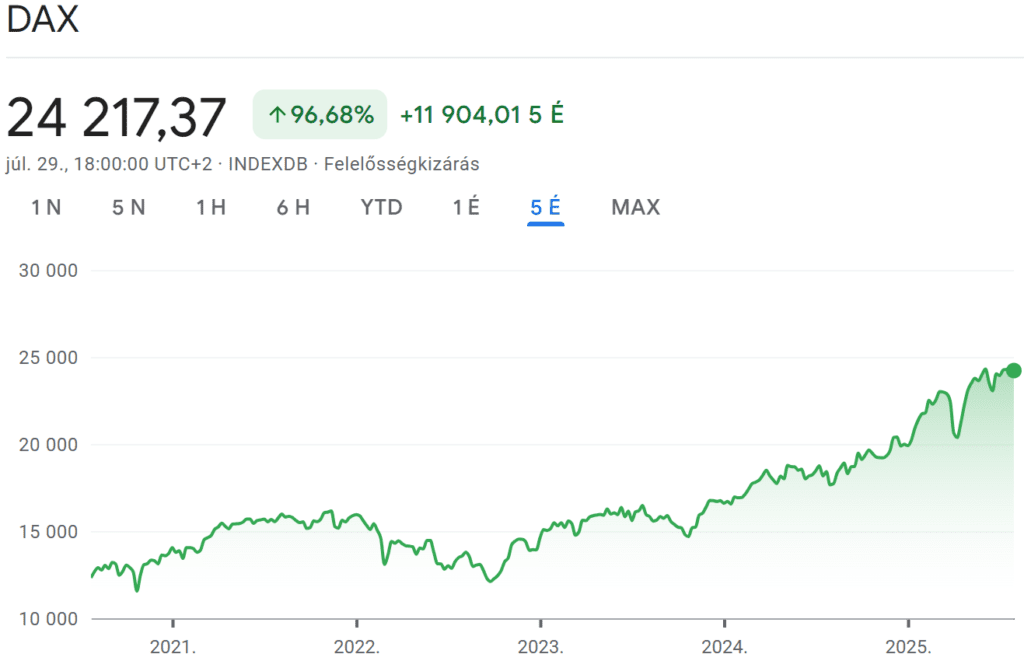
💡Fortunately, ETFs, or exchange-traded funds, have already been created for the DAX index. These work by creating a basket of shares from the DAX index by physically purchasing them, with the weightings that they are included in the index.
In other words, they implement the tracking of the index and the price movement not only as a virtual, but also as a physical product. Since the liquidity of the DAX index is high, such instruments are actually suitable for both short- and long-term investment. You should find out more about DAX ETFs on the Justetf website, which you can access here: justetf.com
💰Tax implications of the DAX index for Hungarian citizens
📄Taxation of instruments tracking the DAX index
💸Some interesting facts about companies listed on the DAX index
When I looked at which of the 40 stocks in the DAX index pay dividends and which don't, I was surprised to find that ~35 do, and the remaining few companies also have some that used to pay. The DivDAX index, which includes the 15 highest dividend-paying companies in the DAX, is a good indicator of the preference of German companies to return cash to shareholders in this way.
I should add that dividend payments are not at all the Holy Grail in Europe as they are in America, and the Germans in particular are reticent in this regard. At an Exxon Mobile (XOM) it would be completely unthinkable to cut dividends just to improve their fiscal situation, for example, in the 2020 crisis they fired people and took out loans rather than cut dividends, and they are maintaining this to the extreme.
During the 2020 pandemic, companies in Europe announced many more dividend cuts than in the US, and Germans are also more likely to cut dividends, for example, if a company has too much debt. In other words, even though a significant number of companies pay dividends, it is not necessarily better to buy these companies from this perspective than their American counterparts. It is also worth thinking about whether if so many companies pay out their profits in the form of dividends, they cannot use them in a more efficient way?
The best companies in the DAX index?
However, it is undeniable that Germany also has some excellent companies that are worth looking at. Fortunately, American screener sites list most German stocks – at least the better-known ones – so there is a lot of data available about them. Although I have never analyzed the DAX index stocks in more depth, if I had to start somewhere, I would look at the margins that the companies produce.
That's exactly what I did, and 28 companies were immediately eliminated based on the values, of course, not everyone needs to draw the line as strictly as I did. For the remaining 12, where I saw a negative value, I immediately threw it out, although Porsche – PAH3 – would be worth a specific look, because there is some anomaly with the values there. I marked the medium-sized companies in yellow, but in addition to these I found 3 others – Deutsche Boerse (DB1), Qiagen NV (QIA), SAP SE (SAP) - which don't seem bad at all at a second glance.

source: own
It is very important that these are quantitative values and do not reflect qualitative things – management communication, value creation, diversification, voting shares, acquisitions, etc. – in any way. Many other important elements are also missing from the formula, such as how well the current price reflects the fair value of the companies. If you are interested, you can do some research on Morningstar or Gurufocus if you have a subscription or start a 14-day free trial. Let's quickly run through what you need to know about these three companies and how it is worth starting your research.
Top 3 companies in the DAX index?
This article is not primarily about stock analysis, and although there is a disclaimer section at the end of every article, I would like to draw your attention to the fact that this is not an article encouraging anyone to buy or sell, I cannot do such an activity, nor do I intend to. If you are more deeply interested in these 3 companies, then do your own research and decide for yourself, no article will appear on the iO Charts columns that would encourage anyone to buy or sell.
I would also like to point out once again that this reasoning is not an analysis, it is merely a discussion of what the following companies might be like. It provides the basics, but nothing more, meaning that independent analysis is required to declare these companies to be as good as they seem at first glance.
Deutsche Boerse Group – DB1
Deutsche Boerse AG is none other than the operator of the German stock exchange and the DAX index, in this sense it is similar to Standard and Poor's (SPGI) is the German equivalent. Why do we like these types of companies? One reason is that they are not really in the spotlight, they don't have a big success story behind them, like, say, Tesla (TSLA), but their services are always needed. They do not produce finished products, so they basically do not have large recurring costs, and they are not really cyclical. Of course, some kind of cyclicality can be observed in their operation itself, which follows the fluctuations of the economy, but they are not fundamentally a cyclical company like a steel mill. Their activities do not really depend on raw material prices, but they are a service that is difficult to avoid. You can see exactly what these are on the company's website.
source: Gurufocus
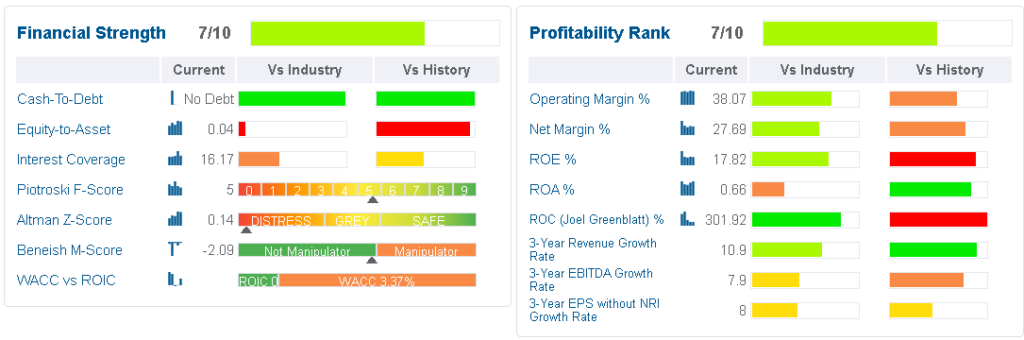
As for the sheer numbers, DB1 has the highest gross, operating and profit margins, which is usually a good sign for a company. Let's see what other numbers you can find about the company online, for example, the Gurufocus site is a great place to look for them (Gurufocus). It returns, for example, data such as companies' debt - which is practically zero in the case of DB1 - or valuation, which in the case of Deutsche Boerse Group is slightly above the long-term average.
It is also a good sign that our company's revenue has been increasing for 10 years, since 2012. There are countless other data points that can be read from the graphs, but that will be your task. Basically, DB1 does not seem like a bad company, but there are problems with its valuation and therefore it is quite a bit weaker in value compared to its American "equivalents" (Standard & Poor's, Moody's). Another tip for finding sources, there is quite a lot of analysis about the company on Seeking Alpha (Seeking Alpha - Deutsche Boerse), as Morningstar recently reviewed the company.
Qiagen NV – QIA
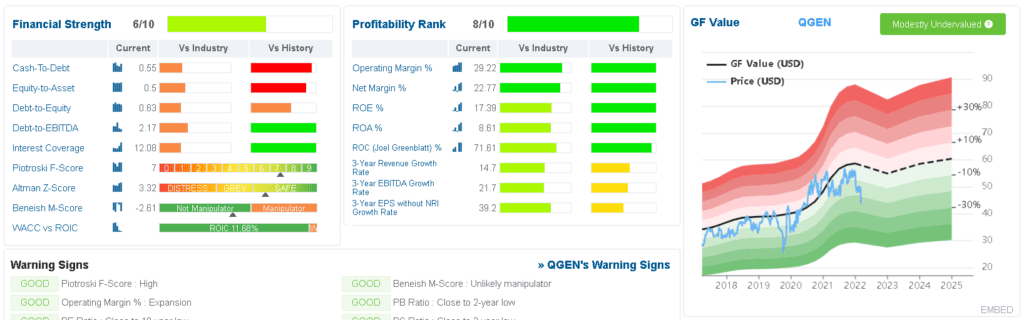
Qiagen NV, with a not-so-German name, is a diagnostic company providing sample and test technologies, and is basically involved in molecular biology, drug and DNA research and testing. The interesting thing about the company is that it is also listed on the New York Stock Exchange under the ticker QGEN, which is good because it has a Morningstar analysis, meaning you can also get to know the company in English. Basically, companies in the “healthcare” sector are quite tricky, because it is very important whether they deal with elderly care, wholesale sales – this is actually a retail business -, generic drugs, the development of drugs against dreaded diseases such as cancer, the production of medical devices, laboratory-related research and testing or the operation of medical systems – this is practically a special IT area. I recently read an analysis on the Yardeni website regarding the margins of the sector, I will also include the picture here, because the variance is quite large. It is also worth noting that if there are orbital lawsuits anywhere, it is the medical sector, so I would not call healthcare a risk-free segment.
source: Gurufocus
I must admit, what Qiagen does is very far from my understanding. I have never dealt with anything like this in my life, and I think that is true for most people. However, the company's metrics are very good, starting with the margins, which you could have seen above. The constantly rising revenue is also convincing, while the EPS per share is quite volatile, although it has increased significantly in the last 2 years. For this reason, the company looks cheap on the often-mentioned Peter Lynch chart, and according to Morningstar, it is trading below fair value. Two other things stood out: this is a company without a significant competitive advantage - it is difficult to defend the business - and that the ROIC value - how much capital investment is needed to generate profit - could be higher. The Americans haven't written much analysis about it, the latest one on Seeking Alpha is more than 1 year old (Seeking Alpha – Qiagen), so I would search among German sources.
SAP SE – SAP
SAP is probably the most well-known of the three. It's basically an IT behemoth that provides various enterprise software solutions, such as resource planning, enterprise management, database management, and the like. This is much closer to me than the previous company, and the tech sector is a more popular, more visible sector than the pharmaceutical industry.
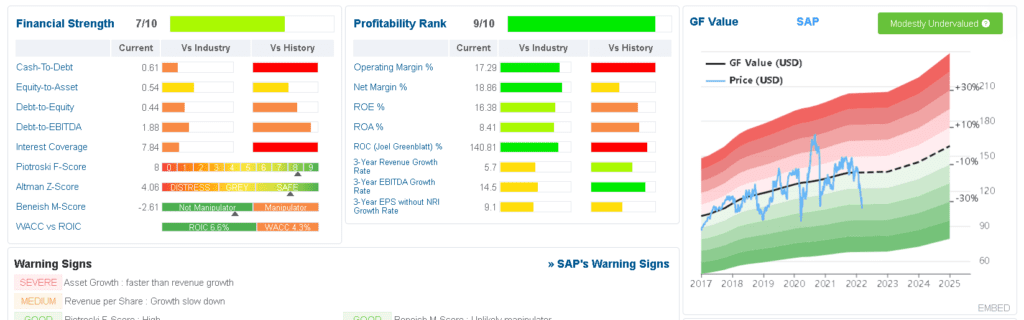
The margins of this company are also okay, but it was noticeable that the 5- and 10-year averages of revenue growth are much higher than the current one, and the operating margin – it is translated as operating profit in many places, but I think this term is terrible – has decreased this past year. However, the EPS is growing nicely, so there is no big problem, and at first glance the debt level is okay. Since this is a company with a market capitalization of 125 billion dollars, I always check here to see if there are any structural problems, since IBM, for example, has been struggling with something like this for years (IBM).
source: Gurufocus
As for its valuation, the company does not seem expensive compared to historical averages on a P/E basis, and this is confirmed by several sites, of course, we should take a closer look behind the scenes to see why this is the case, since the numbers never show the whole picture. I am not saying it is “dirt cheap”, but it is worth adding to the watchlist for anyone who would choose among the stocks in the DAX index. SAP is also listed as an ADR on the American stock exchanges, and Morningstar has also analyzed the company (Morningstar – SAP), and there are even recent articles about it on Seeking Alpha (Seeking Alpha – SAP), so you don't necessarily have to use German-language sources.
Final Takeaway
Now that you know all the ins and outs of the DAX index, you can start analyzing the German stock exchange and the companies listed there. As it turns out, the DAX index is not that different from its American counterparts, it works along similar logic, and it should be used similarly. Although I have written it several times, I will do it again here: the above impromptu description of the 3 companies is at most thought-provoking, and if I have managed to attract your attention to them and thus encourage someone to do a more serious analysis, then it was worth it. I wish everyone successful investments, while managing risks as skillfully as possible.
🤑If you are interested in what brokers we use, read our articles below:
(I.e.Interactive Brokers broker account analysis – Professional for professionals
📈LightYear Broker Account Analysis - Simplicity and cheapness go hand in hand
Frequently Asked Questions (FAQ)
🏢 What are the DAX 30 stocks?
The former composition of the DAX 30 was used until 2021, when the index expanded from 30 to 40 companies (now the DAX 40). The former DAX 30 members included large German companies such as Siemens, Bayer, Allianz, Volkswagen, BMW, SAP, Deutsche Bank and BASF. These companies continue to be dominant players in the current DAX 40.
📈 What does the DAX index mean?
The DAX index is an abbreviation for Deutscher Aktienindex. It is a capitalization-weighted index of the prices of the 40 largest German companies listed on the Frankfurt Stock Exchange. The DAX is one of the most important European stock market indices, reflecting the performance of the German economy.
📊 What are the DAX stocks?
The DAX index currently contains 40 companies, including well-known companies such as Siemens, Volkswagen, Mercedes-Benz Group, Allianz, Deutsche Telekom, Bayer, Adidas, BMW, Porsche and SAP. The full list is updated several times a year and members are selected based on market capitalization and liquidity.
💼 What does EBITDA mean?
EBITDA stands for “Earnings Before Interest, Taxes, Depreciation and Amortization.” This financial indicator shows how much money a company generates from its core activities before financial and accounting factors distort its results.
💰 What does ETF mean?
An ETF (Exchange Traded Fund) is an exchange-traded investment fund that tracks an index or other asset class, such as the S&P 500 or DAX. It is like a stock: it can be bought and sold at any time on the stock exchange, but it also provides a diversified portfolio. It is popular with passive investors.
🏦 What is the Frankfurt Stock Exchange?
The Frankfurt Stock Exchange (Frankfurter Wertpapierbörse) is one of the largest and most important stock exchanges in Germany and Europe, operated by Deutsche Börse AG. It trades shares of companies included in the DAX index, but it also offers bonds, derivatives and ETFs.
📃 What are the stocks of the Frankfurt Stock Exchange?
The Frankfurt Stock Exchange is home to a wide range of German and international companies. The best-known of these are the DAX 40 (e.g. Allianz, BMW, Deutsche Bank, Siemens), but there are also members of the MDAX (mid-cap companies), SDAX (small-cap companies) and TecDAX (technology companies).
🧮 Meaning of capitalization
Market capitalization shows the stock market value of a company, which is calculated as the product of the number of shares and the current share price. For example, a company with a capitalization of 1 billion euros has a greater weight in an index than one with 100 million.
🇩🇪 What are the most well-known German stocks?
The most well-known German stocks include Volkswagen, BMW, Mercedes-Benz, Siemens, SAP, Bayer, Allianz, Deutsche Bank, Deutsche Telekom and Porsche. These are leading players not only in Germany but also internationally, many of them global market leaders in their respective sectors.
📉 What is the capitalization of the German stock market?
The capitalization of the German stock market (primarily the Frankfurt Stock Exchange) was around EUR 2024 trillion in 2, but this value is constantly changing depending on market prices. The DAX 40 companies account for the majority of this, as they are the largest stock market players in Germany.
Legal and liability statement (aka. disclaimer): My articles contain personal opinions, I write them solely for my own entertainment and that of my readers. The articles published on iO Charts do NOT in any way exhaust the scope of investment advice. I have never intended, do not intend, and am unlikely to provide such in the future. What is written here is for informational purposes only and should NOT be construed as an offer. The expression of opinion is NOT in any way considered a guarantee to sell or buy financial instruments. You are SOLELY responsible for the decisions you make, and no one else, including me, assumes the risk.