
ASML's share price skyrocketed in 2025-26 on the back of AI hype, and few companies have benefited as much as the Dutch company. The share price has roughly doubled in a year, and many are asking: Is there still room to go up, or have we missed the rally? In this article, I will go over what makes ASML so special, how much the market is already pricing it in, how it compares to Nvidia and TSMC, and what risks should be considered if someone were to buy in today.
👆Where you see the pushpin symbol, I share my practical experiences with you, because it makes the articles much more lifelike.
You can find the shares subpage with detailed data here: ASML stock page
If you are looking for in-depth analyses of the site, click on this link: iO Charts stock analyses
Quick Take: Is ASML Worth Considering Today?
The short answer: ASML is a company of exceptional quality, but today's pricing assumes near-perfect execution. The company is the only player in the world that makes EUV lithography machines, which are essential for the production of the most advanced chips, and enjoys a virtual monopoly. The results for the second quarter of 2026 exceeded expectations (9.3 billion euros in sales, 54% gross margin), and management raised its annual outlook for the second time, to between 43 and 45 billion euros.
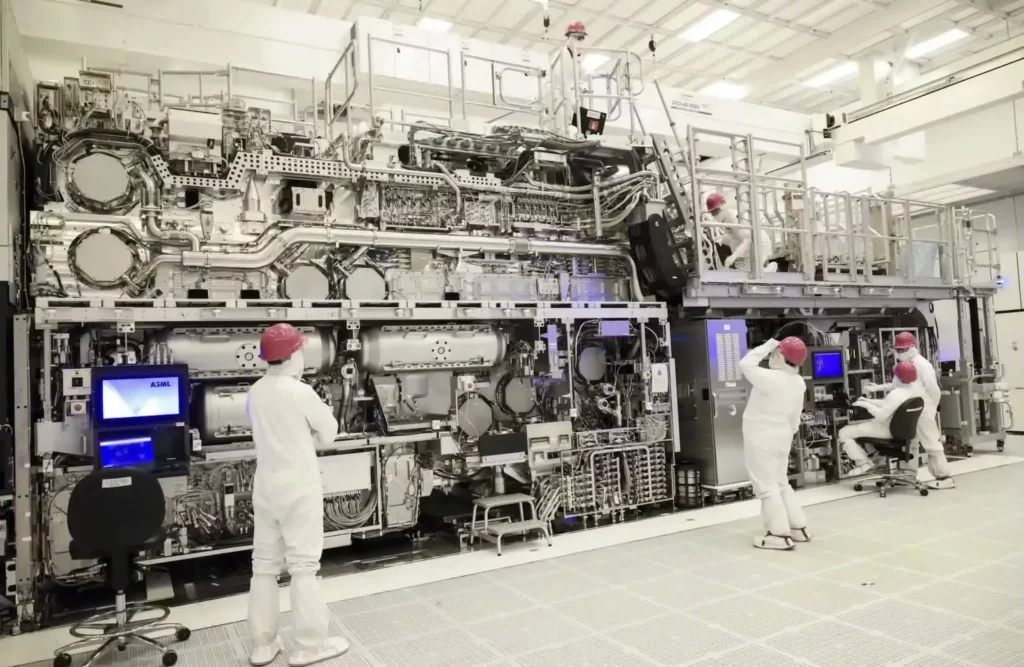
The problem is not with the company's operations, but with the ASML share price. The picture is clear:
- 📈 Trailing P/E: ~52: in the upper third of the decade-long historical range.
- 🔮 Forward P/E: ~29.5: adjusted for future growth, it is lower, but still a premium.
- 💰 FCF yield: 1.81%: This is the lowest value of the presented decade (in 2018 it was 4.38%), meaning the stock is trading at a very high valuation compared to its own historical averages.
💡In short: ASML is commercially flawless, but its pricing assumes that the AI investment cycle will continue unabated for years to come. The question is not whether it is a good company, but whether most of the good news is already priced in. I think basically yes.
📌In practice: As with most hyped AI names, the catch here is that quality and stock pricing are two separate issues. ASML is one of the best companies I’ve ever analyzed, but you can buy a great company for a lot. I always look at the historical valuation range: NOPAT/EV is now 1.87%, while it has been as high as 4.65% over the decade. So the stock is priced with essentially zero margin of safety at the current price of ~1430 EUR.
What you should not forget, however, is that high-quality companies tend to outperform expectations, for example, Morningstar sets a fair value of EUR 1800. Even so, the price was still below EUR 600 a year ago, and such a brutal appreciation usually suggests that there is still plenty of room to go down.

Why ASML Matters in the AI Chip Supply Chain
Modern AI, ChatGPT, Claude, Nvidia's data center chips, physically run on semiconductors that can only be manufactured in the world's most advanced factories, largely owned by TSMC. And these factories can't be built without one thing: without ASML's lithography machines.
Lithography is the process by which the chip's circuits are "printed" onto a silicon wafer. The smaller and denser the circuit, the higher the performance, and for the smallest stripe widths, traditional manufacturing technology is no longer sufficient. As the stripe width has continuously decreased, EUV (extreme ultraviolet) lithography has steadily gained ground, which is an incredibly complex technology for which only one company on Earth manufactures machines in series: ASML.
- 🔬 All advanced AI chips (Nvidia, AMD, Apple, HBM memories) are made with EUV.
- 🏭 TSMC, Samsung and Intel, the world's leading chip manufacturers, all purchase ASML machines.
- 💰 The price of a single High-NA EUV machine is in the range of hundreds of millions of EUR, and an advanced factory requires dozens of them.
💡In other words, ASML does not manufacture the chips, but the only machine without which chips cannot be manufactured. This is the "pick and shovel" position: during the gold rush, it is not the gold digger, but the tool seller who is most likely to earn the most.
📌In practice: When my father was a child, in the 1950s and 60s, he could put together a radio from a few circuit elements, which he could actually hold in his hands. In the 70s, when he worked as a computer development engineer, they soldered various diodes, transistors and capacitors onto printed circuits, and back then these were circuits of a size that could still be seen with the naked eye.
When I was in college in the late 90s, when Intel's Pentium III series was released, it contained 28 million transistors, while today an Nvidia Blackwell (GB300) has 208 billion! This incredibly fast scaling and miniaturization can only be achieved with ASML's EUV machines, no wonder ASML's share price is skyrocketing: there is simply nothing to replace the technology.

ASML’s EUV Moat Explained Without the Jargon
ASML's competitive advantage, or "moat," is one of the deepest and most protected positions in the world. But why can't anyone copy it? It's not because of one reason, but because it consists of several layers that build on each other:
- 🧩 Amazing complexity: An EUV machine consists of hundreds of thousands of parts that are fitted together with extreme precision. This cannot be reproduced without decades of development.
- 🌐 Supplier ecosystem: ASML does not build its machines alone, the German company Zeiss provides the optics, and thousands of suppliers provide the other components. This network cannot be built from scratch.
- ⏳ Decade advantage: ASML spent over 20 years and tens of billions of euros on development before EUV technology started working. A competitor would have to invest the same amount from scratch (although China's SMIC is trying very hard to do this).
- 🔧 Service income: The revenue of the “Service and Field Option” is EUR 9.3 billion, meaning that more than a quarter of the total revenue comes from servicing the installed machinery fleet, continuously, with high margins, on a recurring basis.
💡The bottom line: ASML is not simply the market leader, but practically the only player in EUV. This type of monopoly is one of the most popular competitive advantages among investors because it provides pricing power and predictable profitability.
📌In practice: The depth of the economic moat is best illustrated by one number: ASML's market share in EUV is essentially 100%. There is no second player, this market is completely monopolistic. In the entire decade, a total of 44-48 EUV machines were sold per year, this is a low-volume, extremely high-priced, monopoly product. There is some competition for more traditional (DUV) machines (Canon, Nikon), but for the most advanced stripe widths, ASML dominates.
AI Semiconductor Value Chain: ASML, TSMC, Nvidia and AMD
For an AI chip to make it into your data center, a whole chain has to work together:
- 🛠️ ASML (the toolmaker): They manufacture the EUV machine, without which nothing works. They sell it to the factories.
- 🏭 TSMC (the manufacturer): They buy ASML machines and manufacture chips for designers. They are the world's leading contract manufacturers, so much so that they can best saturate the wafers needed for chip manufacturing and can manufacture them with the smallest strip widths.
- 🎨 Nvidia and AMD (the designers): They design the chips (GPUs), but they don't manufacture them, they outsource that to TSMC.
- 📦 End users: the hyperscalers (Amazon, Google, Microsoft) who buy Nvidia chips for their data centers.
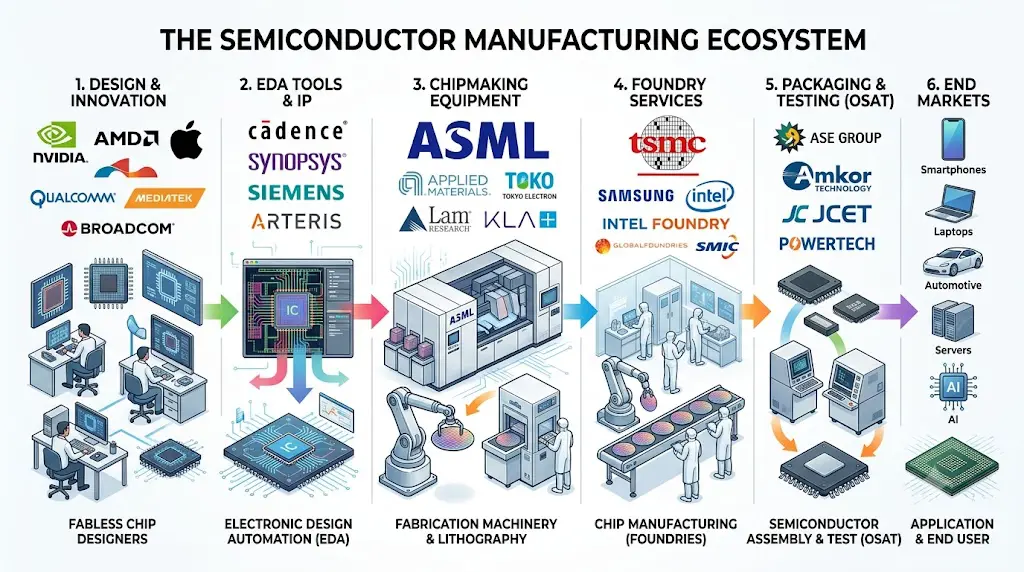
The higher we go in this chain, the more protected the position is. Nvidia has strong competitors (AMD, its own hyperscaler chips). TSMC is dominant, but capital-intensive and competes with Samsung and Intel. ASML, on the other hand, sits at the beginning of the chain, in a monopoly position. I would add that the ASML-TSMC tandem is more of a symbiosis than a competition, neither can function without the other: one provides the machines, the other the production technology and knowledge.
💡This means that the entire AI boom, regardless of which chip designer ultimately wins, will go through ASML's machines. This makes it the most protected player in the entire chain.
📌In practice: In fact, there is another group in the value chain: companies that create software needed for chip manufacturing, such as Synopsys or Cadence. However, with the advancement of artificial intelligence, they are becoming increasingly easy to replace, and since they are not involved in physical production, they are much less protected than the actors in the aforementioned segments.
ASML Valuation: What Is Already Priced In?
Come on, cold shower. ASML stock has roughly doubled in a year (+150.9% on the 5-year chart, 20.2% CAGR per year). This means the following:
- 💵 Share price: ~1585 USD (ADR), 1430 EUR in euros.
- 📈 Trailing P/E: ~50.5.
- 🔮 Forward P/E: ~28.6 (NTM), meaning the market expects rapid earnings growth, which pulls the forward multiple down.
- 🎯 FCF yield: 1.81%, the lowest in the decade shown.
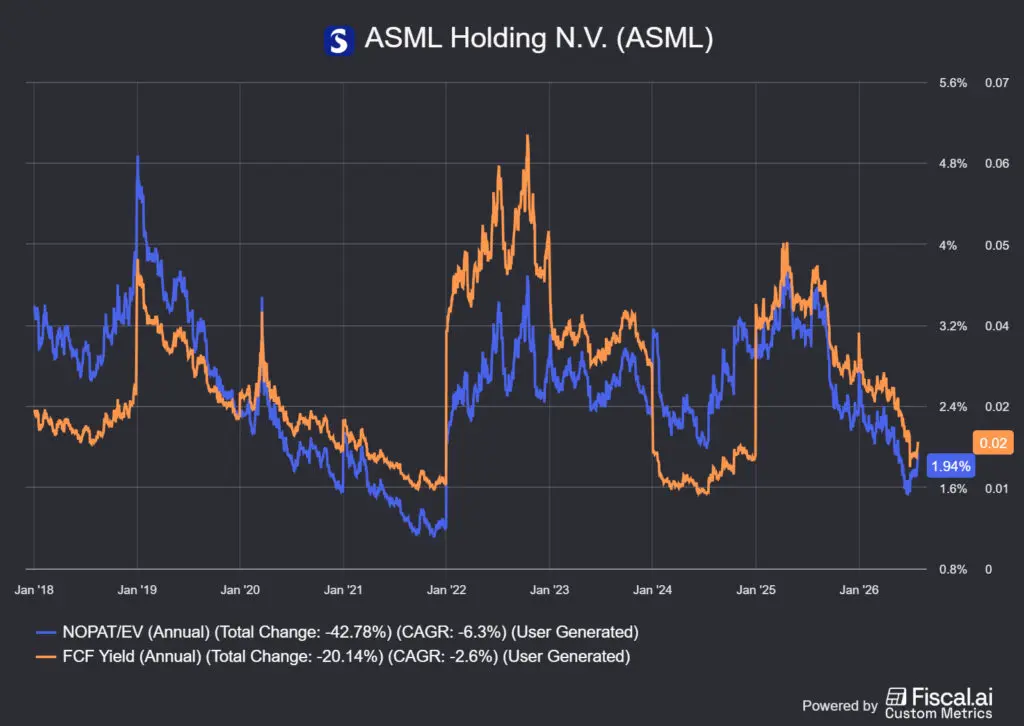
The most important question is not whether ASML stock is expensive in absolute terms, but what one must believe in order for today's price to turn out to be cheap in retrospect. Roughly speaking, these should be true:
- 🚀 Successful mass adoption of High-NA EUV: 2 of the “EXE” (High-NA) units were sold in 2024 and 4 in 2025. This is still minimal today, according to the bullish thesis, this should increase.
- 📊 The AI investment cycle lasts for years: hyperscalers will not slow down chip purchases (but almost everyone will design in-house).
- 🌏 China risk stabilizes: export restrictions are not tightening any further and SMIC is not coming up with similar technology.
🤔That is, today's pricing assumes that the AI-capex cycle continues smoothly, High-NA matures on time, and the situation in China does not deteriorate further. None of these are unrealistic, but all three are simultaneously the "everything goes smoothly" scenario, and this is exactly what is currently priced into ASML's stock.
Bear/Base/Bull Valuation Framework
Let's consider three scenarios for ASML. The numbers are rough estimates, the point is the logic:
| Screenplay | Assumption | What happens to the price? |
|---|---|---|
| 🐻 Bear | AI capex slows, Chinese restrictions tighten, High-NA slips. Cyclicality hits back. | The P/E of 50.5 is being compressed; the price could suffer a substantial drop of up to 30-40%. |
| 😐 Basic | Growth continues, but slows from the current extreme pace; the situation in China is stabilizing. | The price moves roughly in line with profit growth, the multiplier is slowly normalizing. |
| 🐂 Bull | High-NA is spreading faster than expected, the AI boom is enduring, and revenue is set to reach EUR 50+ billion by 2028. | The stock is going to new highs, the highest analyst targets are being met. |
📌In practice: For my part, I don't focus on the bull scenario for such companies, but on how much I can fall in the bear. A P/E of 50.5 and a FCF yield of 1.81% means that a disappointing quarter or a tightening in China can really hurt, because there is hardly any safety margin. Let's say that ASML's share price returns to the EUR 600 level it was at a little over a year ago, then that would correspond to a -60% drop.
ASML vs Nvidia: Better AI Stock or Different Risk Profile?
| Point of view | ASML | Nvidia |
|---|---|---|
| Position in the chain | 🛠️ Toolmaker (machine) | 🎨 Chip designer (GPU) |
| Race | Virtually none (EUV monopoly) | Yes (AMD, own hyperscaler chips) |
| Main risk | Cyclicality, China | Competition, commoditization, concentration |
| Nature of income | Machine sales + recurring service | Chip sales, rapidly changing cycles |
| "Who wins?" question | Whoever wins, they all get an ASML machine. | Nvidia must defend its leadership position |
The essential difference: ASML wins even if it doesn't know which chip designer is winning, because everyone has their chips manufactured on their machines, especially TSMC. Nvidia, on the other hand, currently leads the competition with the CUDA ecosystem, but it needs to defend it. As more and more hyperscaler companies plan to bring design in-house – Google, Amazon, Apple, Microsoft, etc. – it is not at all certain that Nvidia's devices will continue to be sold in this way in the future. Therefore, ASML is a “safer” bet on the AI theme, but in return it is also more cyclical and growing more slowly than in Nvidia's peak years.
💡The question is not which is "better", but what you want to achieve with your investment: ASML is the more protected, monopoly-like AI exposure, Nvidia is the higher growth with more competition and concentration risk.
ASML vs TSMC: Equipment Monopoly vs Manufacturing Scale
TSMC is ASML's largest customer, and the two companies live in symbiosis, but as investments they are significantly different. I have converted the numbers to USD for easier understanding:
| Indicator | ASML | TSMC | Which is better/cheaper? |
|---|---|---|---|
| Trailing P/E | ~ 52 | ~ 30 | 🟢 TSMC (much cheaper) |
| Forward P/E | ~ 29.5 | ~ 19 | 🟢 TSMC |
| EV / EBITDA | ~ 40.6 | ~ 20.1 | 🟢 TSMC |
| FCF yield | 1.81 % | 1.72 % | 🟠 roughly equal |
| ROIC | 37.8 % | 42.0 % | 🟢 TSMC (higher!) |
| Gross margin | 52.7 % | 64.2 % | 🟢 TSMC |
| Capex / revenue | Up to 5% | ~ 33-34% | 🟢 ASML (much easier to capitalize) |
| China ratio | ~ 30-36% | ~ 9-11% | 🟢 TSMC (less China exposure) |
| Main geopolitical risk | China export | Taiwan concentration | 🔴TSMC greater political risk |
The board holds several surprises. One: TSMC is roughly half as expensive as ASML on all valuation metrics, except for FCF yield. ASML's monopoly premium can be quantified. The other: TSMC's ROIC (42%) and gross margin (64%) even surpass ASML's excellent numbers, despite being much more capital intensive. The essence of the difference is in the capex line: ASML manufactures machines (capital-light, 5% capex), TSMC builds physical factories (capital-heavy, 33-34% capex).
📌In practice: This board is thought-provoking in itself. If someone wants pure AI capex exposure, TSMC today offers numerically cheaper exposure to the sector than ASML, and it is no coincidence that I have had exposure to it for years. However, I would also like to have ASML in my portfolio, because I consider both companies to have a self-reinforcing moat, where continuous research and development increasingly strengthens the competitive advantage.
However, what happens if they find another equally effective solution instead of EUV technology? TSMC will still manufacture the chips, but it is not certain that it will be with ASML machines. Of course, this also requires that China not rush Taiwan, but then there will be huge problems for the whole world.
Key Risks: China Restrictions, Cyclicality, High-NA EUV and Valuation
- 🌏 Chinese restrictions: China revenue peaked at EUR 10.2 billion in 2024 (~36% of revenue!), and dropped to EUR 9.5 billion in 2025. EUV machine exports to China are practically prohibited and DUV machines are also limited. The 2024 “forward-buying” boosted the numbers, but its decline mechanically slows down growth.
- 🔄 Cyclicality: Net System Sales actually declined in 2024 (-0.77%) before rebounding in 2025. A single year of decline in a row also reminds investors that this is a cyclical industry, with the AI boom now pulling it up, but machine sales are fluctuating.
- 🔬 High-NA EUV implementation risk: The next-generation machine could be the engine of growth, but it is maturing slowly. In 2025, only 4 High-NA (EXE) units were sold. In July 2026, the company reached an important milestone with Intel, which was among the first to buy the new generation, but TSMC is more cautious in introducing ASML's latest machines. If the introduction of High-NA machines is delayed, the bullish thesis will weaken.
- 📊 Rating: the most important short-term risk. With a trailing P/E of 52 and a decade-low FCF yield, there is little room for improvement; a disappointment or a sector rotation could quickly correct.
📌In practice: The most underestimated risk, in my opinion, is cyclicality. In the AI euphoria, everyone forgets that the semiconductor equipment segment is a volatile industry, and even 2024 was a year of decline. The competition is not completely dead either: Canon, Nikon, and Chinese state projects are also working on various technological achievements, and although they do not have a chance in the EUV segment today, a breakthrough in 2028-30 could theoretically erode ASML's monopoly position, especially in China.
Portfolio Impact: Does ASML Add Diversification?
- 🔗 Hidden concentration: If you already own Nvidia, TSMC, or AI data center names, adding ASML will not dilute but rather thicken your AI capex exposure. They are all betting on the same investment cycle. An AI capex slowdown would hit them all at once.
- 🛡️ But the chain position is different: ASML sits at the top of the chain, in a monopoly position, which gives it a somewhat different risk profile than chip designers. It doesn't protect it from a sector downturn, but it is one of the most protected players within the chain.
💡The bottom line: ASML is a great quality AI exposure, but it's not diversification if you already own chip stocks. It's more of a top quality concentration in the same topic.
📌In Practice: Checking Semiconductor Exposure With iO Charts
ASML and the entire semiconductor chain can be directly analyzed and compared on iO Charts:
- 🔎 ASML, TSMC, Nvidia, AMD side by side: Put the companies' growth, margins, ROIC and valuation side by side, as in the ASML-TSMC table above, it was immediately clear that TSMC is cheaper.
- 📊 Historical valuation: The most important thing is to measure ASML against its own history, NOPAT/EV is now 1.87%, at the bottom of the range (lowest in the last 5 years, meaning expensive).
- 🧮 Watch out for duplication: If you already have AI data center exposure, see how well these names move together (what is the correlation).
- 📋 Watchlist: pick ASML and wait for a better entrant, a cyclical downturn could offer the same excellent company at a much better price.
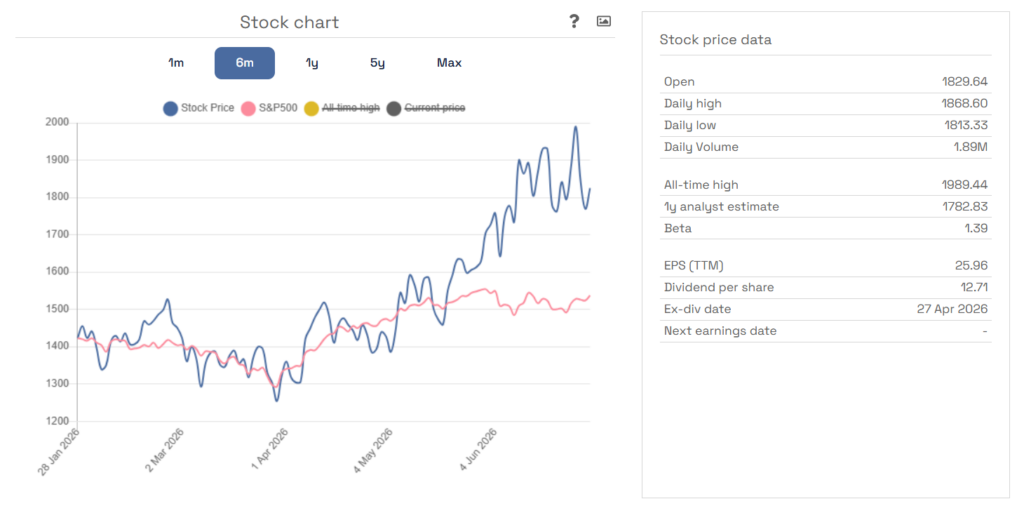
☝️So "ASML exposure" in practice means an objective, data-based analysis of the entire semiconductor chain, not based on hype, but on fundamentals.
Final Verdict
Is ASML a good investment after the AI rush? The company is undoubtedly one of the best quality companies in the world: EUV monopoly, deep moat, 37.8% ROIC, capital-light model, the entire AI boom is passing through its machines. But the stock has roughly doubled in a year, and today's trailing P/E of ~50.5, a decade-low FCF yield of 1.81%, assumes everything falls into place: if High-NA technology matures on time, if AI investments continue, and if the situation in China doesn't deteriorate further.
💡Quality is not an issue, price is. ASML is the kind of company I would like to own, but not at the peak of AI hype, but in a cyclical downturn when excellent business is finally being sold at a decent price. And if anyone wants the same topic cheaper: TSMC costs about half as much today.
With my own value-based, long-term view, ASML is a perfect watchlist stock: The question is not whether it is a good company (it is), but whether today's price gives enough margin of safety (not really). For a patient investor, the cyclical nature of the semiconductor industry will sooner or later offer a better entry point, but until then, objective analysis, with a cool head, based on fundamentals remains.
🪐And if you want to analyze further, use the iO Charts stock and portfolio manager, which you can access here: iO Charts.
Frequently Asked Questions about ASML stock
Answers to the most common questions
Should you buy ASML stock or just want to get a clear picture of the situation? Here you'll find concise answers to the most frequently asked questions: is it a good investment now, why is it a key player in AI chip manufacturing, does it really have a monopoly, is it overvalued after the AI rally, and how does it compare to Nvidia and TSMC.
Click on any question and the answer will open. These are intentionally short summaries: if you are interested in the details, I will expand on them in more detail in the appropriate sections of the article. Important: the situation of ASML and the semiconductor market is changing rapidly, the data reflects the time of writing of the article.
Is ASML stock a good investment now?
ASML is a high-quality company with an EUV monopoly (37.8% ROIC, 52.7% gross margin), but in mid-2026 the stock is trading at historic highs after the AI rally, with a trailing P/E of ~50.5, and its FCF yield is the lowest in the decade presented. Quality is not an issue, but the pricing leaves little margin for safety - for a patient investor, a cyclical downturn may offer a better entry.
Why is ASML important for AI chips?
All advanced AI chips (Nvidia, AMD, HBM memories) are made with EUV lithography, and there is only one company in the world that produces EUV machines in series: ASML. TSMC, Samsung, and Intel all buy from it, so the entire AI boom physically passes through ASML's machines.
Does ASML really have a monopoly?
In EUV lithography, it is essentially yes: ASML has a market share of practically 100% here, and the entire industry only buys 44-48 EUV machines from it annually. There is some competition for more traditional (DUV) machines (Canon, Nikon), but there is no alternative for the most advanced stripe widths needed for AI. The monopoly is protected by decades of development and a unique supplier ecosystem.
Is ASML stock overvalued after the AI rally?
The stock has roughly doubled in a year and is trading at a trailing P/E of ~52, while its FCF yield (1.81%) is the lowest in the reported decade – meaning it is at the most expensive end of its history. It is not necessarily a “bubble”, but today’s price is pricing in near-perfect execution with little margin of safety.
Is ASML better than Nvidia?
The risk profile is different. ASML is more protected (EUV monopoly, no matter who wins the chip race, everyone buys machines from it), but it is more cyclical and grows more slowly. Nvidia offers higher growth, but with real competition (AMD, hyperscaler chips) and concentration risk. ASML is the “safer”, Nvidia is the “bigger bet”.
Is ASML better than TSMC?
In terms of pricing, TSMC is clearly cheaper today: trailing P/E ~30 vs. ASML ~52, EV/EBITDA ~20 vs. ~41, and TSMC's ROIC (42%) and gross margin (64%) are even higher. In return, TSMC is five times more capital intensive (building factories) and burdened with Taiwanese geopolitical risk, while ASML is a capital-light monopoly with Chinese export risk. Both are winners of the AI boom, but ASML now has to pay twice as much for the monopoly premium.
What are the biggest risks for ASML stock?
Four main risks: Chinese export restrictions (~36% of revenue in 2024 came from there), the cyclicality of the semiconductor industry (system sales even fell for a year in 2024), the slow introduction of High-NA EUV (only 4 units in 2025), and high valuation, which makes the exchange rate sensitive to a disappointment.
How much ASML should I hold in a diversified portfolio?
This is a matter of individual risk tolerance, not investment advice. It is important to note that if you already have AI data center exposure (Nvidia, TSMC), ASML does not diversify, but rather condenses the same theme - an AI capex slowdown would hit them all at once. It is worth considering the hidden concentration when sizing your position.
Legal and liability statement (aka. disclaimer): My articles contain personal opinions, I write them solely for my own entertainment and that of my readers. The articles published here do NOT in any way exhaust the topic of investment advice. What is written here is for informational purposes only and should NOT be construed as an offer. You are SOLELY responsible for the decisions you make.