

Introducing the Lightyear broker
Lightyear is an Estonian fintech startup founded in 2020 by Martin Sokk and Mihkel Aamer, both are former Wise employees. The company's founders wanted to solve exactly the problem they themselves experienced: For European retail investors, purchasing securities was expensive, opaque, and cumbersome. Lightyear has a strong list of investors behind it, including Richard Branson (Virgin Group), Taavet Hinrikus (co-founder of Wise) and Jaan Tallinn (co-founder of Skype). It is heartwarming for Hungarians that since July 2025, Péter Balogh's startup company STRT Holding Nyrt. has also become one of the owners. STRT shares are also available on Lightyear. So anyone who wants to gain exposure to Lightyear can do so by owning STRT Holding Nyrt.
It is currently available in 25 European countries, in Hungary since April 2023, with a Hungarian-language interface and application, and in November 2025, at the Lightyear event in Hungary, where I attended, they announced that it is also possible to trade the securities of the Budapest Stock Exchange, and they have also had a Long-Term Investment Account (TBSZ) for some time, which provides significant tax benefits. The number of clients exceeds 300 thousand, and the assets they manage are around ~1 billion USD. In my previous Interactive Brokers analysis, I wrote that based on assets under management, Lightyear is a small, but emerging and rapidly growing player, which plays the role of a discount broker.
TL;DR Summary – the most important information in 3 minutes Don't want to read the entire analysis? Click here for a short summary.
- What is this company?Lightyear is an Estonian fintech startup founded in 2020 by two former Wise employees. It is available in 25 European countries, with a Hungarian-language interface in Hungary since April 2023. It has assets under management of ~1 billion USD, and its investors include Richard Branson, Taavet Hinrikus and, from 2025, Balogh Petya's STRT Holding.
- What is it for?Primarily for passive, long-term investors: for ETF purchases (completely free), TBSZ account management (also free), purchasing individual shares and parking cash in money market funds through interest-bearing safes. With the Investment Mixes function, automated, regular investments can also be set up.
- AwardsETF trading is free. US stocks: 0.1% (max. 1 USD/transaction), EU stocks: 1 EUR/transaction, UK stocks: 1 GBP/transaction. Currency exchange: 0.35%. No account management fee, no inactivity fee, opening and maintaining a TBSZ is free.
- SecurityIt is licensed by EFSA (Estonian Financial Supervisory Authority) within the EU framework. Insurance is valid for European assets of EUR 20,000 and for American securities of USD 500,000. Client funds are kept segregated at partner banks (LHV Bank, CFSB, Wise).
- RisksStartup company, no banking background, no stock market listing, future fee policy may change. Estonia's geopolitical exposure (Russian border, ~25% Russian-speaking minority) is a negligible but real risk.
- Who is it recommended for?Ideal as a first brokerage account or as an additional broker for ETF-based passive investing, buying stocks, and managing TBSZ. For a more serious portfolio, exotic markets, options, or fundamental analysis tools, Interactive Brokers is a much better option.
📒Table of Contents📒
I have created a table of contents to make it easier for you to navigate the longer articles:
- 💰Lightyear costs
- (I.e.Lightyear's surfaces
- 💵Financial instruments available at Lightyear
- 🤵What strategy is Lightyear best for?
- 🆚Competitors: Lightyear's opponents
- ✅Lightyear's advantages
- ❌Disadvantages of Lightyear
- 📝Summary of Lightyear
🙋♂️Basic information about the Lightyear broker🙋♂️
In this section, I examine what specialties the analyzed financial service provider or broker has, what is its position in the market, how it views itself, whether it is an institution with a traditional banking background, a discount broker, an online broker, or a mixture of these. How well does it protect its investors, and what can you expect in the event of a potential collapse?
Before opening my Lightyear account, I did a lot of research on the company to see how reliable it was, and I also went to their November 2025 event to hear what CEO Martin Sokk had to say. Finally, in early 2026, I opened a main account and a TBSZ account, which provides essentially tax-free returns for Hungarian tax residents. This is my third provider, after my Erste Invest and Interactive Brokers accounts, you can read more about the latter here: Interactive Brokers (IBKR) Account: Fees and Features
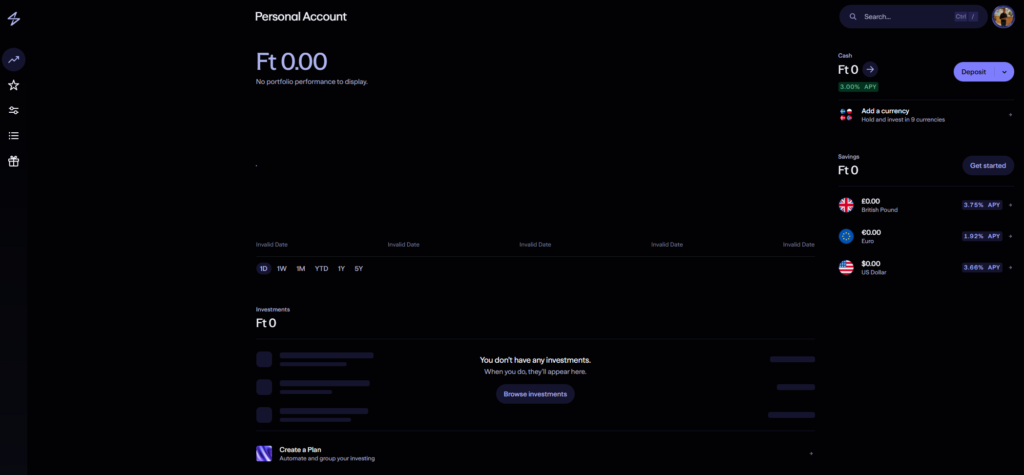
🤔 Lightyear is the first broker I've used more on my mobile phone than through a browser. The interface's simplicity, in a good sense, is immediately striking, making it a refreshing change from Interactive Brokers, even though it lacks many features. Below, I'll try to cover everything important, with special attention to what may not be obvious at first, but could still be crucial for an investor.🤔
Lightyear is an online-only fintech broker, registered in Estonia but regulated at the European level, with the CEO saying most of its money is in London. It has no banking background, no decades of history, and is not listed on a stock exchange, all of which reduce its credibility compared to a more serious institution. In return, it is extremely cheap, modern and easy to use, with a clean interface, making Lightyear ideal for beginners or additional broker providers.
In the ranking of online discount brokers based on assets under management (2025–2026), Lightyear is at the bottom, the list I adapted from my analysis of Interactive Brokers:
- 💼 Interactive Brokers: ~757 billion USD, 3,8 million customer accounts
- 📈 Robinhood: ~255 billion USD, 25,8 million customer accounts
- 💰 Trading 212: ~30–35 billion USD, 4,5 million customer accounts
- 🌍 eToro: ~17,5 billion USD, 3,6 million customer accounts
- 💳 Revolut: ~8,5 billion USD
- 📊 XTB: ~7 billion USD, 1,54 million customer accounts
- 🚀 Lightyear: ~1 billion USD
So Lightyear is at the bottom of the spectrum, which is not surprising for a startup founded in 2020. The question is whether this will change, and if so, how it will affect the quality and price of the service.
🛡️ Investor protection and regulation
Lightyear is licensed by the EFSA (Estonian Financial Supervision Authority), a trusted EU-level supervisory body. In practice, this means that:
- 🇪🇺 The Estonian Investor Protection Fund provides protection for European assets (shares, ETFs) up to EUR 20,000. in the event of the broker's insolvency. This typically applies to cash, as the rest is officially in your name.
- 🇺🇸 US securities are SIPC protected up to $500,000 through a partner called Alpaca.
- Lightyear manages uninvested funds separately from its own assets and holds them in reliable European banks and qualified money market funds (e.g. ABN AMRO, BlackRock).
- The purchased shares and ETFs are registered in the client's name, and in the event of the company's bankruptcy, they can theoretically be transferred to another provider (unlike Interactive Brokers, where client assets are shown under pooled accounts, which is why it is worth saving a statement of this every month).
❗Important: investor protection schemes only provide protection in the event of bad faith or insolvency of the broker. Any exchange rate losses you suffer are not covered by any insurance, so you are solely responsible.❗
How can you find out where Lightyear's money is if they are not considered a bank? By looking at which financial institution the funds are transferred to when the money is transferred, that will be the account-keeping financial institution. I tried this so that you don't have to - but you can also check it if you request the deposit details -, the result was the following:
- 💶EUR: AS LVH Pank, Tartu mnt 2, Tallinn, Harjumaa, 10145 EE) – Estonia
- 🇭🇺HUF: Lightyear Europe AS, Client Account (Volta 1, 10412 Tallinn, Estonia) – Estonia
- 💵USD: Lightyear Europe AS, Client Account (Volta 1, 10412 Tallinn, Estonia), Community Federal Savings Bank (CFSB) – USA, FDIC-insured bank
- (I.e.GBP: Lightyear Europe AS, Client Account (Volta 1, 10412 Tallinn, Estonia), Wise Payment Limited – UK, FCA licensed financial institution
So it really isn't Lightyear and it really does manage its clients' money separately. It can't do otherwise, because if Lightyear files for bankruptcy, its creditors can't touch these funds, because they are legally considered client assets. Interestingly, I couldn't deposit money in Swiss francs, although the option is there, the interface prohibits it for now.
Compared to Interactive Brokers, the protection limit is lower (20,000 EUR vs. the Irish ICC is also 20,000 EUR, but behind IB, the S&P 500 listing and 10 billion USD of equity provide the real security). In the case of Lightyear, the startup nature and lower institutional background are real risk factors that should not be ignored.
📌 In practice: Diversify. It is worth keeping some of your assets with Lightyear, but when it comes to larger amounts, consider it as a supplement, not as the only broker, which is exactly what I do. Interactive Brokers, where the institutional background is much stronger, is better suited to hold the backbone of your assets, but as a secondary broker, Lightyear is a perfect choice, so everyone should open an account here as well, you will see why below.

💰Lightyear Broker Fees💰
In this section, we examine the cost of financial service provider or using the services of a broker, and what types of operations will burden your wallet. Who should open an account: short-term or long-term investors?
Lightyear's fee structure is one of the cleanest on the market, and it's also extremely cheap, which was one of the biggest draws for me when opening an account. The main rule is simple: Buying ETFs is completely free (but of course van maintenance fee), there is a minimum fixed purchase/sale fee for shares, and 0,35% is charged for currency exchange.
✅ What Lightyear doesn't charge for:
- ✅ Buying and selling ETFs: free of charge
- ✅ Opening and maintaining an account: free of charge
- ✅ Transfer money via bank transfer: free of charge
- ✅ Transfer money to a bank account: free of charge
- ✅ Open and manage multiple foreign currency accounts: free of charge (HUF, EUR, USD, GBP)
- ✅ Securities deposit: free of charge
- ✅ Opening and maintaining a TBSZ account (for Hungarian tax residents): free of charge
- ✅ No inactivity fees
- ✅ No stock fees
📌In practice: In my experience, the two biggest deductions are the holding fee and the TBSZ account fee. The first is used by domestic banks with great pleasure, I know an investor who pays nearly 800 USD a year in holding fees at one of his banks and he has a few. The problem with the TBSZ account management fee is that it is charged per account, so if you have 5 of them, it counts as a five-fold fee. Lightyear is completely free of these, which is one of their biggest advantages.
💸 What Lightyear charges for:
| Operation | Award |
|---|---|
| US stocks (e.g. Apple, Tesla) | 0.1% max.; 1 USD/share transaction |
| EU stock (e.g. SAP, L'Oréal) | 1 EUR/share transaction |
| UK stocks (e.g. BP, Shell) | 1 GBP/share transaction |
| Currency exchange | 0.35% (at real mid-rate) |
| Bank card payment | 0.6% (first 500 EUR free) |
| Safe (money market fund) management fee | 0.09–0.30% per annum |
| Monthly interest payment deduction | 0.75 % |
Hungarian customers can check the current fee structure by scrolling down the page at the link below: fee structure.
💰 From the ETF investor's perspective, Lightyear is almost completely free. If you only buy ETFs, transfer funds from a bank account, and do not exchange currencies on the Lightyear platform, your annual cost will be close to zero, you only have to consider the ETF's maintenance fee, which is a negligible amount (0.1-0.2%).
🧠Pro tip: I don't think you should use card top-ups because of the 0.6% fee. Instead, if you have a service provider where transfers are free and there is a free currency exchange limit, use that. Revolut is like that, you can exchange about 1000 USD per month for free with the standard package and it's cheaper to transfer the amounts to the Lightyear account from there. However, I also tried the transfer from Wise, and a huge advantage of this is that the money arrives on your main account in about 10 seconds. I wrote about the Wise card here: Wise: fees, account, card and Revolut comparison.
💵 Interest on uninvested money
One of the special features of Lightyear is that it pays interest even on the uninvested balance, which in March 2026 was as follows:
- 🇭🇺Forint (normal account): evi 3,00 %
- 🔐In safes (via money market funds, BlackRock):
- 💶EUR: ~1,92 % / year
- 💵USD: ~3,68 % / year
- 💷GBP: ~3,75 % / year
☝️Important note: No interest is accrued on uninvested money in a TBSZ account., because Hungarian legislation does not allow this. Behind the safes are low-risk money market funds from BlackRock, the world's largest fund manager, which can be hacked at any time.
📌 In practice: For EU stocks, the fixed fee of 1 EUR/share can be relatively high for smaller transactions. For example, if you buy 1 share for 15 EUR, the transaction fee will immediately jump to ~6,7%. That is why it is worth taking larger positions. However, if you compare it to Interactive Brokers, where the fee is 2 USD/EUR, then this cost is only half of that, while Erste Invest charges 7 USD/EUR for the same service! Which is almost blood-curdling. It is important to note that this fee is not per share, but per order!, so if you buy 200 shares of $10 each, which is $2000, you will still only pay $1, not $200.
🎢Lightyear broker interfaces🎢
In this section, I examined how the financial service provider or broker interface. Where and in what form can their applications be used, how complex are they, perhaps outdated or modern? Do they provide any special services compared to competitors that you have to pay extra for elsewhere?
I think one of the best parts of Lightyear is the interface. It's as simple as a nail, very clear, no spaceship exam like Interactive Brokers, very beginner-friendly. I think 95% of people will be able to use what they know, but for those with 5+ years of experience, it's a bit too much. Since I fall into the latter category, I wouldn't choose it as a main account, but it's a perfect choice for an additional account or for those who are just getting to know the whole subject.


Lightyear is available in two interfaces:
- 📱 Mobile application (iOS and Android)
- 🌐 Web browser (fully functional, can also handle TBSZ)
The two interfaces are essentially the same, which is why I used the mobile app a lot, because there is no significant difference between the two, and the pop-up messages work much better on the phone. What Lightyear provides is a true Generation Z, modern interface.
📱 Lightyear's mobile app
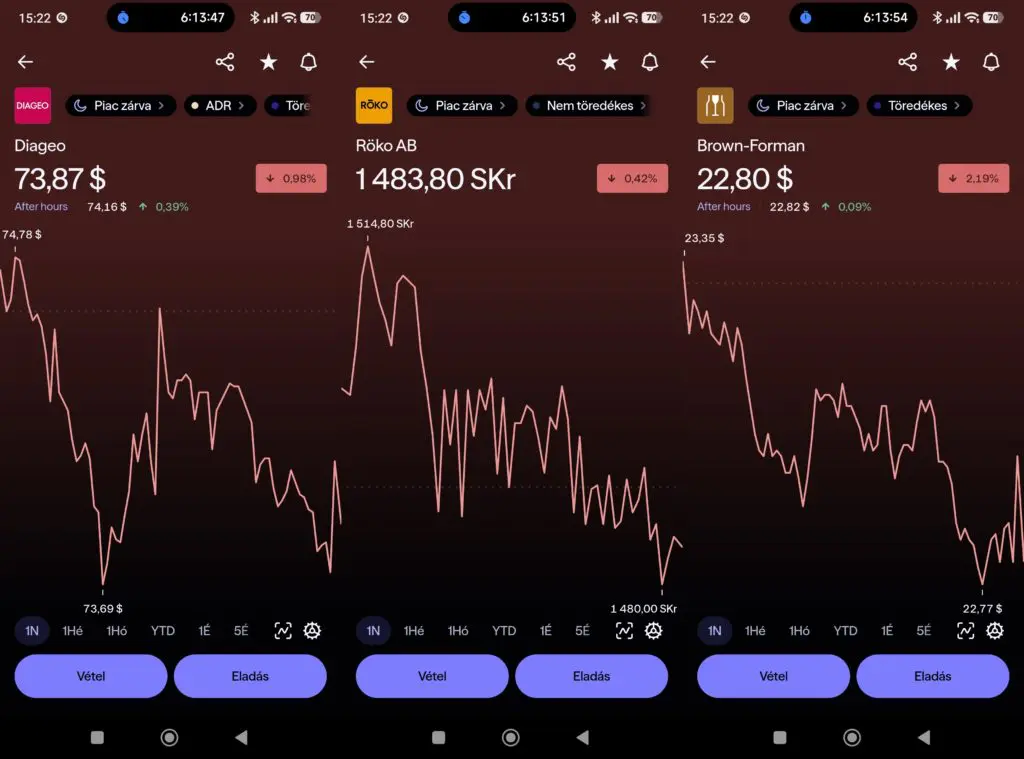
The app is a model of simplicity. Anyone who has ever used the Revolut or Wise apps will feel right at home. The search interface is intuitive, the ETF and stock pages are easy to navigate, and placing orders is a few clicks away. Compared to Interactive Brokers' app, Lightyear's app provides an experience that is at least three generations more modern.
What the app does well:
- 📊 Portfolio view is clear and easy to understand
- 🔀 Investment mixes (automated portfolio construction) are easy to manage (I've never used them)
- 🏦 Safe deposit boxes take a few seconds to open and close (I haven't used them, I wouldn't open a brokerage account for them)
- 🔔 Price alert can be set (on mobile)
- 🌙 Dark mode, hiding options
What the app does less well:
- 🔍 Research, fundamental data are almost zero: no Morningstar, no EVA, no institutional data sources
- 🎮 Demo account not available
- 🚫 No meaningful stock filter (e.g., you can't filter by P/E, ROIC, or sector)
🌐 Web interface
The browser interface is surprisingly comprehensive, with all mobile app functions available, including TBSZ management. However, registration is only possible through the mobile app, and it is a 5-minute process.
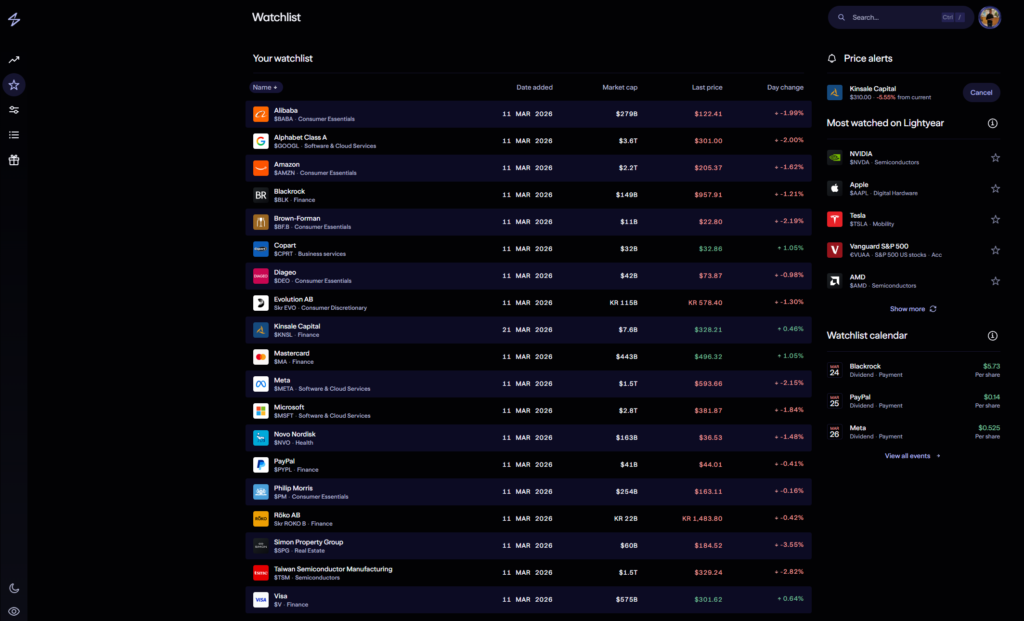
📌 In practice: The application is perfect for what its name suggests, quick and easy execution. For those who don't want to learn Interactive Brokers' TWS, who buy a stock or ETF once a month, and for whom simplicity is the primary consideration, this application is truly a salvation. However, those who want to do fundamental analysis will not do it here, but with an external tool, because Lightyear essentially does not provide data. And I would like to add a few thoughts here:
- 👛The price of cheapness is the lack of data. I know many investors who opened an Interactive Brokers account only because they have Morningstar, Tipranks, EVA and many other data for free, which would cost more to subscribe to than to open an account.
- 💫TBSZ account for Hungarian tax residents: I have never in my life encountered such a smooth account opening and TBSZ reporting process as with Lightyear, even though this is my 7th account opening. Everything is completely clear, you will receive an easy-to-follow description by email, which includes the contact details of the Hungarian authorities and what to do on their website. From the first click, it took me 10 minutes to report the account to NAV and I suspect the service is of the same standard in the UK and other markets. I think this is a big plus for beginners and those opening a Lightyear account.
💵Financial instruments available on Lightyear broker💵
In this section, I examine what instruments are available in financial service provider or on the broker's platform, in what form you can purchase them, and how wide their range is.
Lightyear's offering seems to be optimized primarily for beginners, so it mainly includes stocks and ETFs, but not riskier instruments. Unfortunately, they don't serve all major markets. What I missed were the Canadian and Australian markets, but interestingly, I found Danish, Swedish, and Hungarian in the product search. You can also use an ISIN code in their search, but their instrument filter is quite simple, although it's quick to navigate.
✅ What you can buy at Lightyear:
- 📈 Stocks: over 6500 stocks, mainly from the US, EU and UK markets. Hungarian stocks are also available (approx. 15 companies, e.g. OTP, MOL, Richter, Magyar Telekom), and the list is growing.
- 💹 ETFs: ~300 ETFs from the largest issuers (iShares, Vanguard, SPDR, Invesco, LGIM, VanEck, etc.). Buying ETFs is completely free of charge.
- 🏦 Money market funds (safes): BlackRock funds in EUR, USD and GBP currencies.
- 📃 Bonds: Limited supply, currently 27 bonds available.
- 🔀 Broken share: Yes for US stocks, no for EU stocks.
- 🔀 Broken ETF: Available since July 2025 (searchable with filters).
❌ What you can't buy on Lightyear:
- ❌ Cryptocurrencies
- ❌ Options and futures products
- ❌ CFDs
- ❌ Investment loan (no leverage)
- ❌ Wide range of corporate bonds
- ❌ Exotic markets and small exchanges (e.g. Polish, Swedish, Danish papers)
- ❌ IPOs
☝️ Lightyear is primarily designed for simple, passive investors: it's great for ETFs and the most popular stocks, but those who want more exotic markets, options, bonds or crypto will need a different broker.
The offering is a fraction of what Interactive Brokers offers, but for the average long-term investor who invests their money in index ETFs and stocks of the world's largest companies, it's more than enough.
📌In practice: I started testing Lightyear by searching their instrument search engine to see exactly what they had available and entering the names in my 26-item portfolio, of which I could have bought 20. In the case of Erste Invest, this would have been even less, while with Interactive Brokers, 26 out of 26 were available. What is the reason for this? The fact that the Canadian market (TSX:CSU, TSX:Topicus, TSX:Lumine, TSX:CMG), the Australian market (ASX:KPG) and the Chinese market (TCEHY) are not served, unless the ADR of the Chinese paper is also listed on the US stock exchanges, such as Alibaba (NYSE:BABA).
🤵What strategy is Lightyear broker best for?🤵
In this section, I examine which financial service provider or broker platforms are suitable for which strategies and which are not. Many service providers have specialties with which they want to attract a specific group of investors, and I will also cover these.
Lightyear is clearly the for passive, long-term investors Its pricing structure, tool offerings, and interface all suggest that the ideal user is someone who:
- 📅 You regularly buy ETFs every month,
- 🔀 you want automated portfolio construction (Investment mixes),
- 🧾 You are looking for a tax-efficient investment in a TBSZ account,
- 🙅 You don't want to learn very complicated interfaces (like IBKR's TWS).
What Lightyear is excellent for:
- ✅ ETF-based passive investment (zero trading fees),
- ✅ regular, automated investment (with Investment Mixes function),
- ✅ Tax-efficient investment in a TBSZ account,
- ✅ interest-bearing safes while maintaining liquidity (short-term cash parking),
- ✅ for novice investors looking for a simple interface.
What Lightyear is not really suitable for:
- ❌ active trading, technical analysis,
- ❌ options, futures trading,
- ❌ exotic markets, small-cap stocks (Canadian, Australian, Chinese),
- ❌ crypto investment,
- ❌ Stock selection based on fundamental analysis (assets are missing).
📌 In practice: If someone just wants to buy the S&P 500 or an MSCI World ETF every month and wants their money to earn interest in the process, Lightyear is probably one of the best solutions in Hungary, especially if you do it with a TBSZ account. However, if you want to access unique, small-cap stocks and global markets with professional tools, you can't really do without Interactive Brokers.
Because of the above, I used Lightyear to transfer my smaller positions, which could not affect the overall picture too much, but I did not want to sell them due to the good return potential or my postponed decisions, to my Lightyear TBSZ account with a technical sell-rebuy. This allowed me to test what the service provider was like and free up money elsewhere to further expand my more important positions. This is how the following ended up in the account:
- RÖKO AB (ROKO-B),
- Diageo (DEO) stock analysis: slowing demand and market,
- Brown-Forman (BF.B): cheap valuation, high risk,
but of course I will continue to channel smaller names to the Lightyear account in the future. From the above it is clear that I primarily view the provider as an additional account, I wrote more about this in the disadvantages section.
🆚Competitors: opponents of the broker Lightyear🆚
In this section, I examine who the competitors of the analyzed financial service provider or broker are, what their pricing is compared to them, and who they can and cannot be recommended to.
When evaluating Lightyear, it is important to understand that this broker does not fall into the same category as Interactive Brokers. Rather, its direct competitors are Revolut, Trading 212, and eToro. Let’s see the main points of comparison:
| Point of view | Lightyear | Interactive Brokers | Trading 212 | Revolut |
|---|---|---|---|---|
| Place of entry | Estonia | USA | Bulgaria | United Kingdom |
| Assets under management | ~1 billion USD | ~757 billion USD | ~30-35 billion USD | ~8,5 billion USD |
| ETF fee | Free | ~1 EUR/transaction | Free | There is a spread |
| Share price | 0,1% (US) | 0,005 USD/pc or 2 USD/trillion. | Free (CFDs!) | There is a spread |
| Currency exchange | 0,35 % | Interbank nearby | 0,15 % | Around 0,5% |
| TBSZ | Yes, free | 2000 HUF/month | nincs | nincs |
| Crypto | Gender | Limited | Gender | Yes |
| Investor protection | 20 000 EUR | EUR 20,000 (EU) | 20 000 EUR | 85 000 GBP |
| Interface simplicity | ⭐⭐⭐⭐⭐ | ⭐⭐ | ⭐⭐⭐⭐ | ⭐⭐⭐⭐⭐ |
Important difference compared to Trading 212: Trading 212 is a market maker broker, meaning they match buy and sell orders within their own system. This means a different risk profile than Lightyear's model, where real stock market orders are executed. I have never held a larger amount than a market maker broker and I never will, because I am a counter party to the investor, but I opened a Trading 212 account. Since they do not have a TBSZ service and they have focused their interface on CFDs, I will not deal with them anymore.
Important difference compared to Revolut: Revolut's investment function is limited in many ways. Its ETF offering is narrower, and they don't have a TBSZ account. However, Revolut, along with its banking functions (card, transfer), provides a complete financial ecosystem. You can buy crypto from them, they have a free currency exchange rate, and when I go on vacation, I typically transfer funds here. Since top-ups to Revolut are free, it's worth using them as an intermediary service.
Lightyear's main competitive advantages over rivals:
- 💸 free ETF trading with real stock market orders,
- 🧾 free TBSZ,
- 🏦 safe deposit box function with interest-bearing money market funds,
- ✨ clean, modern interface,
- 🇭🇺 Hungarian language.
📌 In practice: Lightyear and Interactive Brokers are not alternatives to each other, but rather complements. IB is for professionals, Lightyear is for entry-level or passive investors. Ideally, you will have or already have accounts with both: with Lightyear, regular ETF purchases and TBSZ are an advantage, while with Interactive Brokers, it is worth keeping a more serious portfolio, as well as individual stocks and exotic market instruments.
🇭🇺Section for Hungarian investors (and others)🇭🇺
🧮 TBSZ at Lightyear
🔢 Taxation
📊 FX exchange
✅Advantages of Lightyear Broker✅
In this section, I will examine the advantages of being a financial service provider or broker.
Reward benefits
- ✅ ETF trading is completely free, which is extremely attractive for passive investors,
- ✅ Free TBSZ, at IB it is 2000 HUF/month,
- ✅ No account management fees, no inactivity fees, no holding fees,
- ✅ Interest-bearing safes through BlackRock money market funds,
- ✅ Free bank transfers and withdrawals.
Technological and user benefits
- ✅ One of the best mobile apps in its category — simple, clean, modern
- ✅ Hungarian-language interface and customer service
- ✅ Investment mixes feature — great for automated, regular investing
- ✅ Fractional shares and fractional ETFs are also available
- ✅ Fully usable on the web interface
- ✅ Card top-up possible (first 500 EUR free of charge)
Safety considerations
- ✅ EFSA (Estonian) regulation, within the EU framework,
- ✅ 20,000 EUR investor protection (EU assets),
- ✅ $500,000 SIPC protection (US securities, via Alpaca),
- ✅ Client funds are managed separately.
📌 In practice: The best feature of Lightyear is its user experience and zero fees for ETF trading. If someone buys ETFs on a weekly or monthly basis and holds them on TBSZ, Lightyear is perhaps the best domestic alternative in its category.
❌Disadvantages of Lightyear Broker❌
In this section, I will examine the disadvantages of a financial service provider or broker.
The trivial disadvantages:
- ❌ Limited tool range: exotic markets, options, futures, crypto are all missing,
- ❌ Startup uncertainty: no banking background, no stock exchange listing, fees may change in the future for small investors,
- ❌ No institutional data provision (Morningstar, EVA, etc.), fundamental analysts will miss this,
- ❌ No demo account, beginners must enter without the opportunity to experiment,
- ❌ No telephone customer service, only email and message,
- ❌ There is no interest on TBSZ for uninvested money (but this is a legal feature, but the problem can be solved by purchasing government securities),
- ❌ The modern, easy-to-use interface is enticing, It will be easy to deviate from your investment strategy if you look at the numbers a lot and buy something impulsively.
The non-trivial disadvantages:
- 🤔TBSZ account closure: Lightyear's biggest structural risk is the lock-in of the securities. If you hold your portfolio in a TBSZ account and Lightyear starts to go up in price, you can't simply move your securities elsewhere, but you run this risk with all providers. However, Lightyear is currently running in "startup mode", so it is raising venture capital to grow, as it is not profitable. This also means that they will have to start raising prices at some point, and since the size of the managed assets is still small at the moment, the chance of fee increases is much higher in the long term than in the case of IB, which manages ~750x the amount of assets.
- ✈️Proximity to the Russian-Ukrainian war: Estonia borders Russia directly, and the Baltic states are the most exposed members of NATO's eastern flank. Since the outbreak of the Russo-Ukrainian war, this geopolitical risk has become tangible, previously treated by many as a theoretical threat. What is most likely is that a physical armed conflict will not break out, but Estonia has been exposed to Russian cyberattacks in the past. However, it is likely that if an actual conflict were to occur, Lightyear's cloud-based, geographically distributed infrastructure would provide some protection against it, but access to accounts could still be impossible, especially if Lightyear's management is also in the country.
📌 In practice: It is worth going to events like the 2025 Lightyear Summit in Budapest because the Hungarians specifically asked Martin Sokk this question. He said that client funds are held separately at partner institutions, so in theory, such a situation would not affect clients. However, if you go back to the section of my article where I listed the account management banks, you will see that the HUF and EUR-based accounts are in Estonia. This means that the exposure of these accounts would be the greatest in the event of an armed conflict, so you should definitely consider such institutional risks.
☝️The above exposure is greatly mitigated by the fact that the LVH bank systems, which handle EUR and HUF accounts, are mirrored in Luxembourg, while Lightyear, to the best of my knowledge, runs on Amazon AWS, also mirrored. The shares are not held by Estonian custodians, but by Alpaca in San Mateo, California, and Euroclear in Brussels, Belgium.
Added to this is the fact that the Baltic states' cyber preparedness is among the world's leading, and it's no coincidence. Russian hacker attacks are ongoing, which these countries are relatively effective at warding off, and I think that will reassure those who are worried about a potential conflict.
📝Lightyear Broker Summary📝
Summary of the analysis, drawing lessons.
Lightyear has been developing extremely rapidly since 2020 and has become a serious alternative in Hungary with the introduction of TBSZ from 2024. The simple, modern interface, free ETF trading and zero account management fees create an attractive combination, especially for those who are thinking about passive, regular investing.
- ✅What is Lightyear good for? Primarily for ETF-based passive investment, within the framework of TBSZ, with automated investment mixes. Thanks to the safes, uninvested money also earns interest, which is also a plus.
- ❌What is it not good for? It does not offer complex, active investment strategies, exotic markets, options, crypto, or more serious fundamental analysis tools.
🗝️The key question: Can you trust a startup to manage your long-term wealth? The regulatory framework is in place, the funds under management are secure, but the company's future fee policy and sustainability are uncertain, and there's a war raging in Estonia's neighbor. However, with diversification and common sense, you shouldn't have much trouble: Don't keep all your eggs in one basket, as the saying goes.
What makes everyone mandatory to open one, however, is the very cheap fee structure, and the fact that even the most professional need a secondary broker anyway. And you can't do this cheaper and easier than this, so I recommend everyone to open an account, since I voted for it with a part of my own wealth.
You can do this here: ACCOUNT OPENING.
🤑If you are interested in what other brokers we use, read our article below:
(I.e.Interactive Brokers broker account analysis – Professional for professionals
How safe is Lightyear?
Lightyear is licensed by the Estonian Financial Supervisory Authority (EFSA) and is part of the EU framework. European assets are insured up to EUR 20,000 and US securities up to USD 500,000, but this typically applies to cash held in the account, as the securities are in the client's name. Lightyear segregates client funds from its own assets, and shares are in the client's name. However, for a startup company, a long history and lack of banking background are real risk factors.
Does Lightyear have a TBSZ?
Yes, the Long-Term Investment Account (TBSZ) will be available to all Hungarian tax resident users from 2024. Opening and maintaining it is free, the minimum deposit is 25,000 HUF. There is no interest on uninvested money on the TBSZ, but all other functions are available. The account opening must be reported to the Tax Authority within 30 days, but Lightyear will send you a very easy-to-follow information sheet about this.
What awards does Lightyear have?
ETF trading is free. The fee is 0,1% for US stocks (max. 1 USD/transaction), 1 EUR for EU stocks, 1 GBP for UK stocks. Currency exchange 0,35%, credit card deposits 0,6% (first 500 EUR free). There are no account management, inactivity or holding fees.
What instruments are available?
Over 6500 stocks and ~300 ETFs, including Hungarian stocks. Limited offer of bonds (27 pcs). No crypto, no options, no futures and no CFDs.
Who is Lightyear recommended for?
Primarily for passive, long-term investors who buy ETFs or stocks regularly, want to manage their investments in a TBSZ account, and for whom a simple, transparent interface is important. It is an excellent entry point for novice investors, and for more experienced investors, a second broker for diversification purposes.
Why might the fee policy change in the future?
Lightyear is a startup that is funding its growth with investor money and is currently not profitable. Startups typically run cheaply for the first few years to build user base, then raise fees when they reach profitability. This may not be dramatic, but it's worth being on the lookout for.
Legal and liability statement (disclaimer): The article contains personal opinions and is intended for informal and entertainment purposes only. It does not in any way exhaust the scope of investment advice. What is written here should NOT be interpreted as an offer. You are SOLELY responsible for the decisions you make.