

Lumine Group (TSX:LMN) is a global software holding company that will spin off from the ecosystem of Canada's Constellation Software Inc. (TSX:CSU) in 2023, similar to Topicus (TSX:TOI). The Toronto-based company is led by David Nyland (CEO) and has a close relationship with CSU, as CSU is the majority owner of the company, but Lumine operates as an independently listed company on the stock exchange. Their main philosophy is the “buy, build and hold forever” strategy: they never sell the companies they acquire, but develop them in a decentralized manner, transferring best practices. While Topicus focuses more on the general European market, Lumine specializes specifically in the communications and media (telecom) software vertical.
The group currently comprises more than 30 independent software companies and employs approximately 2500-3000 people globally. Their portfolio includes major companies such as WideOrbit, Synchronoss and Flash Networks. Their operation is based on extreme decentralization, which means that the acquired companies retain their own brand name and management, while having access to the financial stability and professional network provided by Constellation Software and Lumine. This model allows them to provide critical business solutions to telecommunications sector players in more than 30 countries around the world.
Market capitalization: CAD 5.2 billion (2026-04-30)
Investor relations: https://www.luminegroup.com/investor-relations/
TL;DR Summary – the most important information in 3 minutes Don't want to read the entire analysis? Click here for a short summary.
- What is this company?Lumine Group (TSX:LMN) is a global software holding company that will spin off from the Constellation Software (CSU) ecosystem in 2023. It specializes in mission-critical software for the communications and media (telco) sector.
- Business modelClassic serial acquirer model: they buy niche market-leading VMS companies and keep them forever. ~80% of revenues are recurring (solid cash flow), and the decentralized structure allows for efficient scaling and best practice transfer.
- Finance LecturesAnnual revenue of 765.7 M USD (+15%), operating profit of 275.7 M USD (+31%). Free cash flow (FCFA2S) increased by 153% (217 M USD). Growth driven by acquisitions, organic growth modest (1%). Zero share dilution since spin-off.
- ManagementLed by David Nyland (CEO) and Mark Miller (President), they follow the Constellation school. Hard “Skin in the Game”: 75-100% of management bonuses are required to be used to buy Lumine shares on the open market.
- RisksGrowth requires continued acquisitions; larger deals (WideOrbit, Synchronoss) are more complex to integrate. AI disruption and low organic growth could pose a long-term threat if the acquisition engine slows down.
- RatingThe average fair value estimate is ~35.5 CAD, which at the current exchange rate of ~20 CAD, shows significant (~43%) undervaluation and a Margin of Safety of over 40% for value investors.
📒Table of Contents📒
I have created a table of contents to make it easier for you to navigate the longer articles:
- 🙋♂️Lumine Group (TSX:LMN) Specialties
- 💰How does Lumine Group (TSX:LMN) make money and what market advantages does it have?
- 📈Lumine Group (TSX:LMN) metrics
- 🛒Lumine Group (TSX:LMN) Acquisitions
- 🧑💼Management of Lumine Group (TSX:LMN)
- 🆚Competitors: Lumine Group (TSX:LMN)'s opponents
- 🎲What risks does Lumine Group (TSX:LMN) face?
- 💎Lumine Group (TSX:LMN) valuation
- 📰Significant news and the last quarter
- 📩Summary
〽️Market segment analysis〽️
In this section, I examine the dynamics of the market segment, how it operates, who the main players are, and what tailwinds or headwinds the players in the given market have to deal with. I will not analyze companies in depth, but I will touch on the market share of individual companies.
Lumine Group (TSX:LMN) is closely tied to its parent company, Constellation Software (TSX:CSU) and its spin-off, Topicus (TSX:TOI). Therefore, when analyzing Lumine Group, I will assume that you have read the Constellation Software analysis I wrote earlier, as I will only partially repeat what was said there where necessary: Constellation Software Stock Analysis (CSU) – In Series
Lumine Group is a serial acquisition company, just like Constellation Software and Topicus. Lumine acquires vertical software companies in the communications and media segment. Sometimes they also acquire companies from other market segments. To understand the inner workings of the company, its brilliant capital allocation, and the decisions of its outstanding management, you also need to clarify the concepts of serial acquisition companies and VMS software.
🔀What does a serial acquisition company do?
A serial acquirer is a company whose growth comes from acquiring other companies, but in some cases these acquired companies also have organic growth. There are several types of acquirer companies, and if you are interested in learning more, you can use the following resources:
- 📖Substack, The Outsiders Corner: https://outsiderscorner.substack.com/
- 📒Scott LLC, serial acquirer types: Scott Investor Letters - Scott Management, LLC
- 📑Multibagger Ideas, list of serial acquisition companies: 100+ Serial Acquirers From Around the World
Simplifying the information found in the above sources, serial acquisition companies can be categorized into “roll-up” and “niche” categories, among others. The former acquire all kinds of companies, the only important thing is that they are of good quality, such as Berkshire Hathaway (BRK-B) or RÖKO AB (ROKO-B), to name a lesser-known Swedish name. The other type is niche, i.e. serial acquirers acquiring special companies that operate in one or more special segments. Examples include Constellation Software, Topicus, Lumine, which work in the VMS segment, HEICO (HEI) operates in the aerospace industry, while Kelly Partners Group (ASX:KPG) is a company that acquires accounting firms, you can read its analysis here: Kelly Partners Group Stock Analysis – Leonard, is that you?.
Like all serial acquisition companies, they share some characteristics:
- 🌐 decentralized operation,
- ♾️ the acquired companies will be their permanent owners (no buy-and-flip mentality, like with private equity funds),
- 🧑💼 most acquired companies leave the CEO and management at the helm,
- 💰 capital allocation is their most important endeavor,
- 📊 they use internal indicators that correct accounting distortions,
- 🎯 management incentives point in the same direction as the company's interests,
- 🏢 the head office is responsible for capital allocation, everything else is done by the acquired companies,
- 🛡️ the more companies are absorbed, the stronger the internal decentralization will be, and the less impact it has on the parent company if a company fails or its metrics deteriorate,
- ⏳ they do not give forecasts, they do not prepare the numbers for the market, their strategy is always long-term,
- 🤝 They generally do not dilute shares, and a significant portion of the owners are often employees of the company.
As you can see, they operate quite differently than traditional companies. They produce more and more cash in a kind of perpetual compounding manner, according to the principle of compound interest. That's why they can put out more and more money without having huge organic growth.
🧑💻What is vertical market software (VMS)?
The vertical market software segment consists of software applications covering small markets and optimized for a single specific task. In contrast to horizontal software such as operating systems, word processors and spreadsheets, or Adobe software, these are so-called mission-critical applications that are very difficult to replace. The common characteristic of such vertical software is that:
- ⚠️ it is very difficult to replace applications because it would either stop critical processes or cause data loss,
- 🪙 Compared to the total cost of the customers, the fee for VMS software is very low, often below 1%,
- 🏆 usually the market leader or the second largest player in the market,
- 💰 they fill their own small market, they can't grow, but they generate a lot of cash due to their low cost of capital,
- 📈 customer retention rate is extremely high, churn is very low, for example, only 1% in the case of WideOrbit,
- 🧲 Once VMS software is introduced, it is very difficult to replace them, they are sticky in nature, and their switching costs are high,
- 🚫 Customers are generally not interested in replacing VMS software because implementing a new one involves more risk than profit.
From the above, you can already guess that vertical market software has two characteristics: They are much more difficult to disrupt than horizontal market software, and can be acquired at low valuations because they can no longer grow. From there, it's just a step to channel the huge amount of cash generated in them into the parent company and use it to purchase new VMS software.
🛜What makes the telecommunications and media segment special?
Lumine Group (TSX:LMN) was formed in 2023 when Constellation Software spun off Lumine, a VMS software company that was part of the Volaris operating group, as a spin-off. It merged it with and acquired WideOrbit, a media and telecommunications company. You can read more about this in the company's history.
When analyzing Lumine Group (TSX:LMN), the first and most important question an investor should ask is: why did Constellation Software choose the telecommunications and media vertical to spin off into a separate entity? The answer lies in the specific dynamics of the sector and the irreplaceability of software.
💽The power of "mission critical" software
Lumine doesn't just buy software companies, it buys VMS (Vertical Market Software) solutions that the client's business would simply grind to a halt without. Think of a large broadcaster or a telecommunications company (telco). For these companies, software is not a convenience feature, but a pillar of the core business:
- 🧾 Billing and revenue management: If the software stops working, the service provider will not be able to bill for calls or subscriptions.
- 📡 Network Optimization: In the 5G era, software controls traffic; in the event of a failure, millions will be left without coverage.
- 🎬 Media content management: In the case of a TV channel, scheduling commercials, managing royalties, and broadcasting automation are complex tasks that cannot be solved in an Excel spreadsheet.
Why is this good for us, investors? Because these softwares are extremely “sticky”, the switching cost is high. A bank or a media giant will not replace its well-functioning, customized system with one that is 10% cheaper, because the risk of replacement, i.e. the loss due to business interruption, is orders of magnitude greater than the savings. This results in a stable, inflation-tracking cash flow. What do media and telco companies make a living from? Basically, three things, which are worth explaining separately.
📰Advertising Revenue
The most important source of revenue for commercial TV channels and streaming platforms. It's not just about the decline in advertising on TV, it's also about fierce technological competition:
- 🔖Ad-Insertion & Management: The software needs to know which ad block is being placed by which advertiser, for how much, and how many times it has been run. If there is an error here, the advertiser does not pay or the service provider has to provide empty slots for the missed service. In addition, these contracts typically include penalties, which can be quite a hefty amount.
- 🎯Targeting: In modern digital broadcasting, you already get personalized advertising. This requires complex algorithms developed by Lumine's portfolio companies, such as WideOrbit. Advertisements can be targeted in many ways: by time slot, age group, gender, political affiliation, but it is also possible to achieve connected consumption, for example in an adult-child relationship.
🫰Subscription/Recurring Revenue
This is the main source of revenue for telco companies (mobile, internet) and streaming providers (Netflix, Disney+, or local cable companies) and an important element of customer acquisition.
- 🧑💼Churn Management (fighting against churn): The software monitors user habits. If they see that you are using the service little, they will automatically offer a discount or a new package.
- 🧾Billing & OSS/BSS: This is one of the most important elements of the telecommunications sector. These are systems that process millions of transactions per month without error. Replacing such a system is equivalent to open heart surgery, meaning the risk is incredibly high, which is why customers stay with it for decades.
BSS is nothing more than an abbreviation for Business Support System and basically encompasses billing and customer management, and also includes product management. Replacing BSS software is an extremely painful and expensive process. Once a telco has deployed a BSS, it will not be thrown away for 10-15 years.
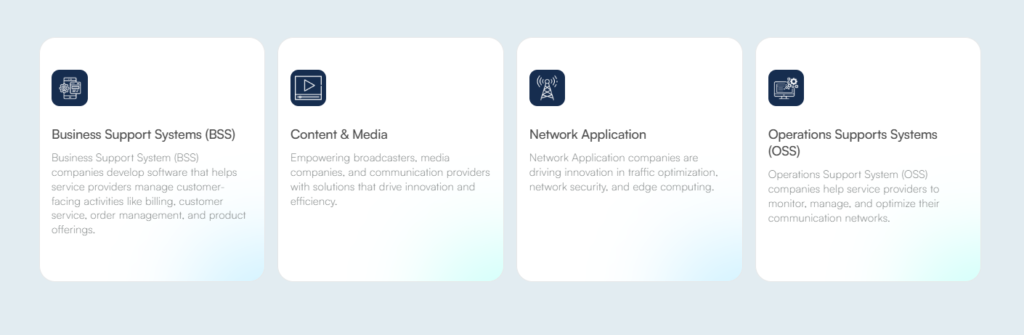
OSS is nothing more than an abbreviation for Operating Support System and it manages the network and technology. This condenses network management, service activation and inventory, such as the latter keeping track of which antenna is on which mast, how old it is, and so on. If a service provider wants to replace their OSS/BSS system, it's a multi-year project and the risk is huge. They'd rather pay Lumine (TSX:LMN) a 15-20% annual maintenance fee just to keep everything running.
The transition to 5G requires upgrading legacy OSS/BSS systems. This presents Lumine (TSX:LMN) with an opportunity for continued organic growth with existing customers. Lumine’s portfolio companies, such as Netonomy and MDS Global, specialize in these niche OSS/BSS areas, as you’ll see later.
👛Content Sales and Licensing Fees (Content Syndication)
Media companies not only broadcast, but also sell their produced content to other countries or platforms.
- 🪙Rights & Royalties: Who owns the rights? How long can it be sold? What percentage does the actor get? It's impossible to keep track of this on graph paper. Lumine's software handles these complicated royalty settlements.
📌In practice: It doesn't really matter how the revenue is divided. For years, the trend has been that revenue from advertising has been increasing, and the ratios are shifting in this direction. I've put together a mini table to make it easier to understand. Of course, this is just a rough estimate and changes a little every year, but it helps to place which is the most important source of revenue for companies:
| Source of income | Ratio | Dynamics | Software significance |
| Advertisements | ~ 45-50% | Growing rapidly (6%+ per year) | critical (WideOrbit specialty) |
| Subscriptions | ~ 40-45% | Stagnant/Slowly growing | high (issue of customer acquisition and churn) |
| License & Other (Content/API) | ~ 5-10% | Niche, but high margin | special (consisting of rights and royalties) |
Among the above, notice the connection that advertising can only be sold to someone who is also a subscriber to the given service, so this is a kind of necessary customer entry point for the service provider to watch ads with users. It is also common practice, for example, streaming service providers do this by charging the user for ad-free viewing with the price of a larger package, a good example of this is Netflix (NFLX).
🤔How are Lumine Group and Cerillion PLC (LSE:CER) related?
While researching other VMS companies in the telco and media segments, I came across a very promising small-cap company, Cerillion PLC (LSE:CER), which operates in the same segment as Lumine Group, but with a somewhat narrower, OSS/BSS focus. The company is interesting because if I find the same recurring patterns here as in the case of Lumine Group, it reinforces the thesis about both companies. Moreover, pattern recognition is one of the most underrated skills in fundamental analysis, in my opinion. Let's talk a little about Cerillion PLC!
- 🏢 Like Lumine Group, the company operates in the BSS/OSS subsegment, meaning they sell critical software systems to media service providers.
- ⏳ According to industry standards, setting up such a system takes 12-18 months for the more skilled, but in extreme cases it can take up to 36 months, or 3 years.
- 🔒 Contracts are typically signed for 5, sometimes 10 years, so there is a kind of "vendor lock-in" in the contracts, it is very difficult to replace them.
- ⚠️ The expected availability is extremely high, according to some sources 99,99%, according to other sources "five nines", this clearly indicates the mission critical nature.
- 💰 Contracts are usually paid in advance for the given year, which is why the company operates very efficiently, with low capital costs, and based on the contracts, you can see in advance how much is still in the backlog and pipeline.
Three things are worth clarifying, as these are industry terms and apply to both Lumine Group and Cerillion PLC:
- 💰 income: the amount of money the company has already collected.
- 📝 backlog: the amount of money that the company has not yet received, but has a signed contract for its performance.
- 📈 pipeline: those contracts that can be concluded by prospective partners and are being negotiated (their fulfillment is around 15-20% according to industry standards, depending on which competitor wins the competition).
As you can see, revenue can be planned quite well in advance for such companies, as you can roughly know how much revenue is expected to come in over the next 12-18 months, which can give extra stability to the theses. This is much more difficult to calculate in the case of a food chain, for example.
💸How much revenue loss will the service provider experience if the BSS/OSS system stops?
Whether a software is truly mission-critical is not just something that is said about a given product, but also needs to be supported by underlying numbers. That's why I tried to find data on what would happen if a telco/media service provider's BSS/OSS system were to fail.
| Company Size / Type | Estimated Annual Software Value (ACV) | Cost of 1 hour of downtime (Lost income + Penalty) |
|---|---|---|
| Medium Telco (e.g. Cerillion customer) | 1-5 million USD | 100-300 thousand USD |
| Giant Telco (e.g. Amdocs customer) | 50-200 million USD | 1-5 million USD |
If you think the above costs are extreme, it is worth knowing that during peak times, such as during the Super Bowl final, a 30-second time slot can cost 100000-1 million USD!, but even an average daily outage can cause a loss of 15-30 million USD in advertising revenue, so the operational reliability of BSS/OSS systems is very important. I looked for a few real examples of what has actually happened:
- ❌T-Mobile US (June 2020): VoLTE calls were not established due to an incorrect IP configuration, the company was fined 19,5 million USD for failing to guarantee emergency calls (in the USA this is the 911 number).
- ❌Rogers Communications (Canada, July 2022): For 15 hours, 12 million people were left without service, at a cost of CAD 150 million.
👱Who are the main customers and why do they pay?
Lumine's (TSX:LMN) portfolio serves giants such as Tier 1 telecommunications companies (e.g. Vodafone, Telefonica, AT&T) and global media companies. These clients choose Lumine's solutions for two main reasons:
- 🧠 Expertise in the vertical: Unlike horizontal software (e.g. a generic CRM), Lumine companies understand the specific regulatory environment and technical protocols of the media and telco sector.
- 🛡️ Long-term stability: In such a critical industry, customers want to know that their software vendor will be there for them 10-20 years from now. Lumine Group, and its parent company, Constellation, have a reputation for holding onto their companies “forever,” never selling them, which builds trust with enterprise partners.
What does it mean to be a Tier 1 provider? They have networks that can reach every corner of the internet without having to pay transit fees to anyone else. They have their own undersea cables and backbones that span continents. They lease bandwidth to smaller players and have the most purchasing power in the market. Lumine's software, such as the aforementioned Netonomy or MDS Global, have such customers. Here, the software must be extremely scalable: it must handle millions of calls or data packets per second without error.
Tier 2 companies have large, often nationwide networks, but they don't reach everywhere. To provide their customers with global access, they need to purchase a path from Tier 1s, this is called peering or transit. The Tier 3 category, even compared to Tier 2, operates with narrow functionality: These companies usually only cover one city or region. They do not have their own backbone network, they are purely resellers of larger companies.
🛍️VMS dynamics: small market, big dominance
The media and communications software market is not a single homogeneous block, but a collection of thousands of small niche segments. A piece of software may only deal with the maintenance scheduling of submarine cables, but it is the best in the world at that.
☝️Lumine (TSX:LMN)'s strategy is precisely this: to dominate these narrow but high-barrier-to-entry market niches. This is a key aspect of stock analysis, as it ensures high pricing power and outstanding returns on capital.

🙋♂️Lumine Group (TSX:LMN) Specialties🙋♂️
In this section, I examine what specialties the analyzed company has, what its position is in the market, and whether it does anything differently than its competitors. If so, what and how, and what impact does this have on their operations.
In the previous chapter, I introduced the general characteristics of serial acquisition companies and linked Lumine Group to the serial acquisition mentality. However, you may have noticed a contradiction, as I said that:
- 🎯 Serial acquirers seek to acquire small, market-leading companies that are very capital-efficient but lack growth.
However, two things follow from this sentence, namely that every serial acquisition company has two big problems:
- 🛑 the number of small submarkets and the software targets in them is finite,
- 📉 If the acquiring company cannot deploy free cash, it cannot grow.
How could this be familiar? The world's most famous roll-up buyout company is Berkshire Hathaway (BRK-B), which has grown to the point where it currently sits on $381 billion in cash and owns 5% of US Treasury securities. That is, they are unable to deploy cash efficiently due to their enormous size, but they are not limited by a given niche market, as they have stakes in all kinds of companies.

The “second most famous” of the serial acquirers is Constellation Software (TSX:CSU), the parent company of Lumine, whose largest market cap before the recent major decline was around CAD 100 billion, but they are in the VMS space, buying up much smaller companies so they don’t have to compete with the big capital funds. The problem is that they have been buying mini companies with revenues of USD 1-5 million, they have made around 1500 such acquisitions by 2026, but the larger size of the company will require more and more companies, which is impossible to execute after a while.
But the father of Constellation Software, Mark Leonard, had thought of this too, because before he founded CSU, the parent company, he had already studied about a dozen serial acquirers, including Berkshire Hathaway, Illinois Toolworks, Danaher Corporation, LVMH, Halma PLC, and a few other serial acquirers. That's why he had a solution to the problem that befell Berkshire Hathaway and will one day catch Constellation Software. He came up with two things, but to do that you need to understand how they measure the returns of their companies!
What is IRR and hurdle rate?
The Constellation family, i.e. CSU, LMN and TOI, uses two concepts in relation to return:
- 🚀 IRR (internal rate of return): This is the percentage that shows the annualized return on an investment. Simply put, it is the actual “speed” of the project in generating money.
- 🚧 Hurdle Rate (threshold value): This is the minimum expected return that the company expects from an investment. If the expected IRR is lower than the hurdle rate, management will not pursue the deal.
Most companies compare the hurdle rate to the WACC (weighted average cost of capital). In contrast, the Leonard school (CSI, Topicus, Lumine) looks at the actual return that can be realized. For them, the expected return, in other words, the value creation ability of the company, is actually the sum of two main components:
- 🔄Expected return = internal ROIC + organic growth
There is one more thing that goes along with the above rule: If a company is bought cheaper, a higher internal rate of return can be achieved, but generally a company is cheap because there is no growth in it. Of course, the reverse is also true. If growth is higher because the underlying market is larger, a company can command a higher price, which reduces returns. And larger markets tend to have larger companies, and more capital is competing for them, meaning that serial acquirers also have to contend with private capital.
How can the above problem be solved? Relatively simple:
- 🍁 Constellation Software (TSX:CSU): buys up many small companies at low prices: high ROIC + lower or zero growth.
- 📡 Lumine (TXS:LMN): acquires fewer but larger companies at higher prices: lower ROIC+higher growth.
- 🇪🇺 Topicus (TSX:TOI): Territorial arbitrage in Europe, not only do they buy up 100% of companies, but they also acquire minority stakes in other companies.
As you can see, all three companies have chosen a different solution to prevail in the market, and the thing is, they all work quite well.
📺Lumine Group (TSX:LMN) is founded
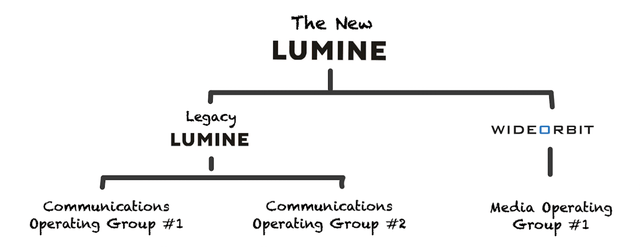
But let's get back to Lumine (TSX:LMN) and the company's formation. Lumine Group was formed in 2023 with the acquisition of a company called WideOrbit. Lumine by Volaris was previously an operating unit (OG) of Constellation Software, and had previously acquired several companies within the CSU structure. However, in 2023, they caught a big fish: WideOrbit, a global media platform company that managed the broadcast and embedded advertising of Tier 1 suppliers. Since the acquisition would have been too expensive on its own, Mark Leonard, then CEO of Constellation Software, decided to spin off the media and telecommunications businesses of the Volaris Group from the parent company, Lumine Group, and merge them with WideOrbit. This became the company that is now known on the stock exchange as Lumine Group (TSX:LMN).
However, before I get into explaining the WideOrbit merger, it's worth looking at the companies acquired in the period before the spin-off. Between 2014 and 2022, 28 units were acquired by the Volaris group, to which Lumine belonged, led by David Nyland, who later became the CEO of Lumine Group (TSX:LMN). This also shows that the acquisition of Constellation Software's 1500 companies was not all orchestrated by Mark Leonard, the founder, and Mark Miller, the current CEO, but the people at the head of CSU's operating units are similarly brilliant capital allocators. These 2-3 companies per year were acquired at an average price of 11.7 million USD/company, which is higher than the previous Constellation Software's price of 1-5 and 5-10 million USD. Since we know that Constellation:
- 🤏more than 25% internal rate of return for companies with revenues of 1-5 million USD,
- 🦣while companies with revenues of 5-10 million USD achieved an internal rate of return of around 20-25%,
therefore, you can expect a lower ROIC, but organic growth is likely to be higher due to the enterprise-level companies. This roughly gives the same math for Lumine as for CSU, but there is no exact information on the specific figures.
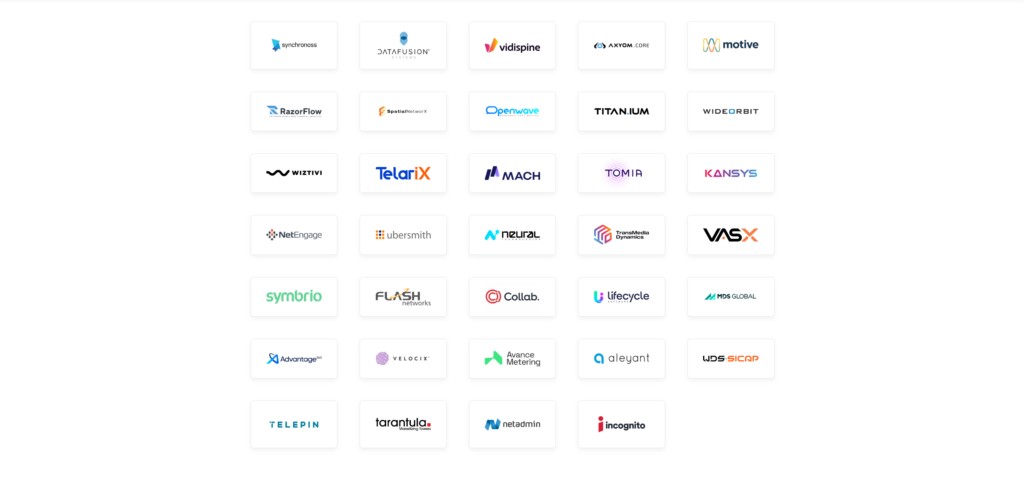
With that in mind, it's worth looking at the companies that have been acquired for which there is information. As of early 2026, Lumine's (TSX:LMN) portfolio includes a total of 34 companies. The full list is: you can find it here.
As a member of the Volaris operating team:
- ℹ️ Incognito (2014): a software house providing critical OSS solutions for the telecommunications sector, supporting network automation and asset management for over 200 global service providers, including Claro and Cox.
- 🌐 Netadmin (2015): is a specialist in optical networks, providing software infrastructure for network operation and monetization to 75 service providers in more than 15 countries, primarily Northern European Tier 2-4 operators.
- 🛜 Active Broadband (2016): The company's technology is now integrated into Lumine's (TSX:LMN) broadband solutions, having originally managed the networks of dozens of North American cable providers. That's why it's not listed separately on Lumine's website.
- 🗼 Tarantula (2017): They are present in 30+ countries worldwide, and their software manages the technical and leasing of over 600,000 mobile towers. This represents approximately $50 billion worth of equipment, across 10+ partners.
- 📞 Telepin (2017): Nearly 40 large enterprise Tier 1 operators are their clients, processing the financial transactions of more than 256 million subscribers through their systems.
- 📲 WDS-Sicap (2017-18): They deliver solutions to more than 75 global service providers, managing more than 100 million mobile devices worldwide with their software.
- 🖨️ Aleyant (2018): is a leading player in the media industry, with more than 2000 printing and media companies worldwide using their workflow automation software.
- 📊 Avance Metering (2018): They are primarily dominant in the northern region, where they process and systematize the measurement data of more than 100 utility providers.
- 🎥 Velocix (2019): approximately 50 global Tier 1 media companies are their customers, their software is responsible for serving a significant portion of the world's IP-based video traffic.
- 📈 Advantage 360 (2019): They have a customer base in nearly 40 countries, typically serving medium-sized telecommunications operators with their integrated platform.
- 💳 MDS (2019): They have approximately 30 large enterprise partners, and their systems handle the complex billing processes of more than 1 million business subscribers.
- 🔄 Lifecycle (2020): Approximately 25-30 British and European service providers use their software, with their main focus on serving mobile virtual network operators.
- 🎧 Collab (2020): They have more than 600 clients in 40 countries around the world, ranging from the financial sector to government agencies.
- 🚀 Flash Networks (2020): Their customer base is a few dozen global operators, but their software solutions optimize the data traffic of more than 500 million mobile subscribers.
- 🏢 Symbrio (2020): More than 100 Scandinavian companies use their solutions to automate purchasing processes and invoice management.
- 📡 Iron (2021): They work with major partners such as Vodacom, reaching a total of over 100 million subscribers with their software.
- 🎞️ Transmedia Dynamics (2021): Their client base includes hundreds of media companies, including renowned institutions such as the British Film Institute.
- 🛡️ Neural (2021): They have more than 100 clients in 45 countries worldwide in both the telecommunications and banking sectors.
- ☁️ Ubersmith (2021): They provide essential business and billing software to over 100 global data centers and cloud providers.
- 🔌 NetEngage (2021): They have fewer but high-capacity customers, and nearly 20 billion calls pass through their network software annually.
- 🏛️ Kansys (2021): They have roughly 20-30 large enterprise partners, including major North American carriers like Altice USA.
- 🌍 Tomia (2022): They have an extremely broad base, serving more than 400 operators, of which 30 are Tier 1 service providers. Professional analysts classify this transaction as a medium-large transaction (around USD 50–100 million), based on the size and significance of the company.
- 📺 Wiztivi (2022): They develop user interfaces for more than 50 global media companies, including Orange and Netflix.
- 💎 Titanium (2023): approximately 1400 facilities, including healthcare institutions and network centers, use their security software.

From here on out, Lumine Group (TSX:LMN) with the WideOrbit merger:
- 🌍WideOrbit (2023): This is where the 25 companies acquired by the Volaris group merged with WideOrbit under the name Lumine, see below. Purchase price: USD 497 million, this was the largest acquisition to date.
- 🌐 Openwave (2023): is a software vendor specializing in mobile data network solutions, helping dozens of global Tier 1 operators manage data traffic congestion and optimize network resources.
- 📍 SpatialNetworX (2023): GIS-based network planning software that helps telecommunications companies accurately record and map the physical assets of their optical and wireless infrastructure.
- 📊 RazorFlow (2023): data visualization and business intelligence platform that provides Lumine's portfolio companies with tools for complex analysis of customer data and network statistics.
- ⚙️ Motive (2024): Nokia's former device management and network automation business, which enables more than 100 major service providers to remotely configure and troubleshoot end-user devices and home networks. Lumine paid a maximum of EUR 185 million for Nokia's device management and network automation business. This consisted of a base price and a performance-based payment (earnout) of up to €35 million, depending on how the business performs in the first year.
- 🛡️ Axyom.Core (2024): is a developer of cloud-based network security and signaling solutions that protect critical communications infrastructures across tens of millions of endpoints.
- 🎞️ Vidspine (2025): media technology software house that supports the digital workflows and archive management of television channels and production offices with its cloud-based content management systems (MAM).
- 🔎 Data fusion (2025): telecommunications fraud prevention (Fraud Detection) and network security expert, whose algorithms help more than 20 global operators protect their revenues against unauthorized network use.
- 📦 Synchronoss (2026): is one of the most significant acquisitions in the history of Lumine, which, with its cloud-based hosting services and digital customer management platforms, manages the data of hundreds of millions of subscribers for partners such as Verizon and AT&T. The total value of the transaction (Enterprise Value) was approximately ~260 million USD. Of this, the equity value was $116.4 million ($9 per share), the rest included the assumption of the company's debt and other costs. This was a publicly traded company, unlike the others.
A few things become clear from the above: quite a few acquisitions stand out from the previous average price of 11.7 million USD, for example, the acquisition price of Motive of 185 million EUR or the amount of 258.5 million USD of Synchronoss are not the usual size either, more about these in the Acquisitions section (Acquisitions). There are also some common characteristics of acquisitions:
- 👥 Extensive customer base: They serve an enormous number of customers, sometimes hundreds or thousands, which greatly diversifies revenues and reduces dependency on a single partner.
- Critical infrastructure: A lot of devices depend on their services to function; for example, Flash Networks' 500 million or Vasx's 100 million mobile subscribers are quite large numbers, which proves the scalability and indispensability of software.
- 🏢 Global corporate relationships: They have strategic relationships with multinational companies such as Tier 1 providers, including Orange, Netflix, Altice, Nokia, Verizon, and AT&T.
- 🌍 Corporate capital strength: This is clearly not the SMB (small and medium-sized enterprise) segment, but internationally recognized multinational companies that are moving the capital, so stable growth can rightly be expected from the portfolio companies, and in return, the pricing power is also significantly higher.
💡From the above, it can be seen that Lumine Group (TSX:LMN) follows a quite different path than its parent company Constellation Software. It does not acquire small companies in its field, which in the case of CSU can be as large as 100, but rather allocates capital through 2-3 larger acquisitions per year.
But it all started with the Lumine-WideOrbit merger in 2023…
👊Lumine (TSX:LMN) and WideOrbit Merger
Constellation Software resolved the separation of Lumine with a rather complicated transaction. The reason for this was that paying WideOrbit in cash would have been prohibitively expensive, and its debt also needed to be consolidated. Therefore, they chose the following solution: they separated Lumine and 24 other previously acquired companies from the Volaris group, then took the whole thing public under the name Lumine Group (TSX:LMN) and used it to finance the WideOrbit acquisition. They paid USD 497 million for WB, but in practice they only bought 55% of the business in cash, USD 180 million in cash and USD 95 million in debt, and 45% was paid in shares as part of the spin-out, which is worth about USD 222 million. In 2022, WideOrbit generated about USD 40-45 million in operating profit, so the acquisition was made at roughly 11-12x EV/EBIT, which is double the usual CSU acquisition, at least on paper.
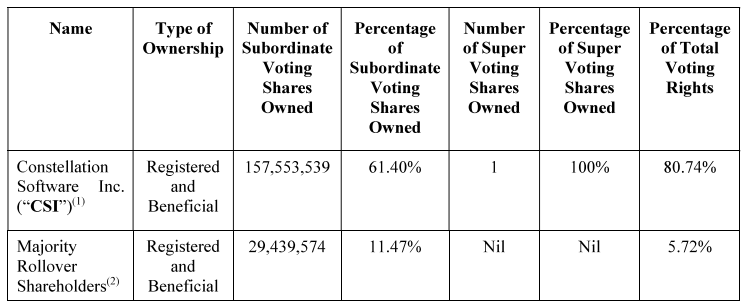
Where is the capital allocation genius here? Constellation issued the following shares:
- 👥 Constellation Software's public shareholders: They received 63.6 million ordinary shares (Subordinate Voting Shares), which is equal to 25.12% of Lumine on a fully diluted basis.
- 🛡️ Constellation Software preferred shares: The parent company received 63.6 million preferred shares convertible into cash or common stock, representing 61.05% of the company on a fully diluted basis. While these shares existed, Lumine paid a 5% annual dividend to CSU in exchange for the transferred assets, but this obligation was terminated on March 25, 2024, upon conversion.
- 🤝 The rollover shareholders of WideOrbit: They received 10.2 million special shares, convertible into cash or common stock under certain conditions; this represented a 13.83% stake on a fully diluted basis.
- 👑 CSU super voting shares: In addition to the above, CSU received 1 super voting share, which provides 50.1% of the voting rights in Lumine Group. Since their other shares also have voting rights, Constellation's total voting share is around 80%, so they exercise stable control over strategic decisions.
There were two more clauses to the above, one of which was that WideOrbit's special shares were convertible into common shares at a ratio of 3.4:1, while the preferred shares were convertible into common shares at a ratio of 2.4:1, thus 256.6 million shares were created on March 25, 2024. This is the number of shares to date, so they have not been diluted or repurchased since then. The trick here is that the issue price on March 25, 2023 was CAD 16.75, while on March 25, 2024 it rose to roughly CAD 35, more than doubling the profit for those who might have wanted to exit the company, a sign of market confidence. As you can see, everyone actually won in the deal, as with a one-time IPO, Constellation Software was able to retain its ownership and voting rights, while WideOrbit shareholders could convert their investment into cash, which doubled in 1 year, or they could have kept it and become shareholders of Lumine Group (TSX:LMN).
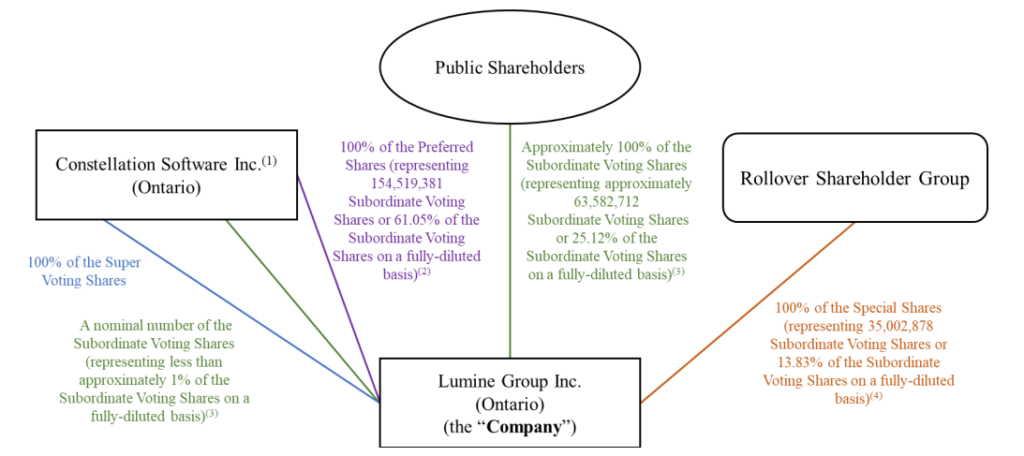
🏢This marked the beginning of the consolidation of Lumine Group (TSX:LMN), and it has been functioning as a mini Constellation in the telecommunications and media segment ever since, but it does not focus on monopoly companies in mini markets, but on mission-critical applications serving multinationals.

💰How does Lumine Group (TSX:LMN) make money and what market advantages does it have?💰
In this section, we examine what exactly the company does to generate revenue, what products and services it has, how indispensable they are. Does it have any competitive advantage (economic moat), how defensible is it, and whether the trend is decreasing or increasing, and what is likely to happen in the long term.
Lumine (TSX:LMN) has an Acquire-Operate-Build business model. Its partners are almost exclusively international, multinational companies whose critical infrastructure and software are operated by Lumine Group (TSX:LMN). But let's take a closer look at what makes up the free cash flow that fuels growth.
🧑💻Software Revenue
Lumine's portfolio companies do not rely on one-off sales. The vast majority of revenues, often over 80%, come from recurring, long-term contracts, which are fed by two sources:
- 🛠️Troubleshooting and support (maintenance&support): Software maintenance fees, in return for which the customer (e.g. Vodafone) receives updates and technical support. This is the highest margin revenue. Typically, when implementing a BSS/OSS system, large companies do not want to replace their systems, which in turn need to be maintained. This is typically a cost associated with operating the base system.
- 💳Subscription (SAAS, or Software as a Service): monthly fees for cloud-based solutions.
- 🤑Development fee: Although the members of the Constellation family are famous for not burning money on speculative technologies, in the case of artificial intelligence they also recognized that it is not just a trend, but an increase in operational efficiency and the value of software.
📌In practice: I was lucky enough to speak with an investor who contacted Constellation Software’s investor relations department and they set up an online meeting with CFO Jamal Baksh. Overall, it turned out that the CSU family doesn’t operate ancient, mature software at all, but rather has a lot of cloud-based, application-supported solutions, and as I looked through the portfolio of Lumine Group (TSX:LMN), I found relatively modern companies here as well. It was also said that they are heavily involved in implementing AI, in all operating groups (OG) and business units (BU).

I think that the continuous developments of the Lumine Group companies will have additional revenue-generating parts, which the multinationals will pay for, because compared to their total cost, this will be a negligible amount, while media and telecommunications BSS/OSS systems are extremely difficult to replace.
🔮Lumine (TSX:LMN)'s "mission critical" nature as a cash guarantee
Lumine buys in sectors (media and telco) where replacing software is riskier and more expensive than paying the license fee. These typically cost companies less than 1%. For example, if WideOrbit's system handles 80% of a US TV channel's advertising time, the channel won't risk a lengthy transition to another system because a single day of downtime would cost more in lost revenue than the annual fee for the software. It is no coincidence that WideOrbit's customer retention rate is 99%, according to some sources, In other words, the dropout rate is only 1%. This gives Lumine extraordinary pricing power: price increases that follow or exceed inflation are accepted by customers without complaint.
📌In practice: Most investors tend to click when it comes to the companies in the Constellation family, wondering how much organic growth can be sustained. As I mentioned earlier, Constellation Software, Lumine, and Topicus calculate their internal rate of return, called IRR, from two components: ROIC + organic growth. Since ROIC, or return on invested capital, largely depends on the price paid for an acquired company, if the deal is expensive, this can be compensated for with higher growth. For these three companies, it looks “roughly” like this, and only roughly because the growth numbers vary, that Lumine (TSX:LMN) is paying more for acquisitions, presumably expecting more growth in return. In other words:
- 🍁Constellation Software: It buys up a lot of companies very cheaply (P/S=1-1.5x or also known as 5-6x EV/EBIT), in return for almost zero or negative growth in these companies.
- 🇨🇦 the Lumine Group (TSX:LMN): pays more, according to some sources 10-12 EV/EBIT, but expects higher organic growth.
- 🇪🇺 Topicus (TSX:TOI): It pays little, buys in Europe, which is a geographical arbitrage, and not only does it acquire companies, but as a minority owner it does not consolidate its stake in the companies (e.g. Asseco Poland deal).
👆If there's only one thing to take away from Lumine Group's analysis, it's this: this is typically the enterprise VMS segment, so you have to pay close attention to how much organic growth LMN can show, because they're paying for it upfront with the higher acquisition price.
Of course, the end result is always the same: since Constellation Software (TSX:CSU) owns the voting rights of its spin-off, you can actually consider the three companies as separate companies or as one, meaning they also produce for the parent company. But the good news is that since they are listed under 3 tickers, you can decide which one to buy.
🛡️ The legacy of the Constellation ecosystem
Lumine uses Constellation Software's collection of best practices. They know how to turn an underperforming software company into a cash generator:
- 📈 Operational efficiency: They use strict benchmarks. If a company's EBITDA margin falls short of expectations, they know exactly where to intervene (e.g., optimizing sales processes, focusing R&D, and so on).
- 🕸️ Decentralized management: Each portfolio company operates independently, but has access to a central knowledge base, combining the agility of small companies with the background of a large corporation. This decentralization will be very important in management.
- 🗄️ Destination database: Constellation Software has a database of approximately 40-45,000 targets, which was also used by Lumine within the Volaris Group before the spin-off. This means that the company does not really have to search for separate targets, but can use CSU's extensive and validated database.
- 🎓 Talent search: The training of capital allocators has been going on for a long time at CSU; it is no coincidence that in addition to people like Mark Leonard, other professionals have also appeared, such as Mark Miller (CSU CEO), David Nyland (Lumine CEO) and dozens of other leaders. In such a “leadership training” workshop, continuity and replaceability of management are ensured, and this mentality also flows down to the level of operating units.
📌In practice: What I've seen of Constellation Software's backend so far tells me that Lumine Group (TSX:LMN) is essentially accessing the very broad resources of a much larger company. For one thing, they don't have to hunt for targets, and for another, CSU has been developing best-practice solutions since 1996, which the other two spin-offs are also adopting. It's a very resource-efficient method that Constellation Software (CSU) has been doing for 30 years.
🚪Gatekeeper role in the media and telco sector
Lumine companies are gatekeepers, their services are a bit like financial infrastructure providers, Mastercard (MA) and Visa (V). So all data that passes through the telco network is handled by Lumine's software. They are so deeply integrated into the customers' infrastructure that they have insight into market trends. If a Tier 1 provider has a new need (e.g. managing a 5G network), Lumine is already there in the prototype phase. This represents a barrier to entry that even a well-capitalized startup would only be able to overcome in decades.
📌In practice: Regarding WideOrbit, I read that more than 6500 TV and radio stations rely on their platform, which they call WO Traffic, which runs behind the daily program schedule and advertising blocks. The system has a customer retention rate of 99%. WO Traffic is used by broadcast station groups to manage over 90% of local TV advertising revenue in the US. WO Traffic is not an analytics tool that may not be opened, but it is the software without which the ad block will not go on air. Every advertising slot, every contract, every billing on a TV station goes through it. If it doesn't work, the station can't generate revenue, so it can't be replaced. There's practically no alternative in the American market. It's no coincidence that the churn rate is 1%, which is incredibly low.
The other side of the advertising market is Mediaocean. Mediaocean is the software through which advertising agencies (e.g. WPP, Publicis, IPG, Omnicom) plan, buy, track and pay for their media spend. So it's the demand side of the process, as opposed to WideOrbit, which serves the supply side (TV/radio stations). I've read in several places that Mediaocean is like the interbank SWIFT system for transfers: almost unavoidable, everything flows through it, which means $150 billion in advertising costs per year. Mediaocean is integrated into WideOrbit's WO Traffic, connecting advertisers with advertising platforms.
This is a pitch-to-payment service: Pitch-to-payment is an end-to-end workflow system that covers every step within the WideOrbit platform from the first advertising offer to the final payment: the sales team sees the available airtime and prices it, concludes the contract with the advertiser, WO Traffic schedules the airtime to the second, the system confirms the performance, then automatically generates an invoice and sends the payment request, all on a single integrated platform, without any human intervention.
Capital Allocation Advantage (M&A Pipeline)
Because Lumine is already a globally recognized professional investor, sellers (often large companies like Nokia or Synchronoss, divesting a non-strategic business) like to sell their companies to them. Why? Because they know that Lumine doesn't break up and sell the company like private equity funds, but rather operates and develops it for the long term. This often allows Lumine to buy at a lower price, i.e. a lower EV/EBITDA multiple, than its competitors.

🏰Economic moat🏰
In this segment, I examined whether the company has any economic competitive advantage, which Warren Buffett referred to as the “economic moat,” which deters competitors from besieging the company’s fortress, i.e. its business, and taking its market. In this case, these could be the following:
- 🫸Cost/scale advantage: yes. But Lumine (TSX:LMN) owes this to its parent company, Constellation Software. The reason for this is that since CSU owns the majority of the voting rights, it is only a technical question of where to channel free cash, credit, etc. due to the almost completely free use of capital. Moreover, they work from a common database, so Lumine does not have to look for new and new targets, it only needs to tap into CSU's database of 40-50,000 names.
- 🫸Switching cost: yes, very high. Almost all VMS purchased is part of critical infrastructure, if a customer wants to switch, they have to shut down their entire system, while the cost of software licenses typically consumes less than 1% of their revenue. There is no reason to switch, especially in the media and telco industries, where large companies pass these costs on to the end user, for example by increasing the price of subscriptions.
- 🫸Network effect: none in the traditional sense. However, Constellation Software is quite famous, many people sell their own, cherished companies to the company because they know that they will find a forever home there, they will not merge it, they will keep the name, they will not fire colleagues, etc. If there is “soft power” in the economy, this is it.
- 🫸Brand power: holding companies do not have it. However, some VMS solutions within the industry may. Suffice it to mention the WideOrbit and WO Traffic platforms.
- 🫸Company culture: yes, very strong. Constellation Software is run by one of the best management teams in the world, with titans like Mark Leonard and Mark Miller. Most of them come from the parent company, including David Nyland, the current CEO of Lumine Group. It is a remarkably decentralized system, with management incentives aligned with the long-term interests of the company. A typical qualitative element that is very difficult to analyze is a kind of hidden value.
- 🫸Intangible assets, know-how, trademark: yes. In fact, corporate culture and brand strength, as well as decentralized structure, could also be included here. Of course, due to the high number of acquired companies, a significant knowledge base and know-how has been accumulated over the years, as you can find 1500 companies in Constellation alone, while Lumine has about 40 of them. Since they use the same methodologies, the parent company's methodology is also applied to spin-offs, including Lumine (TSX:LMN).
- 🫸Barriers to entry: The VMS market would not be particularly difficult to enter, but in most cases it is not worth it because the market is small and 1-2 companies already have a monopoly market position. That is why there are many serial acquirers that deal with this and aggregate the free cash that these companies generate. Within this, Lumine's market is even more specialized, as their customers are large companies that use very critical software and who simply have no interest in switching. So the entry threshold protects Lumine's operation from two sides: The market is not big enough from a competitive perspective, and it is not worth switching from a customer perspective either. There is one way for another company to dominate the market: by consistently outbidding Constellation Group in acquisitions. But that would severely hurt returns, and a venture capital fund doesn't have nearly the reputation of Lumine Group (TSX:LMN), so it's not certain that owners would sell their companies to them.
The above paints a picture of a very special market segment, surrounded by primarily soft power-type competitive advantages. I think Lumine has a slim economic competitive advantage, but it comes together like when the older brother stands behind the younger one and orders those who would hurt his younger brother to do so. Since the resource utilization and knowledge base are essentially shared, this strengthens Lumine Group (TSX:LMN), in turn creating a strong dependency with Constellation Software, where LMN is not the stronger party.
🎢Lumine Group (TSX:LMN) Metrics🎢
In this section, I examined what metrics characterize the company, how it stands on the revenue side, what margins it operates with, whether it has debt, what the balance sheet shows. I look for items that are extreme – too high debt, high goodwill, etc. - what return on capital the company works with, what its cost of capital is, how the revenue and cost sides are structured. I also examine trends, owner value creation, and how the company uses the cash generated.
📈What is the S&P 500 yield?📉
Compared to previous analyses, I have introduced a new section to compare the metrics below. Since many people use the US stock market index as a benchmark and also buy S&P 500 ETFs, it is worth looking at what companies are doing in aggregate (obviously, you should be happy if the company you are analyzing outperforms these values).
S&P 500 2025 data:, based on Factset Insight:
- 📈 SP&500 revenue growth: + 8 %
- 💹 SP&500 Profit Growth: + 13.6 %
- 📊 SP&500 gross margin: 46 %
- 💼 SP&500 net margin: 13.2 %
- 🔁 SP&500 ROE: 17-18%
- 🏗️ SP&500 ROIC: 12-13%
- ⚙️ SP&500 ROCE: 11-12%
As I wrote in my analysis of Constellation Software, serial acquisition companies are incredibly difficult to evaluate using traditional metrics. There are several reasons for this, firstly, they operate completely differently compared to traditional companies, and secondly, calculations based on the cost of capital must be adjusted for an enormous number of items. On top of that, there simply hasn't been enough time since Lumine Group's (TSX:LMN) IPO in 2023 for me to draw long enough graphs for you. The performance of Constellation Software's Volaris group prior to 2023 is quite difficult to find, but fortunately there is an excellent article on the now defunct 10th Man site, currently available on Substack, that goes into great depth into the perceived or actual performance of the pre-IPO period. I also recommend the original Lumine IPO document from Constellation Software (TSX:CSU) for further research:
The other thing is that Lumine also uses some of Constellation Software's special metrics, such as IRR, hurdle rate, FCFA2S and a few others, but I will mention them where necessary. The previously mentioned WideOrbit acquisition also messes up the numbers, as it was a huge capital expenditure, which appears as negative numbers on the balance sheet. So, I had to make estimates in many places, the accuracy of which can certainly be compromised.
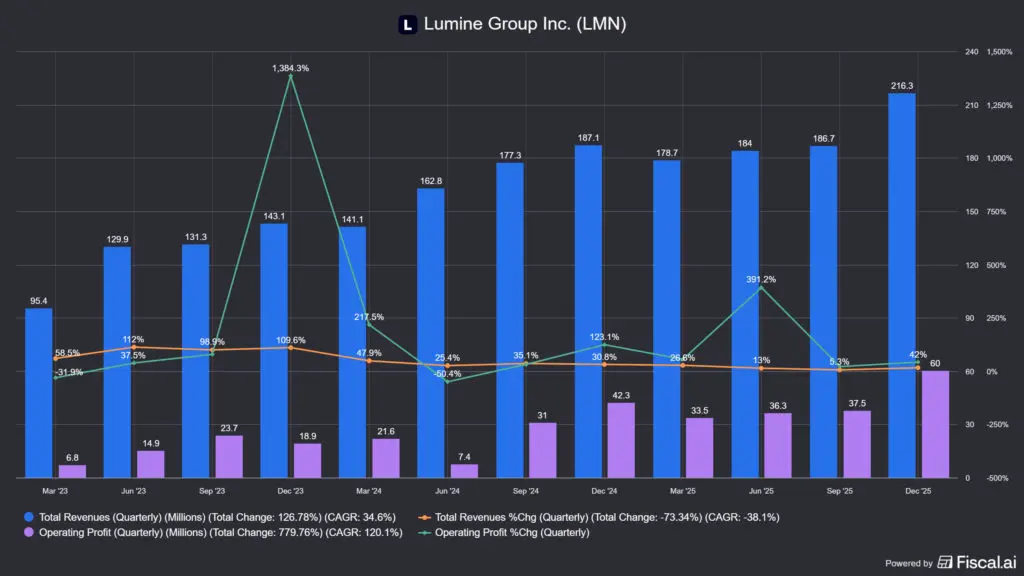
The first picture is revenue, which doesn't tell you much about a serial acquisition company, but it's good to see that companies acquired consistently generate additional revenue overall, which also generates operating profit. The percentage changes are not really significant, as Lumine entered the market in 2023 with the WideOrbit acquisition, which was the largest deal in the company's life, which is why you can see the jump in the picture. Due to the short time frame, I used quarterly instead of the usual annual breakdown, and the numbers should be understood in USD.
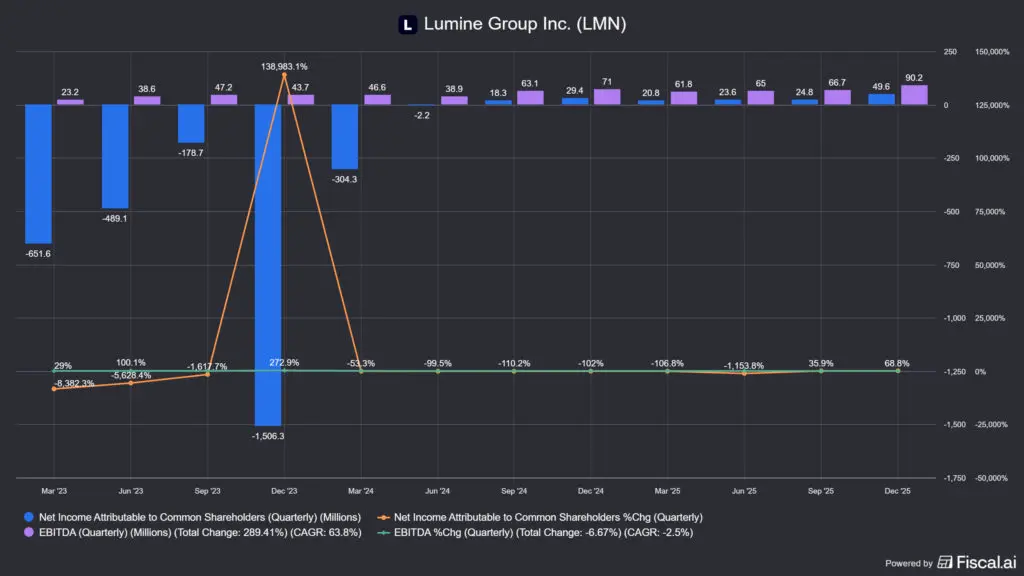
In the following image you can see the EBITDA and net profit figures, which are also completely distorted due to the WideOrbit acquisition. EBITDA is not relevant because it includes amortization (depreciation of intangible assets) and depreciation (depreciation of tangible assets), while the former is quite significant in the balance sheets of serial acquirers. That is why many serial acquirers work with EBITA or EBIT values. High amortization values are not a problem, as long as there is no large write-down of Goodwill, which did not happen in the case of Lumine Group (TSX:LMN).
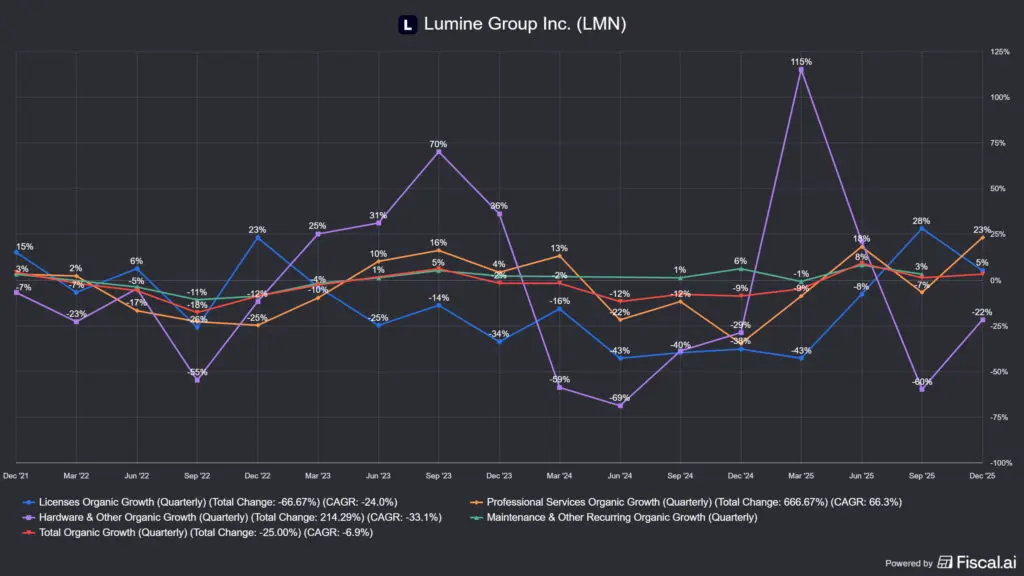
So, you have to find other metrics to interpret the numbers. I'll start by breaking down the revenue by segment. As you can see, the maintenance leg is the most significant, followed by professional services and licenses in roughly the same proportion, while hardware is a negligible part. This is an ideal mix, as services have a much higher margin than hardware sales and attrition is also lower.
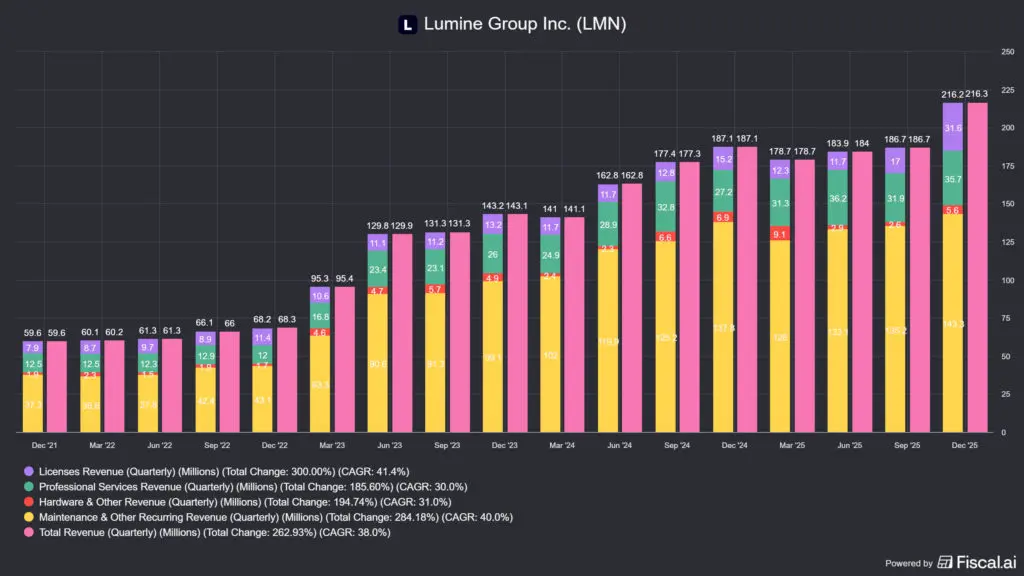
It is also worth looking at the percentage change in each revenue segment, hardware sales fell significantly, all other segments grew, which is also an ideal mix. Interestingly, professional services and maintenance increased year-on-year, while the licenses segment decreased and this has been going on for 3 years. I wouldn't be surprised if the conglomerate's companies transition from SaaS solutions to token-based payment systems in the long term, with the introduction of AI solutions.
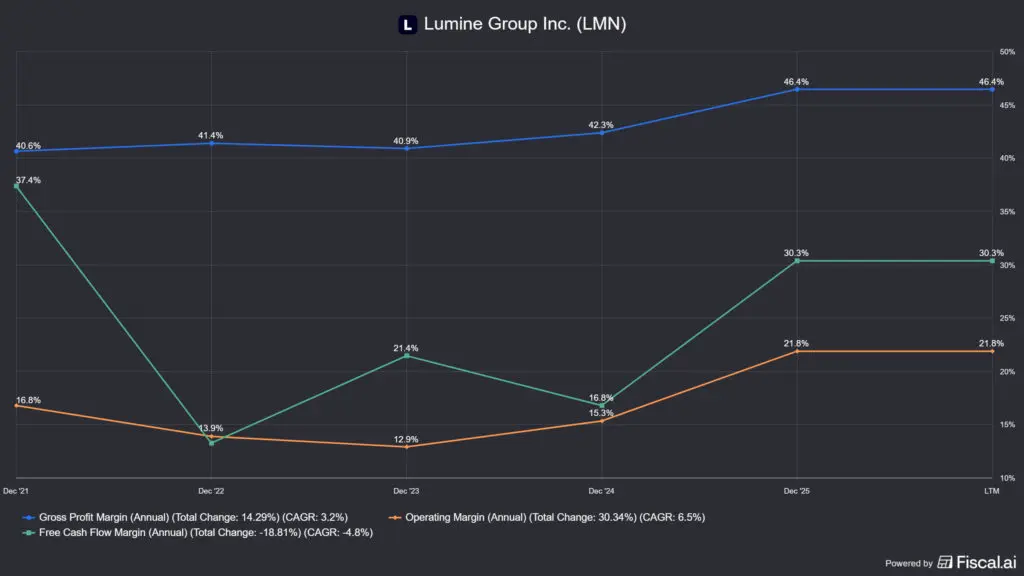
For other companies, the next category is usually margins, but in the case of Lumine Group, net profit margin is not really relevant, as the acquiring companies channel cash into the holding company, which is then used for new acquisitions, so it is worth monitoring free cash flow instead, which is why its margin is worth following. 30% is a particularly high figure, Constellation Software has between 20-23%, while Topicus has between 20-25%. I wouldn't draw any far-reaching conclusions from this, but the point is that Lumine Group is generating a lot of cash.
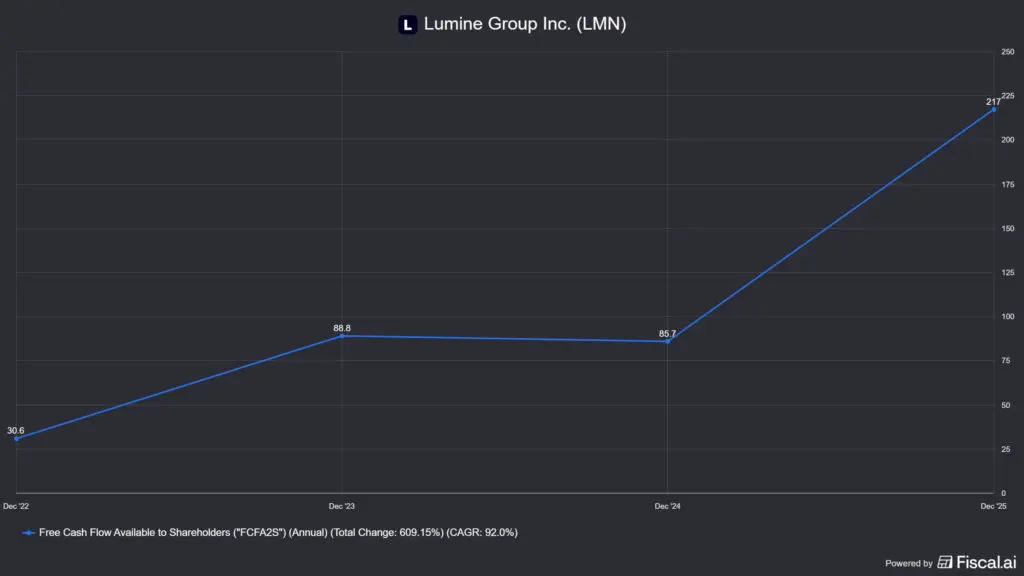
Get to know the FCFA2S metric, which stands for Free Cash Flow Available to Shareholders. This is not an accounting metric, but an internal metric for the Constellation family. Most companies use the “Cash Flow From Operation-CapEx” formula to measure free cash flow (FCF). At Lumine, this would not be accurate enough, so they came up with their own metric. FCFA2S represents the money left over after all liabilities are paid, and with which management can actually buy new companies without having to borrow. If this metric were not used, free cash flow would be distorted by items such as the cost of paying out minority interests and similar amounts. The higher the FCFA2S, the more resources remain for acquiring new companies, as you can see below in annual breakdown.
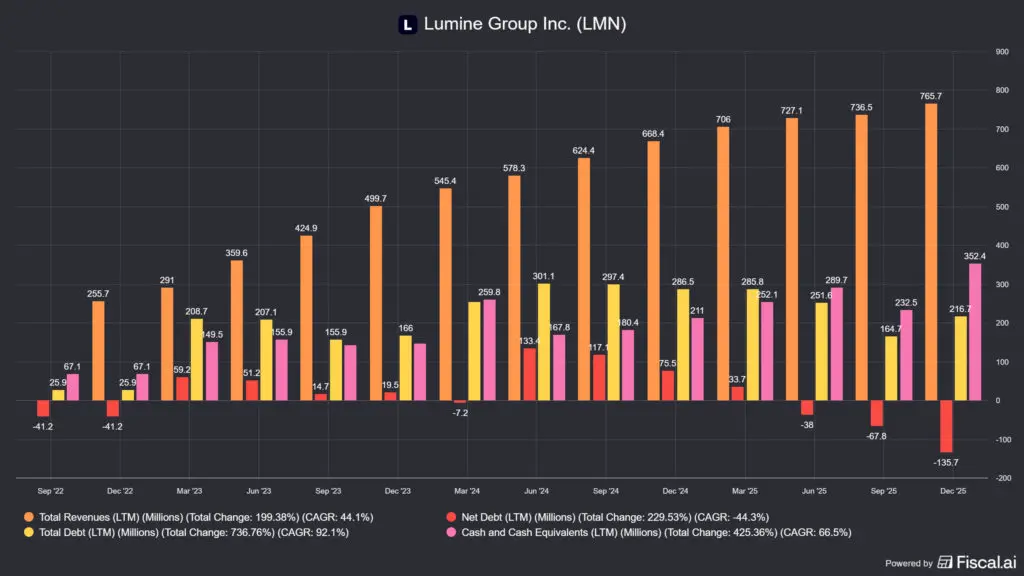
Of course, Lumine Group (TSX:LMN) can't just put up that much money, as it can also use debt, which acts as a form of leverage in acquisitions. For example, if they want to buy a company for $15 million but only have $10 million available, they can buy the remaining $5 million using 1.5x leverage. Since interest expenses are deducted from profits, they reduce the cost of capital, while the acquired company's earnings are added to the acquirer's. The red bars in the image below are negative because Lumine Group has more cash than debt, so there's still plenty of room to use debt.
🧮What do ROIC and ROCE metrics show?🧮
ROIC – Return on Invested Capital – shows how efficiently the company uses its total invested capital to generate profit. Read more here.
- It shows the company's fundamental value creation capability.
- It filters out the impact of the financing structure.
- If ROIC exceeds the cost of capital (WACC), the company is creating value.
ROCE – Return on Capital Employed – shows how efficiently the company uses its long-term financing sources. Read more here.
- It measures the profitability of business activities.
- It does not take into account tax effects.
- A good basis for comparison between different industry players.
| Indicator | What does it measure? | Who is it useful for? | When is it considered good? |
|---|---|---|---|
| ROCE | Total return on capital | Long-term investors | If higher than the industry average |
| ROIC | Return on invested capital | Equity investors | If higher than WACC |
| ROE | Return on equity | Shareholders | If stable and sustainably high |
Lumine Group (TSX:LMN) Ownership Value Creation
On the owner value side, I usually look at what the company uses the free cash generated. Basically, a company can do the following things with cash:
- 🔄 puts it back into business
- 📉 reduced debt
- 💵 pays dividends
- 📊 buys back shares
- 🏢 acquires other companies
Lumine Group (TSX:LMN) is a serial acquirer, so value creation in this case must be viewed in a completely different way. They have virtually no or very low, single-digit organic growth, which is due to the best practice methodology inherited from Constellation Software, but fundamentally these companies have reached their growth limits, which is why they need to be acquired in a series. That is, the following items are essentially eliminated:
- 🔄puts it back into business: the normal course of business is the acquisition itself,
- 📉reduced debt: This is a cyclical process that is part of the acquisition activity. It goes up when you buy, then the company pays you off, and then the cycle starts all over again.
- 💵pays dividends: members of the Constellation Software group (CSU, LMN, TOI), do not pay permanent dividends unless they cannot deploy their capital,
- 📊 buys back shares: CSU and its spin-offs have NEVER repurchased or diluted stock.
From the above, it can be seen that Lumine Group (TSX:LMN) is actually focused on one thing: to acquire companies with appropriate valuations and high cash generation, which are primarily active in the B2B segment. In other words, you can essentially achieve the full return exclusively through price gains. Since the company has only been on the market for 3 years, it is not possible to draw far-reaching conclusions from the price, but based on Constellation Software's 27-30% annual CAGR, you won't be doing too badly.
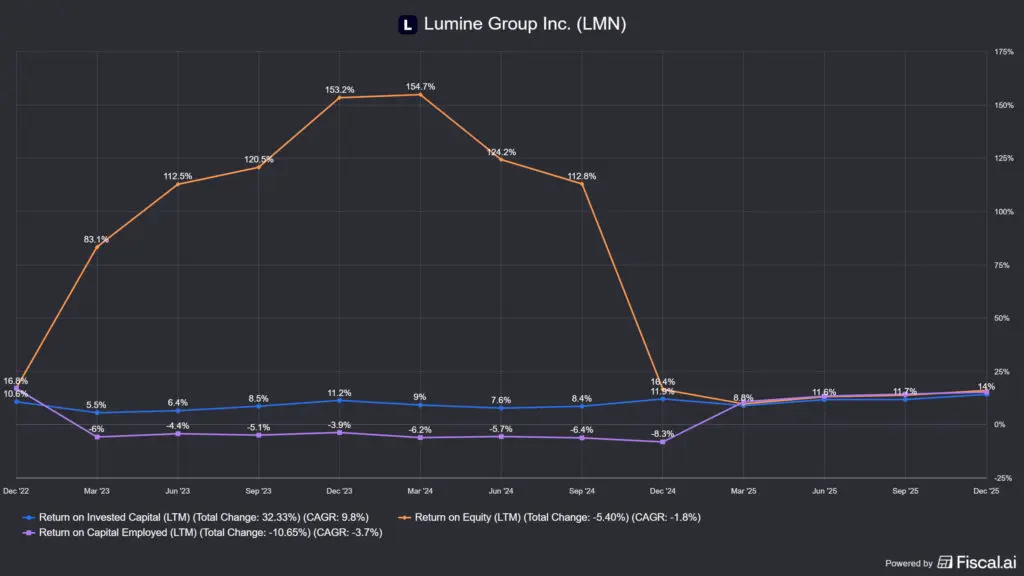
ROIC and ROCE are difficult to calculate for a serial acquirer because there is a lot of goodwill created during the acquisition, and in the case of Lumine Group (TSX:LMN), the numbers are horribly skewed by the special share issue associated with the IPO. One thing you can do is ask the AI to adjust the ROIC and ROCE values for the period after March 25, 2024, when all shares have converted to common stock. If you're interested in more details about what other anomalies are skewing the numbers, read the same section in Constellation Software's analysis: Constellation Software (CSU): the serial acquisition machine.
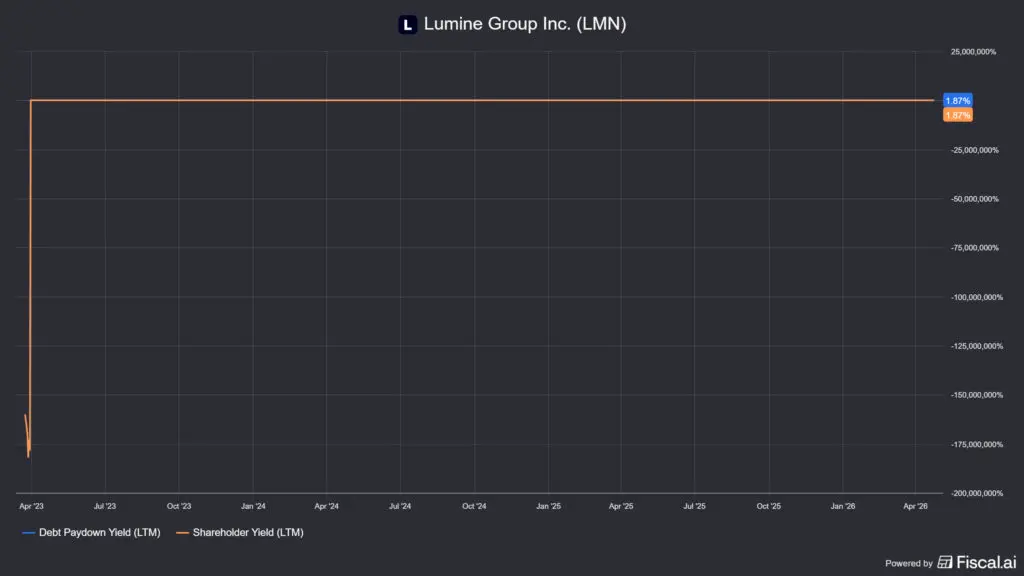
Finally, here's an interesting chart that you haven't seen on the iO Charts blog: a picture where shareholder yield comes exclusively from debt payments. There are no dividends, no share buybacks, so the only component of the aggregate metric of shareholder value creation is debt reduction, which is why the metric can be misleading. But, it's always worth looking at it to see if something comes out of it.
💵Lumine Group (TSX:LMN) Acquisitions💵
In this section, I examine how acquisitive the nature of the company is and what impact each acquisition had on the life of the company, if any.
Lumine Group (TSX:LMN) is a company that does acquisitions, but it's not a typical business like Constellation Software, which has acquired ~1600 companies since 1995. Lumine Group is much smaller and operates in the B2B segment, so they make far fewer acquisitions. In fact, there were years when they added 0 or 1 company to their portfolio, and this is so true that they acquired 1 company in 2023, 0 in 2024, and even in 2025, only 3 companies. The dynamics are clearly visible in the image below, even though, to my knowledge, Lumine Group acquired more companies than this (34 in total), what is more interesting is the market segment-based and geographical distribution of the acquired companies (the image below only shows 24 companies):
- ⚙️ OSS/BSS: 11 pieces,
- 🎬 Film & TV: 2 pieces,
- 🌐 Corporate networks: 1 piece,
- 📁 Other: 10 pieces.
As you can see, all of them are media and telco companies, but not all of them belong to the OSS/BSS segment, but these are usually higher value acquisitions. As for the territorial division:
- 🇺🇸 USA: 8 pieces,
- 🇬🇧 UK: 5 pieces,
- 🇸🇪 Sweden: 4 pieces,
- 📁 Other: 7 pieces.
In other words, Lumine Group (LMN:TSX) is not limited to Europe like its other sister company, Topicus (TSX:TOI), but rather narrows its activities to a market segment.
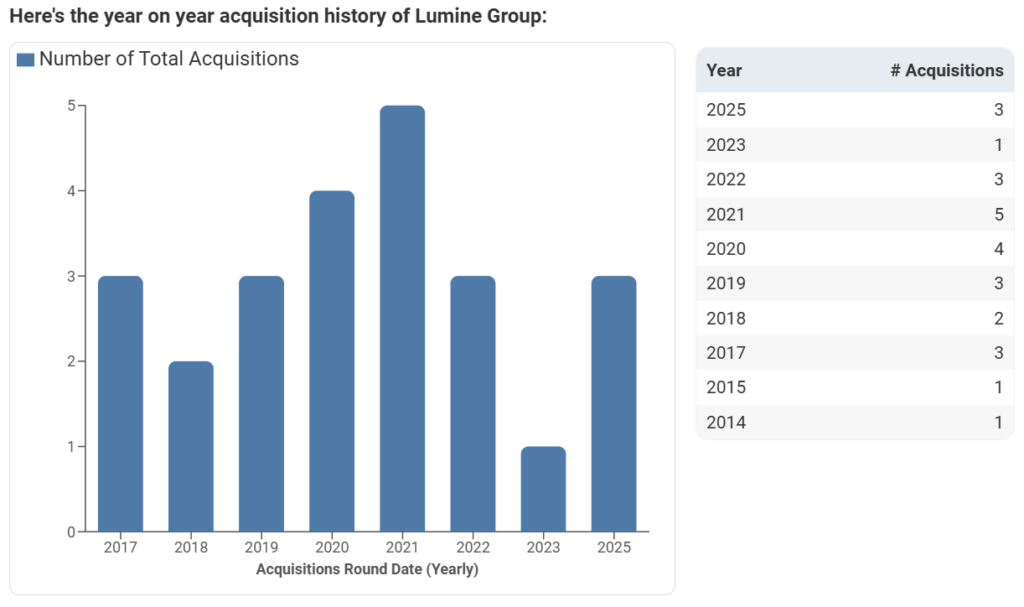
There were 3 acquisitions announced in 2025, but in fact the acquisition of Synchronoss (SNCR) was pushed back to 2026, so I can say that this is a 2026 acquisition. Let's see what we can know about the Synchronoss acquisition, which can be used as a kind of snapshot and provides insight into how Lumine operates.
📦Acquisition of Snychronoss (SNCR)
It is one of the most significant acquisitions in Lumine's history, which, with its cloud-based hosting services and digital customer management platforms, provides data management for hundreds of millions of subscribers at partners such as Verizon and AT&T. The total value of the transaction (Enterprise Value) was approximately ~260 million USD. Of this, the equity value was $116,4 million (at a price of $9 per share), the remaining items included the assumption of the company's debt and other costs. Lumine Group (TSX:LMN) has not officially disclosed the acquisition price, so treat the above figures with caution.
Synchronoss was a publicly traded company, which is actually rare, Lumine typically acquires private companies. Since we know the stock price, net debt, and revenue, you can get a pretty good insight into what Lumine Group bought. How the acquisition price comes together:
- 💰116.4 million USD was paid for the shares,
- 📉Synchronoss had a debt of 145.9 million USD.
I looked at the last available metrics:
- 📈 revenue: ~171 million USD; P/S=1,52x,
- 📉 net profit: -10 million USD,
- 📊 EBITDA: 32.6 million USD; P/EBITDA=~8x,
- 💸 Free cash flow: ~53 million USD; P/FCF=5x.
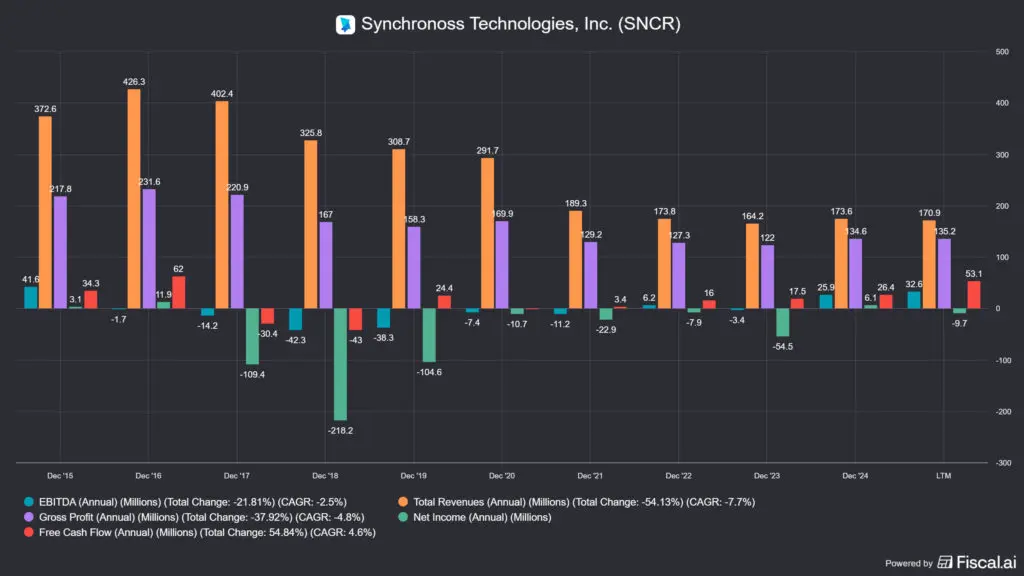
From the above, it can be seen that Synchronoss is a declining but cash-generating company that needs to be stopped, but there are methodologies inherited from Constellation Software for this. Why did Lumine Group acquire SNCR then? Because the company had become very cheap with the price drop and was still generating a lot of cash, and LMN judged that it could still be saved. From the above valuation, it can be seen that Synchronoss was acquired at 8x EBITDA, or in other words, 5x P/FCF, which is roughly in proportion to the price at which Lumine acquired the previous companies.
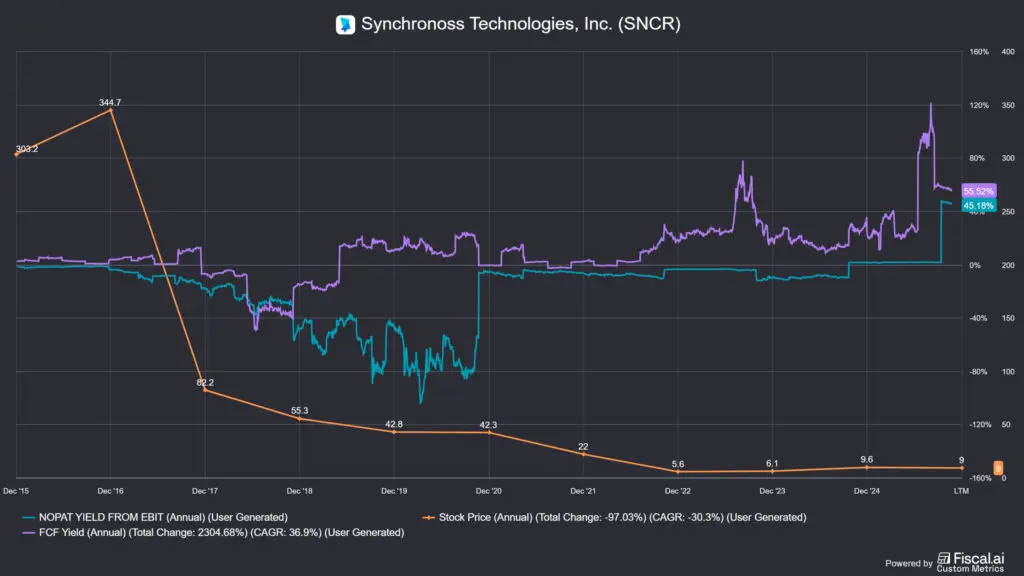
The above numbers show two things: the Constellation Software family of companies not only acquires low-growth companies, but also decliners whose business processes can be improved and their value increased. Synchronoss's clients include AT&T and Verizon, which are Tier 1 carriers and can be offered the services of other acquired companies.
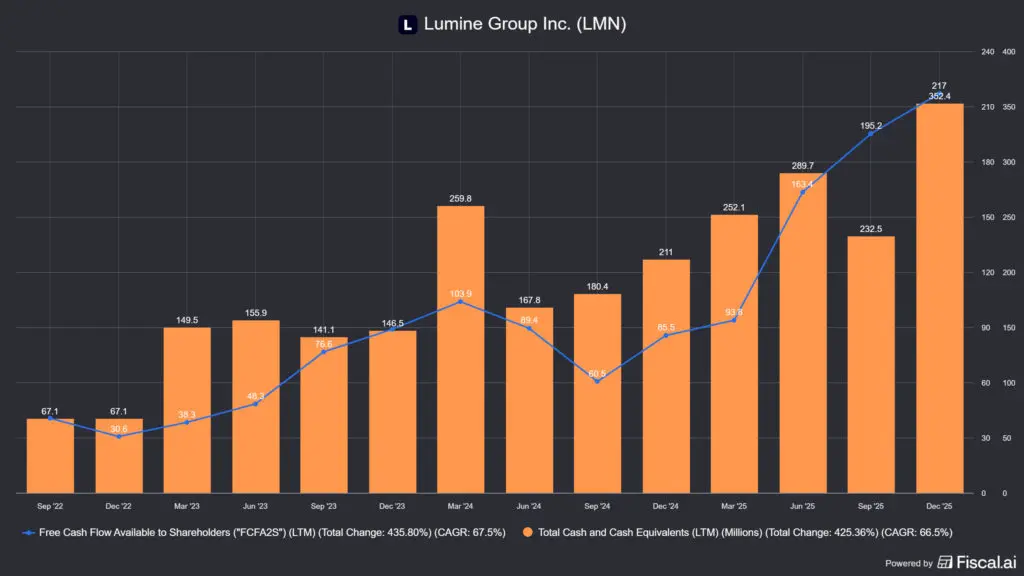
The other thing is that the value of the acquisition should be measured against the available cash, which was ~352 million USD in 2025, meaning that a significant part of this was consumed by the 260 million USD Synchronoss acquisition. Since the acquisitions of Videspine and Datafusion were also made in 2025, where the amounts of the acquisitions were not disclosed, I can easily imagine that the company will only make small, store-on acquisitions in the rest of 2026, but it is also possible that there will be no more acquisitions.
🤵The Lumine Group (TSX:LMN) management🤵
In this section, I examine who runs the company and how. What is the bonus system, how much risk – skin in the game – do the managers take on while running the company? Is there a family connection, or perhaps a special “heritage” factor?
The key person at Lumine Group (TSX:LMN) is David Nyland, who is both CEO and a member of the board of directors. Former Constellation Software veteran, a key figure in the Volaris group, a true key figure responsible for IT and acquisitions. In most of the videos, he also discusses the strategy of Lumine Group. Since LMN is an extremely diversified company, the daily operational tasks are not carried out by the management and board members, but by the management of the acquired companies. Capital allocation and resource allocation, however, are managed by the parent company, whose management is divided into two parts, which are supervised by the board members:
- 👔 actual management: 10 people (company managers),
- 🤝 company development: 10 people (the team working on acquisitions),
- 🏛️ board of directors: 8 people (body supervising management).
🦸These 28 people are responsible for making sure everything runs smoothly within Lumine Group, which is a fairly low number for a company with a market capitalization of 5.2 billion CAD and now comprising 34 companies.
Since each company in the Constellation Software family is extremely decentralized, the organization trains capital allocators in-house, thereby reducing key personnel risk. The CSU family does not use acquisition brokers, like, say, RÖKO AB, which is why they created the corporate development group alongside the management, who follow prospective targets, evaluate companies, and apply the Playbook, which contains the corporate development methodology, to the merged companies after the acquisitions.
🦸Lumine Group Management
🥷David Nyland (CEO)
He is the CEO and a member of the board of directors of Lumine Group (TSX:LMN). He is responsible for the overall strategic direction of LMN and the global portfolio building. Since 2013, he has led the construction of Volaris/Lumine, which now has over 30 acquisitions and over 1000 customers in the telecommunications and media software space. He began his career as a software developer, then led and sold several successful startups to strategic acquirers.
The most interesting thing about David Nyland is that he started his career as an IT professional, specifically developing for telco companies, and later he was responsible for acquisitions in Constellation's Volaris operating group (OG). So essentially, he went from Volaris to head Lumine, meaning he comes from within, with roughly 20 years of management and acquisition experience. CSU founding member, excellent capital allocator.
🧑🍼Tony Garcia (COO)
Tony Garcia is the Chief Operating Officer (COO) of Lumine Group, with over 28 years of experience driving profitable growth for digital software companies. He is responsible for leading the global operations of over 30 businesses, 4500 professionals, and over 1000 clients. Prior to joining Lumine, he held CEO and COO positions at a number of private and public companies.
🙍♀️Mary Anne Lavallee (CFO)
Mary Anne Lavallee is the Chief Financial Officer (CFO) of Lumine Group, joining the company in 2025, bringing significant experience in financial leadership, operational excellence and value creation. She was previously CFO of Gateway Services and prior to that, spent nearly a decade at Postmedia, where she was Vice President, Chief Financial Officer and Transformation Officer responsible for financial operations and enterprise-wide transformation programs. She has also held leadership positions at BlackBerry and began her career in the audit business of KPMG. Her expertise includes driving strategic growth, improving operational efficiency and supporting complex M&A initiatives.
In addition to them, the management team consists of 7 other members, who apply the "Best Practice" methodology (the so-called Playbook) adopted from Constellation Software and Volaris Group to the acquired companies.
📌In practice: I usually look askance when the CEO also serves on the board, but in the case of David Nyland, an exception can be made because Constellation Software is the majority owner of Lumine Group, so they have actual control due to the majority of votes. Another reason is that Mark Miller, the director of CSU, is also the chairman of the board of directors of Lumine Group, so the parent company's ability to enforce interests cannot be questioned.
🤵Members of the Lumine Group Board of Directors
🧓Mark Miller (CSU CEO)
Chairman of the Board of Directors, who is also the Executive Chairman of Volaris Group and the Managing Director of Constellation Software, has been a member of the Board of Directors since the end of 2025. He has extensive experience in the software industry, holding positions at organizations such as ventureLAB and the Computer Modeling Group. He holds a degree in Mathematical Statistics from McMaster University.
👊Another interesting fact is that for about 20 years he was the right-hand man of Mark Leonard, the founder and former CEO of Constellation Software (CSU), who resigned at the end of September 2025 due to health reasons.
According to most sources, Mark Miller is almost as good an asset allocator as Mark Leonard, and a worthy successor. Another interesting fact is that two of the companies mentioned above also have in-depth analysis on the iO Charts website:
- 💻Computer Modelling Group (CMG) stock analysis
- 🧠Constellation Software (CSU): the serial acquisition machine
💁Brian Beattie (Volaris CFO)
Volaris Group’s Chief Financial Officer (CFO) has over 30 years of financial experience. He joined Constellation Software in 2005, having previously been the CFO of Perseus Group. He is an expert in M&A processes, from due diligence to capital allocation, and also oversees legal, tax and IT functions.
🙍♀️Laurie Schultz (CSU director)
Laurie has over thirty years of experience in the software and technology sector, having previously held leadership positions at Intuit and Sage, among others. He was the President and CEO of Galvanize from 2011 to 2021, and has been a member of the board of directors of Constellation Software since November 2021. He received his MBA from the University of Alberta.
💁Eric Mathewson (WideOrbit CEO)
He is the founder (1999) of WideOrbit, a media buying and selling automation company that manages over $35 billion in advertising revenue annually. He previously worked as a portfolio manager at Montgomery Securities and Kidder Peabody, primarily focusing on equity derivatives.
Eric Mathewson joined the company in 2023 when Constellation Software acquired WideOrbit and merged it with the telco and media companies of the Volaris group to form Lumine Group (TSX:LMN). Naturally, the former CEO of the largest company could not be left out of the board of directors.
🙍♀️Lucie Laplante (Independent director)
Lucie is the Chair of the Audit Committee and an independent director. She has over 15 years of leadership experience in finance, having previously served as CFO of companies such as Beanfield, Allstream and Norton Rose Fulbright Canada. She began her career at Nortel Networks and is currently a board member of several organizations, including OntarioMD.
💁Paul Cowling (Independent director)
An independent director, he is currently the Head of Legal and Corporate Affairs at Cogeco Inc. He previously served as the General Counsel of Xplore Inc. and Shaw Communications before moving to the telecommunications sector, where he spent 10 years advising on M&A and securities law. He received his law degree from the University of Toronto and Columbia Law School.
🙍♀️Rosalind Singleton (Independent director)
Rosalind is an independent observer, CEO of Spring Fibre and Chair of the UK5G Advisory Board. She has over 30 years of experience in the technology and telecommunications sectors. He was previously Managing Director of UK Broadband and also works as an independent consultant and angel investor in the UK.
🙍♀️Antonietta Mastroianni (Independent director)
Antonietta is an independent observer and is currently the Chief Digital and IT Officer (CDIO) of Proximus in Belgium. She has over 20 years of experience in the telecommunications industry, having previously held senior management positions at TDC and Sunrise. She was named Telecoms Female Leader of the Year in 2022.
📌In practice: A recurring theme is that the boards of directors of companies affiliated with Constellation Software are filled with CSU executives. Not only are Lumine and Topicus such companies, which are direct spin-offs of CSU, but also Computer Modelling Group, which is an independent company but a similar serial acquisition company to CSU. Also worth mentioning is Kelly Partners Group, where Andrew Cunningham, another highly skilled director affiliated with CSU, was a former board member.
💸Lumine Group: executive compensation (2025)
The executive officers are called NEOs, they are the CEO, CFO and CTO and other key executives. Since Lumine Group is part of the Constellation Software family of companies, the remuneration of both Lumine and Topicus is determined by the parent company. This also means that LMN follows the same scheme as CSU, with the difference that the remuneration of the people holding joint management positions is paid by Constellation.
Remuneration structure:
- 💰 Base salary + annual incentive bonus (+ discretionary increased bonus).
- 🚫 No stock options or long-term equity program, equity exposure is secured by mandatory share purchases, no dilution. This is called SBC elsewhere, which means that employees and managers are given stock options and this dilutes the owners' stake, which is typically compensated for by share buybacks. This burns capital, but Lumine and all CSU family members are completely exempt from this.
Bonus calculation:
- 🧮 Formula: base salary × company performance factor × individual factor.
- 📊 The company factor is based on ROIC (reduced by a 5% risk-free rate) and net sales growth. This is the aforementioned IRR, which is used to calculate the internal rate of return. Historically, this has been around 25% for all three companies, and will decrease as size increases.
- ⚠️ If ROIC does not exceed the 5% threshold, there is no bonus, which is justified given that the weighted average cost of capital, WACC, is around 8-10%, and if it is higher than ROIC, the company is destroying value.
Mandatory share purchase (skin in the game):
- 📈 75% of the after-tax bonus must be invested in Lumine shares (100% in the case of an increased bonus). This means that employees buy their own company shares from the market! This is an exceptionally rare remuneration structure.
- ⏳ 5-year vesting period (equal in years 3–4–5), meaning that the shares cannot be sold for this long.
- 🔒 In case of early exit, unvested shares will be returned to the company at a price of 0.01 USD/piece.
Remuneration of Board of Directors members:
- 🪑 75000 CAD/year base + 25000 CAD/year per committee membership.
- 🛒 50% of the fees must also be invested in shares, with a minimum lock-up period of 4 years.
Important note:
- 🔗 President Mark Miller and Brian Beattie (former CFO) are not paid by Lumine, but by Constellation Software / Volaris Group, so Lumine-level compensation costs are relatively low.
📌In practice: I think all CSU spin-offs have exemplary management compensation, I've never seen anything better. It's completely in line with the interests of shareholders, but I've read that many companies of similar market size pay better than Constellation Software and its smaller brothers. However, it is very telling that there are 3000 employees at CSU who became millionaires from the rise in stock prices, in USD, of course.
🆚Competitors: the Lumine Group (TSX:LMN) opponents🆚
In this section, I examine who the competitors of the analyzed company are, what is their market position, whether they are in a subordinate, secondary or superior role. What is their market share and what is their specialty? Are they losing or gaining market share to their competitors?
You will find Lumine Group (TSX:LMN)’s opponents in two groups. One is the set of serial acquirers, in this capacity the Constellation Software family of companies competes with opponents such as Roper Technologies, Danaher, Dover and I could list more. Over the years, countless copycats have appeared in the industry that wanted to copy the CSU methodology, with more or less success. Starting from the book The Compounder, rather with less, and moreover, if I take serial acquirers moving in the VMS space as a basis, then only a company called Vitec Software can be considered. I have cut here the “DNA map” from the Constellation Software analysis, which presents the opponents of the Constellation family well, more here:
🧾 Summary – CSU DNA Map
| Category | Examples | CSU similarity |
|---|---|---|
| 🧠 Pure decentralized serial acquirers | Indutrade, Lifco, Addtech, Addlife, Lagercrantz. Judges Scientific, Vitec Software | 80-100% |
| 💼 Centralized capital allocator holdings | Roper, Danaher, Ametek, Heico, Transdigm | 60-75% |
| 🧱 Smaller decentralized roll-ups | Diploma, Halma, Teqnion, Tyler Tech, Rentokil, SP Group, Rotork | 40-60% |
| ⚙️ Integrated growth companies, partly from M&A | OpenText, SiteOne, Waste Connections, TopBuild | 30-50% |
However, since this analysis is about Lumine Group, a VMS specialist acquiring media and telco companies, and not CSU, it is worth looking at which companies are most likely to be acquired by telco and media companies. There are probably thousands of companies here, but the most significant are those operating in the OSS/BSS segment, as 22 of the 34 entities acquired fall into this category. The two largest acquisitions were WideOrbit (media) and Synchronoss (telco), which generated roughly $170 million in revenue each, which is 50%, or roughly 1/2, of Lumine Group's ~$765 million expected revenue in 2026. If I include smaller companies in Synchronoss' revenue, we get roughly 500 million USD, so I'm not wrong about 66%, or 2/3 of the revenue.
☝️Based on this, OSS/BSS is the dominant segment, the media segment accounts for 25-30% of revenue, while the rest accounts for approximately 5%. Of course, these are not official figures, just estimates, but they provide a good basis for finding competitors.
The OSS/BSS market can basically be divided into three or four large groups based on the size of the companies, their global presence, and their technological focus. While Amdocs and Huawei are the "omnivorous" giants, Lumine (with its many small companies) competes more with their flexibility and filling market niches.
The “Big Five” (Tier 1 – Full Portfolio)
These companies serve the world's largest telecommunications operators (Verizon, Vodafone, Deutsche Telekom) and cover everything from infrastructure to mobile applications.
- 🏆 Amdocs: is the market leading OSS/BSS operator. It is primarily dominant in the BSS (billing, customer management) side, but in recent years it has also grown enormously in the OSS (network control) area.
- ⚔️ Netcracker (NEC): Amdocs's biggest direct rival. It is exceptionally strong in the OSS segment and cloud-based network automation. CSG International, one of the most dominant billing specialists in the US cable television and telecommunications market, operates in the BSS segment, which is why NEC acquired them in October 2025.
- 📡 Ericsson: Although primarily a hardware manufacturer, its software portfolio (Digital Services) is one of the most influential OSS systems in the world.
- 🛡️ Nokia: Even after the sale of Motive, they still had significant software solutions (AVA platform, NetAct), especially in the areas of network security and AI-based optimization.
- 🌏 Huawei: The master of China and the developing world. They offer fully integrated, vertical solutions from network hardware to the most complex billing systems.
📌In practice: While I was reading about Lumine, a company called Cerillion PLC came up that was worth analyzing, and I realized that small, medium and large companies often compete with each other. For example, Cerillion won several tenders against Amdocs and the NEC+CSG duo. However, these are specialized players, most of them are either hardware manufacturers or just BSS/OSS players, not a Swiss army knife like Lumine Group.
Software Giants (Enterprise Tech)
Tech giants that are not only telco-specific, but are also indispensable in the sector due to their backend systems (databases, cloud).
- 💎 Oracle: world leaders in the field of "Monetization" and complex data management processes.
- 🧠 IBM: They are especially strong in network monitoring (Tivoli/Netcool legacy) and AI-based analytics.
- 🗼 HPE (Hewlett Packard Enterprise): They focus on software services for edge computing and 5G networks.
Billing and Revenue Management Specialists (BSS focus)
These companies are Cerillion's direct competitors. They are often faster and cheaper than the big guys.
- ☁️ Optiva (formerly Redknee): They specialize in cloud-native BSS solutions, built specifically on Google Cloud.
- 🌍 Tecnotree: is exceptionally strong in developing markets (Africa, Latin America) with their digital marketplace solutions.
Regional and “challenger” actors
- 🧩 Comarch: a Polish-based European giant that offers highly flexible and modular OSS/BSS systems.
- 🐋 Whale Cloud (Alibaba Group): a dominant player in the Asian market, bringing Alibaba's cloud technology to the telco sector.
- 📱 ZTE: Huawei's little brother, with a similarly complete portfolio but a smaller market share.
The model of Lumine Group (and its parent company, Constellation Software) is completely unique. They don't sell a single giant software, but rather acquire smaller companies that dominate niche markets.
- 🗡️While Amdocs is a "Swiss Army knife", Lumine is a whole "toolbox" in which each tool (e.g. Netadmin for optics, Tarantula for tower management) is the best in its field.
- 🏁Their competitive advantage is that they don't want to beat the big guys in everything, but are present where it is no longer worth developing for the giants.
📌In practice: Lumine Group can deliver a ready-made package to telco and media companies, there is no need to connect other service providers left and right to provide a complete service, as all solutions are available under one umbrella. Since all software is mission-critical and highly sticky in nature, there is almost zero churn, and customer acquisition comes from acquiring additional companies in the case of LMN. Since none of the above are serial acquirers in the traditional sense of the word, there is very little overlap in this regard.
Moreover, according to the CSU “Playbook”, Lumine Group pays close attention to valuation when making acquisitions, so it can jump ahead of venture capital funds if they try to force it to price compete. Since the media and telco segments are very fragmented, Lumine can find plenty of targets using Constellation’s database, which contains 40-50,000 targets.
💎Thus, due to its special corporate structure, Lumine Group (TSX:LMN) has to deal with relatively few competitors, because it either simply avoids opponents or chooses targets that are low-value, slow-growing companies.
⚡What are the risks of Lumine Group (TSX:LMN)?⚡
In this section, I examine all the risks that could affect the company's long-term future. Currency, regulatory, market disruption, and so on.
In this section, I usually write about things like key personnel and foreign exchange risk (FX), the impact of tariffs, management overpayments, the draining effect of competition, cyclicality, inflationary pressure, but Lumine is almost free of all of these. Instead, other factors arise from the special operation that must be taken into account. The Lumine Group business model is based on the proven recipe of Constellation Software (CSI): They buy up small, mission-critical software companies and keep them forever. Although this model is extremely stable, new types of threats emerge as it grows.
Narrowing of acquisition targets and the economies of scale trap
As Lumine grows, it needs more and bigger acquisitions to maintain its previous growth rate. While previously acquiring companies worth $5-10 million would have significantly increased revenue, now, with a market cap in the billions, these no longer “move the metric.”
- 🌀 More complex transactions: Deals the size of WideOrbit or Synchronoss are much rarer and more complex than those of small software houses, thus concentrating the risk.
- 🎯 Fewer “clean” targets: The OSS/BSS and Media sector is finite, and most of the best, stable cash-flow generating companies are either already sold or too expensive.
- ⚠️ Forced diversification: If targets in key segments run out, management may be forced to make acquisitions in areas where they lack expertise.
📌In practice: The above is much more true for CSU than for Lumine Group, as it is a company that was spun off in 2023, so they are not yet in danger of running out of targets, but I would like to use an example to illustrate how serious a problem this could be over a decade:
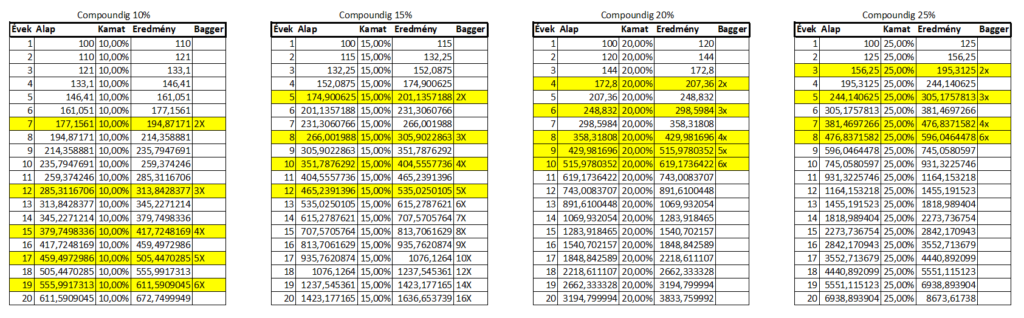
In the image above, you can see how the power of compound interest affects cash generated. A company that grows at 10% per year will double the cash it generates every 7-8 years, while one that grows at 25% will double it roughly every 3 years. Investors like to see as much growth as possible, but the problem with this is that if a company is buying companies with $5-10 million in revenue, then with 25% growth, it needs to double the cash generated and therefore the number of targets every 3 years. It would need to be able to acquire 9x as many companies in 10 years, and 86x as many in 20 years to sustain its growth, which is nearly impossible (but Constellation Software did it).
The answer to this was the separation of Lumine and Topicus from CSU, which brings us to the second problem: If we don't want to increase the number of companies we acquire, we need to reduce their size or the rate of growth.
Increasingly expensive acquisitions and cost of capital
Lumine's success has also attracted the attention of other capital allocators (Private Equity firms, investment funds). Increased competition for vertical software companies is driving up the purchase price, which is worsening the return on investment.
- 💼 Presence of financial investors: Private equity funds are often willing to pay more for a company because they want to exit with leverage over a 3-5 year period, while Lumine buys for eternity.
- 🏦 Interest rate environment: Since the owner often uses credit for acquisitions, persistently high interest rates directly reduce the profit remaining for shareholders and worsen returns.
- 📉 Lower ROI: if the purchase price is higher, the return on equity decreases, which can lead to stagnation in the share price.
📌In practice: The above means that there is more competition for larger companies, which means their pricing is higher, which worsens the return, but in return their organic growth may be higher, which can make up for the lost return from higher pricing. This is why the WideOrbit and Synchronoss acquisitions are in the order of 100 million and not 10 million, but the number of these targets is finite. In the image below you can see how the companies of the CSU family look compared to each other, in proportion to their revenue, from this you can deduce the run-off time (which is still many years).
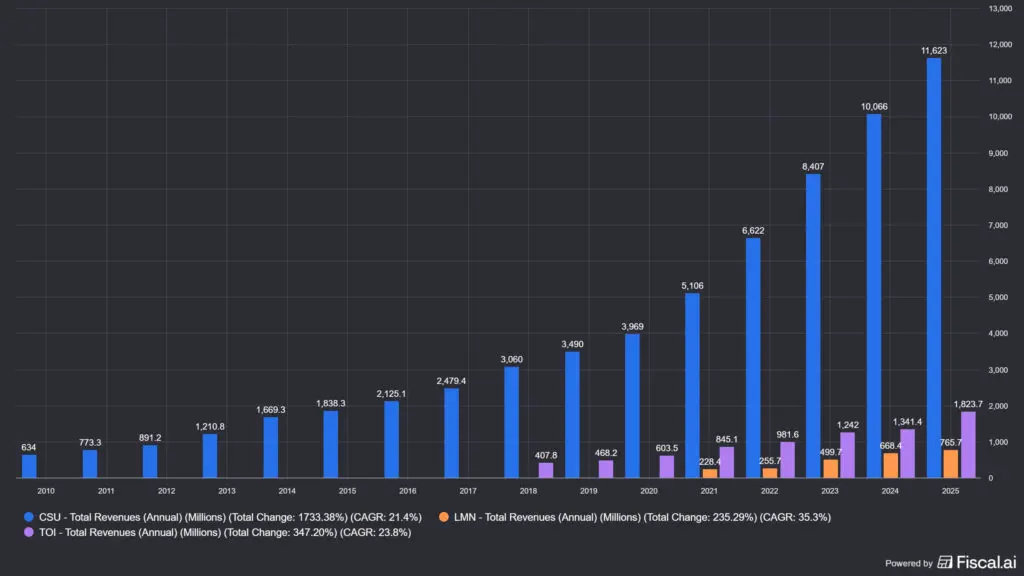
A company's growth can't be infinite, but that's not the case for Lumine Group for now. Assuming they had ~$766 million in revenue in 2025 and Constellation Software had $773 million in 2011, their growth is very similar, so it would take them another 15 years to get to where CSU is now, all things being equal.
The decline of corporate culture and decentralization
One of Lumine's greatest assets is its decentralized model: each acquired company retains its own management and identity. As the portfolio swells to 40-50, then 100 companies, the efficiency of central control and knowledge sharing may deteriorate.
- 👤 Diluting talent pool: It is difficult to find or develop a leader of the caliber of a small company who understands the Constellation philosophy.
- 📑 Bureaucratization: With growth, layers of internal regulation inevitably emerge, which can kill the very flexibility that made companies sell themselves to Lumine.
- 😫 Integration fatigue: If the center (Lumine management) becomes overwhelmed by overseeing many small companies, important strategic adjustments may be missed in the weaker performing portfolio elements.
📌In practice: I've read about this risk in many places, but if there's one thing I'm not worried about, it's this one. It turns out that a lot of capital allocators were trained in-house, the current CEO, David Nyland, spent more than 10 years within Constellation, just moving from one chair to another. This pattern has been repeated several times, talented leaders move to the heads of BUs, from there to OGs, and finally to spin-offs, but board members also sit on the boards of other companies and transform the organizational culture there as well. So, as a kind of capital allocator academy, they solve this task themselves.
Technological obsolescence and lack of organic growth
Much of Lumine's portfolio is legacy software. While these generate stable revenue, they can be technologically vulnerable to new, cloud-native or AI-based solutions.
- 🤖 AI disruption: If a new AI-based startup automates the billing or networking tasks that a Lumine company does for a tenth of the price, customers may defect (this almost certainly won't happen, due to the mission-critical, sticky nature of software).
- 📉 Low organic growth: Lumine companies typically only grow 1-3% organically. If the acquisition engine slows down, the company's growth story could end (which is much more likely).
- 💸 Overpayment risk: Larger companies cost more, so Lumine has to acquire companies at higher valuations. If they misvalue companies for some reason, returns will be cut and the math won't work out.
- 🧪 Research and Development (R&D) pressure: Modernizing old systems can consume huge amounts of money, which reduces the cash available for dividends or new acquisitions (but AI can also be a tailwind here).
📌In practice: I think the overpayment and execution risk are completely real, especially since, based on the CSU logic, they can even acquire companies with declining sales, if the valuation is low enough. This is where the many “best practices” come into play, which either work or not. If the turn around is not successful, then the math will definitely not work out. Synchronoss is exactly such a company, whose revenue has been declining for years, so how the acquired company will function within LMN depends on the execution skills of the Lumine Group management. Since in the B2B sector, where there are mega-companies, the expected growth is theoretically higher than in the case of smaller VMS companies that CSU acquires, I would therefore monitor the growth and ROIC values very closely.
I made a self-check list that confirms the thesis about the company:
- low or zero debt: YES/PARTLY/NO
- significant economic advantage that can be protected in the long term: YES/PARTLY/NO
- excellent management: YES/PARTLY/NO
- excellent indicators, significant owner value creation: YES/PARTLY/NO
- The majority of the total return comes from reinvesting the cash generated, not from dividends: YES/PARTLY/NO
- appropriate company valuation: YES/PARTLY/NO
The above flawless list is essentially the same as the ratings given for Constellation Software, except that the rating has changed since then:
This also means that the parent company's excellent management, corporate structure, and corporate culture are essentially identical, as are the company's operations and internal logic. This cannot be otherwise, since CSU holds the majority of the votes attached to the shares, so the smaller one is essentially a copy of the larger company. However, this also brings risks, so anyone who has trouble sleeping with Constellation Software will also have trouble sleeping with Lumine Group and Topicus.
👛Lumine Group (TSX:LMN) Valuation👛
In this section, I will examine the company's current valuation compared to historical values and consensus fair values.
Rating metrics
In the two rows below you can see valuation metrics. The first row shows the current valuation, the second row shows the historical valuation. Although I don't think these metrics are particularly good - they hide a lot - they can be used as a benchmark.
- Share price (2026-04-29) 20.08 CAD; P/E: 31.96; EV/EBITDA: 13.23; P/FCF: 15.69 (Based on Gurufocus)
- Historical median valuation (10-year average): P/E: 50.9; EV/EBITDA: -3.04; P/FCF: 51.19 (Based on Gurufocus)
- Peter Lynch median P/E: 34.78
In the case of Lumine Group (TSX:LMN), P/E and EV/EBITDA are essentially useless for valuation, and since Lumine has been on the stock exchange for a very short time, this makes the situation even more difficult. Did you think it was over? No, because by March 25, 2024, the former special shares were also converted into regular shares, where some investors could exit, so until then, to put it mildly, it cannot be said that real market conditions prevailed around the share.
Why don't you see a DCF model in this segment? Because each input data produces a huge variance in the output, and most of the data is an estimated value. Therefore, the valuation will never actually be a single exact number, but rather a range can be defined where the current valuation falls.
🤔You should apply a margin of safety to this price range, according to your risk appetite.
So don't expect an exact price, no one can tell you exactly what a stock will be. However, there are fair value prediction services, almost every major stock screening site has one, I've aggregated them below.
Rating (TSX:LMN)
- Wall street estimates: 15.92-33.35=24.6 CAD (I took into account the average of the two extreme values of Alphaspread:)
- Morningstar: 36.36 CAD (3 stars)
- Peter Lynch: 41 CAD
- Gurufocus: 44.53 CAD
- AlphaSpread: 22.13 CAD (9% overvaluation compared to the base case)
- SimplyWallst: 44.25 CAD
Average (based on 6 reviews): ~35.5 CAD (undervalued by 43.44%)
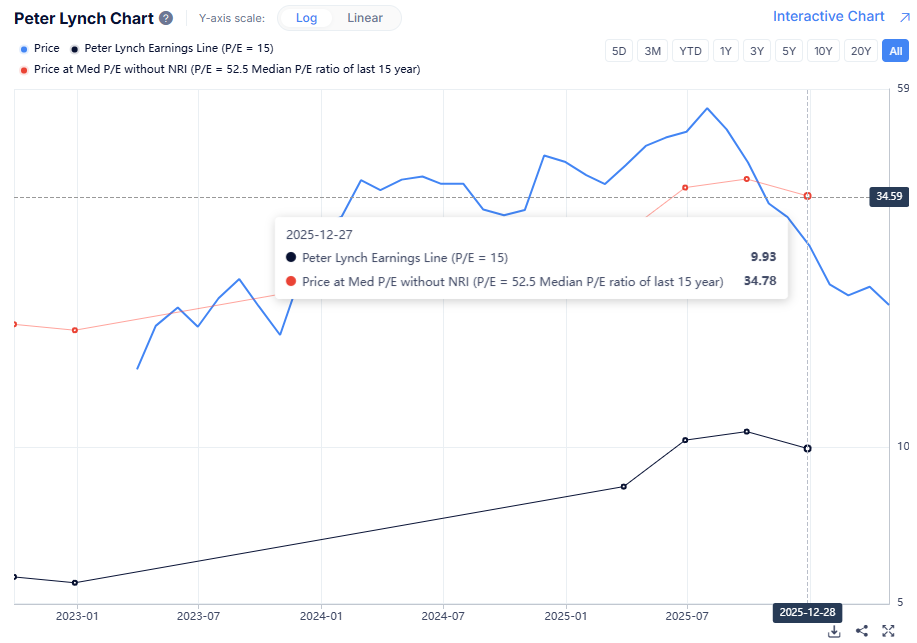
How to interpret the numbers? The above "margin of safety" rule should be applied according to your convictions, so if you really believe in the company, you can buy it at fair value, but if you proceed in 10% increments (whose convictions are strong), the math would look like this:
- 10% margin of safety: 35.5*0.9= 31.95 CAD
- 20% margin of safety: 35.5*0.8= 28.40 CAD
- 30% margin of safety: 35.5*0.7= 24.85 CAD
- 40% margin of safety: 35.5*0.6= 21.30 CAD
- 50% margin of safety: 35.5*0.5= 17.75 CAD
Of course, the list could be continued indefinitely, but the point is that the right purchase price for you is determined by the degree of your conviction.
The problem with the above is that serial acquirers are very difficult to value using traditional metrics, and it is no coincidence that Lumine Group uses its own metrics. One such metric is the FCFA2S value, which is how much free cash is available to owners. This is very similar to what is commonly referred to as FCF yield, but it is a modified version of it. If I assume that the price is falling but the FCF yield is rising, then the stock will be historically undervalued. And this is exactly what is shown in the picture, the FCF yield was higher once in recent years, when the stock fell to 18 CAD.
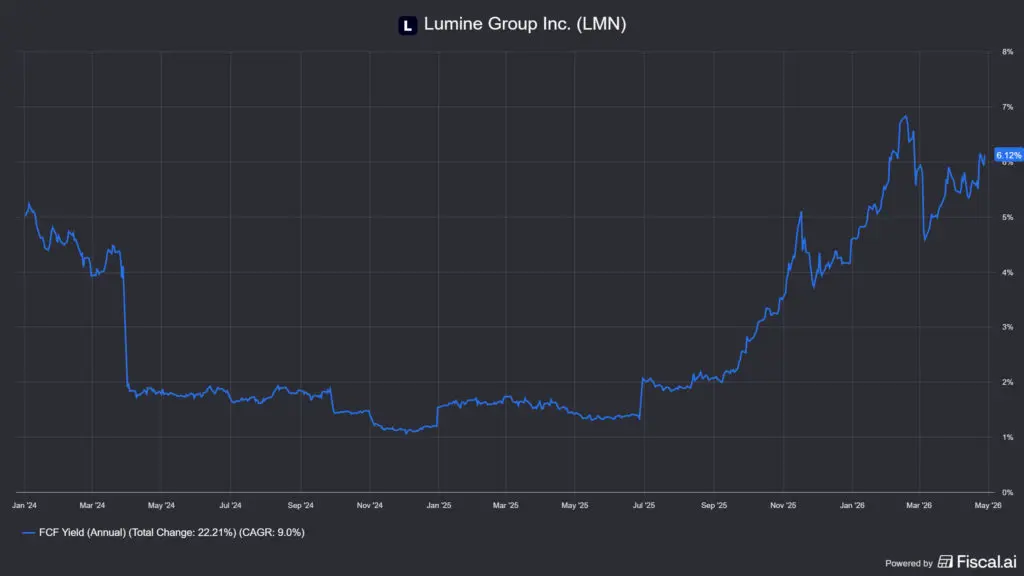
In the image below you can see the decline in Lumine Group's share price, which is actually the inverse of the FCF yield, as shown in the image below.
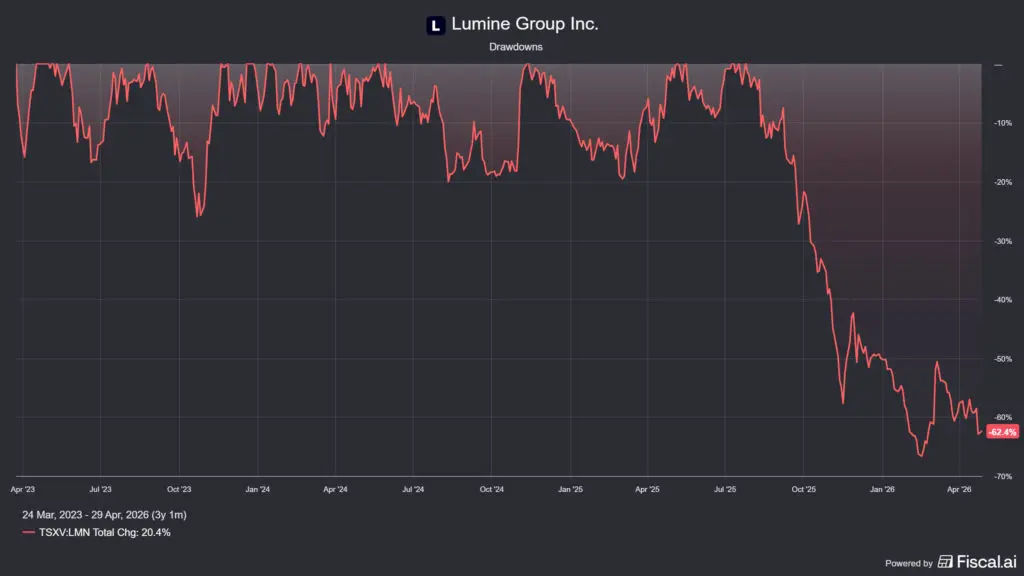
To sum up, Lumine Group's stock looks cheap both historically and in absolute terms. You can't really look at industry valuations because there are very few VMS telco companies in the market that are also serial acquirers, and apples are only worth comparing apples to apples. Given that the other members of the Constellation family are also VMS serial acquirers, it's worth comparing the valuations with the other two companies:
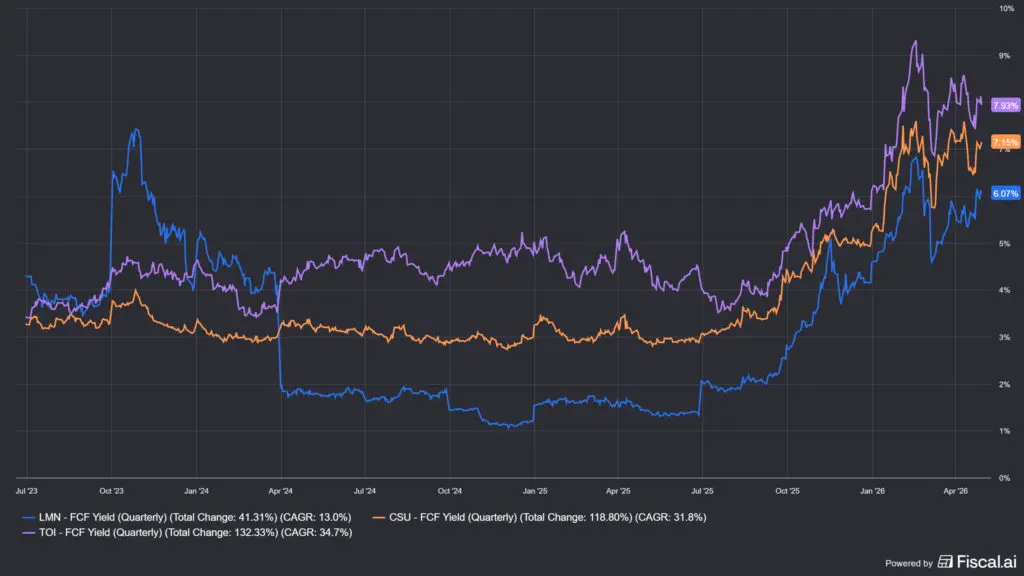
As you can see, the three companies move together and Lumine is the most expensive in terms of shares, but it is also cheap. Since the price does not directly indicate the quality of the companies, it is enough to see that all three stocks are well within the acceptable range. That is, Lumine Group (TSX:LMN) is cheap, but Topicus (TSX:TOI) and Constellation Software (TSX:CSU) are even cheaper in proportion.
🌗Significant news and the last quarter🌗
In this section, I will examine what happened in the last quarter, whether there were any significant news/events. If the company reports semi-annually, we examined this period.
The first thing you need to know is that Lumine Group – like CSU and Topicus – does not hold quarterly conference calls, except when something really important happens, and then they always do. In addition, the three companies also keep the annual investor briefing together. They also do not give forecasts, so you will never see them cut or raised. However, since all companies are required to publish quarterly reports, we of course know the content of the 4th quarter report at the end of 2025.
2025 Q4, key financial indicators
- 💰 Revenue: It increased 16% to USD 216.3 million in the fourth quarter of 2025 and 15% to USD 765.7 million in the full year of 2025. Organic growth was 1% in both periods (adjusted for foreign exchange).
- 📊 Operating result: It grew by 29% to USD 88.4 million in the fourth quarter of 2025 and by 31% to USD 275.7 million in the full year of 2025.
- 🏆 Net result: It jumped 69% to $49.6 million in the fourth quarter of 2025. For the full year 2025, the company reported a net profit of $118.8 million, a significant turnaround from a net loss of $258.9 million in 2024.
- 💸 Operating cash flow (CFO): It grew by 34% to USD 71.4 million in the fourth quarter of 2025 and by 106% to USD 236.5 million in the full year of 2025.
- 🔓 Free cash flow available to shareholders (FCFA2S): It increased by 48% to USD 67.1 million in the fourth quarter of 2025 and by 153% to USD 217 million in the full year of 2025.
- 🪙 Earnings per share (basic and diluted): USD 0.46 for the full year 2025, compared to USD (-1.21) for 2024. The apparent increase is deceptive because 2024 was distorted, so it is much more worthwhile to start from quarterly results.
Legfontosabb tanulságok
The most significant development is the company's successful transition from a large net loss in 2024 to a strong net profit in 2025, which is purely for accounting reasons. This is largely due to the mandatory conversion of senior and special securities in March 2024, which eliminated a significant cost category. This structural change fundamentally improved the company's profitability profile, but in fact this was predictable.
As you can see, revenue increased by "only 15%" in 2025, while operating profit increased by 31%, but other metrics similarly lagged behind revenue. This is very good news, as it means that the Playbook is working, meaning that the methodologies have brought about internal efficiency improvements. In this spirit, we will also have to pay attention to the Synchronoss acquisition, because significant improvements will also be needed there. This will be worth monitoring closely.
📌In practice: It is important to understand that Lumine Group (TSX:LMN) is a countercyclical company, but acquisition targets do not come one after another, the company often waits for the right opportunity. Capital allocation is also uneven, when there is a good opportunity, more than 100% of the cash is allocated, with the help of debt. It is completely normal that some years there are 0 or very few acquisitions, while other years there are much more.
❗So, don't be surprised if there are no acquisitions, no interesting news, and seemingly nothing is happening. This is a terribly boring, long-term stock and that's fine, but you have to believe that the managers are doing their thing behind the scenes and the company is growing just like it has been.
Summary of Lumine Group (TSX:LMN)
Summary of the analysis, drawing lessons.
I think serial acquisition companies are like diamonds in a haystack. Most people don't notice them, or if they do, they don't understand them, and the human mind has a hard time grasping the compound interest effect, which is also present in this case. Yet all such companies, including Lumine Group, operate in this way: they quietly take advantage of years of continuous growth while giving the impression of a pretty boring stock. There are very few real competitors on the market that can be compared to it, and it is more likely to struggle against its own limitations.
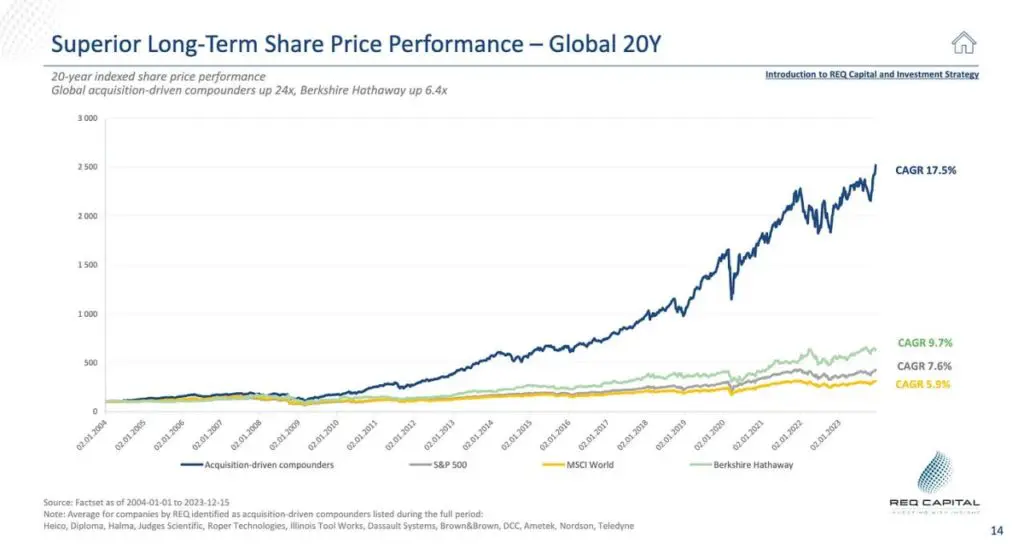
Lumine Group's main risks stem from internal execution and having the right and sufficient number of targets, but in some places they also have to compete with private capital for targets to be acquired. However, its fate is mostly in its own hands, it is difficult to disrupt, so whether the stock can be bought is primarily a question of pricing. And now it's cheap enough, so this could be a good opportunity to take a position, not only in relation to Lumine Group, but also in the case of Topicus and Constellation SoftwareThat's why you should also read the parent company's analysis for a deeper understanding:
🤑If you are interested in what brokers we use, read our articles below:
(I.e.Interactive Brokers broker account analysis – Professional for professionals
📈LightYear Broker Account Analysis - Simplicity and cheapness go hand in hand
Frequently Asked Questions (FAQ)
What is Lumine Group and what does the company do?
Lumine Group is a global software holding company and serial acquirer, specializing in vertical market software (VMS) in the communications and media sector. The company's core philosophy is a "buy, build, and hold forever" strategy, which means that acquired companies are never sold, but are developed in a decentralized manner, transferring industry best practices to further develop their profitability.
How is Lumine Group (TSX:LMN) related to Constellation Software?
Lumine Group (TSX:LMN) was originally a business unit of Constellation Software (Volaris Group) and was spun off as a separate, publicly traded company in 2023. Although Lumine operates independently, the relationship remains close: Constellation Software is the majority owner and controller of voting rights, and Lumine has access to the parent company's decades-old knowledge base and extensive acquisition database.
What is the difference between Lumine, Topicus and Constellation Software?
While all three companies are part of the Constellation Software ecosystem and follow the same serial acquisition model, their focus is different: CSU is the parent company, present globally and in almost every software vertical; Topicus is primarily focused on the European market and acquiring minority stakes; and Lumine Group dominates the niche markets of telecommunications and media software globally.
What exactly does the serial acquisition business model mean?
A serial acquirer is a company that achieves growth not primarily through organic development, but through disciplined and continuous company acquisitions. In the case of Lumine Group, this means that the free cash flow generated (FCFA2S) is immediately reinvested into the acquisition of new, high-return software companies, thus creating a compound interest-based, decades-long value increase for shareholders.
What software does Lumine Group purchase and why is it called mission critical?
The company acquires vertical market software (VMS) that clients, such as telecom giants or TV channels, need to run their core business without, such as billing systems (BSS) or network operation solutions (OSS). These systems are extremely valuable to Lumine Group because the risk and cost of replacing them is much higher than the annual license fee, so customers remain loyal for decades, ensuring stable cash flow.
How did Lumine Group (TSX:LMN) perform financially in 2025?
2025 was a significant turnaround for Lumine Group (TSX:LMN), as it reported a significant net profit after a technical net loss in 2024, while its revenue grew by 15%. Of particular note was the 153% increase in free cash flow available to shareholders (FCFA2S), which demonstrates the company’s excellent cash generation capacity and efficient internal integration processes. However, it should be remembered that previous figures were largely distorted by the complexity of the share issuance arrangements surrounding the IPO and the conversion of special shares to “common” in March 2024.
What risks should a Lumine Group investor expect?
The main risk is low organic growth (typically 1-3%), which forces Lumine Group to continuously make new acquisitions to sustain its growth story. In addition, larger transactions (such as WideOrbit or Synchronoss) require more complex integration, and increased market competition for targets may drive up purchase prices, which may worsen return on equity (ROIC) in the long term.
Why do they say that management has real capital in the company?
Lumine Group's management compensation follows the strict model of Constellation Software: executives are required to use at least 75% of their after-tax bonuses (in some cases 100%) to purchase Lumine shares on the open market. Since these shares cannot be sold for years, management has a direct financial interest in ensuring that the share price and the company's intrinsic value grow sustainably over the long term.
How undervalued is Lumine Group's stock currently?
Based on the average of various analyst models and fair value estimates, Lumine Group's intrinsic value is around CAD 35.5, which indicates a significant undervaluation of more than 40% compared to the current price of around CAD 20. This difference represents a solid safety margin for investors, although the market price may also be significantly affected by the global interest rate environment and acquisition news in the short term.
Where and how can Lumine Group shares be purchased?
The company's shares are primarily listed on the Toronto Stock Exchange (TSX) under the ticker LMN, but are also available on the TSX Venture Exchange. Investors can access the stock through international brokers such as Interactive Brokers or Lightyear, but since it is listed in Canadian dollars (CAD), it is worth paying attention to currency exchange costs and Canadian withholding tax rules when purchasing.
Legal and liability statement (aka. disclaimer): My articles contain personal opinions, I write them solely for my own entertainment and that of my readers. The articles published here do NOT in any way exhaust the scope of investment advice. I have never intended, do not intend, and am unlikely to provide such in the future. What is written here is for informational purposes only and should NOT be construed as an offer. The expression of opinion is NOT in any way considered a guarantee to sell or buy financial instruments. You are SOLELY responsible for the decisions you make, and no one else, including me, assumes the risk.