

🤔What is the Market Momentum column about?🤔
I don't know if you're aware of this, but a thorough fundamental in-depth analysis can take 40-50 hours. As an investor, it's impossible to put that much energy into analyzing each company if you want to effectively manage a long enough watch list. That's why I created the Market Impulse column, which provides a snapshot of each stock, especially Microsoft, and roughly outlines current events. It is not an in-depth analysis, but rather just food for thought based on the current state.
My goal is not to give daily trading tips or analyze technical patterns. Instead, I provide quick, to-the-point fundamental mini-analyses that help you filter. These impulses help you keep in mind whether the current price movement of Microsoft (MSFT) or another market participant is worthy of deeper investigation or is just a passing market phenomenon.
You can find the share subpage with detailed information here: MSFT stock page
If you are looking for in-depth analyses of the site, click on the link below: iO Charts stock analyses
📒Table of Contents📒
I have created a table of contents to make it easier for you to navigate the content:
- 🎢What does Microsoft (MSFT) do?
- 💵Current status of Microsoft (MSFT) and its competitors
- 🤵Microsoft (MSFT) metrics
- ✅Microsoft (MSFT): will you get used to it or will you run away?
- 📝Summary of the thesis
❓What does Microsoft (MSFT) do?❓
Microsoft (MSFT) is one of the clearest examples of a horizontal software company in the global technology sector. While vertical software serves the specific needs of a specific industry (such as the unique solutions in Constellation Software's portfolio), horizontal software is present in almost every industry and on every desk. Whether it's Windows, Office, or Teams, Microsoft (MSFT) makes tools that a hospital needs just as much as a car factory or a bank.
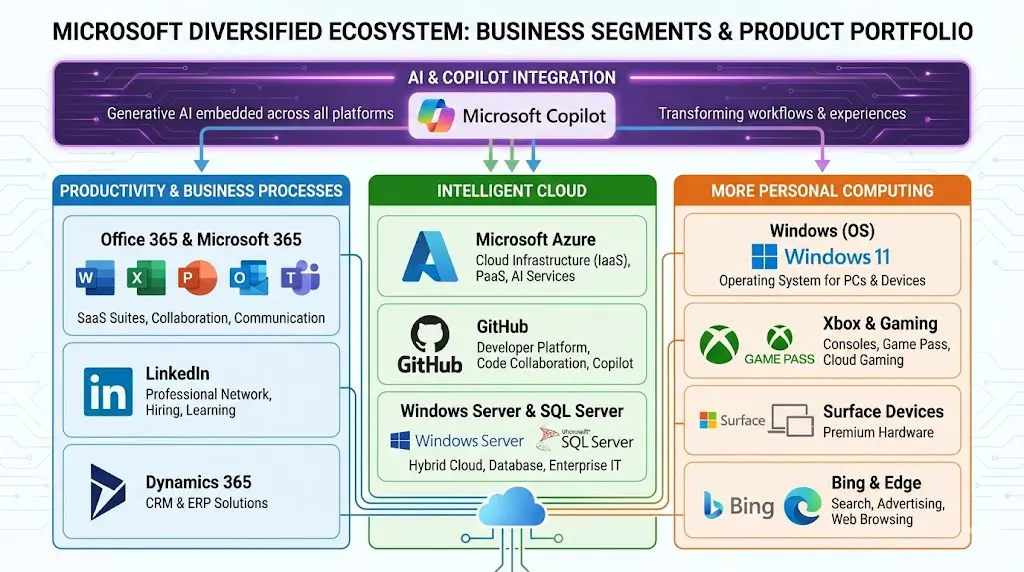
This horizontal nature is what gives the company its enormous size: since its founding in 1975, it has grown into a mammoth corporation employing 220000 people. Its revenues rest on three main pillars: on Azure cloud services, productivity software (in the SaaS model) and personal computing.
🏆Current status of Microsoft (MSFT) and its competitors🏆
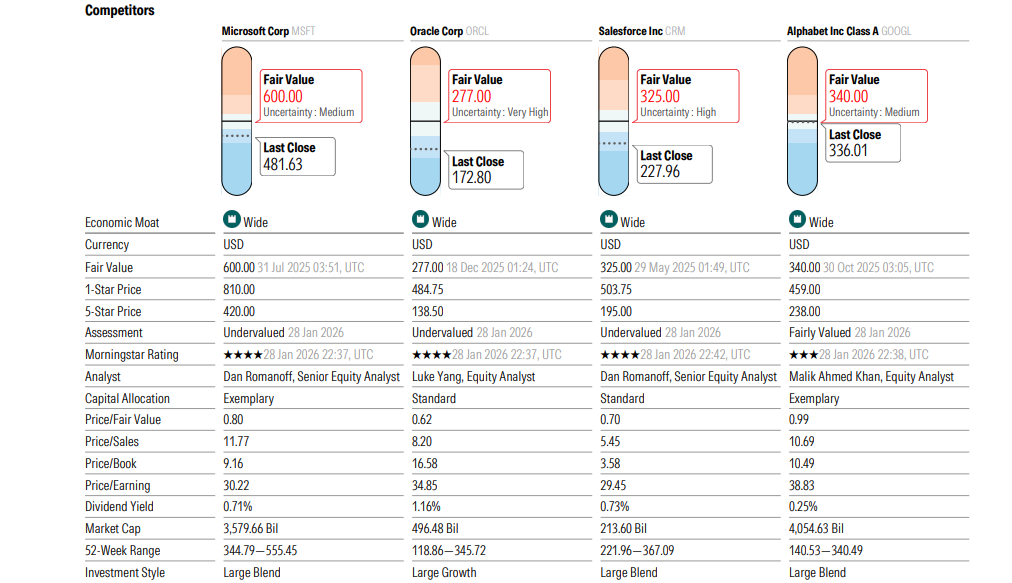
Microsoft (MSFT) is now both dominant and vulnerable. Its biggest battle is in cloud infrastructure, where Amazon (AMZN) AWS's service is its main rival, but Google (GOOGL) Cloud also mobilizes significant resources. In the image below you can see the closest competitors in Morningstar's analysis.
However, it is worth looking further afield: in the global market, especially in the Asian region and in certain segments of cloud-based services, you also have to reckon with giants such as Alibaba (BABA) or Tencent (TCEHY). Although Microsoft (MSFT) still has a significant advantage in enterprise software integration, the technological maturity and aggressive pricing of its eastern competitors may limit Azure's expansion in certain markets in the long term.
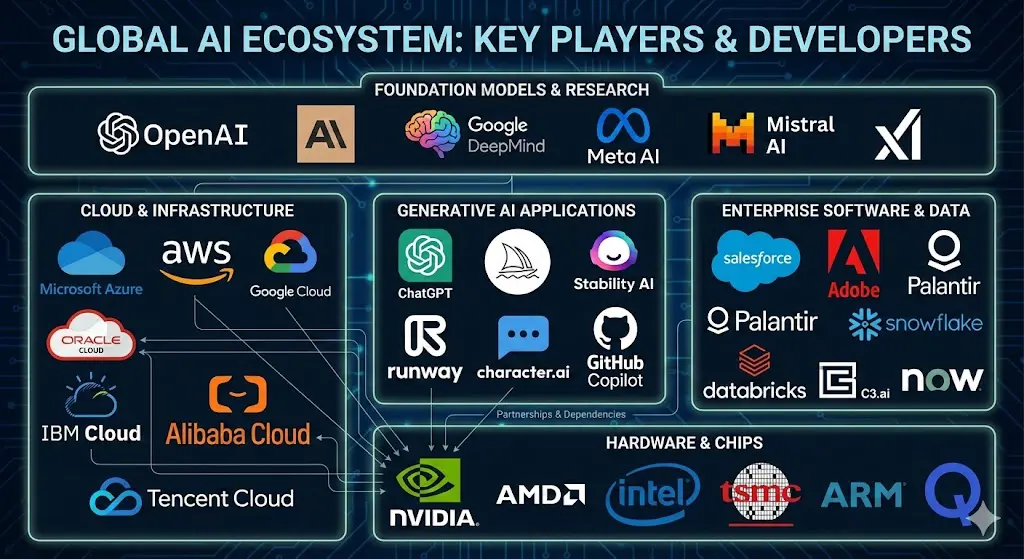
In the field of artificial intelligence, Microsoft (MSFT) is trying to solidify its horizontal dominance through a partnership with OpenAI, hoping that Copilot will become an inevitable part of every existing workflow.

🎢Microsoft metrics🎢
I drew some graphs using the fiscal.ai data source I use to help you understand Microsoft (MSFT) data. The article for Market Impulse does not contain everything, only the essentials that you need to pay attention to. However, once there is an in-depth analysis of it, I will also cover the little things.
📊Price and correction
In the recent period, the price has noticeably moved away from the peaks. From a fundamental point of view, this is interesting when the gap between the company's intrinsic value and the market price starts to widen. What does this mean in practice? The price has fallen by 23.6% compared to the current maximum, or more technically, all-time high, but the picture below shows that this is not a rare case in the case of Microsoft (MSFT)It's more of a completely normal market reaction that happens every few years. The biggest drop in the last 20 years was ~58%, but this ~25% drop has been repeated quite a few times.
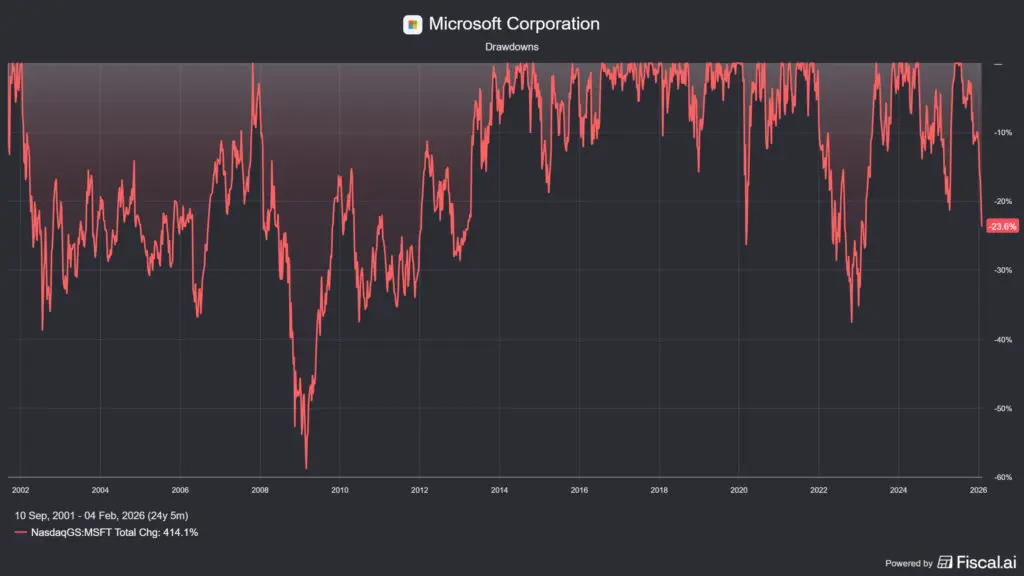
The question is whether the fundamentals have changed. What can be done in such a situation? You need to look at how Microsoft's (MSFT) underlying metrics relate to the price. The fall could mean a decline in underlying value, market panic or some event that investors have priced in. Of course, the opposite is also true, there are events that can be known in advance, but are not reflected in the price, such as the expiration of Novo Nordisk's (NVO) Wegovy and Ozempic patents in early 2026, and the resulting -20% price drop. I mentioned this fact in my analysis, but the market has only now reacted: Novo Nordisk Stock Analysis (NVO) – Sell and consume quickly.
🪙Valuation: EV/NOPAT vs. price
The NOPAT yield (company value compared to after-tax operating profit) often says more than the P/E ratio. If you see that the share price is falling but the NOPAT yield is rising, then the company has become relatively cheaper. Of course, it is also possible that both indicators increase, but the exchange rate increases more slowly, so even a company with a constantly higher exchange rate can be cheaper. But what is NOPAT yield? EV/NOPAT tells you how many years of operating profit you are buying the company for, while NOPAT yield expresses in percentage form how much “operating return” you get for your money. Returning to the first paragraph, in the case of Microsoft (MSFT), the first case is true, the share price falls, the NOPAT yield rises, as can be seen in the picture.
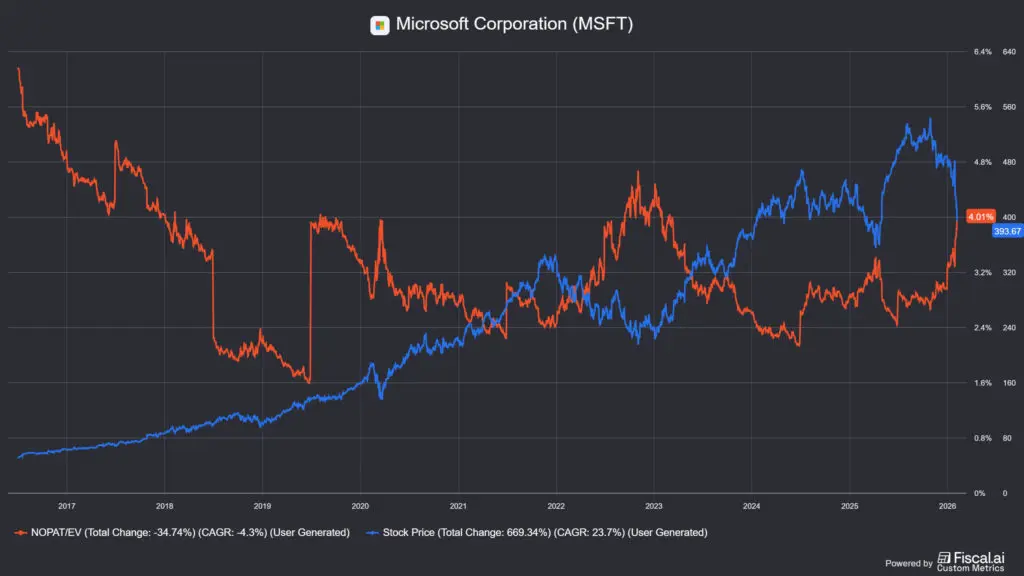
However, this is not enough to determine whether the stock is cheap, since you don't know what the historical average was, but I calculated this for you:
- 🎯NOPAT yield (currently, at 416.5 USD exchange rate): 4.01%
- 📜NOPAT yield 20-year average: 5.76%
- 🗓️NOPAT yield 10-year average: 3.6%
- 📊NOPAT yield 5-year average: 3.1%
- 🕒NOPAT yield 3-year average: 2.83%
That is, the company is currently slightly cheaper than the 10-year, 5-year, and 3-year averages. From there, it's up to you to decide whether that's cheap, but I wouldn't say Microsoft (MSFT) is overvalued. However, it's worth considering how realistic the 20-year average, which includes the 2008 crisis, is.
🫰Revenues and profitability
You can see the revenue and operating profit in the image below, the amount of which is important not only because it shows whether the company is successful, but also because the cash generated from this allows Microsoft (MSFT) to finance its brutal AI investments and other developments.
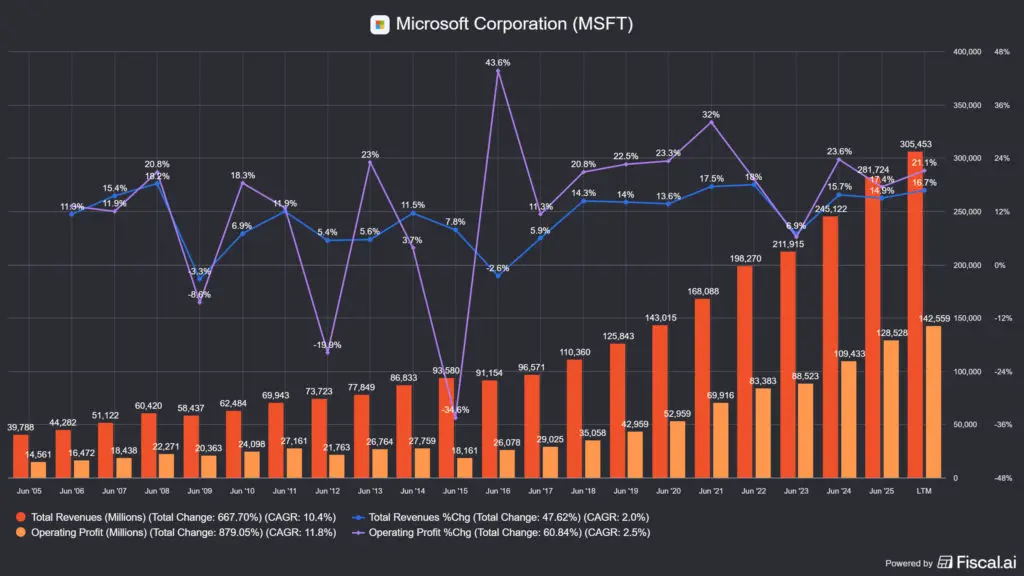
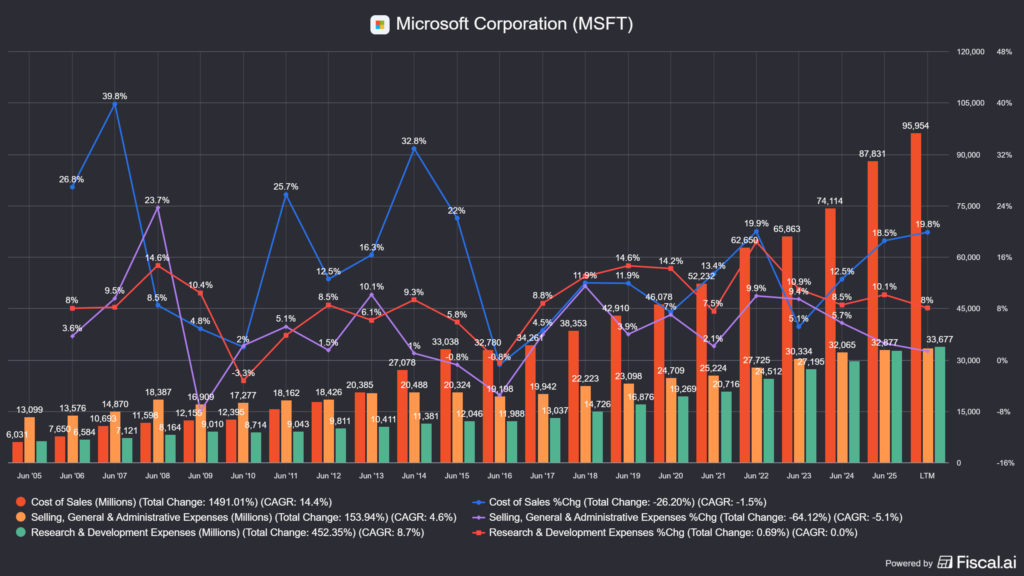
Revenue growth remains stable, but the development of profit margins deserves attention. Building AI infrastructure (CAPEX) takes up significant capital, which the revenue side must compensate for sooner or later. In the image below, you can see that costs are essentially following the growth of revenue and operating profit. In other words, sooner or later, the capital poured into AI by Microsoft (MSFT), more specifically into Copilot and OpenAI, must be repaid. But that's okay for now, the company's revenue and expense sides are in proportion to each other.
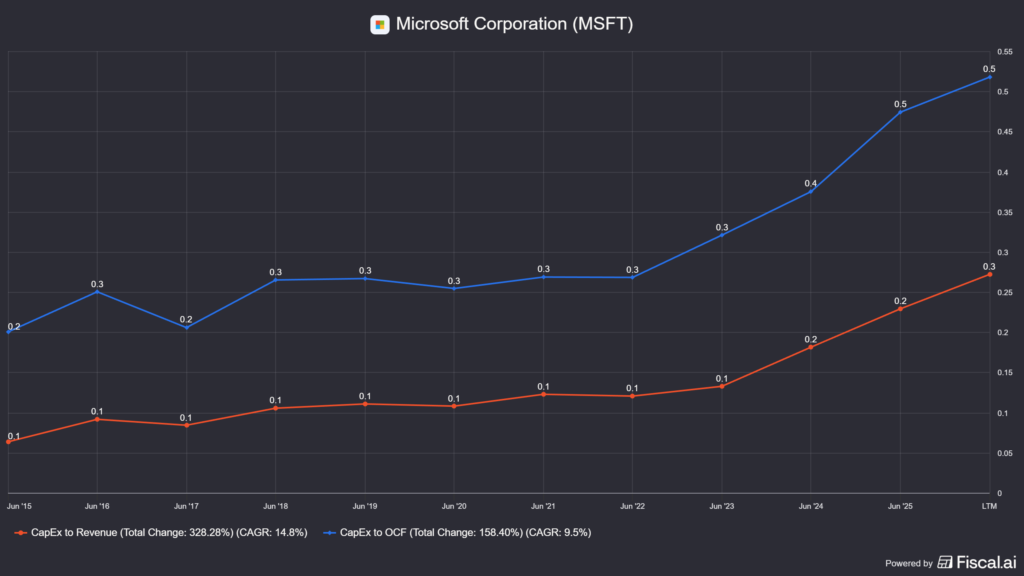
If I plot CAPEX, or capital investment, separately on a graph, it becomes much more impressive: AI development is eating up money, as can be seen in the figure below.
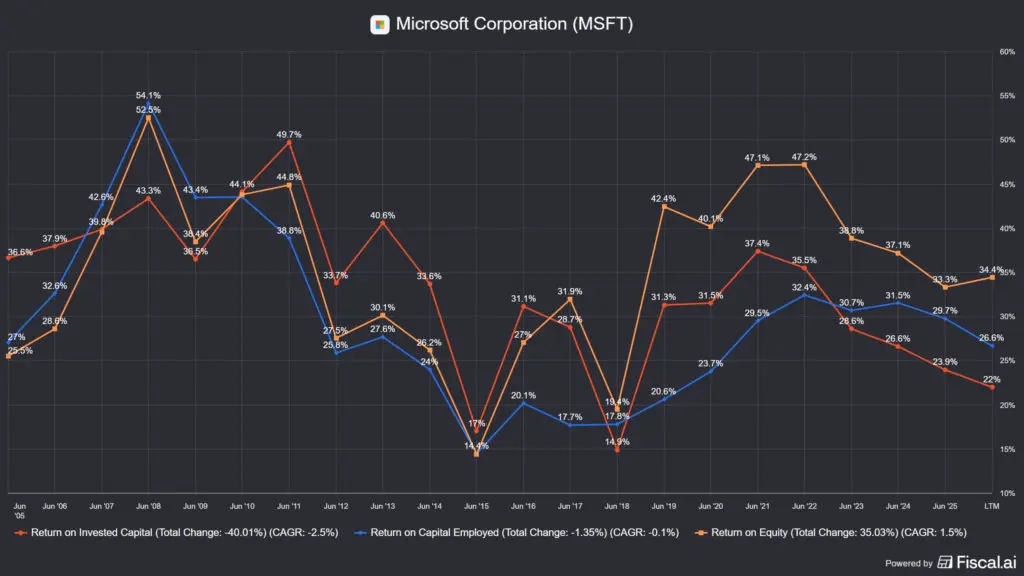
🤞Efficiency: ROIC and ROCE
This is where the company's true strength is visible: ROIC and ROCE indicators are consistently above 25-30%. Simply put, this indicates that management is reinvesting capital with exceptional efficiency. If these numbers were to start to deteriorate, it would indicate a more serious structural problem, but for now they show stability. Here too, it is worth looking at multi-year averages, as fluctuations are a completely normal phenomenon, especially when capital flows into a technology that is not yet profitable.
🎲Risk factors: debt, remuneration and share dilution
The issue of Microsoft's (MSFT) debt can be handled relatively easily:
- 💵cash: 89.5 billion USD
- 👛net debt: USD 33 billion (debt-cash)
- 💵net profit: ~120 billion USD
The debt is marginal, annual profit would be more than three times enough for Microsoft (MSFT) to pay it off, so there's not much to worry about.
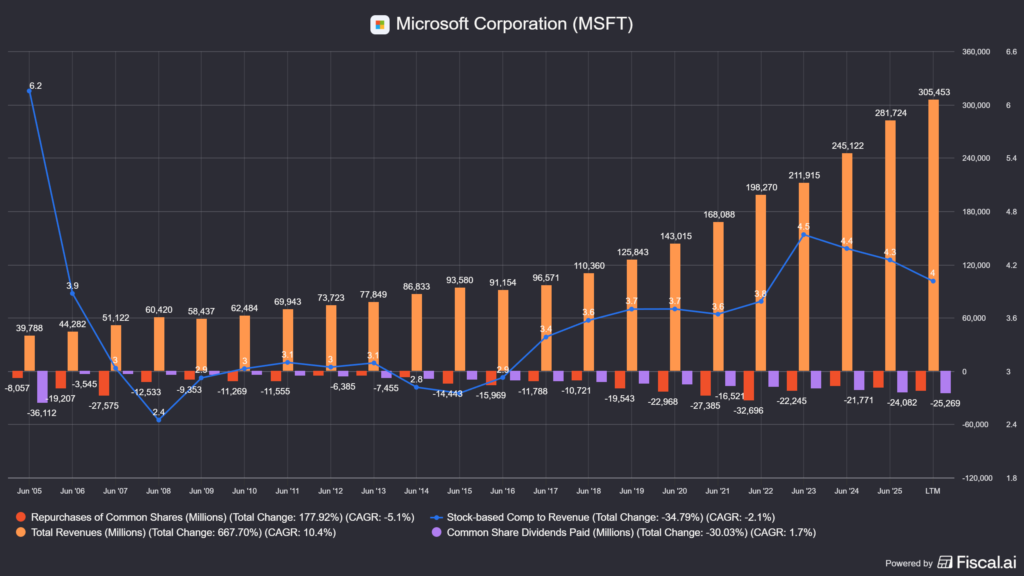
High share-based compensation (SBC) is a common phenomenon among horizontal giants. It's worth keeping track of how much stock the company gives to employees and how much pressure it puts on free cash flow. This is normal for companies like Microsoft (MSFT), as they have to somehow retain talent, and this can only be achieved by making them interested in the company's success. The stock-based compensation, which is usually ~4% of revenue, is covered by share buybacks that exceed this, although not by much. Since Microsoft (MSFT) also pays a dividend, there is additional shareholder value creation here as well, but this is not a classic dividend stock, it is more worth taking a position in the company because of its growth.
💵Microsoft(MSFT): will you get used to it or will you run away?💵
As with all companies, there are always two narratives at Microsoft, which is often called the battle of the bulls and the bears. Optimists and pessimists fight their eternal battle, but no one knows in advance who will be right. However, there are a few ideas that can support both sides in the case of Microsoft (MSFT):
🐂Bulls say (Optimistic scenario):
- 🪐Ecosystem inclusion: Once a company has adopted Microsoft 365 and Azure, the switching costs are so high that they almost “lock” customers in. This is called high switching costs in technical terms, which is one of the company’s competitive advantages.
- 🌐AI Upscaling: Adding AI capabilities to the existing horizontal user base (hundreds of millions of users) can result in huge margin expansion at minimal additional cost. Google is leading the way in this, but Microsoft also has enough platforms to do this, just think of Windows, Microsoft Office or their server software.
- 🪙Capital allocation: The company remains one of the world's best cash-flow generators, which provides a safety net for shareholders, as you saw above.

🐻Bears say (Pessimistic scenario):
- 🌴Growth Limits: With such a large size, maintaining 15-20% growth year after year is increasingly difficult, and the market immediately punishes if the numbers fall short of expectations. With a market capitalization of 3150 billion USD, it is the 4th largest company in the world, even despite the significant drop in share price.
- 🩹Horizontal vulnerability: The biggest threat to the AI revolution is that horizontal, general-purpose software is easier to “replace” with specific AI agents than deeply integrated, vertical industry software. In this regard, for example, Constellation Software (CSU.TO) or Topicus (TSX:TOI) are much more protected software companies.
- 🔍Margin pressure: from Nvidia (NVDA) due to purchased chips and data centers with incredible energy requirements, the profitability of cloud services may shrink.

📝Microsoft (MSFT) Situation Summary📝
I find Microsoft's (MSFT) current malaise to be an important reminder: Even companies with the best fundamentals are not immune to valuation corrections, especially if the market panics about the overwhelming power of artificial intelligence. ROIC and operating profit remain impressive, but the emergence of AI challengers in the horizontal software market warrants closer monitoring. Of course, it's worth asking yourself which companies have the most money to integrate AI services that will generate real profit? Certainly mammoths like Microsoft (MSFT) have a good chance of doing so.
Remember, this mini-analysis does not replace your own research, but it will help you decide whether it is worth devoting dozens of hours to an in-depth analysis of Microsoft (MSFT) or whether it is enough to just keep the paper on your watchlist. In any case, this price correction already makes the company worthy of being listed, and then we'll see where the price goes next.
If you want to analyze further, use iO Charts' stock finder and portfolio manager, which you can access here: iO Charts.
🤑If you are interested in what brokers we use, read our articles below:
(I.e.Interactive Brokers broker account analysis – Professional for professionals
📈LightYear Broker Account Analysis - Simplicity and cheapness go hand in hand
Frequently Asked Questions: Professional Questions About Microsoft (MSFT)
When is the next dividend due and how much is it?
Microsoft (MSFT) last raised its dividend to $0.83 per share in late 2024. Ex-dividend dates typically fall in February, May, August, and mid-November. On an annualized basis, that currently yields about 0.7%-0.8% at the current price. Microsoft isn't a typical dividend-paying stock, but that might be important to some.
What is the difference between Azure IaaS and PaaS services?
In the world of Cloud, IaaS (Infrastructure as a Service) is like renting an “empty server.” In the case of PaaS (Platform as a Service), Microsoft (MSFT) already provides the environment necessary for software development. The latter means higher added value and better profit margins for the company.
Why is AI more dangerous for horizontal software?
Because horizontal software (e.g., a simple word processor) performs common tasks, AI models can more easily learn to replace them. In contrast, vertical software (e.g., a pharmaceutical company's quality assurance system) contains unique regulatory and process knowledge that a general AI has a harder time mastering.
What exactly does CAPEX growth mean in the reports?
This means capital investments. In the case of Microsoft (MSFT), this now primarily covers building supercomputers and data centers for AI. As an investor, you should be watching to see if this spending is reflected in the growth in revenue (ROI) later on.
How does the dollar exchange rate affect Microsoft's (MSFT) earnings?
Since more than 50% of revenue comes from outside the U.S., a strong dollar hurts earnings due to currency translation. When the dollar weakens, the foreign currency received for exported software is worth more, which improves the balance sheet.
Legal and liability statement (aka. disclaimer): My articles contain personal opinions, I write them solely for my own entertainment and that of my readers. The articles published here do NOT in any way exhaust the scope of investment advice. I have never intended, do not intend, and am unlikely to provide such in the future. What is written here is for informational purposes only and should NOT be construed as an offer. The expression of opinion is NOT in any way considered a guarantee to sell or buy financial instruments. You are SOLELY responsible for the decisions you make, and no one else, including me, assumes the risk.