
?What is the Market Momentum column about??
What influences the change in MOL's share price? Is it worth buying the paper now or is it worth waiting until the NIS deal is finalized? How do the state plans affect the company's profitability? These questions were on my mind when I started writing this article, even if the goal was to only contain a collection of thoughts, rather than to create a real in-depth analysis.
I don't know if you're aware of this, but a thorough fundamental in-depth analysis can take 40-50 hours. As an investor, it's impossible to put that much energy into analyzing each company if you want to effectively manage a long enough watch list. That's why I created the Market Impulse column, which provides a snapshot of each stock, specifically MOL's affairs, and roughly outlines current events. It is not an in-depth analysis, but rather just food for thought based on the current state.
My goal is not to give daily trading tips or analyze technical patterns. Instead, I provide quick, to the point fundamental mini-analyses that help you filter. These impulses help you keep in mind whether the current price movement of MOL (MOL.BUD) is worth further investigation or is just a passing market phenomenon.
You can find the share subpage with detailed information here: MOL.BUD stock page
If you are looking for in-depth analyses of the site, click on the link below: iO Charts stock analyses
?Table of Contents?
I have created a table of contents to make it easier for you to navigate the content:
- 🍎What does MOL do?
- 💡MOL's current situation and competitors
- (I.e.MOL's metrics
- ✅MOL: will you get used to it or will you run away?
- 📝Summary of the thesis
❓ What does the MOL Group do?
I have written about the oil industry in more depth in two articles on the iO Charts blog, as we bought a large number of American oil companies in 2020-21, since even then we did not believe that the oil price could remain negative in the long term (it did not). It is worth reading these articles to understand exactly what an oil company does and how they differ from each other.
MOL, or Hungarian Oil and Gas Plc., is a company that has been continuously rewriting the rules of the Central European energy market since its founding in 1991 – previously operating under the name National Oil and Gas Trust – and in 2026, it once again became the center of attention with an acquisition on a geopolitical scale. The Budapest-based group, led by Zsolt Hernádi for 26 years, is the region's leading integrated oil and gas player and the largest company in Hungary in terms of revenue. Going beyond the classic upstream-downstream logic, it now operates a diverse business portfolio ranging from the circular economy to gas station retail. The word "integrated" is key here: the company covers the entire value chain, from the drilling rig to the gas station.
Its activities are divided into four main segments:
- ?Circular Farming: MOL took over the Hungarian waste management concession for 35 years from 2023. This is a lower-margin but extremely stable business that provides regulated cash flow, which is a guarantee of the green transition, but according to bad language, it is actually just a state payment point.
- ?Upstream (Research-Production): This business is responsible for the extraction of crude oil and natural gas. Although the domestic fields are mature, MOL is also present in the Adriatic, Kurdistan and Azerbaijan (the latter with the ACG field is one of the group's crown jewels). When oil prices are high, this segment drives up profits.
- ??Downstream (Processing and Trading): This is where crude oil is refined into diesel, gasoline and chemical products. The refineries in Százhalombatta (Dunai) and Bratislava (Slovnaft) are among the most complex and efficient plants in Europe, which is a huge competitive advantage.
- ⛽Consumer Services: this means the gas station network. MOL has long been selling more than just fuel; with the Fresh Corner concept, it has become one of the largest coffee shop and retail chains in the region, which is less dependent on oil price fluctuations. Interestingly, in Hungary, Fresh Corner and thus the MOL group sell the most brewed coffee, as the margin is usually significantly higher than, for example, fuel sales.
Although it is a well-known fact in Hungary, it is worth mentioning that the Hungarian state has a significant stake in the MOL group, through various foundations, and MOL is often called a “state” oil company. This is not true in this form, as MOL’s public share is ~61.5%, but the state indirectly owns approximately 30.5% of it, so it has a significant influence on what happens in MOL.
?In practice: In connection with the above, the thought occurs to me that MOL may seem to be a fundamentally relatively simple company at first glance, but in reality it is not at all. Behind the simplicity lies an extremely complex geopolitical and regulatory matrix. Whoever buys MOL is not buying a product, but a regional energy infrastructure, with all the institutional and foreign policy risks and opportunities that this entails.

? MOL's current situation and its competitors?
Oil companies are typically CAPEX heavy, with their revenues highly dependent on oil price fluctuations. Since they own a large number of physical assets, depreciation is a significant item in the balance sheet and income statement, and revenue and profit figures must also be adjusted for the effects of oil and gas price fluctuations. For this reason, oil companies often work with CCS (Current Cost of Supply), i.e. adjusted results calculated at replacement cost.
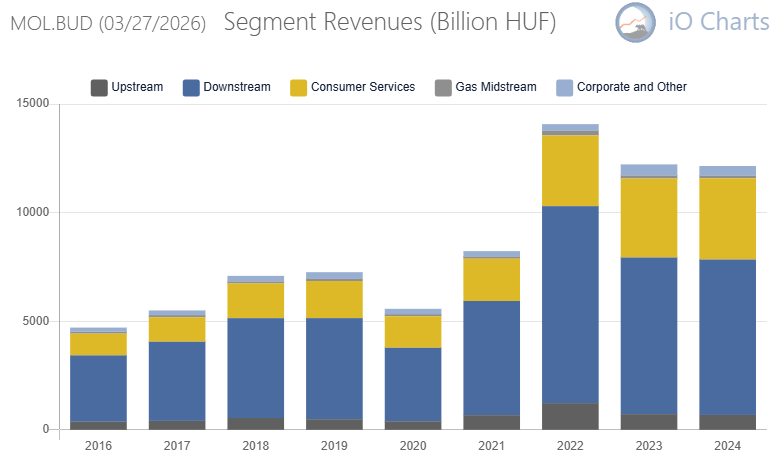
The problem in the oil industry is that refiners hold huge inventories of raw materials. If the price of oil rises, the previously cheaper inventory becomes more valuable on paper, and this inventory gain is included in the accounting profit, while it does not reflect operational performance, but simply the change in price. The opposite is also true: when oil prices fall, inventory losses occur, which worsens the result, also regardless of operational efficiency. This distorts the numbers in ways that are not apparent at first glance, so if you want to analyze such a company, you have to make a lot of corrections. I will largely ignore this now, because this is not an in-depth analysis, but it is worth being aware of the above.
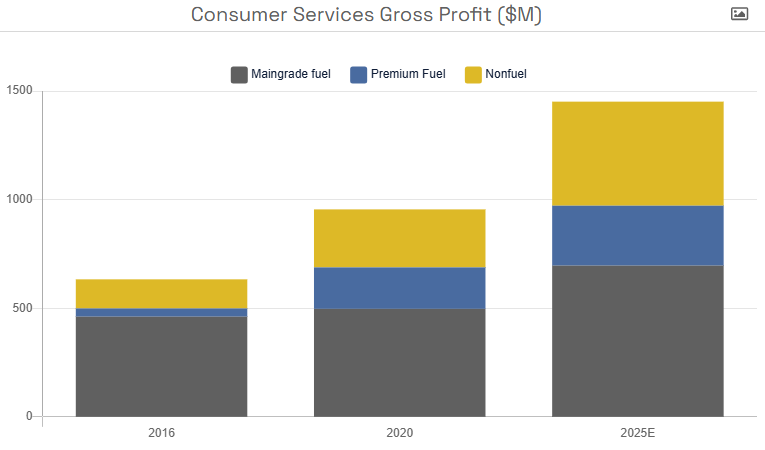
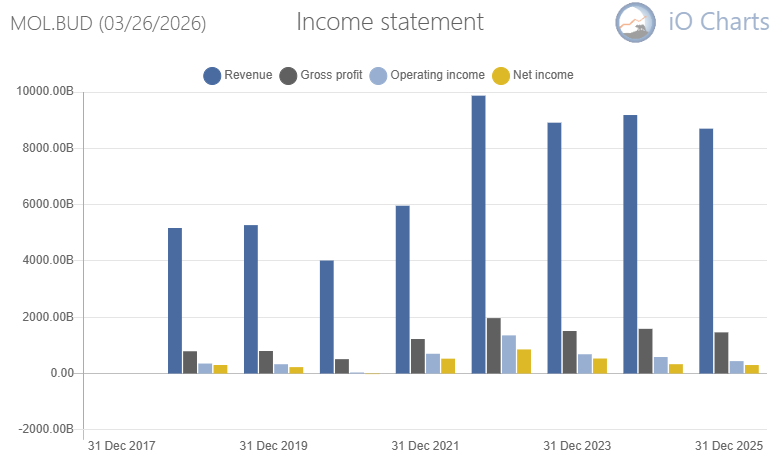
The company generated EBITDA of $3.055 billion in 2025, a 22% increase year-over-year. Q3 2025 was particularly strong: quarterly EBITDA increased to $885 million, compared to $677 million in Q4, but when you adjust for the aforementioned CCS, the numbers look even better. Operating income in 2025 was ~$1.1 billion – down 18% year-over-year due to higher impairments and one-offs – but management expects a significant improvement in 2026.
?️The NIS acquisition may have an impact on MOL's share price
The most interesting recent event is certainly the acquisition of NIS in Serbia. In January 2026, MOL signed a binding letter of intent to acquire Gazpromneft’s 56.15 percent stake in NIS. The deal follows sanctions imposed on the Russian property in October 2025, forcing the Pančevo refinery to shut down and pushing Serbia to the brink of an energy crisis. MOL simultaneously offered Belgrade a solution and acquired strategically valuable assets in the country. The purchase price is estimated at between EUR 900 million and EUR 1.4 billion, according to various sources. The question is what the fair value could be, but some experts estimate the fair value of the 56 percent package to be close to EUR 1.4 billion, and at this price the transaction is value-adding. Analysts estimate the total value of NIS at EUR 2.5-3.2 billion, so the acquired controlling stake does not seem expensive even at the higher purchase price.
It is also worth knowing that a new oil pipeline is being built between Hungary and Serbia, so MOL could take on a transit role with the help of the approximately 300-kilometer pipeline to be built in the future between the countries, the maximum capacity of which could reach 5.5 million tons per year: Világgazdaság article about the transit pipeline.
?MOL's competitors
From the perspective of its competitors, MOL competes in a specific industry environment. The natural basis for comparison is the range of regional integrated oil companies:
- OMV (Austria): the strongest competitor in the region. Integrated model, similar refining assets, but a much larger upstream portfolio and a more active LNG strategy. The fire at OMV's Schwechat refinery in 2022 and the temporary outage at MOL's Százhalombatta refinery in 2025 also showed how much single-refinery exposure depends on an operational event, fortunately MOL has a refinery not only in Százhalombatta, but also in Bratislava through its Slovak subsidiary, Slovnafto. NIS's Pančova unit can further increase diversification and thereby reduce such risks.
- PKN Orlen (Poland): the largest oil refinery in the region, the “bird well network”. With the acquisition expansion of recent years (Lotos, PGNiG, Repsol Polska), it far exceeds MOL in size. However, PKN’s stock market valuation has historically been discounted due to political risks and Polish state influence, but such mergers can also be observed in Hungary.
- ENI, Shell and TotalEnergies: These three global players compete with MOL in retail and have a strong regional filling station network, but are not direct competitors in MOL's focus market in upstream and refining.
? In practice: MOL is undoubtedly the leading oil company in Hungary, but it is also playing an increasingly important role in the region, as it has interests in Slovakia and, if all is true, in Serbia in the future. As for the well network, MOL has approximately 500 filling stations in Hungary, Shell has roughly 210, and OMV has 170. The former Lukoil filling network was taken over by Orlen, which means approximately 70 locations.
We should also not ignore the fact that MOL pays significant amounts into the Hungarian budget through fuels – there was an excise tax of ~158 HUF/liter on gasoline and ~149 HUF/liter on diesel in the first quarter of the year, which is added to VAT, so the tax content of fuels is roughly 250-280 HUF – in the form of extra profit tax, VAT, TAO and other items. Since the fuel price is also a political issue – it is currently maximized by an official price in Hungary – this adds an extra uncertainty factor to the analysis and MOL cannot remove itself from this. As an investor, you also have to take this into account.
?MOL's metrics?
? Exchange rate and catalysts of the year
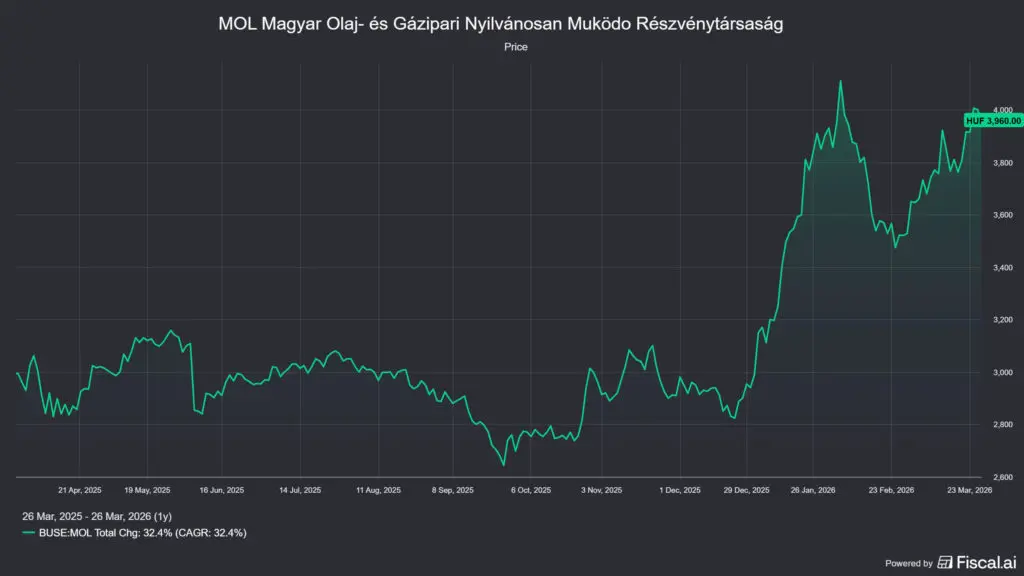
MOL's share price showed a spectacular rally in early 2026: it rose roughly 25 percent in less than a month and a half, primarily following the announcement of the NIS acquisition. Near the peak in February 2026, the price was around 4100 HUF, then retreated somewhat due to global stock market volatility and oil market uncertainty caused by the Iranian conflict, and then corrected back to roughly 4000. What is this, if not volatility?
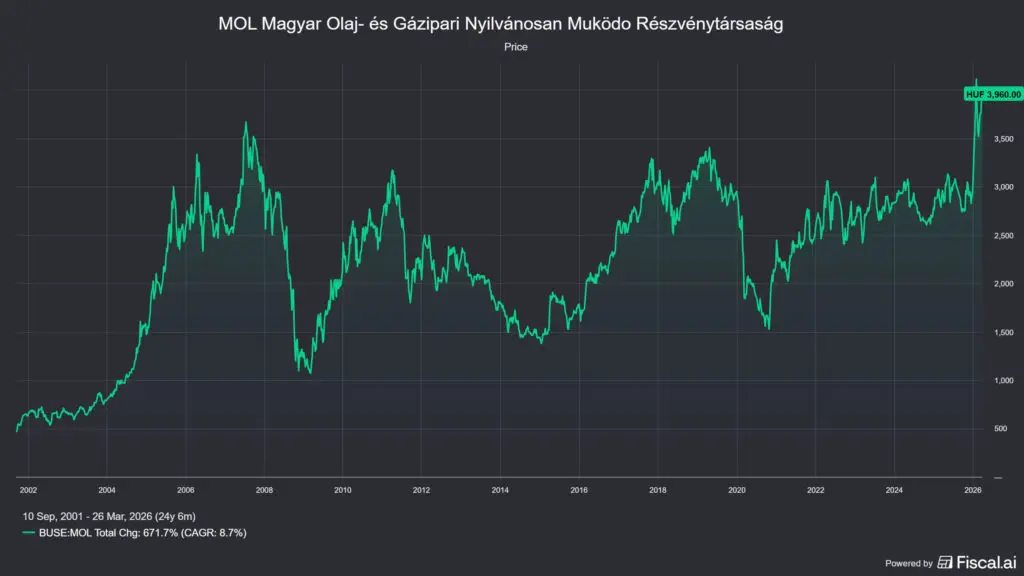
What structurally determines the background of the exchange rate movement: MOL's share price is in a strong positive correlation with the oil price, and since the oil price is denominated in USD by the Brent contract, the HUF/USD exchange rate also has a dual effect on the results. A weaker HUF increases EBITDA expressed in HUF, but also makes foreign currency-based financing more expensive. This correlation was extremely visible during the 2022-2023 energy price spike: MOL achieved its highest result at that time.
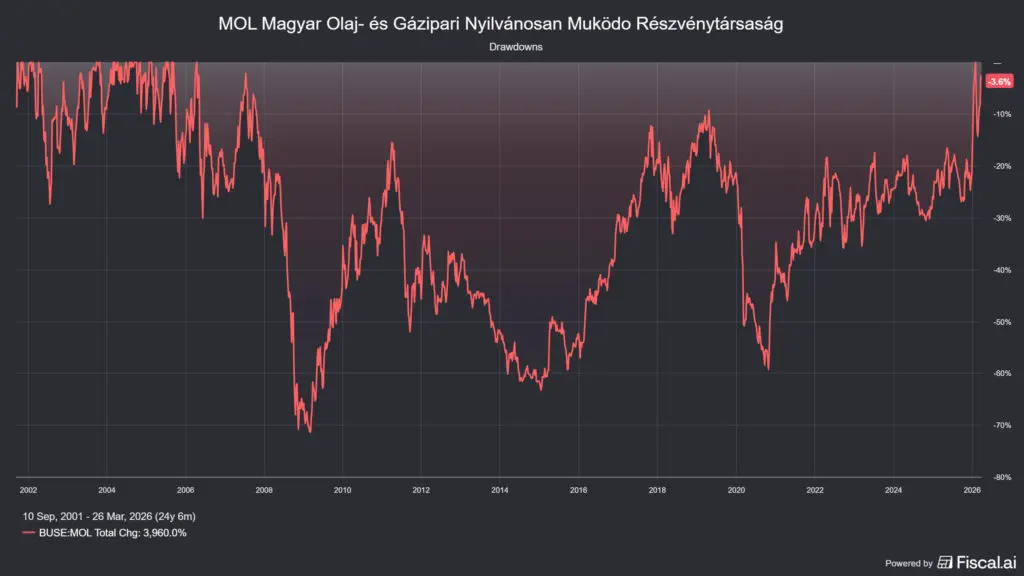
The important contextual factor that many domestic investors do not appreciate enough: MOL's share price is denominated in HUF, which simultaneously means that Hungarian inflation and forint depreciation realistically increase the value of the paper expressed in forint, but this apparent return is partly illusory in terms of real purchasing power outside of forint. If one measures the performance in EUR or USD terms, the numbers are less impressive.
? In practice: MOL's share price is driven by three main factors in the short term: the oil price (Brent), the HUF exchange rate against other currencies, and individual company news (NIS, quarterly results, dividend announcement, etc.). The company cannot control the first two, which is why MOL differs from my preferred business model-based stocks because macro events weigh heavily on the stock, although this is true for all commodity businesses.
? Valuation: EV/EBITDA and dividend yield
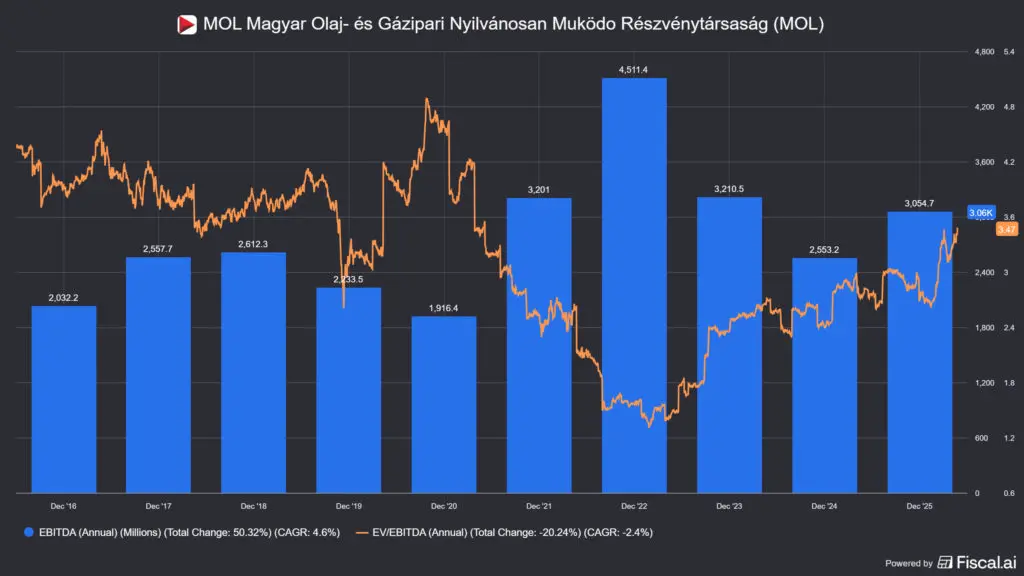
When discussing MOL's valuation, the industry standard indicator is EV/EBITDA, as write-offs and amortization are so high due to capital intensity that they severely distort the picture at the net profit level if something is not done about it. MOL's current EV/EBITDA is 3.47, but this does not tell you much in itself, it is worth looking at the historical averages:
- ? EV/EBITDA: 3.47
- ? EV/EBITDA 3-year average: approx. 2.9
- ? EV/EBITDA 5-year average: approx. 2.54
- ?️ EV/EBITDA 10-year average: approx. 3.16
As you can see, historically the stock can in no way be called cheap, and this is also accurately reflected in the change in MOL's share price.
MOL is a dividend-paying stock, so it can also be evaluated based on its dividend yield. What you need to pay attention to is that the dividend yield can be high not only because the company consistently raises it, but also because the share price can fall. The latter is out of the question in this case, as you saw the MOL share price graph earlier, the stock is much closer to its peak.
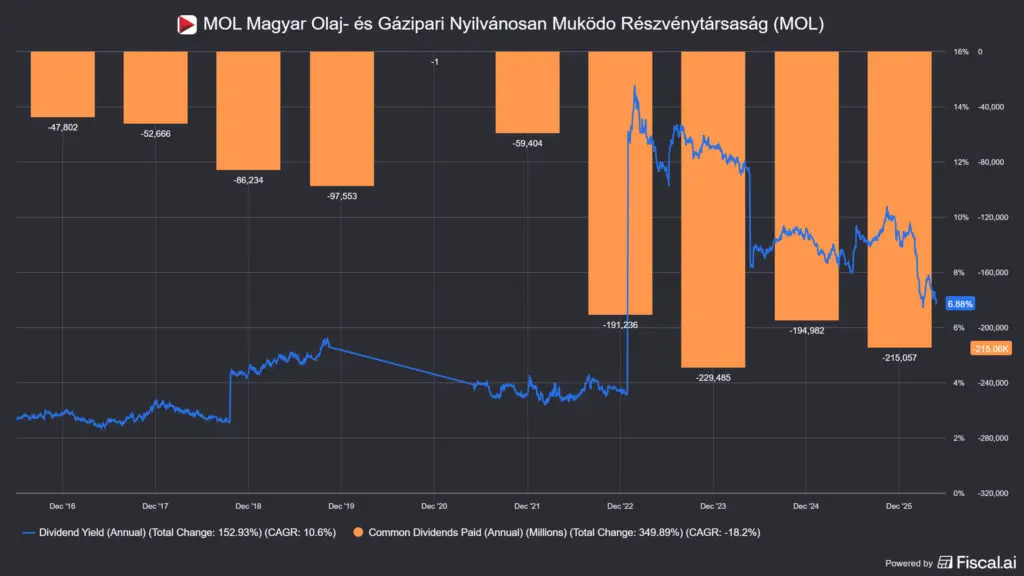
MOL can pay roughly HUF 241 billion in dividends in 2026 after its 2025 results, which means roughly HUF 300 per share, which at the current exchange rate means a dividend yield of 7.5% (the data source shows the status as of December 2025). This may seem like a lot, but historically it is not at all outstanding, the dividend rate has been higher than this in the last 3 years. It is important to note that MOL pays its dividend in a basic dividend + extraordinary dividend structure: the basic dividend reflects stable business performance, the extraordinary part distributes above-average cash flow. In fact, the payout structure is irrelevant in that MOL's share price does not look depressed based on this indicator either.
?️ The state and MOL: the anatomy of a special coexistence
MOL's ownership structure is extremely specific, unique in the Central European region, and must be understood precisely as an investor, without viewing it through a political filter. MOL is formally a private company, its shares being traded on the Budapest and Warsaw Stock Exchanges. The state, as a direct shareholder, has held only 1 series "B" voting preference share (golden share) since 2006, which provides veto rights on certain strategic decisions, but represents a fraction of the economic interest.
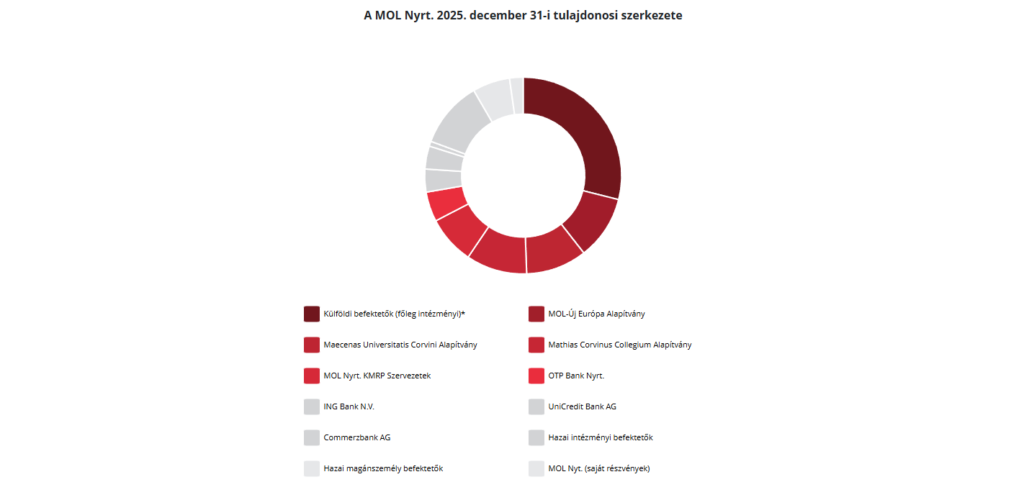
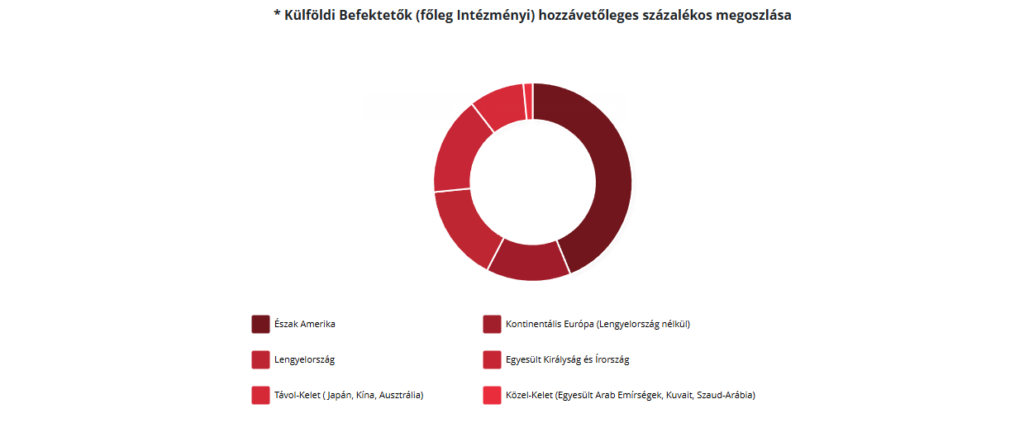
The substantive formula is more complex than this. Over the past few years, the state and MOL itself have granted shares to three private foundations.: the Maecenas Universitatis Corvini Foundation (whose board of trustees is Zsolt Hernádi), the Mathias Corvinus Collegium and the MOL-New Europe Foundation. These three institutions represent a total ownership share of ~31 percent in MOL. OTP Bank also has a nearly 9 percent stake. Taken together, roughly 40% of the shares are in domestic, institutional hands, which means stability in terms of corporate governance, and external capital market pressure has decreased accordingly. The above structures are of course completely public, anyone can check them on MOL's investor relations page: investor relations.
From an investor's perspective, this has two consequences. The first consequence is positive: It is difficult to threaten MOL with hostile takeovers, as OMV attempted in the mid-2000s. This provides stability, and management can think in the long term. The second consequence is neutral, but worth paying attention to: The state's approach to energy price regulation (official fuel prices, extra-profit taxes) directly affects profitability, and MOL is in a relatively vulnerable position in relation to individual tax measures.
It is worth highlighting that the resignations of the board of directors at MOL are also newsworthy: in March 2026, it became known that György Bacsa, the strategic director, would resign from the board of directors with effect from April 30, 2026. He was also one of the most important players in the NIS transaction. Such managerial movements do not in themselves cause a structural break, but they indicate that the organizational reorganization after the transformation into a holding company (October 2025) initiated internal transformation processes.
? Risk factors
- ?️ Oil price volatility: MOL's profit generation is almost linearly related to the Brent oil price. If the oil price falls below 65 USD for a long time, EBITDA will decrease significantly and the sustainability of the dividend policy may be questioned. This risk depends on external factors, management cannot influence it, but can only mitigate it through portfolio diversification.
- ? Forint/dollar exchange rate risk: Revenues are denominated in USD, the financing structure has a partial EUR/HUF exposure. A strong HUF has a relative profit dilutive effect, while a weak HUF shows the forint figures inflated.
- ⚖️ Regulatory and tax risk: The introduction of extra-profit taxes, official fuel prices, or EU-level climate regulation affecting the downstream segment (e.g. CBAM, carbon pricing) carries direct EBITDA risks. Moreover, MOL is in a subordinate bargaining position vis-à-vis the Hungarian state, rather than dictating the terms.
- NIS integration and geopolitical risk: The NIS acquisition is subject to OFAC clearance, Serbian regulatory approval, and the signing of a purchase agreement (target date March 31, 2026). If the clearance process is stalled, it will create uncertainty regarding the purchase price and financing. In the longer term, the integration of NIS presents operational challenges, but also an opportunity for expansion.
- ? Energy transition risk: The declining demand for fossil fuels in the medium-long term is gradually eroding the value of refinery assets. But I don't think MOL will have to run this risk for a few years yet, and it hasn't had a significant impact on MOL's share price movements so far.
? In practice: In MOL's risk profile, oil price risk is one of the largest factors that an investor cannot hedge at the share level. This is not a reason for exclusion in itself, but it does mean that systematic oil exposure should be taken into account when determining the weight of MOL in the portfolio. If someone already has positions in other energy sectors (e.g. OMV, Shell, XOM), MOL represents additive oil exposure, not diversification.
Although I couldn't find specific data on MOL's breakeven oil price, annual capital investments are estimated at 1.7-1.8 billion USD, which is where other items, such as dividends, come in. Based on the breakeven oil prices of larger foreign oil companies, such as Exxon Mobil (40-42 USD) or Chevron (50-55 USD), this point for MOL Group could be somewhere between 55-65 USD.

?MOL: will you get used to it or will you run away??
The investor debate around MOL is less ideological than that of Tesla or Nvidia, and more pragmatic: how much can we value dividend yield and EBITDA stability in the face of geopolitical and regulatory risks? There are two camps, and both have serious arguments.
? Bulls say (optimistic scenario):
- ? The NIS acquisition is a decade-long growth leap: With NIS's Pančevo refinery, Serbian well network and upstream portfolio, MOL simultaneously increases its production capacity, refining volume and retail presence in the Balkans. The ADNOC partnership (Arab investors) gives the transaction a regional energy security narrative, which may also attract institutional investor interest.
- ? Attractive dividend yield in the current interest rate environment: The current dividend yield of around 7.5% is a rarity for an investment grade company. For investors looking for companies with particularly high dividend yields, MOL may be a good choice.
- ? Refinery efficiency is structurally improving: The modernization of the Százhalombatta and Bratislava refineries, the optimization of the petrochemical mix and the increase in the share of higher value-added products are slowly but visibly increasing the EBITDA per unit of processed crude oil. For example, did you know that one of the largest margins in the oil industry is not even on the basic product, but appears when selling related services? For example, in the Fresh Corner product range.
- ? The optionality of the circular economy: The waste management concession provided by MOHU and the renewable electricity projects could open up an EBITDA segment that is completely independent of oil price risk by 2026-2028. Even if their weight is small, they will push the company's portfolio towards diversification.
- ? Low debt exposure: The company has roughly HUF 580 billion in cash, and a debt/equity ratio of ~0.4 (before NIS) represents a conservative debt policy. This allows the company to avoid having to drastically cut its dividend in the event of a possible drop in oil prices.
? Bears say (pessimistic scenario):
- ?️ Oil price cycle turn: If Brent falls below USD 60 for a long time (e.g. due to a global recession or OPEC+ supply expansion), MOL's EBITDA could fall to as much as USD 800-1000 million. However, the exact opposite seems to be happening at the moment due to the effects of the Iran war.
- ⚖️ Regulatory risk does not disappear: Energy market regulation has historically been unpredictable in the region, including the option of a return to regulated prices, possible modifications to extra-profit taxes, or a tightening of the EU carbon pricing system.
- NIS integration is not without risk: obtaining OFAC authorization, the complexity of the financial settlement with Gazpromneft (how does the amount reach the Russian side?), and NIS' geopolitical position (Serbian-Russian proximity, OPEC+ dynamics, Balkan geopolitics) carry risks that are difficult to price before closing. If the deal does not close, most investors will lose one of the main drivers of MOL's share price movements.
- ? Long-term depreciation of fossil assets: Over a 15-20 year time horizon, the real value of refinery capacities will decrease as electromobility spreads and demand falls due to the energy transition. MOL is currently investing intensively in renewables and circularity, but portfolio transformation is a decades-long process and investor patience is limited. It is worth visiting MOL's related subpage: Downstream 2030+ vision.
- ? Liquidity and BUX context: MOL is a dominant player on the BSE, which means that its price is highly dependent not only on its own fundamentals, but also on the general perception of the HUF and the liquidity of the domestic market. When global investors become risk-averse, the Budapest Stock Exchange generates a larger discount than would be justified by fundamentals.
? In practice: Neither of the arguments for or against MOL are clearly dominant. An investor who optimizes for real returns in EUR or USD and does not want to take on oil price risk will not find MOL a good target. On the other hand, an investor who thinks in HUF, values dividend yield and stable cash flow, and is specifically looking for domestic/regional energy exposure will find MOL a fair, if not exciting, long-term position. However, at the current price, most will probably consider the company expensive.
?Summary of the situation of MOL (MOL)?
MOL is a massive, well-managed industrial company that is currently "hostage" to political and geopolitical risks. MOL's share price is not really depressed compared to its fundamental value, despite the fact that it provides an excellent dividend yield. The NIS rally has sent the price skyrocketing; historically, the stock has traded much cheaper on the stock exchange, and the price is practically near a historic high.
Oil stocks are not known for being risk-free. It is a very capital-intensive, cyclical industry, the products they produce are often in the crossfire of social problems, which is why state regulators have a very significant impact on profitability. In addition, external factors can also strongly move prices, over which MOL has no influence. These would certainly justify some discount compared to the usual one, which the paper cannot currently show.
If you want to analyze further, use iO Charts' stock finder and portfolio manager, which you can access here: iO Charts.
Frequently Asked Questions: Professional questions about MOL
Why doesn't MOL's share price closely follow the world oil price?
Although there is a correlation, MOL's share price movements are often influenced by factors other than the crude oil price itself. For example, the Brent-Ural spread (the difference between the price of Russian and North Sea oil) or the extent of government deductions. If the oil price increases, but the government simultaneously increases mining royalties or special taxes, the share price may stagnate or even fall as profit growth evaporates.
How much dividend can we expect in 2026?
MOL's board of directors adheres to a transparent dividend policy. Based on the record-breaking refining margins in 2025, the analyst consensus is that, in addition to the basic dividend, a significant extraordinary dividend is expected in 2026. The exact amount depends on the cash flow situation and investment plans, but market expectations are forecasting a payout of around HUF 300 per share, at least at the time of writing.
How does the green transition affect the long-term outlook for MOL's share price?
MOL is responding to the challenge with its “2030+” strategy: refining will be gradually transformed into chemical raw material production (polyol project) and gas stations will be transformed into mobility centers. The acquisition of the waste management concession also serves this purpose. If MOL successfully transforms itself into a circular economy player, it could reduce its exposure to oil prices. You can read about the polyol project, which was essentially created to produce durable plastics, here: polyol project.
Legal and liability statement (aka. disclaimer): My articles contain personal opinions, I write them solely for my own entertainment and that of my readers. The articles published here do NOT in any way exhaust the scope of investment advice. I have never intended, do not intend, and am unlikely to provide such in the future. What is written here is for informational purposes only and should NOT be construed as an offer. The expression of opinion is NOT in any way considered a guarantee to sell or buy financial instruments. You are SOLELY responsible for the decisions you make, and no one else, including me, assumes the risk.