

What is the Market Impulse column about?
What is driving the Opus share price chart? Is the conglomerate creating real value, or is it more of a political construct? These are the questions that were on my mind when I started writing this article, which, like the others in the series, is not an in-depth analysis, but a quick, to-the-point snapshot of Opus Global Plc.'s current situation.
I don't know if you're aware of this, but a thorough fundamental in-depth analysis can take 40-50 hours. As an investor, it's impossible to put that much energy into analyzing each company if you want to effectively manage a long enough watch list. That's why I created the Market Impulse column, which provides a snapshot of each stock, specifically Opus Global, and roughly outlines current events.
My goal is not to give daily trading tips or analyze technical patterns. Instead, I provide quick, to the point fundamental mini-analyses that help you filter. These impulses help you keep in mind whether the current price movement of Opus Global or another market participant is worthy of deeper investigation or is just a passing market phenomenon.
You can find the share subpage with detailed information here: OPUS stock page
If you are looking for in-depth analyses of the site, click on the link below: iO Charts stock analyses
contents
I have created a table of contents to make it easier for you to navigate the content:
- ❓What does Opus Global do?
- 💡Opus Global's current situation and competitors
- 🎢Opus Global metrics
- ✅Opus Global: will you get used to it or will you run away?
- 📝Summary of the thesis
What does Opus Global do?
Opus Global Plc. is a Budapest-based industrial conglomerate, trading on the Budapest Stock Exchange under the ticker OPUS and a member of the BUX index. The company has existed in its current form since 2017: It was then that Lőrinc Mészáros acquired control of the holding company, previously known as Opimus Group, and began to fill it with strategically important Hungarian assets. This circumstance explains both the peculiarity of Opus' share price movements and the division of investors regarding the stock.
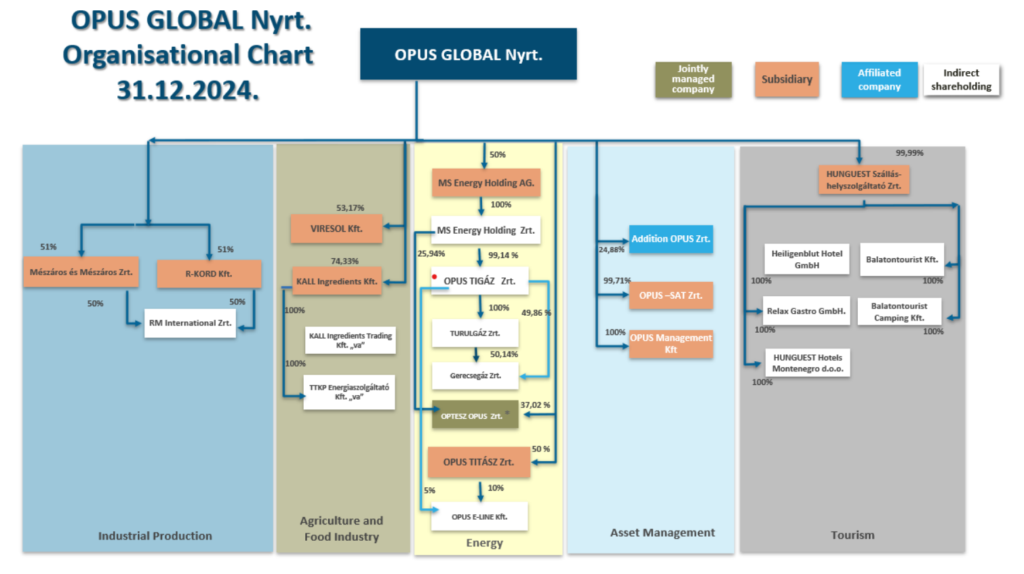
Opus Global operates in five main segments:
- ⚡ Energetics (35%): one of the most dynamically growing segments of the group, through Tigáz, Titász, Mátrai Erőmű and renewable energy-related projects. Energy has been the main driver of EBITDA growth in recent years. This segment generates its revenues entirely from Hungary.
- ?️ Industrial production (45%): This is the segment with the highest sales revenue, primarily engaged in the production of metal and building engineering products (fireplaces, stoves, industrial equipment for export). The EUR/HUF exchange rate directly affects the result, as the majority of the products are exported.
- ? Food industry and agricultural activities (10-12%): The food industry is a stable but lower-margin segment of the portfolio. This includes poultry and agribusiness interests.
- ? Tourism (7-8%): Through the Hunguest Hotels chain, Opus Global has become one of the largest hotel players in Hungary. The segment's recovery after the pandemic has been surprisingly strong.
- ? Asset management and other: minority shareholding management, financial investments.
? In practice: Opus Global is a classic conglomerate, operating in several very different industries that are difficult to fit into a single valuation framework. This in itself tends to result in a valuation discount on capital markets: investors generally don't like it when they can't clearly say what exactly they are buying.
However, in the world of the stock market, this is not an unknown construction, such as Exor NV., but also Berkshire Hathaway, these acquiring conglomerates are called roll-up integrators. This means that they do not specialize in a single niche industry, but are active in all segments where they find value. The problem is that it is very difficult to determine the value of the entire conglomerate, they cannot be taken out (sold out) from the holding, which is why they trade at a discount. Many investors have an aversion to receiving assets as part of the conglomerate package that they would not otherwise buy from the market.
Opus' current situation and competitors
Opus Global is a stock market player in a unique position: it generates most of its revenue in industries where government orders and the regulatory environment play a decisive role. In the case of energy, this is government price regulation, in the case of industrial production, the development of export markets, and in the case of the construction industry, the public procurement environment. Naturally, in such a framework, the amount of revenue the conglomerate can earn depends on the state's intentions, since due to the state's role, competition is not as open as in the free market.
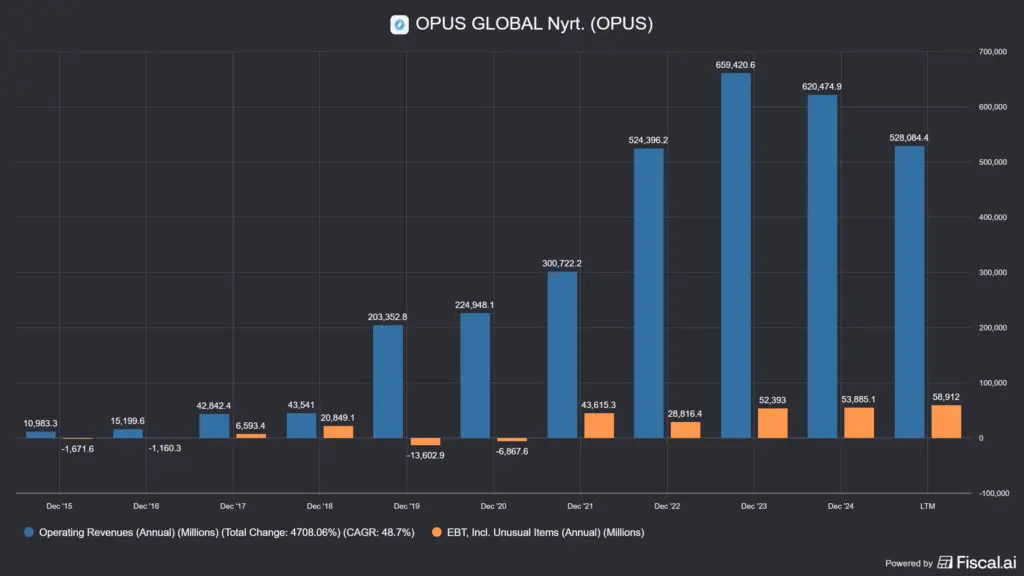
Based on the 2025 data, the group's revenue reached 528 billion HUF, EBIT increased to ~59 billion HUF, which is an increase of 13.7% compared to previous years. Sales revenue decreased significantly, this trend has been going on for 2 years, while in 2023 Opus Global's sales revenue was nearly 660 billion HUF, which shrank to the aforementioned 528 billion HUF, but as a result of efficiency improvement measures, profitability increased, which can be considered a positive operational sign. This represents a 20.9% improvement in numbers, but it must be corrected for the HUF/USD exchange rate, so if you convert the numbers from dollars to forints, the forint-based numbers will be lower due to the weakening of the USD in 2025.
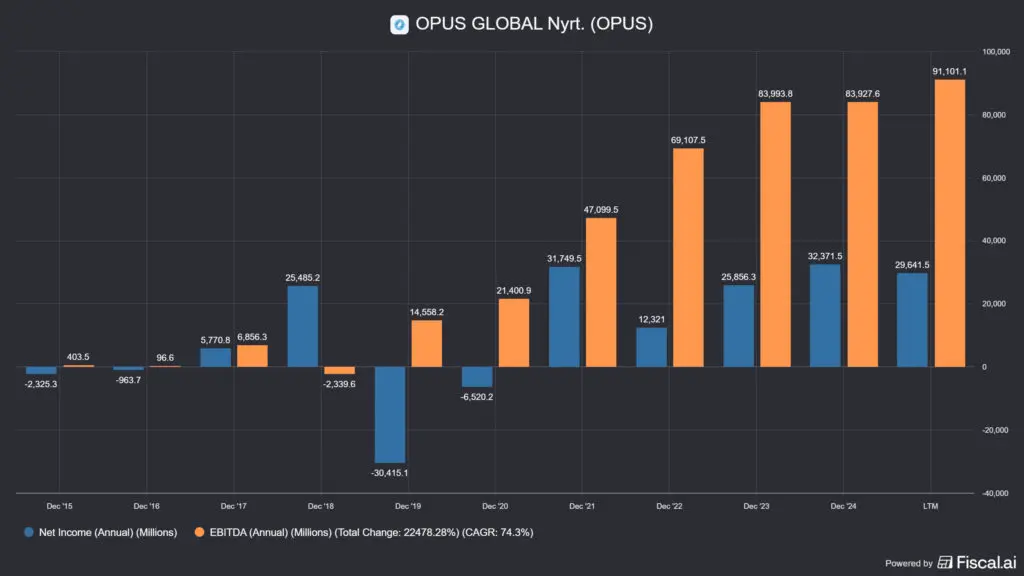
The EBITDA shows that the conglomerate was scaled up after the 2017 takeover, with pre-tax profit increasing from 6.85 billion HUF to 91 billion HUF in 2025, a trend that can also be observed in revenues. In other words, Opus Global 10 years ago painted a completely different picture of a company than it does today, with the inflow of capital mainly related to government orders.
Competitors and benchmark
In the case of Opus Global, it is difficult to identify direct competitors, precisely because of its conglomerate nature:
- ? In the field of building engineering/industrial production, international players (e.g. Vaillant, De Dietrich) and smaller domestic manufacturers represent competition in export markets.
- ⚡ In the energy sector, ALTEO Plc. (Wallis interest) is the closest stock market benchmark, a smaller, more focused renewable energy company whose valuation operates on a more transparent business model than Opus.
- ? In the field of tourism, Hunguest competes with the Danubius Hotels group (owned by the English CP Holdings) in the upper segment of the domestic market.
- ? As a holding company, the most comparable structure is AutoWallis or 4iG, which are also BSE-listed conglomerates with similar political dynamics.
? In practice: In terms of Opus share price movements, you should not look at industry competitors or industry dynamics, but rather at how the regulatory environment is changing. Opus Global belongs to the group of “politically exposed domestic conglomerates,” and you should find out where it fits within that group in terms of its risk-return profile.

Opus metrics
? Exchange rate and catalysts
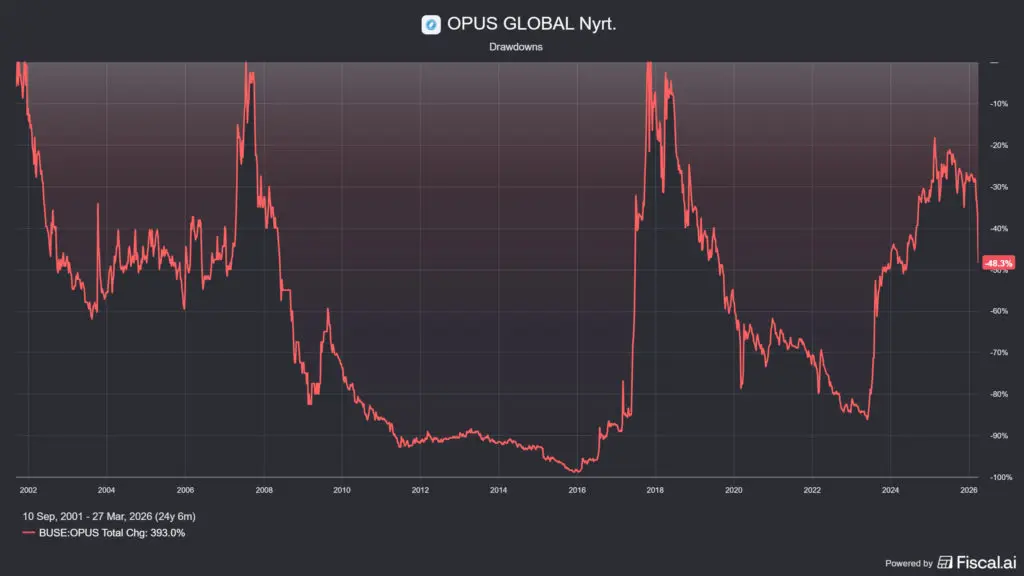
Opus' share price performed spectacularly in 2023: it was around ~100 HUF at the beginning of the year and rose to 630 HUF by mid-2025, which represents a more than six-fold increase. This is clearly an outperformance compared to BUX, and is primarily due to the strong performance of the energy segment, the share buyback program and the general BSE rally. The current price is somewhere under 400 HUF at the time of writing.
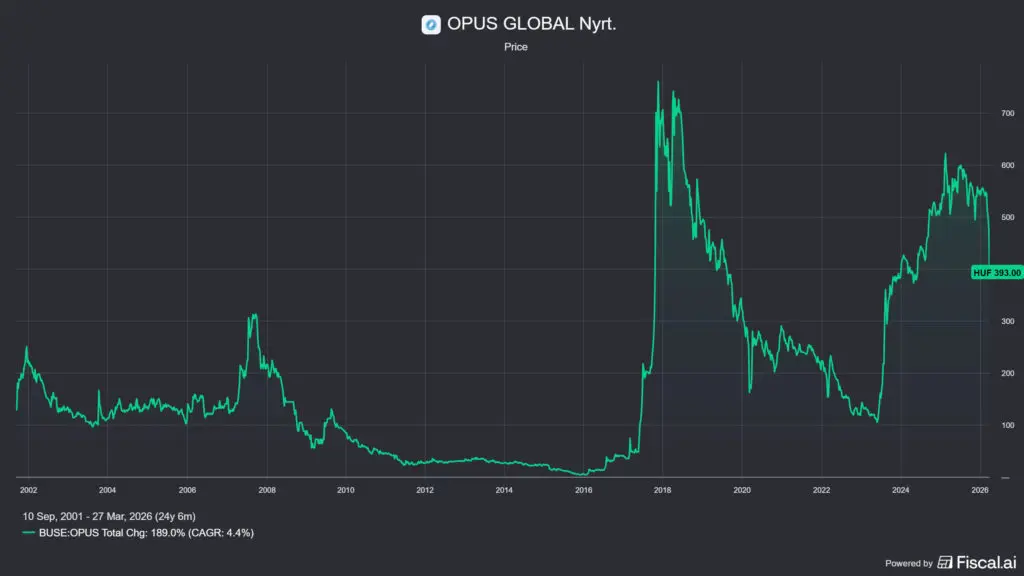
Opus' share price movement in the short term is driven by three factors: the quarterly results of the energy segment, the announcements of the share buyback program (which regularly provide a positive boost), and political news, especially public procurement orders and regulatory changes. Since elections are held in Hungary on April 12, 2026, the falling share price may also be related to this, as if the market expects Opus Global's relationship with the ruling power to weaken, this could have a strong impact on sales and profitability.
Rating
Opus' valuation, at first glance, seems attractive according to certain metrics:
- ? P/E (TTM): ~8
- ? EV/EBITDA: ~5
- ? P/FCF: ~ 200
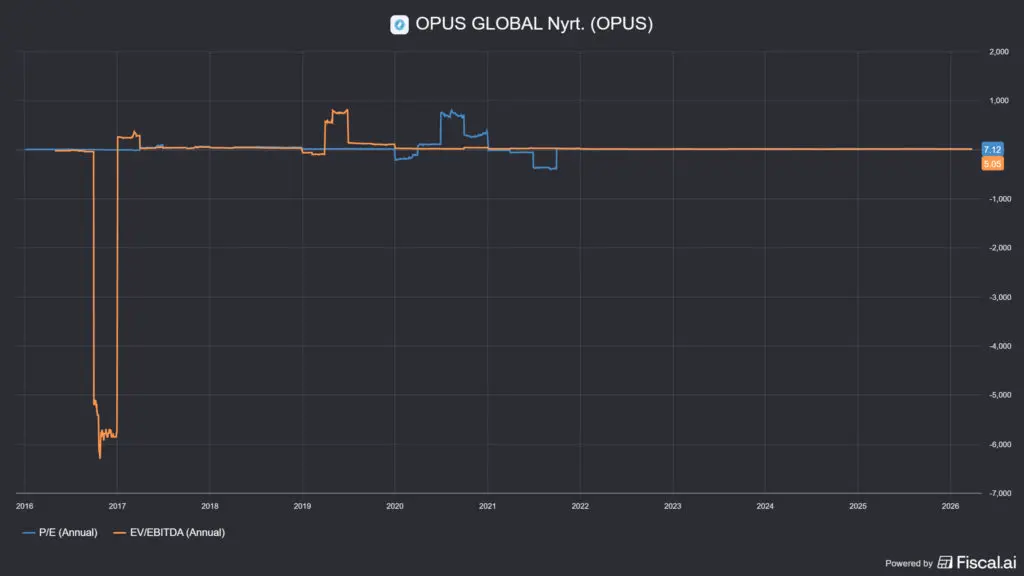
If you only look at the P/E and EV/EBITDA values, the company may seem cheap, but the P/FCF is extremely high, which means that the company is essentially not generating any meaningful cash that could be reinvested in the business. This is typically the result of unhealthy capital utilization, although the company is generating high sales revenue, but it is not really generating cash. This could also be due to high costs, inadequate management of the company, or there could be accounting reasons, which need to be investigated separately. However, a fluctuating P/FCF is usually not a good sign, but it is certainly not a sign of stability. In such cases, it is worth looking at the creation of shareholder value, which is well illustrated by the metrics below.
Value creation, ROIC and ROCE
One of the analytical problems for conglomerates, such as Opus Global, is to separate out each industry segment and determine which ones generate the majority of revenue and profit, and whether they are truly value-creating sectors. However, since every holding company aggregates these numbers in its balance sheet and income statement, you are much better off using value-creating metrics. To put it simply: if the return on invested capital (ROIC) is greater than the weighted average cost of capital (WACC), the company is creating value; otherwise, it is destroying shareholder value. Since Opus Global typically has capital-intensive industries, I don’t think I am wrong to use the usual rule of thumb of setting the WACC at 10%.
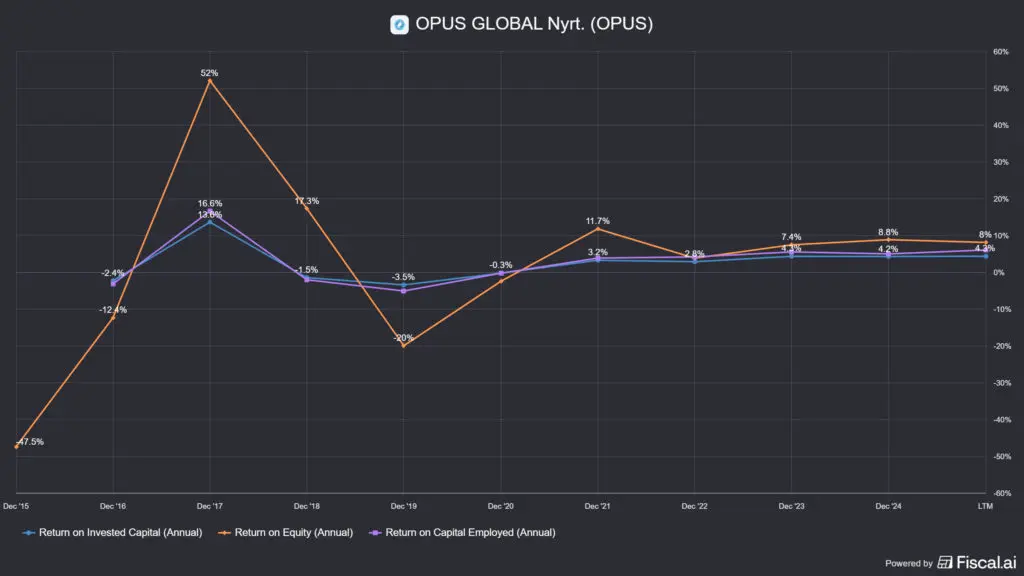
The image above shows that ROIC values do not achieve this, and this is roughly true for other similar indicators as well. The trend, however, is improving, but it starts from such a low base that, unless something big happens, the owners are actually acquiring a stake in a non-value-creating company. So, although the valuation may seem cheap, two events can be linked to the fall in the share price: on the one hand, the political narrative and the uncertainty factor associated with it, and the other is that Opus Global's metrics are not on a steady upward trajectory, to put it mildly, and what's more, they are destroying the owner value based on the numbers. And the market prices this and rewards it with a more depressed valuation.
Ownership structure
The ownership structure is one of the most important contextual factors in relation to the Opus share. Lőrinc Mészáros is the dominant owner of the company, directly and indirectly, through various holding structures (Konzum PE Private Equity Fund, Talentis Group, Addition OPUS Zrt.), with a combined voting power of more than 50%. This results in two things: the Mészáros group can essentially decide the fate of the company alone, and the second is that a lower than ideal public share ratio is circulating on the stock exchange, which limits both liquidity and the attractiveness of institutional investors.

? In practice: The low free float means that even relatively small volumes can significantly move the Opus share price, which is a double-edged sword: it allows for both rapid rises and rapid falls, as was seen a few years ago.
Risk factors
- ?️ Political risk: The value and income-generating capacity of Opus Global's portfolio is partly dependent on government and regulatory decisions. If the political winds change, it could have an impact on the energy segment, the construction industry and public procurement revenues.
- ? Conglomerate discount: Capital markets typically discount holding companies with mixed portfolios because the weaknesses of individual business lines cross-subsidize each other, and the investor has difficulty assessing the fair value and especially cannot extract only the assets that are valuable to him from the package (i.e., the numbers of a loss-making industry can be masked by a profitable one, but this is difficult to disentangle due to the holding structure).
- ? Low liquidity: Due to the narrow free float, Opus stock price movements can be extreme due to a lack of liquidity, which can make it difficult to take on or sell large positions.
- ? Transparency: The complex holding and ownership structure makes it difficult to assess individual segments independently. In many cases, consolidated data mask the true performance of individual business units.
- ? Currency risk: The export revenue of the industrial production segment is denominated in EUR, so a strong forint directly reduces the result expressed in HUF.
?In practice: Whoever buys Opus Global is essentially betting on the current political system and accepting its black box nature, meaning that it is very difficult to identify the parts of the conglomerate that produce specific market segments.
Opus: will you get used to it or will you escape?
Bulls say (Optimistic scenario):
- ⚡ The energy segment is growing structurally: Demand for renewable energy and energy security considerations are both favorable for the segment's long-term prospects. The bulk of EBITDA growth will come from here.
- ? Low valuation behind real assets: Opus' share price is backed by tangible, physical assets, power plants, hotels, factories. If you look at the company at book value, you get a P/B of ~1x. This means that the stock is trading close to book value, which is a low valuation for an asset-intensive holding (but remember that these assets will not be sold for your pleasure, and even if they did, they would not be sold at fair value).
- ? Share buybacks as price support: Opus regularly launches buyback programs, which are both indicative (management believes the stock is undervalued) and create real demand in the market. No shares have been issued since the 2018 acquisition, so the buyback positively supports Opus' share price movement.
- ? Tourism has recovered: The post-pandemic recovery of the Hunguest Hotels segment proved to be durable, and the improvement in hotel industry margins made a significant contribution to the overall result.

Bears say (Pessimistic scenario):
- ?️ The political premium is two-way: What is an advantage now (government orders, regulatory benefits) can quickly become a disadvantage in the event of a change of government. This is one of the most difficult risks to price.
- ? Liquidity trap: If someone builds a substantial position in Opus stock, exiting may be difficult due to the narrow market (but this is generally true in the case of the BSE, especially for stocks with lower turnover).
- ? Lack of transparency: The complex structure makes it difficult to assess whether individual business lines are truly creating value or cross-subsidizing each other.
? In practice: Opus shares represent a high-risk, special domestic exposure. They cannot be compared to MOL or Gedeon Richter in terms of the quality of the business model, transparency, or breadth of the investor base. For those who consciously undertake this, the current valuation and energy growth story may be attractive. However, for those looking for a predictable, fundamentally transparent investment, another paper is probably better suited, especially before the Hungarian elections, when future political changes could have a major impact on the company's revenues.

Summary of the Opus situation
The movement of the Opus share price is primarily based on political and structural influences. The company has real assets, a growing energy segment and improving profitability, these fundamentals are real. At the same time, the narrow public shareholding, low transparency and political exposure carry risks that the market consciously discounts. The latter effect is stronger than anything now, as there will be elections in Hungary in the near future, so you could even be in a very ugly falling knife if the political winds take a sudden turn. If not, then you still need to disassemble the conglomerate into its components and determine how much each of its components might be worth and whether this is proportional to the current share price.
In light of this, Opus Global is recommended for investors who are particularly risk-taking and who know the domestic market well. Not suitable for beginners and conservative portfolios.
If you want to analyze further, use iO Charts' stock finder and portfolio manager, which you can access here: iO Charts.
Frequently Asked Questions: Professional questions about Opus Global
Why is Opus Global's dividend yield so low?
Opus Global paid a dividend of HUF 15 per share in 2025, which was a significant increase compared to the previous year, and represented a total payout of HUF 8 billion. With a share price around HUF 500, this represents a dividend yield of roughly ~3%, which is considered moderate in the Hungarian market, especially compared to MOL’s dividend yield. The company also launched a parallel share buyback program of HUF 8 billion, so the capital contribution will reach shareholders through two channels. This trend is unlikely to break in the future, as Opus has also announced a HUF 1 billion share buyback for April 2026, which you can read about here: Opus emergency informationIf you are looking exclusively for a high, stable dividend yield, Opus stock will probably not be your first choice.
What is the main risk of Opus stock?
Political risk. A significant portion of Opus Global's portfolio operates in sectors (energy, construction, public procurement-sensitive areas) where government decisions and regulatory changes have a direct impact on revenues and profitability. A potential change in political direction or regulatory tightening could quickly and sensitively affect Opus' share price, even without a fundamental reason.
Why is Opus's share price so low?
Lőrinc Mészáros is the dominant owner of the company through various holding structures, which keeps the public shareholding at around 45%. This both stabilizes the price (few shares change hands) and limits liquidity. This represents a serious entry barrier for institutional investors, but retail investors may also find themselves without a buyer or seller with whom to execute transactions.
How does the HUF/EUR exchange rate affect Opus's results?
The industrial production segment, which accounts for the largest share of sales, produces primarily for export and its revenues are denominated in EUR. A strong HUF therefore reduces the result expressed in HUF, while a weak one increases it. This effect is in the opposite direction to what we see in most domestic, import-dependent companies, and investors should take this relationship into account when analyzing the change in the Opus share price.
Does it make sense to hold Opus stock for the long term?
This primarily depends on how comfortable the investor is with taking on political risk and the transparency constraints of the holding structure. If the energy segment continues its growth trajectory and the political environment remains favorable, Opus' share price could outperform in the longer term. However, due to political and liquidity constraints, Opus is more of a speculative than a classic long-term sustainable investment, especially compared to MOL, OTP or Gedeon Richter.
Legal and liability statement (aka. disclaimer): My articles contain personal opinions, I write them solely for my own entertainment and that of my readers. The articles published here do NOT in any way exhaust the scope of investment advice. I have never intended, do not intend, and am unlikely to provide such in the future. What is written here is for informational purposes only and should NOT be construed as an offer. The expression of opinion is NOT in any way considered a guarantee to sell or buy financial instruments. You are SOLELY responsible for the decisions you make, and no one else, including me, assumes the risk.