

?What is the Market Momentum column about??
I don't know if you're aware of this, but a thorough fundamental in-depth analysis can take 40-50 hours. As an investor, it's impossible to put that much energy into analyzing each company if you want to effectively manage a long enough watch list. That's why I created the Market Impulse column, which provides a snapshot of each stock, especially OTP, and roughly outlines current events. It is not an in-depth analysis, but rather just food for thought based on the current state.
My goal is not to give daily trading tips or analyze technical patterns. Instead, I provide quick, to the point fundamental mini-analyses that help you filter. These impulses help you keep in mind whether the current price movement of OTP or another market participant deserves deeper investigation or is just a passing market phenomenon.
You can find the share subpage with detailed information here: OTP share page
If you are looking for in-depth analyses of the site, click on the link below: iO Charts stock analyses
?Table of Contents?
I have created a table of contents to make it easier for you to navigate the content:
- ❓ What does OTP Bank do?
- 💡 OTP's situation and competitors
- (I.e. OTP metrics
- ✅ OTP: will you get used to it or will you run away?
- 📝 Summary of the thesis
❓ What does OTP Bank do?
OTP Bank – which is the abbreviation of the National Savings Bank and Commercial Bank Plc. – is the largest financial group in Hungary and one of the leading financial groups in the Central and Eastern European region. It was founded in 1949 and operated as the country's only retail bank until 1987. This heritage is still one of the brand's most important competitive advantages in the domestic market. The bank is a universal commercial bank. It is based on three main sources of income: interest income (loan and deposit business), fee and commission income (bank cards, account management, brokerage) and other non-interest income. The group is now present in 11 countries, serves nearly 17 million customers, has about 1750 branches and 40000 employees.
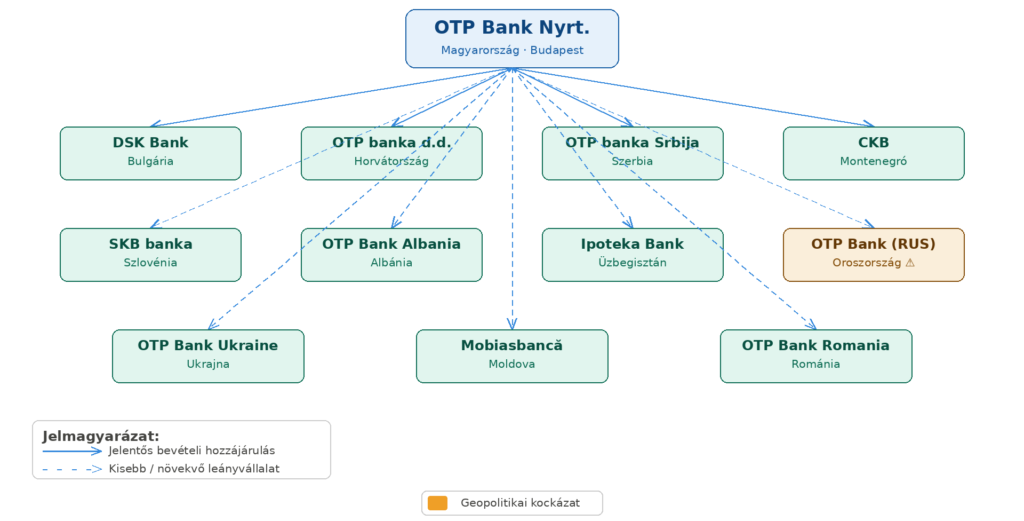
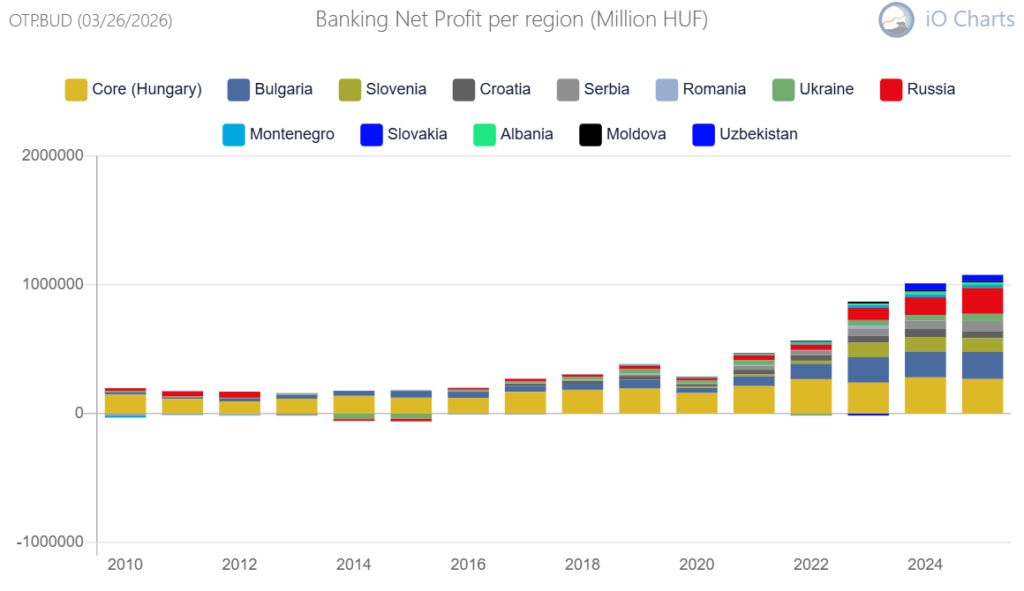
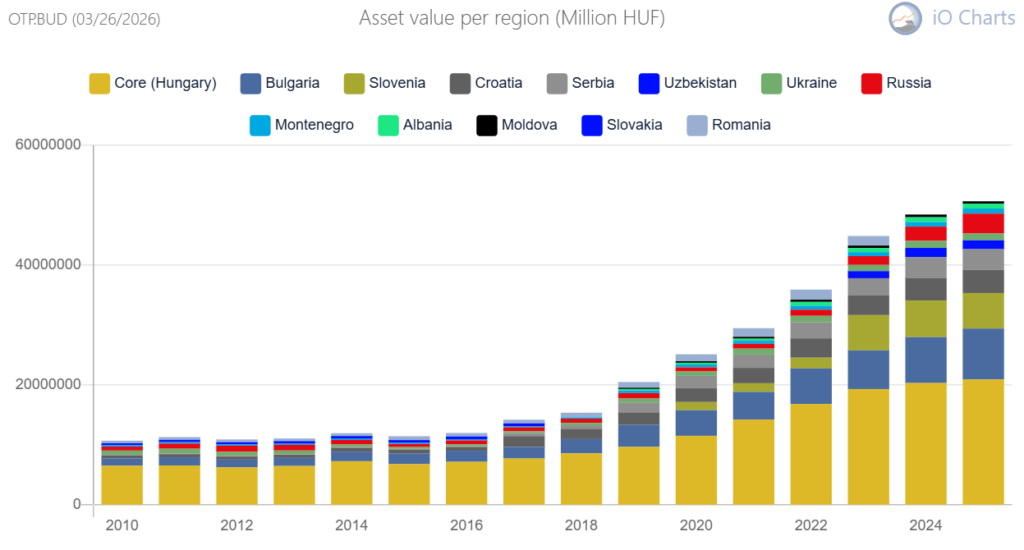
One of the most important pillars of OTP's strategy over the past two decades has been expansion abroad. The bank has made a total of 26 acquisitions, 14 of which in the last ten years. Target markets include Bulgaria (DSK Bank), Croatia, Serbia, Albania and Uzbekistan. This geographical diversification is no longer just an additional business line: In 2024, foreign subsidiaries accounted for 68 percent of the group's consolidated after-tax profit, while the Hungarian operation accounted for only 32 percent.
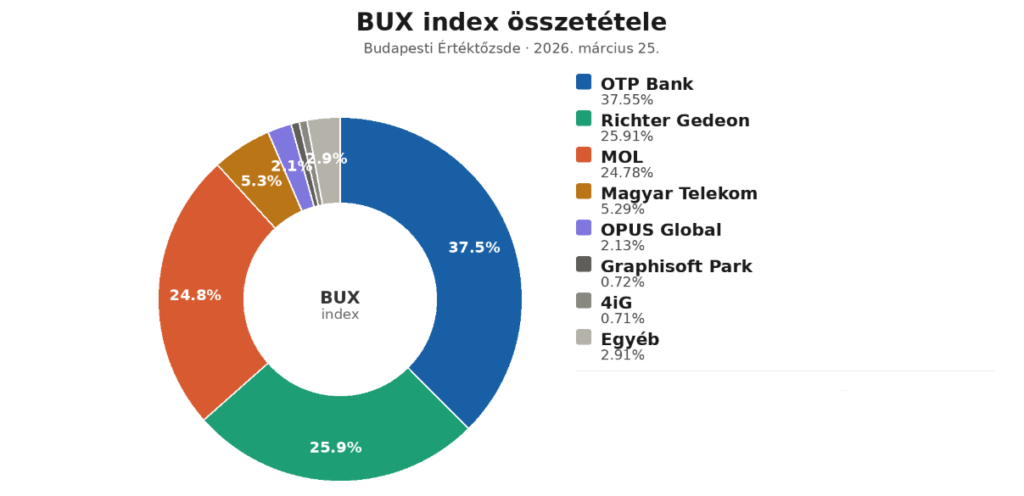
This number in itself says a lot: OTP is now much more of a regional financial platform than a "Hungarian bank". If you focus on Hungary, and within it the Budapest Stock Exchange, it is clear that its role in the BUX index is huge, almost 40%, since the BUX index is also a capitalization-weighted index. The combined capitalization of OTP Bank, Gedeon Richter and MOL amounts to nearly 90%, meaning that anyone who buys these three shares essentially covers the entire Hungarian index, within which OTP Bank has the largest capitalization.
Another interesting fact is that OTP Bank is listed not only under the BET:OTP ticker, but also under other tickers. Its shares are available on the OTC market under the OTCPK:OTPG.F and OTPB.F tickers for Americans, while on the German stock exchange it is DB:OTP, and on the English stock exchange it is LSE:OTPS and LSE:0M69.

? OTP's current situation and competitors
OTP's competitive position in the domestic market is unique. It has a market share of nearly 48 percent in personal loans, 41.5 percent in retail deposits, around 40 percent in baby-sitting loans, and nearly 29 percent in mortgage lending. It also maintains a stable level of ~20 percent in corporate lending. The company also disburses a lot of state loans and subsidies, think of the Baby-sitting loan, the CSOK, or the 3% home loan, for example.
Competitors in the domestic market: K&H Bank (KBC Group), MBH Bank, Erste, Raiffeisen, CIB (Intesa Sanpaolo), Unicredit and a few other smaller institutions. Apart from MBH Bank, which is essentially a state holding, the other competitors are foreign-owned institutions that have other strategic considerations beyond domestic profitability. OTP's advantage, on the other hand, is that as the dominant player in the Hungarian market, it is not competing with itself, but can finance regional expansion from its position here.
At the same time, market dominance is also facing a new type of challenge. Sándor Csányi (then CEO of OTP) openly indicated at the 2025 general meeting that nearly 30 percent of domestic customers were already Revolut users, a fintech player that is not subject to domestic transaction fees and special bank taxes. This was also a signal to the Hungarian government that the special bank taxes primarily affect institutions that have a Hungarian subsidiary, and Revolut does not, and thus has a structural advantage. This could mean a significant loss of market share in the medium term if the regulatory environment does not adapt. However, customers are not interested in this, so they are switching to fintech companies such as Revolut or Wise, which we wrote about here:
- Revolut in-depth analysis: financial service provider and discount broker at the same time
- Wise: fees, account, card and Revolut comparison
?In practice: OTP has a huge tailwind in Hungary, it is strongly intertwined with the current government, but don't forget that OTP's reign spans the 4-year cycles. I remember when I worked for the state, my first salary was automatically transferred to an OTP account more than 20 years ago, which my employer opened for me. In Hungary, OTP is "the bank", the most popular retail and corporate credit institution, one of the pillars of the Hungarian economy alongside Gedeon Richter and MOL Plc.

?OTP Bank metrics?
Before we dive into the numbers, it's important to note: Banks – and insurance companies – are much more difficult to analyze from a fundamental perspective than companies in other industries. A bank's balance sheet is inherently complex, with the asset and liability side, capital adequacy ratios, cost of risk, and regulatory capital requirements all factors that are not reflected in a single P/E or EV/EBITDA number. For this reason, the most accepted measure of bank valuation is Price-to-Book (P/B), i.e. the ratio of the exchange rate to the book value. That's why I didn't include most of the metrics in the OTP Bank article, because it wouldn't have made sense.
? Financial performance
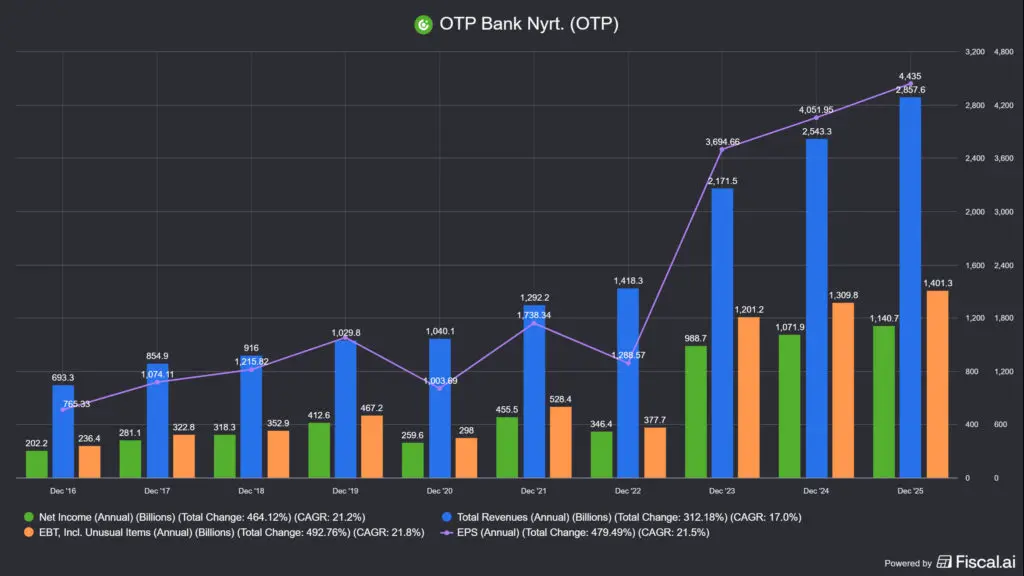
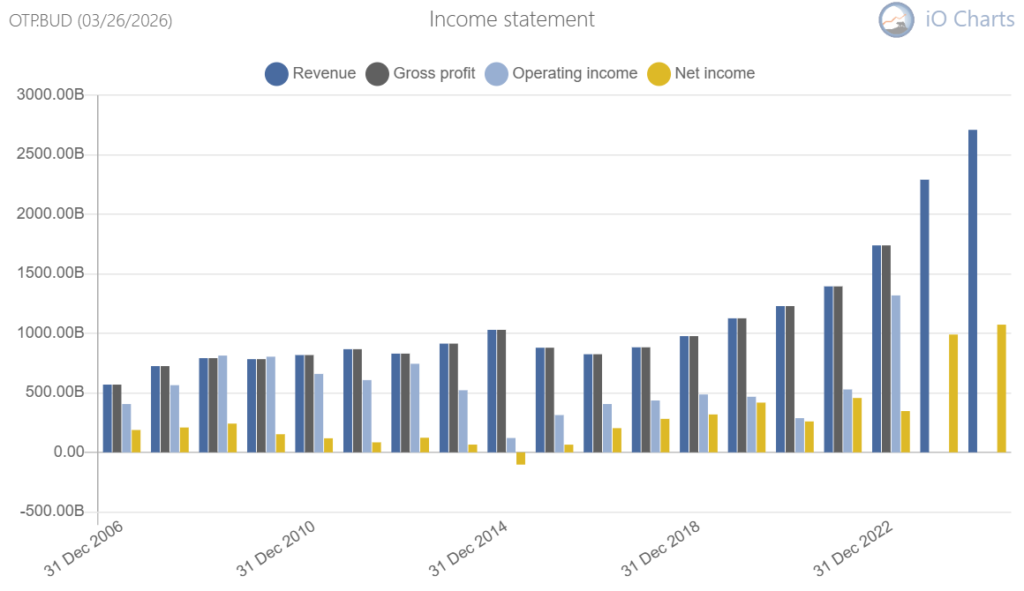
OTP Group set a record in 2024: The consolidated after-tax profit crossed the psychological threshold of HUF 1000 billion for the first time, reaching HUF 1072 billion, an increase of 8.4% year-on-year. The company essentially repeated this in 2025, as its revenue grew by nearly 9% year-on-year. The image below shows that the trend is essentially unbroken, you can see increasing numbers even looking back 10 years, the 2022 setback can mostly be attributed to the Russo-Ukrainian war and the problems of the subsidiary bank in Russia.
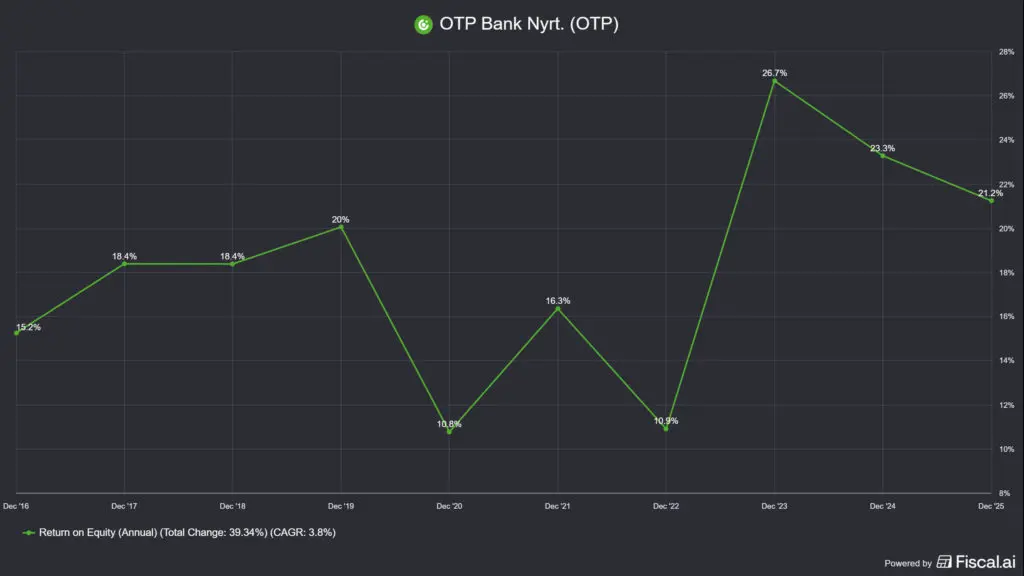
In the case of banks, it would be quite tricky to calculate ROIC and ROCE, which is why they are not used, and the ROE value can be taken into account instead. This is the return on equity (ROE), which was 21.2 percent (23.3% in 2024), which is considered outstanding in the region's banking sector and which was recognized by OTP with first place in Europe in the 2024 financial efficiency ranking by S&P Global Market Intelligence: you can read this here.
It is also worth mentioning that in 2025, OTP Bank paid out approximately HUF 250 billion as extra burdens (special tax on financial organizations, extra profit tax, transaction fee in total), which is roughly a quarter of the result of the Hungarian operation, and this naturally pulls the numbers down.
? Valuation: what do the price and P/B value say?
Let's start with the exchange rate graph, since everyone is looking at it. It's not hard to see that if I extend the graph to the maximum, over a twenty-year period, OTP Bank has produced a 14% CAGR annual exchange rate increase, which even top US companies would envy. Obviously, it would have to be adjusted for the purchasing power of the HUF compared to the USD, or the EUR if you invested in companies registered in the EEA member states, but the point is that OTP owners can't be sad about past returns.
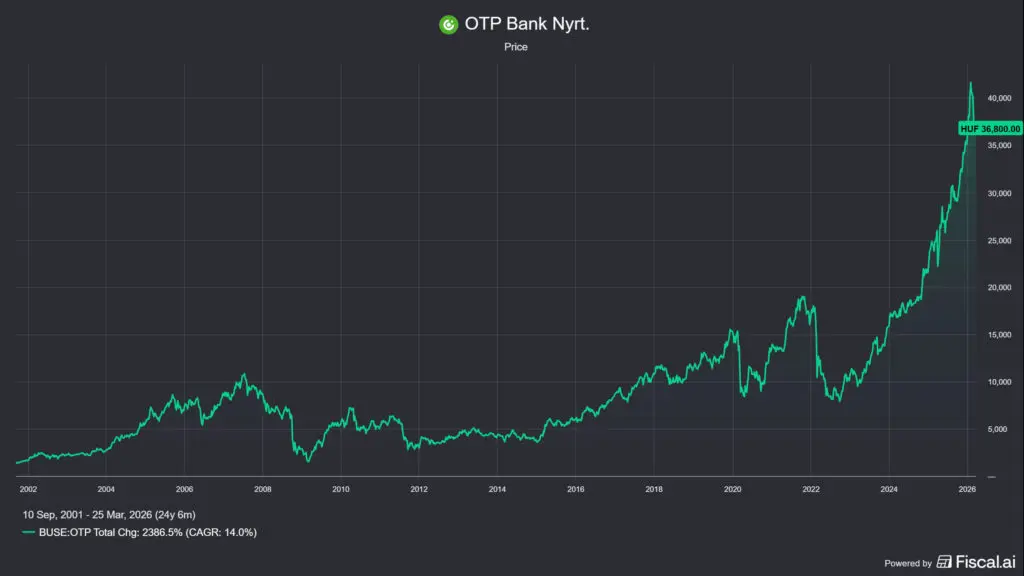
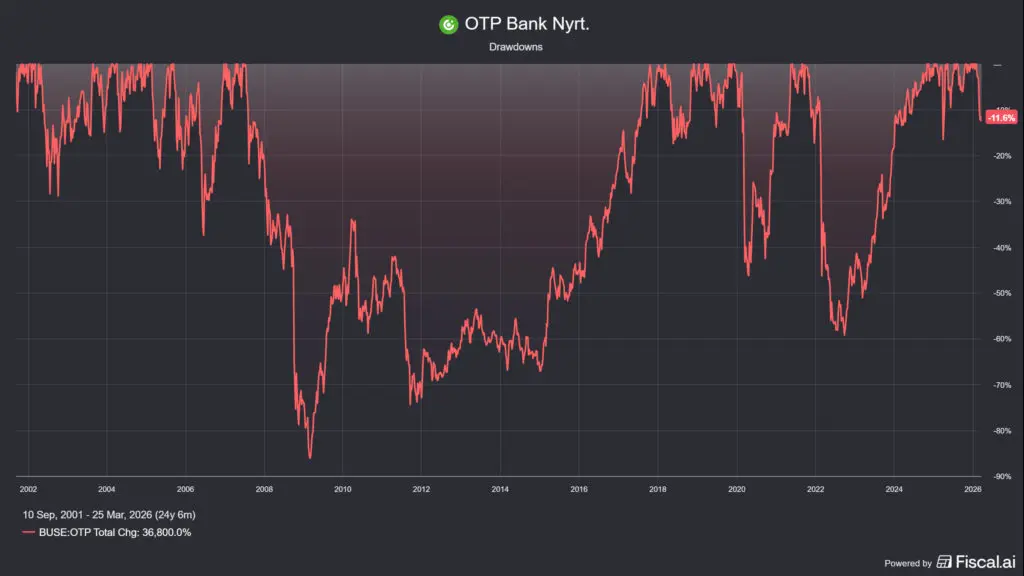
It is much more exciting to examine the declines, which, apart from the 2008 crisis, also contain surprises. The price fell significantly in 2020 and 2022, which meant ~45 and ~60%, but excluding such “black swan” events, the stock continued to rise unabated. This is no coincidence, I think it is the highest-quality, large-capitalization company in the BUX Index by Hungarian standards, which also reached a decent size of EUR 24 billion by international standards. However, it is also clear that the stock is essentially close to its peak, this 11.5% decline is not a particularly rare event.
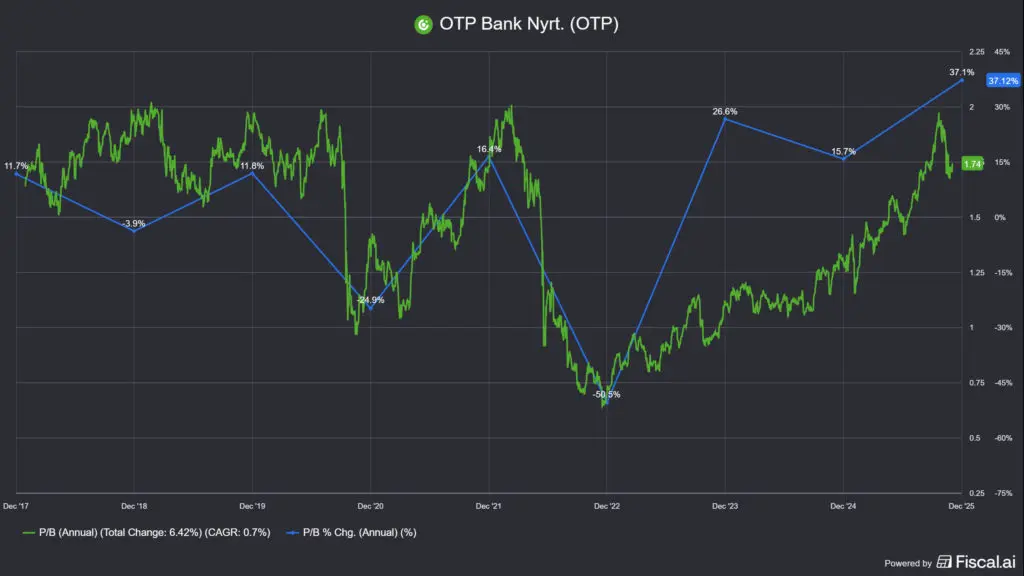
Let's look at the valuation! In the banking sector, analysts typically judge the price of a security based on the Price-to-Book ratio, since the book value (equity) provides a better starting point than other indicators. You can see in the picture that the P/B is currently at 1.74, which in itself does not mean much, but it does show that the security is not particularly cheap compared to itself. But, this does not mean anything in itself, for this you need to know the averages over many years:
- ?P/B current: 1.74 (December 2025)
- ?P/B 3-year average: 1.33
- ?P/B 5-year average: 1.32
- ?️P/B 10-year average: 1.53
Based on these, OTP Bank can currently be considered more expensive than cheap.
If you look at the valuation in a European context, the situation doesn't really change either. The chart below shows the P/B values of competing banks such as Austrian Erste, Czech Komercni banka, Polish PKO, and Brussels-based KBC, and they are 3 times cheaper than OTP Bank based on this indicator. Of course, this doesn't say anything about the quality of the banks, it just shows their relative value compared to each other.
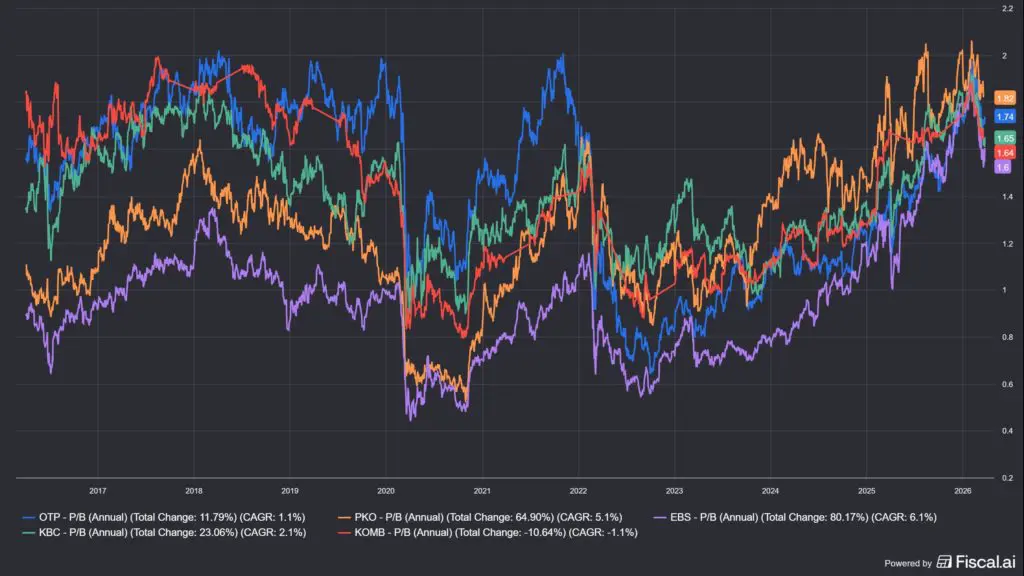
To summarize the above, anyone buying OTP shares now is probably not making the best investment of their life, but since the bank's revenue and profit growth is stable, the company may not seem very expensive in the longer term.
?? Management and the regulatory environment
In the case of OTP, corporate governance and the broader economic policy context are inseparable. Sándor Csányi led OTP as Chairman and CEO for 33 years, starting in 1992. This continuity has been maintained under all previous governments and can be traced back to conscious relationship building. The outgoing CEO himself indicated that the bank received significant government support in implementing the acquisition strategy. From May 2025, the CEO position was taken over by Péter Csányi, the founder's son, while Sándor Csányi remained at the bank as Chairman of the Board of Directors.
The unusual construction of the generational change itself illustrates that the ownership and management roles in the bank's governance structure are highly concentrated. It is worth calculating with this: the key person risk is not negligible, but in fact this has not been a very big problem so far. This does not mean that OTP is not a transparent listed company, a premium category member of the BSE, its GDRs are listed in both London and Luxembourg, and nearly 55 percent of the shareholders are foreign institutional investors. Regulatory and governance risk is not an unknown, but it is a priced-in factor.
?Risk factors: investor remuneration and share dilution
In the case of banks, it should be noted that these are typically institutions with a negative cost of capital, and they earn most of their income by investing client assets and earning interest on them. If the bank is doing well, they cannot reinvest the entire amount back into their business, but they pay it out in some form. OTP Bank (OTP) is a dividend-paying stock, and at the time of writing, it pays a 3% dividend on its shares, with a payout ratio of 22.8%. The effect of share buybacks is minimal, as is dilution, but the number of shares is slowly but surely decreasing.
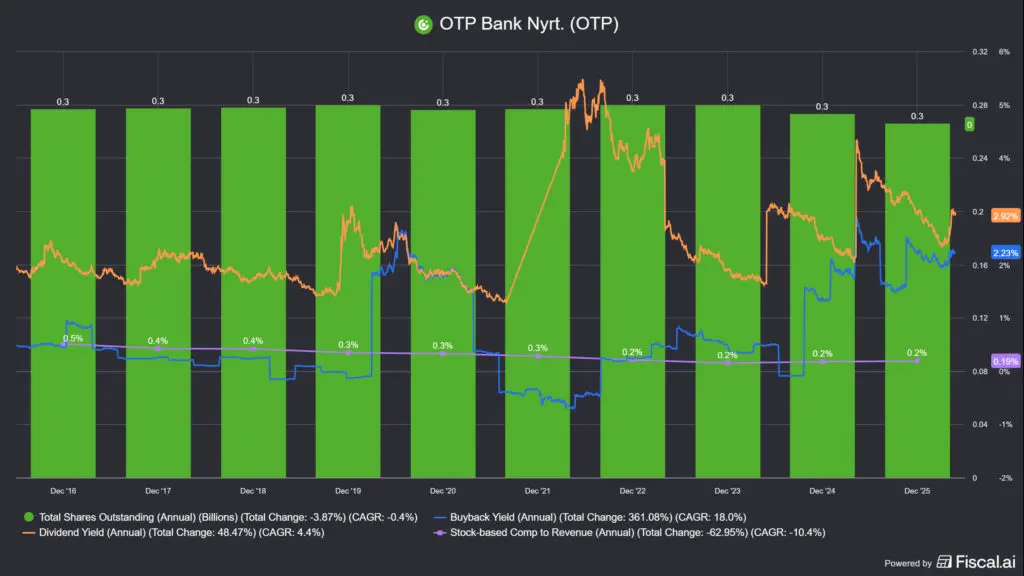
As I wrote earlier, OTP Bank spends most of its capital on acquisitions, which is difficult to analyze because you have to examine the profitability of each subsidiary bank and the valuation of the acquisition separately if you want to decide whether they were successful. But, based on the numbers, they seem to be so for now.

?OTP Bank: will you get used to it or will you run away??
I think the biggest threat to OTP Bank is fintech banks, as the switching costs for customers are relatively low. Opening an account with a neobank now takes 10 minutes, and why shouldn't everyone have more than one account, I have one too. Moreover, if you have to fight with legacy banks, you can easily switch to Wise or Revolut, because it's faster and more convenient. However, if you have, for example, home loans, you will probably apply for them at a local bank, such as OTP Bank. So I am relatively neutral about the future prospects of OTP Bank
? The bull case
- ? Regional competition position: market leader in five countries, Bulgaria's DSK and Uzbekistan's Ipoteka Bank are fast-growing, higher-margin markets, this growth story is not over yet.
- ? Outstanding profitability: 23.3% ROE and ~4.3% net interest margin are first-class in European comparison, and S&P Global selected it as the best bank in Europe in 2024.
- ? Record profit, continuous dividend: In 2026, several articles were published stating that the last quarter of 2025 also ended with a record profit of 1146 billion HUF, which was +7% higher than the previous year, even though the OTP Group was taxed properly in several countries.
- ? Acquisition engine: With 26 acquisitions behind them, the expansion logic has worked, foreign countries now account for ~70% of the profit, thus successfully diversifying the company from Hungary, which I think significantly reduces the risks.
? The bear case
- ?️ Regulatory unpredictability: In 2025, the bank was hit with a special banking burden of HUF 251 billion in Hungary (special tax + extra profit + transaction fee), which ate up all of its domestic profit, and this amount changes from year to year, which adds some uncertainty to the equation. Fortunately, roughly two-thirds of the revenue does not come from Hungary.
- ⚠️ Russian exposure: the Moscow subsidiary bank generated a profit of over 200 billion HUF in 2025, which is both attractive and highly exposed to geopolitical risks (but I think the market has been pricing this in for some time)
- ?? Management Concentration: The position of chairman and CEO was held by one person for 33 years, and the appointment of an heir is unusual for such a large listed institution. However, OTP has stood its ground in all kinds of economic environments for years, and Sándor Csányi has remained a member of the board, so I don't see this as such a big risk.
- ? Forint risk: Some of the income is generated in foreign currency, but the stock is traded in forints. If the forint weakens, the real return measured in euros may be disappointing.
- ? Fintech competition at home: 30% of domestic customers are already Revolut users, and there are other providers that offer a relatively large amount at very low prices.
?In practice: I think that in Hungary, OTP is typically the “best bet” category and that’s pretty much how investors see it. As for the fintech threat, I think they can never 100% replace regular banks. Anyone who has ever tried to do anything via email or chat knows that you shouldn’t keep a lot of money on them, which is why I have more. I know someone who was robbed of 40000 EUR, and it even became a Forbes article (How can someone steal 17 million forints from Wise's account?), so be careful with fintech providers. And if you want a more serious loan, you can only arrange this at a regular bank, as you will have to get a credit rating, get home insurance, fill out a lot of paperwork, and a lot of other things.
The biggest argument against it is probably the forint risk, simply investing in HUF over a 10-20 year period instead of USD, EUR or basically any foreign currency is a huge headwind. In other words, the stock has to significantly outperform, say, the US stock market, otherwise you won't do any better in HUF terms. The last year is an exception, because the HUF was strong, but for example in 2022 the USD was around 430 HUF. Everyone has to consider this, fortunately OTP usually offers decent returns, so even this can be acceptable for many.
?Summary of the situation of OTP Bank (OTP)?
OTP Bank is one of the best managed and most profitable banking groups in the region, and this is indisputably supported by the data. The essence of the thesis behind the paper is: a diversified, regionally expanding bank that invests capital generated from domestic market dominance in the growth regions of Central and Eastern Europe. However, its P/B ratio of ~1.7x is expensive, so I might wait for a better valuation in the longer term. Regardless, I consider OTP to be one of the best Hungarian stocks.
For those looking for regional banking exposure and accepting that a Central and Eastern European market always carries its own specific risks, OTP is a name that is hard to avoid, and domestic investors are almost “obligatory” to own the stock at least once in their lives (just not at such a valuation). However, those primarily looking for predictable dividend yields or politically unpriced bank shares may be better off with Western European sector peers. However, even with this rating, OTP deserves to be put on your watchlist.
And if you want to analyze further, use iO Charts' stock finder and portfolio manager, which you can access here: iO Charts.
Frequently Asked Questions: Professional questions regarding OTP
What factors most influence the development of OTP's share price?
The movement of OTP's share price is fundamentally determined by the international banking sentiment, the Hungarian regulatory environment (special taxes, interest rate freeze) and the profitability of regional subsidiaries. As OTP is the largest stock in the BUX index, it is also directly affected by global emerging market capital flows.
Is it worth buying OTP Bank shares now?
The current P/B valuation of OTP Bank shares at 1.74 times is historically expensive, but the fundamentals are strong based on the record profit in 2025 (1146 billion HUF). At the same time, everyone makes the investment decision based on their own risk appetite, but be aware that there is always a “home country bias” when it comes to domestic shares, meaning we tend to be biased and ignore the premium valuation.
How much dividend does OTP Bank pay?
OTP Bank paid a dividend of HUF 1071 per share against the 2025 result, and for 2026 the board of directors is likely to propose a payment of more than HUF 300 billion to the general meeting. The next general meeting will be on April 10, 2026, and everything will be revealed then.
What are the risks of OTP Bank shares?
The biggest risks to OTP Bank shares come from three sources: the special taxes and transaction fees imposed by the Hungarian state, which vary from year to year (totaling ~251 billion forints in 2025), the geopolitical exposure of the Russian subsidiary, and the forint exchange rate risk. Since most of OTP Bank's profits are generated in foreign currencies, but the shares are traded in forint on the Budapest Stock Exchange, there may be fluctuations in revenue.
In how many countries is OTP Bank present?
OTP Bank currently operates in 11 countries through its subsidiaries, including Bulgaria (DSK Bank), Croatia, Serbia, Montenegro, Slovenia, Albania, Ukraine, Moldova, Romania, Russia and Uzbekistan. OTP Bank is the most active bank acquirer in the region: it has made a total of 26 acquisitions since the turn of the millennium, and foreign subsidiaries now account for nearly 70 percent of the group's profits.
How does OTP Bank compare to other European banks?
OTP Bank was ranked as the best performing bank in Europe among the 50 largest listed banks in the 2024 S&P Global Market Intelligence ranking, and in 2025 it was ranked second in the same ranking. OTP Bank led the regional ranking in The Banker TOP 100 CEE Banks list for three consecutive years, in 2023, 2024 and 2025, you can read about it here: The Bankers. All this indicates that OTP Bank is not only a dominant player in the Hungarian market, but also a leading institution in the Central and Eastern European banking sector.
Legal and liability statement (aka. disclaimer): My articles contain personal opinions, I write them solely for my own entertainment and that of my readers. The articles published here do NOT in any way exhaust the scope of investment advice. I have never intended, do not intend, and am unlikely to provide such in the future. What is written here is for informational purposes only and should NOT be construed as an offer. The expression of opinion is NOT in any way considered a guarantee to sell or buy financial instruments. You are SOLELY responsible for the decisions you make, and no one else, including me, assumes the risk.