

?What is the Market Momentum column about??
The price movement of the Rába share price skyrocketed last year, but in 2026 it showed quite a lot of fluctuations: the 129-year-old Győr-based automotive company was transferred from state ownership to the 4iG defense portfolio, while its core business suffered severely from the decline in European automotive demand. What does this mean for investors?
I don't know if you're aware of this, but a thorough fundamental in-depth analysis can take 40-50 hours. As an investor, it's impossible to put that much energy into analyzing each company if you want to effectively manage a long enough watch list. That's why I created the Market Impulse column, which provides a snapshot of each stock, especially Rába, and roughly outlines current events. It is not an in-depth analysis, but rather just food for thought based on the current state.
My goal is not to give daily trading tips or analyze technical patterns. Instead, I provide quick, to the point fundamental mini-analyses that help you filter. These impulses help you keep in mind whether the current price movement of Rába or another market participant deserves deeper investigation or is just a passing market phenomenon.
You can find the share subpage with detailed information here: RABA.BUD stock page
If you are looking for in-depth analyses of the site, click on the link below: iO Charts stock analyses
?Table of Contents?
I have created a table of contents to make it easier for you to navigate the content:
- ❓What does Rába do?
- 💡Rába's current situation and competitors
- 🎢Rába's metrics
- ✅Rába: will you get used to it or will you run away?
- 📝Summary of the thesis
What is Rába doing?
Rába Járműipari Holding Nyrt. is an industrial holding company founded in 1896 and headquartered in Győr, whose shares are traded on the Budapest Stock Exchange under the ticker RABA. The company is today one of the oldest and best-known industrial players in Hungary, its name has grown together with the production of chassis and military vehicles. Interestingly, its original name was Magyar Waggon- és Gépgyár Részvénytársaság, and they mainly produced railway equipment in Győr, where four rivers, the Rába, the Rábca, the Mosoni-Duna and the Marcal, converge, hence the name of the company.
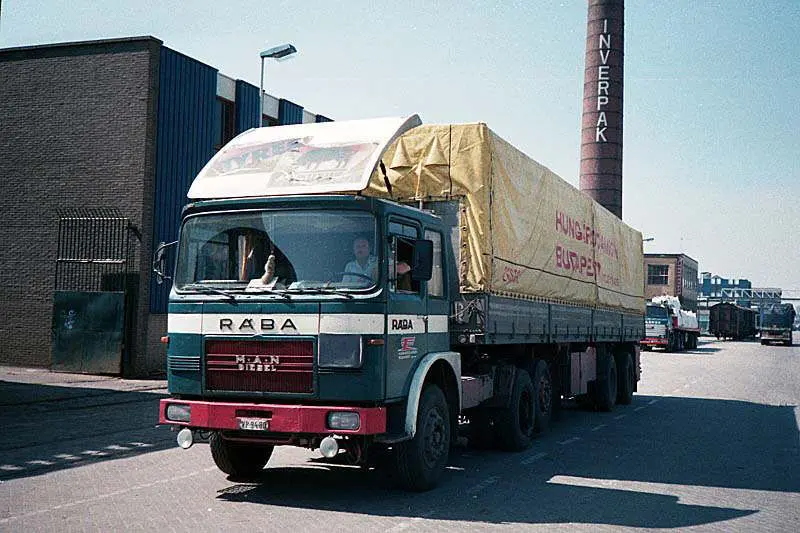
Rába's profile covers four business lines:
- ⚙️ Chassis: chassis and main units for commercial vehicles, agricultural power plants and earthmoving equipment. This is the most significant and profitable segment, with revenues coming primarily from exports to the USA and Western Europe.
- ? Component: seat and seating system production (Mór plant) and machined parts (Sárvár plant) for passenger car manufacturers. This segment reacts most sensitively to fluctuations in the European passenger car market.
- ? Vehicle: development and production of truck families and bus chassis for military use. Its largest customer is the Hungarian Armed Forces. This segment has become strategically the most important after the 4iG acquisition, as the Hungarian government treats military production as a priority sector.
- ⚙️ Transmission (REKARD Ltd.): transmissions and drives for commercial vehicles and agricultural machinery.
? In practice: Rába is a highly export-oriented, capital-intensive industrial company, whose fate is closely intertwined with the cycles of the European and North American commercial vehicle market, and now increasingly with the development of defense industry orders. The European automotive and vehicle industry has recently been in quite bad times, which has also severely affected Rába. This was most evident in the net profit in 2024, which essentially fell to zero, as you will see.
? Rába's situation and its competitors
Rába operates in a specific market segment: the global market for commercial vehicle parts (chassis), where direct competitors are typically not Hungarian, but multinational players, and therefore can produce with much better economies of scale. The defense industry is a completely different matter, but here too it typically has to compete with huge consortia or their component suppliers.
? The most important comparison bases:
- ⚙️ Dana Incorporated (USA, NYSE: DAN): one of the world's leading manufacturers of chassis and drivetrain systems, Rába's number one global competitor in the commercial vehicle segment. Dana also suffered severely from the decline in automotive demand in 2024-2025.
- ? American Axle & Manufacturing (USA, NYSE: AXL): is also a global chassis manufacturer, with similar cyclical automotive industry exposure. Both companies clearly demonstrate that Rába is not struggling with an isolated problem, the entire sector is ailing.
- ? Tatra Trucks (Czech Republic, CSG Group): After the acquisition, they are no longer competitors, but strategic partners. 4iG-Rába-Tatra implements a three-way Central European defense industrial cooperation.
? In practice: Rába's competitive position in the civil segment is difficult, being significantly smaller in size and capital than its global rivals. In the defense segment, however, it was given an opportunity through 4iG and the Tatra partnership that it would never have been able to seize independently.

? Rába's metrics
? Exchange rate and catalysts
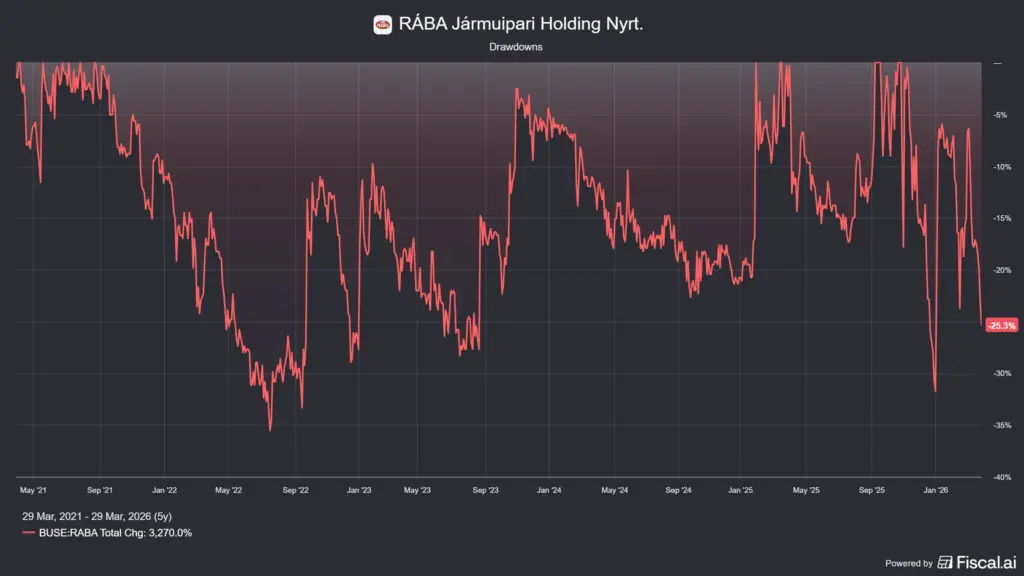
The Rába share price has been characterized by sideways movements in recent years, i.e. it has been moving in the 1000-1500 forint range, without major excitement. The turning point was the announcement of the 4iG acquisition in September 2025, which acquired 74% of the company as an over-the-counter offer. This drove the price up to 4700 HUF, and by the end of the transaction, 4iG SDT EGY Zrt., a subsidiary of the 4iG Group, acquired a 74.34% stake in the company, the remaining 25.66% being the public share, as stated on the BSE websiteThis is exciting because if you look at the ownership structure of 4iG, you can see that 25.12% is owned by Rheinmetall AG, which clearly shows the deep embeddedness in the defense industry.
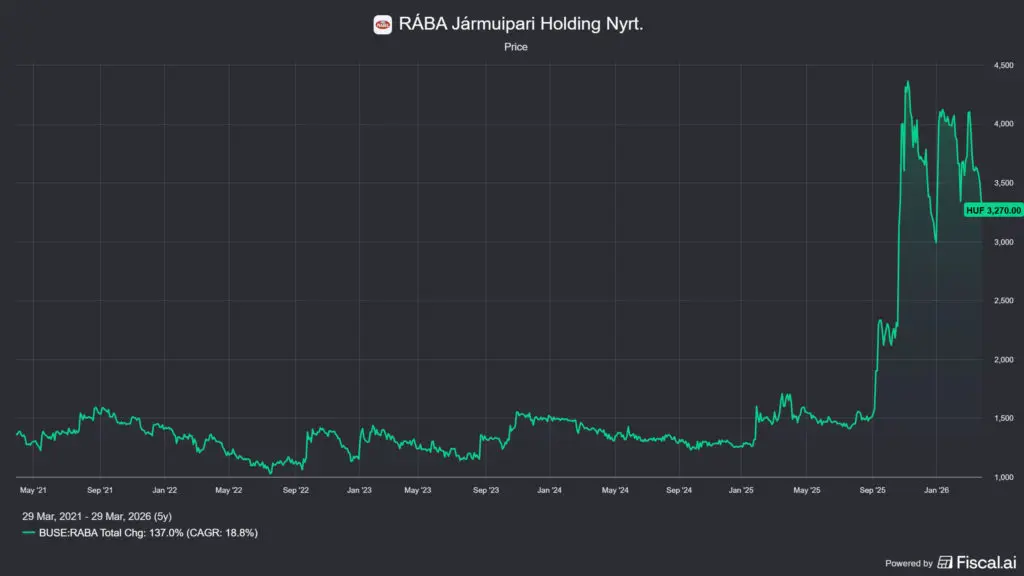
In the short term, the share price is driven by the defense industry developments shared with 4iG (Tatra agreements, NATO orders, HIMARS announcement) and the quarterly figures of the civilian automotive segment, although the latter are currently weak. 4iG has a very strong connection with the Hungarian government through various private equity funds, so the political thread, as you may have come to expect from other companies listed on the Budapest Stock Exchange, is strongly present here. However, since there are many foreign players, it is worth focusing on the increased defense industry spending caused by the Russian-Ukrainian war.
? Rating
To understand Rába's valuation, it is necessary to separate what happened before and after the share price rebound due to the announcement of the 4iG acquisition in September 2025. 4iG took over Rába, which was operating with practically zero profitability, and which should therefore be valued completely differently as an independent company than as part of a consortium.
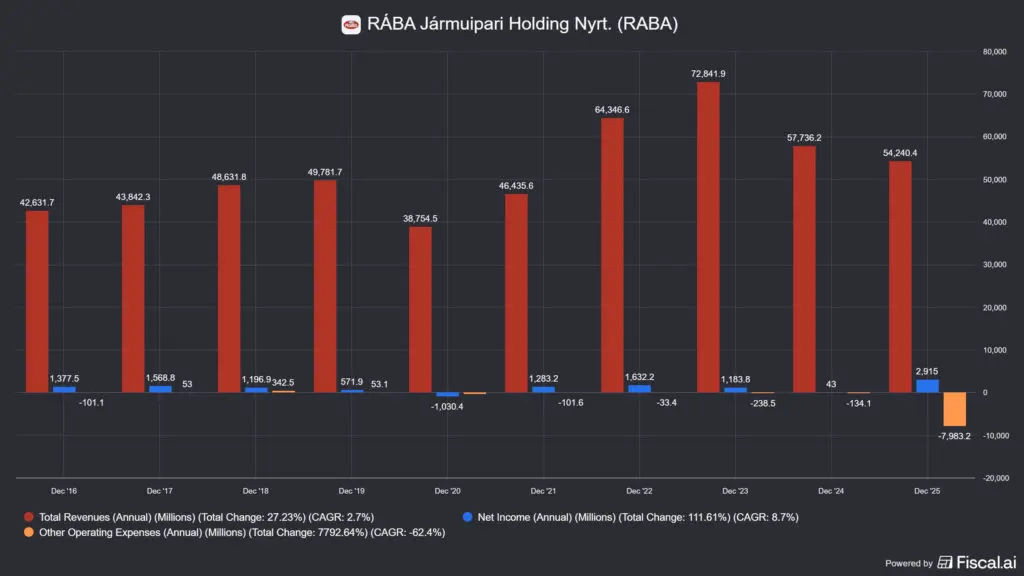
The main numbers are as follows:
- ? 2024 profit: ~43 million HUF (essentially a break-even company)
- ? Profit in 2025: ~2915 million HUF (but this was improved by a one-time property sale)
- ⚠️ Adjusted operating profit in 2025 (excluding one-off items): ~1 billion HUF loss, this is the true picture of core business
- ? Debt: ~17 billion HUF loan portfolio, but with nearly 7 billion HUF cash
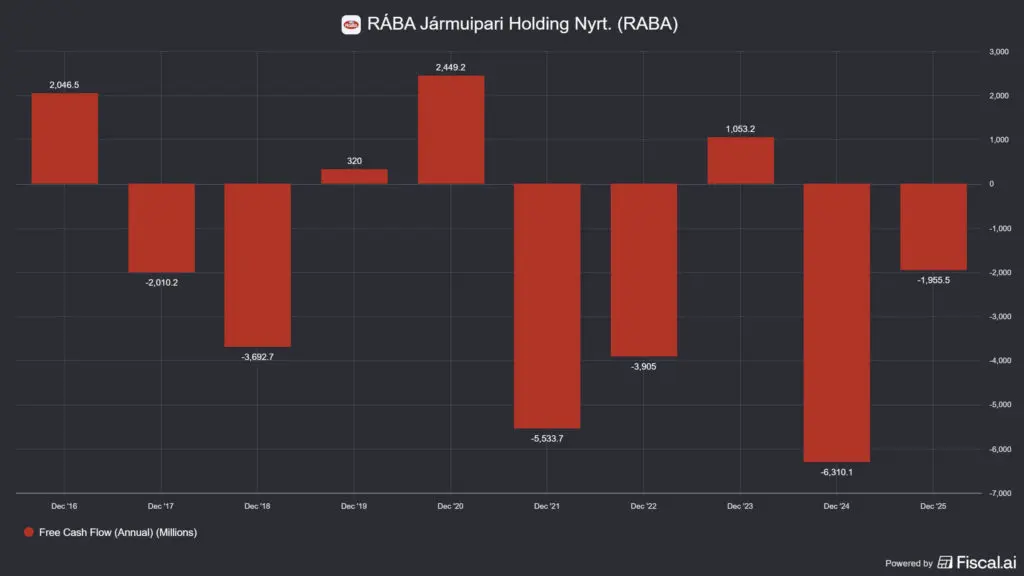
The picture above shows that revenue has been falling for years (-5,5% is the 3-year revenue growth). However, the balance sheet was improved by one-off property sales, part of which was spent on financing the Rába Modernization Program and another part on improving the company's results. What's the problem with this? If you look at the valuation, you will see that:
- ?P/E: 15.1
- ?EV/EBITDA: 5.3
- ?P/FCF: -22.3
Every valuation metric consists of a numerator and a denominator, meaning that even a significant price drop can make a stock seem cheap. However, in the case of Rába, the P/FCF ratio, i.e. the ratio comparing free cash to price, is negative, which means that the company does not generate meaningful cash. In light of this, it is not difficult to guess that the breakout of the Rába share price does not come from the improvement of the underlying business, but from the sentiment effect. This also means that the market has priced in the fact that future military orders will probably increase production and increase revenue. You have to decide whether you consider it realistic that the share price is currently trading at two to three times what it was before the acquisition, and whether you are willing to pay this.
?️ Ownership structure
The ownership structure of Rába changed radically in January 2026: Previously, N7 Holding National Defense Industrial Innovation Co. Ltd. (a subsidiary of the Ministry of Defense) owned 54,34% and the Széchenyi István University Foundation owned 20%. This was a total of ~74% state/quasi-state control.

As of January 2026, 4iG SDT EGY Zrt. (a subsidiary of the 4iG Group) is the 74,34% owner. 4iG SDT is a subsidiary of 4iG, where the holding company is a partner of the Czechoslovak Group. CSG is a Czech-owned global defense and industrial conglomerate, with Tatra Trucks, Excalibur Army and MSM Group in its portfolio. It went public on Euronext Amsterdam in early 2026 and has become one of the fastest growing defense companies in Europe with an order book of EUR 15 billion.
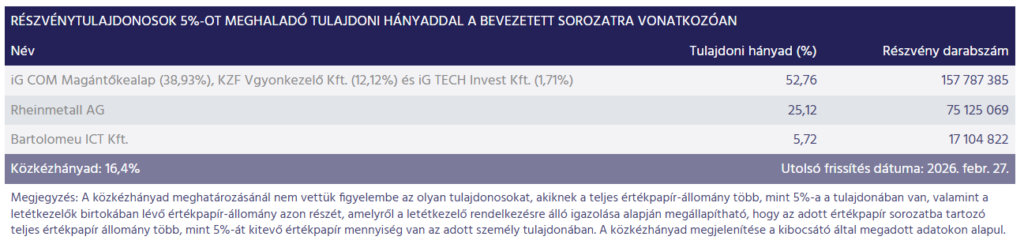
CSG announced that it will acquire a 49% stake in 4iG Space & Defence Technologies, thereby indirectly becoming a 37% owner of Rába Járműipari Holding, which is roughly half of the aforementioned 74.34% Rába stake. The public share is ~25%. It is worth noting that 4iG is owned ~25% by Rheinmetall AG, a German military industrial company, so the mergers in the defense sector are understandable.
? Risk factors
- ? Weak core activity: The 2025 result excluding one-off items was a loss. The parts segment suffered a revenue decline of -20.7% from 2023 to 2024 and -6.1% from 2024 to 2025 due to the decline in European passenger car registrations, and the trend has not clearly turned for the better in 2026.
- ? Automotive industry cyclicality: A large part of Rába's revenues depend on automotive cycles. The European electric transition, weaker demand and capacity reductions have a direct impact on chassis and component orders.
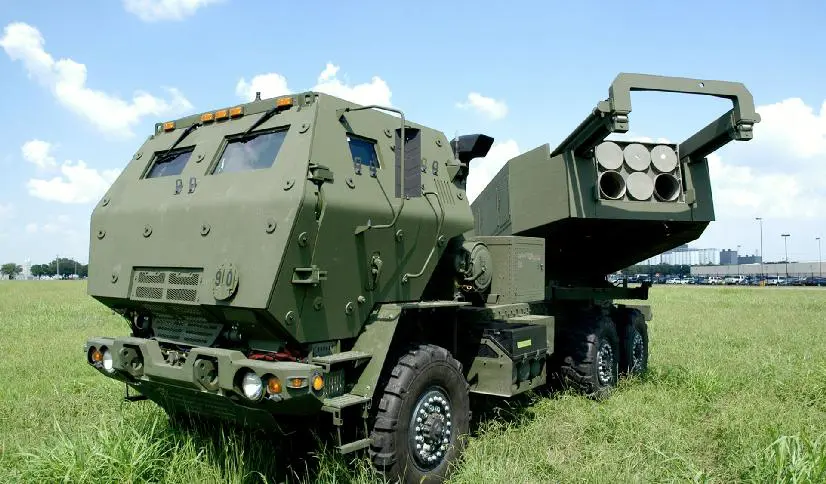
- ? Transition period uncertainty: The 4iG acquisition is complete, but the strategic transformation, Tatra assembly, NATO export, HIMARS integration, is only at the beginning. The risk of implementation is not negligible, but it is an interesting fact that the carrier vehicle platform of Lockheed Martin's HIMARS system will be assembled and integrated in Győr (this is "HUMARS").
- ? Debt burden: A loan portfolio of ~17 billion HUF combined with a loss-making core business means a stretched balance sheet, which could make the company sensitive to any economic shock, but the consortium would probably help them out if they got into trouble.
- ⚖️ Political risk: Rába is now part of the 4iG portfolio, which is owned by Gellért Jászai. This does not reduce the political risk profile, but rather shifts it in another direction: the risks arising from 4iG's political exposure now also apply to Rába.
?In practice: Rába has become part of a defense consortium created by three countries. This means that Rába is likely to receive a large number of defense industry orders, as there is not much other company in the consortium that could fulfill this task. There is the production, assembly and life-cycle support of what is likely to be several dozen HIMARS, and 2000 Tatra 8×8 heavy tactical military trucks. In addition, Rába has also been awarded the full maintenance tasks of the Hungarian Defense Forces' 105-unit Gidrán 4×4 armored vehicle fleet. This is also associated with a factory development and infrastructure modernization program worth roughly 100 billion HUF.

? Rába: will you get used to it or will you run away?
The Rába thesis is like a coin with two sides. The company's capital structure was on weak legs before the acquisition, but according to the news, a lot of orders will flow to the company, which could decisively determine the movement of the Rába share price, the question is in which direction it will move. The bulls say up, the bears say down, but only one group can be right.
? Bulls say (Optimistic scenario):
- ?️ Defense industry as a lifeline: NATO member states' defense spending has been rising sharply since 2022, and this trend will continue until at least 2030. The Rába-Tatra-4iG troika can ride this wave: military trucks, HIMARS integration, Gidra armored vehicles. This is a fundamentally new source of revenue compared to the previous civilian focus.
- ? The Tatra partnership creates a unique position: Rába could become Tatra's second largest European supplier, gaining exclusive sales and assembly rights in Hungary. Behind a strong parent company (4iG + CSG) and a global brand (Tatra), Rába can access markets it would never have been able to approach independently.
- ? Balance sheet strengthening effect of real estate sales: The Győr properties sold in 2025 will partially reduce the debt burden and improve the balance sheet flexibility to finance the strategic transformation (but I wouldn't say it will make it strong).
? Bears say (Pessimistic scenario):
- ? The core business is actually loss-making: Without one-off items, Rába generated an operating loss of nearly 1 billion HUF in 2025, adjusted for special items. If automotive demand does not improve and defense orders arrive slowly, the company's balance sheet will continue to trend downward.
- ⏳ The implementation of the defense story is slow: The Tatra assembly, the HIMARS project, NATO exports are all promising orders, but they will only generate concrete income years from now. Until then, the investor needs patience and capital to get through the transition.
- ? 4iG risk inheritance: The 4iG Group itself is a highly indebted, acquisitive company. If 4iG's capital raising or lending conditions deteriorate, it could also impact Rábára.
- ? Low liquidity: The ~25% free float and low daily turnover make it difficult to quickly build and close positions.
? In practice: The Rába share price today does not reflect current fundamentals, but rather prices the hope of defense transformation, going forward. This is a classic “turnaround story”, for those who believe in the increase in NATO defense spending and the realization of the 4iG-Tatra cooperation, Rába may be attractive. For those who look at the weak automotive industry data and the debt burden, it is less so.
? Summary of the situation in Rába
Rába’s share price is in the midst of an extraordinary transformation: the 129-year-old company has moved from direct state ownership to the 4iG defense portfolio, but that doesn’t mean the state’s entanglement isn’t strong. The core business is weak, the decline in automotive demand is putting serious pressure on the civilian segments, and the adjusted result is a loss. This doesn’t look good, but it’s only half the story.
The defense segment, on the other hand, has received fresh impetus: Tatra partnership, HIMARS integration, NATO export opportunities. The essence of the investment thesis is: this is a high-risk turnaround story, where the reward will only come after several years of patience, if it does. Those who bet on this can win big, but if the story does not work out, they can also lose big.
If you want to analyze further, use iO Charts' stock finder and portfolio manager, which you can access here: iO Charts.
❓ FAQ – Professional questions about Rába
Why did 4iG buy Rába?
The 4iG Group aims to build a complete value chain by acquiring the Hungarian State's defense industry companies, in the air (drone industry, communications), land (Rába vehicles) and space (satellites) dimensions. Rába adds land defense mobility capabilities to this portfolio. Through the Tatra partnership, Rába can offer competitive military trucks and components to NATO member states, which can also appear as carriers of HIMARS missile systems, for example.
What is Tatra and why is it important for Rába?
Tatra Trucks is a Czech manufacturer in the portfolio of the Czechoslovak Group (CSG). It is known for its military and special trucks with extreme off-road capabilities, which are used by many armies around the world. Under the 4iG-Rába agreement, Rába will become Tatra's second largest European supplier and will acquire exclusive rights to sell, assemble and service Tatra military vehicles in Hungary. Viktor Orbán confirmed that future carriers of HIMARS missile systems will be assembled in Győr.
Why didn't the board of directors recommend that shareholders accept 4iG's 1789 forint purchase offer?
The board of directors considered that the price of HUF 1789 per share does not reflect the true value of the company, especially in light of the expected returns from the defense industrial transformation. This position indicates to retail investors that management sees a higher value in the paper than what 4iG is offering. However, the paper is currently trading much higher than this and we do not know whether it will ever fall back to such depths.
Does Rába pay dividends?
Rarely and typically to a modest extent. In recent years, Rába has mostly placed its profits in retained earnings, preferring to strengthen the balance sheet and invest in investments rather than dividends. This is unlikely to change in the short term after the 4iG acquisition, as the funds are needed to finance the defense transformation. However, a responsible investor is happy about this, because a dividend would further weaken Rába's balance sheet, so in the current situation, not paying a dividend is the right decision.
How does the weakness of the European automotive industry affect the price change of Rába shares?
Direct negative impact: The Components segment is receiving declining orders from Western European vehicle manufacturers due to the annual decline in European passenger car registrations. This caused a 6.1% revenue decline in this business in 2025. If European automotive demand remains weak for a long time, which is a realistic scenario due to the pressure from Chinese manufacturers, the electric transition and consumer uncertainty. If the civil segment continues to weaken, only the growth of the defense segment can compensate for the numbers.
Legal and liability statement (aka. disclaimer): My articles contain personal opinions, I write them solely for my own entertainment and that of my readers. The articles published here do NOT in any way exhaust the scope of investment advice. I have never intended, do not intend, and am unlikely to provide such in the future. What is written here is for informational purposes only and should NOT be construed as an offer. The expression of opinion is NOT in any way considered a guarantee to sell or buy financial instruments. You are SOLELY responsible for the decisions you make, and no one else, including me, assumes the risk.