

🤔 What is the Market Momentum column about? 🤔
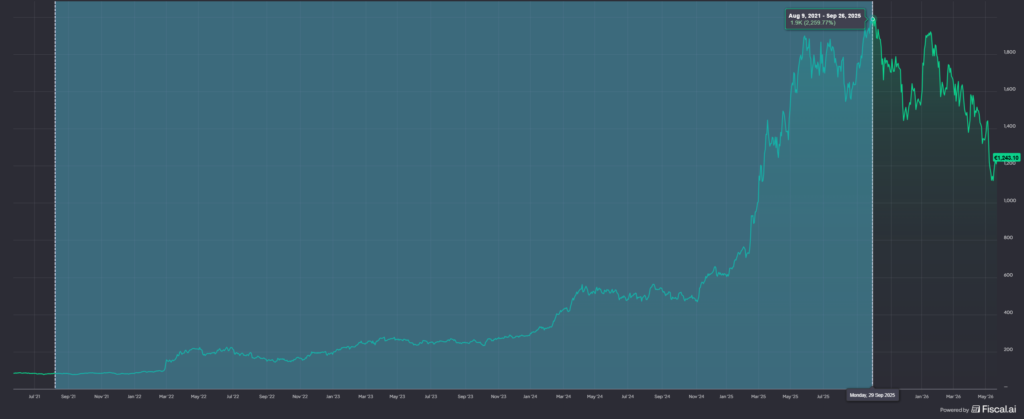
Rheinmetall's share price has been around for the past four years. It rose 2000%, and now, in 2026, it is at a crossroads: the European rearmament wave is far from over, the company's order book is at a record high, yet Rheinmetall fell short of quarterly revenue expectations, and the share price has corrected nearly 40% from its peak in the summer of 2025. That's enough to make the stock worth a look.
I don't know if you're aware of it, but preparing a thorough fundamental in-depth analysis can take 40-50 hours. That's why I created the Market Momentum section: quick, to-the-point fundamental mini-analyses that help you pre-screen. Rheinmetall is now on the agenda. It is not an in-depth analysis, but rather a thought-provoking one based on the current state.
You can find the share subpage with detailed information here: Rheinmetall stock page
If you are looking for in-depth analyses of the site, click on the link below: iO Charts stock analyses
📒 Table of Contents 📒
I have created a table of contents to make it easier for you to navigate the content:
- 🏭 What does Rheinmetall (RHM) do?
- 🏆 Rheinmetall's position and competitors
- 🎢 Rheinmetall stock metrics
- ✅ Rheinmetall stock: will you get used to it or will you run away?
- 📝 Thesis summary
- ❓ Frequently Asked Questions
🏭 What does Rheinmetall (RHM) do? 🏭
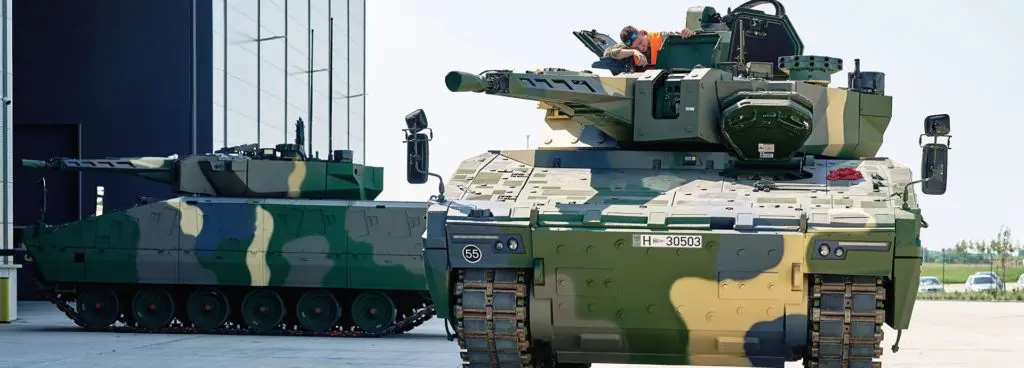
Rheinmetall AG (RHM) is a Düsseldorf-based defense industry conglomerate founded in 1889. Its shares are traded on the Frankfurt Stock Exchange under the ticker XETR:RHM and the company has been a member of the DAX 40 index since March 2023. This speaks volumes about its transformation: a decade ago it was mainly considered an automotive parts manufacturer, but today it is Europe's largest land defense industrial company.
The company operates in two main segments:
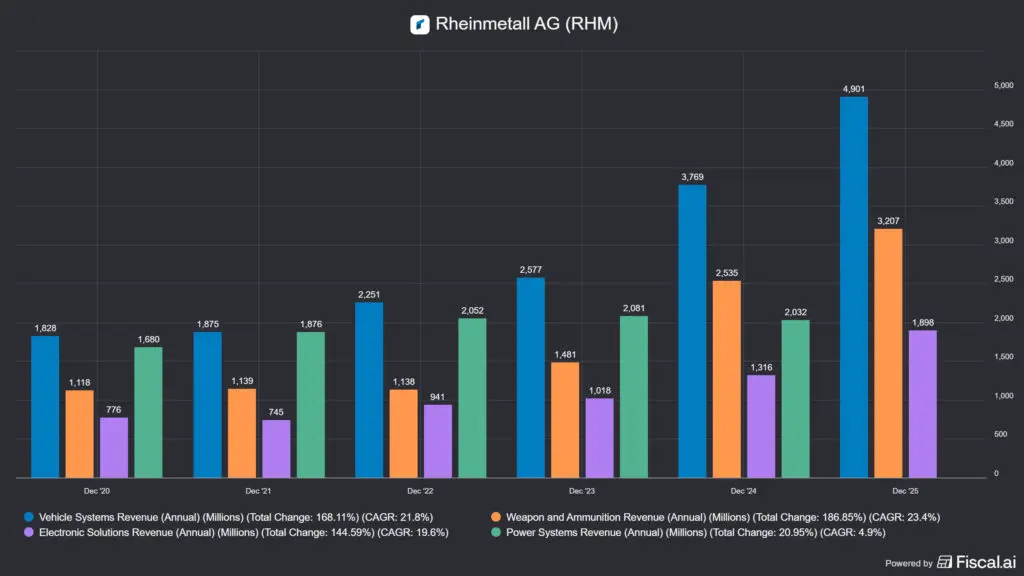
- 🔧 Power Systems division (automotive, ~15%): heat treatment and cooling systems for internal combustion engines. This segment is structurally shrinking, and the company is consciously reducing its weight by selling some businesses.
- ⚙️ Defence division (~85% of revenue): armored fighting vehicles (Lynx IFV, Boxer, Leopard 2 modernization), artillery ammunition (155 mm shells, of which Ukraine consumes gigantic quantities), air defense systems (Oerlikon Skyshield, Skyranger 30), electronic warfare and military simulation software. The Rheinmetall Rh-120 smoothbore gun is the standard armament of almost all NATO tanks.
📌 In practice: The real story of Rheinmetall is that management, led by CEO Armin Papperger, implemented the defense focus shift precisely when geopolitical events provided the best possible backdrop. The outbreak of the Russo-Ukrainian war in February 2022 and the resulting demand for ammunition and armor brought about what is an existential question in the defense industry: real, solvent demand. This has now grown into a rather brutal order backlog that Rheinmetall (RHM) can barely satisfy.
🏆 Rheinmetall's situation and competitors 🏆
The Zeitenwende and what comes after it
A Turning point is a German word that literally means “change of era”. It was first used by German Chancellor Olaf Scholz in February 2022, immediately after the outbreak of the Russian-Ukrainian war, when he announced a special EUR 100 billion defense fund and a radical turnaround in Germany’s defense policy. Since then, it has become a symbolic slogan for the entire European rearmament wave. It expresses that the world in Europe before and after 2022 is fundamentally different, from a security perspective.
The structural reason behind Rheinmetall stock can be described in one sentence: European defense spending has been increasing steadily and systematically since Ukraine, and this means concrete orders. NATO's 2% GDP spending target is now seen as a floor rather than a ceiling. A 3–3.5% threshold is being discussed across the continent, which the US is also "stimulating" with political pressure. Rheinmetall is the biggest beneficiary of Germany's €100 billion special defense fund.
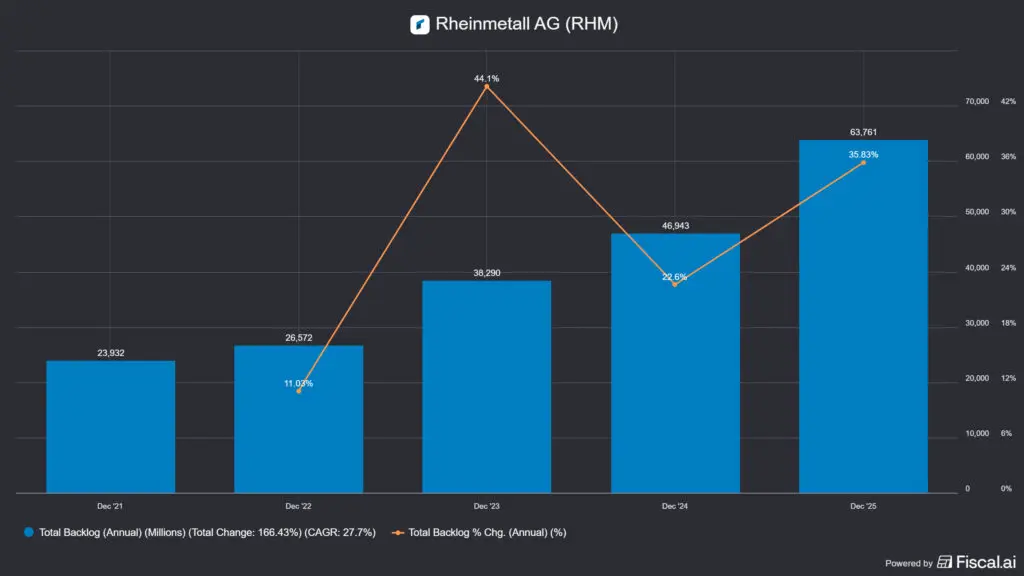
The company's order backlog at the end of 2025 EUR 63.76 billion (+35.83% YoY), which is more than six times the annual revenue. By Q1 2026, this will grow further to ~73 billion EUR. This means that even if the company stopped all new offerings tomorrow, it would still For 6+ years is filled with work. Such an order book is very rare, similar to that seen in companies that cannot meet the needs of their customers. In other words: there is demand pressure because supply is scarce, which gives Rheinmetall AG (RHM) particularly high pricing power.
Rheinmetall's competitors
Competition in the military industry does not work like in other sectors: the customers are almost exclusively governments, products mature in decades-long cycles, and most programs are carried out in consortiums.
- 🇬🇧 BAE Systems: Europe's largest defense company by total revenue. Interestingly, it is both a competitor and a partner: Rheinmetall's joint venture with BAE Systems Land Limited (RBSL) is modernizing the British Challenger 2 tanks.
- 🇮🇹 Leonardo: strong in helicopters, radar and missile defense systems. Revenue in 2024 ~20.9 billion EUR. Also has a joint project with Rheinmetall: Leonardo Rheinmetall Military Vehicles Srl
- 🇫🇷 Thales: outstanding in electronics, cyber defense and sensor systems. Rheinmetall is stronger in physical platforms (tanks, ammunition, vehicles), Thales is better in digital warfare, so they are more complementary companies than direct rivals.
- 🇸🇪 SAAB: known for Gripen and AT4; in certain segments (portable air defense) there is direct competition between the companies.
- 🇰🇷 Hanwha Aerospace: the Korean company's European expansion (K2 main battle tank, K9 self-propelled howitzer in Poland, Romania) represents direct competition with Rheinmetall's armored and artillery portfolio.
It is important that all military-industrial companies work primarily on state orders, the nature of which is that the state regulates both the price and the available profit. This industry is not at all virulent, there is no network effect, but in return the state's pockets are almost infinitely deep, meaning that the military industry cannot be replaced by anything. In return, in times of peace, demand drops significantly, since this is a cyclical industry, but not in the traditional sense.
🇭🇺Hungarian aspect
Rheinmetall's relationship with Hungary is far stronger than most people think. The company operates several domestic subsidiaries:
- 💻 Rheinmetall Electronics Hungary Ltd. (Budapest, since 2022): develops military simulation software and mission systems.
- 🔫 Rheinmetall Hungary Munitions Co., Ltd.: ammunition production, as part of domestic military capacity building.
- 💥 Rheinmetall Polycharge Hungary Ltd.: in the field of charge technology and explosives.
- (I.e.Rheinmetall Hungary Ltd.: the Lynx KF41 "Híúz" infantry fighting vehicles are manufactured at the Zalaegerszeg factory
The Hungarian connection to Rába is also relevant: The Győr holding, having entered the 4iG defense portfolio, has specifically focused on the production of military vehicles, while Rheinmetall is also present in the country with manufacturing infrastructure and ammunition capacity. The two companies are not yet a direct stock market benchmark (Rába is traded on the BSE with a small capitalization), but at an industry level, Rába could be a potential domestic subcontractor for Rheinmetall's programs in Hungary.
📌 In practice: The real competition in the military industry today is about capacity building, not prices. That is why Rheinmetall is opening factories in Ukraine, Lithuania, Romania and Hungary, not because of labor costs, but because of NATO expectations. In other words, this market will likely continue to grow, as the Russian threat will not go away in 1-2 months, and this is also reflected in the companies' backlogs.

🎢 Rheinmetall stock metrics 🎢
| Indicator | Value (fiscal.ai, May 2026) |
|---|---|
| Share price | ~1.231 EUR |
| Market capitalization (LTM) | ~56.8 billion EUR |
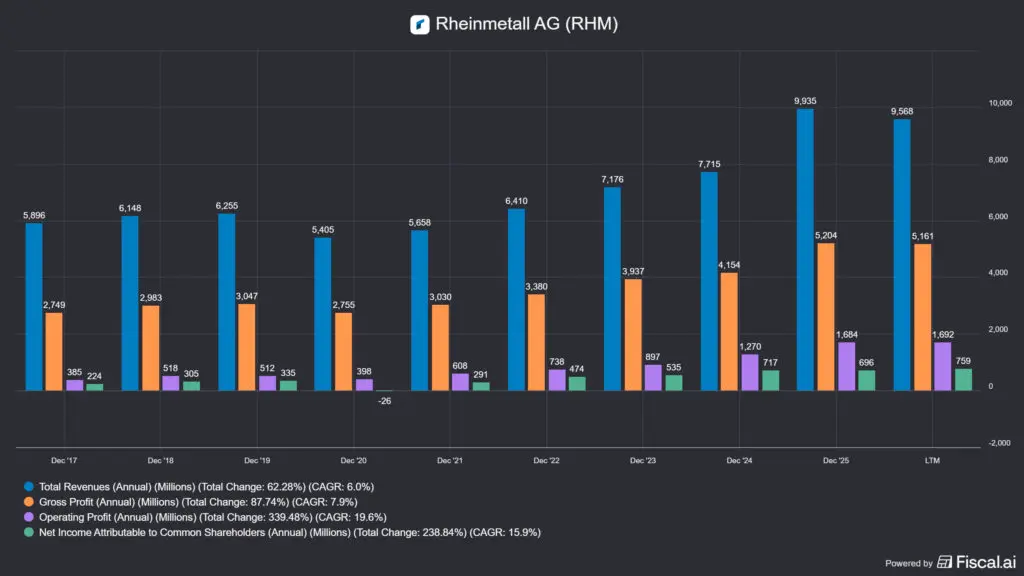
| Revenue (2025 actual) | EUR 9.935 billion (+28.78% YoY) |
| Revenue (2026E consensus) | ~14.16 billion EUR (+42.5%) |
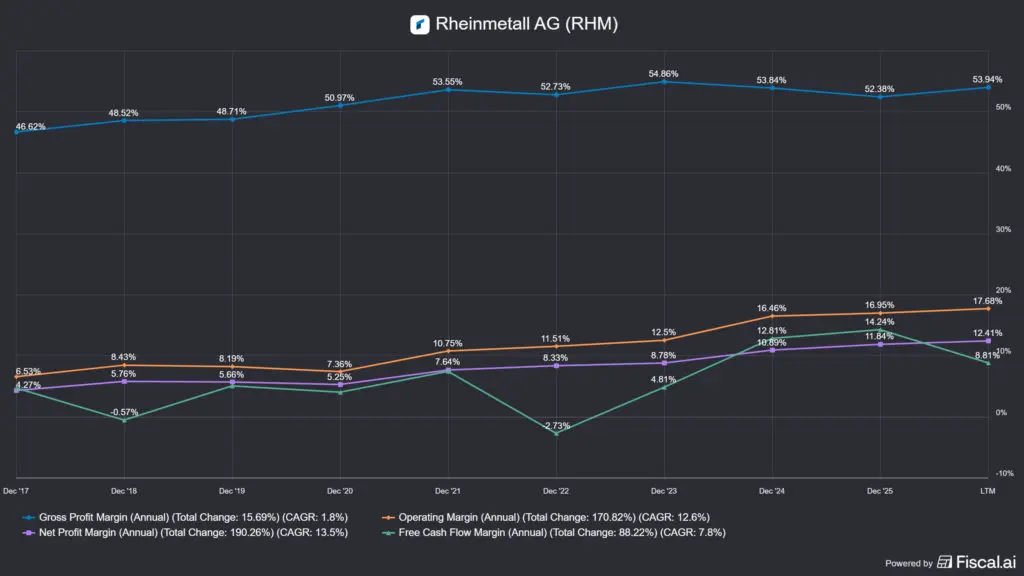
| Operating profit (2025) | EUR 1.684 billion (16.95% margin) |
| Adjusted EBIT (2025) | EUR 1.841 billion (18.5% margin) |
| Adjusted EBIT (2026E) | ~2.593 billion EUR (18.31% margin) |
| EBITDA(2025) | EUR 2.185 billion (21.99% margin) |
| Net profit (2025) | EUR 696 million |
| Adjusted net profit (2026E) | ~1.718 billion EUR (+146.87%) |
| Basic EPS (2025) | 15.38 EUR |
| Adjusted EPS (2025 / 2026E) | 25.28 EUR / 37.26 EUR |
| Free cash flow (2025) | EUR 1.415 billion (14.24% FCF margin) |
| Order backlog (end of 2025) | EUR 63.76 billion (+35.83% YoY) |
| Order Inflow (2025) | EUR 19.87 billion (+20% YoY) |
| P/E (TMT) | ~78.78x |
| Forward P/E (NTM) | ~29.46x |
| Forward P/E (FY2027E) | ~22.47x |
| EV/EBITDA (LTM) | ~25.97x |
| Dividend/share (2025) | 8.16 EUR (yield: ~0.33%) |
| Largest shareholder | BlackRock 7.17%, Vanguard 4.26% |
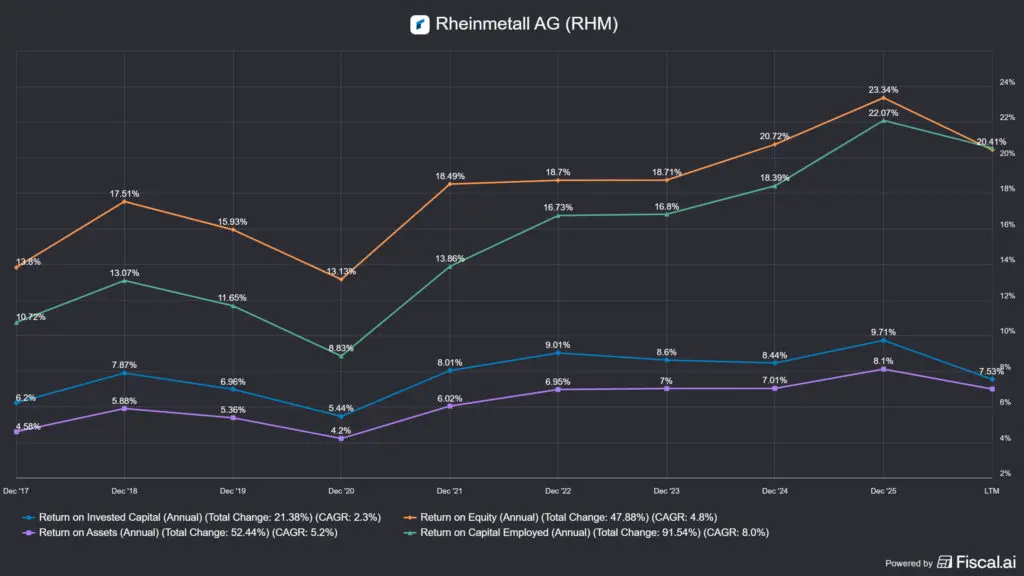
What is immediately obvious from the table: The ~79x TTM P/E seems daunting, but defense stocks are traditionally valued based on order backlog rather than forward-looking. The more relevant number is the NTM forward P/E of ~29.46x, which is much friendlier, especially considering that adjusted net profit could nearly triple in 2026. The adjusted EPS trajectory (25 → 37 → 55 EUR/share between 2025 and 2027) alone shows why Morningstar sees the stock as a 5-star at its current price of ~1.231 EUR.
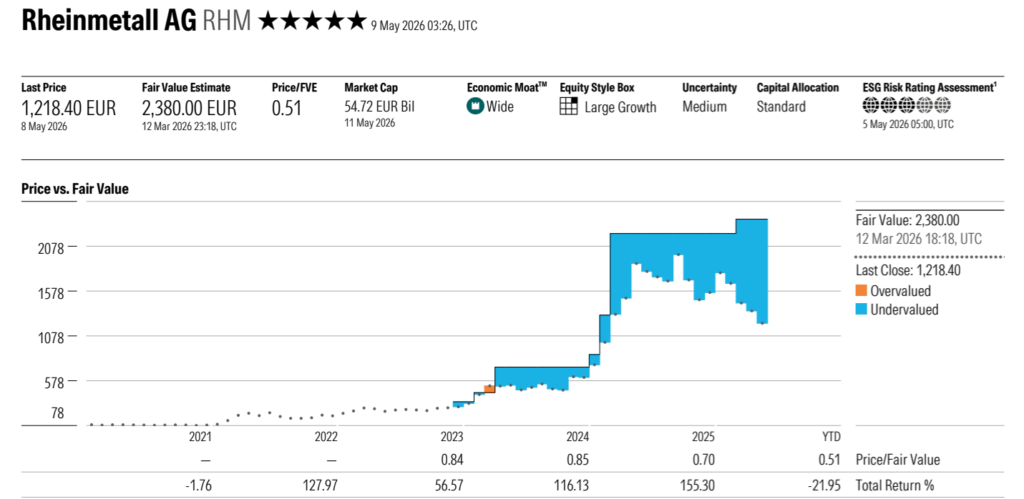
The question is what is priced into the stock, as it is beyond the brutal rise, as can be seen in the Rheinmetall share price, which soared from EUR 90 to EUR 1980, and then corrected back to the current price level. However, in the case of companies with a high order backlog, it happens that the fundamentals quietly catch up with the price, and although the price is high, the metrics also improve a lot, so the stock becomes cheap again.
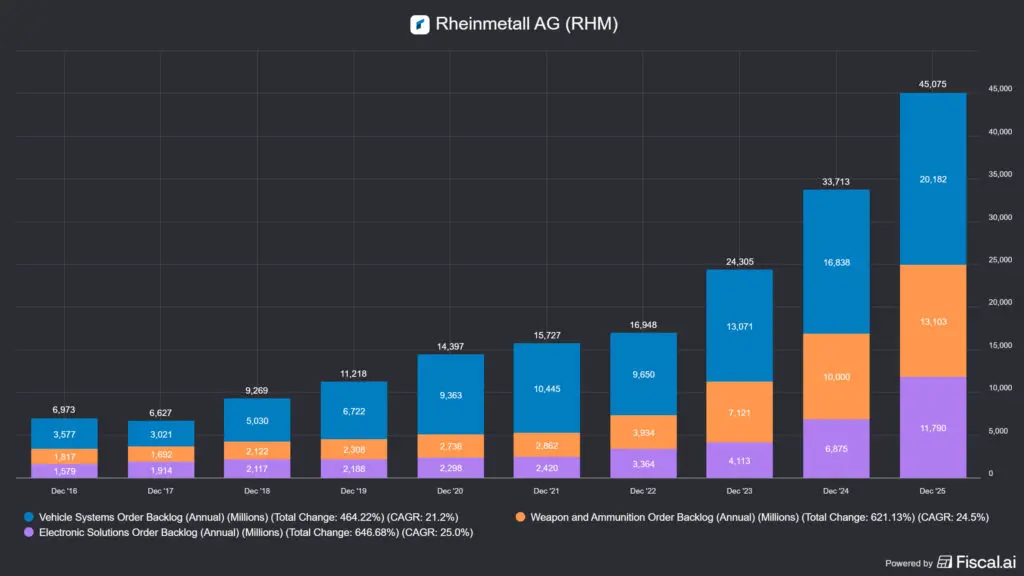
📌In practice: The order book of EUR 63.76 billion is almost 6.5 times the annual revenue. The really relevant question is not whether the stock is expensive now, but whether the company can produce these orders on time and when free cash flow will normalize after the rising capex. However, this is an ideal situation, as you can see the development of revenues in the future, so Rheinmetall AG is relatively easy to analyze, unlike, say, a bank, an insurance company or a complex serial acquisition company.
✅ Rheinmetall stock: will you get used to it or will you run away? ✅
Although this article does not discuss it, there are not only military companies in Europe, but also in the USA, and if you look at the market capitalization, the American companies are the larger ones. However, the same restrictions apply to almost all European and non-European military companies: regulated industry, with state resources, which fluctuates according to the international political mood, i.e. cyclical. However, the individual story of each is different, let's see what is in favor of investment and what is against it in the case of Rheinmetall (RHM).
What speaks in favor of Rheinmetall shares 🟢
- 🛡️ Unparalleled order backlog. EUR 63.76 billion (end 2025), ~EUR 73 billion in Q1 2026, that's 6+ years of revenue coverage. A recession won't upset the trajectory, government military spending spans cycles.
- 📈 European rearmament is structural, not cyclical. The 2% NATO threshold is now a floor: 3% is being set as a target by more and more member states. This means a sustained demand for ammunition, vehicles and air defense.
- (I.e. Vertical integration as a competitive advantage. Rheinmetall is the only European company that simultaneously produces an armored vehicle, its gun, its ammunition and its training simulator. This “platform-to-training” capability is unparalleled.
- ???? Strengthening free cash flow. The consensus is €1.415 billion FCF in 2025, and ~€2.41 billion for 2026E, meaning that the capex-intensive capacity expansion phase is slowly normalizing.
- 🌍 A globalizing portfolio. An office in Virginia, Lynx orders in Australia, factories in Romania-Lithuania-Hungary all show that Rheinmetall does not exclusively serve the Bundeswehr.
What is against Rheinmetall shares🔴
- ???? The ~79x TTM P/E expects priced-in perfection. Any delay in implementation immediately penalizes the exchange rate. This happened after the Q1 2026 report, in which the revenue below forecasts (1.94 vs. 2.3 billion EUR expectation) immediately caused an exchange rate drop.
- ☮️ Geopolitical risk is two-way. A surprise ceasefire between Ukraine and Russia would immediately price in demand reductions in the short term, even if NATO's resupply needs persist in the longer term.
- 🔧 Capacity expansion and implementation risk. It is building factories in multiple countries at once, integrating acquisitions, and fulfilling a record-breaking backlog. Managing projects is quite a challenge, as the quarterly delays so far have drawn attention to.
- 🚗 The Automotive segment is structurally shrinking. The downsizing of the Power Systems division is not yet complete and will hurt consolidated margins during the transition period.
- 🌐 Export restrictions and political sensitivity. A phone call from a government can shut down markets, this is an industry where regulatory and geopolitical risk is never zero.
📌 In practice: The biggest risk is not in the fundamentals, the order book is truly unmatched, but the valuation is already pricing in an ideal scenario. The question is not whether RHM is a good company, but what is the safety margin in Rheinmetall's share price at this price level.
📝 Thesis summary 📝
Rheinmetall is an indispensable name in the European land defense industry: from Lynx to ammunition, from air defense to simulation, it covers the value chain that NATO member states need. The order book of EUR 63.76 billion and the expected revenue growth of ~42% by 2026 reflect structural, long-term demand.
The current valuation (TTM P/E ~79x, but NTM forward P/E ~29x) paints an ambivalent picture: the price has corrected by almost 40% compared to the peak of EUR 1980, Morningstar gives the valuation 5 stars, and the adjusted EPS trajectory (25 → 37 → 55 EUR) is clearly pointing upwards. For those who think in a 5–10 year time frame and accept the construction and geopolitical risk, it is worth keeping this paper on the watch list. But market sentiment weighs heavily on all defense companies, so I'm not sure that the fundamental impact will be stronger than the sentiment impact.
If you want to analyze further, use iO Charts' stock finder and portfolio manager, which you can access here: iO Charts.
❓Frequently Asked Questions❓
Why has Rheinmetall's share price risen so much in recent years?
The nearly 2000% increase in Rheinmetall shares since February 2022 can be summed up in one sentence: the company produces exactly the products, ammunition, armored vehicles, and air defense systems, of which NATO member states have shown a serious shortage due to the Russian-Ukrainian war. The order book of EUR 63.76 billion and the annual order inflow of ~ EUR 20 billion confirm that this is not a temporary boom.
What is Rheinmetall's business model and what makes it special among defense industry stocks?
Rheinmetall covers the entire vertical of land warfare: armor, cannon, ammunition, air defense and training simulators are all in its portfolio. This integrated “platform + ammunition + training” model distinguishes it from other defense companies that issue shares, which usually specialize in one segment (aviation, naval, electronics).
Is there a Hungarian aspect to the Rheinmetall investment story?
Yes, and it is stronger than many people think. The company also operates several domestic subsidiaries: Rheinmetall Electronics Hungary Kft. (simulation software, Budapest), Rheinmetall Hungary Munitions Zrt. (ammunition production), Rheinmetall Polycharge Hungary Kft. (charge technology), and the Lynx KF41 “Hyúz” infantry fighting vehicles are manufactured at Rheinmetall Hungary Zrt.’s factory in Zalaegerszeg. Rába shares (RABA.BUD), which are also available on the BÉT, may potentially be involved in these programs as a subcontractor. Rába’s connection is also historical: the Győr holding previously assembled military transport vehicles for the Hungarian Army from Rheinmetall MAN Military Vehicles components, and its military chassis manufacturing competence is still present today, so Rába, which will be included in 4iG’s defense portfolio, could be a potential subcontractor in Rheinmetall’s programs in Hungary.
How expensive is Rheinmetall stock right now?
The ~79x TTM P/E seems high, but defense stocks are traditionally valued based on forward order backlog and backlog. The more relevant number is the NTM forward P/E of ~29.46x, which reflects the ~147% net profit growth expected by 2026. Morningstar gave the stock a 5-star (strongly undervalued) rating in the ~1.200–1.400 EUR range in the spring of 2026.
How would a Russian-Ukrainian ceasefire affect Rheinmetall's share price?
In the short term, it would likely trigger a rapid and sharp sell-off as the market prices in the immediate demand impact. In the longer term, however, European rearmament is not just about the war in Ukraine: replenishing the structurally insufficient stocks of NATO member states will require decades of work, even in the event of a lasting ceasefire. The bulk of the EUR 63.76 billion backlog is long-term contracts based on intergovernmental agreements.
Legal and liability statement (aka. disclaimer): My articles contain personal opinions, I write them solely for my own entertainment and that of my readers. The articles published here do NOT in any way exhaust the scope of investment advice. I have never intended, do not intend, and am unlikely to provide such in the future. What is written here is for informational purposes only and should NOT be construed as an offer. The expression of opinion is NOT in any way considered a guarantee to sell or buy financial instruments. You are SOLELY responsible for the decisions you make, and no one else, including me, assumes the risk.