

?What is the Market Momentum column about??
What caused the change in Richter's share price? To what extent does the company's future depend on the success of a single drug, cariprazine? What risks does exposure to the Eastern European market entail? These were the thoughts that were running through my mind when I started writing this article, which is not intended to be an in-depth analysis but rather to provide a quick, to-the-point snapshot of the current situation of Richter Gedeon Plc.
Preparing a thorough fundamental in-depth analysis can take 40-50 hours. As an investor, it is impossible to put so much energy into analyzing each company if you want to manage a sufficiently long watchlist effectively. That is why I created the Market Impulse column: I publish quick, to the point fundamental mini-analyses that help in pre-screening and in deciding whether it is worth starting a deeper investigation. Richter's share price has received serious attention recently, and not by chance.
You can find the RICHTER share subpage with detailed data here: Richter stock page
If you are looking for in-depth analyses of the site, click on the link below: iO Charts stock analyses
?Table of Contents?
I have created a table of contents to make it easier for you to navigate the content:
- ❓What does Richter do?
- 💡Richter's current situation and competitors
- 🎢Richter metrics
- ✅Richter: will you get used to it or will you escape?
- 📝 thesis summary
❓What does Gedeon Richter do❓
If you would like to better understand the operation of pharmaceutical companies, and thus Gedeon Richter Plc., I recommend that you read my in-depth analyses of Merck (MRK) and Novo Nordisk (NVO) stocks, which I have also included in this article. From this, you can relatively easily understand what specific and generic drugs mean, what is “pipeline risk”, which is the biggest risk of all pharmaceutical manufacturers. It also reveals whether this is truly a “boom and bust” industry, or whether it is something else.
Richter Gedeon Plc., founded in 1901 by chemist Gedeon Richter, is today one of the largest publicly traded pharmaceutical companies in Central and Eastern Europe. Headquartered in Budapest, it trades on the Budapest Stock Exchange under the ticker RICHTER and has attracted increasing institutional attention since its share buyback programs. The company operates on the “innovative generics” business model: it simultaneously develops original active ingredients resulting from its own research and generic products, which are copies of original medicines with expired patents.
Gedeon Richter's activities are built on four main pillars:
- ? CNS (Central Nervous System Agents): This is the company's crown jewel. The cariprazine-based Vraylar (US) and Reagila (Europe) drugs used to treat schizophrenia and bipolar disorder have been the most important growth drivers in recent years. Under the license agreement with AbbVie, Richter Gedeon Vraylar receives royalties on US sales, the amount of which increases in line with the increase in sales volume. This is a highly capital-efficient revenue stream: the company benefits from the growth of the US market without directly bearing the commercial risks.
- ? Women's Health: Contraceptives and gynecological products have traditionally been one of the strongest pillars of Gedeon Richter's revenue. The company has a dominant market share in this area in the European and CIS markets.
- ? Biosimilars: With the expiration of patents on original biological medicines, the biosimilar business holds long-term growth potential. Richter Gedeon's portfolio expansion in this area is ongoing, although product development times are long and capital intensive.
- ? Generics and other products: The general generic portfolio, mainly in the Eastern markets, is a stable but lower-margin source of income. The presence in the CIS market (former Soviet republics) represents both an opportunity and a geopolitical risk.
? In practice: Gedeon Richter may appear to be a classic pharmaceutical company, but it actually operates in a hybrid model: part royalty company (Vraylar), part generics manufacturer, and part innovator. This combination creates unique valuation challenges because the different segments represent very different risk-return profiles.
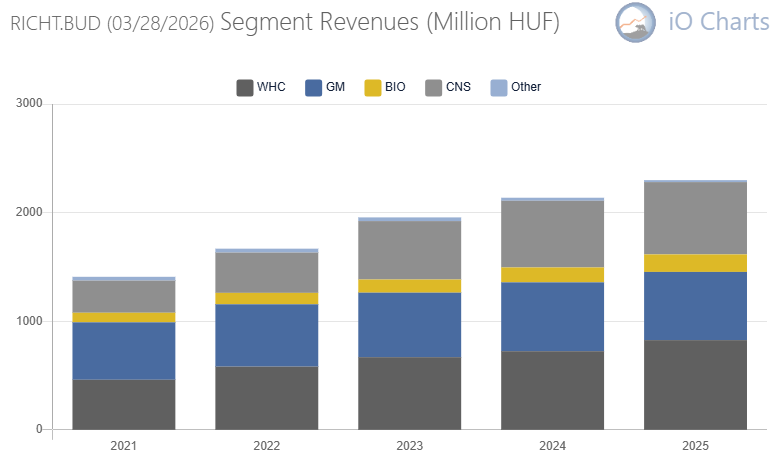
When Gedeon Richter receives royalty income, it does not bear the manufacturing, distribution and other costs, but outsources these activities to another party, such as AbbVie, in return for which it receives royalties as the developer of the drug. Generic drugs are typically drugs that are produced using a chemical process and are not under patent protection, such as Aspirin or Rubophen. Biosimilar drugs are similar to generics, only they work on a biological basis and their production is much more capital-intensive.
?Richter's current situation and competitors
The pharmaceutical industry is a rather specialized industry, with fundamentals that are largely different from other companies. Pharmaceutical companies are capital-intensive, but not in the same sense as, say, a mining company or an oil company. A significant portion of the costs are research and development costs, which are actually invested by biotechnology and pharmaceutical companies upfront in the hope that the drug will be effective and can be scaled up. However, they have to develop several drugs at once, because no one knows in advance whether any of the active ingredients will actually work or not. This risk is called pipeline risk. The drug manufacturer must prove its effectiveness in Phase I-III tests and then obtain approval from the relevant authority, which can cost several billion USD and take up to 10-15 years. Therefore, all pharmaceutical companies fall into the high risk/high reward category, including Gedeon Richter.
This is why you can see big jumps and dips in the Richter share price, because the market is pricing in an opinion that will only happen in the future. For example, the company's launch of Vraylar on the US market or its entry into the consumer products market. Gedeon Richter's revenue has been shaped mostly by two factors in the past few years: royalty flow from increased sales of Vraylar in the US market, and pressure in the Eastern European segment caused by the weakening ruble and political risks in the CIS market. The two act as opposing forces: the former raises the result, the latter keeps it under pressure.
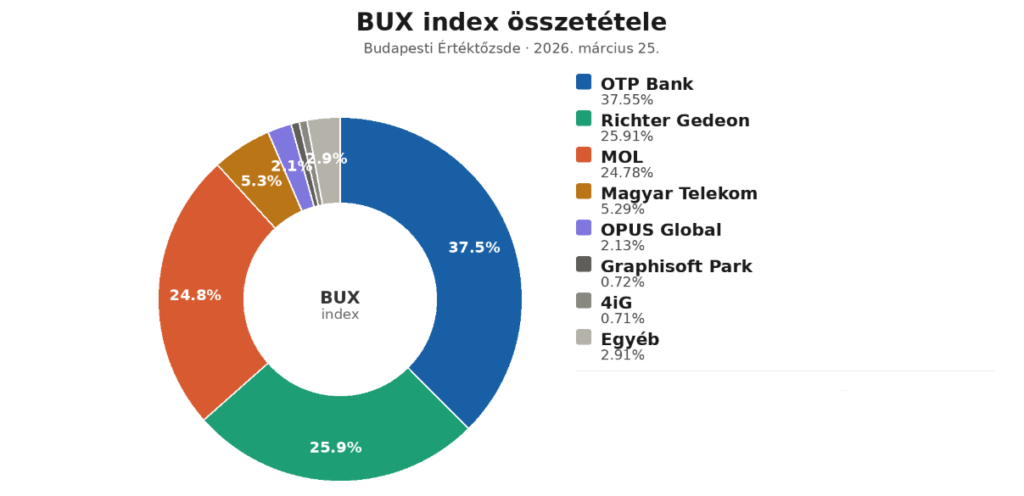
Gedeon Richter, like OTP and MOL Group, is a major player on the Budapest Stock Exchange (BSE), accounting for more than 25% of the BUX index capitalization, making it the second largest company in the index. In fact, the first 3 names move the entire market, which is telling, as the movement of Richter's share price has a significant impact on the entire index.
? Richter's competitors
The direct basis for comparison is the range of pharmaceutical players in Central and Eastern Europe, but it is also worth placing the picture in a global context, as a drug can compete not only in regional markets, but throughout the world:
- ⚕️Egis Pharmaceuticals Plc.: is a direct competitor in Hungary, but lags significantly behind Gedeon Richter in size and stock market weight. It focuses mainly on generics and has a minimal innovative R&D portfolio.
- ?Krka (Slovenia): Central European generics manufacturer with similar business logic. Strong CIS market presence, conservative financial policy. No similar royalty engine compared to Richter, which explains the lower valuation.
- ?Gedeon Richter Poland / Richter-Helm (German subsidiary): the group's own subsidiaries, not direct competitors, but they indicate the extent of Gedeon Richter's vertical integration.
- ?Globally: AbbVie (the Vraylar partner) is of course not a competitor, but a strategic partner. The relevant global benchmark is rather the range of small and medium-sized CNS-focused pharma companies (e.g. Intra-Cellular Therapies, Otsuka Holdings) with which the market position and royalty structure of cariprazine (the active ingredient of Vraylar and Reagila) can be compared.
? In practice: It is important that the pharmaceutical market is fully international. Although I will refer to Central and Eastern Europe or the CIS region several times in the analysis, in fact an active ingredient or a preparation can be sold all over the world. A good example of this is the AbbVie cooperation, which opened the American market for Richter Gedeon. Richter has also entered the GLP-1 market, which less professionally means the market for weight loss drugs, in which Eli Lilly and Novo Nordisk are the leading companies. The opposite is also true, if Richter Gedeon were to discover some world-changing innovation, they would immediately move into the same area from abroad, so the competition is truly international.

?Richter's metrics?
? Exchange rate and catalysts of the year
Richter's share price has shown significant volatility over the past three years, primarily due to two factors: the quarterly development of Vraylar royalty revenues and market data reported by AbbVie, and the movement of the HUF/USD exchange rate. Since royalty revenues are generated in USD, the strengthening of the HUF has a negative impact on the result expressed in HUF, while its weakening has a positive impact, as is the case for MOL.
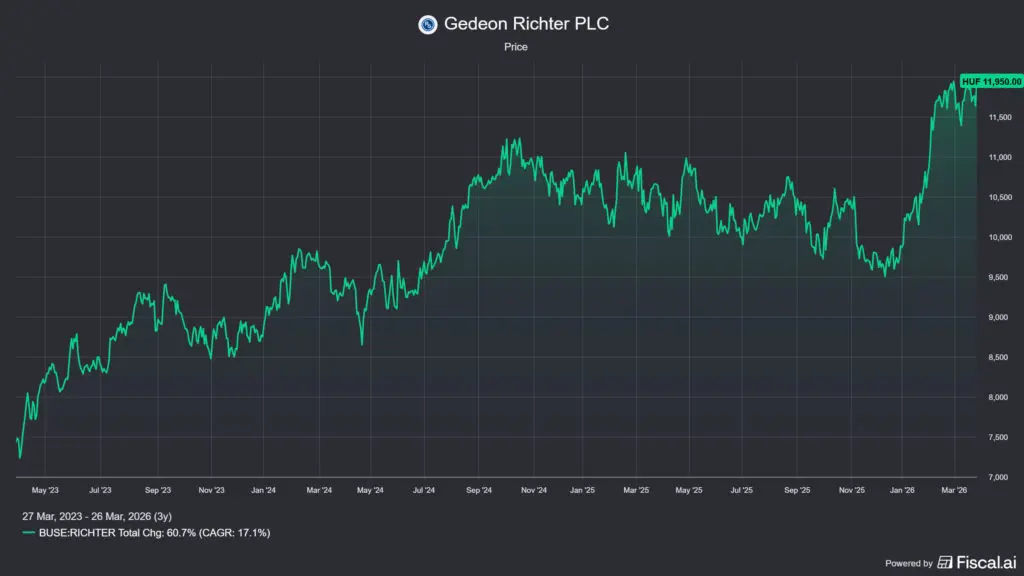
Richter's share price has fluctuated in the 9,000–11,000 HUF range in recent times, and has reacted sensitively to AbbVie's quarterly flash reports, which include Vraylar's US market sales data. Why did this happen? Because the Vraylar royalty business accounts for roughly 250 billion HUF of Richter's total sales of 914 billion HUF, which is 27%. This is both good and bad news: the royalty business operates with very high margins, according to some sources it can account for 40-50% of EBIT, but it also depends on AbbVie and how quickly the drug can scale. What is worth noting in the picture is that over a 3-year period, it rallied from a price level of approximately 7500 HUF to nearly 12000 HUF, which represents a 17% annual CAGR price increase, which is a more than decent result.
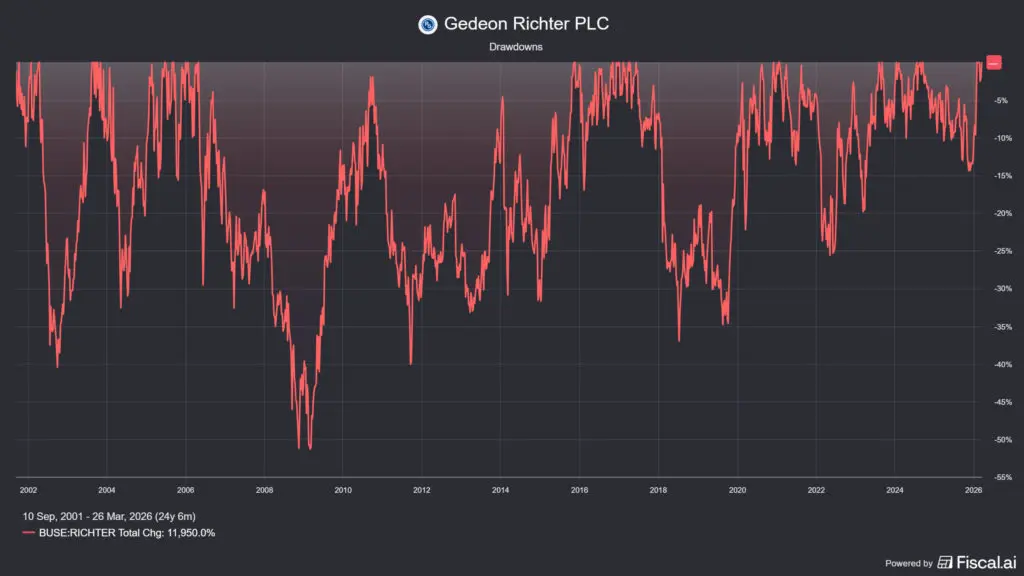
What structurally determines the price movement: the investor narrative is largely about how long Vraylar's patent protection will last and how fast the active ingredient developed jointly with AbbVie will grow its market share in the increasingly crowded CNS drug market. Consequently, Richter's price is a kind of derivative bet on AbbVie's commercial success and also on the fact that after March 2030, when the FDA patent expires, competitors will drive down prices with all kinds of generic drugs (this is a preparation produced by traditional chemical synthesis).
? Valuation: P/E, EV/EBITDA and dividend yield
In the pharmaceutical industry, EV/EBITDA is typically higher than in the energy sector, for example, but fortunately, the valuation of biotechnology/pharmaceutical companies can be examined relatively well using a variety of metrics. However, you should keep in mind that in the books, research and development costs are described in one year, even though these can have an impact spanning years if a development is successful. In the case of Gedeon Richter, it is worth operating with the following indicators:
- ⏳ P/E (TTM): ~9 (varies depending on royalty revenue volatility)
- ?Historical 3-year P/E average: 9.07
- ?Historical 5-year P/E average: 10.06
- ?Current EV/EBITDA: ~ 5.5
- ? Historical, 3-year average EV/EBITDA: 6.52
- ? Historical, 5-year EV/EBITDA average: 5.67
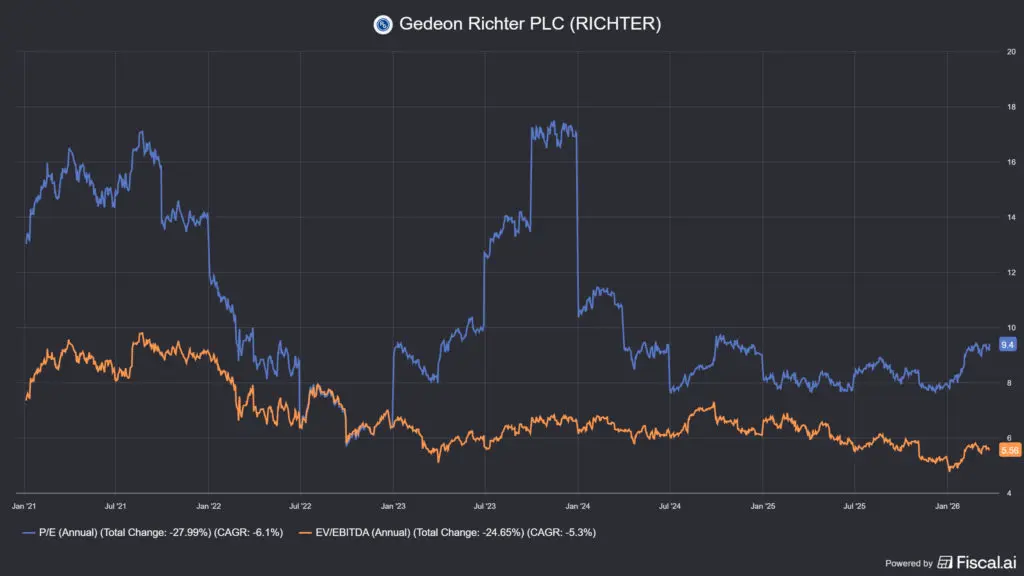
How is it possible that the current P/E and EV/EBITDA values are essentially the same as the historical averages? So that the price increase followed the fundamental strengthening, that is, the market priced in that Richter achieved higher operating income and profit, so essentially the ratios did not change. This is a very good example of why it is not worth following the movement of the Richter share price alone, but you need to look a little behind the numbers. This still does not mean that the share is “at an advertising price”, but the valuation is not far from gone.
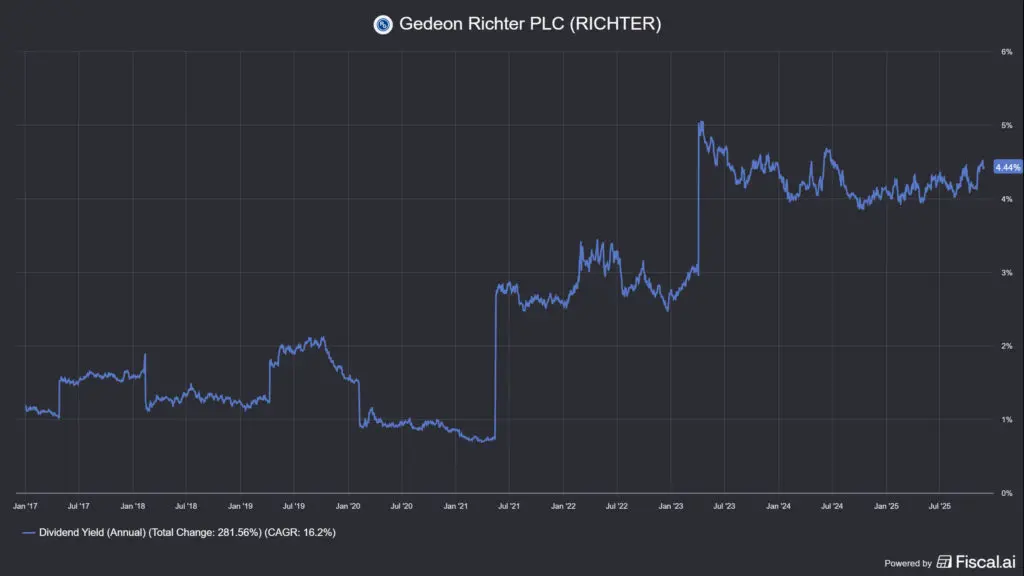
Gedeon Richter pays dividends, but not at the same rate as, say, MOL. According to the logic of the pharmaceutical industry, free cash flow is partly reinvested in R&D and acquisitions, and the rest is paid out as dividends. This is not a negative in itself: this is the expected behavior of a pharmaceutical company in a growth phase. In practice, this meant that a dividend of HUF 509 per share was paid in 2025, which currently means a dividend of ~4.45%. It is expected that they will raise this somewhat, in line with the practice of previous years. However, investors typically buy pharmaceutical companies not because of the dividend, but because of the increase in price, as they are the engines of research & development, so the total return usually comes from this and not from the dividend.
? In practice: Richter's current valuation is not historically high, but it is not cheap either. The valuation is heavily influenced by the amount and duration of royalty income the market expects from the Vraylar portfolio. This is the single variable that has the greatest weight according to market consensus.
?Profitability, value creation, financial stability
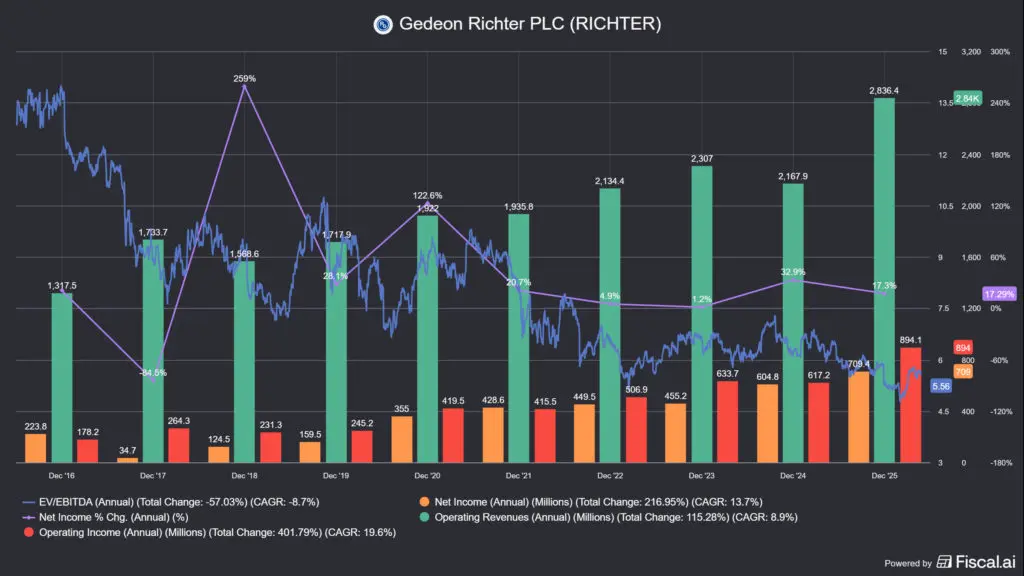
Gedeon Richter can be considered a particularly profitable company, essentially a money printing press at the moment. This is quite typical of biotechnology and pharmaceutical companies, as long as the cart is going well, they have many successful pharmaceutical products and are not close to the expiration of the patents of cashcow drugs. The question here, of course, is what happens to the cash generated and what the capital structure is like.
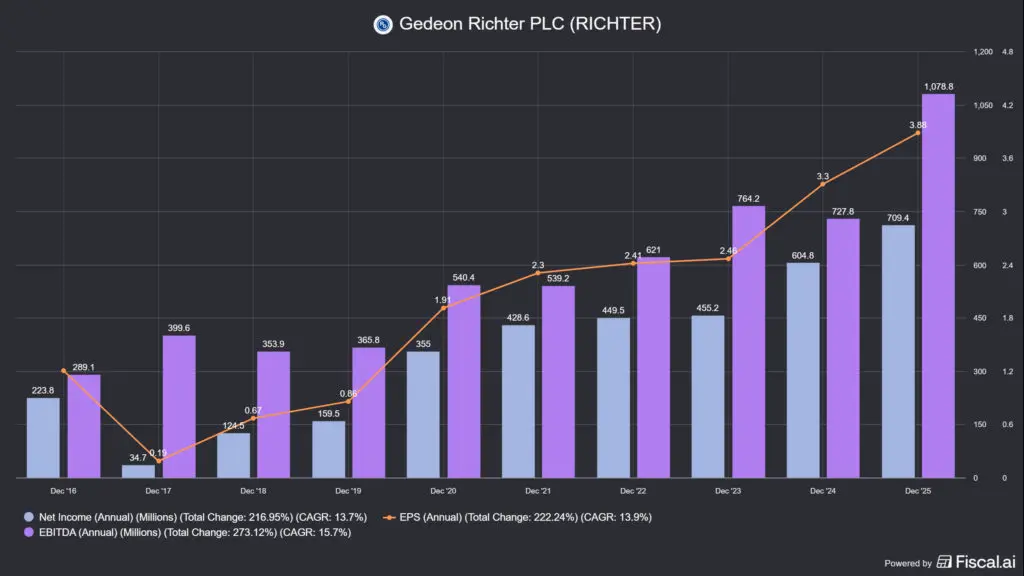
The company is sitting in negative debt, in other words, in net cash, meaning it has no debt, instead it has ~164 billion HUF of freely spendable cash, meaning the company is very financially stable. As for value creation indicators, these are usually described with three indicators, the ROIC, the ROCE and the ROE indicators. Each one represents a different type of indicator achieved on capital. ROIC is contrasted with the WACC and the average cost of capital, where if ROIC>WACC, then Gedeon Richter creates value. Since the ROIC indicator is around 16-17%, while the cost of capital is 10% as a rule of thumb, the result is a positive number, Richter is a value-creating company. ROCE shows a similarly steady but rising trend, which can be driven up by the very efficient use of capital in the royalty business (they essentially work with almost zero cost).
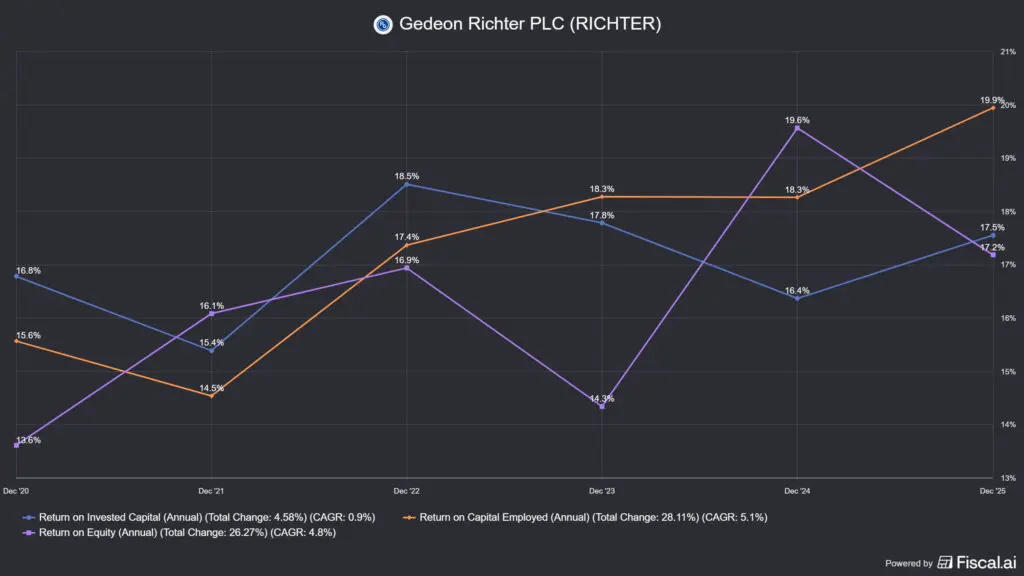
As I mentioned earlier, research & development costs are usually written off as expenses within a year in accounting, even though their impact lasts for years, so this can distort the indicators. However, there is nothing dramatic in the pictures, Gedeon Richter is one of the best quality companies on the Hungarian market.
?️ Ownership structure and the state relationship
The ownership structure of Gedeon Richter is less complex than that of MOL, but there is still a noteworthy element here. The ownership is more concentrated in institutional and foreign hands, but the Hungarian state, through the former Hungarian National Asset Management Company, has transferred ownership to 3 foundations, similar to MOL, which own approximately 25% of the company and Gedeon Richter is considered a strategically important company for the domestic industry. On the one hand, this means security against hostile takeovers, and on the other hand, it can bring political influence in decisions such as R&D investments or possible strategic acquisitions.
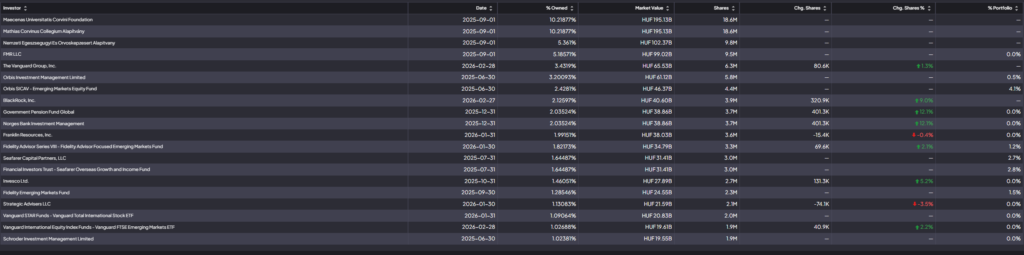
It is also worth knowing that 90% of Gedeon Richter's revenues come from abroad, meaning that this is perhaps the company that can be most described as international, even if its home country is Hungary. But as we saw in the case of OTP, where roughly 2/3 of its revenues come from foreign sources, Hungarian large-cap companies are also increasingly dependent on external markets.
? Risk factors
- ? Vraylar patent risk: The patent protection for cariprazine is finite. The closer we get to expiration, the more likely it is that royalty income will decrease or disappear altogether. This risk will occur in the longer term, but the market may start discounting it years earlier. However, investors don't have to worry so much until 2030.
- ? AbbVie addiction: One of the most valuable components of Richter Gedeon's revenue depends on a partner over which it has no direct control. If AbbVie's commercial strategy changes or another CNS product is brought into focus, it will have a direct impact on the movement of Richter's share price.
- ? CIS market geopolitical risk: Sales in Russia and the CIS region may be under sustained pressure due to geopolitical changes after 2022. The indirect effects of the weakening ruble, export restrictions and sanctions will erode some of the revenue.
- ? Currency risk: Part of Richter's revenues are denominated in USD (royalty), and part in EUR, RUB and HUF. This represents a complex currency exposure that investors who think in HUF tend to underestimate, although this is true for all domestic companies.
- ? R&D success risk: The success of the clinical development pipeline is uncertain. A project that fails in the clinical phase can even result in significant write-offs. But this is a risk for every biotech company, it's simply the nature of the industry.
- ⚖️ Price regulation: European regulatory regulation of pharmaceutical prices and reimbursement systems continue to put pressure on margins, especially in the generic portfolio.
?In practice: The biotechnology and pharmaceutical sectors are often referred to as “boom and bust,” which in practice means that if a big blockbuster drug is developed, the manufacturer or the company collecting royalties from the patent makes a huge amount of money. If not, the company may face some pretty bad times, which can be exacerbated by black swan events such as pharmaceutical lawsuits, but competitors may also develop drugs with similar effects, as competition in the segment is brutal. This sector is recommended for investors with strong nerves.

? Richter: will you get used to it or will you run away??
Here comes the usual "get used to it or run away" column, where in addition to the general risks of the segment, we also examine the special problems of Gedeon Richter!
? Bulls say (Optimistic scenario):
- ? Vraylar royalty may continue to grow for many years to come: Cariprazine's market share in the US schizophrenia and bipolar markets is continuously expanding, and AbbVie is actively pursuing product indication expansion (e.g., adjunctive therapy for depression). This growth trajectory requires no additional capital allocation from Gedeon Richter – almost pure profit.
- ? Long-term value of biosimilar pipeline: The development of biosimilar (i.e. large-molecule biological) drugs can make a significant contribution to the outcome in a decade-long perspective, as an increasing number of patented biological drugs lose their patent protection.
- ? Relative valuation compared to global pharmaceutical peers: Gedeon Richter has historically traded at a discount to Western European and American companies, it's just that Richter's share price movement doesn't fully track the underlying fundamentals. Investors attribute this partly to the premium of the Central European market and partly to the CIS risk. If these risks decrease, valuations could catch up and the stock price could rise.
- ? Stable, well-managed core business: Although the generics and women's health businesses are not exciting growth segments, they generate stable, predictable cash flow, which provides a basis for R&D funding and dividend payments.
- ? Possible pipeline success option: If a new CNS drug from the development pipeline enters the clinical phases and is successful, it could act as a significant catalyst for the share price.
? Bears say (Pessimistic scenario):
- ⏳ The Vraylar story is patent pending: The more Vraylar's future royalty potential is priced in, the riskier the position. If generics emerge or AbbVie's strategic decision causes royalty income to fall short of expectations, it could cause a significant price drop.
- ? CIS risk has not disappeared: The stabilization or possible decline of revenues in the Eastern market will put lasting pressure on the overall result. Geopolitical normalization is not yet visible on the horizon, and the conclusion of the Russian-Ukrainian war remains uncertain.
- ? There is no real “cheap” entry point: Gedeon Richter has historically almost never been the kind of deeply discounted, high dividend yielding stock that value investors prefer. The current valuation is mediocre, and without a particular catalyst, the price will not move much.
- ? The generic portfolio is structurally eroding: Generic competition is becoming increasingly fierce in the price-sensitive Eastern European markets. The margins of Gedeon Richter's older products are continuously decreasing, but this is currently being masked by AbbVie royalties.
- ? Pipeline risk: Drug development has an extremely high failure rate (pipeline risk). If the next big project fails, it will hurt both the narrative and the share price. There have been countless examples of this in history, it is worth looking at Merck's struggles before Keytruda.
? In practice: Richter Gedeon is a high-quality, but complex company to value. For those looking for CNS pharmaceutical exposure in a Central European company and can accept a royalty risk related to AbbVie, Richter Gedeon may be a relevant investment target. However, for those looking for a simple, predictable cash-flow model with a high dividend yield, another paper is probably more suitable.

?Richter's situation summary?
The movement of the Richter Gedeon share price is currently determined by the future of the drug Vraylar. As long as the joint royalty model with AbbVie is in place, Richter is looking for a break on this extremely high-margin partnership that requires almost no investment. The company is fundamentally stable, the management is experienced, and the balance sheet is conservative. Richter's share price has moved mainly as a function of the expected development of royalty income in the recent period, and has not been driven by changes in the core business. However, the market has priced all of this in nicely, and the company's share is trading around its historical valuation.
What investors should be most concerned about: When and at what rate the US patent protection for cariprazine expires, and what comes after that. There are no clear answers to these questions today, but Richter's Gedeon pipeline and the development of biosimilar drugs may provide at least a partial answer to this challenge. But, as is true for all pharmaceutical and biotechnology companies: the success of the drugs under development is what determines the company's long-term future. However, in the short term, AbbVie's quarterly results and the development of the royalty line will be the main price catalysts for Richter's share price. It is not a paper for those who want to sleep soundly, so it is recommended for risk-taking investors.
If you want to analyze further, use iO Charts' stock finder and portfolio manager, which you can access here: iO Charts.
Frequently Asked Questions: Professional questions about Gedeon Richter
Why is Vraylar so important to Richter's share price?
Vraylar (cariprazine) is a CNS drug marketed by AbbVie, developed by Gedeon Richter, and marketed in the United States. Richter receives royalties on sales, which depend on sales volume and contractual terms. Since it is one of the highest-margin revenue streams in the portfolio and Richter does not bear marketing and distribution costs, the share price is very sensitive to Vraylar sales figures reported by AbbVie. If AbbVie's quarterly earnings report for Vraylar falls short of consensus, Richter's share price could fall by 5-10% in a single day.
How much dividend can a Richter shareholder expect?
Gedeon Richter has historically pursued a moderate dividend policy, with a dividend yield of 4-4.5% expected at the current share price. This is significantly lower than that experienced at MOL, but is in line with the logic of the pharmaceutical industry: free cash flow is partly reinvested in R&D activities. For those looking for a high, stable dividend yield, Richter will probably not be their first choice, as the Richter share price follows the logic of growth-type securities rather than dividend-paying stocks.
What currency risk should be considered when investing in Richter?
Gedeon Richter's revenues are denominated in multiple currencies: royalties in USD, European sales in EUR, ruble and other CIS currencies, and domestic operating costs in HUF all impact the result. As an investor thinking in HUF terms, the most important factor is the HUF/USD exchange rate: a strong HUF reduces royalty revenues expressed in HUF, while a weak HUF increases them. In the CIS region, the volatility of the ruble and possible sanctions also pose significant risks.
What is a biosimilar strategy and why is it important for Richter's future?
Biosimilars are copies of original biological active ingredients with expired patents. As biological medicines represent an increasingly large share of the global pharmaceutical market, expiring patents open up significant growth opportunities for biosimilar manufacturers. Gedeon Richter is actively developing this area and is bringing more and more biosimilar products to the market in Europe. In the long term, i.e. over a 5-10 year horizon, this could become a business that could partially compensate for the possible loss of patent protection for cariprazine.
How does the geopolitical situation in the CIS region affect the Richter share price?
Gedeon Richter has traditionally had a strong market presence in the former Soviet republics, especially Russia, Ukraine and other CIS countries. The 2022 Russo-Ukrainian war and the subsequent sanctions environment put serious pressure on this segment: the weakening ruble hurt revenues in forint, while supply chain disruptions and market access difficulties reduced volumes. Gedeon Richter's management is trying to diversify its revenue structure, but CIS exposure remains a significant risk factor in the short to medium term. Should the geopolitical situation normalize, it could act as a positive catalyst for Richter's share price.
Legal and liability statement (aka. disclaimer): My articles contain personal opinions, I write them solely for my own entertainment and that of my readers. The articles published here do NOT in any way exhaust the scope of investment advice. I have never intended, do not intend, and am unlikely to provide such in the future. What is written here is for informational purposes only and should NOT be construed as an offer. The expression of opinion is NOT in any way considered a guarantee to sell or buy financial instruments. You are SOLELY responsible for the decisions you make, and no one else, including me, assumes the risk.