

Building a stock portfolio is not easy, even for us experienced “veterans”. iO Charts His team consists mostly of active investors, one of us mostly travels in cryptos, the other has built a complete portfolio of individual stocks and startups. This article will not discuss startups, but if you are interested in the topic in more detail, read our series on building a startup portfolio, which you can find at the link below:
- 🚀Creating a startup portfolio simply and clearly I.
- 🚀Crowdfunding and what you need to know about it II.
- 🚀Operation of startup platforms in 2025 based on real experiences III.
- 🚀Crowdfunding and what you need to know about it in 2025 IV.
- 🚀Startup exit – The thousand faces of pitfalls V.
I'm going back to the basics of building a stock portfolio, What you should know is that in the following lines I am not sharing theoretical things, but my own experiences, in a kind of best practice manner, so everything I describe is based on practical experience.
🤔It's worth knowing that 95% of my total invested assets, calculated at cost, are in individual stocks, and the remaining 5% are in startups.
Of course, I keep some cash for everyday life, but most of my savings are used to expand my stock portfolio, so I don't just preach about it, I put my money there, which is what I say anyway. You can guess from this that I'm still in the construction phase, not in my FIRE years and the return on my investments is sustainable, but this is obviously the long-term goal.
Building a stock portfolio: what not to do, or what to do
Most people make the mistake of buying something based on hearsay, intuition, or the recommendation of a taxi driver or neighbor, even though you can save the most time, energy, and especially nervousness by buying ETFs instead of individual stocks. ETF is nothing more than an abbreviation for Exchange Traded Fund, which is most often a passive fund, essentially tracking a specific sector or even the stock market as a whole.
The classic 60/40 portfolio, which consists of 60% stocks and 40% bonds, can be built from 2 instruments. For European investors, it is enough to IS0F (1-3 year US Treasury ETF, this is the bond leg), but you can also choose a longer duration bond ETF, and you can even choose the currency. A few examples: AGGH vagy EUNHThe other instrument is the VWCE (All-World ETF, this is the stock price) UCITS ETF with a ticker, and your portfolio is ready, from now on you don't have to do anything, just wait patiently. If you don't like this, there are ETF search sites where you can choose from many: JustETF.
🫰The answer to costs: the EUNH and in the case of VWCE 0.07% and 0.14% per year, which will beat all the bank funds in terms of cost. That's it, put it away for 10-20 years and you'll have a lot of money.
If it's that simple, why didn't I do it? Because in that case I would get the entire market average and I would be carrying a bunch of free riders that I wouldn't buy otherwise. If you want to do this, you will need many years of experience, so I don't recommend it to anyone, I've been "doing" construction for almost 7 years. However, I like doing it, I learn a lot from it, but if you don't have the time, inclination or significant internal motivation for it, then it's better not to take the plunge and stay with ETFs.

Building a stock portfolio: diversification or concentration
In most investment books you will read, to diversify, diversify, diversify. This is very good advice for those who don't understand investing and don't want to delve into the subject in depth. I previously recommended ETF investing to them, for which you can expect market-average returns.
Moreover, there are cases where there is no real advantage to concentration, such as service providers: open accounts with multiple brokers, because this disperses institutional risks.
🤑If you are interested in what brokers we use, read our articles below:
(I.e.Interactive Brokers broker account analysis – Professional for professionals
📈LightYear Broker Account Analysis - Simplicity and cheapness go hand in hand
However, few people describe in books that diversification does not reduce the expected return, but the variance of the outcomes, and with it the chance of significantly differing from the index. Why? Because, as I pointed out above, individual stock selection only makes sense if if you can select companies of better than average quality, with depressed valuations. If you take these two factors out of the equation, you're essentially just randomly picking names from the market that you expect to have higher returns. Which brings us back to the fact that it's much easier to buy the entire market in the form of an ETF, because it will include both the losers and the winners.
If, on the other hand, the quality of the stock portfolio is better and its valuation is lower, then you can reasonably expect it to outperform in the long term. What is the long term? Roughly 10 years, but at least 7-8, and ideally indefinitely. What will be the problem with diversification here? If you select too many names in your portfolio, you will spread your risk - the variance will decrease - but the correlation with the market will also increase.
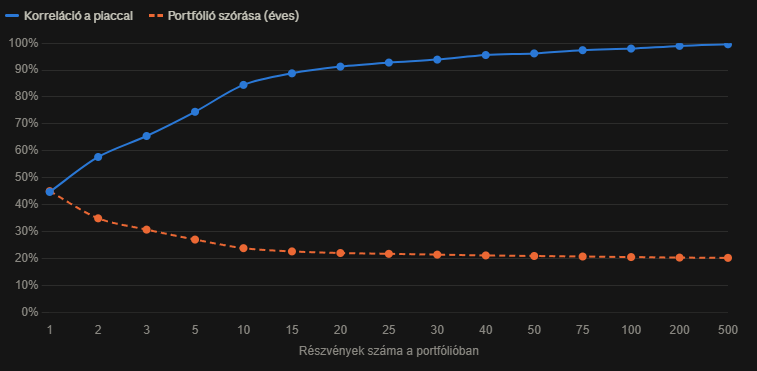
The image above was generated by Claude and shows how the correlation with the market increases as you start increasing the number of stocks. This is why most concentrated portfolios work with a number of elements between 10-20. An example of this is Chris W. Mayer's Woodlock House. Family capital, which typically holds 10-12 shares.
| Shares | Correlation | R² | Tracking error |
|---|---|---|---|
| 5 | 0.75 | 55 % | Up to 18% |
| 10 | 0.85 | 71 % | Up to 13% |
| 20 | 0.91 | 83 % | Up to 9% |
| 30 | 0.94 | 88 % | Up to 7.5% |
| 50 | 0.96 | 93 % | Up to 6% |
| 100 | 0.98 | 96 % | Up to 4% |
In the example above, I generated the data with an average individual stock variance of 45% and an average pairwise correlation of 0.20 (so this is a model calculation example, but it shows the point well). The last column is the most telling, because it is a good approximation TE ≈ 45% / √NThis is what really matters to you: It's not the correlation itself, but how much you can deviate from the index, because if you can't deviate from the index, your return can't be very different.
Building a stock portfolio: even one name can be diversified
However, note that such research is always based on randomly selected names, but you can exclude a lot of industries by pre-filtering. If you have 3 vertical software companies in your portfolio, they are not really 3 items in your portfolio, but rather just one, since they move more or less together. And how many items do investment conglomerates like Berkshire Hathaway, which includes the Coca-Cola FMCG company, the oil company Occidental Petroleum, the BNSF railroad company, the software and search giant Google, and the insurance company GEICO, count as? Certainly not just 1, so the companies may also have internal diversification. You can also find these on the iO Charts page, but you can also look up the companies individually:
What I want to get across is that by drastically increasing the number of elements, on the one hand, the quality names that I understand in sufficient depth will inevitably run out, and on the other hand, I will also get closer to the market return. Not to mention that more stocks means more work, since you have to follow more names. So, in order to outperform, in addition to the factors already mentioned and even other factors not discussed - such as small capitalization - concentration is also needed.

How did I solve the above problem?
Since no one is born with an understanding of fundamental stock analysis, like any other profession in life, it also has to be learned. That's why I figured out years ago to initially build my portfolio with a larger number of elements, accumulating nearly 35 names in it, and then I started to reduce the number of elements. The goal is to have between 15-20 shares, because that's what I'm comfortable with. (closer to 15 is better), I am currently at 24 companies, and this number is constantly falling and approaching the ideal 15-20 for me.
It took me over 6 years to do this, but I can only buy and sell what “Mr. Market” offers. Of course, this does not mean that during this time I only had 35 companies in my portfolio, I would guess the real number to be around 70. The reason for this is that there were unique opportunities that turned out to be the right decision at the time, but they could not be held for a longer period of time.
An example of this was the oil market collapse with negative oil prices after the COVID pandemic in 2020, where it was clear that there was significant potential for appreciation in oil stocks, as the price could not be negative for years. After the valuation correction, I exited these positions, as they are not worth holding in the long term. I wrote several articles about this at the time, which you can see at the links below.
Of course, the opposite is also true, in May 2020 I bought the Simon Property Group (SPG) REIT, which provides a 9.9% dividend yield after taxes at the then-current exchange rate (although the withholding tax has since increased from 15% to 30%), this is the 7th year I've held the stock, there's simply no reason to sell. But these exceptions prove the rule, this is not typical of my philosophy when building a stock portfolio.

Building a stock portfolio: basic principles
I am basically a long-only investor. This means that if I buy a stock, I hold it for a long time, at least a few years, but ideally indefinitely. There is no shorting, because the math is not in my favor there, unlike with long-term holding. Why? Because:
- 📈If you invest long, you are betting on the upside. The price movement of shares is limited downwards (in the worst case it can only be 0), but it is unlimited upwards, so your loss is limited.
- 📉 If you invest in the short direction, you are betting on the decline. The price movement of shares is limited downwards, but unlimited upwards, so your profit can be a maximum of 100% (if the stock goes to zero), but your loss is in principle unlimited, in practice a margin call excludes you from the market (when the broker liquidates your stocks due to lack of collateral).
You can make things worse with leverage, derivatives – e.g. CFDs, warrants, options, etc. – if you don’t understand them, so I don’t do those either. Instead, I analyze companies fundamentally, and there are about 25 in-depth analyses on the iO Charts website: In-depth analyses.
If I want to increase my returns, I basically concentrate my portfolio (fewer names, higher volatility, higher risk), I'm not a fan of diversification, because then I could buy ETFs (although you can basically put together a better quality and still diversified portfolio from individual stocks, but it's not really worth the effort).
Building a stock portfolio: look for companies like these!
But how do I decide which names to buy? My investment philosophy has changed a lot over the years, but basically I look for companies with the following characteristics, significantly better than the market average, which are:
- 💰 they operate with low capital requirements (i.e. not capital intensive, negative working capital is even better),
- 🤖 they are difficult to disrupt with AI (it can still be a software company),
- 🔄 not, or at most partially cyclic,
- 🏰 they have a strong competitive advantage (what Buffett calls the “economic moat”),
- 🛣️ they have a long run, there is a lot of room for growth,
- 🤝 fair manager, appropriate manager incentives (there is skin in the game, the management's long-term interests are aligned with those of the company),
- ⚖️ they have low debt or no higher than justified (e.g. serial acquisition companies may have debt if they use it as leverage),
- 🏷️ they are traded at an appropriate valuation (it doesn't have to be cheap, fair value is also good).
☝️In fact, some of these attributes - such as good management, competitive advantage, fair managerial incentives - define exactly what I mean by quality, so it's a bit self-fulfilling.
Building a stock portfolio: these are left out!
As can be seen from the above, based on the above selection criteria, the stock portfolio cannot really consist of the following categories:
- ⛏️ raw materials (e.g. mines),
- 🔌 utilities (electricity, sewer, etc.),
- 🛢️ energy (gas, oil, uranium, etc.),
- 🏢 REITs (real estate investment trusts),
- 💎 luxury (fashion brands, clothes, watches, cars, jewelry, with a few exceptions like Hermès and Ferrari),
- 💊 pharmaceutical and biotech companies (cyclical, continuous pressure due to pipeline risk),
- 🏭 and industrial stocks are also falling, with few exceptions.
Of course, there are always exceptions, they always prove the rule, but basically it is not typical for me to choose companies from the above categories.
Let's define what it means to be a good company
If I want to simplify the above list, I really only look for 2+1 things in my targets:
- 💰Capital allocation: Every company exists to make a profit. The question is what ultimately happens to the cash generated. The longer a company can generate cash flow within its core business with a high rate of return (IRR), the higher its share price will be in the long run.
- 🇧🇷The board of directors and management: Management runs the company and decides on capital allocation. So the first and second points are closely intertwined. If management's incentives are aligned with the company's long-term interests, then management will have a vested interest in the company's success, which is why special attention should be paid to this. In fact, corporate culture is also related to this, as this is also determined by the board of directors and management.
- 💵Rating: no matter how good a company seems when building a stock portfolio Appreciation matters a lot. On the one hand, no one is infallible, and on the other hand, lower odds limit losses downwards, and add to future profits upwards.
I'll stay a little longer on valuation, because I think few people understand how much of a neuralgic point this is in investing. It's also called the margin of safety, which is an "insurance" against mistakes. The more conviction I have about a target, the higher the valuation can be, the lower the lower. I would like to highlight the above with an example:
- 🎯 maximum conviction: if the fair value of the company I consider the best is 100 USD and the price is 100 USD, then I take an initial position in it,
- 👍 one lower than maximum: I'll take an initial position with a margin of ~20-30% below the fair value,
- 🤔 pretty good conviction: I'll take an initial position with a 50% margin below the fair value.
As you can see, even with a good conviction, I'm not sure I'll select the given company in my stock portfolio, as I want to hold it for the long term. This way, I will NOT buy the company much more often than I will. It is possible that out of the 10 names remaining after the first fundamental screening, only 1 will make it into the portfolio. Most often, the reason for this is valuation, but in at least half of the cases, something bad will be discovered along the way that you don't like and will cause the target to drop out.
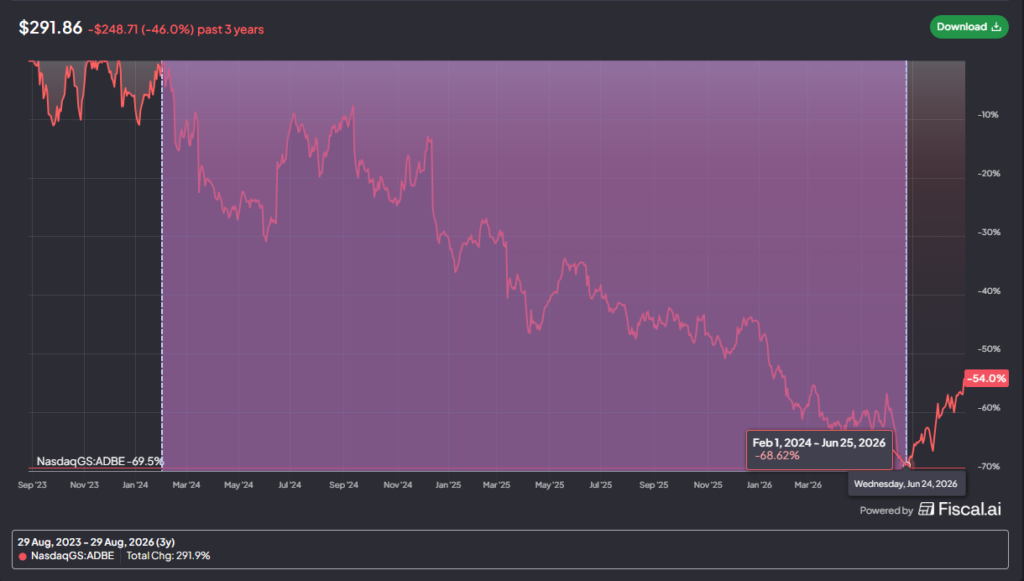
A good example of this is the case of Adobe (ADBE), which:
- 🔝 The highest point of the exchange rate was 630 USD,
- 📤 I sold it for 363 USD,
- 📥 I bought it back for 200 USD,
- 📈 Its exchange rate is 292 USD at the time of writing, which is a roughly +46% exchange rate gain.
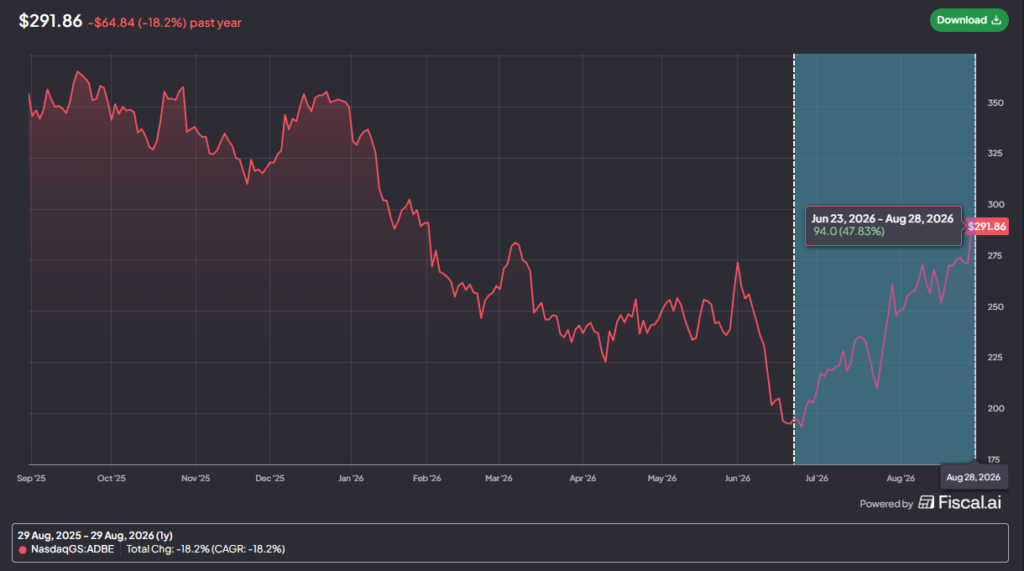
From the above, it is clear that it does matter what your entry price was, in other words: how much margin of safety you applied compared to the current fair price. If you look at the total price, it is still down 54%, even though I am still up 46% with the paper. Free cash often burns your hands and you want to forcefully find the right names for your stock portfolio, but this almost never leads to results. Instead, be patient, the market always provides opportunities.
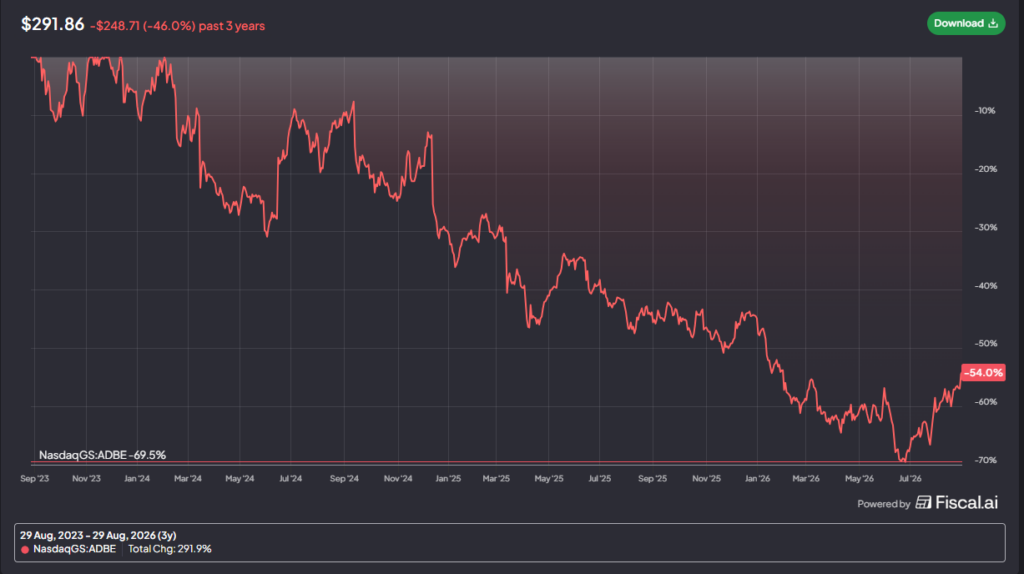
That's why valuation is so important in a stock portfolio, which is not the same as timing. Bad buys can ruin your returns for years, even if you end up being right. As Tamás Fellegi wrote in his book "Anyone Can Be a Stock Market - Adventures of an Investor from the Currency Market to the Stock Market": 2+2=4, but sometimes 2+2=5-1 or 6-2. So, being right in the wrong time is almost the same as being wrong in the right time.
Building a stock portfolio: summary
Above I explained the basic principles of building a stock portfolio, in the second part I will give the specific names, 24 different stocks in number. I have also categorized them for easier understanding, so you can follow my logic more easily. In the meantime, I recommend that you write down the investment principles and time horizon you want to invest according to.
☝️Until you read the second part, I recommend our stock portfolio manager on our site: iO Charts.
Frequently Asked Questions about Building a Stock Portfolio
Are you just starting to build a portfolio, or are you already in it and thinking about the next step? Here you will find concise answers to the most frequently asked questions: when is it worth buying individual stocks instead of ETFs, how many names are worth holding, what diversification actually does to your returns, how many elements count in a conglomerate, what criteria do I use when selecting, and how much margin of safety should I enter with?
Click on any question and the answer will open. These are intentionally short summaries: if you are interested in the details, I will expand on them in more detail in the appropriate sections of the article. Important: what is described here reflects my own practice, it does not provide a general recipe.
When is it worth buying individual stocks instead of ETFs?
When you can do two things at once: you pick better-than-average quality companies and you do it at the right valuation. If these two factors are missing, you are practically picking names at random from the market, making it easier and cheaper to buy the entire market through an ETF.
This takes time and internal motivation. For me, it took more than six years of learning, and the process is still ongoing. For those who don't have the time or inclination for this, ETFs are honestly the better answer, in exchange for the market average return.
How can you put together a 60/40 portfolio from two ETFs?
In principle, a global equity ETF (such as VWCE, Vanguard FTSE All-World UCITS ETF, 0.14% TER) and a government bond ETF are sufficient. The cost level ranges between 0.07% and 0.20%, which is a significant advantage compared to bank funds, and the whole thing can be done for years.
When choosing a bond fund, however, pay attention to duration. A 1-3 year government bond ETF is practically a cash substitute: the classic 60/40 works because the bond fund with a longer duration offsets equity panics. In addition, a USD-based, unhedged bond ETF brings currency risk to the “safe” side of your portfolio.
Does diversification reduce returns?
It doesn't reduce the expected return, it reduces the variance of the outcomes. The expected return of a portfolio of names with the same expected return remains the same whether it has 5 or 50 items. What diversification actually takes away is the chance of you significantly deviating from the index, and this is true both up and down.
In other words, concentration is a necessary condition for outperformance, but it is not sufficient. If you don't have real selection skills, concentration will only increase your variance, not your return.
How many stocks should you hold in a portfolio?
Concentrated portfolios typically hold 10-20 names, and the knee of the standard deviation curve is roughly between 15-25. Beyond this, the marginal benefit of additional names quickly approaches zero, as market correlation continues to increase and the number of companies to follow also increases.
I started with 35 names because I had to learn fundamental analysis, and then I started reducing the number of items. I'm currently at 24 companies, the goal is between 15-20, and within that, closer to 15.
What is tracking error and why is it more important than correlation?
Tracking error measures how much your portfolio's return can deviate from its benchmark index. To a good approximation, it decreases with the square root of the number of names in the portfolio, so for 10 names it's about 13%, for 30 names it's 7.5%, for 100 names it's only 4%.
This is a more important number than the correlation itself, because if you can't deviate from the index, your return can't be significantly different. The numbers come from a model calculation, assuming an average individual stock variance of 45% and an average pairwise correlation of 0.20.
How many elements count as a conglomerate, such as Berkshire Hathaway?
Certainly more than one. Berkshire owns BNSF railroad and GEICO, and its stock portfolio also includes Coca-Cola, Occidental Petroleum, and Alphabet. These are subject to different risk factors, so the companies can have internal diversification.
It also works the other way around: if you have three vertical software companies in your portfolio, they are not actually three elements, but rather one, because they move more or less together. It is not the number of elements that matters, but the correlation structure.
What qualities do I look for in a company?
Low capital requirements (negative working capital is even better), a business that is difficult to disrupt with AI, low or only partial cyclicality, strong competitive advantage, long growth horizon, correct management with appropriate incentives, a reasonable level of debt and an acceptable valuation.
To put it simply, I look at three things: capital allocation (what happens to the cash generated and how much return), the board and management (because they decide on capital allocation), and valuation.
Which sectors should I avoid and why?
Materials (mines), utilities, energy, REITs, luxury, pharmaceuticals and biotech, and most industrial stocks. The common denominator is typically ongoing pressure due to capital intensity, cyclicality, or pipeline risk.
There are exceptions, of course. I have held Simon Property Group REIT since May 2020, and in luxury, Hermès and Ferrari meet most of my own criteria. These exceptions prove the rule, but they are not typical of my philosophy.
What is a safety margin and how do I apply it?
A margin of safety is a safeguard against error: the greater my conviction about a company, the higher the valuation I accept. At maximum conviction, I take an initial position at fair value, at a level lower I ask for a 20-30% margin, and at good conviction, 50%.
In practice, this means that I don't buy the company much more often than I do. Of the ten names remaining after the first fundamental screening, only one often makes it. The reason is usually valuation, but in half the cases something turns up along the way that knocks the target out.
Why don't I short and use leverage?
Because the math is not in his favor. With a long position, your loss is limited, in the worst case you lose the amount you invested, but your profit is in principle unlimited. With a short position, the asymmetry is exactly the opposite: your profit is a maximum of 100%, but your loss is unlimited.
Leverage and derivatives (CFDs, warrants, options) make this even worse, as they introduce time limits and forced liquidation. As a long-only investor, I ideally hold my securities indefinitely, and neither of these instruments is needed for this.