

Objective Corporation (ASX:OCL) share fundamentals, overview
Objective Corporation is an Australian software company founded in 1987, specializing in content and records management and regulatory workflow software for government and regulated industry sectors (e.g. defense institutions, military, etc.). The company is still led by founder Tony Walls today, who owns approximately 64.81% of the shares through the TBW Group holding company, one of the highest founder ownership ratios on the Australian stock exchange. The shares trade on the ASX under the ticker OCL, and are currently trading at around AUD 6.8, with a market capitalization of approximately AUD 607 million. The stock has a dramatic recent history, falling nearly 60% from a peak of around AUD 23 in September 2025, before suffering another thirty% drop in July 2026 due to a one-off event, the non-renewal of a grant contract from the Australian Department of Defence. Nevertheless, Objective Corporation is a high-quality, founder-led, net-cash company that has suffered a significant shock and whose stock is trading at the bottom of its historical valuation range.
Market capitalization: AUD 607 million
Investor relations: https://www.objective.com.au/about/investors
contents
I have created a table of contents to make it easier for you to navigate the longer articles:
- Objective Corporation (ASX:OCL) Specialties
- How does Objective Corporation (ASX:OCL) make money and what market advantages does it have?
- Objective Corporation (ASX:OCL) metrics
- Objective Corporation (ASX:OCL) acquisitions
- Objective Corporation (ASX:OCL) management
- Competitors: Objective Corporation (ASX:OCL)'s opponents
- What risks does Objective Corporation (ASX:OCL) face?
- Objective Corporation (ASX:OCL) valuation
- Major news and the last half of the year
- Final Takeaway
Market segment analysis
In this section, I examine the dynamics of the market segment, how it operates, who the main players are, and what tailwinds or headwinds the players in the given market have to deal with. I will not analyze companies in depth, but I will touch on the market share of individual companies.
To understand Objective Corporation, you first have to let go of everything the word “software company” conjures up in you. There’s no viral user growth, network effects, viral download growth, and the like. Objective develops programs for one of the slowest, most boring, and therefore most protected segments of the software industry: for the government and regulated industry software market. Its customers are not startups or consumers, but ministries, local governments, regulators and police forces, organizations that think in decades, make decisions slowly, and once they have implemented a system, they don't replace it in the next twenty years on a whim or because a competitor offers a price per user that is 3 AUD lower.
I also have personal experience with the above, because I worked for a municipality for 12 years, which is only a notch better than any state-owned company or ministry. The main characteristics of such hierarchically rigid, terribly slow organizations are the following:
- 🐌 they change terribly slowly,
- 💸 they are not price-sensitive, as they live off either the central budget or locally collected taxes and not on the market,
- 🕰️ their systems are often outdated,
- 🗄️ they accumulate a lot of data over the years, which is unreproducible but essential for their operation,
- 🙅 no one wants to take responsibility for the risk of replacing systems, as they are not profit-oriented companies,
- 🔗 there is little internal development, most large systems are outsourced, so they are dependent on service providers,
- 🏛️ Often the decision is driven by politics, not common sense.
Overall, such organizations do not need the most efficient or cheapest system, but the least problematic, compliant with numerous laws and regulations, and with verifiable references.
☝️This also creates the "reference paradox": in order to gain reputation, you need to get into a state-owned company, which you can only get into if you already have a reputation at another state-owned company.
This also means that the segment is protected by regulatory rather than technological barriers, and the government software market is usually dominated by only a few players, often with a segment dominated by 2-3 companies in an oligopolistic manner. This makes it quite difficult to break into a new market, especially if it is in another country.
What does Objective Corporation do?
Objective solves three big problems for the public sector:
- (I.e. Document and records management (the classic ECM line, i.e. Enterprise Content Management): a government agency is required by law to store all generated documents in an auditable, versioned manner, and in accordance with appropriate retention rules. This is not an option, but a legal obligation.
- ️ Regulatory workflow management: When a municipality reviews building permits, a gaming authority oversees casinos, or a police force registers guns, that process must be auditable from end to end.
- 🏛️ Digitalization of services provided to citizens.
The common denominator of all three is compliance: Objective's product is valuable not because it is convenient, but because it protects the organization from legal risk. Typically, cases like this are filed in a filing system and can be retrieved for many decades. Filing works according to laws, in a specific system, according to very strict and binding principles.
The paradox: a hated product, yet protected
This distinction is the key to the company's moat, and at the same time the most interesting paradox of the product. Government records management software is typically disliked by users, it adds friction to daily work, requires filing, metadata, versioning, archiving. But this user dislike is not unique to Objective, but to the entire category: rival systems are hated in the same way, because the task itself, mandatory records management, is unpopular.
🤔It is important to realize that in this market, the buyer and the user are two separate individuals with opposing interests.
The user is the civil servant who just wants to save the file and hates the system. The customer, the organization's compliance department or the head of the unit - department head, clerk, mayor, etc. - buys the software precisely for the auditability. Contract renewal is not determined by user satisfaction, but by considering compliance risk, so user dissatisfaction alone does not cause churn. Competitive advantage does not come from users liking the systems, but from their compliance with certifications and legal prerequisites.
📌In practice: I don't know how many times in 12 years I have heard the whining of colleagues sitting in the registry, but they were never able to get their will across the organization, because the senior managers were bound by law, and they were accountable to the citizens, but perhaps more importantly, to the appellate authorities, that is, the state. The state and politicians appoint or replace the managers if they do not fulfill their duties. Therefore, every year the same items were planned in the IT budget without question, and then paid during the year. The price of the service is practically irrelevant as long as it fulfills its duties, which is a huge advantage over open market software.
Who are Objective Corporation's customers and why do they stay?
When the customer is the UK Gambling Commission, the New Zealand Police or an Australian government department (all of which are Objective Corporation clients), two things follow from this customer base.
On the one hand, these customers almost never leave, The cost of switching is not primarily measured in money, but in risk: Who takes responsibility if a national gun registry becomes inaccessible during a migration? Incidentally, the New Zealand police chose Objective to register all firearms in the country following the new gun laws following the 2019 Christchurch mosque attack, so this kind of critical, embedded reference is telling in itself. On the other hand, the government procurement cycle is brutally slow, which makes it difficult to enter, but for that very reason protects the companies inside.
The Australian specialty: the sovereignty advantage
The Australian specificity that frames the whole business is the issue of sovereign technological capability. Since the country is quite isolated from other continents and the region dominated by the Indian Ocean and the Timor Sea is constantly fighting for influence, primarily against China, Australia tries to maintain its own sovereignty in all areas. It is also typical for the country and the continent to be a member of Western allies or to be drawn to these states. One such example is the Five Eyes (FVEY) intelligence alliance, which brings together 5 Anglo-Saxon countries with a common legal and linguistic tradition. The members are:
- (I.e. New Zealand,
- ???????? United States,
- 🇬🇧 United Kingdom,
- 🇨🇦 Canada,
- 🇦🇺 Australia.
In Australia, there is a political and national security premium for a government data management system to be domestically developed and operated, not in the cloud of an American giant.

☝️This is one of Objective's most difficult advantages to copy in the domestic market: a local, security-certified, sovereign player enjoys a position of trust that is difficult for a foreign competitor to replicate.
The downside of this dynamic, however, is that the domestic market is small. Australia is a country of 27 million, the number of government customers that can be acquired is limited, and Objective can already claim a good portion of the largest ones as its own. Domestic growth from here will come more from deepening existing customers, more modules, transition from on-premise ECM to cloud-based Nexus, comes from a moderate price increase rather than from mass acquisition of new customers. This is typically called upselling, where additional revenue comes from additional modules that can be added to the basic product.
It's worth mentioning that Objective is not the only Australian player in this field. The much larger Technology One (ASX:TNE), also Australian and with similar founding roots, plays in the same government-local government ecosystem, primarily in the enterprise resource planning (ERP) layer. The two companies are more neighbors than frontal rivals, Technology One provides the transactional backbone (finance, HR, payroll), Objective the compliance and content layer, with one disputed boundary: with the local government planning and permitting segment, where the two companies' software competes with each other.
🤔Technology One (ASX:TNE) is also the best evidence that Objective Corporation's business model works on a large scale with excellent quality, and will be an important benchmark in the valuation chapter.
Is Objective Corporation able to sell in other markets?
The long-term growth thesis is decided beyond borders, as Objective Corporation has essentially already cornered Australia. Revenue is now heavily domestic, driven by the aforementioned upsell effect. In the most recent full year, the geographical distribution looked like this:
- 🇦🇺 Australia: about 78% of revenue, mature, dominant, but slowing,
- 🇬🇧 United Kingdom: ~11%, the fastest growing region, doubling in six years,
- (I.e. New Zealand: ~10%, has stalled or even decreased in the last two years,
- 🌍 Rest of the world: ~1%, but among these there are relatively few Anglo-Saxon countries, while entry into non-Anglo-Saxon countries is extremely difficult.
The New Zealand stall is a warning that these regions are dependent on large, one-off projects for revenue, not steadily growing, established markets. The UK, on the other hand, is the real growth option: orders of magnitude larger public sector, similar legal tradition and compliance culture. Entry occurs in two waves:
- 🌊 First wave (already embedded): The Trapeze product, which helps with planning approval, has been around for years and is used by more than 300 British local authorities.
- 🚀 Second wave (starting now): high-value regulatory platform wins. The six-year contract with the UK Gambling Commission, due in 2024, was RegWorks’ first major UK win, and its real value is not in the size of the contract but in the door it opens to other UK regulators. This is what I referred to as the paradox of government: it is incredibly difficult to get into government software without a reference.
Entry barriers: a double-edged sword
The barriers to entry are very high in both directions, and this is the essence of the market structure. A new player must jump over four obstacles at once:
- 🔒 Wall of certificates: It is impossible to handle government data without accreditation, and obtaining it takes years.
- 🥚 The reference paradox: A ministry will not buy a system that does not have a reference from another ministry, but you will only have a reference if someone buys it first.
- ⏳ The multi-year procurement cycle: During which a new player has to burn money, a smaller startup would simply bleed to death, which is why there are no such companies in this segment.
- 🧠 Depth of legal domain knowledge: This is best achieved by working in a place like this for a long time, but then not having the time to build a company.
This results in an oligopolistic market, where a few entrants share the revenue and there are virtually no new entrants. However, the thing is symmetrical: the same constraint that protects Objective at home works against it outside its own markets: in the UK and the US, the new entrant is Objective Corporation itself.
❗This is a problem that cannot be underestimated, even though we are talking about the software market, it is not possible to grow organically in the traditional sense of the word.
That's why conquering the UK market is realistic, and that's why the US, where they currently have no presence, remains an ambition. There, Objective Corporation is the foreign company, excluded by the same sovereignty reflex that gives it an advantage in Australia, and also against one of the most protectionist government procurement systems in the world. The advantage of sovereignty is not an exportable asset, but a place-bound privilege that reverts to local actors at every border crossing.
How big is the market? (TAM, SAM, SOM)
When sizing the market, it is worth treating the layers with caution, as an estimate, because I could not find any specific information:
- 🌐 TAM (total available market): In a broad sense, the global government content and regulatory software market is worth tens of billions of USD, growing at 10-12% per year. However, this number is practically unattainable for Objective Corporation, because the majority of it (USA, continental Europe, Asia) is very different both culturally and competitively.
- 🎯 SAM (targetable market): Anglo-Saxon, common-law, Five Eyes-like government markets, where the sovereignty and embeddedness advantages really apply, can be a few billion USD in size.
- 📍 SOM (acquired market): Objective Corporation is generating approximately AUD 96 million in revenue in Australia by H1 2026. It also only has a fraction of its own available market, which is both encouraging (there is room to grow) and a warning to be cautious (if penetration has been so slow so far, what would speed it up?).
The company is dominant in its domestic market, but is still in the early, proving phase in the British half of its target market, and the entire long-term growth thesis stands or falls on British execution and the fate of its currently most problematic customer relationship.
📌In practice: I wouldn't be far wrong if I said that the Australian market could be a third of the New Zealand market and three times the size of the UK market. This gives the company a very long lead, but mainly because their total revenue is only 128 million USD. So, in this sense, it's more the small market capitalization and low revenue that play a role, not the gigantic market size, as in the case of, say, the future space technology or an insurance market.

Objective Corporation (ASX:OCL) specializes in: What makes this company good?
In this section, I examine what specialties the analyzed company has, what its position is in the market, and whether it does anything differently than its competitors. If so, what and how, and what impact does this have on their operations.
In this chapter, I’ll step back from the numbers and look at how Objective Corporation came to be. In a founder-led company, the story is more than just a curiosity: past decisions explain today’s ownership structure, disciplined capital allocation, and the culture that makes the company behave differently than a typical publicly traded technology company.
From garage company to stock market (1987-2000)
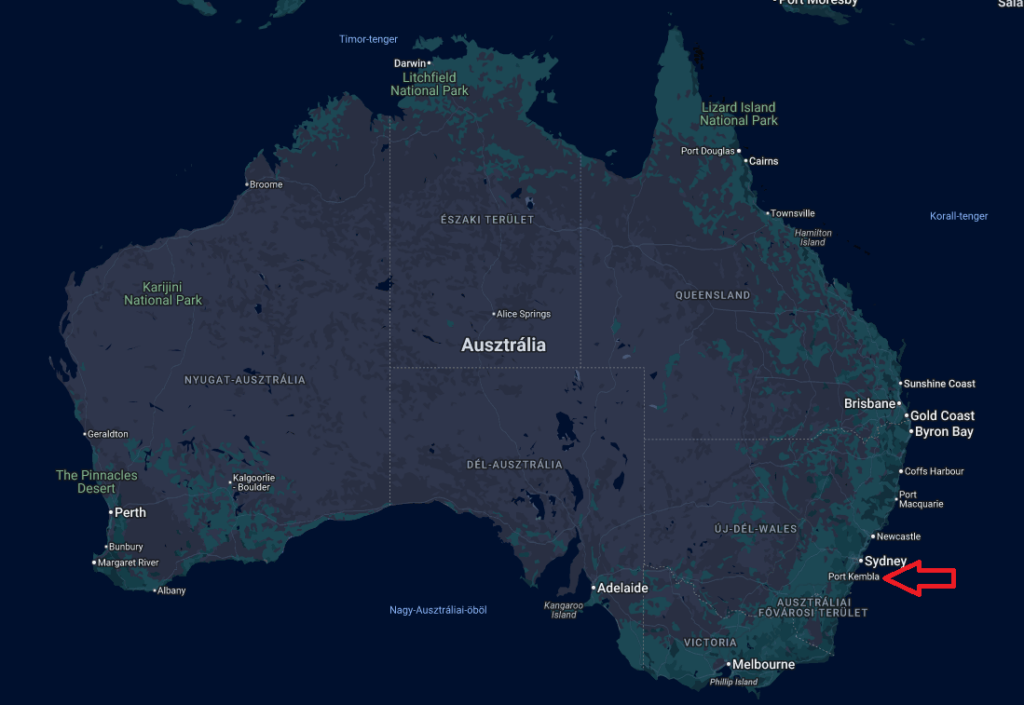
The story of Objective Corporation began in 1987, under quite ordinary circumstances: Tony Walls started the business from the family home in Port Kembla, an industrial town far from the glitz of Silicon Valley. The starting product was the document management system, in an era when government agencies were still drowning in paper-based documents, and digital filing solved a real, tangible problem.
Walls' background explains the company's character: Mathematics and computer science education, later applied finance diploma. In other words, he was not a marketer or a serial entrepreneur, but an engineer-economist who understood both the product and capital allocation, and this duality accompanies the company's entire history. In the 1990s, Objective gradually became the domestic market leader in government document management, building the embeddedness that is the foundation of today's economic moat. But, Objective Corporation (ASX:OCL) can't be accused of being an incredibly innovative company, with a very fresh code base like Adyen or Kinsale Capital.
Going public and the decision that determined everything (2000)
The company went public on the Sydney Stock Exchange (ASX:OCL) in July 2000, at a price of just 50 cents, raising approximately $6 million. And here came the decision that would shape the rest of the story: since then, the company has never raised a single cent of fresh capital (however, there is minimal SBC-based dilution, as you will see later).
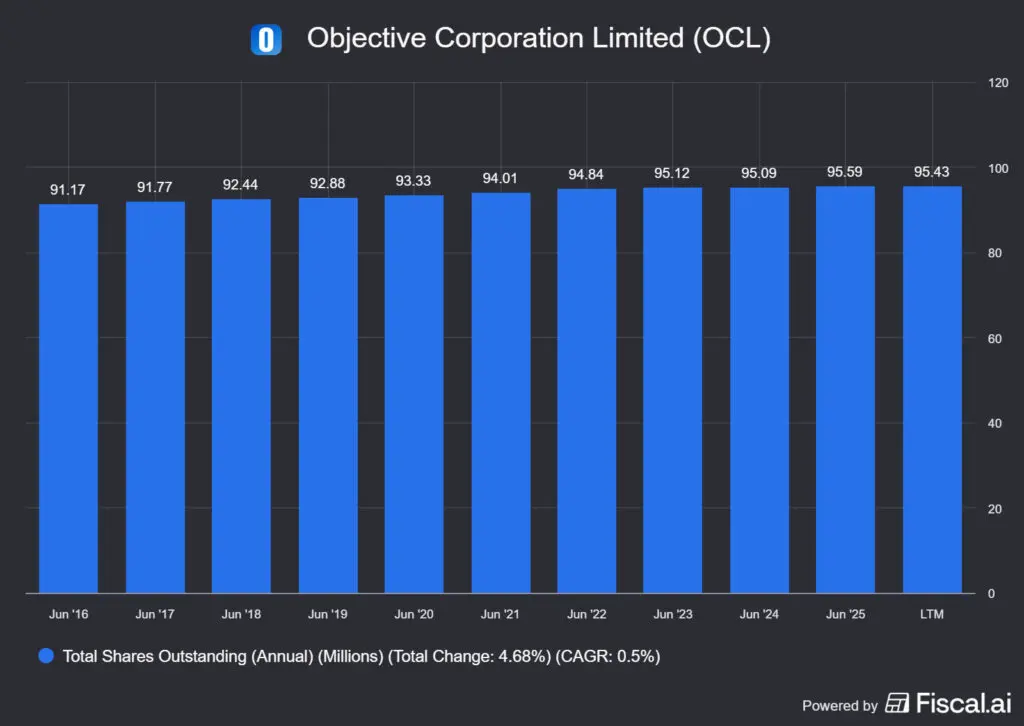
This seemingly technical detail is actually the key to the entire investment thesis. A software company that has grown for a quarter of a century without issuing new stock or taking on significant debt is saying: the growth was financed entirely by its own internal cash flow (plus a few smaller acquisitions). No dilution, no expansion paid for from shareholders' pockets. This kind of self-funding discipline is extremely rare and follows directly from the founder-owner's perspective, who also protects his own assets when he doesn't dilute. In other words: Objective Corporation has invested in itself, it has been a true perpetual compounder so far.
📌In practice: The above should not be surprising, as one of the inclusion criteria in my universe is that the owners are not diluted by the company, otherwise it would not pass the pre-screening. Moreover, founder-led companies are much more motivated to preserve the real value of their assets and increase the share price as quickly as possible.
Objective Corporation's software transition
The most difficult business maneuver in the company's history was one of the software industry's notoriously risky transformations: the shift from a perpetual license (one-time, large revenue) model to a subscription (SaaS) model. This turnaround has been botched by a number of companies because the transition temporarily cuts off revenue, with large, one-time license fees disappearing before smaller, recurring subscriptions can build up.
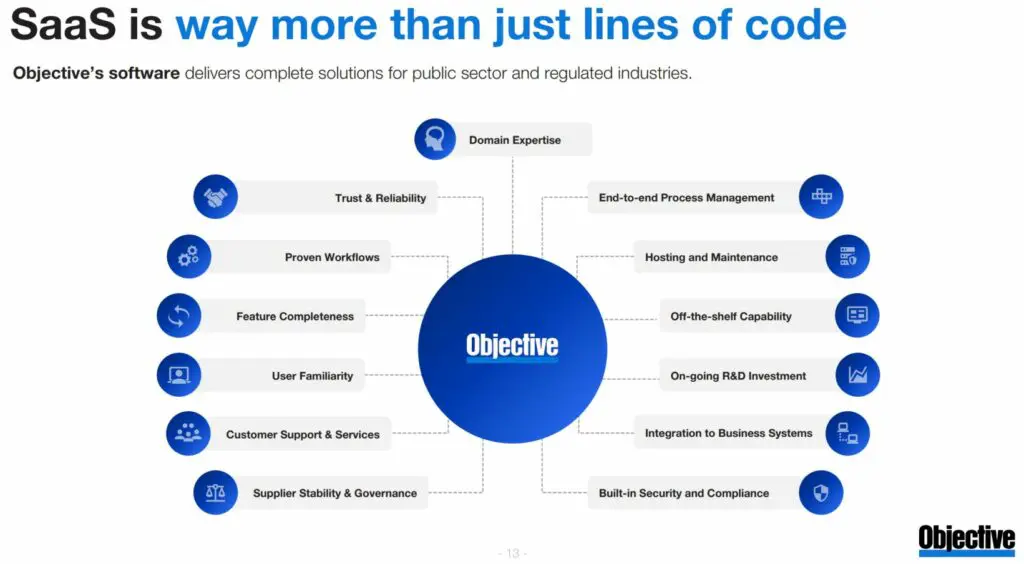
Objective managed to do this without any significant loss of profitability, which is a remarkable achievement for a smaller, founder-led company and one of the best proofs of the management's operational capabilities.
I would like to quote from a Stocks Down Under article that clearly demonstrates how slowly the SaaS transition is progressing in the government segment: "But we note two observations by Goldman Sachs that put these theories to bed. First, that the transition of organizations from on-premises software to cloud SaaS is only 20% completed. And second, SaaS could be a US$800bn Total Addressable Market globally within an overall cloud software TAM of US$1tn. Today, global revenues are US$235bn (about 25% of global GDP) but enterprise IT revenues are much larger (at US$1.4tn). Goldman thinks that the Cloud could easily grab the latter and even more from non-digital spending.” Stocks Down Under, 2026 February
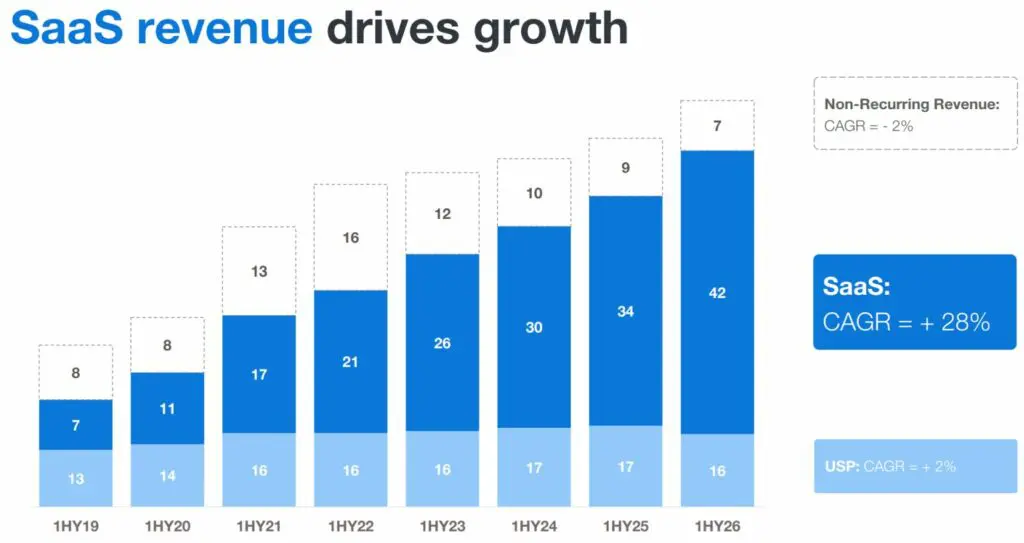
So, users are moving very slowly from traditional on-premise solutions, which I also call boxed, to the SaaS, i.e. license-based software segment, which also means that Objective Corporation's revenue is still in the process of ramping up quite a bit. They basically work with two types of contracts:
- 📈Uplift: This is the migration contract when the organization switches from an older system to a newer one, e.g. from ECM 11 to Nexus.
- 🛡️USP (Upgrade and Support Program): This is the maintenance contract that customers with old, installed systems (such as ECM 11) pay for engineering support, security patches, and version updates. It is not a migration contract, but rather a contract to keep the legacy system alive, and its revenue grows by barely 2% annually, according to the company's own data.
☝️Uplift contracts, according to OCL's intention, will essentially drive all customers towards more modern SaaS systems in the long term, which will generate extra revenue for Objective.
Objective Corporation's international expansion and current size
After establishing domestic dominance, Objective opened up to related Anglo-Saxon markets: first New Zealand and the United Kingdom, then cautious American explorations, always in the direction of common-law, Five Eyes-like countries, where its product and the logic of sovereignty work best. What are these markets? They usually mention 5+1:
- 🇮🇪 Ireland: 5,2 million people,
- 🇳🇿 New Zealand: 5,3 million people,
- 🇦🇺 Australia: 27,6 million people,
- 🇨🇦 Canada: 37 million people,
- 🇬🇧 United Kingdom: 67 million people,
- 🇺🇸 United States of America: 330 million people.
- 🌏Altogether: 472 million people.
The company moved to the SkyLab headquarters in Sydney in the late 2010s, signaling sustained growth and symbolically celebrated by the then NSW Minister for Innovation as a flagship of “homegrown technology capability”, signaling the political weight of a sovereign Australian software company.
Today, Objective Corporation employs around 450 people, has revenues of ~AUD129 million, and 2025 was also the 25th anniversary of going public, a quarter of a century of continuous, self-financing growth, with the same founder at the helm. However, it is still small enough to be able to grow in the Australian market for a long time, and I didn't even consider other Anglo-Saxon markets at that time.
📌In practice: Entering the Anglo-Saxon markets is also paying off for other companies, as Technology One (ASX:TNE) and Kelly Partners Group (ASX:KPG) did, which I analyzed on the iO Charts blog.
Why does this matter to the investor?
Chronology is not important for the sake of nostalgia, but rather for the roots of today's quality features. Three things follow directly from the company's origin story:
- 👤 The founder is still here, risking his fortune: Walls's ~64.6% ownership is not an inherited stake, but his own company, built over forty years; at its peak, his share package was worth AUD 1.4 billion. The shares are held through a company called TBW Trustees Limited. Skin in the game is not just a slogan here, I think of Cerillion PLC or Medpace Holdings, which I also analyzed.
- 💪 Proven crisis resilience: a company that successfully transitioned from licensing to SaaS without a loss of profit has shown that it can handle difficult maneuvers. This gives some confidence in handling the current situation after the defense industry fiasco.
- 🏗️ A culture built on durability: self-financing, non-dilution, and slow, organic expansion all paint a picture of a company that plans for the long term, not just lives quarter by quarter. Since corporate culture is one of the hidden economic competitive advantages that few people take into account, I will examine this separately later (this is called Helmer's 7 Powers Cornered Resources).
This is what makes the current situation so interesting: a company that has managed itself exceptionally well for a quarter of a century, now facing perhaps the greatest unique challenge of his life: its largest partner, the Australian Defense Agency, did not renew its support contract, which is expected to cause a 10-14% revenue loss, essentially wiping out the entire 2026 growth.
📌In practice: I will elaborate on the above corporate culture, but I would just like to mention here that there are very few companies in the world where corporate culture and management excellence are one of the economic competitive advantages of the companies, this falls into the aforementioned cornered resources category. This usually appears primarily in capital allocation steps, and a prime example of this is Constellation Software (TSX:CSU) and its spin-offs, Lumine Group (TSX:LMN) and Topicus (TSX:TOI). You can find the analysis of the first two on the iO Charts blog.
How does Objective Corporation make money and what market advantages does it have?
In this section, we examine what exactly the company does to generate revenue, what products and services it has, how indispensable they are. Does it have any competitive advantage (economic moat), how defensible is it, and whether the trend is decreasing or increasing, and what is likely to happen in the long term.
In the previous chapter, we looked at the market the company operates in and its specialties. Now comes the more important question: how does the company's competitive advantage translate into real, recurring, high-quality cash flow and how protected is this cash flow?
Objective Corporation's business model: 100% subscription
Objective is now a purely subscription software company, we call this SaaS, while the licenses are seats. Previously, the government customer bought the software license once (a large, one-time revenue) and then paid an annual support fee. In recent years, the company has completely transformed this model: revenue comes virtually 100% from recurring subscriptions (ARR, Annual Recurring Revenue). This is the highest quality type of revenue a software company can generate because it is predictable, high-margin, and does not have to be resold every year. The pioneer of this was Adobe, which transformed into a SaaS company in the early 2010s, and it is still the most common solution today, but with the advent of AI, more and more token-based services are emerging, where companies essentially pay for machine time.
The quality of the transition is shown in two numbers:
- 💰 Gross margin above 94%: that is, out of every USD, roughly 94 cents remain after direct service costs. This is a high-end software level, with essentially no cost to produce and operate the systems.
- (I.e. Unearned revenue is approximately AUD 54 millionIn other words, customers practically pre-finance the company's operations: the money arrives before the service is provided. This is a sign of negative working capital, which is typical of the best quality businesses and is the type of company I look for most often.
📌In practice: Negative working capital is typically a feature of some industries: for example, software companies, some CROs, or laboratory companies, and insurance companies, where they first collect the contract fee and then pay out the compensation after the damage event at some point in the future. Negative working capital always indicates that the company's core operations and the industry in which it operates have a good chance of being in the top 5% in terms of return.
The segments: where does Objective Corporation's revenue come from?
Objective's revenue is built on multiple legs, and the legs grow at very different rates. Based on the most recent full year, the picture looks like this:
- 📄 Content Solutions (~AUD 83 million): the largest segment, the classic ECM/records management line, includes the system also running at the Australian DOD. ARR here is growing by about 11-12% per year, includes filing software. This is the mature core business, which has now broken its business cycle, more on that later.
- ️ Regulatory Solutions (~24) million AUD): the regulatory authorities platform (RegWorks). ARR here increases by about 17%, which brings big regulatory victories, for example, the UK Gambling Commission was pulled in by this in December 2024.
- 🏗️ Planning & Building (~13) million AUD): Building permits and planning approvals (Trapeze, Build). The fastest growing segment, ARR here is growing by nearly 29-30%, and it is this segment that accounts for the bulk of the UK local government expansion.
- 🔧 Other (~3,4) million AUD): smaller additional items.
Objective Corporation does not disclose its revenue by software, so I was unable to break it down by individual software items in the previously mentioned list. They only report the three categories above, plus the others, but this gives a rough idea of how the revenue is broken down.
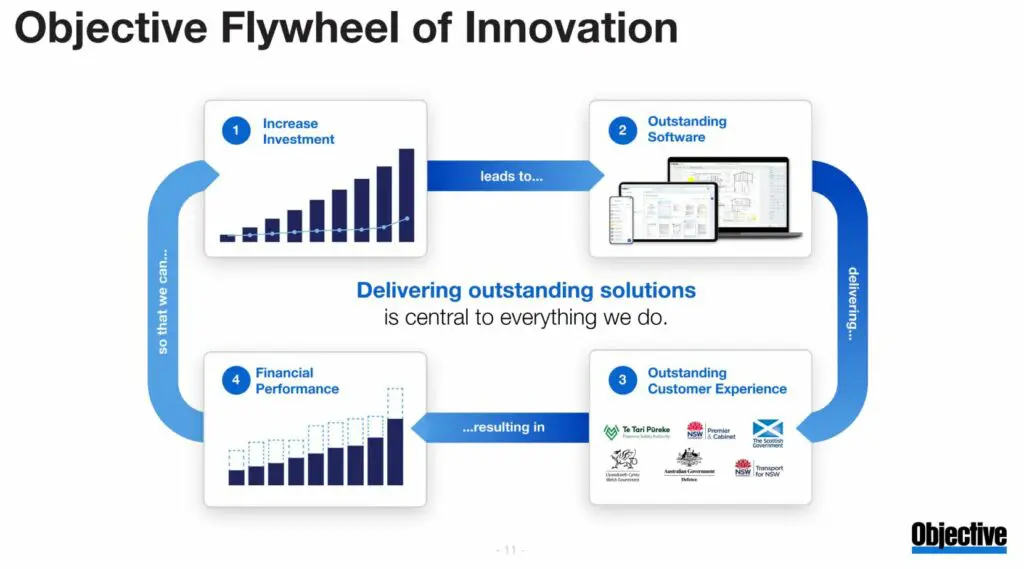
The first layer of the moat: the switching cost
The most important layer of competitive advantage for Objective Corporation (ASX:OCL) is switching costs. A government customer did not switch because:
- 🗄️ Data Gravity: A decades-old archive, millions of documents sitting in the system. Migrating this to another platform is a years-long, risky, and terribly tedious process.
- (I.e. Legal embeddedness: the system is tailored to retention and compliance rules, varying from agency to agency. Exchange is a legal risk.
- 🛡️ Critical operational function: If the system runs a national gun registry or a ministry's entire filing system, no one will risk migration for a few percent savings.
This layer is also confirmed by financial data: the company's customer retention has historically been around 100% net retention, that is, the existing base not only remains, but also spends more every year (more modules, more users, price increases).
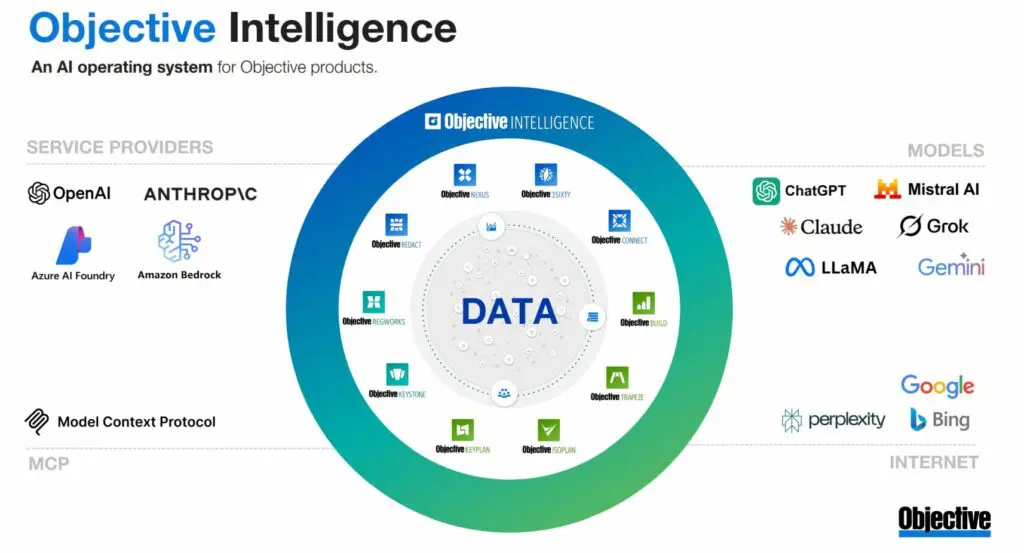
📌In practice: I don't know if this is just a Hungarian peculiarity, but since costs are relatively low on the government side, no one is motivated to replace systems because they would have to take on the risk. And why would anyone do this if it doesn't bring them any real benefits? Large software replacements are much more likely to happen under pressure from above, if the central government deems it necessary or new legislation forces the organization to do so.
The second layer of the moat: sovereignty and certificates
The second layer is what I already talked about in the market chapter: the domestic, sovereign, security-certified position. In Australia, a local, accredited player enjoys a level of trust that a foreign giant would struggle to replicate, and obtaining certifications is a years-long barrier to entry for anyone else. The certificates are issued by local authorities, who understandably have no interest in having an unknown, foreign company issue them. This layer protects domestic cash flow the most, as most revenue flows to local companies.
The capital-light model, with one important twist
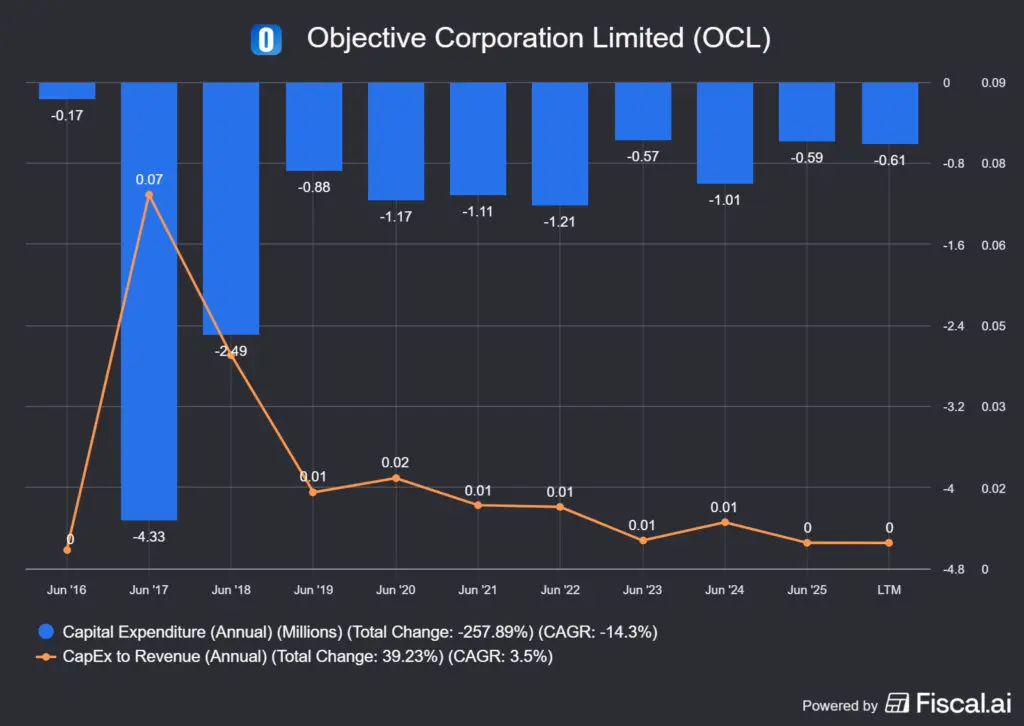
On paper, Objective Corporation is a prime example of a capital-light business: the classic investment (capex) is half a percent of revenue, The company sits in net cash in the vast majority of cases, with ROIC around 27%. Negative working capital (subscriptions collected in advance) further beautifies the picture.
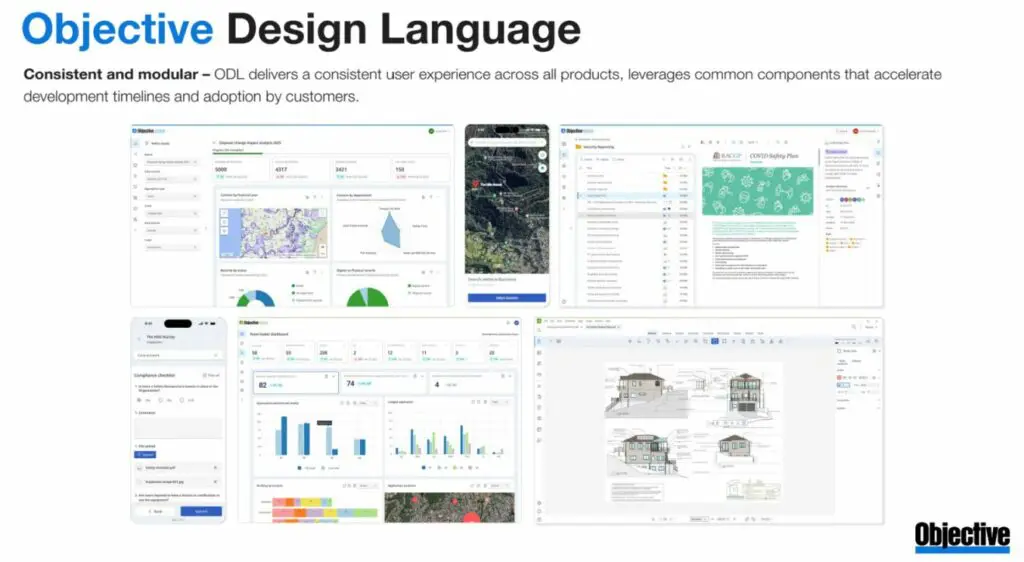
However, there is an important twist, because Objective, in accordance with Australian IFRS accounting practice, does not expense a portion of its software development costs immediately, but capitalizes them (keeps them on the balance sheet as assets and writes them off over a period of years). This is about AUD 16-17 million per year, or roughly 13% of revenue. The impact:
- 📈 Reported profit and margin look higher than realbecause part of the true annual cost of development disappears from the income statement.
- 💵 However, free cash flow doesn't lie: Money goes out, regardless of where it is recorded. Economically adjusted free cash flow is therefore much more relevant than other numbers.
This is not an accounting trick or fraud, IFRS allows this practice, and its larger Australian counterpart, Technology One, also accounts for it in the same way. But out of caution, I have included both the traditional and the more conservatively adjusted values in the analysis, because capitalization is a classic management tool for increasing profitability, and sustaining development is economically more worth considering as a recurring cost.
📌In practice: According to GAAP accounting, development costs must be written off at the end of the year, but whether the developments actually only have an annual effect is another question. The answer is obviously not: so the practice differs from what accounting does, which is why IFRS allows companies to record development costs as an item that can be amortized over several years. Another issue is that if a company is in bad faith, it can even abuse this method and cosmeticize the numbers.
There are countless books about accounting tricks, these are worth reading if you want to get a better understanding, because without them you cannot do serious fundamental analysis. A few books that will help:
- (I.e.Stephen Penman: Accounting for Value
- 📗Mulford, Charles W. Comiskey: Creative Cash Flow Reporting
- (I.e.Heilbrunn Center for Graham & Dodd: Expectations Investing reading stock prices for better returns
- (I.e.Schilit Howard, Perler Jeremy: Financial Shenanigans
Economic moat
In this segment, I examined whether the company has any economic competitive advantage, which Warren Buffett referred to as the “economic moat,” which deters competitors from besieging the company’s fortress, i.e. its business, and taking its market. In this case, these could be the following:
- 🫸Cost/scale advantage: There is, but it is low. All software companies have economies of scale, as the cost of software development is spread over more people as the number of users increases. However, Objective Corporation is a relatively small company, with a market capitalization of AUD 607 million, while its competitor Technology One is much larger. Naturally, larger companies have greater economies of scale.
- 🫸Switching cost: Yes, it's high. Basically, government software isn't exchanged very often, so once a company gets into an organization, it stays there permanently.
- 🫸Network effect: There is no such thing as a traditional reference. However, a company needs to have the necessary references to enter the market, and the better and larger the previous references, the more likely they are to win an even bigger government deal.
- 🫸Brand strength: there is none, but related to the former network effect is that the references of each system are built over time.
- 🫸Company culture: is strong. Basically, from the capital allocation decisions, the number of shares held, the background of the professionals and the remuneration, it can be concluded that the corporate culture is better than average, the about management details are shown in part.
- 🫸Intangible assets, know-how, trademark: There are, primarily government licenses. All software systems have to comply with fairly strict laws and permits. You can't vibe-code a gun registration system or a construction management software, as you can't use them in government tenders.
- 🫸Barriers to entry: very high. All of the above means long, slowly developing state relations, which cannot be reproduced with money alone. Legal compliance, understanding the internal functioning of hierarchical organizations, and the existence of state licenses are necessary for a company to enter a market. Moreover, domestic players are particularly protected by the state, so foreign players can enter there with great difficulty or not at all, which is why markets are usually oligopolistic or duopolistic in nature.
The combination of the above results in a thin moat.. Why isn't the moat wide? Simply because the size of the company doesn't justify it, and the barrier to entry is also an exit barrier when it comes to entering another market. After all, what protects Objective Corporation in Australia becomes a disadvantage in, say, the USA, but even more so in a non-Anglo-Saxon country, such as France. Therefore, after a while, revenue growth will more likely come from selling additional products within the market and raising prices than from conquering new markets.
Objective Corporation (ASX:OCL) metrics
In this section, I examined what metrics characterize the company, how it stands on the revenue side, what margins it operates with, whether it has debt, what the balance sheet shows. I look for items that are extreme – too high debt, high goodwill, etc. - what return on capital the company works with, what its cost of capital is, how the revenue and cost sides are structured. I also examine trends, owner value creation, and how the company uses the cash generated.
What is the yield of the S&P 500?
Compared to previous analyses, I have introduced a new section to compare the metrics below. Since many people use the US stock market index as a benchmark and also buy S&P 500 ETFs, it is worth looking at what companies are doing in aggregate (of course, you should be happy if the company you are analyzing is outperforming these values).
S&P 500 2024 data:
- 📈 S&P 500 Revenue Growth: + 7 %
- (I.e. S & P 500 profit growth: + 10 %
- 📊 S & P 500 gross margin: 45 %
- 💼 S & P 500 net margin: 13 %
- (I.e. S & P 500 ROE: 15 %
- 🏗️ S & P 500 ROIC: 12 %
- ⚙️ S & P 500 ROCE: 11 %
Before we get into the numbers, a methodological caveat that could change the entire chapter. Objective Corporation (ASX:OCL) is an Australian company, so its accounting is prepared according to IFRS (International Financial Reporting Standards), not US GAAP, which is common in most American analyses. The two systems are similar in many ways, but they differ in one crucial way, and this point is key to the entire assessment: managing software development costs.
- 🇺🇸 Under US GAAP, most software development must be expensed immediately (the profit decreases immediately).
- 🌍 Under IFRS, as with Objective, a significant portion of development can be capitalized. That is, it can be held as an asset on the balance sheet and can only be written off over a period of years, therefore its cost distorts the years in which the write-off occurs.
❗This means that Objective Corporation's reported profits and margins are not comparable one-to-one with the GAAP numbers of a US software company, IFRS capitalization pushes profitability up, so the numbers look better than they are. I will get to the practical implications as I go along.
I also have one more comment: while writing the in-depth analysis, the second half-year report was released, but the data source still published the numbers up to H1, which is why they are better than the current ones. I updated the numbers at the end of the in-depth analysis: last semester.
As usual, I'll start with revenue, which is shown in the image below. Revenue is sometimes boosted by larger contracts, but generally the average is around 10% per year. This is a pretty impressive growth rate for a government company, but I think the small market size may also be a factor here. Revenue is essentially followed by profit.
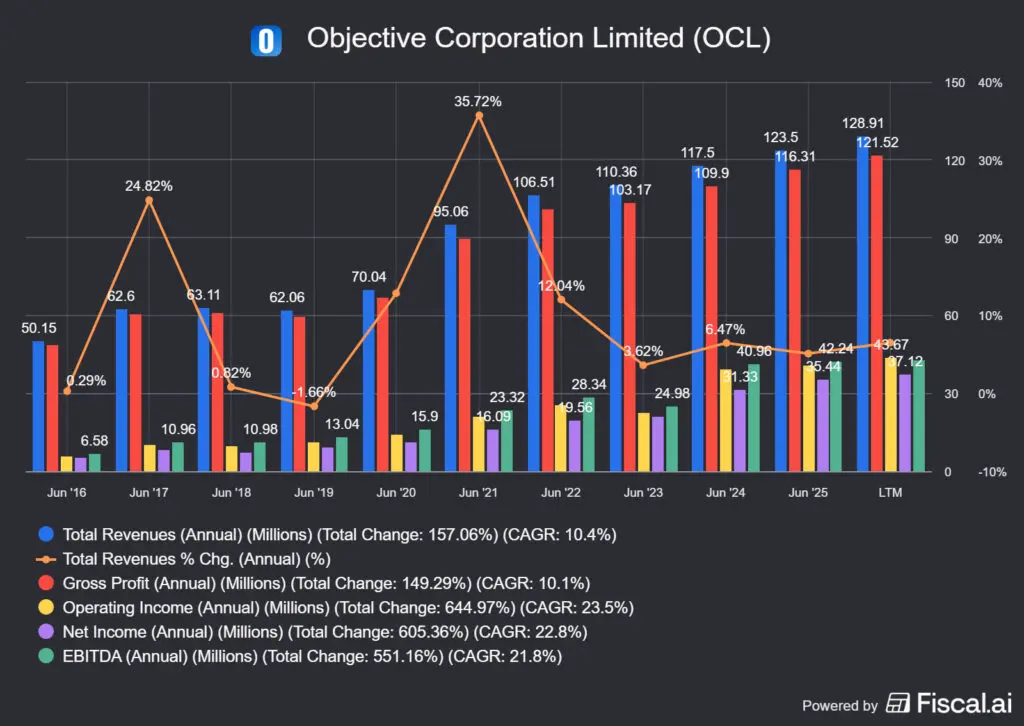
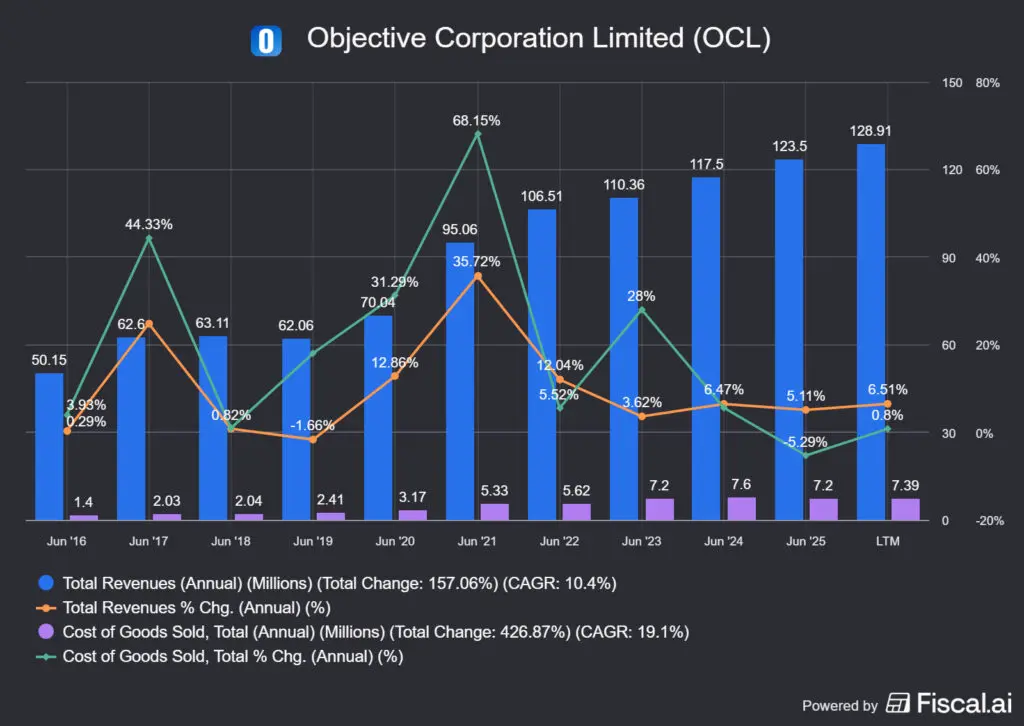
What is less fantastic is the relationship between COGS and revenue, as shown in the orange and green graphs, with revenue increases comes an increase in costs, but in proportion to revenue this is a very low cost, 5-6%, a typical value for a software company.
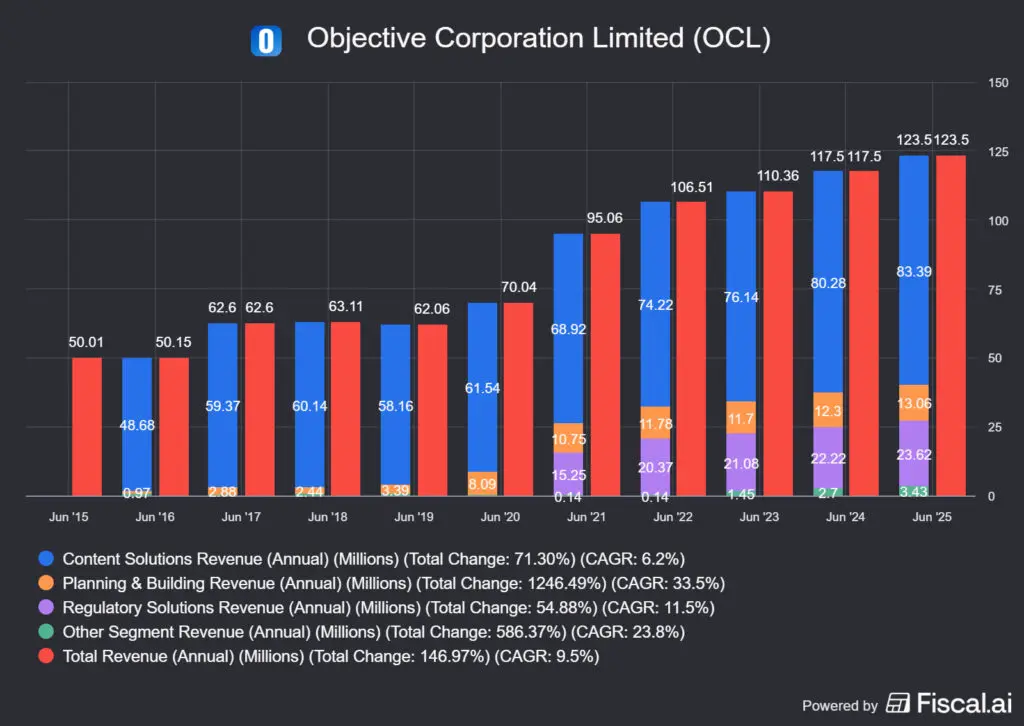
The columns above show the distribution of income, but which category is which:
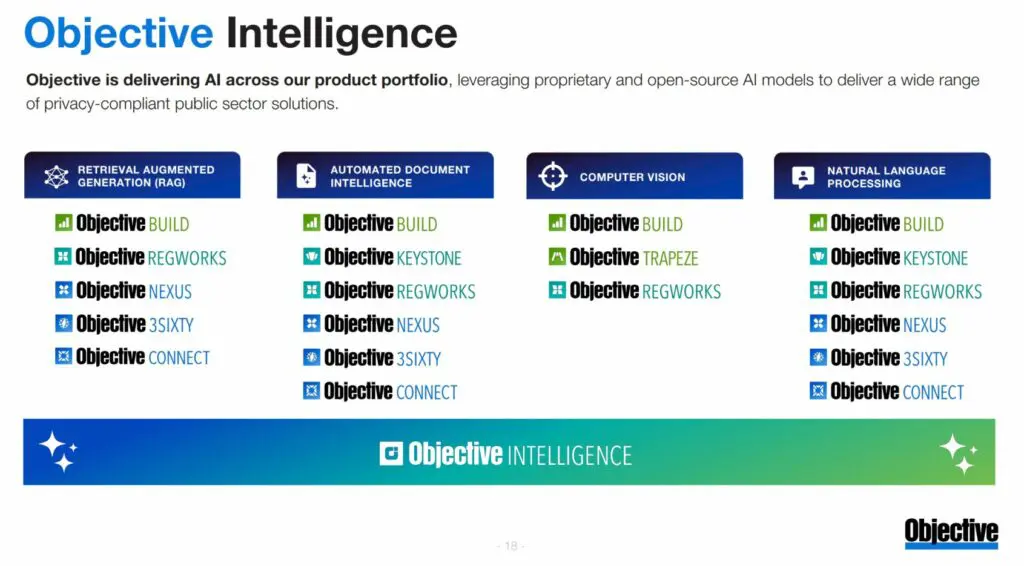
- (I.e. Content Solutions: the EDRMS/ECM business, i.e. records management and content management for public administration organizations. This includes content and process management (Objective Nexus), federated information management (Objective 3Sixty), secure external file sharing (Objective Connect) and automated redaction/anonymization (Objective Redact). In addition, there is Objective Inform (document and records management, Office 365 / SharePoint governance), Objective Perform process automation, GOV365, and Objective Ministerials, which manages the workflow of ministerial submissions and correspondence.
- 🏗️ Planning & Building: building and zoning permits, primarily for municipalities. Three products: the Objective Build design and development platform, the Objective Trapeze toolkit for assessing building plans, and Objective Keyplan for managing zoning regulations. Trapeze is specifically the software in which the building inspector marks and measures the permit plans digitally, instead of on paper.
- ️ Regulatory Solutions: Objective RegWorks (“data-driven regulation”) and Objective Keystone (regulated document production). RegWorks is the administration/licensing system for regulators themselves, licensing, inspection, compliance, enforcement. References that illustrate this include the New Zealand Police’s gun registry and the UK Gambling Commission’s regulatory digitisation. Keystone is the document authoring and approval side, typically for financial institutions and climate risk disclosure compliance.
- 🧩 Other: typically unallocated/company-level and smaller items not reported as separate segments.
I have explained the above in such detail because in the government sector it is not nearly as clear what does what, and everyone tends to see everything as an element of the ECM framework, which is document management. My other thought is that if AI is dangerous for anything, it is the above software, but this is offset by the fact that the government segment is protected by the aforementioned moats and difficult entry. Objective deals quite a lot in its reports with being able to implement AI into its systems, which, due to the closed nature of the government sector, can be considered more of a tailwind than a headwind. It does not replace them, but makes their operation more efficient.
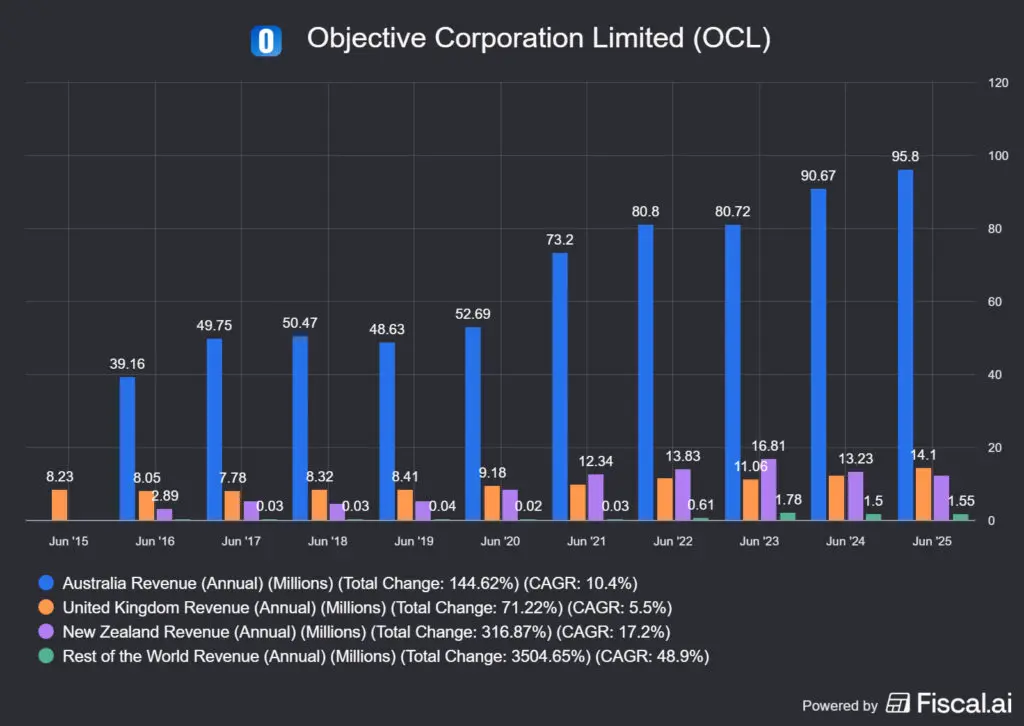
The territorial distribution of revenues is also telling, with Australia taking everything. It's worth breaking things down with the growth figures:
| Region | Revenue (USD) | Share | Change |
|---|---|---|---|
| 🇦🇺 Australia | 95.80 | 77.5 % | + 5.11 % |
| 🇬🇧 United Kingdom | 14.10 | 11.4 % | + 16.43 % |
| 🇳🇿 New Zealand | 12.00 | 9.7 % | −8.81% |
| 🌍 Rest of the world | 1.55 | 1.2 % | + 3.20 % |
| Altogether | 123.45 | 100 % |
One thing that is not clear from the above is how much growth there may be: A good indicator for this is Technology One, which operates in the same segment, does a little differently, and is a significantly larger company in terms of market capitalization:
| Region | Revenue (USD) | Share | Change |
|---|---|---|---|
| 🇦🇺 Australia | 487.29 | 81.4 % | + 17.49 % |
| 🇳🇿 New Zealand and Asia Pacific | 61.03 | 10.2 % | + 12.39 % |
| 🇬🇧 United Kingdom | 50.18 | 8.4 % | + 37.27 % |
| Altogether | 598.50 | 100 % | + 18.37 % |
From the above, it can be seen that Technology One's revenue in Australia is five times as large and is still growing dynamically, so Objective Corporation may still have a decade of growth ahead of it. What is not so bright is that OCL is growing slowly in its domestic market, while Technology One can show 17.5% there, albeit on a wider spectrum. But this is a warning sign that foreign markets are more likely to pull in revenue. Management does not disclose the backlog, so we do not know how much this is in the case of OCL, they only refer to ARR, and what they mention, the recurring revenue rate, which is 84%.
The gross profit margin is sky-high, 94% doesn't need much explanation, and the minimal decrease is nicely offset by the increase in all other values. Operating margin has increased by 11.8%, EBITDA by 10.3%, and net profit margin by 11.2% over the past 10 years, a continuously upward trend with relatively minimal fluctuations. That's exactly what I like to see in companies.
| FY23 | FY24 | FY25 | LTM | |
|---|---|---|---|---|
| R&D expenditure (P&L) | 27.21 | 15.65 | 15.55 | 16.18 |
| R&D / revenue | 24.65 % | 13.32 % | 12.59 % | 12.55 % |
| Capitalized intangible assets (CF) | −14.09 | −15.67 | −16.58 | |
| Amortization of capitalized items | 1.40 | 2.99 | 5.35 | |
| Other intangible assets (balance sheet) | 2.03 | 14.24 | 26.80 | 33.56 |
| Operating margin | 20.47 % | 33.22 % | 33.06 % | 33.88 % |
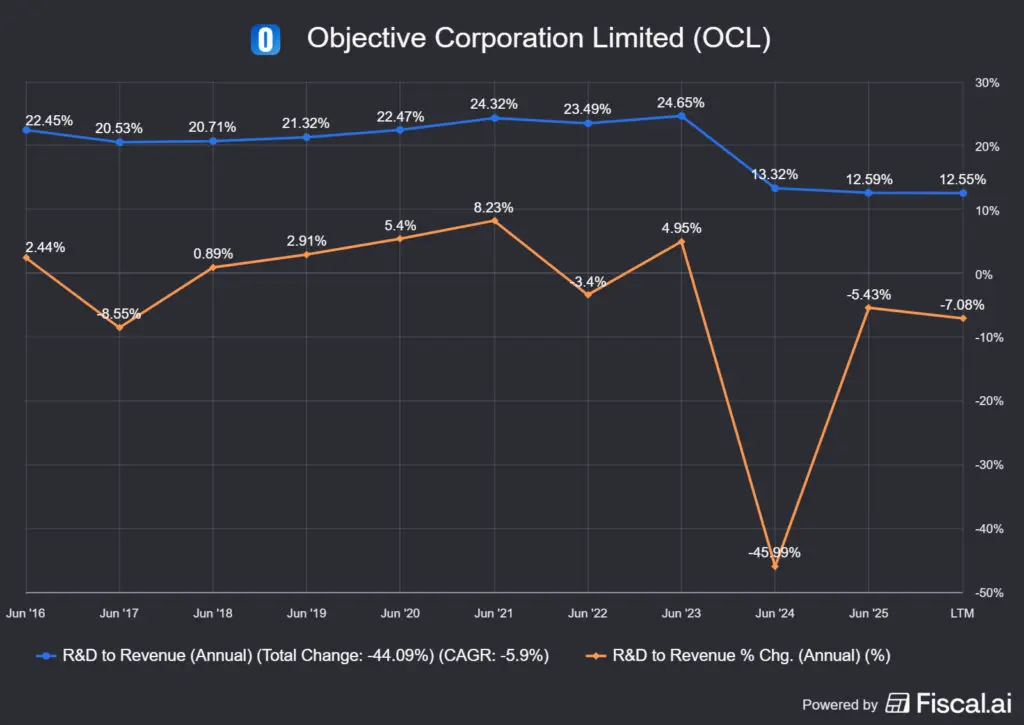
But wait a minute? What did I write at the beginning about R&D capitalization? That this cost is not written off in one year, but spread over years. If I adjust according to GAAP, then these are not even the same numbers, but margins that are a third lower.
| FY23 | FY24 | FY25 | |
|---|---|---|---|
| Reported operating profit | 22.59 | 39.04 | 40.83 |
| Net activation effect | 0 | −12.69 | −12.68 |
| Adjusted operating profit/loss | 22.59 | 26.35 | 28.15 |
| Adjusted operating margin | 20.5 % | 22.4 % | 22.8 % |
It doesn't really matter whether it's 33.88% or 22.8%, it's an 11% difference. That's not bad either, I just want to point out that IFRS-type accounting greatly inflates the numbers compared to if the company wrote everything down based on GAAP, like an American company would.
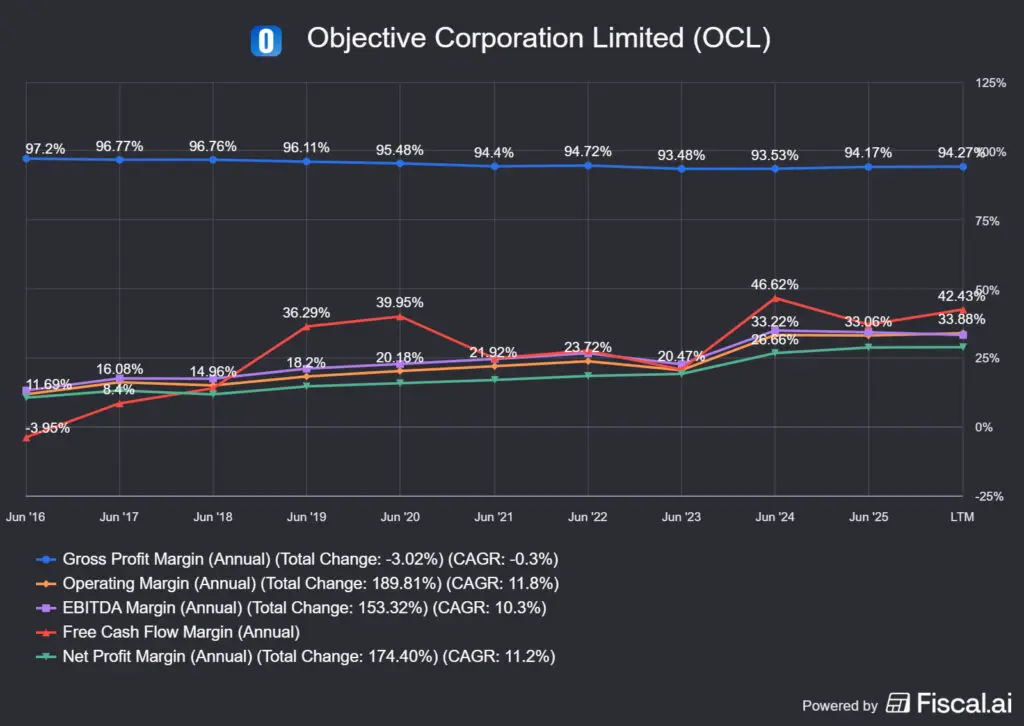
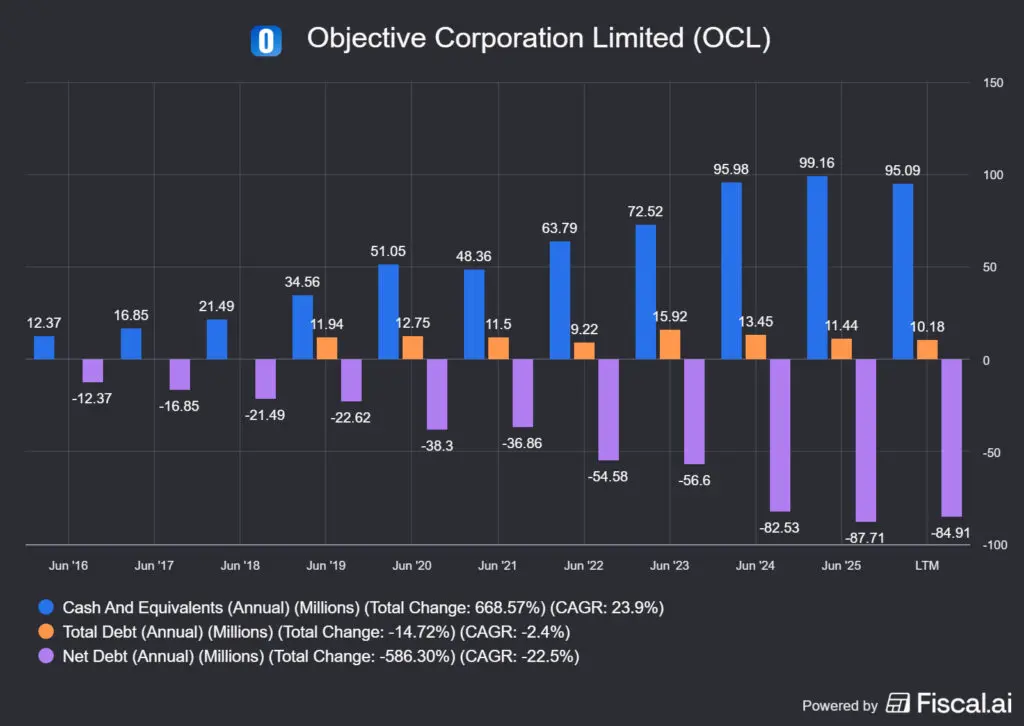
After the above, a much clearer situation is the lack of debt. The picture below shows cash and cash equivalents versus debt. Since the former is more, the company is sitting on net cash, which is ~93 million AUD.
Activation bias: what it means and how to read it
Before I get into the use of available free cash and capital efficiency, let's talk a little bit about how non-GAAP accounting changes the numbers. IFRS capitalization skews three numbers upward, and each of them needs to be adjusted to see the true economic picture, as I did earlier:
- 📈 Profit and margin, because part of the true annual cost of development is recorded on the balance sheet, not on the income statement. The reported operating margin (~33%) is therefore optimistic; by recoupling the development as a full cost, the real margin is lower, which is what I wrote above.
- 📊 AP/Et (reversed): The higher reported profit makes the reported P/E appear lower, and therefore “cheaper.” When we include the development as a full cost, the profit decreases and the P/E increases from ~18 to ~27. The higher the number, the more honest it is, but this problem is actually true for other valuation ratios as well, e.g. EV/EBITDA and NOPAT yield.
- ⚙️ ROIC and invested capital: capitalized development sits on the balance sheet as an asset, distorting return on capital ratios.
☝️ Related to the above is the fact that, for example, the dividend payout ratio, which shows the dividend paid per share compared to earnings per share, is also distorted.
The problem here is that if you adjust EPS for R&D costs, it goes down, meaning the dividend payout ratio goes up. Since Objective Corporation pays dividends, this also affects them.
The correct approach is not that capitalization is fraud, because IFRS allows it, and there is an economic argument for it (an improvement that benefits for several years is truly a long-term asset). But out of caution, and because most of the improvement is actually a maintenance cost to keep the product competitive, I used the more conservative, adjusted numbers in the analysis.
One final note for comparison: this activation practice is not unique to Objective. Its larger Australian counterpart, Technology One, activates in the same way, and even to a greater extent, so this is an Australian software industry norm, not unique.
What do ROIC and ROCE metrics show?
ROIC – Return on Invested Capital – shows how efficiently the company uses its total invested capital to generate profit. Read more here.
- It shows the company's fundamental value creation capability.
- It filters out the impact of the financing structure.
- If ROIC exceeds the cost of capital (WACC), the company is creating value.
ROCE – Return on Capital Employed – shows how efficiently the company uses its long-term financing sources. Read more here.
- It measures the profitability of business activities.
- It does not take into account tax effects.
- A good basis for comparison between different industry players.
| Indicator | What does it measure? | Who is it useful for? | When is it considered good? |
|---|---|---|---|
| ROCE | Total return on capital | Long-term investors | If higher than the industry average |
| ROIC | Return on invested capital | Equity investors | If higher than WACC |
| ROE | Return on equity | Shareholders | If stable and sustainably high |
Objective Corporation's Ownership Value Creation
On the owner value side, I usually look at what the company uses the free cash generated. Basically, a company can do the following things with cash:
- 🔄 reinvests it into the business (he doesn't know all the cash),
- 📉 reduced debt (he doesn't have any),
- 💵 pays dividends (3.8% at current valuation),
- 📊 buys back shares (yes, compensating for SBC),
- 🏢 acquires other companies (yes).
Objective Corporation is a mixed bag, because they generate a ton of cash while having very little cost of capital. This means they can't reinvest everything back into their business, and they have no debt, so the other categories are left. Morningstar says their capital utilization is outstanding, which I don't entirely agree with, as the current situation is more of a constraint for the company because they can't pump capital back into their business. What the company is doing instead:
- 💰pays dividends: 0.26 AUD per share, which is 3.8%, with a payout ratio of 66.9%, while the value adjusted due to IFRS is 83.9%;
- (I.e.buys back shares, but this is only the offset to the stock-based compensation and even that doesn't fully cover it, although this may change based on the latest semi-annual report, see the end of the analysis,
- buys up other companies.
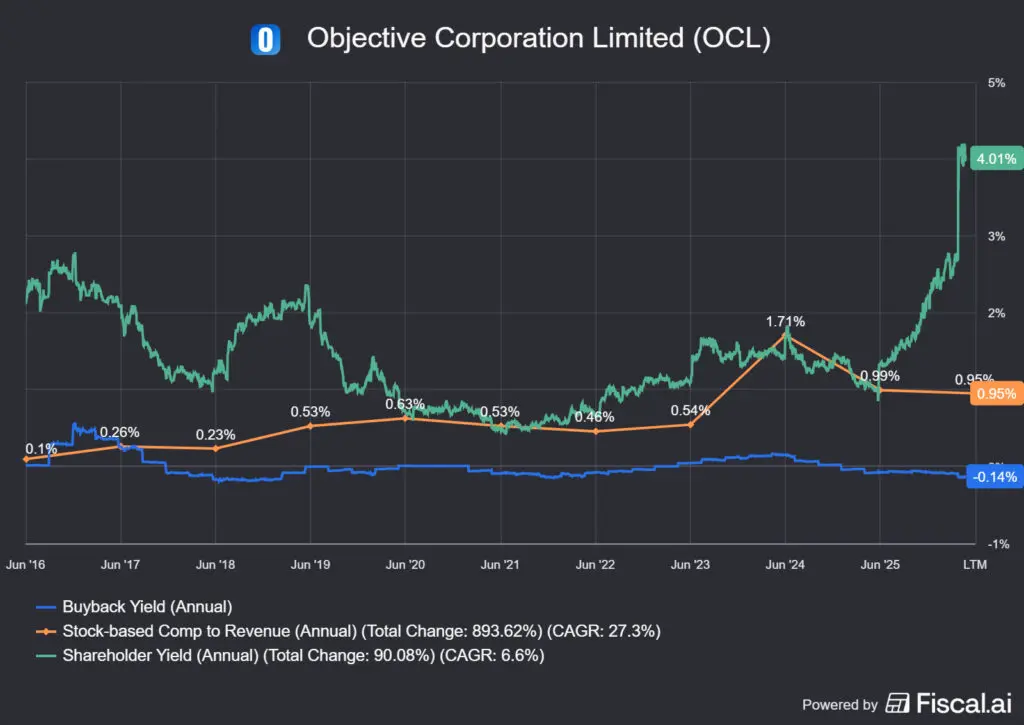
The problem with the above is that they essentially bring the shareholder return to between 0-1%, which is a great way to illustrate the above chart. The problem is that executive compensation essentially eats up what dividends and share buybacks would provide. The jump in the green chart results from two things:
- 📉decrease in value, meaning that the stock has become cheaper,
- 📈the rapid dividend increase: 30% is the five-year average, 21.4% is the ten-year average (but based on the high adjusted payout ratio, this will not continue).
This means to me that since the company doesn't really know what to do with the cash, it pays it out or acquires other companies, as you will see in the next chapter. How does this affect ROIC/ROCE/ROE values? The image below shows it!
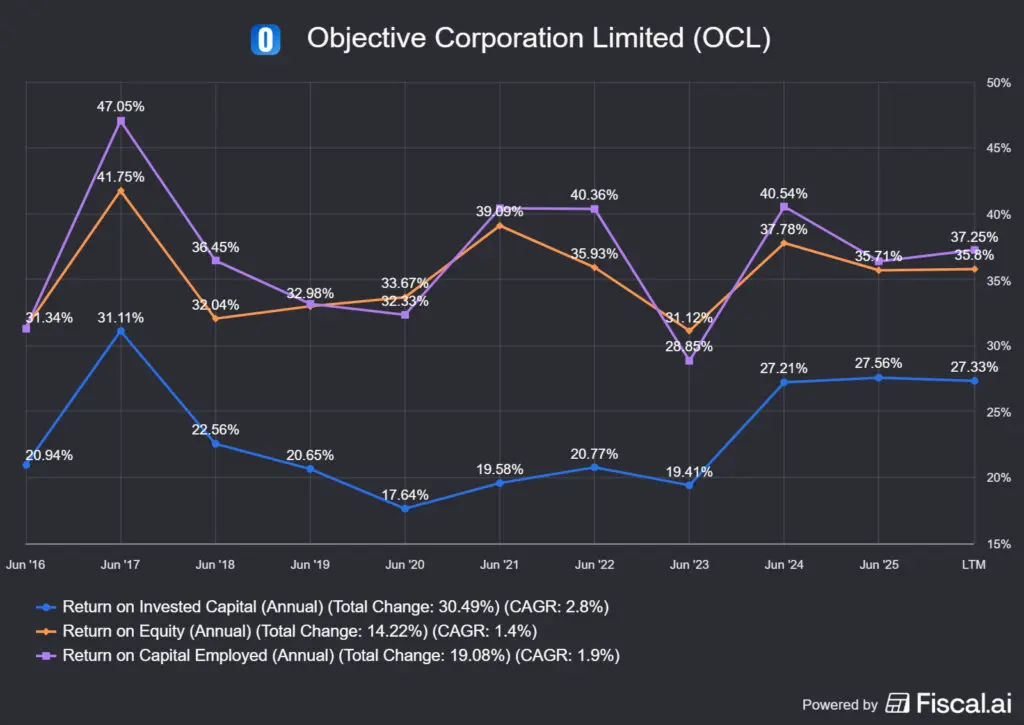
The above numbers are convincing, although they jump up and down quite a bit, but it doesn't really matter whether the ROIC exceeds the cost of capital of around 8% by 17.64% or 31.11%, there is still plenty of room for value creation. Where is the fraud? Due to the aforementioned IFRS accounting methodology, if I correct the above numbers with AI, the following comes out:
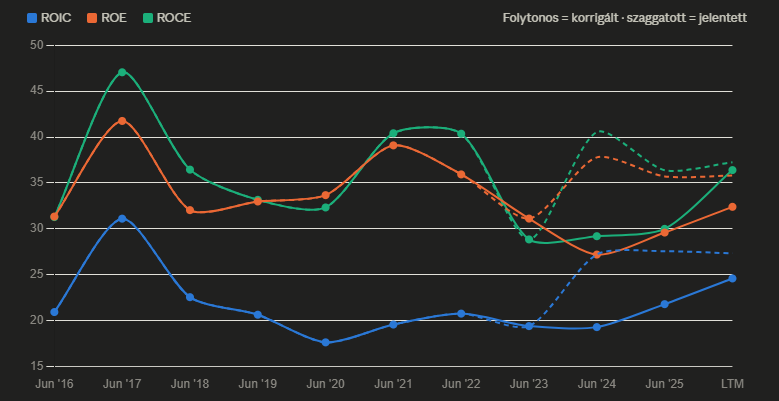
The corrected values are not the end of the world, but in some places the numbers are even 10% lower. The same is perhaps even more telling in tabular form. Of course, these are not bad either, but they do greatly distort the picture.
| FY23 | FY24 | FY25 | LTM | |
|---|---|---|---|---|
| ROIC reported | 19.41 % | 27.21 % | 27.56 % | 27.33 % |
| ROIC adjusted | 19.41 % | 19.3% (−7.91) | 21.8% (−5.76) | 24.6% (−2.73) |
| ROE reported | 31.12 % | 37.78 % | 35.71 % | 35.80 % |
| ROE adjusted | 31.12 % | 27.2% (−10.58) | 29.6% (−6.11) | 32.4% (−3.40) |
| ROCE reported | 28.85 % | 40.54 % | 36.39 % | 37.25 % |
| ROCE adjusted | 28.85 % | 29.2% (−11.34) | 30.0% (−6.39) | 36.4% (−0.85) |
Overall, I think Objective Corporation's thesis doesn't hold up, but you're actually getting a less brilliant, but still very good, capital-light company for a higher price.

Objective Corporation (ASX:OCL) acquisitions
In this section, I examine how acquisitive the nature of the company is and what impact each acquisition had on the life of the company, if any.
Objective Corporation is not a serial acquirer, but it has occasionally acquired other companies, primarily to gain access to new markets. They acquired Onstream Systems and Alpha Group, both New Zealand-based, and Simflofy, American. As you can see, they did not acquire any companies in their home country, Australia.
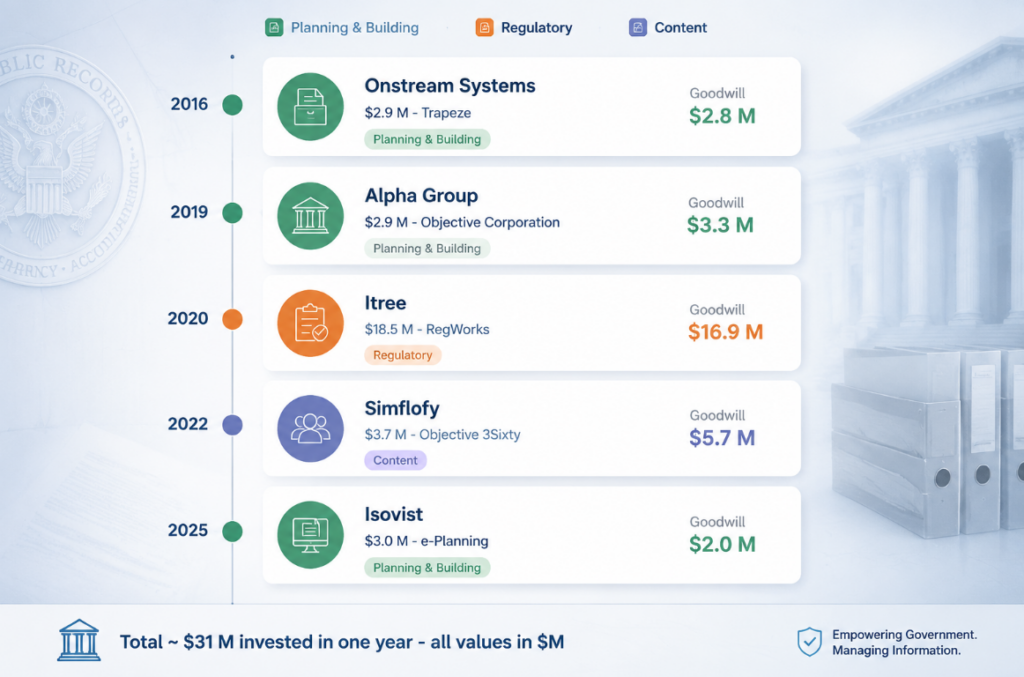
But why does OCL buy other companies? Because then it does not have to enter the given market separately with its own products and it also acquires references through the acquisition. From there, it can also cross-sell their original systems, which is also an avoidance of the previous reference paradox. The interesting thing is that if you look at which sectors are soaring, it turns out that 30% of the revenue in 2025 will actually come from the acquired businesses.
| Segment | FY25 revenue | Origin |
|---|---|---|
| Content Solutions | 83.39 | organic seed (+ Simflofy) |
| Regulatory Solutions | 23.62 | Itree, 2020 |
| Planning & Building | 13.06 | Onstream + Alpha + Isoplan |
| Other | 3.43 |
The question, of course, is whether it was worth acquiring the companies, or whether Objective Corporation overpaid for the companies, but it seems not.
| Transaction | Announced price | Cash flow line |
|---|---|---|
| Onstream (Feb. 2016) | secret + 200,000 share issue | −2.87 |
| Alpha Group (Apr 2019) | not reported | −2.88 |
| Itree (Jul 2020) | 18.5 MA$ (EV, reduced by cash) | −18.73 |
| Simflofy (March 2022) | not reported | −3.67 |
| Isoplan (Jul 2025) | not reported | −3.00 (LTM) |
In the case of the Onstream deal, it was revealed that the purchase price was covered by cash reserves and the issuance of 100,000 shares each to the two remaining executives, without an earn-out clause, and the acquired business was expected to generate more than NZD 2.5 million in FY2017 revenue, as it was a New Zealand company. This is a multiple of around 1x revenue, which means it is very cheap. There is another piece of evidence for excellently priced acquisitions: if the items on the goodwill line do not need to be written down. A write-down occurs when there is no real value behind part of the price and it needs to be written down in the books. This is the amount that we say the acquirer overpaid. The goodwill line of the balance sheet:
| FY16 | FY17 | FY18 | FY19 | FY20 | FY21 | FY22 | FY23 | FY24 | FY25 | LTM |
|---|---|---|---|---|---|---|---|---|---|---|
| 9.45 | 8.55 | 8.73 | 12.00 | 15.87 | 32.72 | 38.43 | 39.09 | 39.17 | 40.08 | 42.12 |
☝️There is practically no indication of a description. There is no impairment line in the cash flow statement, if there had been a substantial goodwill write-down, it should have been recognized as a non-cash item in the operating phase. But it is not, so I can say: Objective Corporation has deployed its capital very well in acquisitions.
Objective Corporation (ASX:OCL) management
In this section, I examine who runs the company and how. What is the bonus system, how much risk – skin in the game – do the managers take on while running the company? Is there a family connection, or perhaps a special “heritage” factor?
Objective Corporation is run by a rather special board of directors/management. The reason for this is that founder Tony Walls owns 64.81% of the company, so it might seem that it doesn't matter what its structure is. But in reality, it doesn't. The 5-member board of directors is called the Board of Directors, and there is no management, and the OCL website doesn't provide any information about it either.
Tony Walls (CEO, founder)
Tony founded the company in 1987 and is the CEO. He is currently 62 years old. He has extensive experience in the IT industry, holds a Bachelor of Mathematics (majoring in Computer Science), a Postgraduate Diploma in Applied Finance (SIA) and is a Fellow of the Australian Institute of Company Directors.
- 🫰Property: 62 million shares, 64.81%, which is approximately AUD 438 million. This ownership is held through a company called TBW Trustees Limited
- 💰Reward: ~300,000 AUD, but lives primarily on dividends, which amounts to AUD 16.1 million after his stock position, which is fifty times his base salary.
Nick Kingsbury (independent, non-executive director)
Nick is an experienced international software entrepreneur, strategist and venture capitalist. He founded, led and then sold a leading UK business process management (BPM) company. He then spent seven years at international venture capital firm 3i, where he led the software sector team. From October 2011 to June 2015, he was Chairman of Accumuli plc, a cyber security company listed on London’s AIM, which was successfully sold to NCC Group. In addition to his role at Objective, he is a partner at venture capital firm Amadeus Capital Partners and sits on the boards of several early-stage technology companies. Nick is the Chairman of the Audit and Risk Management Committee.
- 🫰Property: 100,000 shares, ~707,000 AUD, non-significant owner.
- 💰Reward: ~120,000 AUD.
Darc Rasmussen (independent, non-executive director)
Darc is a seasoned enterprise software professional with over 25 years of experience building and growing software-as-a-service (SaaS) and cloud businesses in global markets. He has worked at growth companies such as Infor, SAP, IntraPower (Trusted Cloud) and Integrated Research. Darc led SAP’s (NYSE:SAP) global CRM business, which he built from scratch to $1.5 billion in annual revenue by 2007. As CEO, he led Integrated Research (ASX:IRI), leading a comprehensive business transformation strategy that resulted in revenue and profit growth of over 70% and a tripling of the company’s market capitalization. Darc is a member of the Audit and Risk Management Committee.
- 🫰Property: 100,000 shares, ~707,000 AUD, non-significant owner.
- 💰Reward: ~120,000 AUD.
Stephen Bool (independent, non-executive director)
Stephen joins the board after 17 years of leadership at Objective Corporation, the last five of which he served as Chief Operating Officer (COO). During this time, he made significant contributions across the organization and shaped the culture and operating structure that underpins the company’s current business success. Prior to Objective, he held senior leadership positions at US multinational software and consulting companies, including PeopleSoft (Oracle) and SPL WorldGroup (Oracle), spanning over 30 years of professional experience. Stephen holds a Bachelor of Science in Computer Science and a Master of Business Administration (MBA). Stephen is a member of the Audit and Risk Management Committee.
- 🫰Property: 127,025 shares, ~898,000 AUD, this is not a significant owner.
- 💰Reward: I didn't find it.
Ben Tregoning (company secretary and financial director)
Ben was appointed Company Secretary in July 2016, effectively becoming the CFO. He has over 15 years of experience in finance roles, both in financial services and corporate finance firms, both in Australia and the UK. Ben is the Finance Director of Objective Corporation, responsible for Company Secretarial and Corporate Governance Support. He holds a B.Commerce and an M.Commerce degree.
- 🫰Property: 100,000 shares, ~707,000 AUD, non-significant owner.
- 💰Reward: 40,000 AUD.
The official website only refers to Walls as “Chief Executive Officer,” even though the corporate governance statement states that he is also executive chairman, meaning he holds the position of president. If you are building on this in the governance section, it is worth noting separately in addition to the translation that the website does not display this duality.
I have a lot of thoughts on the above. The board of directors is also the management, so if there were an operational problem, you can't practically fire anyone, but I can say that Tony Walls can fire anyone at any time. Since he is also the CEO, this is a double-edged sword, as he has a vested interest in the success of the company, but he cannot be removed in the event of operational errors. Since I have never encountered such a structure before, I have gathered the lessons:
- 🏛️ Essentially, there is no control over the company, what happens is what Tony Walls wants, who controls the company in one person, he can make all regular decisions alone. There is one exception, special resolutions related to 75% ownership, amendment of the articles of association, selective buybacks, certain capital operations.
- 💸 The remuneration of the board members is ridiculously low, and I found no evidence that it is tied to internal return metrics. But this also allows them to remain independent, which is also stipulated by the ASX stock exchange rules. However, their shareholding is negligible.
- 📊 Since he lives off the dividend, it is in his interest to increase it, meaning that the capital allocation is grossly distorted. If he were to cut it to spend this cash on something else, he would be screwing himself. From now on, how much can we expect him to do this? I don't think so.
- 🧾 The Audit and Risk Management Committee is a nominal thing, they actually have an auditing role, they do not form a counterpoint to the founder.
- 🚪 Former major shareholder Gary Fisher has no position in the company, he essentially exited, selling his shares through open market operations, even though he still owned 20 million shares in 2011.
There was no insider buying in the drop, so it is highly unlikely that the board thinks the stock is underpriced.
What is franking?
Franking is a feature of the Australian system: A tax credit may be attached to the dividend, which avoids double taxation.
- The logic: If an Australian company has paid 30% corporation tax on its profits and then pays a dividend, the shareholder will receive a “franking credit” with the dividend, a certificate that tax has already been paid on this money. The shareholder can set this off against their own tax.
- Example with 100% franking: the company pays $30 in tax on a $100 profit and pays out $70 as dividends. The Australian shareholder, however, is taxed on $100 instead of $70 (this is the “gross-up”) and can deduct the $30 credit. If he is in the 45% bracket, he has to pay $45, minus the $30 credit = net $15. If he holds it in a pension fund (15% rate), then 15 minus 30 = -15, meaning you get a refund. The latter is what makes dividends extremely popular in Australia.
Objective Corporation no longer pays tax on dividends (because it pays corporation tax on profits, which is where the franking comes from, which can be deducted from the dividend), so zero percent franking means that there is no Australian corporation tax paid behind it, so there is no credit. The shareholder is taxed on the entire dividend at their own rate, without compensation. Why is this happening at OCL? I would guess, although I am not certain, that since some of the profits are generated and taxed overseas (UK, New Zealand), the foreign tax does not generate an Australian franking credit. The company's "franking account" has been exhausted, so it can only pay dividends without franking credit. The turning point is clearly visible in the table: until 2021, almost all payments were franked 100%, and since 2022, they have been practically zero. You can see this in the table cut from the Marketindex website, below. However, in the latest report, the CEO said that the dividend was fully franked, so it seems to me that the dividend will be covered until the credit runs out.
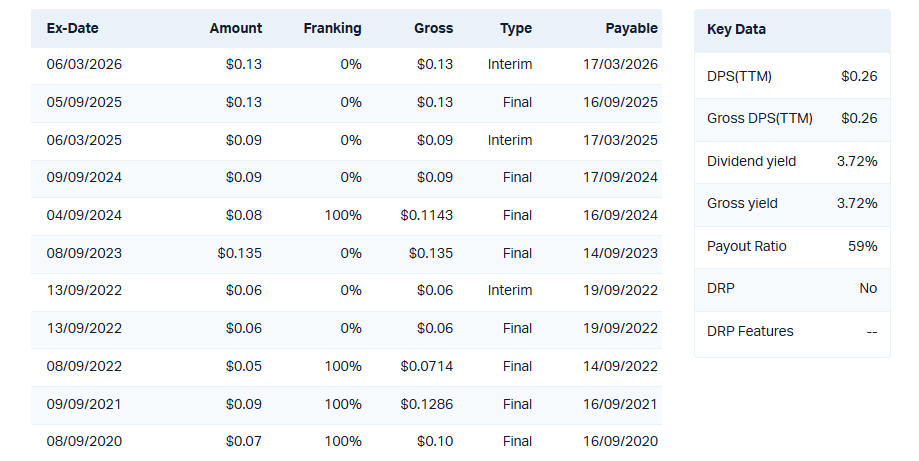
📌In practice: I wondered why the founder would take the money out as a dividend if it was very tax inefficient, although it's still better to do it through a company than as an individual. I figured he couldn't do anything else. After all:
- 📈if you were to buy back shares, your ownership would increase further, in an illiquid market,
- 📉 selling would be a bad signal to the market, which would erode the company's value,
- 🧱 but the most important thing is that the company is unable or unwilling to invest its capital elsewhere. This, in turn, also refutes the perpetual compounder thesis.
Since I can't describe the company's capital allocation as good, and I also don't like the fact that there is no management, and their remuneration is not tied to the company's internal rate of return, growth, or anything else, this is actually a frozen ownership situation. The company simply has no reinvestment target, it doesn't buy back its own shares, in fact, the wind has run out of their sails.
Competitors: Objective Corporation (ASX:OCL)'s opponents
In this section, I examine who the competitors of the analyzed company are, what is their market position, whether they are in a subordinate, secondary or superior role. What is their market share and what is their specialty? Are they losing or gaining market share to their competitors?
Regarding Objective Corporation, Morningstar mentions the following competitors, but I think this is a mistake. Box Inc is a file sharing service for corporate customers, zero government focus. It could only be compared to Objective Connect. Tyler Technologies is an acquirer (not a true serial acquirer), a so-called roll-up, but has US government software exposure, a wide moat company, with a capitalization of 12,5 billion USD. It has no geographic overlap with Objective Corp, but it shows where an embedded government supplier can grow.
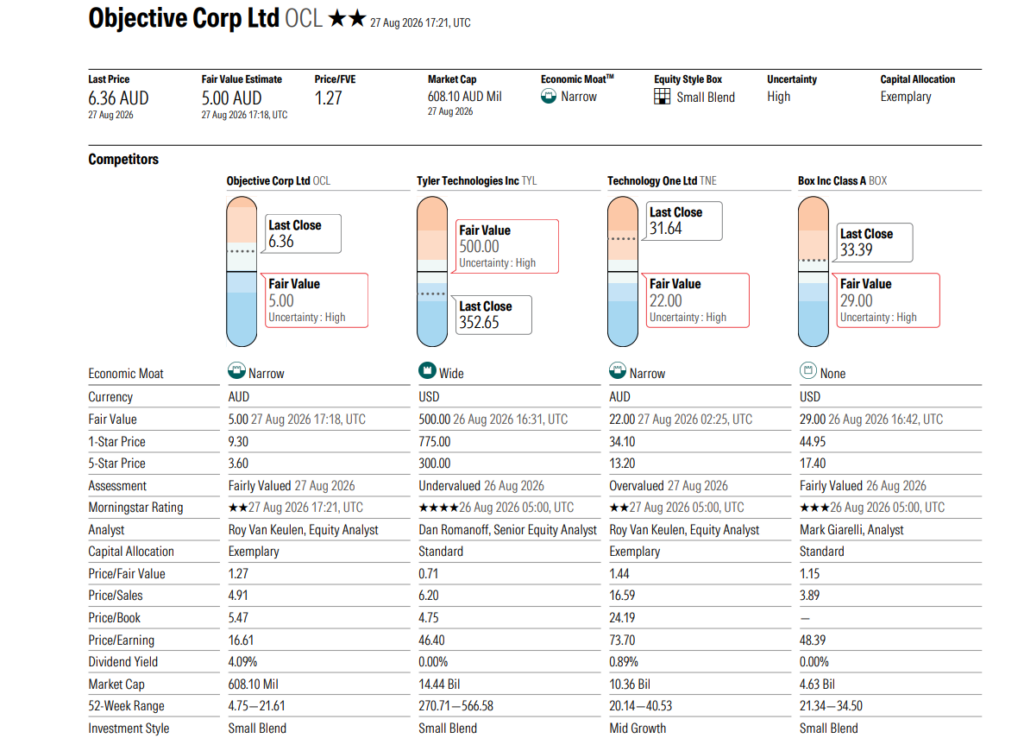
However, there are four companies that are truly opponents of Objective Corporation:
- 🇦🇺 ReadyTech Holdings (ASX:RDY),
- 🇬🇧 Idox plc (AIM:IDOX),
- 🔒 Civica, but not a listed company,
- 🏛️ Technology One (ASX:TNE).
ReadyTech Holdings (ASX:RDY)
ReadyTech Holdings (ASX:RDY) is essentially the controlling group of Objective Corporation, as it is a great example of how it is possible to do something wrong in this market segment. It was founded in 1998 by Marc Washbourne, who is still the CEO today, so this is also a founder-led company like OCL. Headquartered in Sydney, it went public in 2019 at AUD 1,50. Three segments: Education and Work Pathways, Workforce Solutions, and Government & Justice, the latter generating the most revenue.
The Government & Justice segment runs the Ready Community, Altus and Synergysoft products, municipal platforms that are rivals to Objective Build and Trapeze systems. In the 2025 presentation, they specifically mention their AI product called Planner Assist, which they sell to local governments, which directly conflicts with Objective Intelligence's planning line.
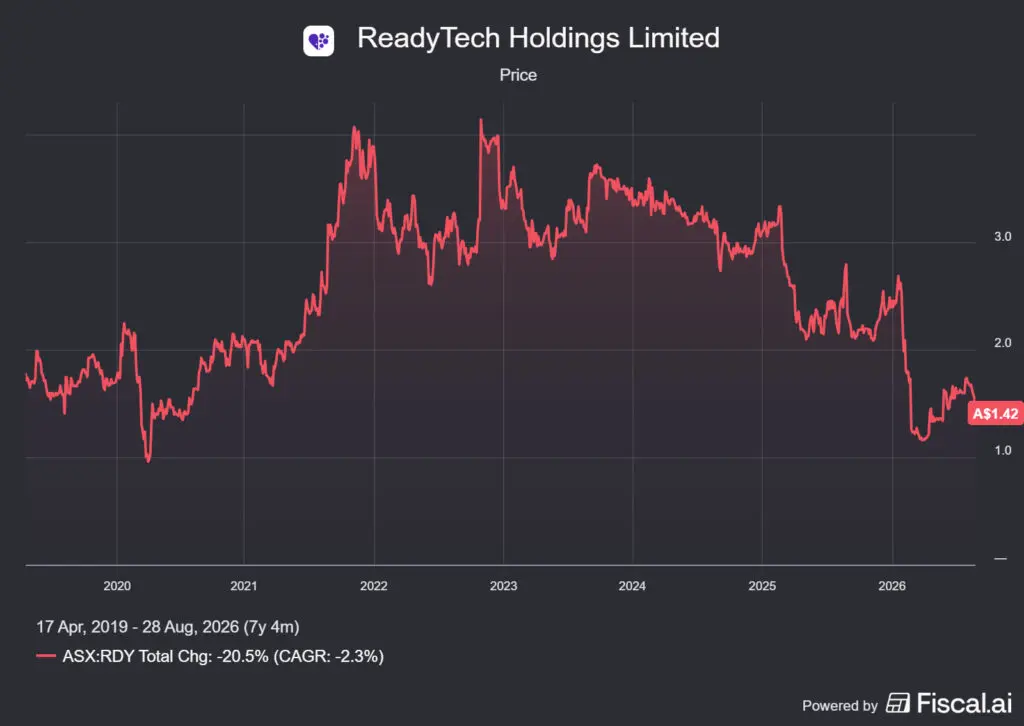
The relative valuation speaks for itself. RDY trades at ~1,2x P/S, OCL at 5,35x, with nearly identical sales. The 4x difference is exactly what shows that OCL is the much better quality company: it generates AUD 35,4 million in profit, sits on AUD 99 million in net cash, and has grown organically, while ReadyTech grew through acquisitions, with debt, and is now writing down what it bought.
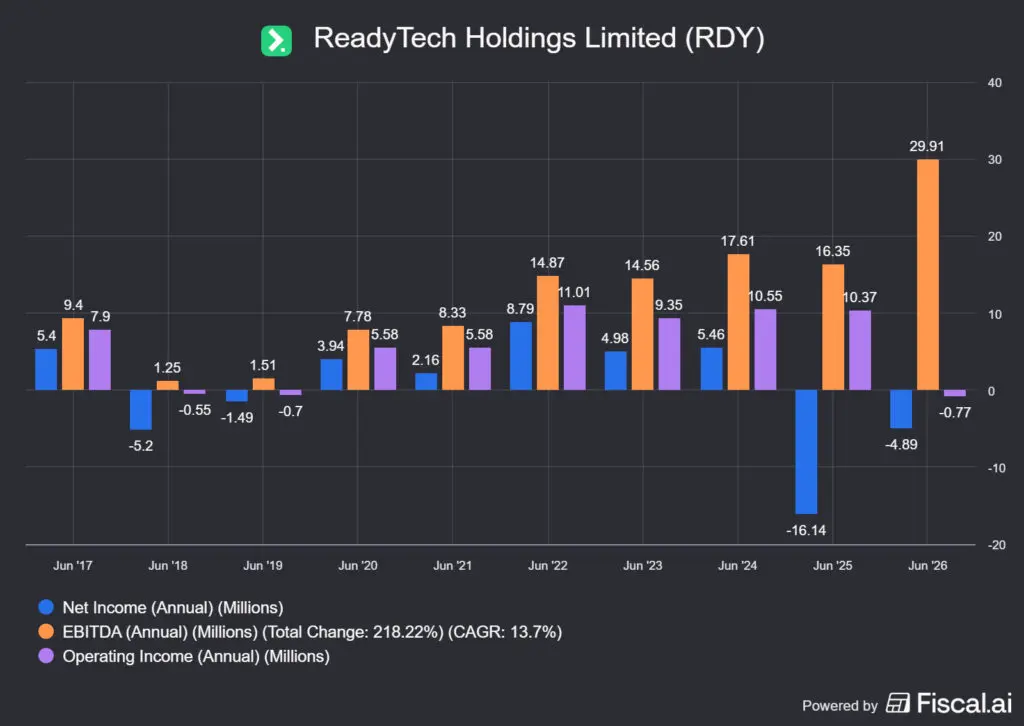
Finally, the bad news: ReadyTech Holdings has received a takeover bid from Topicus, a spin-off of Constellation Software, which is also in my portfolio. This means that there is still value left in the beaten-down valuation, but it would essentially remove RDY from its competitors and become a member of a VMS holding. You can read the official news here: Topic news.
For now, the company has rejected the acquisition.
Idox plc (AIM:IDOX)
Idox plc (AIM: IDOX) is a UK planning, construction and land charges software company that sells to local authorities, making it a direct competitor in exactly the segment (Planning & Building) that is OCL's fastest growing business and exactly the market where growth would come from. If the UK is the engine of the thesis, the picture is not complete without Idox.
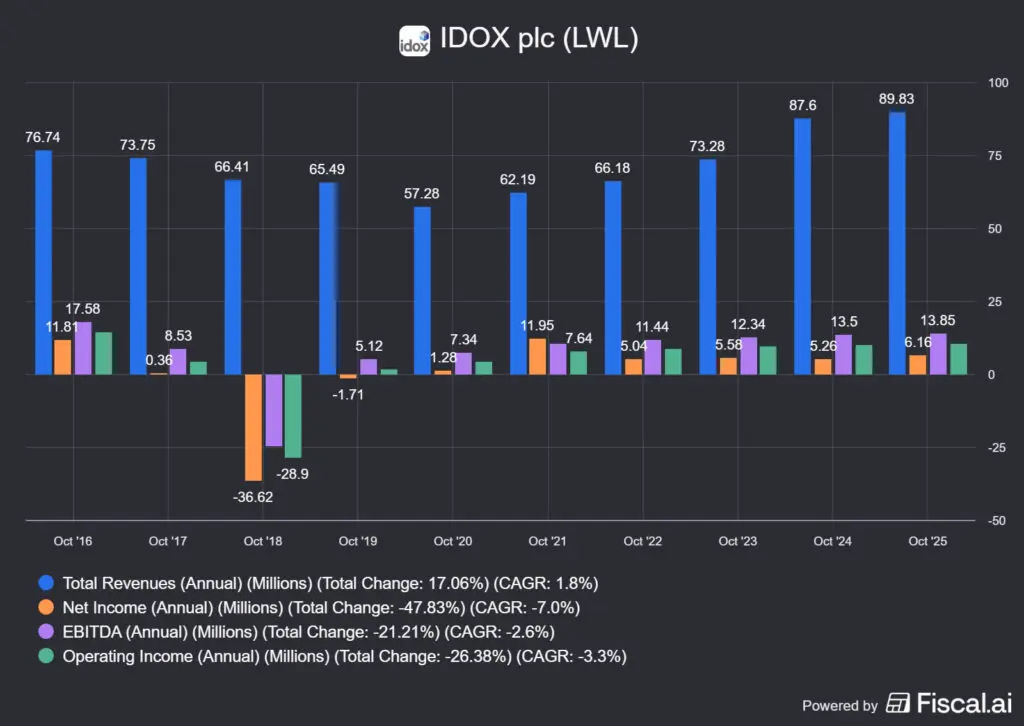
Idox plc, listed on AIM, led by David Meaden. Specialist information management software and geospatial data for the public sector and asset-intensive industries. Divisions: Land, Property & Public Protection (LPPP, a direct rival to OCL Planning & Building), Communities, Assets and the geospatial business (Emapsite). Market leader in UK planning systems and electoral software, but not Australian.
Idox plc is being acquired, Frankel UK Bidco Limited's cash offer is 71,5 pence per share, valuing the company at GBP 339,5 million. The offer was announced on 28 October 2025, and in January 2026 the structure was changed to a contractual takeover offer with an acceptance threshold of over 50%, and the board did not recommend a dividend for FY25 as a result. That is, the board supported the acquisition, the buyer is Long Path Partners, LP, an American investment manager based in New York, so the company went private.
Civica (non-listed company)
Civica is a privately held company that produces software for local government in ANZ and UK. OpenText (ex-Micro Focus Content Manager) is a classic EDRMS rival in Australian government; OCL's own FY19 report specifically mentions integration with it. Started in 1999 as a buyout from Sanderson Group, backed by Alchemy Partners; today's Civica Group Limited was formed in 2001. Headquartered in London, with regional offices in Australia, Singapore and North America. CEO Lee Perkins. Divisions: Government, Social Housing, Law Enforcement and Emergency Services, Education and Libraries.
The scale is serious: 6000+ clients, in eight countries, serving over 100 million citizens, UK, Ireland, Australia, New Zealand, India, Singapore, USA, Canada. Product range: case management, tax and benefits systems, financial management, workforce management, community services, data analytics.
The chain of ownership is the key
Partners Group acquired it in 2017 and in November 2023 agreed to sell it to Blackstone; the deal closed on May 2, 2024, for approximately $2500 billion. Official announcements did not disclose terms, the price comes from secondary sources.
In other words, Civica is moving from private equity hands to private equity hands and growing in the process. The acquisition strategy continues under Blackstone: in September 2025, they bought OLM Systems (social care), and previously the Australian cloud-based facilities management company Booka, so they are also actively expanding in the ANZ region through acquisitions. This is OCL's most serious competitor in both markets, In the UK and New Zealand at the same time.
Objective is looking to expand into the UK, where Idox is already in the planning and Civica in the wider local government stack; Civica is also buying in Australia. This is significant competition, and it's hard to really understand this market enough to judge how much risk it poses. Plus, private company numbers are much harder to come by than public companies.
Technology One (ASX:TNE)
If the above were not enough, Technology One is the most dangerous opponent of Objective Corporation. One of the most important findings is that it is a company ten times its size, capital-strong, working with very high ROIC and ROCE numbers. Of course, Technology One is not only present in the same segment as OCL, but their portfolio is broader than that.
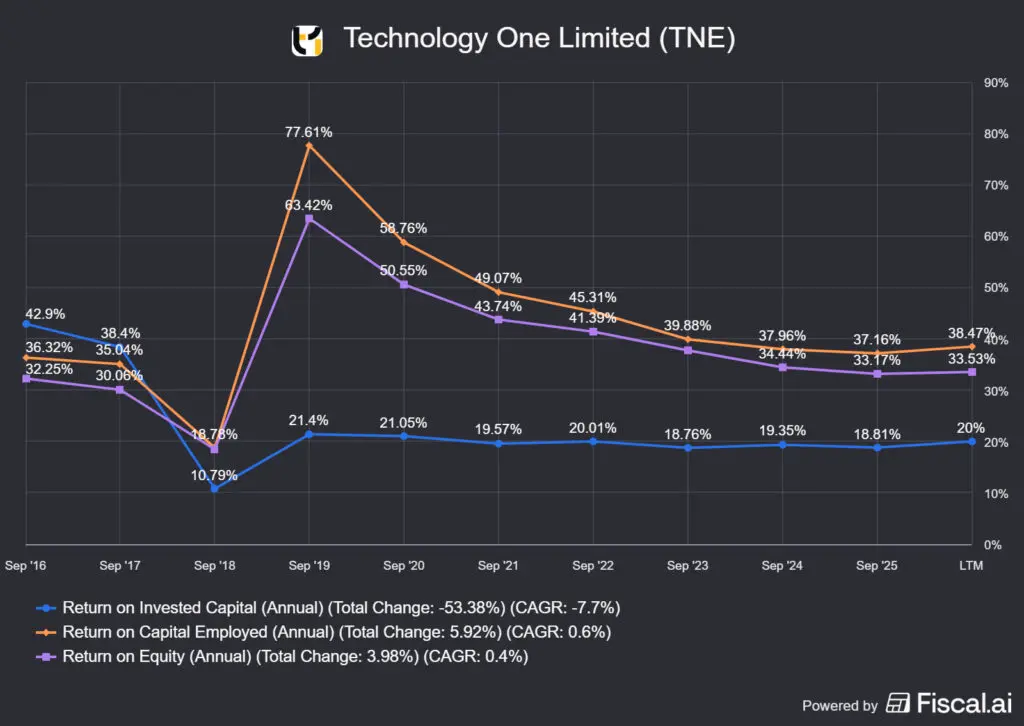
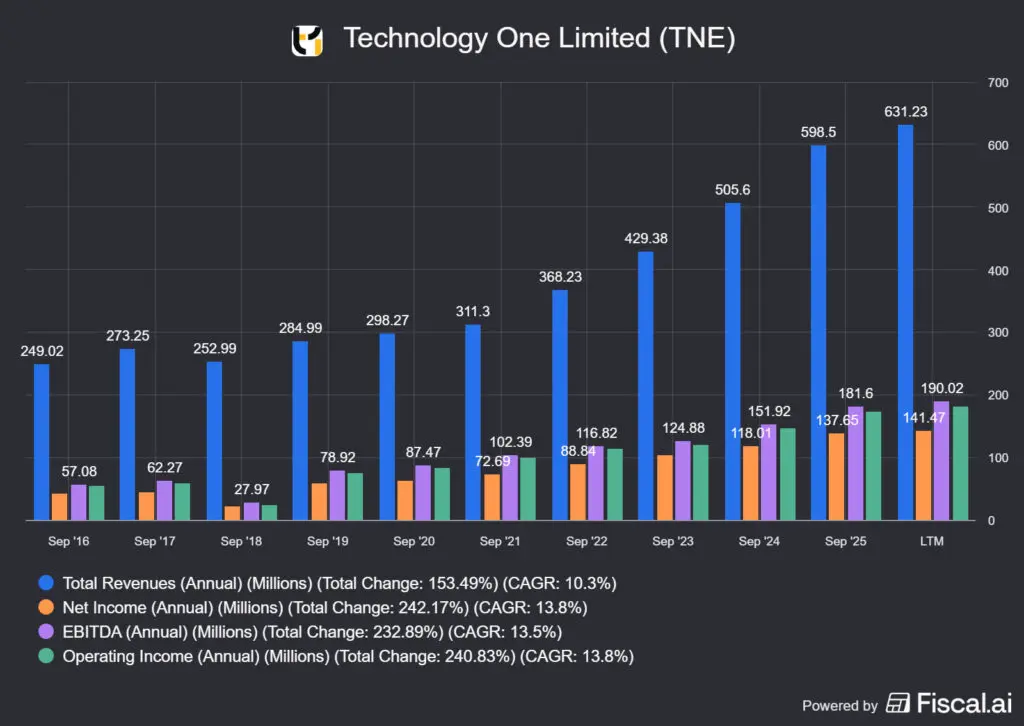
Revenue up 18% to AUD 610 million, pre-tax profit up 19% to AUD 181.5 million, ARR up 18% to AUD 554.6 million, both above previous guidance. Recurring revenue ratio at 91%. Rule of 40 score of 59%, placing it in the top quartile of the global SaaS field. Debt-free balance sheet, AUD 245.5 million in cash and investments in 1H FY26. In summary: pharmacy balance sheet, managed at least as well or better than Objective Corporation.
Breaking down the verticals is the key
The local government vertical grew 22% to AUD 39.4 million; higher education grew 24% to AUD 27.6 million; government grew 8% to AUD 6.7 million. Let's pause here for a moment. Technology One added AUD 39.4 million in ARR to its local government business in a single year, this is more than double Objective's entire Planning & Building segment (AUD 18.2 million). OCL's fastest growing business is smaller than its competitor's one-year growth in the same vertical.
And the two companies should also clash in the British market. TNE won the London boroughs of Islington and Greenwich in FY25, winning them from globally embedded competitors. That is, it is winning in exactly the market where OCL wants to expand, and is not entering a blank space, but displacing incumbents.
| OCL FY25 | TNE FY25 | |
|---|---|---|
| Income | AUD 123.5 million | AUD 610.0 million |
| ARR | AUD 120.2 million | AUD 554.6 million |
| ARR growth | +15% (we know this was cut) | + 18 % |
| Recurrence rate | 84 % | 91 % |
| Capitalization | ~AUD675 million | ~AUD10.5 billion |
| P / S | 5.35 | 16.27 |
| P / E | 18.07 | 72.26 |
TNE trades at roughly 5x revenue to 15x market cap. The difference is not irrational, with bigger, faster, higher recurring revenue, 114% net revenue retention and 50-55% Australian market share in government and education ERP. In return, it is wildly overvalued, meaning it is expensive, but not by accident.
And two things that partially answer my earlier questions about OCL:
- Tony Walls's succession is possible and the situation at TNE proves it: the company was founded by Adrian Di Marco, is now led by Ed Chung, and performance has not only not broken, but has improved. This is the only direct counterexample to the “founder succession” risk, which you can see below: The transition was successful in the same market, in the same country, and at a company led by the same founder.
- Platform consolidation was successful here. TNE's OneCouncil product plus the Property and Rating module are pushing from ERP into the planning and real estate space, right in the direction of OCL Build and Trapeze. However, there could be a real risk that Technology One will try to acquire Objective Corporation, especially if Tony Walls wants to retire.
📌In practice: The above raised alarm bells in my head: this environment is surprisingly competitive and OCL is not the big fish. Technology One is a much larger company, but there is also quite a lot of venture capital here, which can have a say in the chess game. Despite the fact that this is a regulated industry, there are quite a few players and acquisitions are not uncommon, and this usually does not bode well for smaller companies. I really don't like when good acquisitions are wrung out of my hands, and this is not unthinkable in the case of a company where the largest owner has ~65% ownership.
What if the founder doesn't want to continue the company and sells it to a competitor in a few years? Tony Walls is now 62, so that doesn't seem like a very distant possibility to me. Until the succession is sorted out, it remains a big, open question.
What risks does Objective Corporation (ASX:OCL) face?
In this section, I examine all the risks that could affect the company's long-term future. Currency, regulatory, market disruption, and so on.
Objective Corporation's risks are relatively simple, as the previous parts of the analysis have already revealed the problems.
Technological obsolescence⭐⭐⭐⭐⭐
- 🤖 OCL's core product of document management and capture is exactly the layer that Microsoft Purview, Copilot and SharePoint's feature expansion could gradually absorb. The "Objective Intelligence" AI portfolio is more defensive than offensive. If the governance layer is integrated into the general office platform, OCL loses its raison d'être as a separate product category. In other words: AI disruption is only an advantage and increases OCL's efficiency if external, more capital-rich competitors do not break into this market.
- ⚙️ The migration risk of legacy software is already proven to be real. Objective Corporation's ECM 11 system is not getting AI development, Nexus is the future, but Defence has shown what happens when a large customer is sitting on the old generation and refuses to switch. The same is true for hundreds of other ECM customers: OCL is already developing a new system, but no one knows whether these institutions will switch to the newer software.
- 🔐 Cybersecurity incident. The company handles defense-classified and government documents. A major incident would not be a loss of revenue, but an existential loss of trust in a market where security is the product.
📌In practice: During the analysis, I felt that this was a very closed market, for which I could gather little information, even with 12 years of experience in the public sector. But not in Australia, where there are obviously many local specialties.
Customer and revenue concentration⭐⭐⭐⭐
- 🎯 The failure of the Defence contract may not be an isolated case, but it could also be the first manifestation of a structural pattern: a few large government clients account for a disproportionate share of revenue, and the departure of one of them can absorb an entire year of group-level growth. The company does not disclose client concentration data, which is a risk in itself, as you do not know how many other such contracts there are. The current growth rate is around 10-14%.
- 🏛️ In all cases, the buyer pays from the state budget. An Australian or British spending cut cycle affects multiple segments at once, and OCL has no private sector counterweight (the Keystone FSI leg is the exception, but it is small). There is no viral spread or network effect like with other software companies.
- 📋 Changes in public procurement rules: Sovereignty requirements, mandatory competition for renewals, or the transformation of whole-of-government procurement framework agreements can all force a decade-long customer relationship to tender. The Defence case showed exactly this.
📌In practice: This is not a real software company, and it shouldn't be treated like one. I think of VeriSign, where government contracts also regulate the rate of revenue growth, but they also ensure that .com and .net domains can only be purchased from them. If this breaks down, the company loses its competitive advantage, and the same is true for Objective Corporation: if the government decides otherwise, the company's life could take a major turn.
Competition and market expansion⭐⭐⭐
- 🇬🇧 The UK is the most likely growth engine (+16,4% in FY25), but OCL is a challenging, unincorporated player there. There are several strong local competitors in the UK local and central government market, and the embeddedness advantage, which is the essence of economic advantage in Australia, is missing.
- 🇺🇸 US expansion has remained symbolic so far (Simflofy, ~5M USD, 2022). US procurement is slow, capital intensive, and requires FedRAMP certification. In a realistic scenario, this is a decade-long project, not a year-long one.
- 🏆 Technology One as a benchmark and partial competitor: bigger, growing faster, and eating from the same government budget. If local governments consolidate onto a single integrated platform, OCL's point products will be squeezed out.
📌In practice: The problem with Objective Corporation is that there is also a Technology One in the same market. I wouldn't be surprised if the bigger fish eats the smaller one if it doesn't succeed in the other markets in the long run.
The founder's identity and capital allocation⭐⭐
- 👤 Walls is 62 years old and has been leading the company since 1987, serving as both CEO and president. There is no public succession plan, and the company does not disclose a management team on its website, so the next level cannot be assessed from the outside. The closure of a 35-year founding cycle is inevitably on the agenda in the next decade, and the market is not prepared for this.
- 🧱 The company cannot find a high enough return reinvestment path. The ~93 million AUD cash sits on the balance sheet, the dividend is up 18%, and there are no buybacks. This defeats the perpetual compounder thesis for me, and thus the justification for the high multiple.
- 🗳️ Minority vulnerability. At 64.81%, all ordinary resolutions pass on their own. The practical danger is not in day-to-day operations, but in the event of a liquidation: for a company sitting at a five-year low with net cash, this cannot be a zero-risk event.
📌In practice: I don't consider the above to be a big risk, but that's why I won't buy OCL. I'm simply not looking for a company like that, it's not a company that reinvests in itself, with special risks.
Accounting and valuation risk⭐⭐
- 📒 Capitalization of development costs. In FY25, AUD 15,7 million of the AUD 31,2 million R&D was capitalized, while in FY19 the company proudly emphasized that it would immediately account for 100% of R&D, because it believes this reflects real sustainable profitability. The practice has changed, this distorts the numbers, which constantly needs to be corrected.
- 📉 Liquidity and coverage risk. The free float is ~35%, and according to Market Index, no major brokerage houses cover the stock. This magnifies the movement on bad news and makes it difficult for a positive turn to be priced in quickly.
- 💰 Dividend sustainability. The payout ratio is 66.9% (of course, it is higher in reality, because due to R&D capitalizations, if you were to calculate the company's accounts for one year, it would be even higher). If FY27 results narrow due to the Defense loss, the upward dividend path will be broken, and since part of the shareholder base is already holding the stock on a yield basis, this could trigger a secondary wave of selling.
📌In practice: Another criterion in my framework is appropriate valuation. Since the paper is relatively illiquid and its value still needs to be adjusted, I am quite uncertain about what its fair value might be. This affects my other basic criterion, so in my analysis, the two lower-probability risks will be the first to fail the position.
I made a self-check list that confirms the thesis about the company:
- low or zero debt: YES/PARTLY/NO
- significant economic advantage that can be protected in the long term: YES/PARTLY/NO
- excellent management: YES/PART/NOT
- excellent indicators, significant owner value creation: YES/PART/NOT
- the majority of the total return comes from the reinvestment of generated cash, not from dividends: YES/PARTLY/NO
- appropriate company valuation: YES/PARTLY/NO
Objective Corporation failed on the list above. The biggest problem is that the company doesn't really know how to reinvest the cash it generates, and the frozen ownership structure doesn't help with that. They basically pay it out as dividends because they have no other choice. Growth in new markets is also questionable, as it is a market dominated by government regulation. And I think the valuation has followed the fair value, the price has fallen by about the same amount as the company is worth. Based on this, this company could only be bought at a very large discount, but it's a relatively illiquid market, and I have a hard time seeing how that could happen.
Objective Corporation (ASX:OCL) valuation
In this section, I will examine the company's current valuation compared to historical values and consensus fair values.
Rating metrics
In the two rows below you can see valuation metrics. The first row shows the current valuation, the second row shows the historical valuation. Although I don't think these metrics are particularly good - they hide a lot - they can be used as a benchmark.
- Share price (2026-08-28) 6.8 AUD; P/E: 17.2; EV/EBITDA: 11.1; P/FCF: 13 (Based on Finchat.io)
- Historical median valuation (10-year average): P/E: 51.02; EV/EBITDA: 35.02; P/FCF: 43.71(Based on GuruFocus)
Why don't you see a DCF model in this segment? Because each input data produces a huge variance in the output, and most of the data is an estimated value. Therefore, the valuation will never actually be a single exact number, but rather a range can be defined where the current valuation falls.
You should apply a margin of safety to this price range, according to your risk appetite.
So don't expect an exact price, no one can say this for a stock. However, there are fair value prediction services, almost every major stock filter site has one, I have aggregated them below. However, if you want a good stock support service, you should subscribe to To The Falcon Method, entry prices are given for the stocks analyzed there.
Rating (ASX:OCL)
- Wall street estimates: 6.25-13.7 =9.975 AUD (I took into account the AlphaSpread, the average of the two extreme values:)
- Peter Lynch Median P/E: AUD14.13
- Morningstar: 5 AUD (2 stars, so overrated)
- GuruFocus: 16.52 AUD
- AlphaSpread: 8.7 AUD
- Simply Wall St: 5.33 AUD
Average (based on 6 reviews): 9.95 (undervalued by 31.7%)
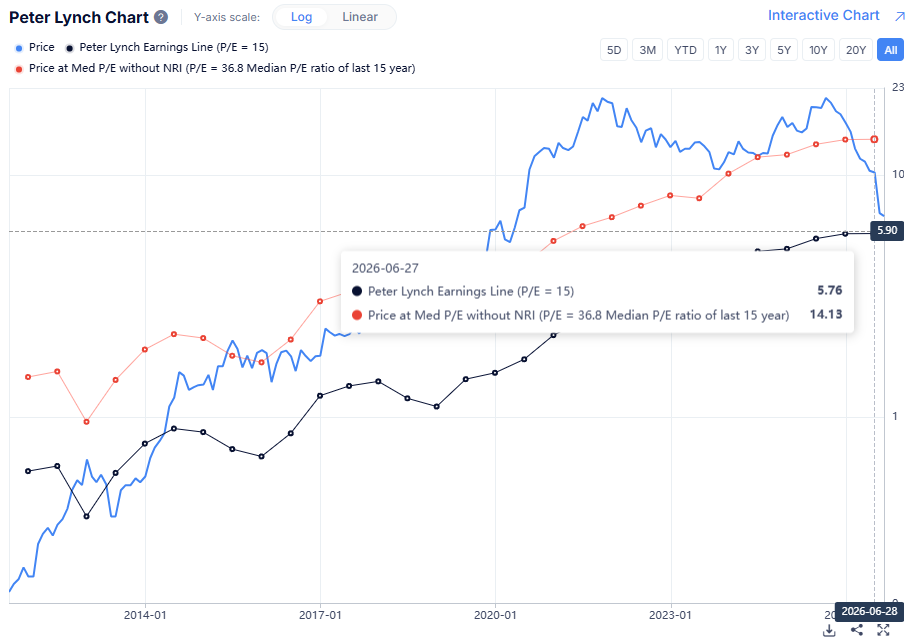
How to interpret the numbers? The above "margin of safety" rule should be applied according to your convictions, so if you really believe in the company, you can buy it at fair value, but if you proceed in 10% increments (whose convictions are strong), the math would look like this:
- 10% margin of safety: 9.95*0.9 = 8.96 AUD
- 20% margin of safety: 9.95*0.8 = 7.96 AUD
- 30% margin of safety: 9.95*0.7 = 6.97 AUD (we are here now)
- 40% margin of safety: 9.95*0.6 = 5.97 AUD
- 50% margin of safety: 9.95*0.5 = 4.98 AUD
Of course, the list could go on and on, but the point is that the right purchase price for you is determined by the level of your conviction. However, on paper we are already more than 30% below fair value, apparently. The problem is that if we also include the lost revenue from the aforementioned defense contract, then you get the following:
| Indicator | Current | Future presentation | Median |
|---|---|---|---|
| P / E | 17.2 | 24.0 | 51.02 |
| EV / EBITDA | 11.1 | 12.9 | 35.02 |
| P/FCF | 13.0 | 41.6 | 43.71 |
Objective Corporation still looks cheap compared to the median, but if you look at the forward-looking data, it's not so cheap. And the current numbers still include the expected revenue from the defense contract, since that was included in the annual estimate. So the numbers are very misleading, and if you look at the numbers above, they gave all kinds of prices between 5 and 16.52 AUD. That's more than a three-fold difference, so basically no one knows how much this company could be worth. And the management doesn't help with insider buying, essentially the founding owner already owns about two-thirds of the shares.
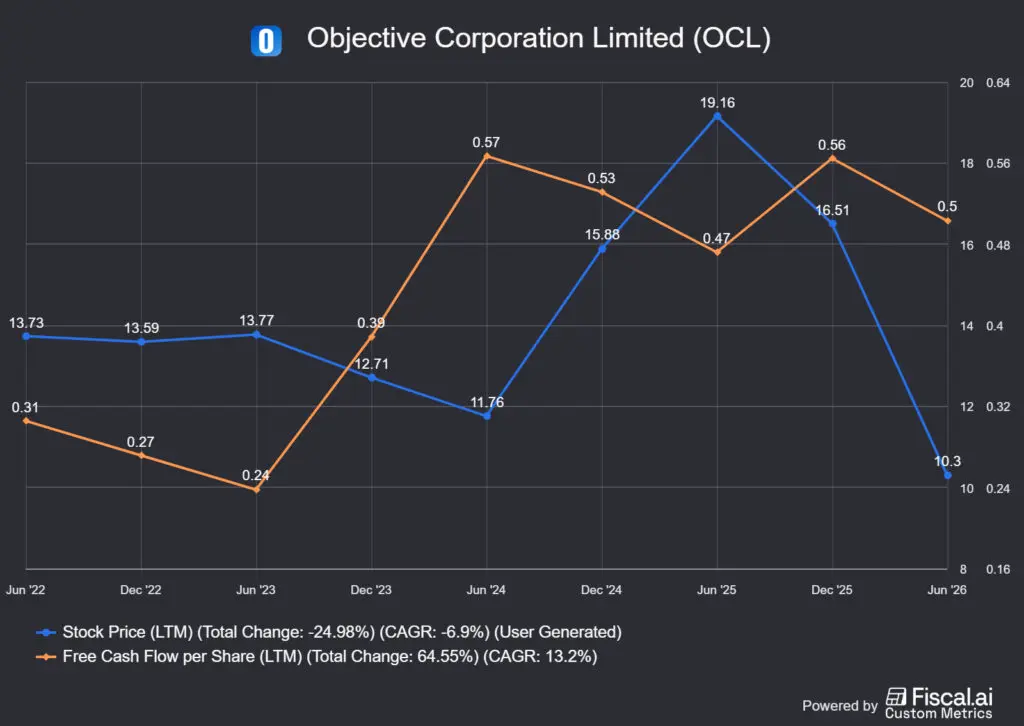
Let's then look at cash per share and mentally adjust the price to 6.8 AUD, as well as the FCF with the loss of the protection contract, then we get the following:
| Incremental margin | FCF loss | Adjusted FCF/share |
|---|---|---|
| 60 % | AUD 4.5 million | 0.453 AUD |
| 80 % | AUD 6.0 million | 0.437 AUD |
| 100 % | AUD 7.5 million | 0.422 AUD |
The above are strong estimates, the point is that there will be 0.42-0.45 free cash per share, at a share price of 6.8 AUD. The 70% drop is greatly exaggerated compared to the amount of pullback from the defense contract, so it still looks like mispricing. But it also highlights that the market does not really believe that Objective Corporation will return to growth. My other thesis is that weak hands simply threw away the paper, but since liquidity is low, they only found anyone willing to buy them at a very large discount. Don't forget that Tony Walls owns almost two-thirds of the company, and he did not sell, but he did not buy either. If he had wanted to signal to the market, he could have supported the price with a signal purchase of around 6 AUD.
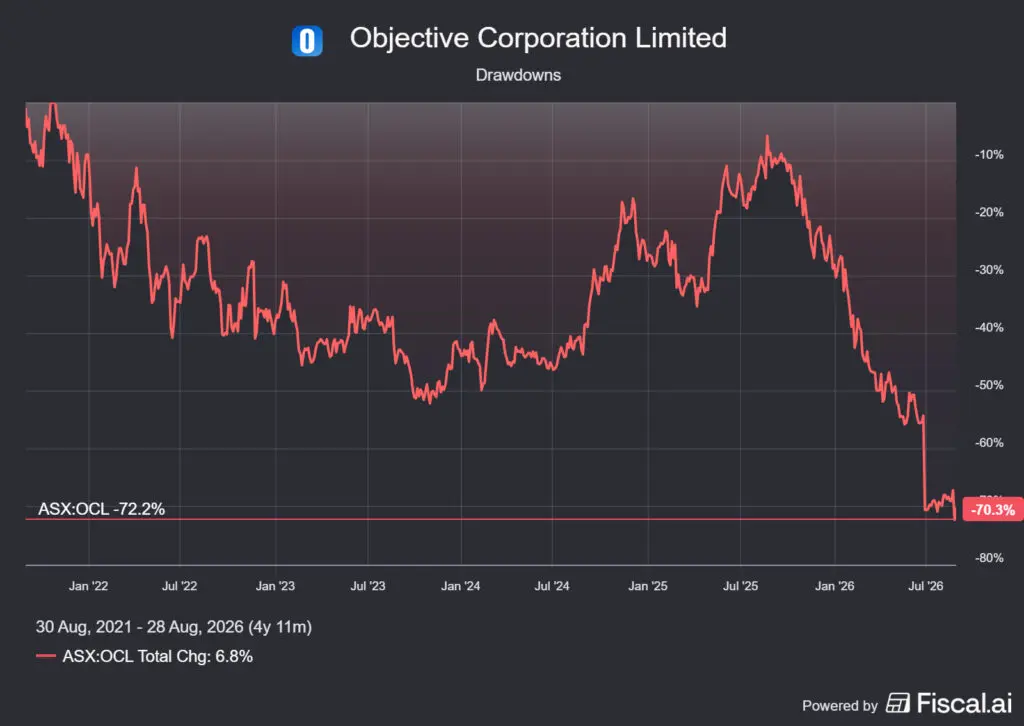
To summarize the above, I have not found a method that can meaningfully determine the fair value of Objective Corporation, one of the reasons for which is the lack of liquidity, and the fact that I do not know whether the loss of the defense industry support contract is a permanent problem or just a temporary disruption, or perhaps the beginning of a process. And no one likes too much uncertainty, so I will not take a position at this company.
Major news and the last quarter
In this section, I will examine what happened in the last quarter, whether there were any significant news/events. If the company reports semi-annually, we examined this period.
One of Objective Corporation's largest contracts has fallen through
Let's start with the most important event: the collapse of the Australian Department of Defense (DOD) support contract (USP). This does not mean the termination of the contract, there was supposedly a verbal agreement, but it was never made official, but the additional support contract was not signed. This means that out of the 140,000 ECM users served by Objective Corporation, about 55,000 were left without support, software and security patches, while OCL's estimated annual growth of 10-14%, or ARR, was neatly wiped out by the lost revenue.
The matter is relatively recent, the case broke out on 2026.06.30, as the contract was supposed to come into effect on 1 July, to which the share price responded with a significant drop. It is important that this does not affect the 2026 revenue, but the zeroing of the previously calculated growth, meaning that at that time they still thought that the expected revenue would be roughly the same as in 2025, if the parties could not reach an agreement. There are several interpretations of the matter:
- 💰opportunity to return to the negotiating table: The previous license was for the ECM 11 system, now there would be the opportunity to migrate to the newer SaaS software, Nexus. This would mean additional revenue and an immediate price correction, even sending the share price above previous levels.
- ????permanent loss: If the subsidy contract is not renewed, growth will remain flat through 2026, which is now reflected in the repricing.
- ⏳The signature is just delayed, but everything goes on: They sign the contract in accordance with the verbal agreement, but do not touch the basic system, the price increase is returned to the exchange rate.
What I don't think is very likely is that this will remain the case, as government organizations that store critical data such as weapons records or other sensitive data certainly cannot do without the USP contract in the long term. The big question is whether they want to migrate to another provider, or whether it's just the usual bureaucratic hoops and slow decision-making mechanism. If they really want to break the basic contract, it's not very likely that they would do it this way, especially not in such a floating form.
However, in the meantime, the full-year report came out on August 27th, and the market punished OCL with another 24% drop, dropping the price to AUD 6.4 (it has since corrected to AUD 6.8).
Financial Highlights — FY26 (Full Year)
- 💰 Income: AUD 135 million, +9% (FY25: AUD 120 million). The consensus was for AUD 136.4 million, which is slightly below. The growth was held back by two items: the impact of foreign exchange and the termination of a legacy contract with the National Heavy Vehicle Regulator (NHVR).
- 📊 Adjusted EBITDA: AUD 52 million, +11%, with a margin of 39%. So, cost discipline was in place, despite the management consciously expanding sales capacity.
- 💵 Operating cash flow: AUD 49 million. This is 94% of EBITDA, meaning cash generation is good, but no longer exceeds EBITDA as it did in FY25.
- (I.e. ARR: ~117 million AUD calculated from segment data, i.e. not only did it not grow, but it also slipped below the AUD 121 million in FY25. The company promised ARR roughly in line with FY25 at constant exchange rates; the reported figure is weaker due to currency effects. If we also deduct the discontinued NHVR business, we are left with AUD 114 million in ARR, a change of roughly -5%.
- (I.e. R&D: 34 million AUD, 30% of software revenue, 146 million AUD cumulatively over five years. Management did not cut R&D, this is a consistent decision, but due to accounting capitalization, the impact on the result is less than what goes out of cash flow (I wrote about this earlier).
- ☁️ SaaS revenue: +22%, and software revenue is now 100% subscription-based. The transition is complete.
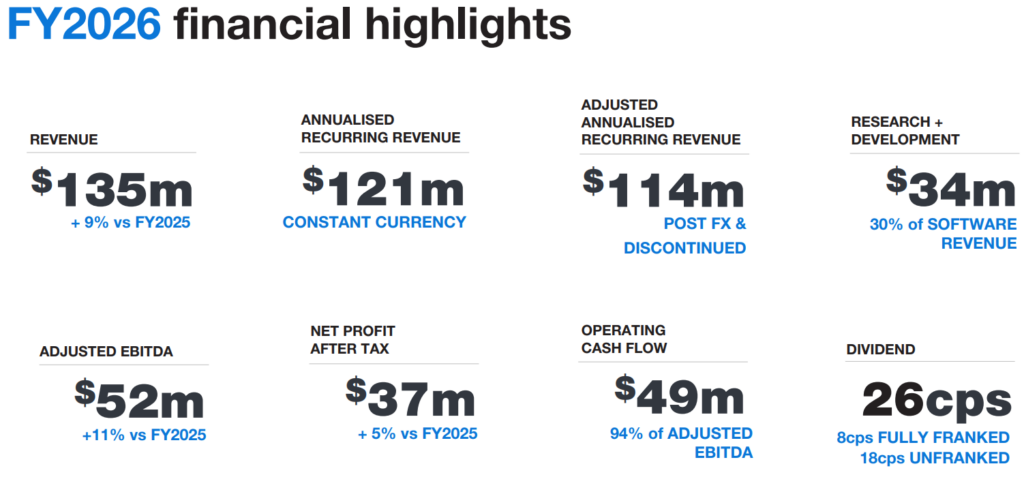
Fő tanulságok
- 🎯 Product maturity turning point: The company claims to have achieved “absolute product maturity” on its Nexus (the successor to ECM 11), Build and RegWorks platforms, positioning them as the desirable choice for the GovTech sector.
- ???? Strategic shift in sales: management has acknowledged historical underperformance in sales channels and is aggressively expanding go-to-market teams in Australia and the UK to better leverage its R&D investments.
- 🤖 AI integration: Instead of treating AI as an add-on, Objective has built it into the “core DNA” of its products, specifically using systems of record to deliver reliable and secure AI results to its government clients. This seems like a bit of bullshit to me, but it remains to be seen in the long run whether this will lead to any meaningful improvements in the use of the software.
- 🤝 M&A strategy: As private equity firms exit the sector, the company sees current valuations as attractive and intends to remain active in the acquisition market for growth. My experience in this regard is completely different, as I wrote in the Competitors section. Blackstone bought Civica in 2024, Long Path acquired Idox in May 2026, and Topicus made an offer for ReadyTech in the spring.
- 🛡️ Expansion in the defense sector: The company has created a dedicated team for the defense and national security space and is actively pursuing opportunities in the British market.
- Nexus transition: The migration of the ECM 11 system to the new Nexus has been underway for some time, and the revenue growth of existing USP contracts can be estimated at 1,5-2,5 times compared to the old system. Even a conversion of 24 million AUD could theoretically bring in 36-60 million AUD SaaS revenue. This could also be the basis for the bull thesis, as it will increase revenue.
- 📉Share buyback: For the first time in the life of Objective Corporation, a possible share buyback was discussed, but the management left the issue open, and no substantive steps have been taken yet.
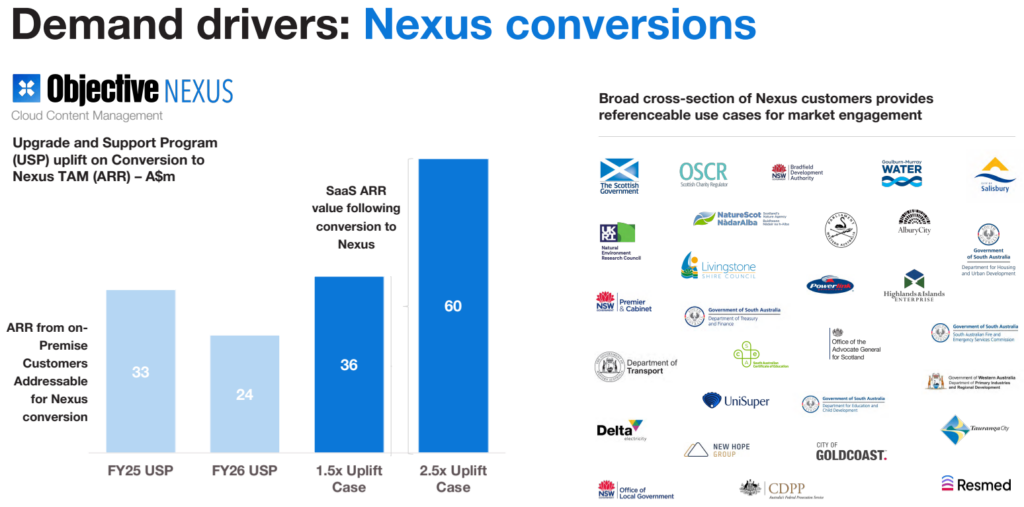
Future direction and operational goals
In the first half-year report for 2026, management also expected the following: Objective Corporation maintains its long-term ARR growth target of 15%, though it currently forecasts 10-14% at constant exchange rates. Management expects to maintain strong EBITDA margins while continuing to invest significantly in R&D, bucking the industry trend of developer layoffs and instead accelerating a three-year innovation roadmap with AI-powered coding tools. The company will focus on organic growth opportunities for the remainder of FY2026 and will take a cautious M&A approach until private market valuations align with current economic conditions.
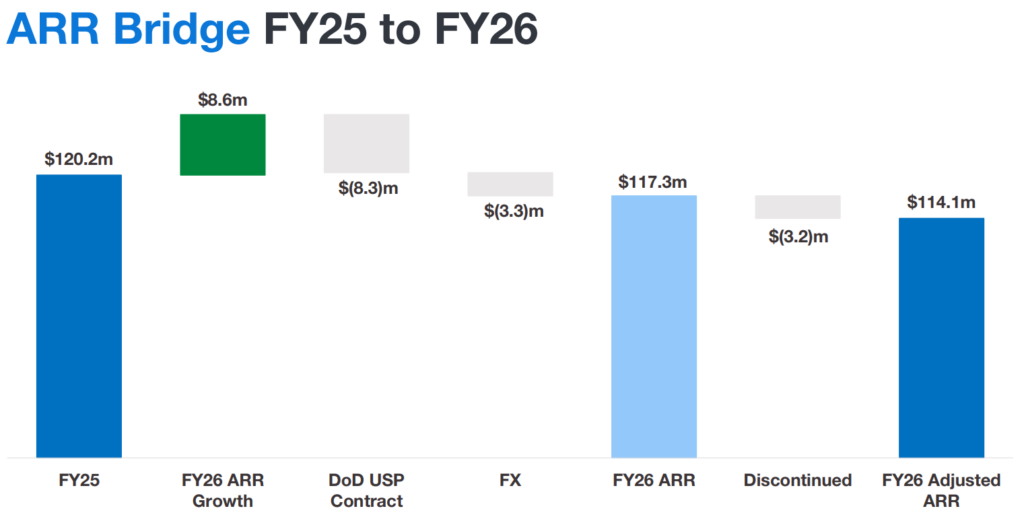
⚠️ Correction for the entire section (after FY26 report): the long-term growth target of 15% became irrelevant and the management also underestimated the 10-14% revenue loss from the loss of the contract. ARR did not remain flat, but decreased by 5% to AUD 114 million. For FY27, management already expects a profit floor: at least AUD 40 million adjusted EBITDA, compared to ~52 million in FY26, which is a decline of about 22%. The reason for this is not a decrease in revenue, but a conscious increase in costs: expanding sales capacity in Australia and the UK. Management's attitude towards acquisitions has changed: instead of H1 caution, they now see valuations as attractive.
📌In practice: while I was writing the analysis, the second half-year report came out, and the management narrative has changed dramatically, skeletons are starting to come out of the closet. I don't really like that because it can mean two things: either the management has no idea what to expect or they haven't told the truth. I suspect it's the former, since instead of a 15% increase, they managed to get a 5% decrease, which I think caught them by surprise.
This was mainly covered up with side conversations and panel puffing, not too many clues were given. However, the 5% minus compared to the 15% increase is not justified by the loss of the Ministry of Defense support contract, it is simply that the previously promised 10-14% increase was not achieved, since the 120 million AUD was increased by 8.6 million AUD (green bar in the picture), this is a 7.2% increase (3-7% below what was expected), and this resulted in the loss of the DOD USP contract, the currency effect and the exit of the NHVR business. This does not bode well for the future.
Summary of Objective Corporation (ASX:OCL)
Summary of the analysis, drawing lessons.
It's very rare that I'm quite uncertain about a company that's not in my portfolio, but Objective Corporation is exactly that. On paper, it's a great business built on a very strong and protected market, which has resulted in high margins, excellent ROIC and ROCE, at least so far. However, in the last two semesters, OCL has lost a key defense-related support contract and their growth has slowed down. One reason for this is that it's a highly regulated market, where it's hellishly difficult to enter, but the companies operating here are dependent on the state.
☝️The advantages that protect the company in Australia, such as the fact that domestic service providers are given priority by the state in the defense sector, hinder expansion in other markets.
Therefore, organic growth has slowed down, and Objective Corporation must necessarily turn to acquisitions in order to enter the markets of other countries. This requires a lot of cash, but the company's capital allocation can never be very good due to the very high founder ownership. Tony Walls, the CEO, owns nearly two-thirds of the shares, so it is in his interest to pay out free cash as dividends or increase its level. However, this fundamentally goes against my selection rules because it restrains organic growth and thus prevents the company from becoming a perpetual compounder.
Determining valuation is also problematic, as OCL's price has been hammered, making it look cheap, but there are not only sentimental but also fundamental reasons for this. The future is too hazy for me to take a position in this company, and I'm not sure the numbers won't continue to deteriorate. This is a pass for me, but the industry is still interesting, and there is another Australian player, Technology One (ASX:TNE), which is much larger, if you're interested, you should also look at that.
That's why I recommend the in-depth analyses so far, because I think there are companies with a better risk/return ratio there: In-depth analyses.
🤑If you are interested in what brokers we use, read our articles below:
(I.e.Interactive Brokers broker account analysis – Professional for professionals
📈LightYear Broker Account Analysis - Simplicity and cheapness go hand in hand
Frequently Asked Questions about Objective Corporation Stock
Would you buy Objective Corporation shares or just want to get a clear picture of the situation? Here you will find concise answers to the most frequently asked questions: what does the company do, why did the share price fall twice in 2026, what does losing the USP contract with the Department of Defense mean, what are its competitive advantages in the GovTech market, what does the founder's 64.81% ownership mean, and how cheap the stock really is now.
Click on any question and the answer will open. These are intentionally short summaries: if you are interested in the details, I will expand on them in more detail in the appropriate sections of the article. Important: Objective Corporation's position and valuation are changing rapidly, the data reflects the time of writing of the article.
What is Objective Corporation and what does the company do?
Objective Corporation (ASX:OCL) is an Australian software company based in Sydney, founded in 1987, specializing in content and records management and regulatory workflow software for the government and regulated industry sectors. Its customers include government departments, local governments, regulators and police forces in Australia, New Zealand and the United Kingdom. It operates through three business units: Information Intelligence (records management, the Objective Nexus platform), Planning & Building (building permits, Build and Trapeze) and Regulatory Solutions (the RegWorks regulatory platform). Revenue in the 2026 financial year was AUD 135 million, with software revenue now 100% subscription-based.
Where is Objective Corporation stock traded and when was its IPO?
Objective Corporation shares (ticker: OCL) are traded on the Australian Stock Exchange, ASX, where they debuted in July 2000 at a price of 50 cents. The company has not raised a single cent of fresh capital since then and has not taken on any significant debt, financing its growth entirely from its own cash flow. The stock peaked at around AUD 23 in September 2025, before falling to AUD 4.75 in the summer of 2026. The market capitalization is currently around AUD 600-650 million, which makes it an unusually small, illiquid stock for Hungarian investors.
Why did Objective Corporation's share price fall in 2026?
Two separate events. First, on June 30, 2026, the company announced that the Australian Department of Defense (DoD) would not renew its more than 25-year-old Upgrade and Support Program (USP) contract, which covered engineering support, security patches, and version updates for its Objective ECM 11 system, which has approximately 140,000 users. The stock fell 24%, as its ARR growth guidance of 10-14% became irrelevant.
The second time was on August 27, 2026, the day of the full-year report, when the share price fell another 18%. The closing ARR was not flat, but fell by 5% to AUD 114 million, and management only gave a profit floor for the 2027 financial year: at least AUD 40 million in adjusted EBITDA, compared to 52 million in 2026. This is a decline of about 22%.
What is a USP contract and why is it important for Objective Corporation?
USP is an abbreviation for Upgrade and Support Program: a maintenance contract that a customer sitting on an old, installed system (such as ECM 11) pays for engineering support, security patches, and version updates. It is not a migration contract, but rather keeping the legacy system alive, and its revenue grows by barely 2% annually, according to the company's own data.
The transition to a more modern system is a separate event, which the company calls an uplift. According to management, when a USP customer is upgraded to Nexus, the new subscription is 1.5-2.5 times the previous contract, and there is still AUD 24 million in USP revenue waiting to be converted by 2027. This would theoretically mean AUD 36-60 million in SaaS revenue, which is the numerical basis for the bull thesis.
What competitive advantages does Objective Corporation have?
Morningstar rates the company as narrow, which is roughly in line with my own assessment. The strongest layer is the switching cost: a government client has decades of records, millions of documents, and different retention policies per agency, so the switch is not measured in money, but in risk. The second layer is the sovereign, security-certified position: In Australia, there is a political and national security premium for a government data management system to be domestically developed.
But the thing is symmetrical. The same entry barrier that protects the company at home works against it across borders: in the UK and the US, Objective itself is the new entrant, and the sovereignty advantage cannot be exported.
Who are Objective Corporation's main competitors?
There are four serious rivals. Technology One (ASX:TNE) is the most dangerous: with five times revenue, a 91% recurring revenue ratio and a 50-55% Australian market share in government ERP, plus its local government vertical added AUD 39.4 million ARR in a single year, more than double Objective's entire Planning & Building segment. ReadyTech Holdings (ASX:RDY) is more of a control group than a threat: with similar revenue but losses and a goodwill write-down. Idox plc is an incumbent in the UK planning market, and Civica is present in both the ANZ region and the UK.
The pattern is telling: Idox was taken private by Long Path Partners in May 2026, Civica was bought by Blackstone in 2024, and ReadyTech was offered by Topicus. The sector is being consolidated worldwide, but Objective is structurally excluded due to Walls' ownership stake.
What does Tony Walls' 64.81% ownership mean for minority shareholders?
The founder-CEO holds 62 million shares through TBW Trustees Limited, which is enough to pass all ordinary general meeting resolutions alone. The minority only has a say in special resolutions subject to a 75% threshold. This is a double-edged sword: the founder’s exposure is the strongest vested interest signal an investor can get, but there is no mechanism to replace him in the event of operational failure, and the minority’s only protection in the event of a liquidation is a three-member board, one of which has previously been the company’s chief operating officer for five years.
The practical consequence is that the auction that showed how much the company is worth in the eyes of a professional buyer in the case of ReadyTech or Idox cannot be launched at Objective.
What is the valuation and fair value of Objective Corporation?
The average of six different valuation methods gives a fair value of AUD 9.95, which would be roughly a 30% safety margin compared to the current exchange rate. However, the variance is huge: Morningstar indicates AUD 6, Simply Wall St AUD 5.33, GuruFocus AUD 16.52. This is more than a three-fold difference, so no one can meaningfully determine the fair value.
Furthermore, the backward-looking indicators (P/E 17.2, EV/EBITDA 11.1, P/FCF 13) still include the defense contract revenue, while the forward-looking ones do not: P/FCF jumps from 13 to 41.6. Added to this is the IFRS capitalization bias, which pushes the reported profit upwards, so the adjusted P/E rises from 18 to close to 27.
Does Objective Corporation pay dividends and what is franking?
Yes, it paid 26 cents per share for fiscal year 2026, an 18% increase from the previous year, with a yield of about 3.8%. What's interesting about the increase is that it came in a year of declining ARR, after two lost contracts.
Franking is the Australian tax credit system: if a company has paid the 30% corporation tax on its profits, the shareholder receives a credit in addition to the dividend, which can be included in their own tax. Objective's dividends have typically been paid without franking since 2022, probably because part of the profits are taxed abroad and the franking account has been exhausted. As a Hungarian investor, the credit would not be available anyway, but withholding tax can be deducted on unfranked dividends, at a rate of 15% according to the tax treaty.