
🤔 What is the Market Momentum column about? 🤔
Visa and Mastercard stock prices have taken a tumble. If there is one company that deserves the label “inevitable,” it is Visa and Mastercard, but now their momentum seems to be breaking, as for the first time in many years there are technological solutions to COMPLETELY bypass their networks. This means that these companies will lose a large part of their revenue, which is what this article will discuss.
I don't know if you're aware of this, but a thorough fundamental in-depth analysis can take 40-50 hours. As an investor, it's impossible to put that much energy into analyzing each company if you want to effectively manage a long enough watch list. That's why I created the Market Impulse column, which provides a snapshot of each stock, currently the twin pair of payment networks, Visa and Mastercard, and roughly outlines the current events. It is not an in-depth analysis, but rather just food for thought based on the current state.
My goal is not to give daily trading tips or analyze technical patterns. Instead, I provide quick, to-the-point fundamental mini-analyses that help you filter.
You can find the share subpage with detailed information here: The Mastercard stock page
You can find the share subpage with detailed information here: The Visa stock page
If you are looking for in-depth analyses of the site, click on the link below: iO Charts stock analyses
📒 Table of Contents 📒
- 💳 What do Visa (V) and Mastercard (MA) do?
- 🏆 The current state and challenges of the payment duopoly
- 🔥 Can the moat be disrupted? The big question
- 🎢 Visa and Mastercard metrics
- ✅ Visa / Mastercard: will you get used to it or will you run away?
- 📝 Thesis summary
❓ What do Visa (V) and Mastercard (MA) do? ❓
Visa and Mastercard operate the world's largest payment infrastructure. The history of their founding closely links the two companies: Mastercard was actually created in 1966 to counter the growing market power of Visa. The banks that Visa's predecessor (BankAmericard) rejected joined forces to form the rival, ironically creating the duopoly that today forms the backbone of transaction traffic around the world.
The business models of the two companies are almost identical, which is why it is worth analyzing them simultaneously. Neither Visa nor Mastercard grant loans, manage bank accounts, or bear credit risk. What they do: act as technical and financial intermediaries for transactions between the card issuer, the merchant's bank, and the store. Therefore, they charge a small fee for each card payment, which is the network fee. The essence of the business model is therefore: They are toll collectors, not commercial banks, and they also call this business model the toll-bridge or tollbooth model.
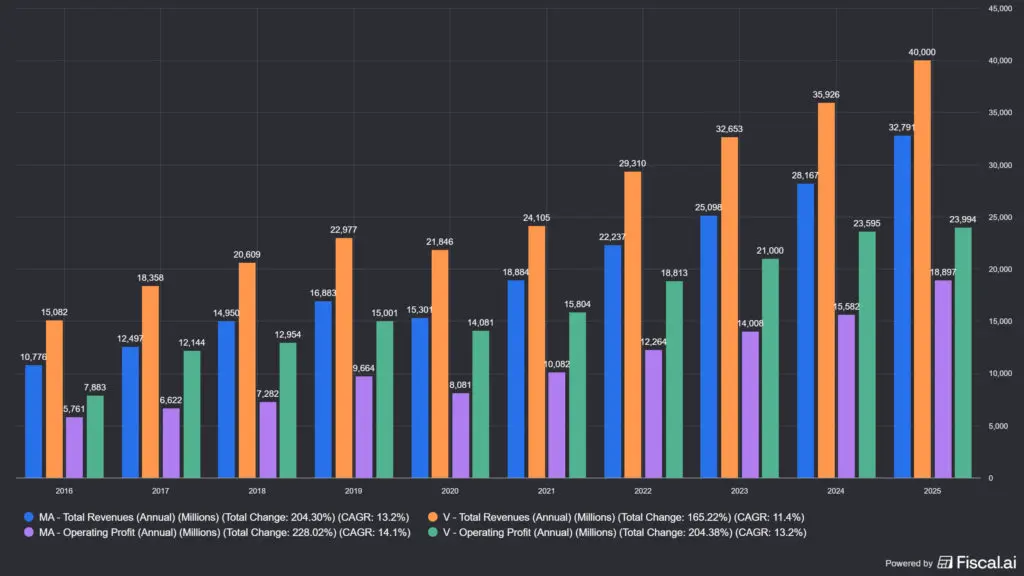
The business model is built on three pillars. The first is transaction revenue: they receive a small percentage for every payment transaction. Visa currently handles approximately USD 17000 trillion in payment volume per year, Mastercard nearly USD 10000 trillion, but the service providers only take a very small portion of this. The second pillar is value-added services (fraud protection, tokenization, analytics, B2B payment solutions): Visa generated USD 17,5 billion of this in 2025, which is about 44% of total revenue. The third pillar is cross-border transactions: when tourists, online shoppers and companies pay with foreign cards, the network charges higher fees, a segment that is structurally growing, especially with the globalization of e-commerce.
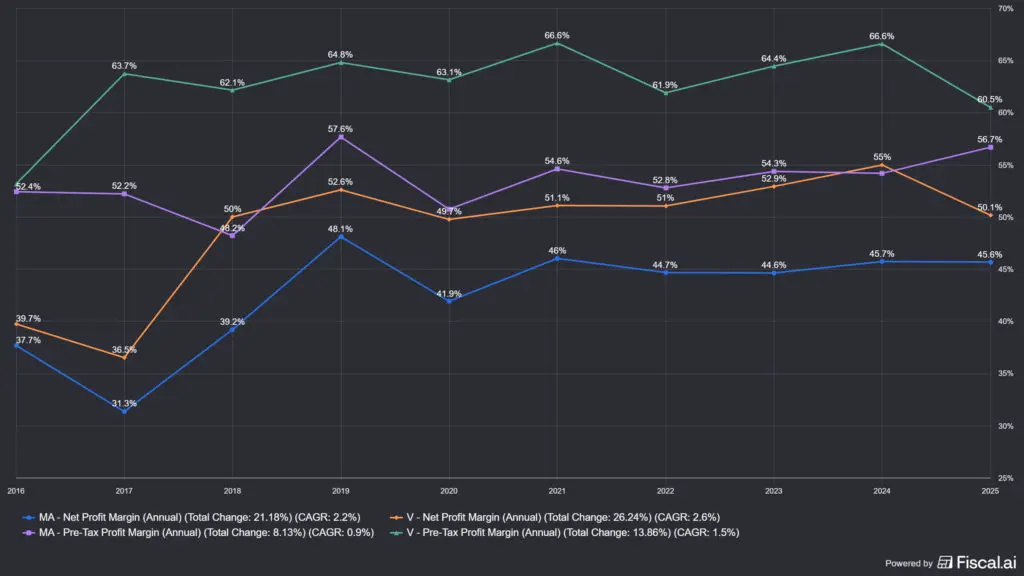
📌 In practice: What I like about these two business models is that what many people think of as a “financial company” is actually a technology infrastructure operator, where incremental transactions flow through the system at almost zero marginal cost, meaning they are incredibly easy to scale. This is what investors call the “tollbooth” model, and it is this characteristic that is responsible for net margins of over 50%. There are not many business models in the world that are as efficient, but it may not be sustainable, as you will see below.
🏆 The current state of the payment duopoly and its challengers 🏆
Visa and Mastercard together control approximately 90% of the world's card payment transactions., outside of China. This is an oligopoly in which competition does not cause price erosion, but rather the opposite: both networks have steadily raised their rates over decades. The classic two-sided platform logic applies: the more merchants accept Visa/Mastercard, the more valuable the card is to the consumer, and the more consumers carry their cards, the more obligated every merchant is to accept them. This self-exciting flywheel effect has become almost unstoppable over four decades.
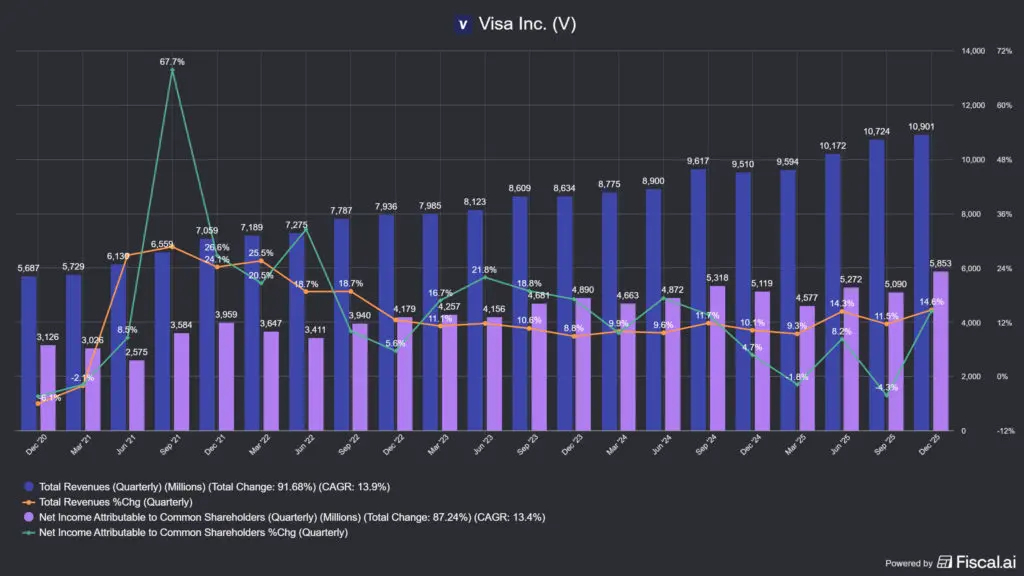
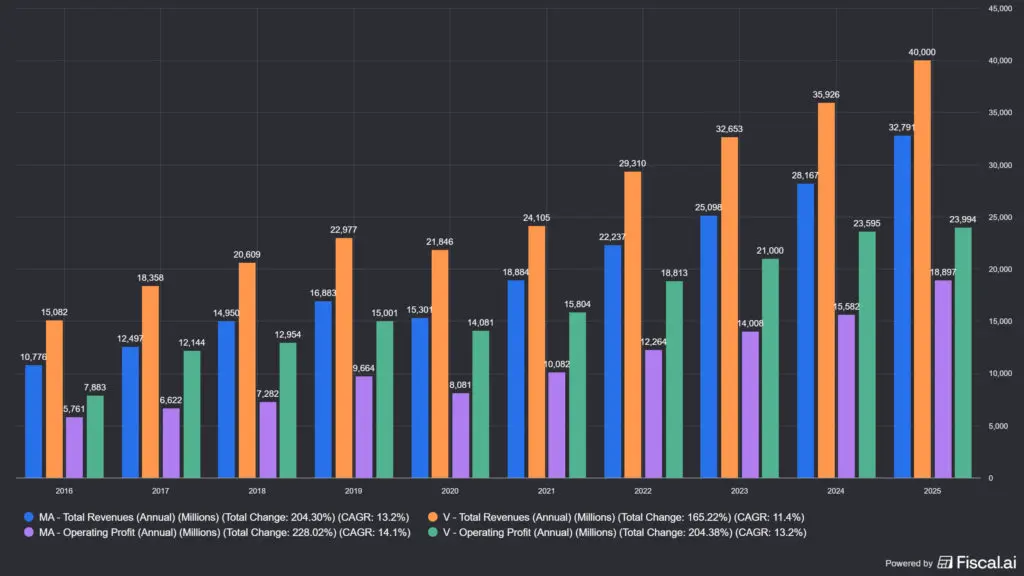
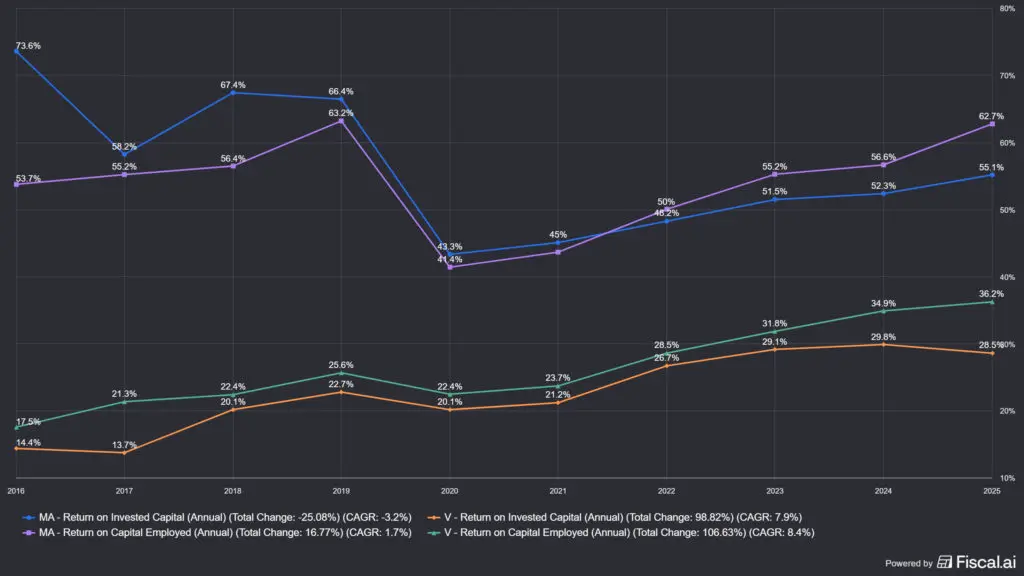
Recent financial results support this narrative. Visa generated revenue of $10.9 billion in the first fiscal quarter of 2026, a 14.6% year-over-year increase, and earnings per share rose by 15-17%. Mastercard also shows strong margins: operating margin is around 59%, revenue growth was 16.4% year-on-year in the last quarter, but in fact, the numbers are brutal no matter what time frame we look at them. The gross margins, ROIC metrics, and free cash flow generation of the two companies are considered outstanding on any stock exchange in the world.
From the perspective of the challengers, it is worth considering the nuances. Apple Pay, Google Pay and Samsung Pay are not technological competitors, but customers: most digital wallets are powered by Visa and Mastercard infrastructure. PayPal and Venmo are in similar shoes, dependent on card networks. Stripe handled $1900 trillion in transactions in 2025, which is a significant amount, but Stripe itself runs on Visa/Mastercard systems and is increasingly positioning itself as a partner, not a challenger. In fact, Stripe itself is investing in maintaining the Visa connection, rather than replacing it. This clearly shows that Visa/Mastercard is not an enemy for the majority of fintech companies, but rather an indispensable infrastructure provider.
Where there is a real competitive challenge, the example of India and Brazil. India’s UPI system handles over 13 billion instant transactions per month, about 71% of all real-time transactions worldwide, and the local RuPay network already handles 28% of card purchases. This is a working example of how a determined government infrastructure development can create a real alternative. The question is whether this model can be exported to developed economies. What the European Union has done is much more interesting, and this is nothing more than a SEPA-based intraday transfer solution that bypasses the Visa and Mastercard systems. There is also an excellent summary video about this that is worth watching:
📌In practice: the Indian example above is not a unique case. The Netherlands also has such a system, but in China, for example, Alibaba-owned Alipay (BABA) and Tencent's (TCEHY) WeChat-based payment solutions do not go through Visa and Mastercard's systems either. Moreover, these are not bank card-based systems, but use QR codes for payment, but PayPal, for example, also has a PYUSD-based system. This is nothing more than a stablecoin and uses the blockchain to handle the crediting of transactions, I wrote more about this in my analysis of PayPal (PYPL):
So the bottom line is that there are a lot of people working to displace the V and MA systems, which obviously doesn't help keep Visa and Mastercard stock prices high.

🔥 The big question: can Visa and Mastercard's economic competitive advantage be broken?🔥
This is the point that the video accompanying the analysis also asks: Does the Visa/Mastercard moat have an Achilles heel? Let's look at the most important disruption scenarios and be honest about the chances.
🪙Visa and Mastercard disruption: stablecoins and blockchain-based payments
This is the most talked-about topic right now. The amount of money moving through stablecoins is estimated to be between $28 trillion and $33000 trillion by 2025, a 72% year-on-year increase, which on paper is explosive expansion. Blockchain-based settlement can indeed be faster and cheaper in cross-border B2B transactions, the remittance market, and peer-to-peer transfers.
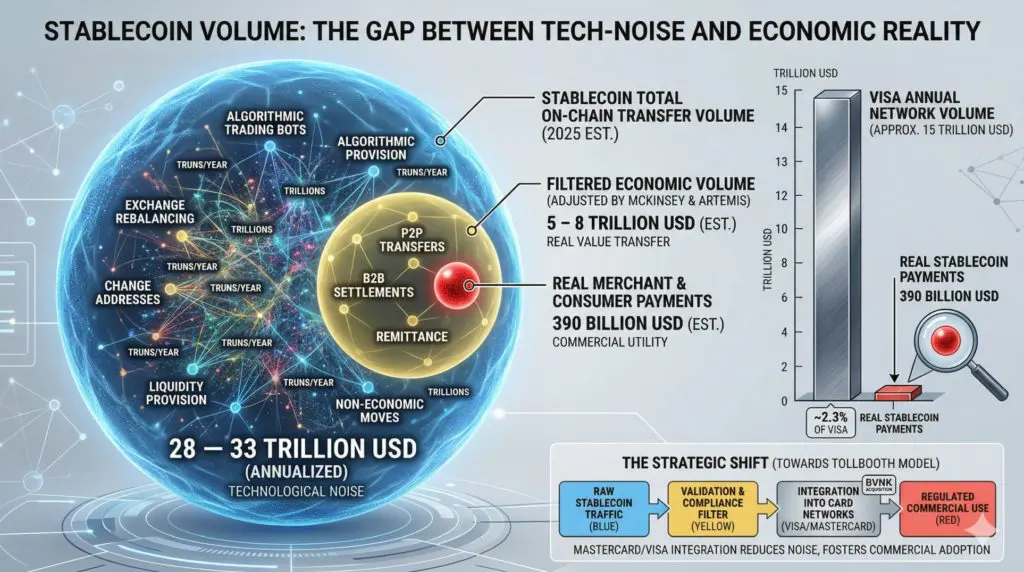
However, the reality is more nuanced. According to McKinsey and Artemis, the actual stablecoin-based payment volume (between merchants and consumers) is about $390 billion per year, which is only ~2,3% of Visa’s annual turnover. 90% of stablecoin turnover is currently trading between cryptocurrencies, not general-purpose payment instruments. These are very often bot-to-bot transactions, because if you just move money between addresses, it actually multiplies. There is no purchase behind it, and therefore no economic performance. According to the vice president of financial products at Mastercard: the attributes alone are not enough to make a stablecoin a general-purpose payment instrument. Meanwhile, Mastercard has acquired stablecoin infrastructure company BVNK for $1,8 billion, and Visa has already launched USDC-based settlement and achieved an annualized run rate of $4,6 billion.
So the lesson is: stablecoins don't break down the gate from the outside, but Visa and Mastercard open them themselves and integrate them into their own infrastructure. They did exactly the same with contactless payments (which was also helped by the spread of NFC-equipped phones), tokenization, and e-commerce. They didn't break every technological wave, they assimilated it.
💳 Government instant payment systems (RTP, UPI, FedNow, PIX)
I think this challenge is more serious and more lasting than the stablecoin narrative. India and Brazil (PIX) have shown that where the state is determined, it is possible to build its own payment infrastructure. The US FedNow system has been live since 2023, but acceptance is limited for now. The European EPI (European Payments Initiative) is also trying, but progress is slow. The biggest threat, then, is not crypto, but sovereign governments that have the political will and resources to build their own networks. The example of India is a warning: there, Visa/Mastercard's market share in digital payments fell from 43% (2018) to 21% (2024). In other words, regulators are more powerful than multinationals and can regulate anyone with the government's will.
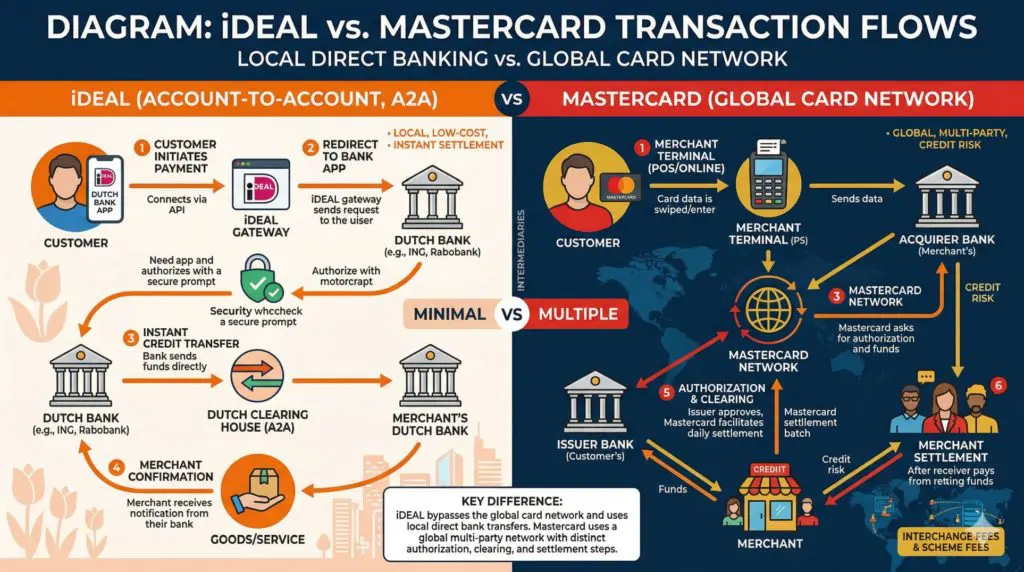
A good example of the above is the Dutch iDEAL, which is an account-to-account (A2A), i.e. an instant payment system that does not run through the Visa and Mastercard systems. There is no card number, no need to enter a 16-digit number when making a transfer, the user just selects their bank in the app and that's it, so you can save 1-3% by using the system. The system worked so well that it will become the basis of the European Payment System (EPI), called Wero. It is true that it took 20 years for iDEAL to reach the point where more than 70% of payments go through their system. In Hungary, the QVIK system is similar, which uses the GIRO and MNB systems.
🤵AI-based autonomous trading and agentic payments
This is the latest narrative: as AI agents complete more transactions without human intervention, the question of “who has the card” will become less relevant. According to Morgan Stanley, agent-driven online shopping could grow to a $385 billion market in the US by 2030. If AI agents prefer stablecoin or blockchain-based micropayments, it could actually bypass card networks. However, both Visa and Mastercard are actively involved in agent payments consortia., and their pre-screening, fraud prevention and identity verification capabilities are most essential for machine transactions.
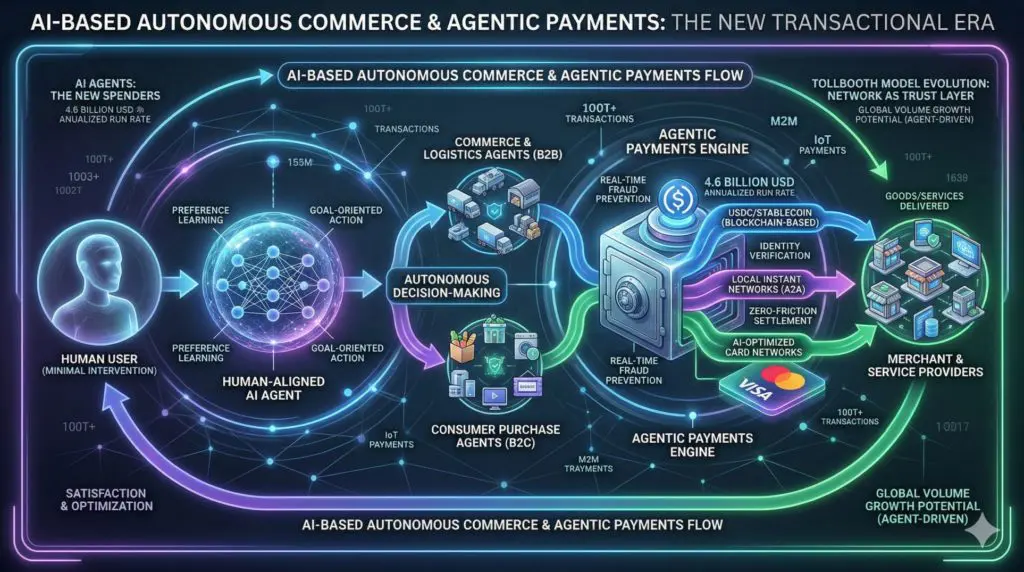
In summary: the moat is not invulnerable, but the source of disruption is not the fintech startup, but the sovereign state. Stablecoins and AI trading are more of an opportunity than a threat for Visa/Mastercard, as they have been for every technological revolution so far. The only scenario that is fundamentally dangerous is if major economies (EU, US, Japan) decide to build their own closed payment systems, following the example of India. There is currently no political will for this, but the risk needs to be managed in the investor thesis.
📌In practice: the political will is mostly in the EU to break this monopoly, and in fact everything is ready for this to happen in Europe of 580 million. There is a ready-made Dutch system, the regulations are in place, the system just needs to be spread. The big question is how long it will take to replace the bank cards people have, how much inertia the technology has, how V and MA will participate in this space, and, perhaps most importantly: how will these processes affect the share price of Visa and Mastercard in the long term?

🎢 Visa and Mastercard stock metrics 🎢
| Indicator | Visa (V) | Mastercard (MA) |
|---|---|---|
| Market capitalization | ~580 billion USD | ~443 billion USD |
| Annual revenue (2025) | ~41 billion USD | ~33 billion USD |
| Net margin | Up to 50% | Up to 45% |
| Operating margin | Up to 60% | Up to 58% |
| P/E (TTM, April 2026) | ~28x | ~30x |
| Forward P/E | ~22.4x | ~24.6x |
| 5-year historical P/E average | ~32x | ~38x |
| ROIC (excluding goodwill) | >90% | >80% |
| Annual EPS growth expectation (2026) | ~12–14% | ~15–16% |
| Dividend yield | Up to 0.8% | Up to 0.6% |
| Annual payment volume | ~17000 billion | ~10000 trillion USD |
| Number of reception places | >150 million | >100 million |
What is immediately apparent: Both stocks are currently trading at a discount to their historical P/E. Visa’s current TTM P/E of ~28x is 16% below its 10-year historical average (~34x), while Mastercard’s ~30x is well below its 5-year average of ~38x. This is partly due to the stablecoin scare and partly to the Trump administration’s proposed interest rate cap (10% lending rate cap), which have pulled prices down 18–19% from their highs.
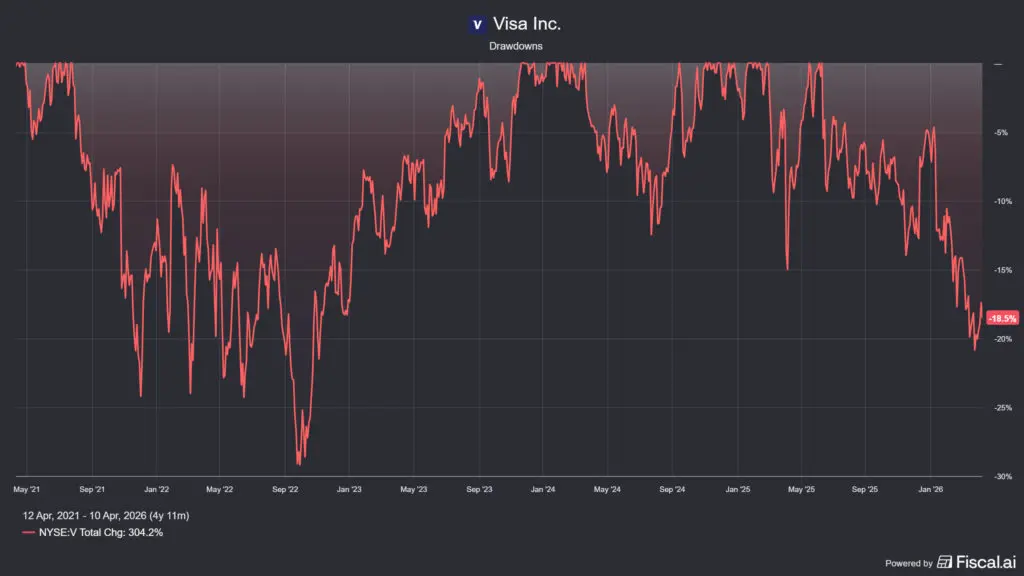
Free cash flow generation is outstanding: Visa's $18+ billion share repurchase program through 2025, Mastercard's $3,3 billion quarterly buybacks indicate that these companies are truly free cash flow-generating, non-CAPEX-intensive machines. Return on invested capital, excluding goodwill, exceeds 90%, a figure typical of a tollbooth model, not a traditional financial institution.
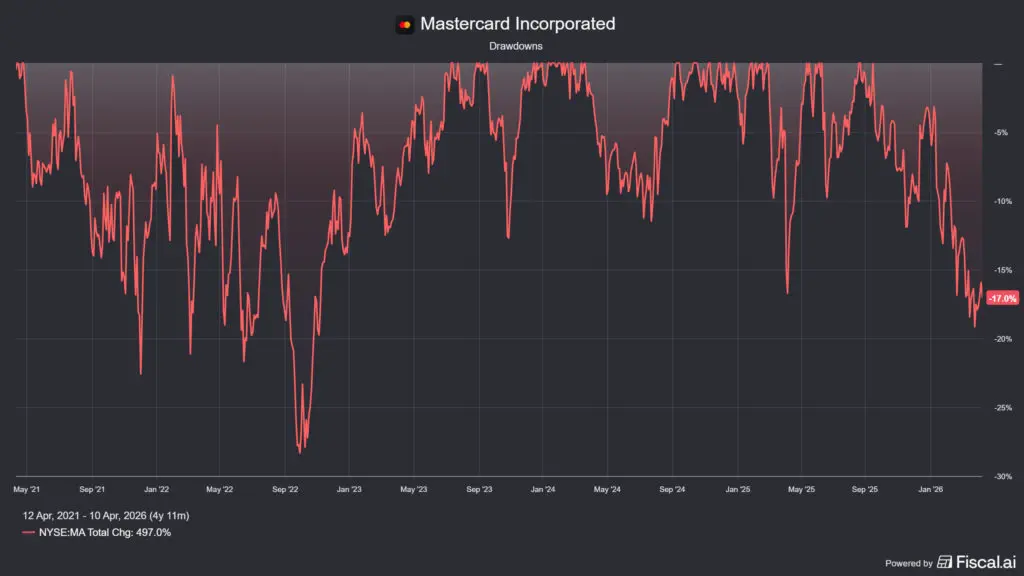
📌 In practice: I find it remarkable that Buffett (Berkshire Hathaway) holds both companies, with a total position size of 4,9 billion USD, meaning Warren is not too concerned about the stock prices of Visa and Mastercard going to crash. It is not relevant when he bought them, but why he did not sell them. The stocks in Berkshire's portfolio usually end up in BRK's portfolio because the economic competitive advantage is long-lasting, so there is no need to rush, but it is worth following the companies.

✅ Visa/Mastercard stock: will you get used to it or will you run away? ✅
What speaks for them 🟢
- 🛞The flywheel deepens itself. Every new merchant gives the consumer a multi-use card, every new cardholder means a more valuable network for the merchant. This spiral cannot be replicated with advertising campaigns or price cuts, it is built over decades, and that is why it is almost impossible to replicate.
- 💻Technological adaptation is proven. From magnetic stripe to chip card to contactless payments, digital wallet integration and now stablecoin settlement, they have been there for every change, not standing aside. This is no coincidence: their infrastructure is flexible and their capital is enough to acquire what they cannot build in-house (see Mastercard-BVNK acquisition, for $1,8 billion).
- 💎Value-added services diversify revenue. The revenue mix is increasingly shifting from pure transaction fees to data analytics, fraud protection, tokenization, and identity verification. These are SaaS-like, hard-to-substitute services with high margins and sticky margins.
- (I.e.The current valuation offers a historically attractive entry point. If 10–15% annual EPS growth can be sustained (this is the consensus), then at the current forward P/E level of ~23–26x, the reinvestment risk can be considered low.
What is worrying 🔴
- (I.e.Sovereign risk is underestimated. India and Brazil have already shown that card networks can be replaced with strong government will. If the EU can actually build its own unified instant payments system (the EPI project is still in limbo, but political pressure is growing), it could cause significant market share losses in the long term.
- (I.e.Regulatory threat is structural. The pressure on interchange fees in the US and Europe is persistent. The latest concern is Trump's credit card interest rate cap (10%), which, although primarily affecting issuing banks, may indirectly reduce card usage (reduction of incentive programs, etc.).
- 🪙The impact of stablecoins and agentic payments is currently unknown. The current penetration of ~2,3% is small, but if Citi’s estimate of $100000 trillion in stablecoin transactions by 2030 were to materialize, that would be more than six times Visa’s annual turnover. This scenario is unlikely to happen, but it cannot be ruled out.
- 💯High appreciation demands priced perfection. At ~28–30x P/E, any slowdown in revenue (e.g. if US consumer spending declines in a recession) could cause a sharp price drop in the short term.
📌In practice: whatever you think about the above, it seems that many are starting to hammer the nails into the coffin of the former duopolistic market, which will certainly bring down the share prices of Visa and Mastercard. These scenarios do not have to actually come true, it is enough for the market to panic a lot about them, as you could see with the AI para.
📝 Thesis summary 📝
Visa and Mastercard are the purest fee-collecting business models available on the exchange. They do not grant loans, bear credit risk, or manufacture physical products, but merely operate the infrastructure through which the vast majority of the world's money flows. The economic competitive advantage associated with this is the two-way network effect, the decades-old web of banking relationships, the global acceptor base, and the ever-deepening value-added service package, which is probably one of the most enduring competitive advantages that a listed company can experience, or at least has had so far.
The question is how real the previously listed disruptive effects are. Stablecoins, AI trading and instant payment systems will not destroy card networks, but will transform their position. For now, Visa and Mastercard have the infrastructure layer, and most alternatives also run through their systems. The only real long-term risk is sovereign state intervention, which could appear in other major economies, following the example of India and Brazil, and the EU has been specifically striving for it for some time.
In terms of evaluation The current historical discount (both stocks trade 15-20% below their long-term average P/E) could make the entry level attractive for those who think in a 5-10 year time horizon and accept that the disruption risk exists but seems manageable. Visa is somewhat better valued (lower P/E, higher margin, higher free cash flow yield), but Mastercard is on a faster EPS growth trajectory. But it's certain that this is not a beaten category yet, the share prices of Visa and Mastercard are holding up surprisingly well, so if I were you, I would definitely take a contemplative stance and do nothing for now.
If you want to analyze further, use iO Charts' stock finder and portfolio manager, which you can access here: iO Charts.
Frequently Asked Questions: Professional questions about Visa and Mastercard
Why are Visa and Mastercard shares considered a “toll-bridge” business model?
The companies behind Visa stock and Mastercard stock actually operate technology networks that connect banks, merchants, and consumers. Because they don't lend money but charge a fixed or percentage fee for transactions, they are like operators of a toll bridge: everyone who wants to cross the global payments infrastructure is forced to pay them a toll, while the companies have almost zero incremental cost of processing another transaction.
Do stablecoins pose a real threat to the exchange rate of card companies?
Although the turnover of stablecoins on paper already reaches the order of billions of USD, the vast majority of this is technical crypto trading, and only a tiny part (about 2.3%) is real consumer payments. The fundamentals of Mastercard stock and Visa stock will not be shaken by this technology in the short term, and in fact, both giants are actively integrating blockchain settlement (e.g. USDC) into their own networks, so stablecoins may become another, more efficient “rail” in their hands, rather than an external disruptor.
What impact could the European Wero system have on the market position of Visa and Mastercard?
Europe's Wero (formerly iDEAL) is an account-to-account (A2A) instant payment solution that completely bypasses international card networks, offering merchants significant cost savings. If this model spreads across Europe, it could capture significant market share in transaction volume, posing a long-term growth risk and putting pressure on the historically high profit margins of Visa and Mastercard shares on the continent.
Why does Warren Buffett still hold both payments giants in his portfolio?
Buffett likes the combination of Mastercard and Visa because both companies have incredible network effects (moats) and it is almost impossible for a new competitor to copy their infrastructure on a global scale. Their return on invested capital (ROIC) is one of the highest in the world, and because their revenues grow in proportion to transaction value, they also have a natural hedge against inflation, which fits perfectly with Berkshire Hathaway's long-term value-based strategy.
Will the Trump administration's interest rate cap proposal affect card networks' revenue?
Although the 10% cap proposal would primarily hit card-issuing banks, it could also indirectly negatively impact the trading volume of Visa and Mastercard shares if banks cut back on loyalty programs and card incentives. However, it is important to emphasize that network operators themselves do not charge interest, so the regulation does not cause them to lose direct revenue, and market panic often triggers an exaggerated reaction in their share prices.
Legal and liability statement (aka. disclaimer): My articles contain personal opinions, I write them solely for my own entertainment and that of my readers. The articles published here do NOT in any way exhaust the scope of investment advice. I have never intended, do not intend, and am unlikely to provide such in the future. What is written here is for informational purposes only and should NOT be construed as an offer. The expression of opinion is NOT in any way considered a guarantee to sell or buy financial instruments. You are SOLELY responsible for the decisions you make, and no one else, including me, assumes the risk.