

Introducing the XTB broker
XTB's analysis reflects the status as of April 2026.
XTB – whose name is a combination of the names X-Trade Broker – was founded in 2002 by Jakub Zabłocki in Warsaw, As the first leveraged forex broker in Poland. The company has since grown into one of the largest listed FX and CFD brokers in Europe, and has been listed on the Warsaw Stock Exchange (WSE) since 2016. Under XTB tickerThis is a key difference compared to Lightyear or Revolut: XTB is a public company, its financial data is accessible to anyone, which in itself means a more serious institutional background.
XTB had 2.16 million clients globally by the end of 2025, of which 1.19 million were active clients, which represents one of the best growth rates among players in the sector. It acquired 864,000 new customers in 2025, compared to 498,000 in 2024. Assets under management are around 7 billion USD, which places the provider between Revolut (8.5 billion) and Lightyear (1 billion) in the brokerage ranking.
The company's original DNA is CFD trading, and this is still clearly visible in the interface and product structure today. The big turn came in 2025: XTB moved its headquarters from Cyprus to Poland and launched real stock and ETF trading (OMI, or Organized Market Instruments), where the client is the real owner of the assets. This is one of the most important developments in the history of XTB and has fundamentally changed the perception of the product. Previously, stocks and ETFs were only available in the form of CFDs, now real stock custody is also available.
As for business performance, in 2025 XTB's revenue increased to PLN 2.15 billion (+14.6%), but net profit decreased by 24.8% to PLN 644 million. This is due to aggressive marketing spending: marketing expenses jumped to PLN 584.9 million (in 2024 it was only PLN 344.8 million). Ibrahimović, Tyson Fury and Mourinho sponsorships are not cheap. This type of marketing focus is a classic customer acquisition strategy that is worth keeping an eye on, but for now the company is still profitable.
TL;DR Summary – the most important information in 3 minutes Don't want to read the entire analysis? Click here for a short summary.
- What is this company?XTB is a Polish brokerage firm founded in 2002 and listed on the Warsaw Stock Exchange. It is one of the largest regulated providers in Europe, with over 2.16 million clients. It has public financial data and a strong institutional background.
- Trading DNAOriginally a CFD and Forex-focused platform, real stocks and ETFs (OMI) will be available from 2025. Its professional desktop platform (xStation 5) is one of the most intuitive on the market, with plenty of technical analysis tools and built-in stock filters.
- broker9300+ real stocks and 500+ ETFs available. The interface is dual: it serves both active speculators (leveraged CFDs) and long-term investors. Fractional shares and automated investment plans are also available.
- AwardsThe commission is 0% for monthly turnover up to 100000 EUR. The main cost is the 0.5% currency exchange fee (if the currency of the account and the paper is different). Inactivity fee (10 EUR) is only charged after 365 days of inactivity. Bank deposits are free, card deposits are subject to a fee (0.7–0.95%).
- SecurityPolish Compensation Fund (KDPW) protects investors up to EUR 22000. Its supervisory body is the Polish KNF. Client funds are kept segregated at banks such as Santander, JP Morgan or HSBC.
- RisksThere is no TBSZ, so Hungarian investors have to reckon with a 28% tax burden. The platform aggressively pushes CFDs, on which 70–80% of clients lose. The cybersecurity incidents of 2025 highlighted the need to pay attention to such risks.
- Who is it recommended for?For active traders, technical analysts and those looking to learn (unlimited demo). For long-term, passive Hungarian investors, due to the lack of TBSZ, it is only recommended as an additional account or for special securities.
📒Table of Contents📒
I have created a table of contents to make it easier for you to navigate the longer articles:
- 💰 XTB fees and costs
- (I.e. XTB's interfaces
- 💵 Available instruments at XTB
- 🤵 What strategy is XTB best for?
- 🆚 Competitors: XTB's opponents
- (I.e. Section for Hungarian investors
- ✅ XTB advantages
- ❌ Disadvantages of XTB
- 📝 XTB Summary
🙋♂️Basic information about the XTB broker🙋♂️
In this section, I examine the broker's specialties, its position in the market, how it views itself, and how well it protects its investors. XTB is an interesting broker with a dual identity. On the one hand, it is an old-fashioned, a CFD and FOREX platform built for active traders, and on the other hand, increasingly a discount stock broker from 2025. This duality is also evident on the interface: on the xStation platform, CFD products are the default, and the stock section seems to have been added as an afterthought. This is not necessarily a problem, but it is important to clearly see who and what the service is primarily developed for, and what you want to use it for. Incidentally, this duality also applies to Interactive Broker, where traders and long-term investors can also find their way.
In the ranking of online discount brokers based on assets under management (2025–2026), XTB occupies the following position:
- 💼 Interactive Brokers: ~757 billion USD
- 📈 robinhood: ~255 billion USD
- 💰 Trading 212: ~30–35 billion USD
- 🌍 eTorus: ~17,5 billion USD
- (I.e. Revolution: ~8,5 billion USD
- 📊 XTB: ~7 billion USD, 2,16 million clients
- 🚀 Lightyear: ~1 billion USD
With $7 billion in assets under management and 2.16 million clients, XTB manages an average of around $3200 in assets per client. This is lower than IBKR (~$200,000/client), but comparable to Revolut’s brokerage arm. XTB is built on a predominantly smaller, active trading account base, which explains why marketing and ongoing client acquisition are so important to the company.
🛡️ Investor protection and regulation
XTB is regulated in multiple jurisdictions, which is a significant structural advantage compared to smaller, single-regulated fintech brokers. EU clients are primarily served through the Polish subsidiary (XTB SA), which is subject to the supervision of the Polish KNF (Komisja Nadzoru Finansowego).
Investor protection for Hungarian clients:
- 🇵🇱 Polish Investor Protection Fund (KNF Framework): It provides protection up to EUR 22000 in the event of the broker's insolvency. This is the same as the EU base level (in reality it is only EUR 20100 because investors have a 10% deductible due to double risk, i.e. 90% of EUR 22000 is EUR 20100).
- 🏦Client funds are managed separately from equity in reliable European banks (Santander Bank Polska SA, JP Morgan, HSBC, Barclays, etc.).
- 📈Since OMI trading was introduced in 2025, clients are the true owners of the shares and ETFs they purchase.
Other jurisdictions:
- 🇬🇧 UK clients: FCA regulated (£85,000 FSCS protection).
- 🇨🇾 Cyprus subsidiary (XTB Europe): CySEC supervision, options trading.
Stock exchange presence: XTB has been listed on the Warsaw Stock Exchange (WSE: XTB) since 2016. This is a fundamentally different situation than Lightyear or Revolut: quarterly and annual reports are public, and financial performance can be verified by anyone. This is one of the most important security guarantees of institutional transparency., which people tend to underestimate, but in reality very few people look at it and even fewer can interpret it.
❗Important: Investor protection schemes only protect against bad faith or insolvency of the broker or bank. Any market exchange rate losses you suffer are not covered by any insurance.❗
Cybersecurity incidents in 2025: It is worth mentioning that in mid-2025, according to Polish press reports, cybercriminals accessed some XTB client accounts and caused losses to the affected parties through illiquid shares. XTB responded, but the exact number of affected clients was not made public. This is a warning sign that no broker is safe without strong passwords and two-factor authentication.
📌 In practice: XTB is a listed company and supervised by the KNF/KDPW, so it is about as serious an institution as Lightyear or Revolut, for example, but compared to the ~10 billion USD equity behind Interactive Brokers and 757 billion USD of assets under management, XTB is a small player. It is worth diversifying here too, and based on where the broker is heading, I would not rule out that sooner or later they will target wealthier long only investors. This requires savings accounts, such as the English ISA or the Hungarian TBSZ, at least that is what I expect.
💰 XTB fees and costs
In this section, I will walk you through the fee structure of XTB, focusing on what is not clear at first. To understand XTB’s fees, you need to separate two different product types: OMI (Organized Market Instruments, i.e. real stocks and ETFs) and CFDs. The two have completely different fee structures, and if you don’t understand this, you might be surprised, but the logic may be familiar after working at Interactive Brokers.
✅ What XTB does not charge a fee for:
- ✅ Account opening and closing: free
- ✅ Monthly account management fee in the basic situation: free
- ✅ Manage and open multiple currency accounts: free (HUF, EUR, USD)
- ✅ OMI (real stock/ETF) buying and selling: 0% up to EUR 100,000 in monthly turnover
- ✅ CFD trading commission: 0% (there is a spread, see below)
- ✅ Demo account: free, for an unlimited period of time
- ✅ Deposit by bank transfer (from EU): free
- ✅ No stock fees
💸 What XTB charges for:
| Operation | Award* |
|---|---|
| OMI trading (stocks/ETFs), monthly turnover over EUR 100,000 | 0.2%, minimum 10 EUR/order |
| Currency exchange at OMI trading | 0.5% on the exchange rate |
| CFD spread (stock CFD) | 0.30 % |
| CFD currency conversion | 0.5% of the transaction result |
| Deposit by card (HUF) | 0.90 % |
| Deposit by card (EUR) | 0.70 % |
| Deposit by card (USD) | 0.95 % |
| Deposit with PayPal (in all currencies) | 0.85 % |
| Currency exchange between accounts (weekdays) | 0.50 % |
| Currency exchange between accounts (weekends) | 0.80 % |
| Inactivity fee | 10 EUR/month (conditions, see below) |
| Transferring securities to another broker | 8500 HUF/ISIN |
| Deposit fee (for portfolios over EUR 250000) | 0.02%/year, billed monthly |
* You can access XTB's full fee structure here: fee structure.
The inactivity fee in detail: the 10 EUR/month fee will ONLY be charged if if the following two conditions are met simultaneously:
- no positions have been opened or closed on the client's account in the last 365 days,
- and no payment has been received in the last 90 days.
If the client has any open positions, no fee is charged. So, someone who is actively trading or regularly replenishing the account will never pay this fee. However, someone who forgets about the account and leaves their money on it without investing will pay 10 EUR/month. If their balance is zero, they are also exempt from this. The point of this fee is to filter out inactive users in the long term.
The big question: is there a transaction fee when buying shares? The answer is that within OMI, there is no fee for monthly turnover of up to EUR 100,000 no commission, however, there is always a currency conversion surcharge (0,5%) if the currency of the stock and the account is different. This is a hidden fee that XTB does not communicate clearly enough.
🫰Trading is free on XTB
OMI trading, i.e. buying and selling physical assets such as shares and ETFs, is free up to a monthly turnover of EUR 100000, which is more than enough for most investors. If someone buys, say, EUR 500 worth of ETFs per month, that is about EUR 6,000 in turnover per year, then it remains far below the limit. However, deposit fees can be unpleasant surprises: if you deposit by bank transfer, it is completely free (but there may be a cost on your bank's side), but if you deposit by card, then there is a 0.90% HUF charge. This naturally annoys many users, but for those who have an account from which bank card transfers are free, this cost is eliminated.
The same is true for currency exchange, for which we usually use Revolut, because there is a free exchange limit of up to ~1000 EUR, so it is worth using it for both exchange (at least on weekdays) and remittance.
💵 Interest on uninvested money
According to XTB's GTC, the average annual interest rate on client funds is between 0% and 6.5%, depending on the currency and market conditions.
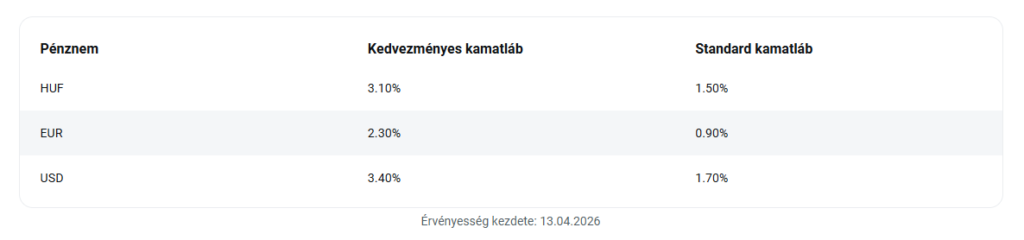
At XTB, you can earn even by simply letting your money rest: You will receive preferential interest on your free cash in the first 90 days after registration. After that, the system switches to the basic (standard) interest rate. The exact amount is calculated daily and the credit is credited to the accounts monthly. It is worth paying attention to the announcement, as interest rates may be updated weekly depending on market movements.
🎢 XTB interfaces
XTB's proprietary trading platform is xStation 5, which is available on both web and mobile. MetaTrader 4 (MT4) access was also offered in the past, but this caters more to the needs of older FOREX traders, and is no longer available today.
🖥️ XTB desktop (xStation 5 web client)
The desktop interface is XTB's real strength, and this is where its CFD broker background really shines. xStation is one of the best in-house developed trading platforms in Europe, unlike brokers who license third-party solutions, essentially using a white label solution.
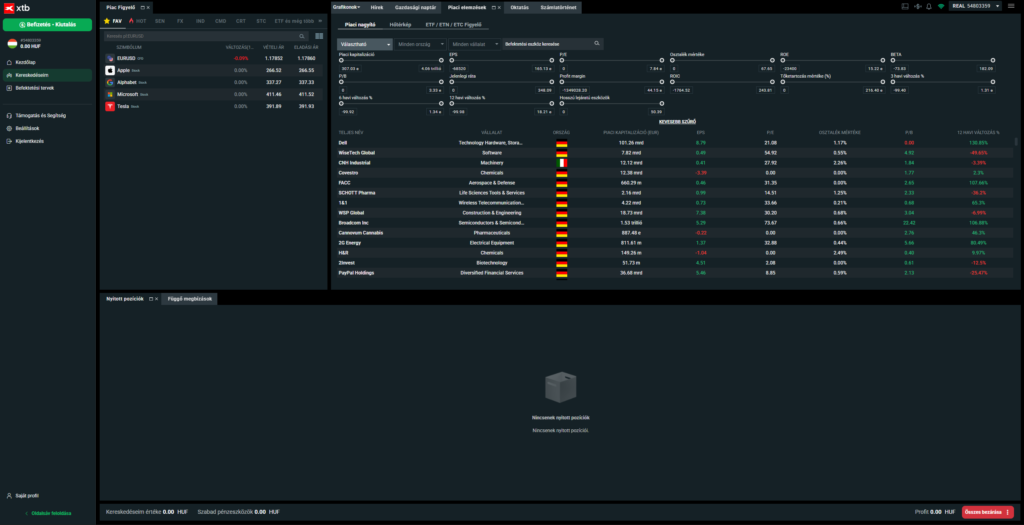
What the xStation desktop version does well:
- 📊 advanced technical analysis: multiple views, freely arrangeable panels, the chart can be traded immediately on the first screen (primarily good for CFD products).
- (I.e. WiFi/network quality indicator: Real-time latency and signal strength display, a lifesaver for active traders.
- (I.e. PiP chart for FOREX trading: This is a tool that you usually only find on dedicated FOREX platforms.
- 🔔 Price alert: can be set up, and the buy/sell interface can be opened directly from the notification (and it's worth opening an XTB broker account for that reason alone, because the app can send notifications to your phone, and quite a few brokers know how to do this).
- 📰 Economic calendar: with all kinds of economic data, especially useful for active traders (e.g. CPI reports and the like).
- 🔍 Stock filter and heatmap: This is one of the best filters in the category, you can also filter based on metrics (P/E, ROE, market cap, etc.), there is an ETF/ETN/ETC monitor, which is far more than Lightyear's filter (however, you cannot add custom parameters).
- 📰 News: It's a basic news service, but at least it's integrated into the interface.
- 🔀 Investment plans: You can create an automated portfolio construction plan from 500 ETFs.
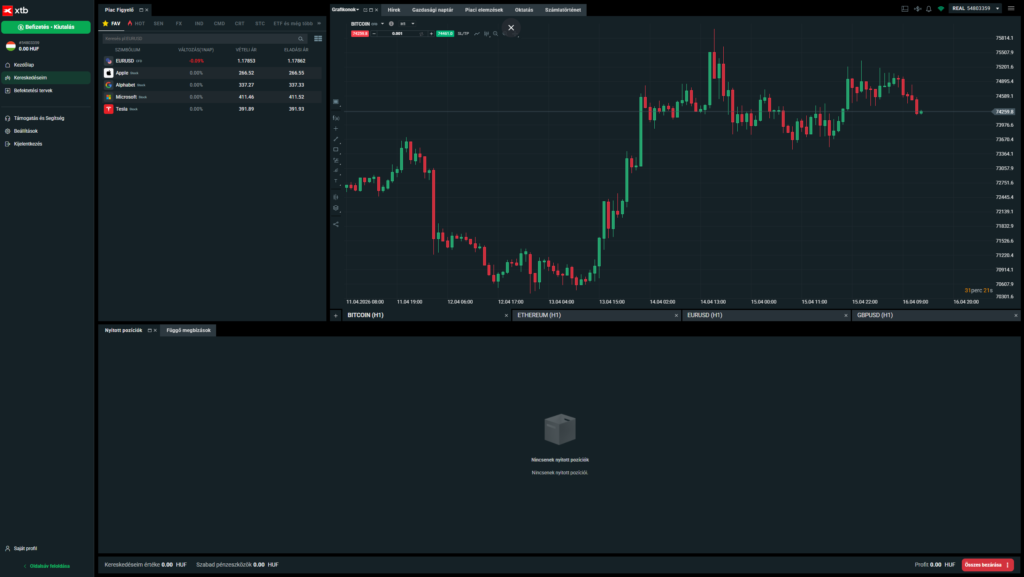
Where xStation desktop is less powerful:
- ❌ The education section (at least during testing) did not load properly.
- ❌ You can't hide data, which is a great feature in the case of Lightyear.
- ❌ CFD products are always the default: when you search for a stock, the CFD version is offered first, the actual stock is displayed only afterwards. This can be misleading for those who don't know the difference, but the interface indicates it with the abbreviations "CFD" and "STC".
- ❌ The favorites list also has CFD products pre-filled, which strongly suggests what XTB wants to sell, but these can be deleted and anything else added instead.
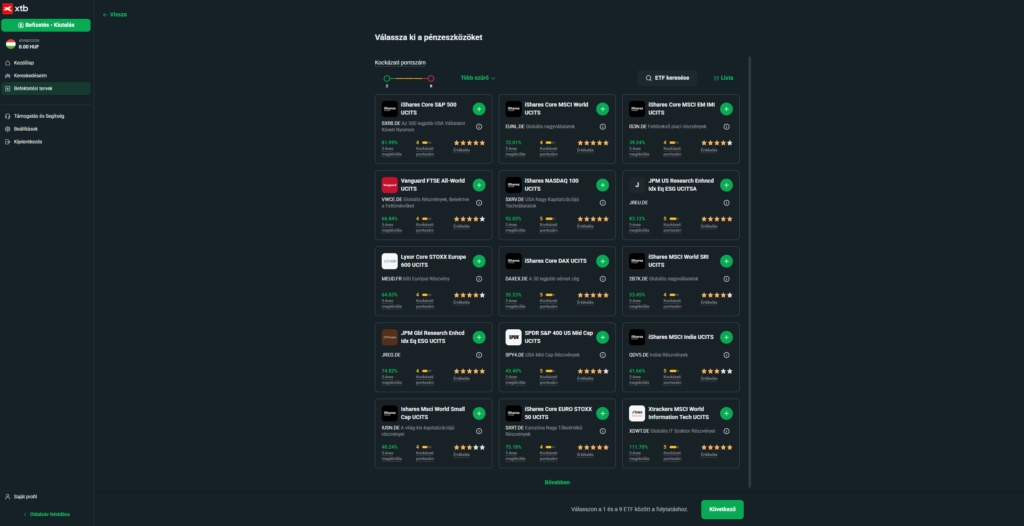
📱 The mobile app (xStation Mobile)
xStation Mobile is powerful in functionality, but its user experience is inferior to that of Lightyear or Revolut's mobile apps. It doesn't have a Revolut-level design, but rather gives the impression of a desktop client ported to mobile. What it has: exchange rate monitoring, trading, price alerts, economic calendar, portfolio overview. What it doesn't have: the simplicity and visual clarity of Lightyear or Revolut, but I didn't find it bad at all. However, if someone wants to trade CFD products, they can navigate much better on the XTB desktop client.
📌 In practice: XTB's desktop platform is one of the best self-developed trading platforms on the market (especially if you are familiar with IBKR's old-school platform), and if you are an active trader with serious charting, filtering and market data needs, you will be surprised by how much more xStation can do than Lightyear or Revolut. However, for a long-term, passive investor, this richness is more distracting than useful, and you will prefer a much simpler interface.
💵 Available instruments of XTB
As I did with Revolut, Lightyear and Interactive Brokers, I took my 26-asset portfolio and typed all the names into the XTB instrument search, which is a pretty good interface, much better than Lightyear for example. The result was not surprisingly 20/26, just like Lightyear, the same with Revolut 18/26, while with IBKR 26/26 stocks. What they don't serve:
- Chinese market, unless there is a US ADR (for example, Alibaba (BABA) is there, Tencent (TCEHY) is not),
- Canadian market, this is how Constellation Software, Topicus, Lumine Group and Computer Modelling Group fell out,
- Australian market (Kelly Partners Group),
but for example the entire UK market is available, even smaller caps like Judges Scientific (LSE:JDG). You can find the full list of XTB instruments here: instrument finder.
But, most investors won't need this, as few people buy individual stocks, so I put together another ETF-based model portfolio that contains the real positions of one of my friends, and I was able to buy all of them on XTB. The first two items essentially give you an average 60/40% stock/bond portfolio with XTB, while the other two items add some emerging market exposure to the formula:
- VWRA, Vanguard FTSE All-World UCITS ETF (Acc., USD)
- IBTA, iShares USD Treasury Bond 1-3yr UCITS ETF (Acc., USD)
- IBCJ, iShares MSCI Poland UCITS ETF (Acc., EUR)
- NDIA, iShares MSCI India UCITS ETF USD Acc (Acc, USD)
XTB's instrument offering is theoretically one of the widest among discount brokers, but it is worth understanding what is a real investment (OMI - Organized Market Instruments) and what is a CFD.
✅ Organized Market Instruments (OMI) – real ownership
- 📈 Shares: ~9,300 stocks in US, EU and other markets. This is one of the widest offerings in the category, surpassing Lightyear (~6,500).
- (I.e. ETFs: ~500 ETFs in the Investment Plans section, with a wide range of issuers. This also far surpasses Lightyear's ~300 ETFs.
- 🔀 Fractional share: available.
- 🌍 Markets: US, EU, UK, and a few smaller ones.
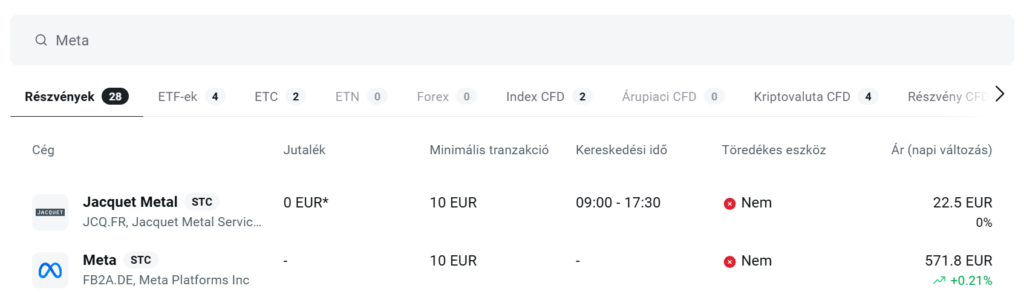
What cannot be bought in OMI (as CFDs only): You can check the current OMI offer in the instrument finder, because not all shares are available in real form: instrument finder.
⚠️ CFD instruments – leveraged, not actual ownership
- 📊 Share CFDs: ~2,600 products, with leverage.
- (I.e. FOREX: 50+ currency pairs.
- 📦 Commodity market products (CFDs): 20+ raw materials (gold, silver, oil, gas, coffee, sugar, etc.).
- (I.e. Index CFDs: Dax, S&P500, Nasdaq, FTSE, etc.
- 🪙 Crypto CFDs: available (spot crypto was also launched in 2025 with a Cyprus license).
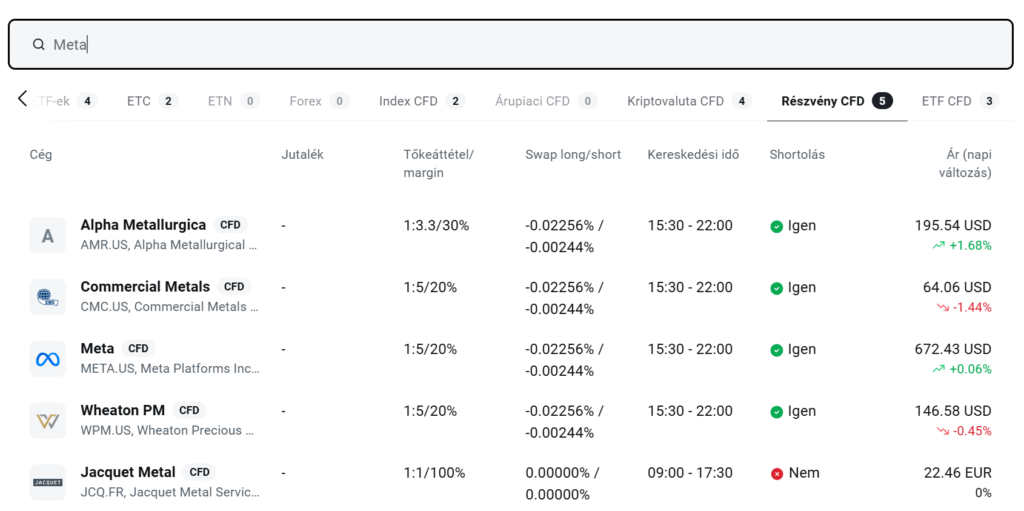
❌ What you cannot buy on XTB:
- ❌ Hungarian Stock Exchange (BÉT)
- ❌ Options (in Hungary, for EU retail customers)
- ❌ Wide range of bonds
☝️ XTB launched options trading in January 2026, but exclusively through a Cyprus (CySEC) entity, on US stocks. This is typically not available to EU retail clients and its risk profile does not match that of a traditional passive investor.
📌 In practice: The CFD instrument is an abbreviation for Contract For Difference, or otherwise known as a contract for difference, and was basically invented for trading stocks. The biggest risk of CFDs (contracts for difference) compared to traditional shares is leverage., which amplifies losses, so you can lose more than your entire invested capital in a short time. While with a normal share purchase you become a true owner and can hold the shares for the long term without any extra costs, Meanwhile, a CFD is just a contract for difference where the broker charges a daily financing fee. (swap) charges for maintaining the position, so, in parallel with the holding period, costs can eat up your profits. For this reason, CFDs are more of a speculative, short-term instrument, where you do not own the asset, but play against the broker, while buying shares (OMI) is a real investment, where your biggest risk can theoretically only be the loss of the invested amount. So anyone who wants to invest should avoid CFD instruments.
🤵 What strategy is XTB best for?
What XTB is excellent for:
- ✅ Active trading: FOREX, CFDs, indices, commodities, if someone is actively trading, xStation is one of the best platforms for this in the EU.
- ✅ Technical analysis: advanced charting tools, historical data, indicators, this is the area where XTB clearly outperforms Lightyear and Revolut.
- ✅ Monitoring economic data: The built-in economic calendar and news feed are essential for active traders.
- ✅ ETF/stock filtering based on fundamental indicators: no external tool is needed, xStation's stock filter can be used as a basic screener, but it is a Fiscal AI he knows much more than that.
- ✅ Demo account: risk-free trial, which is otherwise available for an unlimited period of time (other brokers limit it to 30 days).
- ✅ Investment plans: Automated portfolio construction from 500 ETFs for regular investors.
What XTB is not really suitable for:
- ❌ Exotic small markets: Canadian, Australian and other smaller papers are difficult to obtain.
- ❌ Passive, long-term ETF investment on TBSZ: there is no TBSZ account, which is a huge tax disadvantage in Hungary.
- ❌ Fundamental in-depth analysis: no Morningstar, no EVA, no TipRanks, data provision is truncated compared to IBKR.
- ❌ Hungarian stock market securities: BSE shares cannot be purchased.
- ❌ Bond portfolio: very limited supply.
🆚 Competitors: XTB's opponents
| Point of view | 📊 XTB | 🚀 Lightyear | 💼 Interactive Brokers | 💳 Revolut |
|---|---|---|---|---|
| Registration | Poland (listed on WSE) | Estonia | USA (EU: Ireland) | UK / Lithuania |
| Assets under management | ~7 billion USD | ~1 billion USD | ~757 billion USD | ~8.5 billion USD (broker) |
| Listed on the stock exchange | ✅ Yes (WSE) | Partially (STRT) | ✅ Yes (NASDAQ) | ❌ No |
| ETF fee (OMI) | 0% (up to 100000 EUR/month) | 0% | ~1 EUR/transaction or 0% | Spread-based |
| Share price | 0% (up to 100000 EUR/month) | 0.1% (US), 1 EUR (EU) | 0.005 USD/piece min. 2 USD/EUR | Spread-based |
| Currency exchange | 0.5% at OMI | 0.35 % | Interbank nearby | 0% or ~1% (above limit) |
| CFD trading | ✅ Strong | ❌ None | ✅ Yes | ✅ Yes |
| FOREX | ✅ 50+ pairs | ❌ None | ✅ Yes | There is no real FOREX |
| TBSZ | ❌ None | ✅ Free | ✅ 2000 HUF/month | ❌ None |
| Investor protection | 22000 EUR (KNF/KDPW) | 20000 EUR + 500k USD (US) | EUR 20,000 (EU) | 22,000 EUR (LT) |
| Demo account | ✅ Unlimited time | ❌ None | ✅ Paper Trading | ❌ None |
| Stock filter | ⭐⭐⭐⭐ | ⭐⭐ | ⭐⭐⭐⭐⭐ | ⭐ |
| Surface complexity | ⭐⭐⭐ ⭐(relatively easy) | ⭐⭐⭐⭐⭐ (very easy) | ⭐ (very complex) | ⭐⭐⭐⭐⭐ |
| Economic calendar | ✅ Yes, integrated | ❌ None | ✅ Yes | ❌ None |
| Heatmap | ✅ Yes | ❌ None | ✅ Yes | ❌ None |
🆚 XTB vs. Lightyear: XTB's instrument offering is far wider, the stock filter is stronger, there is FOREX and CFD, there is an economic calendar. Lightyear's advantage is TBSZ, simplicity and an interface clearly optimized for passive investors. If someone wants to buy ETFs and nothing else, Lightyear is a better choice. If someone is actively trading, XTB is clearly stronger.
🆚 XTB vs. IBKR: Interactive Brokers is another category with nearly $800 billion in assets under management and Morningstar/TipRanks/EVA integration. IBKR is better suited for managing larger amounts due to its 30-year track record, SIPC protection, and professional tools. XTB, on the other hand, offers a friendlier interface and a more trader-friendly stock filter.
🆚 XTB vs. Revolut: The main function of Revolut is not to act as a broker, but as a travel bank account. The main problem with Revolut is that it does not have tax-efficient accounts, such as TBSZ, and relatively few instruments are available on it. However, it is a very good all-round account, you can exchange money in many currencies at zero cost, and transfer money for free, for example to accounts such as XTB.
📌 In practice: XTB and Lightyear are not actually the same providers. XTB is an active trading platform that is now trying to appeal to passive investors. Lightyear is a passive trading platform that has never wanted to be a trading tool. IBKR is the rocket in the investment industry, both in terms of knowledge and complexity. The easiest way is to open one of them, try out which one you like, or use them both for diversification purposes.
🇭🇺 Section for Hungarian investors
🧮 TBSZ at XTB
XTB currently does not offer a Long-Term Investment Account (LTIA) for Hungarian clients. This is the only, but very serious disadvantage from the perspective of a long-term, passive investor. TBSZ is one of the most powerful tax optimization tools in the hands of Hungarians: after 5 years of holding, all exchange rate gains are free of personal income tax and social security tax. In contrast, 15% personal income tax and 13% social security tax are payable on profits realized on XTB, which means a total burden of 28% on the return. In the long term, with compound interest, this tax disadvantage amounts to enormous amounts.
If someone is driven by passive, long-term investing and not active trading, XTB It is only worth investing in things that you could not do tax-efficiently elsewhere. – for example, more specialized products that are not available on Lightyear or the IBKR TBSZ account.
📊 Currency exchange and deposit
When making a HUF deposit, please note that there is no deposit fee for bank transfers (it is free for EU SEPA transfers), but there is a significant fee for card or PayPal:
- HUF card: 0,90%
- With PayPal: 0,85%
The cheapest way: convert from HUF to EUR within Revolut's free monthly limit, then transfer it to your XTB account via SEPA transfer (also free). This combination means almost zero deposit costs.
🔢 Taxation on XTB
XTB does not prepare tax returns, but you can download the necessary documents from your account. After the exchange rate gain:
- ???? 15% PIT payable after exchange rate gain
- 💰 Interest income: 15% personal income tax + 13% social security tax
- 📑 XTB tax statements can be downloaded from your account
The issue of withholding tax is complex in the case of CFDs and foreign shares: according to XTB's information, it holds client securities in a collective account (street name), therefore withholding tax benefits (e.g. based on a double taxation agreement) are not always applicable. For example, with US shares, a 30% withholding tax can also be applied to dividends, which is a common structural disadvantage of European brokers compared to Interactive Brokers (where, as it is a dedicated account, the 15% treaty rate can be applied).
🔒 Withdrawal
At XTB only bank account withdrawal is possible, and only to a bank account that is in your full name (same as the name on your XTB account). PayPal withdrawals are not available. This restriction is for bank compliance reasons, but it is important to know before you go.
✅ XTB Advantages
Interface and tools:
- ✅ xStation is a self-developed platform, one of the best in the discount broker category.
- ✅ Advanced technical analysis tools, integrated charting.
- ✅ Stock screening based on metrics (P/E, ROE, etc.), rare among cheaper brokers.
- ✅ Heatmap, ETF/ETN/ETC monitor.
- ✅ Integrated economic calendar for active traders.
- ✅ PiP chart for FOREX traders.
- ✅ WiFi/network latency meter, a sign of a serious trading platform.
- ✅ Price alert, and the transaction can be started immediately from this interface.
- ✅ Unlimited demo account.
Instruments:
- ✅ ~9,300 real shares (OMI), one of the widest offerings.
- ✅ ~500 ETFs in the Investment Plans section.
- ✅ ~2,600 CFD products for active traders.
- ✅ FOREX, commodities, indices, crypto (in CFD form).
- ✅ Fractional shares available.
Institutional background:
- ✅ They are listed on a stock exchange (Warsaw Stock Exchange), their financial data is public.
- ✅ KNF/KDPW + FCA + CySEC regulation, many jurisdictions.
- ✅ Profitable company (also in 2025, although at a reduced profit level).
- ✅ Hungarian customer service, Hungarian-language interface.
Fees:
- ✅ Free bank deposit
- ✅ 0% OMI trading commission up to EUR 100,000 monthly turnover
- ✅ 0% CFD commission (only spread)
❌ Disadvantages of XTB
Critical for Hungarian investors:
- ❌ No TBSZ: This is the biggest disadvantage. Hungarian investors pay 15% personal income tax + 13% social security tax on the realized return on XTB, while 0% on Lightyear or IBKR with a TBSZ account.
- ❌ No BSE: Hungarian stock market shares are not available
- ❌ High card deposit fee: 0.90% (HUF), which is high compared to many platforms, those who deposit by card already gave the broker a small return.
Product structure:
- ❌ CFD Broker DNS: The interface constantly pushes users towards leveraged products, with CFDs being the default view, with the actual stock secondary. This can be misleading for less informed investors.
- ❌ 71-80% of CFD clients lose on their transactions: XTB itself requires this to be stated, it is a fundamentally important number, and it means that the CFD model structurally favors the broker (he is the market maker, you have to bet against him).
- ❌ Limited bond supply: negligible compared to IBKR.
- ❌ No option for EU retail customers (it is on the Cypriot entity, but outside the framework of EU retail regulation).
Technical and security:
- ❌ Cyberattacks in 2025: some customers' accounts were accessed by unauthorized persons.
- ❌ Trustpilot debate in 2026: Trustpilot removed XTB's review and flagged its profile due to fake reviews, this is not an isolated case among brokers, but it is a warning sign.
- ❌ Bank account withdrawal only: PayPal or other transfers are not possible.
🤔 The true price of free: The prominent placement of CFDs and FOREX trading on the xStation platform is not accidental. XTB's business model is largely based on CFD traders (who lose 71-80% of their trades), and they generate part of their revenue from clients paying spreads on leveraged trades. In light of this, the 0% OMI commission is more of a customer recruitment tool than a sustainable business model in itself.
📝 XTB Summary
XTB has remained one of the most trusted and regulated CFD brokers in Europe for the past 20+ years. After the 2025 turnaround, they also introduced real stock and ETF trading, which expanded the range of potential users. The xStation platform is truly one of the best in-house developed trading platforms in its category, and the stock filter, economic calendar, heat map and PiP chart are tools that Lightyear or Revolut do not offer.
XTB may be a good choice if:
- you are an active trader in FOREX, CFDs, indices, commodities,
- you are looking for technical analysis tools integrated into the trading interface,
- you want a wide range of stocks and ETFs with filters and heatmaps,
- you want to learn on a demo account for an unlimited period of time,
- You prefer the security of a transparent, publicly listed company.
XTB is not a suitable prime broker if:
- you rarely access your account and want to avoid the inactivity fee, pay attention to the 365-day rule,
- If your goal is passive, long-term ETF investing and you want to use TBSZ, Lightyear (free TBSZ) is the better solution for this,
- If you are looking for professional fundamental data services (Morningstar, TipRanks, EVA), IBKR is the best for that and there is a TBSZ account there too.
The optimal combination for Hungarian investors in 2026:
- 📊 XTB: active trading, FOREX, CFD, technical analysis, demo for learning.
- 🚀 Lightyear: TBSZ account, free ETF for passive investment: Lightyear: the best cheap broker in 2026? Prices, features
- 💼 Interactive Brokers: serious portfolio, individual stocks, fundamental analysis, exotic markets: Interactive Brokers (IBKR) Account: Fees and Features
- 🔵 Revolut: currency exchange, daily payment, travel: Revolut in-depth analysis: financial service provider and discount broker at the same time
XTB is a relatively reliable, publicly listed company, which is excellent for active traders, but for passive investors, the tax disadvantage (no TBSZ) is a serious obstacle. If you can only open one account and want to invest passively, Lightyear is the better choice. If you want to trade actively, learn, filter and analyze, or are looking for a second account, XTB is your platform.
👊IF THE SERVICE IS INTERESTING YOU, YOU CAN OPEN XTB ACCOUNTS AT THIS LINK: ON THIS LINK.
Frequently Asked Questions (FAQ)
Does XTB have a TBSZ?
Currently, none. XTB does not offer a Long-Term Investment Account for Hungarian clients, which represents a serious tax disadvantage compared to Lightyear and Interactive Brokers.
How much does it cost to buy shares on XTB?
The commission for OMI (real stock/ETF) trading is 0% for monthly turnover up to 100000 EUR. Above that, it is 0.2%, minimum 10 EUR. In addition, there is a 0.5% conversion fee for each currency exchange if the currency of the instrument and the account is different.
What is CFD and why is it dangerous?
CFD (Contract for Difference) is a type of leveraged product where you do not actually buy the asset, you only gain or lose on its price movement. According to XTB's own information, 71-80% of CFD clients lose money. It is not recommended for beginners and long-term investors.
How are returns earned on XTB taxed?
15% personal income tax is payable on exchange rate gains, 15% personal income tax + 13% social security tax on interest and dividend income. XTB provides the necessary tax documents from the branch, but does not prepare a tax return.
Is XTB reliable?
Yes, KNF/KDPW, FCA and CySEC regulation, and stock exchange presence (WSE) make XTB one of the most vetted brokers in its category. Cybersecurity incidents in 2025 are not unique to the industry, but two-factor authentication is mandatory (provided by the platform).
What payment methods are available?
Bank transfer (EU SEPA, free), card payment (0.70-0.95% per currency), PayPal (0.85%). Withdrawals are only possible to a bank account, matching the name on the account.
Legal and liability statement (aka. disclaimer): My articles contain personal opinions, I write them solely for my own entertainment and that of my readers. The articles published on iO Charts do NOT in any way exhaust the scope of investment advice. I have never intended, do not intend, and am unlikely to provide such in the future. What is written here is for informational purposes only and should NOT be construed as an offer. The expression of opinion is NOT in any way considered a guarantee to sell or buy financial instruments. You are SOLELY responsible for the decisions you make, and no one else, including me, assumes the risk.