
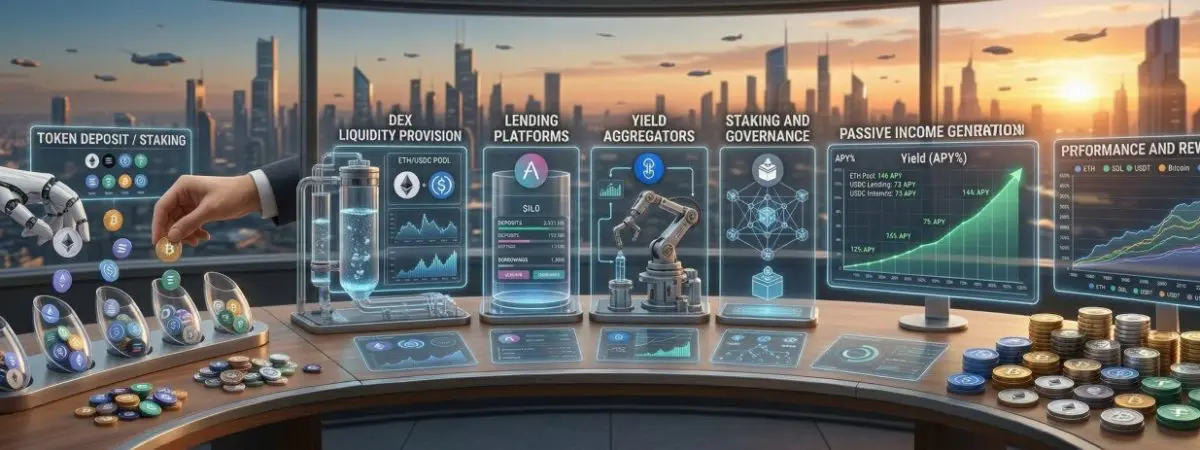
In the traditional financial world (TradFi), investors realize passive income through government securities, corporate bonds, and dividend-paying stocks, or by tying up their money in the bank for a few percent interest per year. However, decentralized finance (DeFi) has brought a new form of capital utilization, yield farming.
Yield farming is an active investment strategy that aims to maximize the annual percentage yield (APY) of cryptocurrencies by moving capital between different DeFi protocols. Yield farmers not only benefit from transaction fees or loan interest, but also (usually) receive the platforms’ own “governance tokens” as an extra reward.
In the 2026 DeFi market, unsustainable inflationary returns of thousands of percent have been replaced by yield generation based on real revenues (transaction fees, loan repayment interest), the main threat being the depreciation of volatile tokens and smart contract risk.
💡This article will discuss the possibilities of yield farming in detail. We examined the difference between traditional dividend yield and DeFi yield farming in a previous article, which you can read here: Staking yield vs. dividends: Which is the better passive income?
💡If you want to learn more about the world of DeFi in general, you can do so here: What is DeFi? A guide to the future of finance
🌾What is Yield Farming?
Yield farming is one of the most popular concepts in decentralized finance (DeFi), in which investors lock up their cryptocurrencies in various smart contracts in order to generate passive income in return. Essentially, you don't just hold your crypto assets passively in a wallet, but actively put them to work on the blockchain.
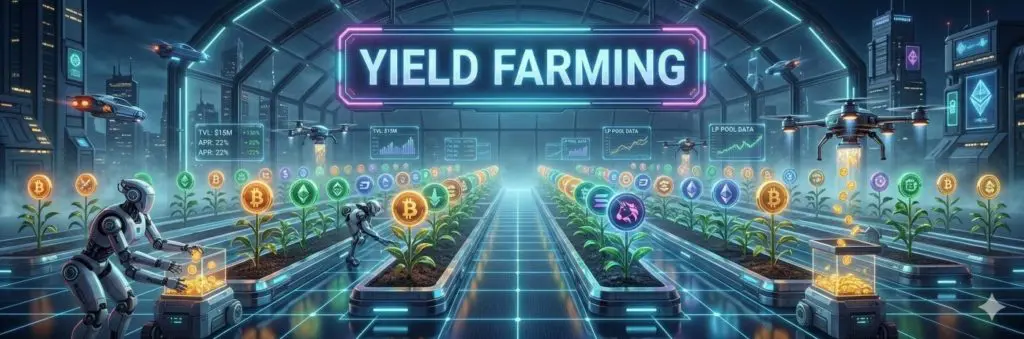
In traditional finance, the equivalent is a bank escrow (in the case of stablecoins) or when we “lend” a share to someone, which is usually done with options. This process can be implemented on several DeFi platforms, each of which performs different financial functions and thus rewards users with different mechanisms:
- (I.e.Decentralized exchanges (DEXs): Here, users deposit their paired tokens (usually paired, but not always) into so-called liquidity pools (LPs) to enable others to trade them. For example, if someone holds USDC (a token that tracks the US dollar exchange rate) in their wallet and wants to buy ETH (the native token of the Ethereum network), they can do so through an ETH-USDC liquidity pool: They submit the USDC to the smart contract, which calculates how much ETH it corresponds to using a mathematical formula and allocates it to the user. In return, users who provide liquidity to this pool (i.e., have previously deposited their ETH and USDC tokens into the smart contract) receive fees paid for the transaction, and often also the protocol's own token. Examples: Uniswap, PancakeSwap, Curve Finance.
- 💰Lending & Borrowing platforms: These work like decentralized banks. Users lock their assets into smart contracts, which others can borrow as overcollateralized loans. So for example, if I want to realize a return on my USDC tokens, I submit this to a smart contract. Someone else submits their ETH token to the smart contract and uses this as collateral to borrow USDC, which the smart contract services from my USDC. The borrower pays interest to the lender (me) for this. In the event of a loan default or a decrease in the value of the collateral, the smart contract liquidates the position, i.e. sells the borrower's ETH token on the market and repays the principal to the lender. It's the same mechanism as in traditional finance. Examples: Aave, Compound, Spark.
- 📈Option and derivative protocols: More advanced strategies include investors providing liquidity to leveraged trading platforms or decentralized options markets, where returns are derived from traders' losses, fees paid, or option premiums. Examples: GMX, Ribbon Finance, Lyra.
At this point, it is particularly important to distinguish between the types of assets used, as the risk and expected return differ drastically between volatile tokens and stablecoin farming. When farming volatile cryptocurrencies (such as ETH, SOL, but also smaller project tokens), the potential annualized returns (APY) are often extremely high, but you are constantly exposed to exchange rate fluctuations and potential capital loss. In contrast, stablecoin farming (such as pairing USDC and USDT in a liquidity pool) is much more predictable: here the exchange rate risk is minimal, and investors can realize stable returns that exceed traditional bank interest rates, but are lower and more consistent than volatile farms.
📌In this article, we do not address other risks of cryptocurrencies, such as smart contract risk, custodian risk, etc., you can read more about this in our previous article: Crypto portfolio diversification: sectors, contracts and margins
It is important to clarify that there are many other forms of yield generation in the crypto market, which differ in their mechanism and risk profile from classic DeFi liquidity provision. Such as traditional network token staking (when you contribute to the security and validation of a Proof of Stake network by staking), or governance token staking (when you lock up a protocol’s governance token in exchange for voting rights and a share of the platform’s revenues). While these are also excellent sources of passive income, they technically fall into a different category, so we will discuss these methods and the exact differences between them later in the article.
💸Yield farming: Where does the profit come from?
As a first step, it is worth breaking down the sources of yield. Apart from compounding (reinvestment), we can talk about two basic components:
1. 〽️Basic profit (transaction fees or loan interest)
When you deposit your capital into a liquidity pool on a decentralized exchange (e.g. Uniswap) or lend it on a lending protocol (e.g. Aave), the system basically pays you an organic return from the fees collected. This is the most sustainable source of return in the long term, as it is paid directly by users for using the platform and liquidity pools.
2. ⛏️Liquidity mining
This is classic yield farming, as it accounted for almost 100% of the realized return in the early days. New (or growth-oriented) DeFi protocols need capital, as the system only works if there is liquidity, which is when the platform can service trading and borrowing transactions. To attract capital, they reward investors with their own newly issued tokens (governance tokens) in addition to normal transaction fees (in the vast majority of cases).
📌In practice: After you deposit your capital into a liquidity pool, you receive a receipt (LP token). This LP token usually starts to “collect” trading fees, but in addition, you can stake it (staking) on the platform’s “farm”, and the code generates new tokens for you every second as an extra reward. In some cases, you can choose where to stake the LP token and realize additional returns. Examples: Convex Finance, StakeDAO.
2+1. 🔄️Reinvestment (auto-compounding)
Reinvestment is not a source of income in itself, but we mention it here because in DeFi there are very convenient options to do this easily, this is called auto-compounding. Platforms specializing in this do not hold the reward tokens received, but sell them and reinvest their value back into the original capital. This automatically applies the principle of compound interest, which drastically increases the annualized yield (APY) in the case of higher interest rates.
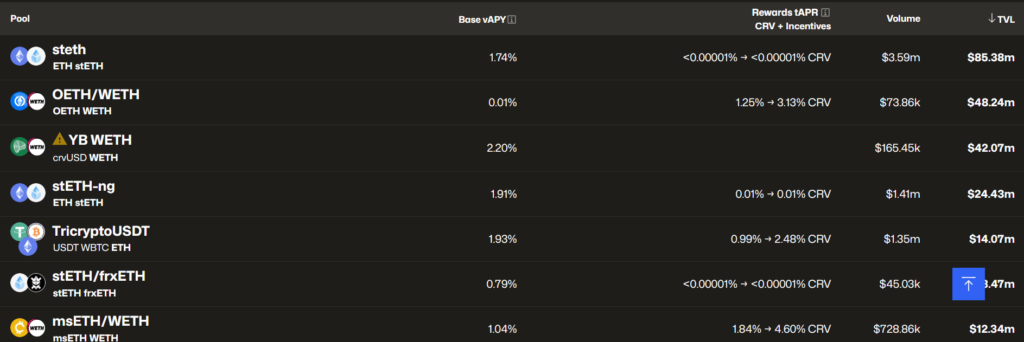
🖼️In the image below you can see the Curve Finance interface, with the largest liquidity pools containing ETH.
- The first column shows what tokens are in the given smart contract (ETH and stETH tokens in the case of the very first pool).
- The "Volume" column shows the trading volume in the recent period, so (looking at the first row) this amount of ETH tokens were exchanged (swapped) for stETH tokens through the given smart contract, or vice-versa.
- The last "TVL" column shows the total value of the tokens in the given smart contract (Total Value Locked).
- The two middle columns (Base vAPY and Rewards tAPR) show that those who provide liquidity to these smart contracts (i.e. place their own capital here) benefit from trading fees (swap fees, Base vAPY column) and from token rewards provided by Curve Finance (percentage value, annualized in the form of CRV tokens).
📌In practice, in the case of this type of yield farming, we don't really have to worry about what token we will receive the yield in, since we will definitely get it and if we sell the reward tokens within a short time, the exchange rate risk of these tokens can only be minimal. The main risk here is primarily the exchange rate risk of the base capital. For example, if we provide liquidity in the ETH-USDC pool on the Velodrome platform, we will receive the rewards in VELO tokens (transaction fees and inflation token issuance are not separated here). If we deposit $1000 worth of ETH and USDC tokens into the pool (50-50%) and receive 1% worth of VELO tokens as a reward per week ($10 per week), then even if the value of the VELO token completely drops to zero, we will have lost only $10. However, if ETH drops by, say, 10% in a week, we will already lose about $50.
⚠️Yield farming: Risks and returns (Risk-reward)
In the heyday of yield farming (2020-2021), projects promising 10000% APY were commonplace. However, this has now become normal. Investors have recognized the biggest structural pitfall of farming: the phenomenon of “Ponzinomics”.
If a platform prints its own tokens from scratch to pay huge returns to farmers, it causes brutal inflation. When farmers receive their reward tokens, they immediately sell them on the market, causing the token price to crash. This is a problem when the condition for earning a return is to stake the project's own token, as it is pointless to get a 10000% return if your capital is reduced to zero.
📣Opinion: Let me digress here: this shouldn't have been a "new" thing in the crypto community at any level, as the concept of inflation and hyperinflation has been a familiar phenomenon in the traditional financial system for centuries. But why was it?
Software developers were the first to appear in the blockchain ecosystem, as blockchain is essentially a technology platform accessible to everyone (you can read more about this in our previous article: More than Bitcoin: What are cryptocurrency and blockchain technology really good for?). But of course, most of the software developers did not have financial knowledge, which is why they started implementing financially completely meaningless ideas and organizing huge communities around them. The basic attitude was clearly that the traditional financial system itself was the devil and this new revolutionary community would reinvent this system. But it became clear to most people relatively quickly that blockchain technology could not override the laws of mathematics and finance (a huge surprise) and practically all that remained were those projects (with the exception of a few zombie projects) that were able to successfully adapt concepts that already existed in the traditional system to the blockchain.
That is why the DeFi market in 2026 has clearly shifted towards “Real Yield.” Investors and portfolio managers are now looking for protocols that do not pay with inflationary tokens, but rather distribute real revenues generated by the platform (such as fees collected in ETH or stablecoins) back to users who provide liquidity. Here again, the only thing that matters is that the project must have a viable business model and must be able to distribute the profits generated during the project's operation back to investors as "dividends".
💡You can read in detail about what makes a project viable in this article: Crypto fundamental analysis: value-based investing on the blockchain
It is important to emphasize here that the above ideas are valid when we stake a specific project's own token, which can also be called yield farming or staking, but it is definitely different from when we stake a stablecoin (a token always worth $1) or, say, the native token of the Ethereum network, ETH, and receive a reward for it. As we have mentioned several times above, a distinction must be made in terms of risk between the token in which the invested capital is denominated and the token in which the return is denominated. The greatest risk is always caused by the depreciation of the base capital, since the capital will be reduced to zero even with an arbitrarily high annual return, while the sudden disappearance of the return only means that it is worth moving our capital elsewhere so that it continues to produce money.
We can also lock up large, reliable tokens like Ethereum or Bitcoin, and although we still take on the risk of the smart contract of the given project, our risk in terms of exchange rate fluctuations will be the same as if we were holding these assets in our wallet. In addition, we can lock up stablecoins, and when we do not take on any exchange rate risk, this would correspond to a bond or bank lock-up in traditional terminology.
However, the eternal rule is true here as well: Generally, the greater the risk taken, the greater the return. However, in practice there are anomalies, so if an asset seems risky and the expected return is low, it is worth switching and trying to find an asset that seems safe and yet pays higher interest for various reasons.
⚙️How does this work in practice?
🪙Entering the world of crypto
To participate in this ecosystem, the first step is to purchase cryptocurrencies, which you can then deposit/invest. You can do this through traditional companies that form a bridge between the traditional financial world and crypto. These companies are commonly called CEXs (Centralized Exchanges).
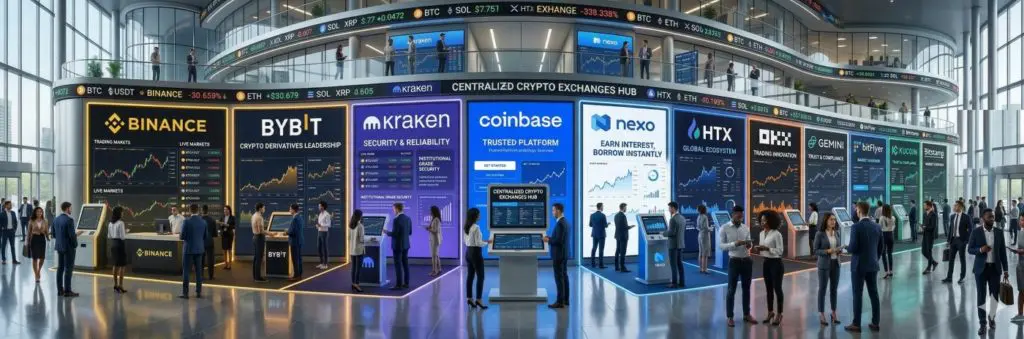
💡 If you are interested in how CEXs work and their business model, you can read more about it in our previous article: Crypto stocks: Business models behind the blockchain
In terms of user experience, these companies are in many ways like traditional brokers where we can buy shares, and more and more players are providing the opportunity to buy crypto and shares on one platform. We need to open an account on one of the CEXs, transfer money from our traditional account and we can convert it into a crypto asset.
We have countless options for this, but it is worth checking how big the company is before opening an account, as larger companies usually:
- They are more reliable, there is less chance of bankruptcy and thus of losing our assets stored there (Same principle as with a stock broker)
- They operate at more favorable rates, although this may change over time
Such large companies include Binance, Coinbase or Bybit, but also Kraken or Nexo, we also have a referral code for the latter two, with which you will receive a financial bonus for opening an account (Kraken account opening, Nexo account opening). Of course, don't make your decision based on this, but in the case of reliable exchanges, it's worth opening an account with such referral codes, because it's free money 🙂
These platforms offer user-friendly options to stake your assets right away (even without a minimum holding period), so you can generate returns on your chosen crypto tokens. Of course, this is only available for a limited number of tokens and the returns are also lower than directly on the blockchain (since CEX invests your assets on the blockchain, deducts its own fee, and then pays you the rest). This brings us to the next step.
🧰Allocation of crypto assets to a self-custody wallet
In order for you to take advantage of the opportunities offered by DeFi projects, you need to create a Web3 wallet that can "store" your assets on the blockchain itself.
💡A Web3 wallet doesn't actually store any assets, just the cryptographic keys that you use to identify yourself on the decentralized internet. We won't go into this in depth here, as we've already covered it in detail in a previous article. So if you don't have a Web3 wallet or haven't heard of it before, you can learn more about it in this article: What is a web3 wallet? A guide for beginners
Once you have created your web3 wallet, you will see the public address of the wallet, which is a long hexadecimal string (for example: 0x7Fc66500c84A76Ad7e9c93437bFc5Ac44E2DDaE9). You can enter this address on the CEX interface and allocate crypto assets purchased on CEX to it.
Once this is done, you can then interact with any project running on the blockchain.
🫱Interaction with blockchain and DeFi projects
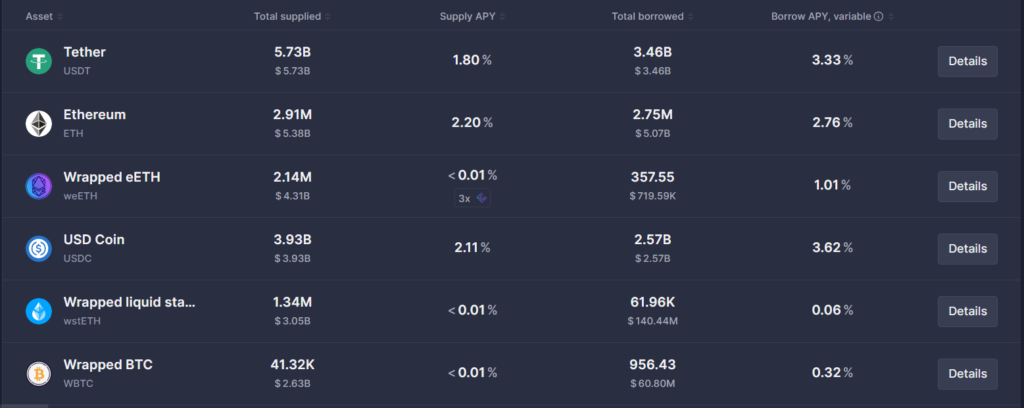
The image below shows the interface of Aave, the currently largest decentralized lending platform, and the web3 wallet called Rabby (which works as a browser extension in Chrome, for example), where we can approve transactions.
The user interface of web3 projects is the same and accessible as traditional websites, for example, the Aave interface is here: Aave web interface. Below are the tokens that can be lent/borrowed, here in the figure: USDT (USD stablecoin), ETH (native token of the Ethereum network), weETH (wrapped and staked ETH token), USDC (USD stablecoin), wstETH (another wrapped and staked ETH token), WBTC (wrapped Bitcoin token).
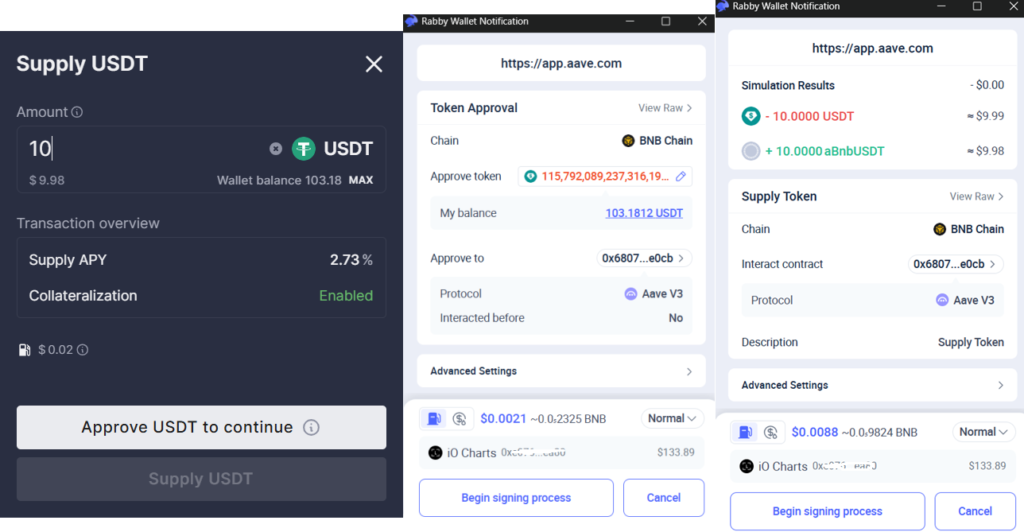
The first step is to deposit our tokens. By clicking on the USDT token and then the “Supply” button, the interface shown on the left in the image below will appear.
We then need to execute two transactions, an “Approve” transaction that allows us to submit our USDT token to the smart contract, and a “Supply” transaction that actually submits the token. You can see these two transactions in the Rabby browser extension in the image below, center and right. Once we have done this, from now on our capital will generate the “Supply APR” value shown in the image above (Annualized Percentage Rate).
If we want to borrow something using our deposit as collateral, we can click the “Borrow” button, select the token and quantity, and then perform another transaction, and the borrowed amount will appear in our web3 wallet. Therefore, we must pay the percentage interest in the “Borrow APR” column, which will appear as an increased amount when the loan is repaid.
📌In practice: if we were to borrow ETH tokens, for example, we would be “shorting” ETH in the traditional sense. What is much more typical is that investors want to sell their volatile crypto assets (e.g. ETH or BTC) in order not to miss out on the subsequent price increase. In this case, they use ETH or WBTC tokens as collateral and take out the loan in the form of USDT or USDC tokens. In the traditional sense, this corresponds to when someone borrows from a broker using Microsoft shares as collateral (or even their real estate). The borrowed amount is then either reinvested in something or spent for their own purposes.
Then, in order to withdraw your deposited ETH or WBTC tokens again, you must repay the value of the loan plus interest.
If the price of ETH or WBTC drops too low, the smart contract will liquidate the position (sell the ETH or WBTC token and automatically repay the loan), ensuring that depositors always get their money back. The borrower assumes all risk.
👁️Risk management and transparency
It is very important to keep risk management in mind when doing yield farming. Hacker attacks occur every day, resulting in the permanent loss of users' capital.
In addition to proper preventive research, smart contract risks can only be reduced through diversification. The goal is to prevent all of your assets from being lost due to a hidden bug in a smart contract. This means that you are forced to hold your assets in multiple places and in multiple tokens (most tokens are smart contracts themselves, so they carry their own risks, even if this risk is lower than in the case of complex smart contracts). However, tracking a properly diversified portfolio is not trivial, and you will definitely need a portfolio tracker where you can see your exposure to each token or project. It doesn't hurt to be able to track the value of your rewards as well.
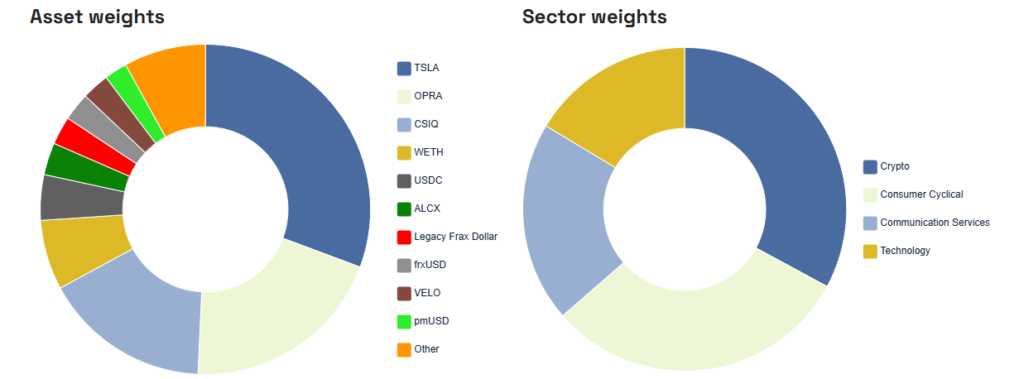
We can help you with this with our portfolio tracker specialized in DeFi projects, where you can track the contents of multiple web3 wallets at once, along with your stocks and ETFs, providing full coverage for your financial portfolio.
💡Diversification and proper portfolio tracking together make DeFi risks manageable. Try our Portfolio Tracker: iO Charts Portfolio Manager
Frequently Asked Questions (FAQ)
1. What is the difference between Yield Farming and Staking?
In practice, the word staking is used for both, but in its original meaning, staking is a passive process: you stake your native token (e.g. ETH) on a single network to maintain the security of the blockchain, in exchange for a fixed return. Yield farming is an active strategy where investors continuously move their capital between different protocols, lending platforms, and liquidity pools to maximize returns in the form of transaction fees and token rewards.
2. Is it possible to farm with stablecoins (Yield Farming)?
Yes, and it is the most popular strategy for risk-averse investors. For example, if you provide liquidity on the USDC/USDT pair, you will almost completely eliminate exchange rate fluctuations while enjoying the transaction fees and farm rewards paid by the protocol.
3. What are Yield Aggregators?
These are smart contracts (like Yearn Finance or Beefy) that automate yield hunting. Instead of you having to manually withdraw reward tokens daily, sell them, and put them back into the base capital, the yield aggregator code does it for you in the background. This maximizes the effect of compound interest (auto-compounding) and saves on transaction (gas) fees.
4. What does “Real Yield” mean?
Real Yield refers to returns that do not come from a protocol’s own token, printed from scratch and inflated, but from real economic activity. For example, if a decentralized exchange distributes fees paid by traders back to farmers, that is considered a real, sustainable return.
5. How can I calculate whether it is worth "claiming" the rewards?
Withdrawing tokens from a smart contract incurs a network transaction fee (gas fee) and takes up your time if you do it too often. What is worth considering is how much money the accumulated return can generate in the next period compared to the transaction fee, and how much you are afraid of the depreciating value of the reward token if you wait too long to harvest. Dedicated portfolio management software (like iO Charts) shows the value of the rewards in aggregate, so you know exactly when it is worth “harvesting”.
Legal and liability statement (aka. disclaimer): My articles contain personal opinions, I write them solely for my own entertainment and that of my readers. The articles published here do NOT in any way exhaust the scope of investment advice. I have never intended, do not intend, and am unlikely to provide such in the future. What is written here is for informational purposes only and should NOT be construed as an offer. The expression of opinion is NOT in any way considered a guarantee to sell or buy financial instruments. You are SOLELY responsible for the decisions you make, and no one else, including me, assumes the risk.